Showing posts with label murder. Show all posts

May 01, 2026

A Deadly Inheritance

Written by Kelley Armstrong
Tundra Books
978-1-77488-803-2 
424 pp.
Ages 14+
March 2026 
 
Understanding where you fit in the world is rare here. Embracing it is even rarer. (pg. 45)  

For seventeen-year-old Liliana Green, getting by since her mother died recently is everything to her. That and avoiding the Illinois Department of Child and Family Services. She works two part-time jobs, works hard at school to get that full scholarship to college in September, and she sells stuff to make rent. When lawyer Cecilia Robbins appears on her doorstep and announces that Liliana to be the grandchild of the billionaire Chamberlains, Liliana's financial troubles appear to be over. She's whisked away to Westdale, her mother's alma mater and a school that only admits the wealthiest of students. 
 
Of course Liliana has lots of questions, especially why her mother never went to her parents for help, but once she's at Westdale, Lili just has more questions. She may be enjoying the perks of being part of a billionaire family—". . . I'll enjoy what I can, while I can" (pg. 20)—but she still has to navigate meeting new peers who see her as the new Chamberlain girl. She becomes friendly with Maddox Moreno, son of a tech wizard, and Theo Dubois, son of an actor and a director, although the two boys have a cool relationship with each other. And Lili is invited to join Allegra Khan, Polly Reeves, and Isolde Brandt in the Lilith society, one of four societies on campus. 

Soon Lili is being recruited to join the race for that year's Optima, a prestigious competition that would win her a place in an elite networking group outside the school. Even before she has agreed, she's targeted and told to watch herself. Would her competitors really try to eliminate her? But Lili has another mystery to solve when she learns her mother was the Dux (leader) of the Liliths, and ran away with her father before she graduated. Why did they run away? What does it have to do with the death of a scholarship student? And what secrets is Westdale keeping?
 
Like many boarding schools, Westdale is a microcosm of good and bad and ugly. There is a clear class structure and distinct peer groups. There are secrets from the past and mysteries from the present. There are rules to be broken and a system to work in. And there is danger hiding everywhere. Kelley Armstrong takes us into a school of the fabulously wealthy and lets us watch as the students form alliances and friends, tread cautiously around others, and do what they can to safeguard themselves and support those for whom they care. But no one is ever safe. So, as we learn more about the secrets behind Liliana's parents, Rose (Rosalyn) Chamberlain and Will Green, and several suspicious deaths, including that of Maddox's sister and that of a friend of Rosalyn's, Kelley Armstrong twists and turns the reader into believing no one is to be trusted. She gives us all the clues but she cleverly tangles us into seeing connections where there are none and ignoring key players because they seem inconsequential. Still, even if you pay attention, Kelley Armstrong will surprise you, both with her ending and the solution to the mystery. And there's nothing better than the unraveling and intertwining of plot threads leading to a refreshing and a gratifying denouement, which is what you always get with Kelley Armstrong's suspenseful reads.

January 25, 2024

40 Days in Hicksville

Written by Christina Kilbourne
DCB
978-1-77086-715-4
264 pp.
Ages 12+
October 2023
 
Moving to Clarendon with her mother to live in her grandparents' old home was supposed to give Kate Cooper a clean break from living in the city. Little did they know that she'd just find a new trouble with classmate Zach Whitchurch. Yeah, she's definitely safer in Clarendon a.k.a. Hicksville. Not. 

When Kate and her mom Sally move into the Cooper place next door, Zach is smitten. And Kate, determined to convince her mom Sally that she's making an effort, let's Zach show her around. When he points out Peter Goheen's property, warning her that he is known to be cruel and maybe even dangerous, Kate reveals that he is her grandfather, though she's never met him. When they venture onto his property to introduce Kate, Pater Goheen is less than welcoming and warns them against trespassing again. That doesn't deter Kate who, with Zach, discovers a cave-like crevasse which they investigate after midnight so that she can make a video. What they discover deep inside are the remains of two bodies. 
 
Zach's dad, a detective in Clarendon, reveals that a wallet in the jeans of one is that of Sally's fifteen-year-old brother James who disappeared in 1982 along with his friend Luke McLeod. For the first time, Kate learns about her uncle and his disappearance and about Sally's troubled family life because of her mean drunk of a father. Though Peter Goheen was questioned, Kate's dad Mitch provided an alibi for his father. And without bodies, it was impossible to know the truth. But that was then.

Are these the bodies of James and Luke? What happened to them? Who did it and why? 40 Days in Hicksville could be a true crime podcast, unravelling the story through Kate and Zach's eyes–chapters are alternating perspectives of the two teens–and with the twists and turns that often come with a thriller. Christina Kilbourne, author of The Limitless Sky, Safe Harbour and Dear Jo, takes us to a small Ontario town as if the setting for an episode of Dateline or 20/20, unravelling the mystery with each interview and piece of evidence and investigative step of the police.  And, as in those in-depth investigations of the newsmagazine shows, the trajectory from missing person to justice is not a straight line. There are those who keep secrets, those who hide truths, those who lie, and those who grieve. There are those who are determined to make things right and find justice. There is danger and revelations, standstills, and action. With a variety of characters, some who are aggravating, others naive, some scared, others aggressive, 40 Days in Hicksville remind us that small towns are not always boring communities in which nothing happens. Sometimes they are seething with secrets and dangers and history that are only revealed when someone from outside arrives. Kate may not have wanted to be in Clarendon but her first forty days in the town her father called Hicksville are as thrilling as the urbex videos that got her in trouble in the city. Fortunately, Christina Kilbourne's "Epilogue" reveals that this adventure has a far more constructive outcome for both Kate and her community.

July 28, 2022

Cold

Written by Mariko Tamaki
Roaring Brook Press
978-1-62672-273-6
240 pp.
Ages 12-18
February 2022

He was already getting used to being so much less than he was when he was alive. Maybe because there's something in death that makes being nothing feel natural. Maybe because he had somehow always been a sort of figment. (pg. 49)
On a cold January night, seventeen-year-old Todd Mayer died, naked except for a pair of hand-knitted pink mittens, and found in Rosemary Peacock Park by a dog the next morning. Now a ghost, Todd watches and remembers as his death is investigated by Detectives Greevy and Daniels, seemingly disregarded by classmates at his private boys' school, and considered by Georgia Walker who never even knew Todd. 
 
Georgia hears of Todd's death from Carrie Harper, a new friend who was the former friend of the uber popular Shirley Mason. The girls are still negotiating their newfound friendship and one thing they spend time talking about is Todd's death. In fact, they go to the scene of the crime, discuss alibis and such. But Georgia begins to get a bad feeling when she realizes Todd went to school with her older brother Mark and may have even visited their house. So, as Georgia starts to question her brother and others to learn more about Todd and perhaps his death, Todd, as a ghost, watches as detectives question his virtually-silent peers and his teachers, including Mr. McVeeter, a social studies teacher who offered Todd support and refuge from bullies. But, as he watches and recognizes the mistakes he made and the complexity of his choices and of his feelings, Todd remembers all that led to his death and those involved.

Told in the alternating voices of Georgia and Todd as Todd's death is revealed and investigated, Cold takes a hard look at how the lives of two teens unknowingly come together. Both had recognized they were gay and were finding ways to deal with it for themselves, sometimes with support from others. Still, they were struggling: Todd at a private boys' school where those who were deemed different were persecuted, and Georgia with her mother, a children's book author who tactlessly used her children as the basis for her stories. That may be their only obvious commonality, other than seeking to fit in and avoid harassment, a goal of many school-age young people, but it's their endeavour to find the truth and share that truth that supersedes all. Georgia needs to find out what happened to Todd and how her brother may or may not be involved. Todd needs to take responsibility for his actions which may or may not have led to his death and make things right for those who had trusted him. In Cold, Mariko Tamaki, who has never shied away from weighty issues of young people coming of age, including conflicts in friendship, questions of sexuality and balancing family with friends, tells a complex mystery wrapped in a story of trying to survive challenging social circumstances. While the solution to the mystery of Todd's death is never fully realized until the end, Mariko Tamaki has kept the teens' circumstances so familiar and common that her explanation sadly makes perfect sense.

The cold, hard facts of Cold are that a teen died because he was perceived as different while he was determined to make positive connections with others. He did what he could but others made choices that were ill-considered at best and thoughtless and despicable at worst. And Mariko Tamaki shows us, with hindsight, choices made, independent of intentions, have consequences and we can only hope that they hurt no one and can be endured and even survived.

April 05, 2022

The Red Palace

Written by June Hur
Feiwel and Friends
978-1-250-80055-8
336 pp.
Ages 13-18
January 2022
Revenge begets revenge; the anger is unquenchable. We become the monsters we are trying to punish. Justice, however, brings closure, and that is what I want. It can only be achieved by remaining sober-minded and rational. (pg. 173)
It is 1758, and eighteen-year-old Baek-hyeon is a nurse (uniyeo) at Changdeok Palace, a position for which she has worked tirelessly in her efforts to gain the attention of her biological father, Lord Shin, and appreciation of her mother, one of his oft-neglected concubines. But the palace is a place of spies, secrets, and worse, and Hyeon learns first-hand to keep her counsel when she and her friend Nurse Jieun and a royal physician are called to the Crown Prince's chambers to participate in a charade of caring for Prince Jangheon who is AWOL. But then the nurses are alerted to a massacre at the Hyeminseo, the public medical office where Hyeon had studied to become a nurse. Two student nurses, Head Nurse Heejin and Court Lady Ahnbi, who served Madam Mun, the King's concubine, have all been violently murdered and Hyeon's mentor, Nurse Jeongsu, is Commander Song's prime suspect.
 
Hyeon vows to prove Nurse Jeongsu's innocence, even as Commander Song endeavours to torture a confession from her. It seems someone else thinks the same, peppering the capital with handbills declaring the Crown Prince to be a murderer. Undertaking her own investigation, speaking with several nurses including Nurse Inyeong who'd reported the murders, with Royal Physician Khun who'd been seen arguing with Court Lady Ahnbi, and with Sulbi, a damo working for the police bureau, Hyeon forms an unlikely alliance with the young Police Inspector Seo whom she believes at first is only Eojin, a police servant. Together, the two young people work to uncover lies and truths, protect the innocent, thwart injustice and develop a relationship deemed socially improbable.

The Joseon dynasty which ruled Korea from the 1300s to the 1800s is not a familiar one for this reviewer or many readers. But June Hur skillfully takes us to this era and its society of classes ranging from royalty and the nobility to the cheonmin (vulgar commoners). It is a time when men kept concubines, sons were revered over daughters, and Confucian ideals were followed. From the clothing which marks the roles and status of many, like the nurse uniform of pale blue silk jacket and dark blue skirt and white apron with garima headpiece,  and meals of gukbap and sullungang, to naming protocols, June Hur makes us believe in this reality, with these people and these histories. Her "Author's Note" reveals the true history which she incorporated into her story but her characters and the mystery to be solved are all her own, intricate and vivid. As with her earlier books, The Silence of Bones (2020) and The Forest of Stolen Girls (2021), June Hur tells a story but readers do more than just absorb it. They become invested in it. Even as I learned of a different culture, I wanted justice for the honourable Hyeon, for the victims of violence, and for women who were limited by their birth. I wanted resolution. And, with tenderness, compassion and honesty to time and place, June Hur eloquently gives readers that.

July 24, 2020

Deadly Curious

Written by Cindy Anstey
Feiwel and Friends
978-1-250252272
304 pp.
Ages 13-18
June 2020

Investigating required a fair amount of questioning, thinking, and rethinking–mental exercises that she found invigorating. But there was a noble purpose to her questions now: solving a crime. What could be more rewarding than assuaging the pain brought on by the premature ending of a life? Yes, Sophia nodded to herself, she had found the perfect way to spend her days. (pg. 99)
Eighteen-year-old Sophia Thompson, first introduced in Cindy Anstey's The Hummingbird Dagger, has decided that, now that her prospects for marriage have dissipated because of family troubles, she will pursue a career as an investigator. Reading "Investigating Murder and Mayhem: A Runner's Journey" with aspirations of becoming the first woman to be appointed to London's police force known as the Bow Street Runners, Sophia responds to a summons from her cousin Daphne Waverley who fears the ineptitude of the local constable looking into the murder of her older brother, Andrew, a year earlier. But a request has also been made for Bow Street to assist the haberdasher-cum-constable Marley so new trainee Mr. Jeremy Fraser, 20, is sent with a driver/assistant Hal Stacks to the town of West Ravenwood.

But with a recent change of law that prohibited hunting on common lands, many locals see Mr. Fraser as an authority figure and are reluctant to assist him in his inquiries. Fortunately, Sophia, who is seen as being a harmless woman, places herself in a position to help the attractive Mr. Fraser. With her irritable Uncle Edward having recovered a knife in the woods, the scene of the crime, Aunt Hazel spending an inordinate amount of time with the Reverend's daughter, Charlotte Dewey, who makes herself quite at home at Allerton Park, and a series of mishaps threatening both Daphne and Sophia, the young woman feels compelled to work with Jeremy to share information and pursue her own inquiries, with her lady's maid Betty in tow. 

In a twisted story, intricate with subplots of poaching, jealousy, murders old and new, and romances suitable and not, Deadly Curious keeps the reader enthralled, never knowing whether a knife merchant or a local constable or even an herbalist might have a role in the multiple murders that take place around West Ravenwood. Though I may have guessed the involvement of one character–my years of reading Agatha Christie and other cozies has given me practice in predicting outcomes–Cindy Anstey has created a multitude of sophisticated characters who all seem to be viable suspects. From a footman and housekeeper to the local surgeon and even Daphne's other brother William, all are complex and multi-dimensional and present as potential threats. Moreover they all react realistically and uniquely and the reader will feel as if they've been dropped into a Jane Austen mystery with charming characters and reprehensible ones, from the landed gentry to merchants and those in service. And the plot will carry them all from the unknown of a whodunit to a satisfying resolution and even a happy ending and new beginnings.

• • • • • • •

Though several of the characters in Deadly Curious were introduced in Cindy Anstey's The Hummingbird Dagger (2019), readers can be assured that Deadly Curious is a solid standalone historical YA mystery.  Still I encourage all readers to also read The Hummingbird Dagger for an equally compelling Regency mystery with a hint of romance.

March 11, 2020

Notorious: Guest review


Today's review was written by teacher-librarian Elizabeth Cook.


Written by Gordon Korman
Scholastic Canada
978-1-44317-592-0
312 pp.
Ages 8-12
March 2020

Gordon Korman has written another great book for children and adults alike.  Moreover, Notorious is a great book for both Canadians and Americans, as the story takes place on the island of Centrelight which sits in the middle of a river that bisects these two great nations and through which a border that zigzags through town equally divides it.

The story begins with spunky Zarabeth, known by everyone as Zeebee, and her dog Barney Two.  Zeebee inserts herself into the role of official tour guide to Keenan, the new boy in town, often focusing her tours on the history of the gangsters who used to run the island back in the 1920s and 1930s during Prohibition.  Zeebee’s stories about Al Capone, Myer Lansky, and Tommy-Gun Ferguson always contain a dramatic flair and seem to have direct links to every spot in town.  These gangsters were up to all sorts of criminal activities in their time, but it seems that contemporary life on the island might not be any more innocent.  Zeebee is convinced that her first dog, Barney, who was well-known as a town menace, was murdered by someone on the island several months earlier and it's up to her and Keenan to solve the mystery. 

Each chapter of this novel is written from a different character’s perspective, which advances the story in a fun way.  Gordon Korman uses both Zeebee and Keenan to narrate the majority of the story.  I always enjoy seeing how the different characters view the same event, especially when it is a teenager’s point of view.  Zeebee’s over-the-top nature lends itself well to some hilarious stories, while it was quite fun for me to see how Keenan reacted to his first taste of poutine.

Gordon Korman’s Notorious is a great story for students in the middle grades and up.  It is a story about friendship, fitting in, love of pets and, of course, tales of gangsters and lost treasure!  This story will keep you guessing from start to finish with many laughs along the way.  I do have one lingering thought however: if Zarabeth is a Canadian, shouldn’t her nickname be Zedbee? 

n.b. Teachers, you will find a character analysis of Barney One to be quite a fun endeavour with your class!


~ Elizabeth Cook is a teacher-librarian in the Halton District School Board. She is an avid reader and fan of Canadian literature. 

February 21, 2020

The Silence of Bones

Written by June Hur
Feiwel and Friends
978-1-250229557
336 pp.
Ages 13+
April 2020

The eyes that stare out from the cover of The Silence of Bones are haunted. They are the eyes of sixteen-year-old Seol, a girl indentured to the Capital Police Bureau, who has lost her parents, wants to find her brother or his grave, and is far too curious about those she serves and the investigations in which she must assist. In 1800s Korea, time of the Joseon dynasty, Seol knows her place and, like all servants, knows to "Be cautious. Cross no one. Obey always." (pg. 14)

As a police damo, Seol goes where she is needed to help with female criminals and victims whom the male police are forbidden from touching, according to Confucian tradition. When Lady O, daughter of Cabinet Minister O of Southerner faction, is stabbed and her nose cut off, Seol finds herself talking to her maid, Soyi, and learning about a man and a letter that took the young woman to her death. When Inspector Han discovers Seol eavesdropping and trying to learn more about the murder, he informally mentors her about motives for murder, how to tell if someone is lying, etc. After she saves the inspector's life from a tiger and the two share stories of their families, Seol becomes devoted to Inspector Han. So when evidence is revealed that a man in the blue robe of the inspector was seen near the scene of the crime, Seol tries to help. But the mystery is complicated and Seol begins to wonder if the man she has grown to respect is guilty after all.

Sometimes my reviews cannot do justice to the complexity of the story and such is the case for the extraordinary historical mystery of The Silence of Bones. June Hur has woven countless characters, each with their own motivations revolving around class structure, religion, and family, into an intricate story in which the honourable may not be and the lowly may be of the highest integrity, and vice versa. Amidst the class hierarchy, largely based on birth, in which there are aristocrats, palchŏn (low class), and even baekjeongs (outcasts), June Hur's characters are real but flawed, looking for family and acknowledgement for their efforts, humble and otherwise. But among those characters is evil and...
"...evil comes from the unfulfilled need for significance." (pg. 192)
This is June Hur's debut novel and it is an accomplishment of plot and writing, taking readers into the Korean dynastic kingdom of Joseon at the turn of the 19th c., a time of Confucian traditions, prohibition of Western teachings, and the persecution of Catholics. From behind the covers of the book, you will cheer for those who looked beyond their station, ignoring censure–"This is what happens when a foolish girl thinks she can be someone of consequence. She creates chaos, utter chaos." (pg. 131)–and search for truths, to honour the dead and the living, while you suspect character after character of murder and misdeeds, never guessing where June Hur will take her story. The Silence of Bones has given us a new voice in YA CanLit for which I'll be listening from now on.

January 08, 2020

Aggie Morton, Mystery Queen: The Body Under the Piano

Written by Marthe Jocelyn
with illustrations by Isabelle Follath
Tundra Books
978-0-73526-546-2
336 pp.
Ages 9-13
February 2020
Reviewed from advance reader's copy

At the time, I did not see that a sequence was unfolding. One never does. Afterward, it was clear how the moments piled up, each leading naturally to the next, quietly altering the course of things. (pg. 4 in arc)

The events to which twelve-year-old Agatha Morton is referring are those that have lead to the death of their neighbour, the cankerous Mrs. Irma Eversham, at the dance studio of her sister-in-law Miss Marianne Eversham.  It's 1903 Torquay, England and the murdered woman has been discovered by Aggie the morning after the "Befriend the Foreigners" recital aimed at collecting clothes for needy refugees and immigrants, many of whom have fled persecution, hunger and political turmoil. Among the recipients will be Agatha's new friend, Hector Perot, a Belgium boy with impeccable manners and a brain blistering with reasoning, who becomes her compatriot in sleuthing.

When it is discovered that Mrs. Eversham has been given rat poison, Agatha and Hector lead their own investigation, sometimes with the assistance of Aggie's Grannie Jane, to ascertain who had the opportunity and the motive to murder the prickly widow who'd tried to control her daughter Rose's social life and disapproved of her sister-in-law's efforts to help newcomers and get the vote for women. But what of Mr. Roddy Fusswell who was interested in Rose and whose hotel had provided food and dishes for the charity drive event? Or the reporter Mr. Augustus Fibbley who keeps popping up and getting Aggie to reveal what she has learned? There are so many potential suspects and players in this middle-grade mystery that it's helpful that Swiss artist Isabelle Follath provides illustrations of 16 characters, including Aggie's dog Tony.
From Aggie Morton, Mystery Queen: The Body Under the Piano by Marthe Jocelyn, illus. by Isabelle Follath
If the reader is a fan of cozy mysteries, they will recognize the names of Agatha and Hector Perot and Grannie Jane as homage to writer Agatha Christie and her sleuths Hercule Poirot and Miss Jane Marple. But for our youngest readers for whom Agatha Christie is an unknown, author Marthe Jocelyn will snag them with an excellent murder puzzle and a host of rich characters in a unique historical context while introducing them to Christie through a detailed author's note and list of information sources. Aggie is a precocious child who is developing her investigative skills while she tries her hand at writing descriptions and scenarios that could become part of future books. She inserts herself into police investigations and processes what she sees and what she knows into a logical interpretation and ultimately a resolution that will amaze the professionals and dumbfound her family and others. As a reader, I am so pleased that Marthe Jocelyn chose to introduce us to her Aggie in the context of a soft whodunit–there is absolutely no violence to distract from the plot–and look forward, as we all should, to the series's second book, Peril at Owl Park, set for a fall 2020 release.

October 18, 2019

Wolfe in Shepherd's Clothing (A Shepherd & Wolfe Mystery, Book 3)

Written by Angie Counios and David Gane
Your Nickel's Worth Publishing
978-1-988783130
480 pp.
Ages 15+
2018

Regina authors Angie Counios and David Gane introduced their teen protagonists Tony Shepherd and Charlie Wolfe in Along Comes a Wolfe (Your Nickel's Worth, 2016) when Tony's girlfriend disappeared and the two went sleuthing. Now in their third book, Wolfe in Shepherd's Clothing, a finalist for the John Spray Mystery Award of the Canadian Children's Book Centre's book awards, the two teens are in their senior year of high school and trying to respect Detective Gekas's request that they try to keep out of police business. But there's a serial killer on the loose and the two can't seem to stop themselves from investigating, especially after it becomes personal.

While Tony's family includes parents celebrating their 25th wedding anniversary, supportive older siblings Heather and Jodi and countless family and close friends akin to family, Charlie's is more of a black hole. Though treated like a son by the Shepherds, Charlie tends to keep himself at a distance, that is until he is evicted and comes to live with them and attend school with Tony.

School becomes the focal point for the two boys and Charlie definitely seems to be fitting in. He comfortably hangs with Tony and his best friend Mike, makes new friends, and seems to catch the eye of several girls. When Tony is convinced that Detective Gekas wants their help in investigating the brutal murders of three seemingly-unrelated persons, the boys pursue leads left by a manipulative killer who feels compelled to retaliate against them when they get too close. But, as the title suggests, not all are as they seem and the deadliest character may be hiding in plain view.

Wolfe in Shepherd's Clothing is a cat-and-mouse psychological thriller as Tony and Charlie attempt to uncover a serial killer. Even as author Angie Counios and David Gane alternate the story from the boys' perspective with that of the twisted killer, it was impossible to predict the criminal's identity. With a plethora of twists and turns and a multitude of characters, Wolfe in Shepherd's Clothing is as involved a read as it is a thrilling plot. Still Angie Counios and David Gane tie things up effectively without being frivolous or simple–no one likes solving a mystery easily– even leaving readers hanging with a teaser about the elusive Charlie for their next Shepherd & Wolfe Mystery book.

June 24, 2019

You Owe Me a Murder

Written by Eileen Cook
Houghton Mifflin Harcourt
978-1-328-51902-3
359 pp.
Ages 13+
March 2019

Travel provides opportunities for new experiences, for meeting new people, and for personal growth.  But for seventeen-year-old Kim, her summer trip to London with Student Scholars for Change seems doomed from the beginning. Not only is she no longer in a relationship with Connor for whom she'd initially signed up for the trip, he is travelling with new girlfriend Miriam, and Kim has to watch it all from the sidelines of their small group of eight Vancouver high schoolers. But after meeting English girl Nicki, who challenges her to steal a bottle of duty-free vodka and lets her vent about Connor all the way to London, Kim is ready to find "a new me" (pg. 41), one that could be daring and isn't a quitter.
Being good at something doesn't mean that it isn't hard or scary–it just means that you keep moving forward when other people quit. (pg.25)
But in that vodka-infused venting session, Kim prepares a list titled "WHY I HATE CONNOR O'REILLY AND WHY HE DESERVES TO DIE" and Nicki suggests that she will kill Connor and Kim could kill Nicki's mom whose alcoholism is making her life miserable. Of course, Kim barely remembers their laughable discussion until Connor is killed in a Tube station and she gets a message that reads "You're welcome" along with the news story about his death.

Panicking, Kim doesn't know to whom she can turn. Worse still, the police begin investigating and Kim realizes her silence about her relationship with Connor is going to make her look suspicious. Worst of all, Nicki still has the incriminating document and is using it to blackmail Kim into murdering her mother.

So while sightseeing in London and relishing a budding romance, Kim tries to evade a drunken commitment to homicide, investigate the mysterious Nicki, and keep herself and others safe from a girl who purports to be owed a murder.

I would call You Owe Me a Murder a roller-coaster except that ride suggests highs and lows and twists and turns and this young adult novel has no lows. From start to finish, it's more like a high-wire act: tense, dangerous, and unrelenting. With Eileen Cook's exceptional plotting, You Owe Me a Murder becomes a magnificent melding of relationship angst with psychological thriller. It's a waiting game for the reader who is compelled to read through to learn whether Kim will go with through the murder pact or become victim to Nicki's vengeance. With characters like Kim and Nicki, and even secondary ones like Connor, Miriam and Alex, You Owe Me a Murder becomes a complex study in human behaviour as young people fall in and out of love or lust, seek revenge and fulfilment, and try to discover who they really are and what they are capable of being and doing.

Like Hitchcock's movie Strangers on a Train, Eileen Cook's You Owe Me a Murder demonstrates that meeting the right or wrong person can turn your life upside-down, and finding the way to right things may require courage and recognition that the truth hides in the details. (pg. 324)

December 28, 2018

Sadie

Written by Courtney Summers
Wednesday Books
978-1-250-10571-4
308 pp.
Ages 14+
September 2018

If you notice that the book cover is larger than I usually post, it's because Sadie, the book and the girl, should not be relegated to the back or to a corner to be forgotten. In her life, Sadie was neglected and abused and she may have felt insignificant, but she is courageous and responsible, and she deserves to be noticed–and not because of her stuttering–and her extraordinary efforts appreciated.

Sadie begins with the murder of Sadie's thirteen-year-old sister, Mattie Southern, after she'd left their home in Cold Creek, Colorado, ostensibly to search out their mother Claire, who'd left 3 years earlier. Mattie had never given up hope on her mother, an addict who'd showered her meagre love and limited attention on her youngest daughter and essentially ignored or was hostile to her eldest.
I can't even put into words what it's like to swallow down a moment like that, but I can tell you exactly how bitter it tastes. (pg. 55-6)
Sadie had given all of herself to her baby sister and mothered Mattie even more, when at 16, it was just the two of them, abandoned and living in a trailer park run by their surrogate grandmother, May Beth Foster.  When Sadie disappears eight months after her sister's murder and her car found abandoned the next month, May Beth contacts WNRK New York to get some media attention and help. So begins a serialized podcast, The Girls, by producer West McCray, who pursues Sadie's story and consequently Mattie's as well.
The Girls explores what happens when a devastating crime reveals a deeply unsettling mystery. It's a story about family, about sisters, and the untold lives lived in small-town America. It's about the lengths we go to protect the ones we love. . . and the high price we pay when we can't. (pg. 1)
Sadie alternates between The Girls podcast and Sadie's telling of her pursuit of justice for her sister. West's podcast includes narration and interviews with persons of interest as he tries to locate Sadie, all the while unravelling her story. There's May Beth Foster who acts as his home base for information and clarification, and then the people Sadie meets along her journey. The chapters based on Sadie's pursuit of Mattie's murderer begin at an out-of-town diner where Sadie suggests she's looking for her father, always showing a photo of her family with Claire's ex, Keith. From that starting point, she gets one lead after another, desperate to locate the man she is convinced is responsible for Mattie's death. Mixed with reminiscences, many unsettling, as triggered by those she meets, Sadie must uncover Keith's story, told from the points of view of those who considered him a good guy and those who won't reveal much from the cloak of shame and trauma. Regardless, she pursues and inevitably helps in ways she might never know.

Courtney Summers always tells bold stories, whether based on zombies (This is Not a Test, 2012; Please Remain Calm, 2014), on sexual assault and shame (All the Rage, 2015), on bullying (Some Girls Are, 2010) or self-destruction (Cracked Up to Be, 2008). They immerse the reader in tense situations of agonizing brutality, emotional and physical, that rarely have happy endings. But that's reality. Life is not neat and it's not fair. It's raw and real and not for the faint of heart. Courtney Summers sugarcoats nothing. Nothing at all. Even as West McCray speaks to witnesses or persons of interest, they spin Sadie's story with an effort to make themselves look better. It's not honest but it's real. Take Claire, for instance. This woman cared more for the child who looked like her than the one who didn't (and blames that on her youth, her mother's death and May Beth); neglected her children in favour of her addiction; sends an abuser packing only when she suspects he might have attacked her favourite; abandons her children for years; and blames West McCray when he can't find Sadie. Yikes. Sadie's story is gut-wrenching in itself: bullied for her stuttering, neglected by her mother, abused by her mother's boyfriend, abandoned, becoming a surrogate parent to a resentful child, and grief-stricken for her beloved sister. Her story is almost too much to take.

Don't look for a happy ending in Sadie, and it's not because Courtney Summers ends Sadie with another tragedy. It's just hard to tell what kind of an ending Courtney Summers has given readers. While there is justice, Courtney Summers also leaves a gaping hole in Sadie's story that readers will need to fill, either with hope for a new story for Sadie or with another tragedy to complete her original one. Read Sadie and let me know what you think happened to this fierce young woman because her story is far too important to let her be forgotten.

August 13, 2018

Immortal Reign: Falling Kingdoms, Book 6

Written by Morgan Rhodes
Razorbill
978-1-595-14824-7
391 pp.
Ages 13+
February 2018

I have avoided reading Morgan Rhodes's conclusion to her Falling Kingdoms series ever since I got my autographed copy at the beginning of February. I knew it would be stellar–it was– but, after five books, I wasn't ready to say good-bye to Magnus and Cleo, Jonas and Lucia, Nic and Felix and the rest that live in Mytica and elsewhere and carry Morgan Rhodes's story through every power struggle, magical conflict and romantic interlude. But, the time has come when I have to honour this final book, Book 6 in the series, and share with you the tempest that is Immortal Reign.

When last we visited the worlds of Falling Kingdoms, much deception resulted in the Kindred gods taking over the bodies of mortals to allow them reign: the fire god, Kyan, took over Nic's body; the earth Kindred took over Olivia's; the air Kindred went to Taran; and the water goddess took Cleo as her vessel. Because the ritual was interrupted, Cleo and Taran still have control over their bodies though Kyan is determined to remedy that by coercing Lucia to perform the ritual. But with the recent birth of her daughter, Lyssa, during which Lucia lost most of her magic, the sorceress is determined to do what's right for her daughter, including imprisoning Kyan back in his amber orb and reuniting with her father King Gaius and her brother Magnus. But all is more complicated as Magnus fights for his life after being buried alive, the king is assassinated and Lyssa is kidnapped.

Meanwhile, the Kraeshian empress Amara is set for her Ascension but, as much as she wants to rule, she is realizing that much of what she desires has been directed by her manipulative grandmother Neela. Still Amara has perpetrated far too many atrocities, against her family and others, for anyone to be her true ally so to whom can she turn? She intends to make things right, or somewhat right, but she has a lot of relationships to mend.
"I regret very few decisions I've made these last months, but I deeply regret how I've treated you. I've been horrible to you."
     Ashur gaped at her. "Horrible? You stabbed me in the heart." (pg. 57)
The dialogue is so clever, often draped in mirth, especially the banter involving Magnus, Jonas and Felix. Still the situation with the Kindreds is dire and, while Cleo and Taran fight off the powerful Kindreds attempting to take over their bodies fully, and Magnus, after freeing himself with some powerful dark magic, does all he can to keep Cleo safe, Lucia tries to regain her magic by stripping Jonas of his so that she might continue to fight for her daughter.

There is so much more to tell about Immortal Reign but  trying to condense a review of the book into a few sentences is near impossible. Morgan Rhodes's story telling is bigger than the worlds she has created in Falling Kingdoms. Her tale weaves in and out, backwards and forwards and sometimes sideways, and still creates a tightly-knit story of struggles, love and redemption.
We don't change. We are who we are throughout our lives. We can try other paths, other roads, but it never works. (pg. 294)
Immortal Timotheus believes these words as he says them but Immortal Reign shows us that change is possible for all.  From Book 1 to Book 6, all the characters have changed, becoming more sympathetic, less silly, less violent or self-righteous, more accepting of others and their mistakes, and open to possibilities they would never have accepted previously as viable or desirable.  I have grown to love each and every one of them as they've descended and ascended and transcended into the bountiful characters for whom readers have cheered and booed. (Check out some of the astounding fandom drawings of the characters that readers have shared on the Falling Kingdoms wiki, Tumblr, Pinterest and numerous blogs. These readers love these characters as much as I do.)

Morgan Rhodes could not have written a better ending to her six-part series. It's satisfying with unexpected elements and a frisson of the predictable (hurray for Magnus and Cleo finally getting together). She lead us through widespread rebellions and strife between nations, as well as personal triumphs and tragedies. And we followed. And we would do so again.  With Morgan Rhodes at the writing helm, it's a pleasure to accompany her on the voyage.

••••••••••••••••••••••••••••••••

If you haven't read the whole series, do check out my reviews of Books 1 through 5 for a taste of what you've missed and the order to follow to get caught up. You'll definitely want to do so.
  1. Falling Kingdoms (2012)
  2. Rebel Spring (2013)
  3. Gathering Darkness (2014)
  4. Frozen Tides (2015) 
  5. Crystal Storm (2016)

July 09, 2018

All That Was

Written by Karen Rivers
Farrar Straus Giroux
978-0-374-30246-7
384 pp.
Ages 12-18
January 2018

Seventeen-year-olds Piper and Sloane are friends. On the surface, they are very similar, or at least make themselves appear similar in hair style and colour and clothing, and spend all their time together or they did until the No-Boyfriend Rule is broken.  But Piper and Sloane's friendship is one of contradictions: love and hate, appreciation and disrespect, and camaraderie and rivalry. With that kind of a basis for a friendship, what happens when one of the friends is gone?

Though Sloane Whittaker thinks of herself as common compared to the more exotic Piper Sullivan, Piper is actually more like the flirty alpha in their friendship. If she wants something, she goes after it and is oblivious to the nuances in their friendship that might indicate Sloane may think differently.  So when they attend an art show that includes the work of Soup Sanchez, a boy Sloane has liked since fourth grade, Piper teases her shamelessly until Sloane denies liking him. The next day Piper reveals she and Soup connected after the show and are now going out. Now Sloane must endure Piper's personal divulgences about their kisses and sex while secretly yearning for the boy she has always liked and coincidentally seems to like her. But it's hard to say "No" to Piper. So when Piper decides that Sloane must experience sex, and she sets her up with a boy, James Robert Wilson, Sloane goes along.

But trouble is brewing as Soup and Sloane are regularly thrown together and Piper, oblivious until one fateful night, continues to direct their lives and her story to her best advantage.  That all changes when Piper dies.

All That Was is told in the voices of Sloane and Soup in terms of "Before" and "Now" relative to Piper's death. Most of the story is the "Before" in which we learn about the basis for Sloane and Piper's friendship; their revealing discussions which are both friendly and hostile; Sloane's aspirations to be a documentary filmmaker; and Soup and Piper's relationship. The "Now" brings to light the police investigation and arrest of a murderer, the guilt Sloane and Soup harbour, and the necessity of perspective and forgiveness, even of oneself.

Although many would consider Piper and Sloane frenemies and their friendship essentially doomed, I think it goes far deeper than that. The two girls sincerely love one another as friends but there is an inherent meanness to their interactions.  Theirs is a dance of sarcasm and one-upmanship, trying to be individuals but scared to be separated.  It's a very real relationship though not one to which anyone would aspire. Although I like some aspects of Sloane, probably identifying her as the underdog of the two, neither Piper nor Sloane are very likable. Karen Rivers made them very real–I suspect most teens know a Piper and a Sloane at their high schools–and their connectedness authentic though strained. Whether there is a message here about forgiveness or getting past tragedy, I don't know.  I do know that Karen Rivers makes it clear that not all friendships are rainbows and unicorns, just as she did in her earlier book Finding Ruby Starling (2014).  Some relationships are darker and deeper like crows and tumultuous waters, but they still build our life experiences, good or bad. Sloane and Soup, and yes, even Piper, can take from this chapter and move forward. Sometimes it is what it is. And All That Was just was.

June 26, 2018

The Ruinous Sweep

Written by Tim Wynne-Jones
Candlewick Press
978-0-7637-9745-7
400 pp.
Ages 14+
June 2018

You're a traveler in a land that is part memory, part dream, and with all vestiges of the kind of pain that only the living can feel.  (pg. 127)

Donovan Turner, 17, is a reluctant traveler but one just the same. He is everywhere and nowhere.  He is running away from his sleazy dad Allen, with whom he's supposed to stay while mom Trish and boyfriend Scott are off camping in Algonquin Park. He is hitchhiking in the rain. He's hallucinating, he is disoriented and nothing seems real.  But it's far too real.

As the reader accompanies Donovan from one precarious situation to another, the teen's confusion is palpable. He worries that he has caused an accident that kills a man with a briefcase full of money, which Donovan takes. He finds his way to a farm where he hides the money and discovers his bruised and bloodied father drinking and playing cards with two rough-looking men. How could that be? Donovan can't figure out what he did, if he's guilty of anything for which he is accused and all he wants to do is find a way to connect with his girlfriend Beatrice.

Bee too is trying to figure out the story but she's starting at it from the side of Donovan's hospital bed. The story she hears from the police is that Donovan was a victim of a hit and run just outside his home, but they're also investigating the death of Donovan's dad. Bee doesn't believe that Donovan killed his dad but the few murmurings from Donovan, which she records in her journal, have her determined to protect him and learn the truth herself.

While Donovan is navigating new worlds, trying to understand his circumstances, wondering if he is dead or can make things right, Bee is looking for the answers the police will not pursue. Allen was a reprehensible person whose actions "had landed him in a country tattered around the edges and peopled by all manner of fallen comrades: addicts and losers and barstool prophets; the let-down, it-wasn't-my fault crowd" (pg. 93) and Donovan intended to stop seeing him. But would Donovan take his own baseball bat to his father?

Tim Wynne-Jones knows how to tell a great story.  He has won two Governor General's Awards for English-language Children's Literature (Some of the Kinder Planets, 1993, and The Maestro, 1995) and his last three novels have been short-listed for that same notable award. Though his middle-grade fiction is unsurpassed for its empathetic characters and depth of plotting, I believe his young adult suspense novels (check out my review of Blink & Caution), to which we can add The Ruinous Sweep, are unparallelled in the complexity of their mysteries and magnitude of their stories.  The Ruinous Sweep is a layered and woven story of so many dimensions that the reader can be forgiven the need to pause. While Bee's story line is essentially one of progression from learning of Donovan's accident and solving the mystery, with the occasional memory of their dating, Donovan's is complicated. His story is a tragic one that goes backwards and forwards and sideways. It's one of anger, shock, violence, running from and to, and connecting.  He's in limbo and looking for salvation. 

Readers may recognize references to Dante's Divine Comedy throughout The Ruinous Sweep from characters including Beatrice, the Pagans, and the Virgil-like Jilly, and other attributes such as the deadly sins of wrath and greed.  While these references to Dante's epic work provide additional scope to Tim Wynne-Jones's story, they are not everything. The Ruinous Sweep is, in its lyrical telling and intricate mystery, as daring as YA just as Dante's work is as epic poem.

✜✜✜✜✜✜✜✜✜✜

Check back tomorrow for my interview with author Tim Wynne-Jones and an opportunity to win a free audio book edition of The Ruinous Sweep, read by Tim Wynne-Jones. This giveaway is open to Canadian and US residents.

December 30, 2017

Strangers: The Reckoner, Book One

Written by David A. Robertson
HighWater Press
978-1-55379-676-3
216 pp.
Ages 14+
October 2017

David A. Robertson, author of the Governor-General's literary awarded illustrated children's book When We Were Young (illustrated by Julie Flett, HighWater Press, 2016), returns his writing to young adults with Strangers, the first book in a new supernatural thriller series called The Reckoner. Still honouring his Cree roots with a story installed in the fictionalized Cree community of Wounded Sky, David A. Robertson shows us life on a remote Manitoba reserve where a past tragedy and current illness and murder have its inhabitants reeling in suspicion and anger.  And it doesn't help that that trickster Coyote is playing a leading role.

Seventeen-year-old Cole Harper has been living in Winnipeg since his Aunt Joan and grandmother moved him there to forget "everything he'd lost in the tragedy and his role in it" (pg. 13) ten years earlier.  Now his friend Ashley Ross is summoning Cole back to Wounded Sky with cryptic messages about needing to come home.   But Cole's return is far from welcome and he learns from Ashley that his phone had been missing and he'd never sent any messages to Cole.  And he tells Cole this minutes before he is shot dead.  While he awaits RCMP Constable Wayne Kirkness, Cole is visited by Choch, the anthropomorphized spirit being Coyote, who reminds Cole of a deal they'd made ten years earlier when Cole had saved two friends, Eva and Brady, from a burning school in which everyone else perished, including Cole's mother. Now Choch expects payback though he doesn't tell Cole exactly what he needs of him.  After Ashley's murder and an illness hits the community, Cole is sure it is to make things right here at Wounded Sky.  But then two more murders and deaths from the illness have the community turning on Cole, whose arrival coincided with the newest tragedies.  How can he do right by Wounded Sky when it's obvious the community, except for a few, resent his return from the city and his earlier role in the fire in which he only saved two lives?

There are mysteries aplenty in Strangers and not all are able to be solved in this first book in the series.  Who murdered Ashley?  How is the research facility, now closed, involved in the tragedies at Wounded Sky? How did the fire at the school start? With the advice of his grandmother to find his peace and "If you accept yourself for who you are, you belong anywhere" (pg. 109), Cole faces the challenges of an angry community, the antics of an arrogant and reckless Choch, and his own anxiety to be the hero needed to heal himself and others.
All legends, Cole, come from some place of truth. Whether they're about Coyote or a sky that was cut and bled the heavens like tears, or a boy that saved others. Look at your own scars. (pg. 124)
Beyond David A. Robertson's intricate plotting, he creates a character of Wounded Sky itself.  He makes sure that readers, Indigenous or not, get an authentic glimpse of life on a reserve: remote, ignored, self-reliant, challenged, vulnerable and cohesive.  From Elder Mariah making hot muskeg tea and Cole's tobacco tie, to the northern lights of spirits playing and Coyote's pranks, Strangers is both singular and inclusive, educating readers and encircling many in its story. I look forward to Book 2 in The Reckoner series so that I can witness how David A. Robertson resolves mysteries first revealed in Strangers and undoubtedly creates a few more for Cole to confront.

December 21, 2017

Tangled Planet

Written Kate Blair
Dancing Cat Books
978-1-77086-504-4
260 pp.
Ages 13+
October 2017

Four hundred years of ancestors have travelled on the ship Venture leaving behind Alpha Earth in search of a Beta Earth to colonize.  For seventeen-year-old Ursa, the ship has always been home.  As a junior engineer and daughter of a former captain, Ursa knows every control, vent and tech that keeps the Venture working, now in orbit above the planet being readied for full colonization. But there is silent dissension between those who want to embrace life on Beta fully and those who appreciate the safety and known entity that is the ship.
It smells right, here.  Not like the empty scent of Beta.
     It’s the smell of hundreds of years of skin cells, waste reclamation pipes, and generations of people stuffed in a cramped space. I never noticed it until we went to the planet, where the air is so clod and clear I choked on my first breath.  Here it’s rich and musky.  The smell of home. The Venture is cozy, human-sized, lived-in, unlike the muddy mess of the planet below.
(pg. 23)

It’s astonishing, Ursa.  Just being here.  Humanity, stretching out into the stars.  We’re the dream Alpha Earth had so many hundreds of years ago. (pg. 65)
When Ursa  discovers the murdered body of Orion, the husband of her sister Celeste and of former friend Vega, planet-side, Ursa becomes a suspect, though she had observed a wolf-like creature hiding in the forest.  Because of her reluctance to spend much time on Beta and because no animals matching that description or DNA had been created or released onto the planet by the genelab, few believe her.  But then a second murder leaves the crew reeling and Ursa begins to investigate in earnest to clear herself and keep her family and those for whom she cares safe.

Much like Kate Blair’s debut YA novel Transferral (DCB, 2015), Tangled Planet is speculative fiction, asking a “What if?” question, here about inhabiting new worlds of space or on new planets.  It’s about choosing that which is familiar but limited over that which is unknown but holds much potential.  Kate Blair makes it clear that in this sci-fi setting, even with the development of astounding tech, genetic manipulation and more, people are still human, enduring grief and resentment, loss and jealousy, and making decisions that are both selfish and selfless, resulting in the murder mystery at the book’s heart.  In this well-plotted and suspenseful novel, belied by its unremarkable cover, it’s clear that for all its newness, Beta Earth is nevertheless being colonized by those driven by old hurts and fears and the future may still be determined by what has happened in the past.


(A version of this review was originally written for and published in Quill & Quire, as noted in the citation below.)

Kubiw, H. (2018, January/February). [Review of the book Tangled Planet, by Kate Blair]. Quill & Quire, 84 (1): 48.

November 07, 2017

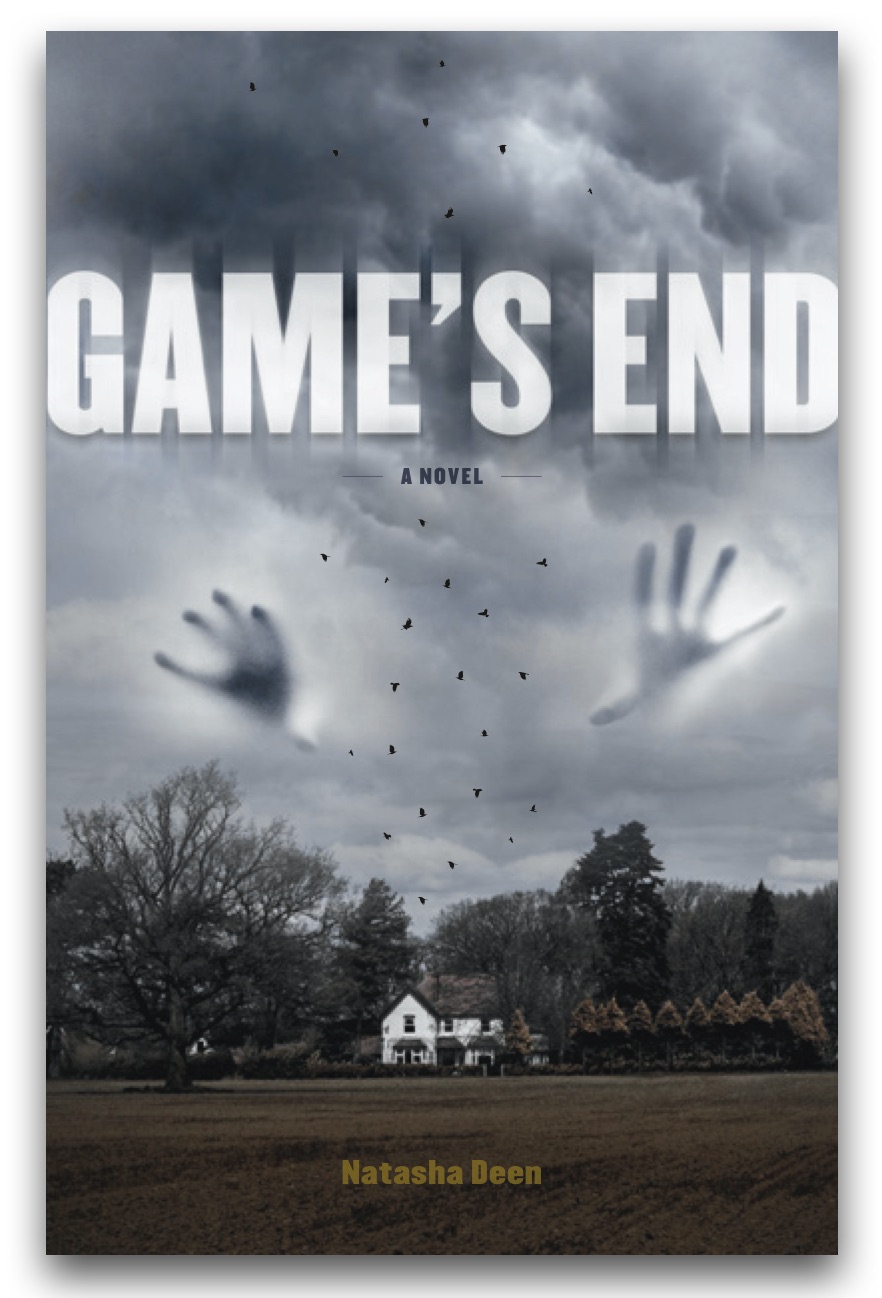
Game's End: Q & A with author Natasha Deen


Game's End
Written by Natasha Deen
Yellow Dog (formerly Great Plains Teen Fiction)
978-1-927855 -85-0
240 pp.
Ages 13+
November 2017


Yesterday I reviewed Game's End, the third book in Natasha Deen's series that began with Guardian and Gatekeeper. Today I have the thrill of interviewing author Natasha Deen about her newest young adult paranormal mystery.


•••••••••••••••••


HK: In my review of Gatekeeper, I called you the “princess of YA paranormal murder mysteries” and I stand behind that moniker, though I know you can write other genres as well.  But, though there are wild supernatural elements to Game’s End, at its heart the story is a whodunit, a murder mystery to be solved.  Are you a fan of mystery books and if so, who are a few of your favourite authors?

ND:  First of all, thank you for those kinds words! That thrills me. ☺

I am a huge fan of mysteries. There’s just something—thrilling, fascinating, intriguing—about hunting and gathering puzzle pieces, and delving beneath the personalities to find the truth. (I think it’s a bit like real life, where you listen and talk to people, and search for the subtext of their actions and words, and puzzle out who they are versus who they (1) want you to think they are (2) who they are trying to be).

I come by my love of mystery via family genetics.  Some of my favourite memories are the weekend afternoons when everyone was taking a nap, except my mother and I, who drank tea, ate cookies, and watched PBS Masterpiece Theatre,  as well my family coming together during the weeknights to watch TV and guess the murderer in Murder She Wrote, Columbo, and Matlock.

When it comes to my favourite authors, there are too many to name, but my first mystery-author love has to be Agatha Christie. Murder on the Orient Express, And Then There Were None, and any of the Miss Marple mysteries are tops in my books (no pun intended).


HK: Your subplots do double-duty, adding depth to the mystery as well as being the source of red herrings to trick the reader into guessing the identity of the murderer and more.  How hard is it to craft subplots that have to lure readers into thinking the story is going one way and then take them completely off course?  

ND:  It definitely takes some doing, but it’s so much fun to play with readers, and I really enjoy it. It’s like hiding Easter eggs and I love trying to find the balance of hiding clues deep enough to trick readers, but still making it apparent, so when they go back, they can see the clues.

As a reader, I love that feeling of racing to guess the bad guy before the main character/detective reveals them. It’s so exciting when you have that “Aha! I knew I was right!” moment, but I also love the “Ahh! They got me, I didn’t see it coming!” But when I go back, I can see how they were setting up the clues.

Stories that drive me crazy are when the author has some off the page clue that only the detective is privy to, or some sudden plot twist that’s not actually a twist, it’s just a sharp turn/plot device—that’s cheating. Put the clues on the page and let’s see how it turns out.


HK: From Guardian to Gatekeeper and now Game’s End, you have kept Maggie honest, humble and very real, though she has supernatural powers.  How did you ensure that she stay this real when she obvious isn’t?

ND:  I think from Maggie’s perspective, she’s not special.  Everyone has powers and talents, hers just happens to be seeing the dead. It doesn’t make her any better than anyone else, and with a dad like Hank, I just couldn’t see her being raised any way but the way she shows up on the page.

Also, I come from a culture (Guyanese) that embraces the idea of the supernatural, so why would you freak out or act weird? That would be like acting strange when you see the sun, but the sun is always there.

It’s not that Maggie doesn’t understand her power is unusual, but since it’s part of her, it just is…one of my favourite shows is West Wing, and one of the things that struck me was that the characters are never over the top or shrill. Then I realized that what was unusual for me (i.e., another country threatening to launch weapons or impose sanctions) is an everyday event for them. If they were over-reactive to it, they’d exhaust themselves by the end of the day. So, I think it’s the same with Maggie. It’s her everyday. She’s always seeing ghosts, transitioning them, learning about the terrible, beautiful aspects of their life. I’d like to think that it gives her depth and an appreciation for all the ways life is special and unique.


HK: While you’d made Maggie a sympathetic character, there are many others who are totally reprehensible and yet very real in the abuse they inflict on others.  Did you find it emotionally draining to write about domestic abuse and self-righteousness and violence against those who are vulnerable?

ND:  The short answer is yes. There’s a lot of personal experiences that inform those narratives, both mine and people I care about, and it’s a hard place to go, a hard place to live in, BUT, as storytellers, it’s important for authors to take the pain of those moments to make sure the story we tell is true to life, and the characters are as real as they can be.

One of the things that I feel is my saving grace and helps me not to get mired in the pain/darkness is my characters rise above those circumstances, so the bad things in life aren’t there to weigh them down, but to lift them up. I hope it’s something my readers can trust about my work—that there’ll be intense moments and difficult scenes, but in the end there is some kind of positive resolution.

There are a lot of studies on the effects of reading on the brain, on the physiological changes that happen when we imagine, so it’s important for me that even if there isn’t always a Hollywood happy ending in a book, it ends on some kind of hopeful note.

If I can expand out the answer, then it’s worth noting in my personal philosophy, I believe we’re all storytellers, and that’s why sharing stories (with friends, in writing, with groups) is an important thing. The world is made better and stronger when we connect through our shared stories and experiences.


HK: While there is much fear associated with death and dying, the concept of an afterlife offers some prospect for good to come out of that fear.  Do you believe in a particular version of an afterlife?  If so, does this belief come from a spiritual background, personal experiences with a psychic medium, or something else entirely?

ND:  Asking a Guyanese person if they believe in ghosts is akin to asking them if they believe in the sky. ☺ The sky exists, it’s there whether you believe it or not. According to Guyanese philosophy, ghosts and the supernatural is just another level of existence. Your ancestors will visit you in your dreams, they can change the reality around you, so you must always be aware of unusual occurrences in the everyday (a butterfly showing up in a location butterflies aren’t known to appear, for example). It’s why you should always behave—no one wants a lecture from long-dead Auntie who shows up in your dreams.

As a kid of two nations, Canada and Guyana, it’s one of the things I had to reconcile. North American culture doesn’t embrace the supernatural in the same way as Guyanese. But I’m so proud of my heritage and the subtext of this belief, that love can be so strong, your family members so connected to you that even death can’t break that bond, and I love the lesson to pay attention to the world around you, to pay attention to the unusual things because something beautiful might be coming your way.


HK: Although I’ve never heard of them, the supernatural creatures called serengti seem familiar to me yet I can find no reference to them in the literature.  Are these creatures from any particular mythology or are they your own fantastical creation? 

ND:  I sketched out the series back in 2010, and I remember coming across a reference to an ancient creature that was female and…that’s all I remember. When I tried to find my notes, they were missing. I *feel* like I came up with the serengti term, but that it’s based off of mermaids, sirens, and my wondering about what the after-life of Hans Christian Anderson’s Little Mermaid may have been like.


HK: I so enjoy your humour.  Even in a book that deals with death and the supernatural, I found myself laughing aloud at the banter between Maggie and Serge and Nell’s pluck.  How can you remain light and jovial in your writing when immersed in a story about murder and violence and dangerous situations?

ND:  I have to thank my family and my family history for that. When you grow up as a POC, your life is just different from the non-POC kids (I still remember being 9 years-old and telling a Caucasian girl in my class that I was creeped out by white pillows, and her not having a clue about why, and when I said, “Well, because of the KKK and the Aryan Nations,” she still looked confused. That was one of the many moments I realized my growing up and how I navigated the world wasn’t going to be like my classmates, and what the world offered me versus what it offered them was never going to be the same).

My family history is one of struggle and overcoming, of standing strong while terrible things happened, and letting the bad things pass. Part of the standing strong involved love, forgiveness, a lot of humour. There’s an unspoken code of conduct in my family. In a bad situation, find a way to laugh. If you can do that, you can find a way to overcome, you can find the light, and a way out of whatever darkness is encroaching on you.

From a story/character perspective, I wanted to give Maggie, Serge, Nell, and Craig a similar philosophy. Certainly from Maggie and Craig’s perspectives, they’ll have seen things they can’t unsee. Serge is now heading down that path, and for Nell, she doesn’t have the same abilities (or any supernatural powers) as her friends, so how does she navigate the stories she hears from them, and how does she step in to support? Humour seems like the perfect weapon.


HK: The ending of Game’s End leaves it open for the possibility of more books in the series.  Are you planning on continuing Maggie’s story?  Readers will definitely want to learn about the return of a key character. (I won’t spoil the ending for readers, though they should be prepared that, as you say, “Maybe there are no happy endings.  Maybe there are just endings, and it is up to us to make them happy.”; pg. 240)

ND:  I’m giggling because for writers, our stories are forever continued, and we’re always living with our characters. The Guardian trilogy wrapped some of the big issues facing Maggie—bullying, domestic violence, abuse, forgiveness, resilience—in a series of horror/mystery/suspense novels, and I feel as though I’ve told that portion of her story. Having said that, I’m definitely open to more of Maggie’s adventures.


•••••••••••••••••

Many thanks to Natasha Deen for answering my somewhat lengthy questions 
and 
Marketing Director Mel Marginet at Great Plains for facilitating this interview.

• • • • • • • • • • • • • • • • •

If you haven't read the whole series, time to get your own copies of Guardian, Gatekeeper and Game's End!