Showing posts with label Yellow Dog. Show all posts

December 23, 2020

Underland

Written by Colleen Nelson and Nancy Chappell-Pollack
Yellow Dog (An imprint of Great Plains)
978-1-77337-052-1
192 pp.
Ages 12-15
October 2020 
 
So the truth lies buried in the Underland. (pg. 33)
 
Though authors Colleen Nelson and Nancy Chappell-Pollack didn't really leave us hanging at the conclusion of Pulse Point (2018), the book to which Underland is the sequel, they did hint that there was more to learn about the world they created and the inhabitants of the City protected under a dome and the Prims who lived on the Mountain outside of it. In fact, though we'd met Kaia who'd escaped from the City to find out the true nature of her heritage, there is so much more to learn about the City, from its Councillors who govern, the overseers who watch, and Citizens who generate energy through their physical efforts. And now we learn, as does Sari, Kaia's best friend, that there is an Underland to the City, unknown to its above-ground and more privileged inhabitants. 
 
Told in the alternating voices of Ama, a young Under who lives and labours in the tunnels beneath the City, and Sari, who was matched with Councillor Tar's offspring Lev who'd gone after Kaia when she'd fled the City, Underland is a story of separation and convergence. Kept hidden from the Citizens above who believe their own efforts generate power, Ama and her fellow workers, primarily "younguns" who can fit through the narrow tunnels, dig the precious brine which the City above requires to run everything. They believe in Big Mother who gives life and protects them and Old Father who shows his anger when displeased but, except for the two Prims Jacob and Noah who were captured and forced to serve, the Unders only know enslavement and nothing of the world beyond their pit where they live and the tunnels they mine.
 
Above, in the very different world of the City, Sari still feels guilty about being matched with Lev when she'd known how much Kaia and Lev cared for each other. But Tar makes it clear that Kaia was an inappropriate match for Lev and she sees the qualities of a leader in Sari. Curious, Sari looks into Kaia's birth record which reveals a special notation of "intertwining." With the help of Ren, a former classmate and now overseer, Sari learns more about Kaia's origins but also about the Underland.
 
With their worlds in danger of physically and socially collapsing, those of the City and the Underland can no longer remain separate and Colleen Nelson and Nancy Chappell-Pollack's dystopia evolves into something less dissonant, advancing towards the cooperative and diverse.
 
At this time of year, Underland offers hope that acceptance of others and compassion for all is possible. While both the Unders and the Citizens, except for the Councillors and those who oppress those of the Underland, know nothing of the others' existence and experiences, they are part of a social order of epic inequities and horrific discrimination. Based in fear and ignorance, their different worlds would not ever have come together if individuals like Ama and Sari, among a handful of others, had not stepped up and recognized the need for change. For themselves and others, they needed to see beyond themselves.
If I want to move forward, I need to make sure I'm okay with what's behind me. (pg. 157)
With suspenseful action-filled scenes and a wide cast of characters from all levels–geologists, fetal assessment technicians, diggers, mules, bureaucrats, elders, younguns, mothers and more–Colleen Nelson and Nancy Chappell-Pollack have created a grim world, borne of good intentions but managed into the objectionable and worse. Fortunately, Underland inspires faith that a few good people can make the difference and that redemption is possible through transformation. Sometimes it's all we need to go forward.

October 27, 2020

Underland: Book launch and Twitter takeover (Online)

 
We 💖 Pulse Point
 
which was Colleen Nelson and Nancy Chappell-Pollack's first collaborative YA novel of a dystopian world in which Citizens under a dome are monitored via an implanted microchip in a forefinger and kept separate from the Primitives beyond the protective shell.
 
Written by Colleen Nelson with Nancy Chappell-Pollack
Yellow Dog (Great Plains Publications)
978-1-927855-97-3
192 pp.
Ages 12-15
2018 


 Now their sequel is launching!

Underland
Written by Colleen Nelson and Nancy Chappell-Pollack
Yellow Dog (An imprint of Great Plains)
978-1-77337-052-1
192 pp.
Ages 12-15
October 2020


To celebrate the book's release, co-authors
 Colleen Nelson and Nancy Chappell-Pollack 
will be taking over their publisher's Twitter account
to answer questions and 
share details about the writing of their latest book

on

Wednesday, October 28, 2020
             6-8 PM (Central Time Zone)
 
 
PLUS
You have time (until this online launch) to enter 
to win a signed copy of Underland
(Entrant must be 13 years of age or older)
 
 
See you at the launch!


May 29, 2018

Pulse Point: Q & A with author Colleen Nelson

Written by Colleen Nelson with Nancy Chappell-Pollack
Yellow Dog (Great Plains Publications)
978-1-927855-97-3
192 pp.
Ages 12-15
May 2018

Yesterday I reviewed Colleen Nelson's newest YA novel, Pulse Point, which she wrote with Nancy Chappell-Pollack.  Today Colleen Nelson with input from Nancy Chappell-Pollack answers a few of my questions about the book, their writing process and the future for Pulse Point.


HK:  Pulse Point is totally unlike any YA novel you have written to date both in genre and in its collaborative authorship, and I’d really love to delve into this.  First, how did you come to write the novel with your sister and what did you find most challenging as well as most advantageous about writing Pulse Point as part of a team?

CN:  Pulse Point began as an idea that Nancy had for a screenplay. Her background is in screenwriting and theatre, so we pitched it to a screen writing contest. I wrote the ‘treatment’ which is a type of synopsis used in the television/movie industry. We didn’t win, but the idea was too good to let go. Nancy and I were both invested in the idea, so we decided to work on it together.

One of the challenges writers face is the isolation factor. For hours every day, I sit in a room by myself and tap away on my laptop. Sometimes writing feels like a very slow, uphill slog and what’s worse, I have no idea if what I’m writing is any good! It was motivating to send Nancy a chapter and get her feedback on it. She knew the characters as well as I did and knew the direction of the story. We collaborated on every aspect of the book, even though I did the bulk of the writing.

As for the genre, writing dystopian wasn’t as different from realistic YA as you’d expect. Pulse Point might have a different setting and the characters face unusual challenges, but they still have to be relatable. Just like in realistic fiction, Kaia had to deal with conflicts with friends, family and figuring out who she is. We tried to remember it is the characters, not their dystopian world, driving the story.


HK:  Second, have you always wanted to write speculative fiction or did the idea for Pulse Point originate with your sister Nancy Chappell-Pollack?

CN:  The idea was Nancy’s. It started with a ‘what if’. What if a pulse point, implanted in a finger and meant to control a person’s life, suddenly malfunctions? How would they react to this sudden freedom? Other than continuing on with Kaia’s story, I don’t have any plans to write other speculative fiction.


HK:  Speaking of speculative fiction, do you consider Pulse Point more science fiction or dystopian, and why?

CN:  Nancy and I talked about this and decided that it’s more dystopian than sci-fi. We wanted to create an alternate version of our world where climate change has made it impossible to live outside, or so Kaia thinks. I think in dystopian, a writer can play with politics and economics and world building in a different way than in science fiction. 


HK:  The scientists who created the City under a dome seemed to have good intentions after global warming brought disaster after disaster to their world.  But, like the saying goes about good intentions, their decisions about the nature of the City including who should be allowed in and how relationships are structured, seem to be discriminatory and harmful.  What message did you want readers to get about this new world?

CN:  The scientific minds that created the City were concerned with saving a species. They were intervening with natural selection, or maybe speeding it along, by only selecting people with disease- and ‘defect’-free genetics. We were thinking of a couple of things when we wrote Pulse Point. The first is the Spartan society where weak newborns were left to die because the city-state wanted to raise only the strongest soldiers (and have mothers who would breed the strongest soldiers). The second was the lack of humanity that a purely scientific-based community would develop. In the same way that AI (read Erin Bow’s excellent Scorpion Rules for more on this topic!) uses reason, not empathy, to make decisions, the City relies on efficiency.

While the City’s decisions make sense at a practical level, they are harsh and inhumane. There is so much to discuss about the morality attached to embryonic testing and selection. You might have also noticed that there is no dance, art, religion or literature in the City. All of those things are considered unnecessary and a waste of resources. I’m really glad I don’t live there!


HK:  Because Kaia’s world within the City is very much dictated by genetic rankings in which features like blue eyes and birthmarks are considered defects, there is much discrimination.  Even Kaia expresses this disdain for her newly-discovered brother who is blind.  How difficult was it to have your characters express such negative thoughts and for you to write those ideas?

CN:  Kaia is a product of her environment, so her prejudices are a result of what she has been taught. The flipside is that the people she meets outside of the City do not have those same discriminatory ideas. The conflict that results lets Kaia grow to accept differences and see the value that everyone brings to a community.


HK:  Many young adults will be delighted to know that there is frisson of romance brewing under Pulse Point’s main plot.  But with Lev and Gideon both in the picture, Kaia may have some choices to make. Did you always intend to have a romance as a subplot in Pulse Point or did it develop as your story took shape?

CN:  The truth is, I hate writing romantic scenes. There’s nothing more cringey than a cheesy kissing scene with awkward dialogue. It can kill a story and put a damper on good writing. Nancy was the one who pushed for more romantic tension and the creation of a love triangle between Kaia, Lev and Gideon. Like with most things, Nancy’s instincts were correct and I agreed to write it.

This book went through so many drafts, characters and plots changed drastically with each one. The one thing that never changed was Kaia’s strength and determination as a female lead. We did not want her to be focused on her hunt for a mate, or a potential romance. We wanted this book to be accessible to male and female readers and to make sure the romance furthers the tension, but doesn’t make it seem that all female characters need a male-focused romance.


HK:  Readers will recognize that Kaia’s story is not over at the conclusion of Pulse Point. When you started writing Pulse Point, was it always your intention to have a sequel? What plans are there for publication of a sequel or sequels?

CN:  At first, we envisioned Pulse Point as a trilogy, but our editor suggested we make some significant changes to the ending. Those changes altered our original plan from three books to two. I’d love to write a second book and find out what happens to Kaia and Lev and the Prims. I think there’s more going on in the City than we know about and I hope it doesn’t take us another seven years to find out what it is! 

Thanks to Colleen Nelson and Nancy Chappell-Pollack
for talking about Pulse Point with CanLit for LittleCanadians.  
It's always a pleasure to talk books with writers of wonderful stories 
and to learn about the creative process.

•••••••••••••••••••••••

Check out other blog tour stops for more about Pulse Point

May 28, 2018

Pulse Point

Written by Colleen Nelson with Nancy Chappell-Pollack
Yellow Dog (Great Plains Publications)
978-1-927855-97-3
192 pp.
Ages 12-15
May 2018

With global warming, many of us acknowledge that things in our world are going awry.  Scientists have been warning about its consequences that include increased flooding, droughts, fires, mudslides and more, though it seems too few are listening now and in the world from the time Kaia's elder Mae (whom we would call grandmother) was much younger. But, in their world, when those impacts escalated and became dire, the scientists had prepared and created self-sufficient Cities run on the energy of its Citizens.

Though the Citizens may not consider it to be a problem, happy to be safe under the dome of the City, the social constructs of their new home have been exclusionary and are discriminatory. Only people with the right skills and genetics are allowed to live in the City.  Those excluded, called Prims (for Primitives), retreated to the Mountain outside, and the City is constantly on guard and setting Prim Threat Levels. Within the City, each Citizen is connected via a pulse point or microchip implanted in a forefinger to allow for monitoring of energy generation to ensure balance with energy usage. Kaia, who lives with her birth elder Sy, a gardener, and Mae, works as a fetal assessment technician (where defectives are identified for termination) and endeavours to generate extra energy at the gymnasium to share with the elderly Mae.  Anyone who cannot produce sufficient energy must undergo balancing, the process by which the Council ensures the City stays in equilibrium.

But Lev, the progeny of an Overseer, Kellan, a fallen hero, and Tar, a Councillor, is smitten with Kaia, though her genetic ranking is far beneath him. With Tar manipulating people and circumstances to ease Lev's path to becoming a leader, and Kaia's pulse point no longer working, essentially taking her off the grid, Kaia makes a decision that will take her from the only life and people she has known into a wilderness and on the run.

Colleen Nelson is well known for her dramatic YA fiction (The Fall, 250 Hours, Finding Hope, Blood Brothers) and Pulse Point is no less suspenseful in its story nor less powerful in its delivery.  However, because it is her first speculative fiction and collaborative work with her sister Nancy Chappell-Pollack, Pulse Point reveals layers in characterization and world-building that are new.  It's a tense read with all the attributes of great YA: relationship drama, interfering progenitors (i.e., parents), burgeoning romance, secrets, confusion, and conflict. But, all that takes place in a world in which stasis is achieved through the generation of energy and elimination of the unproductive, in which blue eyes are considered a defect, romantic matches are based on genetics, and everyone is monitored (a.k.a. linked) through their fingertips, making Pulse Point a bigger story. Look carefully and you'll see how Pulse Point's worlds could be our own. The two communities, one outside the City and the other under its dome, are a sharp contrast of old ways and new ways and the distrust and clash between the two is inevitable. While Colleen Nelson and Nancy Chappell-Pollack resolve the story, revealing Kaia's origin story and secrets long kept hidden, they also leave a door open for a sequel. It's a good thing because there's still a whole new world that needs to evolve to make things right for Kaia and Lev, and Citizens and Prims alike.

••••••••••••••••

Check back tomorrow for my Q & A with authors Colleen Nelson and Nancy Chappell-Pollack in which they reveal much about their writing process and story lines from Pulse Point.  Always an insightful discussion when speaking with Colleen Nelson, we learn more than any blurb on a cover could reveal!

Here are all the stops on this blog tour:
Be sure to check them all out!


May 10, 2018

Family of Spies: Blog Tour


Today I'm reviewing Jodi Carmichael's newest middle grade novel Family of Spies as part of the book's blog tour.  Please check out the others stops on the tour as listed at Chapter by Chapter Blog Tours and Promotions and enter to win a free copy of Family of Spies here.


Written by Jodi Carmichael
Yellow Dog (an imprint of Great Plains Publications)
978-1-927855-94-2
288 pp.
Ages 8-13
April 24, 2018

Most people who delve into their family histories are hoping for the unusual like connections to royalty, a hint of scandal or extraordinary accomplishment.  But for most, the exercise of discovering family history details is more likely to be a slog and end in disappointment, since  most people in the past lived lives of work and family with few opportunities for the exotic or the mysterious.  Not so for the great-grandfather of thirteen-year-old cousins Ford MacKenzie and Ellie Whitaker and Ford’s older brother Gavin.  Great-Granddad’s story would be the stuff of legends, if it didn’t have to be sealed.

The MacKenzie and Whitaker families, from Canada and the US respectively, are meeting in Paris for a European vacation. Soon after their arrival, Ford begins to experience moments of déjà vu that seem to time-slip him into Nazi-occupied Paris during World War II.  These episodes are especially emphatic when he touches any of the personal effects–letters, photos, postcards, bookmarks, etc.– in his great-grandfather’s briefcase. A visit to a psychic confirms Ford to be a clairvoyant who is able to connect to the past. 

Using a letter his mother received denying them access to Edward Crawford’s service records,  Ford connects to that military office and sees his great-grandfather’s file identifying him as part of  Special Operations Executive, a top-secret spy agency in operation during the war. But the three teens’ search at the military library alerts other forces to their interest in E. H. Crawford and soon Ford’s “visions” are not the only worries they have.

Assessing the various materials in his great-grandfather’s briefcase, Ford determines that he can connect with Great-Granddad and would be able to envision what he was doing during the war by (re)visiting a café/restaurant, the Louvre, Notre Dame, the Eiffel Tower and several more stops.  With each visit, Ford reveals more about his great-grandfather’s covert activities, as well as his fears and guilt for a mission gone awry.

The story is very loosely based on Jodi Carmichael’s own grandfather whose military records remain sealed.  By weaving family history with Ford’s supernatural ability to divine the past, Jodi Carmichael has created a multi-layered mystery that honours her family and entertains readers with intrigue, adventure, a bit of the fantastic and a history lesson like no other. Family of Spies also reveals much about family dynamics and reminds us that, like Great-Granddad’s records of spy activity, nothing is ever final, even in relationships modified by guilt or jealousy because forgiveness can unravel much.

For young readers who enjoy an action-adventure story with a bit of history and the supernatural, Family of Spies will completely captivate and satisfy, and leave them anticipating Ford, Gavin and Ellie’s next adventures (fingers crossed) as the family continues their travels to London and Cairo.

🌆🌆🌆🌆🌆🌆

Jodi Carmichael’s dreams of becoming an author began to come true when she attended her first SCBWI conference in Los Angeles in 2007 and was nominated for the Sue Alexander Most Promising New Work Award. A champion for the underdog and kids who think differently, she wrote Spaghetti is NOT a Finger Food (and Other Life Lessons) (2013) which won numerous awards including a Gold Mom’s Choice and a Silver Moonbeam in 2013. In 2016 her novel about relationship abuse, Forever Julia (2016), won the Manitoba Book Award, the McNally Robinson Books for Young People Award - Older Category and received a Bronze Moonbeam Award for Young Adult Fiction - Mature Issues.

When not channeling characters from her books, she can be found strolling Manitoba beaches with her husband, two daughters, and exceedingly scruffy Border Terrier named Zoe. 

April 25, 2018

Family of Spies: Book launch (Winnipeg, MB)

Join author

Jodi Carmichael

for the launch of

her new middle-grade novel

Family of Spies
Written by Jodi Carmichael
Yellow Dog
978-1-927855-94-2
288 pp.
Ages 8-13
April 2018

on 

Sunday, April 29, 2018

2 p.m.

at

 McNally Robinson Booksellers
Grant Park Shopping Centre
1120 Grant Avenue
Winnipeg, MB


I'm pleased to share that I'll be participating in the blog tour for Family of Spies on May 10, 2018 with my review of this action-adventure with a touch of the fantastic inspired by the author's own grandfather's rumoured espionage activities during World War 2.  But, until then, here is the blurb from publisher Great Plains.


When cousins Ford, Ellie and Gavin, discover their great-grandfather was a rogue World War 2 spymaster, they must outrun MI6 and the CIA through the streets of Paris, relying on their wits and Ford’s newfound clairvoyant skills to unlock Great-Granddad’s spy secrets buried in the past. Great-Granddad hid something important to the war effort and these agencies want it back! 
Retrieved from 
https://www.greatplains.mb.ca/product/family-of-spies/ 
on April 25, 2018.

April 23, 2018

Pulse Point: Book Launch (Winnipeg, MB)

Join sisters and now collaborative authors


Colleen Nelson

and

Nancy Chappell-Pollack

for the launch of their debut collaboration

Pulse Point
Written by Colleen Nelson and Nancy Chappell-Pollack
Yellow Dog (Great Plains Publications)
978-1-927855-97-3
192 pp.
Ages 12-15
May 2018

on

Friday May 11, 2018

at

7:00 p.m.

McNally Robinson
Grant Park in the Atrium
Winnipeg, MB

In Kaia’s world, setting foot Outside can be deadly. The safety of the City has kept humans alive as climate change destroys the world. But the City has found a way to survive sustainably: it is run by the energy generated by its Citizens. The energy that citizens create is calculated and displayed on their pulse point, a transmitter embedded in their finger.

Kaia is a Citizen, one of the few deemed genetically perfect enough to live under the protective dome of the City with her grandmother and father. But when Kaia discovers her mother is alive and living Outside, she escapes the safety of the City and learns the truth about the sinister world she left behind.


November 07, 2017

Game's End: Q & A with author Natasha Deen


Game's End
Written by Natasha Deen
Yellow Dog (formerly Great Plains Teen Fiction)
978-1-927855 -85-0
240 pp.
Ages 13+
November 2017


Yesterday I reviewed Game's End, the third book in Natasha Deen's series that began with Guardian and Gatekeeper. Today I have the thrill of interviewing author Natasha Deen about her newest young adult paranormal mystery.


•••••••••••••••••


HK: In my review of Gatekeeper, I called you the “princess of YA paranormal murder mysteries” and I stand behind that moniker, though I know you can write other genres as well.  But, though there are wild supernatural elements to Game’s End, at its heart the story is a whodunit, a murder mystery to be solved.  Are you a fan of mystery books and if so, who are a few of your favourite authors?

ND:  First of all, thank you for those kinds words! That thrills me. ☺

I am a huge fan of mysteries. There’s just something—thrilling, fascinating, intriguing—about hunting and gathering puzzle pieces, and delving beneath the personalities to find the truth. (I think it’s a bit like real life, where you listen and talk to people, and search for the subtext of their actions and words, and puzzle out who they are versus who they (1) want you to think they are (2) who they are trying to be).

I come by my love of mystery via family genetics.  Some of my favourite memories are the weekend afternoons when everyone was taking a nap, except my mother and I, who drank tea, ate cookies, and watched PBS Masterpiece Theatre,  as well my family coming together during the weeknights to watch TV and guess the murderer in Murder She Wrote, Columbo, and Matlock.

When it comes to my favourite authors, there are too many to name, but my first mystery-author love has to be Agatha Christie. Murder on the Orient Express, And Then There Were None, and any of the Miss Marple mysteries are tops in my books (no pun intended).


HK: Your subplots do double-duty, adding depth to the mystery as well as being the source of red herrings to trick the reader into guessing the identity of the murderer and more.  How hard is it to craft subplots that have to lure readers into thinking the story is going one way and then take them completely off course?  

ND:  It definitely takes some doing, but it’s so much fun to play with readers, and I really enjoy it. It’s like hiding Easter eggs and I love trying to find the balance of hiding clues deep enough to trick readers, but still making it apparent, so when they go back, they can see the clues.

As a reader, I love that feeling of racing to guess the bad guy before the main character/detective reveals them. It’s so exciting when you have that “Aha! I knew I was right!” moment, but I also love the “Ahh! They got me, I didn’t see it coming!” But when I go back, I can see how they were setting up the clues.

Stories that drive me crazy are when the author has some off the page clue that only the detective is privy to, or some sudden plot twist that’s not actually a twist, it’s just a sharp turn/plot device—that’s cheating. Put the clues on the page and let’s see how it turns out.


HK: From Guardian to Gatekeeper and now Game’s End, you have kept Maggie honest, humble and very real, though she has supernatural powers.  How did you ensure that she stay this real when she obvious isn’t?

ND:  I think from Maggie’s perspective, she’s not special.  Everyone has powers and talents, hers just happens to be seeing the dead. It doesn’t make her any better than anyone else, and with a dad like Hank, I just couldn’t see her being raised any way but the way she shows up on the page.

Also, I come from a culture (Guyanese) that embraces the idea of the supernatural, so why would you freak out or act weird? That would be like acting strange when you see the sun, but the sun is always there.

It’s not that Maggie doesn’t understand her power is unusual, but since it’s part of her, it just is…one of my favourite shows is West Wing, and one of the things that struck me was that the characters are never over the top or shrill. Then I realized that what was unusual for me (i.e., another country threatening to launch weapons or impose sanctions) is an everyday event for them. If they were over-reactive to it, they’d exhaust themselves by the end of the day. So, I think it’s the same with Maggie. It’s her everyday. She’s always seeing ghosts, transitioning them, learning about the terrible, beautiful aspects of their life. I’d like to think that it gives her depth and an appreciation for all the ways life is special and unique.


HK: While you’d made Maggie a sympathetic character, there are many others who are totally reprehensible and yet very real in the abuse they inflict on others.  Did you find it emotionally draining to write about domestic abuse and self-righteousness and violence against those who are vulnerable?

ND:  The short answer is yes. There’s a lot of personal experiences that inform those narratives, both mine and people I care about, and it’s a hard place to go, a hard place to live in, BUT, as storytellers, it’s important for authors to take the pain of those moments to make sure the story we tell is true to life, and the characters are as real as they can be.

One of the things that I feel is my saving grace and helps me not to get mired in the pain/darkness is my characters rise above those circumstances, so the bad things in life aren’t there to weigh them down, but to lift them up. I hope it’s something my readers can trust about my work—that there’ll be intense moments and difficult scenes, but in the end there is some kind of positive resolution.

There are a lot of studies on the effects of reading on the brain, on the physiological changes that happen when we imagine, so it’s important for me that even if there isn’t always a Hollywood happy ending in a book, it ends on some kind of hopeful note.

If I can expand out the answer, then it’s worth noting in my personal philosophy, I believe we’re all storytellers, and that’s why sharing stories (with friends, in writing, with groups) is an important thing. The world is made better and stronger when we connect through our shared stories and experiences.


HK: While there is much fear associated with death and dying, the concept of an afterlife offers some prospect for good to come out of that fear.  Do you believe in a particular version of an afterlife?  If so, does this belief come from a spiritual background, personal experiences with a psychic medium, or something else entirely?

ND:  Asking a Guyanese person if they believe in ghosts is akin to asking them if they believe in the sky. ☺ The sky exists, it’s there whether you believe it or not. According to Guyanese philosophy, ghosts and the supernatural is just another level of existence. Your ancestors will visit you in your dreams, they can change the reality around you, so you must always be aware of unusual occurrences in the everyday (a butterfly showing up in a location butterflies aren’t known to appear, for example). It’s why you should always behave—no one wants a lecture from long-dead Auntie who shows up in your dreams.

As a kid of two nations, Canada and Guyana, it’s one of the things I had to reconcile. North American culture doesn’t embrace the supernatural in the same way as Guyanese. But I’m so proud of my heritage and the subtext of this belief, that love can be so strong, your family members so connected to you that even death can’t break that bond, and I love the lesson to pay attention to the world around you, to pay attention to the unusual things because something beautiful might be coming your way.


HK: Although I’ve never heard of them, the supernatural creatures called serengti seem familiar to me yet I can find no reference to them in the literature.  Are these creatures from any particular mythology or are they your own fantastical creation? 

ND:  I sketched out the series back in 2010, and I remember coming across a reference to an ancient creature that was female and…that’s all I remember. When I tried to find my notes, they were missing. I *feel* like I came up with the serengti term, but that it’s based off of mermaids, sirens, and my wondering about what the after-life of Hans Christian Anderson’s Little Mermaid may have been like.


HK: I so enjoy your humour.  Even in a book that deals with death and the supernatural, I found myself laughing aloud at the banter between Maggie and Serge and Nell’s pluck.  How can you remain light and jovial in your writing when immersed in a story about murder and violence and dangerous situations?

ND:  I have to thank my family and my family history for that. When you grow up as a POC, your life is just different from the non-POC kids (I still remember being 9 years-old and telling a Caucasian girl in my class that I was creeped out by white pillows, and her not having a clue about why, and when I said, “Well, because of the KKK and the Aryan Nations,” she still looked confused. That was one of the many moments I realized my growing up and how I navigated the world wasn’t going to be like my classmates, and what the world offered me versus what it offered them was never going to be the same).

My family history is one of struggle and overcoming, of standing strong while terrible things happened, and letting the bad things pass. Part of the standing strong involved love, forgiveness, a lot of humour. There’s an unspoken code of conduct in my family. In a bad situation, find a way to laugh. If you can do that, you can find a way to overcome, you can find the light, and a way out of whatever darkness is encroaching on you.

From a story/character perspective, I wanted to give Maggie, Serge, Nell, and Craig a similar philosophy. Certainly from Maggie and Craig’s perspectives, they’ll have seen things they can’t unsee. Serge is now heading down that path, and for Nell, she doesn’t have the same abilities (or any supernatural powers) as her friends, so how does she navigate the stories she hears from them, and how does she step in to support? Humour seems like the perfect weapon.


HK: The ending of Game’s End leaves it open for the possibility of more books in the series.  Are you planning on continuing Maggie’s story?  Readers will definitely want to learn about the return of a key character. (I won’t spoil the ending for readers, though they should be prepared that, as you say, “Maybe there are no happy endings.  Maybe there are just endings, and it is up to us to make them happy.”; pg. 240)

ND:  I’m giggling because for writers, our stories are forever continued, and we’re always living with our characters. The Guardian trilogy wrapped some of the big issues facing Maggie—bullying, domestic violence, abuse, forgiveness, resilience—in a series of horror/mystery/suspense novels, and I feel as though I’ve told that portion of her story. Having said that, I’m definitely open to more of Maggie’s adventures.


•••••••••••••••••

Many thanks to Natasha Deen for answering my somewhat lengthy questions 
and 
Marketing Director Mel Marginet at Great Plains for facilitating this interview.

• • • • • • • • • • • • • • • • •

If you haven't read the whole series, time to get your own copies of Guardian, Gatekeeper and Game's End!


November 06, 2017

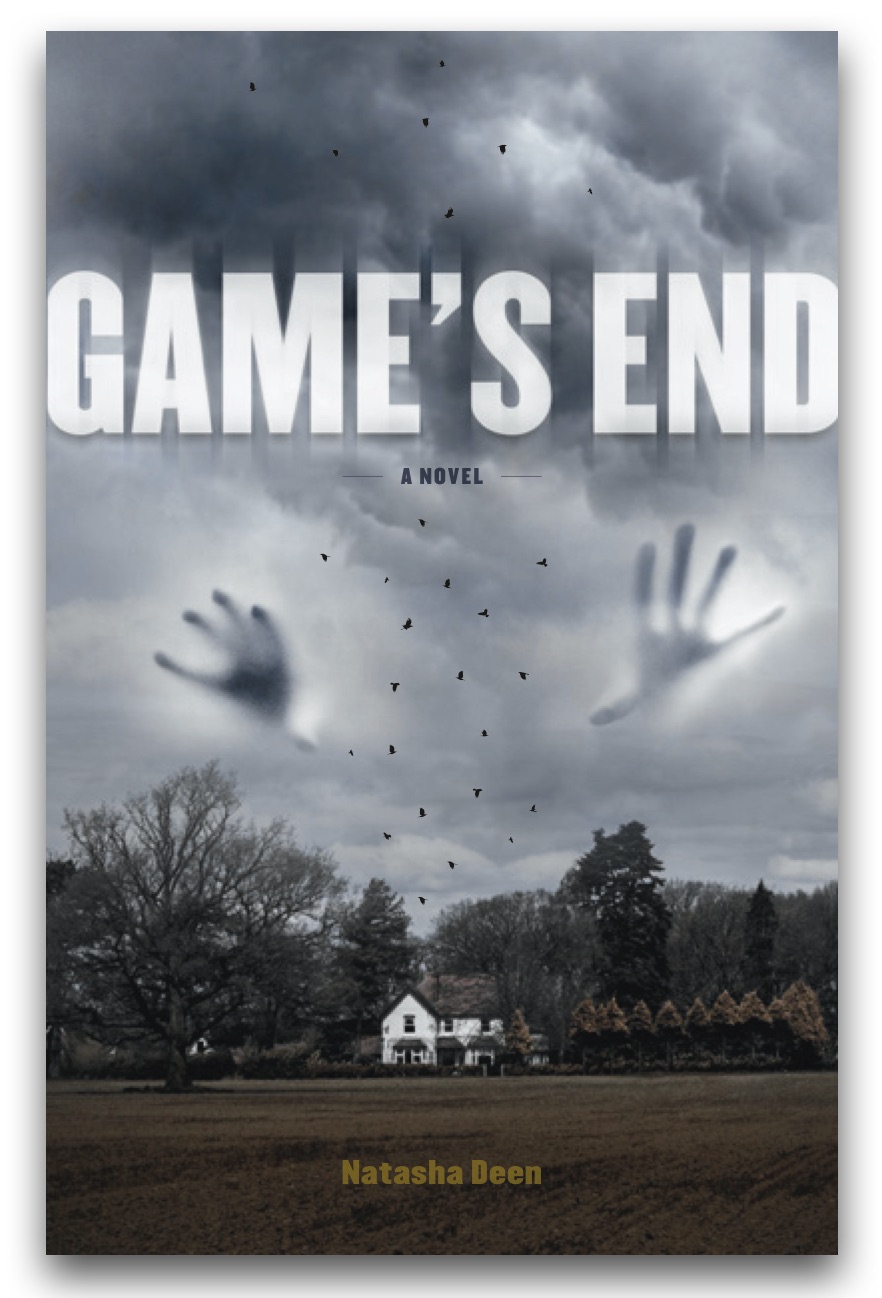
Game's End

Written by Natasha Deen
Yellow Dog, an imprint of Great Plains Publications
978-1-927855-85-0
240 pp.
Ages 13+
November 2017


     “He’s not my real brother, we’re soul-bonded.”
     “If he’s not your brother, why do you call him that?” asked Zeke.
     “Because.” Serge wriggled into the spot between us. “It sounds better than ‘hi, meet Serge. We used to go to school together and he bullied me until I wanted to die. Luckily, he was the one who stopped breathing.  I helped him figure out that his so-called suicide was a murder, and then we discovered in this life we were both scripted to become guardians.  We watch over the dead and living, transition souls from this plane to the next, and make sure the bad spirits from hell stay there.’”
     “Yeah,” Zeke nodded. “I can see how that’s a mouthful.”
(pg. 25)

That's essentially the creation story of Maggie Johnson and Serge Popov though there is so much more to their story.  There's Maggie's supernatural boyfriend Craig who is a ferrier of the dead, and her extremely plucky (her word, not mine) and loyal best friend Nell, and her dad Hank and his girlfriend Nancy who is the sheriff.  They all "live"–some more than others–in Dead Falls, Alberta where Maggie has been involved, with some supernatural help, in exposing those responsible for the deaths of several people, sadly raising the ire of some local citizens who consider the teen "a death magnet" (pg. 159) who has ruined the reputations of the town and some people like Serge's father, Reverend Popov.  The vibe in the town is definitely off but there's something worse coming as foretold by The Voice–the disembodied voice that comes through radios and whom Maggie suspects is her mother–and it's coming for Maggie.  Craig believes it's as a power-seeking soul-eater, which appears and swallows up lost and wandering dead just as Maggie is trying to help the newly dead Zeke cross over with his little brother Homer.  If the soul-eater is the only threat is yet to be seen.

As Craig and Serge attempt to get more info from the other side about her mother, Maggie is being pulled into her own investigations.  She tries to learn more about her mother from Hank who reveals that she too had powers that were tearing her apart.  On top of that, Maggie is experiencing unusual out-of-body experiences that take her to different times and places to witness the rescue of children's souls by a serengti, a supernatural called Serena, who compassionately tries to spare them the trauma of their deaths.

Then a murder shatters Maggie's world, and she's on the trail, both of our world and a supernatural one, to find the killer and keep those she loves safe.

Game's End is the conclusion of Natasha Deen's Guardian trilogy that began with Guardian (Great Plains Teen Fiction, 2014) and led to Gatekeeper (Great Plains Teen Fiction, 2016), all stories that embed the reader in the worlds of the dead.  For the dead in Game's End those worlds includes both the good and the bad, those who attempt to ease the dead to the other side and those, both living and supernatural, who seek to harm for the sake of power.  The evil that kills and aims to destroy is palpable in Game's End and, except for those who attempt to harm the children Serena wishes to rescue, not always easily identifiable.  Like evil everywhere, it is masked with lies and smiles and facades of rational behaviour.  The only reassurance is that, whether they are the self-righteous or domestic abusers or murderers, justice, in this world and the next, will be levelled against them.  That's the reassuring message of Natasha Deen's paranormal mystery: revenge is not necessary because there's karma.

Even so, Natasha Deen makes Game's End a story about a typical teen who is trying to find her niche in the world.  What she has on her plate is a little different than most teens, balancing being a friend and daughter with battling evil on both sides of the death divide.  But it all reads so naturally because of Natasha Deen's characters and a healthy infusion of comic relief.  While Maggie may be playing "demonic whack-a-mole" (pg. 29) with some unfriendly entities, she's rolling her eyes at Serge's wisecracks and Nell's off-hand comments that always alleviate the tension.

“Oh, he’s cute,” said Nell.
“Calm down,” I said. “He’s dead.”
“I could make him feel alive again.”
(pg. 21)

I know it's bizarre to match Natasha Deen's intense plotting with her tongue-in-cheek humour but the two work so artfully together, one escalating the drama and the other cushioning it, that Game's End would be a very different entity without this curious pairing.

Game's End may be Book 3 in this series but it's far from game over for Natasha Deen.  And if you're a new reader to the Guardian series, you've got three books of robust plotting, clever characters and bright banter ahead of you. Enjoy!


•••••••••••••••••

Look for my in-depth interview with author Natasha Deen tomorrow.  She graciously answered some tough questions about her writing, her beliefs and plotting for Game's End and her whole Guardian series. 

•••••••••••••••••