Showing posts with label dystopia. Show all posts

April 11, 2022

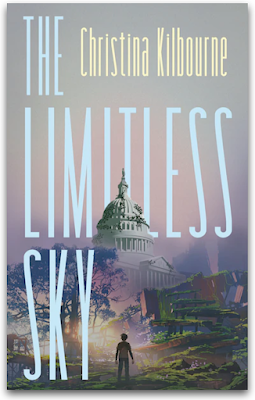
The Limitless Sky

Written by Christina Kilbourne
Dundurn
978-1-45974-887-3
384 pp.
Ages 12+
May 2022

They may be living in the same world, but Rook and Gage don't know it. 
 
Rook lives with her family in ArHK whose descendants, the Chosen Ones, had left the Outside hundreds of OT (Outside Time) years ago. In ArHK where she lives with her father and mother and young sister Sparrow in their pod on the Knowledge Level, one of four levels in ArHK, Rook is destined to be a Keeper, running the Archives and monitoring the Great Hall of Human Records, as is her family's heritage. 

Fifteen-year-old Gage lives with his parents, younger sister Brindle and dog Scruff in a yurt at a scouts' base camp. Organized by the Scholars, scouts have been going out for generations to find the Ship of Knowledge purportedly in the ancient city of Washington. When Chief Coil's map readers believe they are at the gateway to that city, Gage volunteers to join the scouting expedition as a Reader to assist his father and others in looking for artefacts and old structures that might reveal the ancients' knowledge of curing diseases, harnessing power and communication over vast distances.

During her regular assignments and exploratory days at the Archives, Rook delves into restricted files and starts piecing ArHK's history, much of which was buried by the Governors and for which her Grandmam had been exiled to the Growing Sector. Meanwhile, just as Rook is coming to some startling revelations, Gage is making his own discovery and one that will bring their two worlds together, even if at a distance.

Christina Kilbourne has not just created one new world; she has created two. Both are borne out of poisonous air, fires, floods and winds, with one world escaping into a newly-manufactured one and the other surviving in what is left behind. Though readers will be hopeful that the two worlds, those of Rook and Gage, will ultimately come together so that they might become whole again, Christina Kilbourne does not guarantee anything. She shows us alternatives of what our world might be like after climatic change has altered our landscapes and societies and offers an opportunity to see how power can corrupt, how progress can be a setback, and how inspiration may come from our youth. How limited our world is comes down to us.

Dystopian novels have always offered us a mix of angst and aspiration, and The Limitless Sky does just this. In a gritty read that will work for middle-grade readers as well as teens, The Limitless Sky begins a new story for a future that may or may not be. And, as this is first book in the potential trilogy, it's a future I'm looking forward to reading about.

May 28, 2018

Pulse Point

Written by Colleen Nelson with Nancy Chappell-Pollack
Yellow Dog (Great Plains Publications)
978-1-927855-97-3
192 pp.
Ages 12-15
May 2018

With global warming, many of us acknowledge that things in our world are going awry.  Scientists have been warning about its consequences that include increased flooding, droughts, fires, mudslides and more, though it seems too few are listening now and in the world from the time Kaia's elder Mae (whom we would call grandmother) was much younger. But, in their world, when those impacts escalated and became dire, the scientists had prepared and created self-sufficient Cities run on the energy of its Citizens.

Though the Citizens may not consider it to be a problem, happy to be safe under the dome of the City, the social constructs of their new home have been exclusionary and are discriminatory. Only people with the right skills and genetics are allowed to live in the City.  Those excluded, called Prims (for Primitives), retreated to the Mountain outside, and the City is constantly on guard and setting Prim Threat Levels. Within the City, each Citizen is connected via a pulse point or microchip implanted in a forefinger to allow for monitoring of energy generation to ensure balance with energy usage. Kaia, who lives with her birth elder Sy, a gardener, and Mae, works as a fetal assessment technician (where defectives are identified for termination) and endeavours to generate extra energy at the gymnasium to share with the elderly Mae.  Anyone who cannot produce sufficient energy must undergo balancing, the process by which the Council ensures the City stays in equilibrium.

But Lev, the progeny of an Overseer, Kellan, a fallen hero, and Tar, a Councillor, is smitten with Kaia, though her genetic ranking is far beneath him. With Tar manipulating people and circumstances to ease Lev's path to becoming a leader, and Kaia's pulse point no longer working, essentially taking her off the grid, Kaia makes a decision that will take her from the only life and people she has known into a wilderness and on the run.

Colleen Nelson is well known for her dramatic YA fiction (The Fall, 250 Hours, Finding Hope, Blood Brothers) and Pulse Point is no less suspenseful in its story nor less powerful in its delivery.  However, because it is her first speculative fiction and collaborative work with her sister Nancy Chappell-Pollack, Pulse Point reveals layers in characterization and world-building that are new.  It's a tense read with all the attributes of great YA: relationship drama, interfering progenitors (i.e., parents), burgeoning romance, secrets, confusion, and conflict. But, all that takes place in a world in which stasis is achieved through the generation of energy and elimination of the unproductive, in which blue eyes are considered a defect, romantic matches are based on genetics, and everyone is monitored (a.k.a. linked) through their fingertips, making Pulse Point a bigger story. Look carefully and you'll see how Pulse Point's worlds could be our own. The two communities, one outside the City and the other under its dome, are a sharp contrast of old ways and new ways and the distrust and clash between the two is inevitable. While Colleen Nelson and Nancy Chappell-Pollack resolve the story, revealing Kaia's origin story and secrets long kept hidden, they also leave a door open for a sequel. It's a good thing because there's still a whole new world that needs to evolve to make things right for Kaia and Lev, and Citizens and Prims alike.

••••••••••••••••

Check back tomorrow for my Q & A with authors Colleen Nelson and Nancy Chappell-Pollack in which they reveal much about their writing process and story lines from Pulse Point.  Always an insightful discussion when speaking with Colleen Nelson, we learn more than any blurb on a cover could reveal!

Here are all the stops on this blog tour:
Be sure to check them all out!


May 27, 2018

Ruthless Magic: Online book launch

Megan Crewe

author of multiple books of speculative fiction including her trilogies
Fallen World 
and
Earth and Sky
 
launches her new series

Conspiracy of Magic

with its first book

Ruthless Magic
Written by Megan Crewe
Another World Press
978-1-989114001
352 pp.
Ages 13+
May 30, 2018

on

Wednesday, May 30, 2018

8 a.m.- 11:30 p.m. (EST)

at

https://www.facebook.com/events/230095127572989/

The online launch which will take place throughout the day will include:
• games
• giveaways
• a virtual book signing (you can request a signed bookplate)
• live chat from 9:30-10:30 p.m. EST, and
• guest authors visits (30 minutes each):
Kristin D. Van Risseghem - 9 a.m.
Olivia Wildenstein - 10 a.m.
Nina Walker - 11 a.m.
Alison Ingleby - 12 p.m.
Tessonja Odette - 1 p.m.
Tiki Kos - 2 p.m.
Merrie Destefano - 3 p.m.
Cordelia Castel - 3:30 p.m.
Jesikah Sundin - 4 p.m.
Kristine Schwartz - 6 p.m.
K.M. Robinson - 7 p.m.
C.L. Cannon - 8:30 p.m.
Julie Hall - 11 p.m.

Get more details about the book at http://www.megancrewe.com/ConspiracyofMagic/ or read Megan Crewe's synopsis on her blog at http://www.megancrewe.com/blog/:

In the contest to keep their magic, the only options may be die… or kill.
 
Each year, the North American Confederation of Mages assesses every sixteen-year-old novice. Some will be chosen. The rest must undergo a procedure to destroy their magical ability unless they prove themselves in the mysterious and brutal Mages’ Exam.
 
Disadvantaged by her parents’ low standing, Rocío Lopez has dedicated herself to expanding her considerable talent to earn a place in the Confederation. Their rejection leaves her reeling—and determined to fight to keep her magic.
 
Long ashamed of his mediocre abilities, Finn Lockwood knows the Confederation accepted him only because of his prominent family. Declaring for the Exam instead means a chance to confirm his true worth.
 
Thrown into the testing with little preparation, Rocío and Finn find themselves becoming unlikely allies—and possibly more. But the Exam holds secrets more horrifying than either could have imagined. What are the examiners really testing them for? And as the trials become increasingly vicious, how much are they willing to sacrifice to win? 

April 23, 2018

Pulse Point: Book Launch (Winnipeg, MB)

Join sisters and now collaborative authors


Colleen Nelson

and

Nancy Chappell-Pollack

for the launch of their debut collaboration

Pulse Point
Written by Colleen Nelson and Nancy Chappell-Pollack
Yellow Dog (Great Plains Publications)
978-1-927855-97-3
192 pp.
Ages 12-15
May 2018

on

Friday May 11, 2018

at

7:00 p.m.

McNally Robinson
Grant Park in the Atrium
Winnipeg, MB

In Kaia’s world, setting foot Outside can be deadly. The safety of the City has kept humans alive as climate change destroys the world. But the City has found a way to survive sustainably: it is run by the energy generated by its Citizens. The energy that citizens create is calculated and displayed on their pulse point, a transmitter embedded in their finger.

Kaia is a Citizen, one of the few deemed genetically perfect enough to live under the protective dome of the City with her grandmother and father. But when Kaia discovers her mother is alive and living Outside, she escapes the safety of the City and learns the truth about the sinister world she left behind.


March 06, 2018

The Marrow Thieves

Written by Cherie Dimaline
Dancing Cat Books/Cormorant
978-1-77086-486-3
231 pp.
Ages 14+
2017
Poisoning your own drinking water, changing the air so much the earth shook and melted and crumbled, harvesting a race for medicine. (pg. 47)
This is the world in which Frenchie is trying to survive.  After his father had gone with the Council to the Southern Metropolitan City, hopeful of enacting some change, and their mom passed, it was just Frenchie and his older brother Mitch evading the Recruiters, truancy officers seeking Indigenous people to place in their new version of residential schools.  Seems that, though all were highly impacted by the stresses of water shortages, climatic shifts and conflict, non-Indigenous people lost the ability to dream and sought out Indigenous Peoples for their bone marrow as a source for that ability.  What actually happened in the schools, though, was the stuff of rumours and nightmares.

When Mitch sacrifices himself to the Recruiters to save Frenchie, the teen heads north and joins a  group headed by a man named Miigwans and the Elder Minerva, along with teens Chi-Boy and Wab, twelve-year-old twins Tree and Zheegwon, and a young boy Slopper and seven-year-old RiRi.  Along with a new arrival, Rose, the mixed group of Cree, Métis and more, from the east coast and the west lands and everywhere in between, work to stay safe, learn "old-timey" skills like hunting and homesteading but also language which has been lost.  Each comes with their own creation story, framing their lives with the scars of their histories and the jewels of their heritage.  How they will outrun their pasts and those who seek to harm them while making some future in a world gone terribly wrong can only be told by those telling the story and dreaming.

While the environmental degradation alone could result in the dystopia of The Marrow Thieves, it is but a fraction of the agony of the world Cherie Dimaline has created.  It is a world that has gone beyond decline and into catastrophic collapse.  The heinous racism against Aboriginal Peoples coupled with the carnage perpetrated against them is terrifying but not unfamiliar.  By telling this story in a dystopian world set decades into the future, Cherie Dimaline tells much more about the past.  Still, within that horror, there is a wisdom of self and others, a pocket of compassion and understanding that might be the only hope.
"...running only works of you're moving towards something, not away. Otherwise, you'll never get anywhere." (pg. 217)
Moreover, Cherie Dimaline tells it with such depth of feeling and imagery that The Marrow Thieves becomes a lyrical epic.
Out here stars were perforations revealing the bleached skeleton of the universe through a collection of tiny holes. And surrounded by these silent trees, beside a calming fire, I watched the bones dance.  This was our medicine, these bones, and I opened up and took it all in. And dreamed of north. (pg. 9)
The accolades for The Marrow Thieves have been robust and far-reaching.  They include winning the 2017 Governor General for Young People's Literature and the 2017 Kirkus Prize; a nomination for the Forest of Reading's White Pine Award; selection as The Globe and Mail Best Book; and most recently selection for CBC's 2018 Canada Reads battle of the books. The Marrow Thieves deserves each honour and more as does its creator Cherie Dimaline for weaving a cautionary story of sorrow and history with a future that still has a sliver of reverie.


September 08, 2017

The Winnowing blog tour: Q & A with author Vikki VanSickle

Let's celebrate the release of Vikki VanSickle's newest novel!

The Winnowing
Written by Vikki VanSickle
Scholastic Canada
978-1-4431-4886-3
312 pp.
Ages 12+
September 2017


As part of the blog tour for The Winnowing, Vikki VanSickle kindly answered some questions about her new book.  Her answers are revealing and provide background to the book's premise and her writing of it, and I am delighted to share this interview with readers of CanLit for LittleCanadians.


HK:  Using the word “winnowing”–an agricultural term for cleaning the chaff from the grain–is a brilliant term for the process to which adolescents are subjected in The Winnowing.  How did you ever come up with this term?

VVS:  I actually came up with the title long before the plot or characters, which is something that has never happened to me before. I stumbled across the word in another book and even though it's an agricultural term, it felt eerie to me. I walked around for days thinking 'the winnowing, the winnowing' and eventually ideas started to come together. The first image I had was of the kids gathering at the abandoned pool in the middle of the night for a secret meeting. I didn't even know why they were there, I just liked the image. Things started to snowball from there.


HK:  The process of winnowing comes about to help alleviate the detrimental effects of puberty, like going ACES (Adolescent Chronosomniatic Episodes) and imps (Adolescent Physical Impairments).  The coming of age that is puberty is never an easy transition for young people and this has been a common theme in your earlier novels.  Why make puberty a focus of the government’s control? 

VVS:  I'm obsessed with puberty! I have very vivid memories of that period (pun intended) and how out of control I felt. Everything was so intense. I wanted SO much to be an adult, but I also felt a deep sense of loss, as if childhood was something physical I had left behind and could never get back. It didn't help that the transition was rockier than I expected. I found a lot of solace in books, which is one of the reasons I write for this age group. It's really for my 11-year-old self. Years later as a camp counselor I worked with kids in the midst of puberty and found I was STILL fascinated by it. There's still a lot of shame, confusion, and a lack of conversation around puberty. I like to think I'm adding to the conversation in small ways.

I'm highly aware of the ways in which governments control our bodies already, mostly through health care and legislation. I'm thinking specifically of women's bodies, but this extends to children's bodies and our health and autonomy over our bodies as a human race. I don't think it's that farfetched to imagine a situation in which a government intervenes as drastically as it does in The Winnowing.


HK:  There is much discussion about natural vs. normal when someone who is Natural i.e., conceived without aid of SuperGen hormone, is made to feel abnormal.  The idea of different being worrisome is especially poignant in today’s world.  What message did you hope readers would take from this in light of our current climate?

VVS:  I want readers to think carefully about labels and what they imply. Natural vs unnatural, villain vs hero, conqueror vs refugee, all of these labels depend on the perspective of the person doing the labeling. At the beginning of the book Marivic is a black or white kind of thinker, but as the book progresses she learns to live in the grey space between these opposites. This is also part of adolescence. We teach the concept of opposites very young (think of all those board books: cold/hot, wet/dry, up/down), but as we grow up we learn about ranges, spectrums, and all the possibilities that exist between those opposites. Most importantly, we learn that these differences are okay. Adolescence is an age where people should be expanding their horizons, not limiting them.


HK:  When I saw Dr. Roddenberry’s name, it brought to mind the creator of the original Star Trek TV series, Gene Roddenberry.  Then I noticed several other characters shared surnames with key writers of speculative fiction like J. J. Abrams, William Barton and Lois Lowry.   Is it just a coincidence or did you honour more than several characters with famous writers’ names? 

VVS:  This is definitely intentional! I am a science fiction fan and I wanted to pay homage to creators who made an impact on me. Some of them (like Roddenberry and Lowry) are more obvious than others. I also like the idea of leaving Easter eggs for readers to discover throughout the book. Because there is so much secrecy and conspiracy in the book I thought it would be fun to drop hints and references here and there for the reader in a way that doesn't affect the narrative.


HK:  On your blog at www.vikkivansickle.wordpress.com you write about being a fan of The X Files TV show, even winning a story pitch contest.  The  Winnowing has so many of the elements that made the series popular: conspiracy theories, aliens, the little guy fighting nefarious plots, secret government practices.  Is there any overlap between that story pitch and The Winnowing?

VVS:  That's a great question! The pitch was a response to a scenario the moderator gave us, which was "How does Mulder find out the truth about his sister?" (I'm paraphrasing a bit here). If you're not familiar with The X-Files, Mulder's sister Samantha was abducted (potentially by aliens) when they were kids. This mystery drives him to become an FBI agent and study the supernatural and unexplained. In my pitch, Mulder is called into an FBI tribunal and discovers his sister Samantha is not only in charge of covert FBI operations, but is a double agent for the aliens. So not exactly related, but this is essentially Abrams' biggest fear come to life. I never made that connection before! The mind works in mysterious ways.


HK:  There are probably quite a few YA readers who will be craving a romance between characters.  Is there a reason you chose not to include one?  

VVS:  First love and crushes are definitely a huge part of adolescence, but I think this need is very well serviced in YA and even middle grade fiction. It can be trickier for kids who are not into romance to find books that don't go down that route. I wanted The Winnowing to be another kind of love story, about the love between friends. Marivic isn't motivated by heroism or altruism- in fact she has very little interest in 'saving the world.' She wants to avenge/save her best friend, Saren. At no point during the writing process did it feel natural to give Marivic (or Abbot or Kamal) a crush–they were all far too busy!


HK:  Though you tie up all loose ends in The Winnowing, making it a perfect stand-alone novel, there are many stories within that could still be told.  Abbot’s, Kamal’s or Ren’s stories could all reveal so much more about their world.  Even a story from the perspective of the Kesla is viable.  Are there any plans for follow-up stories? If not, will you continue to write science fiction or speculative fiction?

VVS:  After doing all the world-building for The Winnowing I understand why fantasy and science fiction writers create series.  I have so much material that no one will ever see! It feels like an awful lot of work for one book. That being said, I don't have any plans for a direct sequel. At one point I conceived of a three book ARC for The Winnowing, but in the end I was more interested in telling a small, singular story (Marivic's tale) in the midst of a big, highly conceptual story (what if puberty was dangerous and controlled by the government?) I would like to explore science fiction again. I have been noodling a time travel story around in my head for ages, maybe I'll try that next!

⇲⇲⇲⇲⇲⇲

Thank you to Vikki VanSickle
for sharing her writing with us,
 in The Winnowing and in this Q & A,
 and for allowing us a glimpse into her world.


⇲⇲⇲⇲⇲⇲

You can learn more about Vikki VanSickle 
and her books and writing
at


If you're in southern Ontario this weekend, you can purchase 
a copy of The Winnowing at the Eden Mills Writers' Festival this Sunday 
and even get Vikki VanSickle to autograph it.  Bonus!
September 07, 2017

The Winnowing

Written by Vikki VanSickle
Scholastic Canada
978-1-4431-4886-3
312 pp.
Ages 12+
September 2017

If powerful people believed in a theory, it became real.  It didn’t matter if it was crazy.” (pg. 292)

In Marivic Stone’s world, there are many beliefs that are accepted as real.  There’s the Infertility Crisis that was only resolved by SuperGen, a hormonal shot developed by the Barton Five scientists. There are the stigmatizing changes at puberty that include the Adolescent Physical Impairments a.k.a. imps which produce bizarre traits of superhuman eyesight or hearing or speed or strength, and the ACEs, Adolescent Chronosomniatic Episodes, which are vivid night terrors.  No wonder young people who begin to experience the imps and ACEs are eager to be winnowed at their local center for adolescent health to stop the progression of these horrors.

When the ACEs and imps arrive for Marivic, she is fully prepared to be checked into the Barton Center for Adolescent Health, the facility to which best friend Saren Silver had only gone the day before.  Though she doesn’t know what to expect, as those winnowed have memory impairment, and though she knows complications can lead to death, as they did for Saren’s older brother Lex, Marivic sees the winnowing as a rite of passage in which she is eager to engage.  But things seem less clear when a group of new intakes, including Marivic and Saren and classmates Kamal, Quin, and Tavi, are invited to a covert “Dis-orientation.”  There a young teen, Abbot, tells them that everything they’ve been told about the winnowing and Barton is untrue and that the organization called Winfree, the People for a Winnowing Free World, wants to help them escape before they come to harm. Most of the teens scoff at the idea of the authorities conspiring to hide the truth about the winnowing, ACEs, imps and more but, after learning the next day that Saren died during her winnowing, Marivic goes rogue–“Mrs. Silver could be sad for both of us.  I was going to be angry.” (pg. 121)–and joins Kamal in escaping the facility.

But getting out is just the beginning.  In addition to Abbot, who harbours a secret about his own origins, Marivic and Kamal are introduced to Dr. Lowry, one of the original Barton Five, who reveals the source of the SuperGen and her research on the ACEs; Ren, a young man with whom Marivic is able to communicate telepathically; and Daisy, the proprietor of the Starlight Diner and adopted mum of Abbot.  There are a lot of theories to sort through regarding the truth and lies about the winnowing and SuperGen but some answers will only come when Marivic breaks back into Barton.  She may be on a rescue mission, but she has no idea that she is the key to blowing open the whole conspiracy.

Reaching adolescence is never easy but not as problematic as in Vikki VanSickle’s first novel of speculative fiction for teens.  Just as the term winnowing suggests–cleaning of the chaff from the grain–the adolescents are sanitized from the effects of puberty.  But it’s the wholesale acceptance of the need for this process that is so alarming.  It’s easy to understand how a crisis, like infertility, can establish fear but it’s this fear that allows government and experts to make recommendations that are accepted as necessary.  There’s a type of internal terrorism to promote compliance.  Only when anomalies such as death at winnowing and the existence of those conceived without benefit of SuperGen–Abbot is one of these Naturals–contradict the accepted belief system that the faith and submission are shattered.  But it takes courage and conviction to see beyond the established way of doing things and Vikki VanSickle makes sure that readers see Marivic as someone who is enlightened enough to question these incongruities as important.

In fact, it’s Marivic who is astute enough recognize that it’s the fears of those who are different that are the source of the problems, leading to paranoia and violence.  Whether it’s seeing the Naturals like Abbot as a threat–“…if superhuman is the new normal, then where does that leave me?” (pg. 238)–or seeing danger from those only seeking refuge, fear distorts thinking and creates the very problems they hope to avoid.

Vikki VanSickle has lots to say about fear, distrust, manipulation, and blind submission but also about defiance, courage and winnowing the irrational to reveal the truth.  What The Winnowing teaches us is that there is a need for caution in construing meaning within the realm of fear, as well as for openness and respect for all.


Look for my Q & A with author Vikki VanSickle tomorrow as part of the blog tour celebrating the release of The Winnowing.  Vikki VanSickle reveals much about her path to writing speculative fiction and her enthusiasm for sci-fi and The X Files.

August 12, 2015

Eden Mills Writers' Festival: Sunday, September 13, 2015


As a resident of the quaint hamlet of Eden Mills, just outside of Guelph, I love promoting its annual Eden Mills Writers' Festival celebrating the written and spoken word arts.  This year will be the 27th since Governor-General award-winning author and poet Leon Rooke started the festival and, though the festival continues to evolve over the years, it is at its heart an outdoor festival of authors of children's, young adult and adult literature reading from their works.  

Details about tickets (less expensive if purchased in advance) and schedule, and all the authors who will be present are available at the Eden Mills Writers' Festival website here.

If you're around southern Ontario on Sunday, September 13 (the main day event of readings and author events), come on down and visit with a few of our favourite CanLit authors, including the children's and young adult writers and illustrators I've listed below with images of some of their most recent works.


Children's Authors

Carolyn Beck 


Sean Cassidy 


Wallace Edwards 


Debbie Ridpath Ohi 


Jan Thornhill


Kari-Lynn Winters


Magician Ben Caesar and Singer-Songwriter Eddie Douglas will also be on hand to entertain in the Children's Venue.


Young Adult Authors

Lesley Choyce


Megan Crewe


Catherine Egan


Alyxandra Harvey


Norah McClintock


Caroline Pignat


Bill Swan


Caitlin Sweet


We're anticipating a great day, so come out and join us and meet a few of your favourite authors and illustrators, do a little book-buying on Publishers' Way and through The Bookshelf, get a book or five signed, and enjoy a spectacular day!  

Hope to see you there.

March 09, 2015

Dark Company: Book Launch (Toronto)

Award-winning Author

Natale Ghent

whose children's and YA books include

Against All Odds (HarperCollins, 2011)
The Odds Get Even (HarperCollins, 2010)
Gravity Brings Me Down (Doubleday Canada, 2009)
The Book of Living and Dying (HarperCollins, 2006)

will be launching 
her newest young adult book


Dark Company
Doubleday Canada
978-0-385667333
304 pp.
Ages 12+

on

Saturday March 28, 2015

8 p.m. - 12 a.m.

at

Junction Craft Brewing
90 Cawthra Avenue
Suite 101
(Keele-St.Clair area)
Toronto


Having not yet read Dark Company (though I have it on my to-be-read pile as I type this), I thought I'd share the synopsis from Penguin RandomHouse's website.  Tell me if this doesn't get you uncomfortably curious:

Natale Ghent brings us an engrossing fantasy set in the near-future about the war between two worlds and a girl pitted in the battle of good and evil. 
     Seventeen-year old Caddy is haunted by visions of global destruction. They come on like seizures, taking her to a desolate place where dispossessed souls struggle to be heard. It is one possible future--one she feels she must prevent. But in a world where food and money are scarce, and the struggle over resources between the continents is escalating toward war, Caddy has little hope. 
    When her father goes missing, she searches for him and is abducted into a cabalistic society called The Dreamers--visionaries who "dream" to sustain the light against the dark energies that threaten to take over the planet. Caddy is shepherded into the society by a high school classmate called Poe, and through him, uncovers long-hidden truths about herself and her father. 
    The situation darkens when Caddy learns that the dreamers are hunted and killed by an ancient order known as the Grey Men--a cult dedicated to eradicating the light to assist a demonic entity they call The Speaker. By killing the dreamers, the Grey Men open rifts in the light that allow The Speaker to seed evil and darkness on the earth plane with the ultimate goal of destroying the planet. Things become more complicated when Meg, a girl from Caddy's high school, who has been ushered into this other reality, clashes with Caddy to supress the forces of light and to try to win back Poe's heart.
    As she falls deeper and deeper into the world of the dreamers, Caddy discovers layers of deceit and treachery realizes it's up to her to find a way to overcome the dark and prevent the light from being extinguished forever. . .
Retrieved from Penguin Random House on March 9, 2015.


August 03, 2014

Glory (The Dust Chronicles, Book Three)

by Maureen McGowan
Skyscape
978-1477817261
312 pp.
Ages 13+
June 2014

Please read this review only if you've already read Deviants and Compliance, Books One and Two respectively, in Maureen McGowan's The Dust Chronicles.  I'd hate for you to miss out on the twists and turns of the plot that have led the way to Glory.


Glory Solis has experienced quite a trajectory from her dismal life in Haven hiding her brother Drake's deviance as well as her own, and believing that their father Hector had murdered their mother before he was expunged to outside Haven, ostensibly to attempt to survive attacks by Shredders.

Glory, her best friend Jayma and Glory's former dating partner Cal have now joined Drake and Hector in Concord, having escaped the clutches of the evil Mrs. Kalin, who uses mind control to manipulate the masses.  But, although Burn, the young Freedom Army (FA) fighter with whom Glory is romantically entangled, has helped them escape, his apprehension about hurting her when his deviance arises is pulling them apart.

A well-orchestrated Shredder attack on Concord, when Rolph and the FA are away, has Glory suspecting Mrs. Kalin, even more so when she taps into the mind of a female Shredder.  This Shredder, who Glory hides away in a concealed cellar to limit her access to Dust, had been a Haven employee before entering Hospital, Mrs. Kalin's domain, and then sent out to
"Find the girl.  Bring the girl.  The President needs the girl." (pg. 77)
While the FA works at forming treaties with another Outside community before launching its ultimate attack on Haven, Glory's focus is on finding her missing father; resolving her attractions to both Burn and Cal; helping the female Shredder, Caroline, get off the Dust; and easing Burn's conviction that he is a monster, having been abandoned by his family for this reason. Add the hostility of the revenge-seeking Zina, a long-lost Shredder relative, Jayma's newly-found Deviance (or gift), and the death of a significant character, and Maureen McGowan has brilliantly composed a spectacular conclusion to The Dust Chronicles. The writing is tight, the subplots intricate, and the resolution gratifying.

But, beyond the story, I think the success of Glory and the entire series is the flawed nature of the characters.  Regardless of any deviances, they are imperfect, making both poor and better choices; conflicted by what they see or hear and what they feel; readily jumping to conclusions, often incorrectly; and continuing to try to resolve situations well. And they don't know in whom to place their trust. Trust is a very fragile commodity.

In a dystopian world in which time is measured relative to the coming of the Dust–BTD represents "before the Dust"–perspective and perceptions are flawed, based on limited communications and movement, as well as wholesale propaganda about the Dust and the ensuing social hierarchy.  It's scary to see how easily a dystopian world arises after a cataclysmic event.  (This is especially frightening when I consider the current climatic evidence of global warming.)  And, even though there are supernatural elements that wouldn't correspond to anything in our world, it is reassuring to know that there are those  who care about the welfare of others, first and foremost, and work towards ameliorating prejudices, addictions, and hierarchies that hide greed and aggression.  The people of Haven, Concord, Houston, and Fort Huron are too realistic to be discounted but Maureen McGowan presents both possibilities (e.g., mind control) and impossibilities (e.g., displaying protective scales) to disquiet and reassure the reader.  Couple that with an ingenious plot and a little romance, and that's a hefty accomplishment.  

New covers for the entire Dust Chronicles


Maureen McGowan will be reading at this year's Eden Mills Writers' Festival. Come out on September 14, 2014 to meet Maureen McGowan and other youngCanLit authors.  It's always a great time!

June 22, 2014

Raging Star (Dust Lands, Book 3)

Written by Moira Young
Doubleday Canada
978-0385679244
448 pp.
Ages 12+
May, 2014

Proclaimed as "Better than The Hunger Games" (MTV's Hollywood Crush), Moira Young's trilogy Dust Lands embeds the reader in a dystopian world that has the characters struggling first with brutality then survival and finally retribution in this final book, Raging Star.  Set in motion with the abduction of Saba's twin Lugh in Blood Red Road (Doubleday, 2011; reviewed here), Saba has endured life as the cage-fighter known as the Angel of Death, met Jack and the Free Hawks who help her free Lugh, and then part ways as she and Jack attempt to rebuild connections with others, all within the threat of the Pathfinder's establishment of New Eden (Rebel Heart, Doubleday, 2012; reviewed here).

Saba has become the unofficial leader of a motley resistance group that includes Lugh, her younger sister Emmi, the deaf boy Tommo, the raider Creed, Free Hawk Ash, Ike's beautiful Molly and travelling medicine man Slim.  In secret collaboration with Jack who has infiltrated the Tonton, Saba works to sabotage the Pathfinder's (DeMalo's) plans for a new world he has envisioned.  While young teens are paired as Stewards to settle on plots of land in New Eden, babies and children are raised at Eden House to become Stewards, and slaves are used to construct roads and bridges, Saba is unsure of the efficacy of destroying the Pathfinder's work by violent means.  It doesn't help that she is conflicted by her feelings for Jack, who seems less loving to her, and DeMalo, who convincingly suggests that all her friends and family would be safe if she would agree to be his.

Still, encouraged by the very images DeMalo uses to impress others of his vision of a new world, Saba suggests the idea of using non-violence to ensure a New Eden that accepts all, gaining power through bringing families and loved ones together again.  As shrewd as that plan may sound, not everyone believes it to be so.  But Saba has grown as a sister, a leader, and a friend, and she knows to draw on all her skills and experiences to keep those she loves safe while offering hope for a better future. Sadly, as determined as she is, trust is an issue that she still hasn't resolved.

While dystopian literature is hot everywhere, only Moira Young takes readers into a society so unfamiliar in its way of speaking, vocabulary, and way of doing things that it becomes a true representation of life in a post-Wrecker world. We are the Wreckers, those who developed the technology and advances of planes and cars and structures that only exist as ruins or remnants. The Wreckers who dragged the world through global warming, leaving the land a dust bowl of sand storms and infertile soil. And with a crumbling society, education and schooling would have crumbled as well, leaving few characters speaking the English of our Wrecker world. Deciphering their literal and oral vocabulary, from shooters and firesticks to long-lookers and trackways, and spellings such as fer, yer, and git, make it clear that their world has been built on the vestiges of another time and culture. 

With Raging Star, Moira Young has ensured Dust Lands a critical spot on any top ten list of dystopian literature.  Don't be fooled by its lack of film adaptation, not yet any way.  Dust Lands will surpass all other dystopian literature by virtue of its chaotic world, fallible characters, including their relationships, and honest representation of the world we're bringing about through our actions, greed and arrogance.  We can only hope Dust Lands remains a world of literature, not our future.

March 11, 2014

The Rule of Three

by Eric Walters
Razorbill
978-0-670-06705-3
405 pp.
Ages 12-18
January, 2014

While the Eden Mills of Eric Walters' The Rule of Three becomes a dystopian world, it is not a futuristic community under a totalitarian or an environmentally-degraded one.  It's the suburban neighbourhoods so many of us live in. The story begins in a high school with teens desperate to complete an assignment, a typical event in any high school in Canada or the US today.  But everything changes when the power goes out.  Not just the electricity that ultimately provides heat, light, water, sewage, refrigeration, and the countless amenities of our power-dependent lives, but also computerized devices like cell phones, lap tops, cars, etc. The unpleasantness of a dystopia is not immediately evident, but it's coming.

For Adam Daley and his family, the onset of the power outage doesn't create as much chaos as it does for the majority of the population.   Because Adam's 1970's Omega doesn't rely on fancy electronics, they have one of the few functioning vehicles around.  Mom is a police captain who works in the nearly precinct, so not only is she close to home, she commands some respect among those who may be acting less than nobly.  Dad is a pilot for Delta and was safely grounded in Chicago (not in the air) when all devices stopped working, and had been helping Adam, who is learning to fly, to build an ultralight plane in their garage.  Probably most significant is the close relationship the Daley family has with their elderly neighbour, Herb Campbell, whose former governmental job that took him around the world (Adam wonders if he was a spy) has him well-prepared for any disaster and skilled in diffusing dangerous situations.

As people become more desperate for food and water, and fearful for their families, Herb recognizes that, "We have to become increasingly more organized as the world becomes more disorganized." (pg. 141) In addition to patrols and checkpoints and a credit system to prevent further looting,  they conduct a census to determine what skills are already within the community.  Moreover, they convince the Petersons, the parents of the girl that Adam is crushing on, to transport all their farming equipment and animals to Eden Mills to share their knowledge of farming, building wells, etc. with them.

While occasional forays in the ultralight reveal much destruction and the establishment of other communities, the group works to build up their own community, establish better defense strategies, and attempt to deal with potential allies and enemies.  Sometimes mistakes, even fatal ones, are made as they learn what works and doesn't work, but they develop, amend and create solutions that might help them all survive yet another day.

The consummate author of engaging books for young readers, Eric Walters will have no difficulty grabbing fans of adventure, survival, dystopian or speculative fiction with The Rule of Three and its series. (There are sequels coming, as the last line in the book suggests.) Strangely, Eric Walters does not need to rely on supernatural elements or demand that readers completely deny their common sense.  Every and any reader could place themselves in the role of Adam, Lori, or another character, and recognize that their reactions are very honest and real.  There are the know-it-alls, the aggressors, the innocents, the ignorant, the leaders and the followers.  There are those you'll despise, those for whom you'll cheer and those you'll want as your neighbours.  Herb calls it well when he declares that, "Crisis doesn't change people; it reveals them." (pg. 325) In The Rule of Three, Eric Walters reveals us to ourselves in a time of crisis, albeit with names of Adam, Herb, Brett, Ernie, Howie and Stan, and we may not always like what we see.  Luckily, though The Rule of Three seems very real, it's only fiction. Right?

July 21, 2013

Compliance (The Dust Chronicles, Book Two)

Written by Maureen McGowan
Skyscape
978-1-1477816530
378 pp.
Ages 12+
June, 2013

In Deviants (reviewed here on January 6), Glory Solis had made the escape from their enclosed community of Haven with the help of the enigmatic but alluring Burn.  Having found safety for her Deviant brother Drake at the Settlement where her father, long thought dead, lives, Glory has returned from the Outside to Haven as an undercover agent for the Freedom Army to rescue other Deviants from inside. 

Her return has been accepted on the premise that she had been kidnapped by a Deviant and cannot remember her painful experiences at his hands.  In fact, Mr. Belando, the Junior VP of Compliance, has had Glory placed in Compliance Officer Training (COT), believing her kidnapping may give her insight into Deviants, particularly those conspiring against Management and launching terrorist attacks prior to the President's Birthday. 

So, by day, she participates in Comp training, along with her HR department-sanctioned dating partner, Cal, for whom she has conflicting feelings after being with Burn, and enduring the harassment of their Recruiting Captain, Larsson, and fellow classmates.  At night, she searches out Deviants to hand off for transport to the Settlement.  But everything changes when she learns from Burn that her regular contact for transport, Clayton, was killed along with a young Deviant, and that he blames her.  Determined to make things as right as she can, Glory searches for an elusive Deviant named Adele Parry.

Meanwhile, with Cal continuing to cover for her and protect her regularly against any harassment, Glory confides in him about her work for Mr. Belando and a suspected mole in COT.  Everything becomes even more complicated when Cal's brother Scout is seriously injured and video shows Burn loosening the bolts on their scaffolding!  With Scout "going to the Hospital" which many believe is a euphemism for execution, Cal and Scout's dating partner, Jayma, are distraught, unlike Glory who has been reassured by Mrs. Kalin, the VP of Health and Safety, who has taken a special maternal interest in Glory, that the Hospital is perfectly safe.

Whereas Deviants emphasized the false premises upon which Haven has been established and the journey from Haven to the Settlement, Compliance underscores the role of trust in moving the plot forward.  Nobody seems to trust Deviants. Deviants have valid reasons not to trust others, knowing their inevitable fate is being expunged to the Outside and attacked by Shredders.  Glory is confused by the trust she has for Cal, though he is a Comp Recruit, and for Burn, whose tenderness has been replaced by nastiness.  Who to trust now?  And what of Mrs. Kalin with whom Glory feels safest?  Or Jayma who has always been her best friend but may not accept Glory's Deviance?  But as Glory tells a young Deviant she is rescuing,
"I figured out that it's one thing to be cautious and another to never trust anyone." (pg. 7)
Maureen McGowan has topped the uneasiness of Deviants' dystopian story with Compliance's psychological tension, as neither Glory nor the reader ever has any indication whom to trust.  Moreover, trust is an ephemeral concept, appropriate in one situation and not in another.  Glory's strength in continuing to be fair and non-threatening i.e., harnessing her own Deviance just exacerbates the reader's heart-stopping trepidation each time she interacts with someone, friend or foe, Deviant or not.  While Maureen McGowan does relieve some of the reader's tension at Compliance's ending, it's not quite resolved for Glory, whose confusion is now compounded with the convergence of her two worlds, previously separated by space and time.  It's inevitable that Book Three of The Dust Chronicles will extend Compliance's gripping adventure but it's a relief to know that there will be some respite from the tension by way of the unavoidable amorous interludes Glory will share, hopeful of alleviating some confusion.

January 06, 2013

Deviants (The Dust Chronicles, Book One)

by Maureen McGowan
Amazon Children's Publishing
978-1-6121-83671
312 pp.
Ages 12+
2012

Trust is a big issue in any relationship: bosses and employees, husbands and wives, friends, parents and children, leaders and citizens, and even in ourselves.  So much of our society requires some element of trust in order function without stumbling into anarchy.  But how trust is earned or given is not necessarily obvious.  For that matter, what does it take for trust to be lost or questioned? 

In the dystopian world in which sixteen-year-old Glory currently resides with her thirteen-year-old brother Drake, her trust lies in the rhetoric (e.g., Haven Equals Safety) of Management who rule over Haven, the domed community protected from the outside world of dust and cannibalistic Shredders.  Glory also trusts in her knowledge that her father was a Deviant who killed her mother three years ago and injured Drake, leaving him a paraplegic.  Her father may have been taken by the Comps (Compliance Officers) and publicly expunged to the outside but Glory has been left to protect Drake, who would be considered a Parasite if Management knew of his existence.  With only her best friend Jayma knowing about her brother, Glory is constantly vigilant about keeping him a secret, especially now that he is displaying his own Deviance, a scale-like armour that covers his torso when stressed.  For that matter, Glory realizes that she too is a Deviant, able to focus her strong emotions to inflict pain.  Luckily she is able to use this "curse" to kill the rats she needs to supplement her rations to feed Drake.

But two developments occur that have Glory questioning who and what to trust.  Eighteen-year-old Cal, who graduated from GT (General Training) at the top of his class and is recruited to join the Jecs (Junior Ethics Committee) for the opportunity to become a Compliance Officer in Training, asks Glory to apply for an official dating license with him.  Luckily, Glory really likes Cal, although she does worry that the strong feelings she has for him could pose a threat to him.  And when he shares with her that he knows of Drake's existence, she is especially concerned for Drake's safety.  Secondly, a young man named Burn, whose strong healthy physique is in contrast to that of most inhabitants of Haven, tells her that her father is alive and that Burn has been instructed to get her and Drake to safety.

What follows is an anxiety-wrought, perilous venture that has Glory questioning her firmly-entrenched beliefs and emotions, while continuing to focus on protecting her younger brother.  Sadly, in their dystopian world of overcrowding, rationed food, televised expungings, violent Shredders and a gun-toting military-like community, it's hard to believe Glory can find anything worthy to motivate survival.  But Maureen McGowan ensures that there is some brightness amidst the worlds of Deviants.

Most readers will find similarities between popular dystopian novels such as Blood Red Road (Moira Young, Doubleday Canada, 2011) and The Hunger Games (Suzanne Collins, Scholastic, 2008) but all fictional dystopian societies, including those of George Orwell's 1984 and Aldous Huxley's Brave New World emphasize totalitarian governments and the dehumanization of the masses.  But Glory and Drake's beliefs about the murder of their mother takes Deviants from an exposé of an undesirable society to a story about a family with a secret lodged in destruction, love and redemption.  A story in which trust can be superfluous and imperative, depending on ... everything and anything.  But isn't that how trust works?  

And it's with this trust issue that Maureen McGowan ends Deviants, the first book of The Dust Chronicles, leaving the reader questioning Glory's shift in allegiances, both real and virtual, and apprehensive about her newest venture.  As with any great novel, Deviants has trapped the reader in a world in which gratification is only as near as the sequel.  Let's hope dust isn't allowed to settle before Maureen McGowan offers up Book Two of The Dust Chronicles.