Showing posts with label Indigenous people. Show all posts

March 16, 2026

Canada: We Are the Story

Written by Richard Wagamese
Illustrated by Mangeshig Pawis-Steckley
Swift Water Books (An imprint of Tundra Books)
978-1-77488-638-0
32 pp.
Ages 3–7
Releases March 17, 2026
 
The cover of Canada: We Are the Story announces this book as bold, beautiful, and powerful. From its flow of luminous colours and glowing shapes, this picture book, one of the first releases from Tundra's new Indigenous imprint, Swift Water Books, declares itself to be what it is: momentous.
From Canada: We Are the Story, written by Richard Wagamese, art by Mangeshig Pawis-Steckley
Based on a poem by Richard Wagamese, Canada: We Are the Story speaks to a child tasked with a school assignment, "What makes you proud to be Canadian?" Struggling, the child is guided to listen and feel so that they might sense their ancestors and what they could impart.
Close your eyes and tell me if you can hear your Ancestors in the Spirit World exhaling all at once. They are standing beside you even now. They are talking. Listen. (pg. 7)
From Canada: We Are the Story, written by Richard Wagamese, art by Mangeshig Pawis-Steckley
It doesn't matter whether the ancestors speak in Dene, Cree, Inuktitut, or German, Mandarin or English, because they are the Old Ones and their souls had "fallen head over heels in love with the spell of this country." (pg. 13) More importantly, the ancestors tell us that we are all in this together, no matter whether we're on the East Coast, on the prairies, or at the Arctic Circle. (Richard Wagamese mentions more than several place names like Belle Isle, Labrador; Wynyard, Saskatchewan; Revelstoke, BC; Okotoks, Alberta; the archipelago Haida Gwaii, and Pangnirtung on Baffin Island.) The message is that the ancestors come from throughout the country, and if we just listen, they'll tell us its story.

We are the story of our time here,
they have come to say.
 
It is all we bring with us
and all we leave behind. (pg. 24)
From Canada: We Are the Story, written by Richard Wagamese, art by Mangeshig Pawis-Steckley
Richard Wagamese's message is one of inclusivity and acknowledgement. His free verse poetry recognizes that everyone is part of the land and part of its story, whether Indigenous or immigrant. And this child, once they listen to the ancestors and hear their stories, can accept and cultivate themself as part of it. The voice of Richard Wagamese's narrator is profound and sweepingly affirming of all. They want this child to feel connected and embraced from their ancestors and from the people of the country to which they belong.
 
Mangeshig Pawis-Steckley, whose illustrations I first enjoyed in Mii maanda ezhi-gkendmaanh / This is How I Know (written by Brittany Luby, 2021) and Biindigen! Amik Says Welcome (written by Nancy Cooper, 2023), has acknowledged the message of Canada: We Are the Story with his simple but weighty dedication: "For all my relatives, Indinawemaaganidog." His Ojibwe (Anishinaabemowin) words invite all of his people to enjoy the art of this book, just as all readers will. Every page is a delight of colour and shapes. Mangeshig Pawis-Steckley draws his main character as a unique individual, wearing a personalized jacket with badges like a thunderbird, an NDN sweater, and a plaid skirt. They are unique and fit in because they belong. Mangeshig Pawis-Steckley has made this child any child, from an Indigenous community or one of a diverse background. They are Canadian by being part of the land. And with their meaningful background of ancestors, from all cultures and traditions, Mangeshig Pawis-Steckley urges us to see ourselves as part of the story.
From Canada: We Are the Story, written by Richard Wagamese, art by Mangeshig Pawis-Steckley
From words to art, Canada: We Are the Story is a stunning picture book, as valuable in its message for young children as it would be as a visual art book for the adults who might purchase it. It should give us all pause to think about how we belong, perhaps in our way, perhaps like others, to this country, and our stories will become part of it, now and forever.

March 04, 2026

The Unbeatable Sonya Ballantyne

Written by Sonya Ballantyne
Illustrated by Rhael McGregor
Coloured by Azby Whitecalf
Lettering by Kielamel Sibal 
HighWater Press
978-1-77492-137-1
64 pp.
Ages 12–14
Releases March 10, 2026 
 
Sonya Ballantyne, a Swampy Cree filmmaker based in Winnipeg, did not just spring onto the scene with her first movie Crash Site or as a writer for The Walking Dead: Last Mile or Acting Good. Her origin story helped make her who she is. But what is that story?
From The Unbeatable Sonya Ballantyne, written by Sonya Ballantyne, illustrated by Rhael McGregor, coloured by Azby Whitecalf, lettered by Kielamel Sibal
As a child, Sonya Ballantyne had a lot of dreams of what she would be when she was older. She considered being Bret Hart or a marine biologist or a musician, but becoming a writer was a special dream. Problem was that Sonya knew that girls like her—Indigenous—didn't often finish high school or get to fulfill their dreams. And though she had incredible support from her parents and much family love, there were others who reminded her that her options were limited by being an Indigenous girl. Sonya was determined to find a way.
 
Sonya imagined herself as a superhero who'd arrived on Earth as an alien whom her parents found and protected, along with her grandparents. After all, the origin stories of all superheroes were clouded with tragedy, and they still went on to do good.
From The Unbeatable Sonya Ballantyne, written by Sonya Ballantyne, illustrated by Rhael McGregor, coloured by Azby Whitecalf, lettered by Kielamel Sibal
From her connection with her mother through a shared love of movies—"The trouble with seeing your life as a movie is that nothing can ever live up to your expectations" (pg. 33)—to her love of hockey, Sonya started to see her life in terms of what she could get, not what she wanted. Her journal writings speak of her questioning her sexuality, her anger, depression, and suicidal ideation. But she finds a way to make her anger her superpower, becoming an activist, finishing high school, going to university, and never limiting herself as others might. 
From The Unbeatable Sonya Ballantyne, written by Sonya Ballantyne, illustrated by Rhael McGregor, coloured by Azby Whitecalf, lettered by Kielamel Sibal
Sonya Ballantyne's story is laid out in The Unbeatable Sonya Ballantyne, though it is not presented as a linear one. I suspect that, as with the challenges of racism and bullying she faced, it wasn't straightforward. There were those who set her back time and time again and then circumstances that propelled her forward in her self-discovery. She works to explain her own origins and understand them as they might have been and how they were. It's obvious that there is still much story to be told of Sonya Ballantyne, but this is a good start, particularly for older middle grade and young teen readers who might better understand some of her challenges and the grittiness of a world in which bullying, racism, abuse, and crass language exist.
 
Because The Unbeatable Sonya Ballantyne is a graphic novel, the art gives much of the story, supporting it with visuals of Sonya's real life and that of her superhero alter ego. Rhael McGregor shows us both a child and then teen who enjoys the warmth of those who care for her but also has struggles against those who bully, anger, insult, or wrong her. And they give us very real depictions of Sonya from a young child to middle grader to teen so that she is recognizable and still changing as she grows up. But it is the context of that development, from Sonya imagining herself as a superhero rescued as a baby, to a child enjoying play—versus an overprotective grandmother—and a teen journalling her angst that Rhael McGregor makes us see Sonya through all her phases and faces. With the art coloured by Azby Whitecalf and lettered by Kielamel Sibal, these graphic elements enhance the storytelling of the life of Sonya Ballantyne, while making us want to know more.

September 15, 2025

Rez Kid

Written by Andrea Landry
Illustrated by Isabelle Fassler
Kids Can Press
978-1-5253-1125-3
32 pp.
Ages 4–7
September 2025 
 
When kids shout out labels or taunts that are meant to hurt or to expose personal vulnerabilities such as poverty or physical appearance, it can be to bully and demean. But, though taunts of "Rez Kid" on the school bus are hurtful, the main character in Andrea Landry and Isabella Fassler's picture book focuses on what living on the reserve means to her and how she can help others understand what being a rez kid is like.
From Rez Kid, written by Andrea Landry, illustrated by Isabella Fassler
Being singled out as a rez kid makes this child's heart sink as she makes her way to the back of the school bus to return home at the end of the school day. But as the bus gets closer to home, her spirits are lifted. For her, being home on the rez means being with her mom and beading together. It's the smell of sweetgrass and sage.
From Rez Kid, written by Andrea Landry, illustrated by Isabella Fassler
It's picking sage, porcupine root and dandelion for medicine with her Nóhkom. It's riding horses with her Moshum. It's enjoying tea with her aunty and harvesting vegetables out of the garden. And it's listening to their wise suggestions about how to deal with the name calling. They suggest she show the other kids how to be kind, how to learn something new, how to be confident, and how to be generous. With every heartfelt interaction with her family and her own kindheartedness—she prays for those with hard hearts—this child turns taunts into understanding and appreciation.
From Rez Kid, written by Andrea Landry, illustrated by Isabella Fassler
Though the verbal jabs at the child are meant to hurt, she is able to be mindful about seeing beyond the bus ride and embrace the rez as a place that she loves. It is a place of trees, lakes and land, and it is one of family and love. This child knows what goodness is in her life by virtue of life on the rez but, in order to resolve the bullying she endures, she must help others see it too. By recognizing that their ignorance is the root of the bullying, she invites them to visit with her and her family on the rez to see the wonderful life she has there. 
I show them the home of my ancestors.
The home of my family.
I show them the beads,
the medicines,
the horses,
the vegetables from my aunty's garden.
My home.
Andrea Landry, an Anishinaabe who now lives on Poundmaker Cree Nation, shares some background into reserves (or reservations as they are called in the U.S.), including the challenges endured because of broken promises by settler governments. But, as she does in Rez Kid, Andrea Landry focuses on the communities that Indigenous families are creating despite these difficulties, and invites readers, like the child does to her bus mates, to see the rez not as a less-than-favourable place but as a home of heritage and compassion. The rez is not a place of less but a place of different and more.
From Rez Kid, written by Andrea Landry, illustrated by Isabella Fassler
While the school bus ride has some cruel moments, Toronto's Isabella Fassler gives us the warmth of brightness in her artwork, rendered in pencil crayons and digitally finished.  And everywhere she incorporates elements important to Indigenous culture, whether it's the brightest of beads becoming flower earrings, a ribbon skirt, or the bannock that is shared. When Isabella Fassler lets the light of the child's pride in her rez home shine, even that dark bus is enlivened. From swirls of colours, stars and waves of flowers and plants, Isabella Fassler gives movement and spirit to rez life and those who make their homes there.

While I know that all schools will not enjoy the presence of rez kids, I hope that Rez Kid, the book, will start a discussion about different cultures, traditions, families and the understanding which we should all show those who are different than us. This child and others including Andrea Landry and her children see the good in living on a reserve. For any child, rez or not, who is lives differently, be proud. Your experiences are incomparable and that makes them all the more special, especially when they abound in love and compassion.

November 18, 2024

Raven Gets Tricked (Coast Salish Tales)

Written and illustrated by Andrea Fritz
Orca Book Publishers
978-1459836273
32 pp.
Ages 6-8
September 2024
 
Andrea Fritz of the Lyackson First Nation brings us a new story for her Coast Salish Tales series, continuing to connect young readers to the teachings of the Coast Salish peoples through storytelling. 

It's winter and Smuy (little deer in the Hul'q'umi'num' language) finds his food stores empty except for some berries. When he realizes that he always shares with his cousin Spaal' (raven) who never reciprocates but often tricks Smuy instead, Smuy concocts a plan.
From Raven Gets Tricked, written and illustrated by Andrea Fritz
Smuy's plan begins with mashing up his remaining berries and pouring them out onto the snow beneath Spaal's tree. When Spaal' sees the red snow and asks Smuy to share it, Smuy does so. But Spaal' needed more space for this wonderful red snow so deposits his dried salmon and leaves it on the beach. While Spaal' continues to help himself to the red snow and even trying to hide that he'd taken more than his share, Smuy helps himself to the discarded salmon. 

Back after a night near Spaal's fire, all the red snow melts and floods his house. Smuy kindly takes Spaal' to his house and feeds him salmon, and even gives him some to take home as all his food is now gone. (At least Spaal' thanks Smuy with "Huy ch q'u!")
From Raven Gets Tricked, written and illustrated by Andrea Fritz
Between the art and the story, Andrea Fritz teaches, entertains, and delights with Raven Gets Tricked. The story has much to say about greed and sharing, self-sufficiency and helping others. It never occurs to Spaal', the raven who is known as a trickster, that he should think of others. He wants what he wants, never sharing–except when tricked into it–but always wanting from others, never wondering if they need something more than he. He asks, he takes, and he holds. Smuy, on the other hand, needs food. Whether his stores were always inadequate or because he shared with others or whether someone like Spaal' stole from him is irrelevant. I don't know why he didn't just ask but I suspect he knew that Spaal' would have many excuses not to share. Regardless, Andrea Fritz has created two very different characters. She makes Spaal' the selfish and manipulative creature upon whom misfortune occurs because of his own greed and Smuy, the kind animal who is compelled to reciprocate trickery but still shows goodness to help another.
From Raven Gets Tricked, written and illustrated by Andrea Fritz
Andrea Fritz even differentiates the two animals in the style of her art. Using a lovely and generously emotive Woodland style of art, Andrea Fritz gives Smuy a softness while Spaal' is somewhat sharper in shape and line. Of course, with a beak and talons, there is more sharpness to a raven, but the little deer looks lithe and muscular and still delicate. Moreover, Andrea Fritz's illustrations take us beyond the two characters, placing us in a northern environment of coniferous trees, laden with snow, purple and blue waters, and wooden plank houses. (The grain of the wood is reflected in many surfaces, from water and beach to sky and land.)

The story in Raven Gets Tricked offers a lesson in sharing but Andrea Fritz takes that teaching a step further by appending it with a discussion of Coastal Salish Plank Houses. She shares her personal experiences of building plank houses and even moving them to foraging grounds in the summer. Along with time spent in the houses, there is discussion about sharing and trading with local Nations.

Spuy may have to trick Spaal' in order to get food to survive but the little deer still does it with kindness and generosity, a lesson Spaal' should have learned.
 

• • • • • • •
 
Coast Salish Tales by Andrea Fritz
Otter Doesn't Know (2023)
Crow Helps a Friend (2024)
Raven Gets Tricked (2024)
Woolly Dog Warms His Family (expected 2025 or 2026)


January 20, 2020

Nibi's Water Song

Written by Sunshine Tenasco
Illustrated by Chief Lady Bird
North Winds Press (Scholastic Canada)
978-1-4431-0789-1
32 pp.
Ages 4-8
2019

Though I've already started reviewing books being released in 2020, I'm still finding gems from last year that I really, really want to bring to the attention of young readers and the adults in their lives. Nibi's Water Song is one such title. Its premise of an Indigenous young person searching for potable water is both a cautionary tale and one of resilience and hope, and supportive of the need for clean water in all communities.

Nibi means water in Anishinaabemowin. Considering this young person's thirst, it is highly appropriate that it is her name. But when Nibi is desperate for water to quench that thirst, she finds no clean water at her home or that of her neighbour, only brown water.

From Nibi's Water Song by Sunshine Tenasco, illus. by Chief Lady Bird
So begins Nibi's search for clean drinking water. When she finds only dirty water in the river, she skips to the next town of "big, shiny houses." Though a nice lady gives her a teeny-tiny plastic bottle of water, she is given no more, no matter how much knocking she does at the doors of the big, shiny houses. Finally she dances in the street with her sign that "Water is Life."
From Nibi's Water Song by Sunshine Tenasco, illus. by Chief Lady Bird
Desperate for more water, thirst overpowering her, Nibi is joined by her friends, all begging for water. Their signs shout "Clean Water" and "We All Need Water."
From Nibi's Water Song by Sunshine Tenasco, illus. by Chief Lady Bird
It is only when their voices are joined together in volume and purpose that the people in the big, shiny houses fall in to help Nibi get clean water.
With a lot of hard work, digging and singing, everyone worked together. And finally, thirsty, thirsty Nibi got her clean water...and she shared with all of her friends.
From Nibi's Water Song by Sunshine Tenasco, illus. by Chief Lady Bird
Nibi's Water Song reminds us that we are part of a larger community, one whose members may not all have water safe for drinking or washing. The United Nations may have declared it a human right to have safe drinking water and sanitation but there are numerous Indigenous communities who have lived with drinking water advisories as well as compromised water and waste water systems for decades. Author Sunshine Tenasco, Anishinabe from Kitigan Zibi Anishinabeg, Quebec makes it clear that improvements will only be realized when the people in the "big, shiny houses" get involved. It may only take one person, like Nibi, to step forward and start a movement but it will take a concerted group effort from within and outside these unhealthy situations to make them safe. Still Nibi sings and dances to get the attention needed to address the problem.

Nibi's hope is reflected in the bold and bright illustrations of Toronto artist Chief Lady Bird of the Rama First Nation and Moose Deer Point First Nation. Her colours are vivid and lively, from the blue of the clean water to the greens of the grass. Her characters wear red and pink, and blue and orange, and traditional clothing and regalia like moccasins, fringed shawls, and beadwork. Most important are the flowers that surround Nibi, symbolic of the hope for water, the element that grows and sustains life. Chief Lady Bird's highly-stylized plants surround Nibi and reach forward, stretching to advance her quest for clean water.

The message of Nibi's Water Song is a simple one: everyone deserves clean water. I hope that the words and art of Sunshine Tenasco and Chief Lady Bird will reach all communities to spur to action those of us in our big, shiny houses so that we might help everyone quench their thirst and realize that human right to clean water. 

🚰🚰🚰🚰🚰

Nibi's Water Song is also available as a French-language edition, Nibi a Soif, Très Soif.

 ðŸš°ðŸš°ðŸš°ðŸš°ðŸš°

n .b. As of May 2025, there is a dual-language edition with text in both English and Anishinabemowin.
 
Nibi nigomon/Nibi's Water Song
Written by Sunshine Quem Tenasco
Illustrated by Chief Lady Bird
Scholastic Canada
978-1-0397-0067-3
32 pp.
Ages 4-8
2025

November 27, 2019

Summer North Coming

Written by Dorothy Bentley
Illustrated by Jessica Bartram
Fitzhenry & Whiteside
978-1-55455-465-2
32 pp.
Ages 5-9
November 2019

Though a picture book titled Summer North Coming may seem incongruous for release in November, Dorothy Bentley and Jessica Bartram's book is actually very suitable for this time of year, and just about any, as it examines in verse and art the changing of seasons and activity in the north.

Divided into two parts, Summer North Coming and Winter North Coming, Alberta author Dorothy Bentley takes the reader across muskeg and forests, shores and skies, and inside to experience all with two children.
From Summer North Coming by Dorothy Bentley, illus. by Jessica Bartram
From her first quintain which accompanies the two children paddling through the open water of marshland, Dorothy Bentley immerses us in Alberta's far north.
Fragrant muskeg rose,
tickle my nose
sun climb,
warm shine
summer north coming
Soon the children are picking raspberries in their birch bark baskets, ready for jam-making and spreading on bannock. Then they're swimming in a river and running through rain puddles and dreaming of flight on bats and birds. With the leaves falling and "summer north fading," preparations for winter begin. The family puts on their beaded mukluks and go fishing, and later enjoy a hearty meal.
From Summer North Coming by Dorothy Bentley, illus. by Jessica Bartram
In the later half of the book, winter has set in and the children play in the snow, relish a dog sled run, watch ravens at play, and enjoy some winter camping. Indoors everyone partakes in venison stew and some family games before a final spread which foretells the end of the cold season.
Hills icy sliding,
crash mud landing
sun roams, 
earth moans
winter north melting
Dorothy Bentley makes the seasonal activities of a northern family with some Indigenous roots into a sensory experience. From the berry-stained hands to thunder loud calling and daytime smiles yawning, Summer North Coming is an evocative rendering in words and art of life in northern Canada. Ottawa artist Jessica Bromley Bartram provides the visual for Dorothy Bentley's expressive free verse, giving the illustrations a folksy feel of family who enjoy the outdoors and live with the seasons. The art, which appears to be a blend of watercolour, gouache and pencil crayon, is surprisingly detailed–the trees in the forest are easily identifiable–yet organic in its rounded edges and softness of energy.

Summer may have passed for now and winter is here and not, but Summer North Coming will take young readers through all the seasons as they advance and retreat in the subarctic environment of northern Canada.
From Summer North Coming by Dorothy Bentley, illus. by Jessica Bartram

August 19, 2019

Gaawin Gindaaswin Ndaawsii, kimotinâniwiw itwêwina, & Nibi Emosaawdang

This September, Second Story Press will release a trio of translations for previously-published picture books of stories based in Indigenous peoples' experiences. By sharing these stories in dual-language editions, the publisher is inviting new readers of Plains Cree, Anishinaabemowin (Ojibwe) and Nishnaabemwin (Ojibwe) to draw personal connections with the text while also encouraging discussion and influence on English-language readers. This is especially meaningful and appropriate as we become more and more aware of the necessity to embrace all cultures and meet demands for multilingual editions of stories.

The English-language editions of the three picture books, both non-fiction and fictionalized accounts based on true events, have all been reviewed here on CanLit for LittleCanadians but here are their translations, presented in dual-language editions, which are set for release September 10, 2019:

Gaawin Gindaaswin Ndaawsii/I Am Not a Number
Gaa-zhibiigeuwaad/written by Jenny Kay Dupuis minwa/and Kathy Kacer
Gaa-mzinbiiged/illustrated by Gillian Newland
Gaa-aankanoobiigewaad/translated by Muriel Sawyer minwa/and Geraldine McLeod
Gaa-waadookaaged/with contributions by Tory Fisher
Second Story Press
978-1-77260-099-5
44 pp.
Ages 7-11
September 2019

English edition (978-1-927583-94-4), 2016


kimotinâniwiw itwêwina/Stolen Words
omasinahikêw/written by Melanie Florence
otâpasinahikêw/illustrated by Gabrielle Grimard
translated by Dolores Sand êkwa
Gayle Weenie kî-nêhiyawastâwak
Second Story Press
978-1-77260-101-5
28 pp.
Ages 6-9
September 2019

English language edition (978-1-77260-037-7), 2017


Nibi Emosaawdang/The Water Walker
Gaa-zhi-biiyang miiniwaa gaa-mzinbiiyaang/written and illustrated by Joanne Robertson
Gaa-aankinootimaagejig/translated by Shirley Williams miiniwaa/and Isadore Toulouse
Second Story Press
978-1-77260-100-8
40 pp.
Ages 6-9
September 2019

English language version (978-1-77260-038-4), 2017


Each of these poignant stories take on issues which are at the heart of the Indigenous experience, whether it be residential schools, loss of language and culture, or environmentalism and activism. The stories are well told and heartfelt but, with these translations, readers will gain a different perspective that opens up possibilities for learning, discussion and impact. I encourage teachers to make use of these editions, even if they have copies of the original English language versions, to promote those discussions and inclusivity, especially in a land where we need to do so much more to build supportive communities.

August 16, 2019

Sharing Our Truths/Tapwe

Written by Henry Beaver and Mindy Willett
with Eileen Beaver
Photographs by Tessa Macintosh
Fifth House Publishers
978-1-92708352-9
34 pp.
Ages 9-12
May 2019

We can't tell you what to do with the truths we share in this book, but we hope that reading our story will help you get to know us a little better so that together we can make this nation a place we can all be proud of.

With his opening, Henry Beaver explains his intention for Sharing Our Truths/Tapwe. He and his wife Eileen Beaver live in Fort Smith, NWT and through time have taught their children and now their grandchildren about their culture and their ways.  Sharing Our Truths/Tapwe is an opportunity to teach others the same.
From Sharing Our Truths/Tapwe by Henry Beaver, Mindy Willett and Eileen Beaver, photos by Tessa Macintosh
With their grandchildren visiting, Henry Beaver and Eileen Beaver introduce them to a variety of activities, places and learning that comes from living where and as they and their ancestors have. There is the harvesting of salt from the Salt Plains, and trapping of the beaver as well as preparation of its hide and meat. Henry Beaver shows his grandchildren how to set up a mikiwawhp (tipi) and prepare a scared fire circle. As a retired educator, Eileen Beaver shares her teaching about the medicine wheel, smudging, sacred plants and storytelling including her telling of How the Female Moose Lost her Beautiful Antlers
From Sharing Our Truths/Tapwe by Henry Beaver, Mindy Willett and Eileen Beaver, photos by Tessa Macintosh
Amidst the richness of their activities and teachings, the authors also share details about the Salt Plains and Wood Buffalo National Park, the Nēhiyaw or Cree, and the Salt River First Nation, as well as including a glossary and short list of Cree words. Sharing Our Truths/Tapwe may only scratch the surface of the teachings that Henry Beaver and Eileen Beaver and other elders can and have shared with others but it's a wonderful introduction that places young readers into their culture. Co-authored by Mindy Willett, who has been integral to the whole The Land is Our Storybook series, and documented in photographs by Tessa Macintosh, Sharing Our Truths/Tapwe shows us the actuality of what it is to be Cree in the NWT and to live on the land.

Tapwe means "it is so" or "the truth" and so it is in this exemplary non-fiction book for young readers which will surely engage and educate.
From Sharing Our Truths/Tapwe by Henry Beaver, Mindy Willett and Eileen Beaver, photos by Tessa Macintosh
••••••••••••••••

The Land is Our Storybook series, which includes several in French translation, is a great starting point for teaching the culture of Indigenous peoples from a child's perspective. There are now nine titles in this series, written at an early reader-middle grade level and featuring photographs that take readers into the heart of Nunavut, the Northwest Territories and Indigenous communities in Canada.

March 25, 2019

This Place: 150 Years Retold

Written by Katherena Vermette, Sonny Assu, Jen Storm, David A. Robertson, Rachel and Sean Qitsualik-Tinsley, Kateri Akiwenzie-Damm, Richard Van Camp, Brandon Mitchell, Niigaanwewidam James Sinclair, Chelsea Vowel

Illustrated by Scott B. Henderson, Kyle Charles, Natasha Donovan, GMB Chomichuk, Ryan Howe, Jen Storm, Tara Audibert, Andrew Lodwick

Colour by Donovan Yaciuk, Scott A. Ford, Natasha Donovan, GMB Chomichuk, Andrew Lodwick

HighWater Press
978-1-555379-758-6
274 pp.
Ages 13+
May 2019
Reviewed from advance reading copy
...what this anthology does. It takes stories our people have been forced to pass on quietly, to whisper behind hands like secrets, and retells them loudly and unapologetically for our people today. 
 Foreword by Alicia Elliott

This Place: 150 Years Retold is an anthology of graphic novels that covers stories by Indigenous writers about historical figures, events and more, providing a new perspective for all to read. They should have been allowed to be told sooner and more frequently but This Place: 150 Years Retold starts that here.
From Annie of Red River by Katherena Vermette, illustrations by Scott B. Henderson, colour by Donovan Yaciuk in This Place: 150 Years Retold
In ten stories, told in chronological order from the 1850 story of Annie Bannatyne to the world of 2350, This Place chronicles in graphic format Indigenous lives lived, struggles endured and work pursued. These are the stories of the Inuit, Cree, Métis, Wiwéqaýl, Mi'gmaq, Mohawk, Anishinaabe and others from the north to the Pacific, the prairies to Quebec and New Brunswick.

The first story, Annie of Red River by Katherena Vermette and illustrated by Scott B. Henderson, highlights Métis Annie Bannatyne's 1800s feminism and refusal to allow a newspaperman's disparaging remarks about Métis women to go unpunished. David A. Robertson's story Peggy, illustrated by Natasha Donovan, also focuses on an important Indigenous person whose name should not be forgotten. Francis "Peggy" Pegahmagabow was the most decorated Indigenous soldier in Canadian history though he returned from World War I, including battles at Ypres and Passchendaele, to combat discrimination on the homefront.
From Peggy by David Robertson, illustrations and colour by Natasha Donovan in This Place: 150 Years Retold
Sonny Assu's story, Tilted Ground, illustrated by Kyle Charles, focuses on the banning of the potlaches and honours his ancestor Chief Billy Assu's efforts to learn the white man's ways while protecting his community. Other stories of protest and civil disobedience include Richard Van Camp's Like a Razor Slash, illustrated by Scott B. Henderson, about Chief Frank T'Seleie's 1970s fight against the Mackenzie Valley pipeline project which was significant in returning unceded lands; the 1980s salmon wars in Migwite'tmeg: We Remember It by Brandon Mitchell and illustrated by Tara Audibert; and Warrior Nation by Niigaanwewidam James Sinclair and illustrated by Andrew Lodwick which chronicles discussions on the Meech Lake Accord and the Mohawk resistance at Oka in 1990.

A horrific story of starvation and killing, Red Clouds by Jen Storm, illustrated by Natasha Donovan, recounts the true story of the shaman Zhauwuno-Geezhigo-Gaubo a.k.a. Jack Fiddler who was imprisoned for the murder of those who subsumed the wendigo.
From Rosie by Rachel and Sean Qitsualik-Tinsley, illustrated by GMB Chomichuk in This Place: 150 Years Retold
Other stories tell of those who would attempt to usurp the identities and cultures of Indigenous People. Rachel and Sean Qitsualik-Tinsley's Rosie, illustrated by GMB Chomichuk whose graphics are both surreal and subtly evocative, demonstrates the complexity of the Inuit traditions for naming and the importance of protecting those names. Nimkii by Kateri Akiwenzie-Damm and illustrated by Ryan Howe and Jen Storm speaks to those taken into foster care, losing family but finding it among themselves.
From Warrior Nation by Niigaanwewidam James Sinclair, illustrations and colour by Andrew Lodwick in This Place: 150 Years Retold
Finally, This Place: 150 Years Retold ends with a futuristic story in which fifteen-year-old Wâpanacâhkos is sent back in time to learn about those who'd left the kisiskaciwani-sipiy (a.k.a. Saskatchewan River) valley three centuries earlier.  Her mission is to learn what happened and how best to welcome the 1.5 million Returners. Even for Wâpanacâhkos who witnesses the racism, the struggles and standoffs, and the injustices, it is too much. In kitaskînaw 2350, writer Chelsea Vowel and artist Tara Audibert show the darkness of our current world from the Indigenous perspective and sadly it is overwhelming.

This is the power of storytelling. It's going deeper and truer than the history books and the newspaper accounts. It's bringing the stories to the people for the people and doing it for the right reasons: to teach and to illuminate. This Place: 150 Years Retold is the dawn to a new storytelling tradition that doesn't need to be held back. It should be shouted forward from now on.

February 20, 2019

Surviving the City

Written by Tasha Spillett
Illustrated by Natasha Donovan
HighWater Press
978-1-55379-756-2
56 pp.
Ages 13+
November 2018

Though of different Indigenous heritage, Dez, who is Inninew, and Miikwan, who is Anishinaabe, are more like sisters than best friends. They completed a year-long Berry Fast together and have been important supports as Dez worries about the health of her kokum with whom she lives and Miikwan struggles with the loss of her missing mother.
From Surviving the City by Tasha Spillett, illus. by Natasha Donovan
Walking everywhere in the city, the two girls are seen among blue spirits of Indigenous women watching over them while scary black shadows partner with some men to encroach on their spaces and safety.  When Dez sees her grandmother with the social worker at their house, she is fearful of being sent to a group home. So Dez walks away, her phone battery draining, and ends up sleeping on a park bench, watched over by the spirits of murdered Indigenous women but vulnerable to the predators of white men shadowed by monsters.
From Surviving the City by Tasha Spillett, illus. by Natasha Donovan
When Miikwan does not hear from Dez for several days, she is scared that her best friend may be lost as her own mother was. After talking to the elder of the school's culture room, Miikwan agrees to participate in a march to recognize missing women, girls and two-spirit persons.

Fortunately, while Miikwan helps support her community in a march that attends to those who have been lost, Dez is helped by another Indigenous woman to the Ka Ni Kanichihk Indigenous centre and the two are ultimately reunited.
From Surviving the City by Tasha Spillett, illus. by Natasha Donovan
With extensive notes, including statistics and references, about murdered and missing Indigenous women, girls and two-spirit people, Tasha Spillett takes Dez and Miikwan's story from very personal to big picture. But don't be deceived that this story is anything less than personal.  It may reassure that the spirits of those missing and murdered are always there to guide and protect, and that there are those on this earth who want to help but the ubiquity of glowing blue spirits and shadowy monsters suggests that the stories of those missing and murdered and the families left behind are still too common. Sitting on a park bench should not be an invitation for assault. Being followed and in fear for your safety because of your heritage should not have become the norm for girls like Miikwan and Dez. But sadly Tasha Spillett reveals the very real worries of Indigenous women, girls and two-spirit persons go beyond the everyday concerns and expand into those about personal safety and loss of home and family.
From Surviving the City by Tasha Spillett, illus. by Natasha Donovan
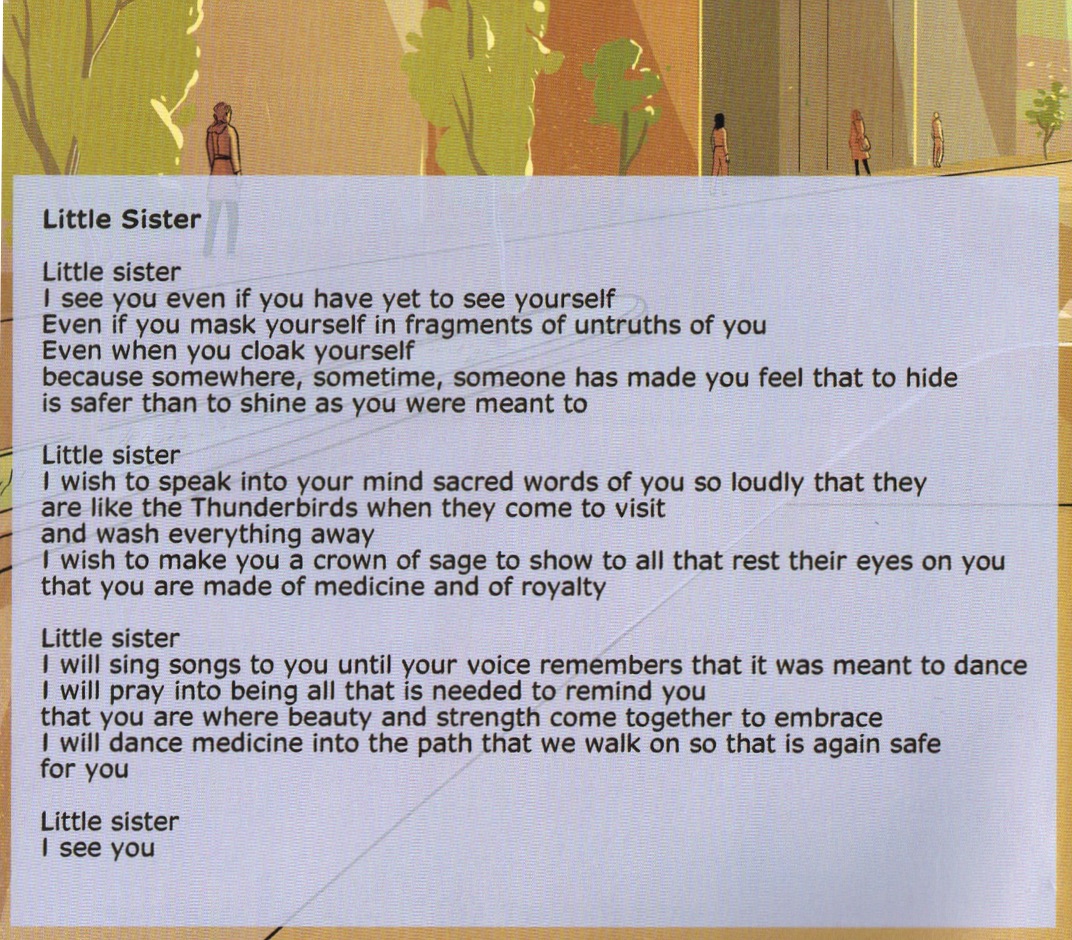
Author Tasha Spillett is of Nehiyaw and Trinidadian ancestry and dubs herself as a PhD student by day and a poet by night. Relevantly she begins Surviving the City with a poem titled "Little Sister" which, with poignant words, notes the starkness and vulnerability of being a young Indigenous woman but offers support, hope, and recognition.

Métis artist Natasha Donovan likewise focuses on the teen realities of Dez and Miikwan, from school to home and in between but overlays it with the supernatural blanket of spirits. The starkness of the city is conspicuous, with colour and brightness only evident when the teens honour their cultures and people and each other.

Surviving the City is not a happy-ending story of everything working out. It's a story about reality for far too many Indigenous women, girls and two-spirit persons who are negatively targeted rather than honoured for being just as they are. But, with Tasha Spillett and Natasha Donovan telling the story of Dez and Miikwan, reality is brought to the light and little sisters are seen.