Showing posts with label Fitzhenry & Whiteside. Show all posts

December 26, 2024

Hungry for Engineering: Poems to Gnaw On

Written by Kari-Lynn Winters and Lori Sherritt-Fleming
Illustrated by Dave Whamond
Fitzhenry & Whiteside
978-1-554556427
32 pp.
Ages 5-8
December 2024
 
For teachers and parents who love a blend of everything, the Hungry For series by Kari-Lynn Winters and Lori Sherritt-Fleming will always fit the bill. A blend of non-fiction STEM with poetry and humour and fabulous illustrations, Hungry for Engineering: Poems to Gnaw On is their fourth and latest addition to the series, introducing a variety of engineering concepts in bite-size poems that educate and entertain.
From Hungry for Engineering: Poems to Gnaw On by Kari-Lynn Winters and Lori Sherritt-Fleming, illustrated by Dave Whamond
In a series of eleven poems, some short and others than span several pages, Kari-Lynn Winter and Lori Sherritt-Fleming delve into all manner of the physical sciences. From the concept of fasteners ("Handy Luke Randy's Fit-It-Up Fasteners") to get power from the sun and wind ("Run by the Sun" and "Wind Tower Power"), and to the ubiquitous "Egg Drop" challenge, they cover a full range of engineering concepts. There's lots to learn about simple machines and forces at work and the mechanics of movement of different materials. Better yet, their poems show kids having fun trying things out, making things move, experimenting and observing, and persevering in their learning. I particularly enjoyed the poem "Clear As Mud?" which shows two children working at filtering muddy water to make it potable, and ends with....
It worked a little, I must admit...
I'll try some more. I will not quit!
From Hungry for Engineering: Poems to Gnaw On by Kari-Lynn Winters and Lori Sherritt-Fleming, illustrated by Dave Whamond
The concepts that Kari-Lynn Winters and Lori Sherritt-Fleming include, many described in the appended glossary, are a great sampler for the physical sciences and a great introduction for younger readers. Hungry for Engineering would be a fabulous hook to start a lesson or two or even a follow-up for children to identify all the concepts they've already learned. Best of all, the poems are funny rhymes with a host of wacky characters from Scary Miss Mary and Luke Randy to Liam O'Leary the inventor and Marianne the girl who uses wind power to blast her to Japan. And the forms these poems take are everything from a limerick and familiar quatrains, to visual poems, in which some words demonstrate their meanings like fall, drop, and downward. 

There's learning that will happen and rhyming joy with the read-aloud but Dave Whamond's illustrations take the poems from entertaining to vigorously animated. There are Godzilla-like creatures munching skyscrapers, a dragon using a stapler, several ingenious Rube Goldberg machines, and a fully-occupied bug hotel created of a variety of materials. His art is colourful and wacky, inclusive and bustling. There's much to see in the details, and the learning will go beyond the text into the illustrations as they search for simple machines and fasteners and more.
From Hungry for Engineering: Poems to Gnaw On by Kari-Lynn Winters and Lori Sherritt-Fleming, illustrated by Dave Whamond
Whether your little ones are building or taking apart, investigating or observing, Hungry for Engineering: Poems to Gnaw On will inspire them to see the magnitude of engineering in their lives and in the world around them. They'll be learning while they're laughing, and rhyming their way through the nuts and bolts of engineering, courtesy of Kari-Lynn Winters, Lori Sherritt-Fleming and Dave Whamond.
 
 • • • • • • •
 
Hungry for Engineering: Poems to Gnaw On (2024)
 

February 26, 2024

Ary's Trees

Written by Deborah Kerbel
Illustrated by Sophia Choi
Fitzhenry & Whiteside
978-1-55455-509-6
32 pp.
Ages 5-8
October 2023
 
On March 21, the world will recognize the United Nations-designated International Day of Forests. Sadly, no matter how long forests have been around, in their different forms around the world, there are still those who might take a lesson from Ary and her friends about the importance of forests and see beyond what they can do for us and what we should do to ensure their constancy.
 
From Ary's Trees, written by Deborah Kerbel, illustrate by Sophia Choi
When their island home is longer viable, Ary's father goes searching for a new home, and finds it in a flourishing island.
As they begin to prepare the island for their new community, Ary, who delights in the trees, begs him, "Please don't cut too many this time."
She closed her eyes and took a deep breath. The air smelled green. Leaves swished overhead as the tree covered her with a blanket of cool shade. How she'd missed that sound!
Not surprising, with every "chop-chop of busy axes," Ary's heart aches. And though she is assured by her father that, "There are lots to spare," she sees that more and more are being cut, for building, and then for crops, and to construct boats, and then because everyone wants more, more, more.
From Ary's Trees, written by Deborah Kerbel, illustrated by Sophia Choi
Ary is bereft for and with the trees. As the palm trees are cut, brown tears rain down. And when the people can't be bothered cutting, they burn down the trees.

Ary is furious, and some of her friends join her in protest. Still, no one listens. They are but children and know not of what they speak, apparently. Ah, but an island without trees suffers. The land crumbles, the structures crack and splinter, and there is no relief from the sun. Ary's father and the other adults choose to find a new island. Ary and a handful of friends find a different solution, one borne of loyalty and regeneration.

Deborah Kerbel's story of environmental responsibility is still one that needs to be heard and empowered in all. Ary's Trees reminds us that it may be the children who will be the ones to change the attitude of their own generation and the subsequent ones, especially when their elders are not getting it. Ary sees the truth, that thinking that "a little bit more (cutting) won't make a difference" is flawed, that "The trees are here for our use" is selfish and short-sighted, and that the trees are their friends and worthy of consideration and charity.

Though I've reviewed many of Deborah Kerbel's books, from picture books like Snow Days and Before You Were Born (still my go-to book for expectant parents) to middle-grade novels like My Deal with the Universe to her YA (e.g., Under the Moon), this is my first opportunity to review a book illustrated by Toronto's Sophia Choi. Also a surface pattern designer, Sophia Choi creates art that speaks of bold colours and shapes, whether it be palm trees or flowers in the understories, or tree stumps and birds. There's a folk-art vibe to her art that speaks of a natural world that will mesmerize and delight, but that also will be missed when gone.
From Ary's Trees, written by Deborah Kerbel, illustrated by Sophia Choi
Whether you read Ary's Trees with your children or students for International Day of Forests, or save it for World Tree Day on June 28th, or for Earth Day on April 22, or to teach a science curriculum, Deborah Kerbel and Sophia Choi's picture book will demonstrate that trees are more than just a producer of materials for human consumption. Trees are living entities that can provide shade and soil stability, habitat, and food, and provide oxygen while absorbing carbon dioxide. As they live, so do we. Fortunately, the youngest inhabitants of the island, Ary and her friends, were able to realize that we humans have an interrelationship with trees, and all living things, and if we sustain them, then they will help sustain us. (Still a lesson too many developers and even politicians haven't learned.)
 

May 30, 2022

Hungry for the Arts: Poems to Chomp On

Written by Kari-Lynn Winters and Lori Sherritt-Fleming
Illustrated by Peggy Collins
Fitzhenry & Whiteside
978-1-55455-466-9
32 pp.
Ages 5-8
March 2022

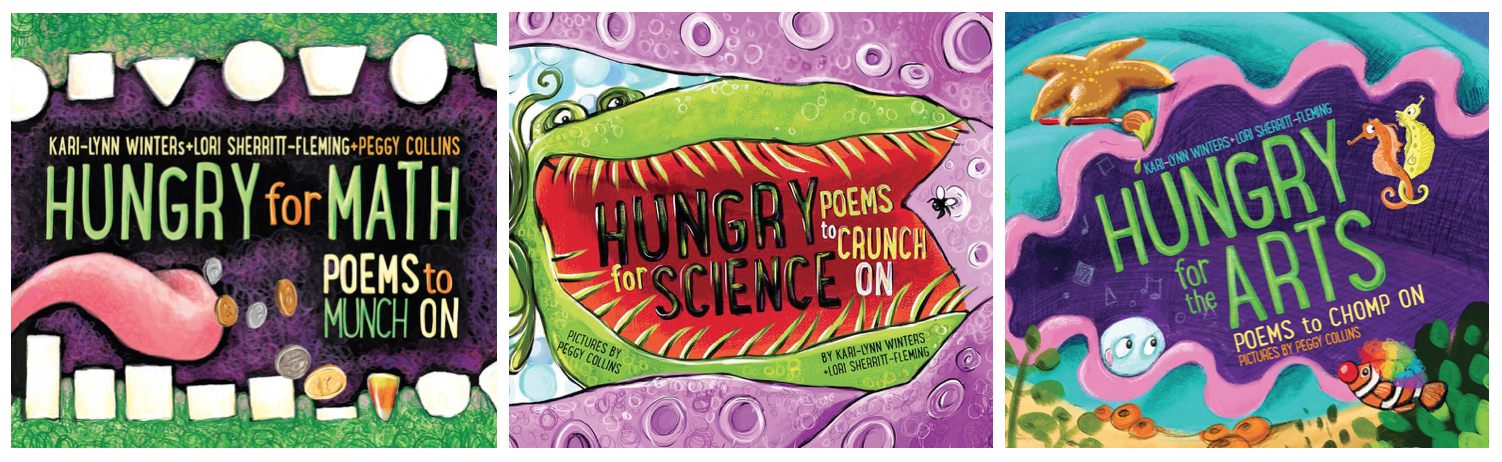
From the creative team that brought us Hungry for Math: Poems to Munch On and Hungry for Science: Poems to Crunch On comes a new book of lively poetry based in the arts of drama, music, dance and visual arts. 

From Hungry for the Arts: Poems to Chomp On by Kari-Lynn Winters and Lori Sherritt-Fleming, illus. by Peggy Collins
Colour-coded to organize the poetry which can span several pages–orange for dance, green for drama, turquoise for music and purple for visual arts–authors Kari-Lynn Winters and Lori-Sherritt-Fleming take young readers onto the stage and into the studio to find ways to express themselves. They are encouraged to...

Munch on motion
Chomp on play.
Chew on chants.
Eat ARTS all day!
And to...
Choose buffets or a-la-carte.
Music,
  dance,
    drama
      art!
From Hungry for the Arts: Poems to Chomp On by Kari-Lynn Winters and Lori Sherritt-Fleming, illus. by Peggy Collins

There's the poem called "Those Cats Can Play" which has a quartet of felines improvising with a variety of notes and "A Little More Forte" in which an elephant and a house mouse must learn about forte, piano, decrescendo and crescendo. In the dance poems, identified by the orange dot in the corner of the first page, some dinosaurs disco, tango and hip hop their way across the dance floor ("Dinosaur Dance Floor") while in "The Whammy-Roo" a child in a wheelchair introduces her friend to her new dance.
From Hungry for the Arts: Poems to Chomp On by Kari-Lynn Winters and Lori Sherritt-Fleming, illus. by Peggy Collins

In the drama poems that include  "When I'm" and "A Dramatic Ride" kids try out movements, improvise with costumes and perform, imaging themselves as anything from a roller coaster to a tiger and a pirate. And the poems based in the visual arts are just as colourful and entertaining, encouraging young readers to think about textures and shapes and create from found objects. In the thirteen poems in the book, Kari-Lynn Winters and Lori Sherritt-Fleming introduce children to new terms–a snappy glossary summarizes this new vocabulary–and encourage them to explore the different art forms with some playful poems that may or may not rhyme.

From Hungry for the Arts: Poems to Chomp On by Kari-Lynn Winters and Lori Sherritt-Fleming, illus. by Peggy Collins
Peggy Collins, whose book Harley the Hero recently won the Forest of Reading's Blue Spruce Award, brings the joy of making art to the page. Her own artwork bursts from the story in an explosion of life through her use of colour and shape and line. There are no wallflowers in Hungry for the Arts. Every poem is animated with animals and children, robots and activity. As the creators make art, through their singing, their dancing, their performance and their displays, readers will learn from the words and the play.

We've munched on poems, crunched on poems and now we get to chomp on them too. With the rhythm of the music, the step of a light foot, a stroke of a brush and a flourish on a stage, Kari-Lynn Winters, Lori Sherritt-Fleming and Peggy Collins take us into the places where children get creative and express themselves in whatever art form speaks to them, and we're there to applaud all their efforts.

November 24, 2021

Do You Know...? series: Guest review

 
This review was written by Grade 3 student Hudson G.
 

Written by Alain M. Bergeron, Michel Quintin and Sampar
Illustrated by Sampar
Fitzhenry & Whiteside
64 pp.
Ages 7-11
2013-2018

The Do You Know...? series by Alain Bergeron, Michel Quinton and Sampar are little books that are only 64 pages long. This small graphic novel is the size of a regular novel, but is packed with a lot of information and funny cartoons. Children who read this book won’t realize they are learning because the book is one big long cartoon about the animals with scientific facts listed at the bottom. The focus is on the joke with the large picture taking up almost the whole page. The artwork is very cartoonish and that is very good for when kids are learning. This type of artwork attracts children and makes them want to read more. The cartoons are still realistic because dinosaurs look accurate, but it is funny because they are wearing clothes.

Each book in the series is a quick read, taking me about twenty minutes to finish. In those twenty minutes, I learned a lot. The facts were new to me and very interesting. The information learned is quite advanced about these animals. Each book has a glossary at the back to explain the new vocabulary. The graphic novel reads like a comic book and you don’t realize you are learning. So, if you want specific information about a topic, you can look at the index at the back, since there aren’t headings or a table of contents.

I would give this series a 9 out of 10. I couldn’t give it a perfect score because I would like each book to be longer. I wanted to keep reading. I would recommend this book to children in grades three to five because some of the words are harder to understand for younger readers. I only got to read four of the books in the series but I would like to read all of them listed on the back. I am going to ask my librarian to buy the rest of the series for our school so I can read them all.

~Review by student Hudson G., Gr. 3 
 
• • • • • • •
To date, I believe there are 16 (!) titles in this series so Hudson can look forward to more great reading and learning since, like Hudson, I recommend them all as entertaining and informative.
 
Do You Know Spiders? (2013)
Do You Know Crocodiles? (2013)
Do You Know Leeches? (2013)
Do You Know Rats? (2013)
Do You Know Crows? (2013)
Do You Know Porcupines? (2013)
Do You Know Toads? (2013)
Do You Know the Rhinoceros? (2015)
Do You Know Tigers? (2015)
Do You Know Piranhas? (2018)
Do You Know Owls? (2018)

March 10, 2020

Cooper Clark and the Dragon Lady

Written by Valerie Sherrard
Illustrated by David Jardine
Fitzhenry & Whiteside
978-1-55455-462-1
80 pp.
Ages 7-10
2019

Cooper's friends Jared and Nina like dragons but Cooper does not. He just tries to avoid anything to do with dragons: movies, games, play. But when his regular after-school babysitter, Linda, takes a new job and can't look after him anymore and his parents suggest Mrs. Mulligan, it becomes a whole lot harder to deal with his fear.

Cooper's parents don't know what he knows about the elderly Mrs. Mulligan. Older boys Lenny and Matt have told everyone that she has a dragon with a pointy tongue in her basement and sometimes she lets it run free. So Cooper creates a web of lies to try to get out of going to Mrs. Mulligan's house.  When those don't work, the boy takes evasive actions.  In the end, after a series of missteps, Cooper learns a thing or two, including how to knit, and that all dragons are not the same.

Cooper Clark and the Dragon Lady is an early reader that addresses the power of the imagination to feed fears from gossip and rumours. There really is a dragon in Mrs. Mulligan's basement but it's a version that delights not hurts. Sadly Cooper, like most children, believes those who are older and might know better and this proves to be his undoing. Well, that and his fear of dragons that he doesn't share with his family or friends.

Tackling important issues in early readers is not always easy. You don't have the expressive illustrations of picture books that can carry much of a message or the vocabulary and word count of middle grade or YA novels to delve deep into issues such as anxiety and fears. So, for Valerie Sherrard to speak to young readers at their level of worry and the expression of that worry, she has accomplished much with Cooper Clark and the Dragon Lady. It's a short story that accepts that young children will have fears that seem outlandish to those who are older and that they will find clumsy strategies to deal with those fears. However, those fears are very real. But, with some support from others, and a dose of the truth, those fears can be reconstructed into something less destructive.

January 14, 2020

The Imperfect Garden

Written by Melissa Assaly
Illustrated by April dela Noche Milne
Fitzhenry & Whiteside
978-1-55455-408-9
36 pp.
Ages 4-8
2019

I know that it's still winter for many of us. Here in southern Ontario we have snow on the ground and below zero temperatures. But this is the time of year gardeners are perusing gardening catalogues and ordering seeds to germinate indoors or sketching out plans for their outdoor veggie gardens. Let Toronto's Melissa Assaly and Vancouver's April dela Noche Milne motivate you to start planning your own garden with The Imperfect Garden.
From The Imperfect Garden by Melissa Assaly, illus. by April dela Noche Milne
A child and his mother prepare a garden each spring, hopeful of growing their own food. In April they plant, and in June the first cucumbers are ready for picking. But Jay is fascinated by their shapes, so unlike the very straight cucumbers they see in the grocery stores. His mother explains that shoppers seem to prefer the straight ones so the unusually-shaped ones are thrown away.

In July, it's the carrots that are picked and again the child is intrigued by the odd shapes, so unlike those in the store, though they taste "crunchy and delicious." In August, it's apple-picking time and he delights in the assortment of colours and shapes. It doesn't matter what they look like as "Mom says all apples taste delicious in pies" and, by not discarding the less-than-perfect ones, they have sufficient for two pies.
From The Imperfect Garden by Melissa Assaly, illus. by April dela Noche Milne
When the growing season has passed and Jay and his mom go to the grocery store, he misses the variety of shapes they produced in their own garden.
Where are the two-legged carrots, the twirly-whirly cucumbers, and the funny-faced apples? Don't grownups know they all taste the same? Even better, maybe?
Fortunately, the imperfect ones are still available and at a reduced cost.

Melissa Assaly's The Imperfect Garden will raise interesting discussions about gardening with children but also about food wastage. She shares notes about both, providing tips for planting with children but also about how much food is wasted when so many go hungry.  In her inviting story about a mother and child growing their own food and appreciating whatever grows, however it grows, Melissa Assaly will make us all think about why we think some foods are considered "perfect" when they are still very edible and tasty, and how we can change that attitude with our children. Jay's pleasure in finding heart-shaped kiwis and other oddities suggests that we've learned and taught our children poorly when they think that only one kind is the right kind.

I like April dela Noche's earthy illustrations, from her misshapen fruits and vegetables to her characters' clothing to a yard that is less manicured and more wild and real. At this time of year, it's lovely to see what will be and can be and to feel the warmth and green of the natural world growing, producing and feeding. In The Imperfect Garden, everything is perfect.
From The Imperfect Garden by Melissa Assaly, illus. by April dela Noche Milne

November 27, 2019

Summer North Coming

Written by Dorothy Bentley
Illustrated by Jessica Bartram
Fitzhenry & Whiteside
978-1-55455-465-2
32 pp.
Ages 5-9
November 2019

Though a picture book titled Summer North Coming may seem incongruous for release in November, Dorothy Bentley and Jessica Bartram's book is actually very suitable for this time of year, and just about any, as it examines in verse and art the changing of seasons and activity in the north.

Divided into two parts, Summer North Coming and Winter North Coming, Alberta author Dorothy Bentley takes the reader across muskeg and forests, shores and skies, and inside to experience all with two children.
From Summer North Coming by Dorothy Bentley, illus. by Jessica Bartram
From her first quintain which accompanies the two children paddling through the open water of marshland, Dorothy Bentley immerses us in Alberta's far north.
Fragrant muskeg rose,
tickle my nose
sun climb,
warm shine
summer north coming
Soon the children are picking raspberries in their birch bark baskets, ready for jam-making and spreading on bannock. Then they're swimming in a river and running through rain puddles and dreaming of flight on bats and birds. With the leaves falling and "summer north fading," preparations for winter begin. The family puts on their beaded mukluks and go fishing, and later enjoy a hearty meal.
From Summer North Coming by Dorothy Bentley, illus. by Jessica Bartram
In the later half of the book, winter has set in and the children play in the snow, relish a dog sled run, watch ravens at play, and enjoy some winter camping. Indoors everyone partakes in venison stew and some family games before a final spread which foretells the end of the cold season.
Hills icy sliding,
crash mud landing
sun roams, 
earth moans
winter north melting
Dorothy Bentley makes the seasonal activities of a northern family with some Indigenous roots into a sensory experience. From the berry-stained hands to thunder loud calling and daytime smiles yawning, Summer North Coming is an evocative rendering in words and art of life in northern Canada. Ottawa artist Jessica Bromley Bartram provides the visual for Dorothy Bentley's expressive free verse, giving the illustrations a folksy feel of family who enjoy the outdoors and live with the seasons. The art, which appears to be a blend of watercolour, gouache and pencil crayon, is surprisingly detailed–the trees in the forest are easily identifiable–yet organic in its rounded edges and softness of energy.

Summer may have passed for now and winter is here and not, but Summer North Coming will take young readers through all the seasons as they advance and retreat in the subarctic environment of northern Canada.
From Summer North Coming by Dorothy Bentley, illus. by Jessica Bartram

September 18, 2018

Hungry for Science: Poems to Crunch On

Written by Kari-Lynn Winters and Lori Sherritt-Fleming
Illustrated by Peggy Collins
Fitzhenry & Whiteside
978-1-55455-396-9
32 pp.
Ages 6-9
June 2018

It's Science Literacy Week in Canada and Kari-Lynn Winters and Lori Sherritt-Fleming use rhyming verses and inclusive and diverse perspectives on biology, chemistry and physics in Hungry for Science: Poems to Crunch On to help children see the science in everything.

There are poems about geology, structures, life cycles, chemistry at work, seasons, magnetism, brain waves, senses, botany, force and differentiating between living and non-living things. It's the primary curriculum plus in a fun package of poetry and dynamic illustrations by Peggy Collins. And everyone is doing science: girls, boys, monsters, armadillos, physically-challenged individuals, kids with braces, kids with glasses, and kids of all hues and abilities.  It's science learning at its best and most lively.
She's hungry for science.
Her hunger's so great.
Stirring her mixtures
who'd guess that she's eight?
It's the manner in which the concepts are shared that makes Hungry for Science so entertaining. The life cycle of a flea in "An Ode to Flea" details the birth and death of Little Miss Pesky Flea who
Lived three months and caused such strife
a doggone long and itchy life!
Captain Chemistry helps unclog a sink drain with an all-purpose cleaner of baking soda and vinegar, and Scary Miss Mary shares how her odd garden of "carnivorous snappers and large creepy wrappers and that stinky, zombie-faced rose" grows.
From Hungry for Science: Poems to Munch On by Kari-Lynn Winters and Lori Sherritt-Fleming, illus. by Peggy Collins
With a glossary and descriptions of the concepts taught in each poem, Kari-Lynn Winters and Lori Sherritt-Fleming complete Hungry for Science with the expository text perfect for a book on science. Peggy Collins, who also illustrated Kari-Lynn Winters and Lori Sherritt-Fleming's earlier STEM picture book, Hungry for Math: Poems to Munch On (Fitzhenry & Whiteside, 2015), ensures the lightness and brightness of tone is reinforced in her artwork, adding quirky creative details like a rainbow of plumes from the primary sense organs and an evil below-ground carrot in Scary Miss Mary's garden.
From Hungry for Science: Poems to Crunch On by Kari-Lynn Winters and Lori Sherritt-Fleming, illus. by Peggy Collins
Have some fun with teaching simple science concepts to children with Hungry for Science: Poems to Crunch On and inspire a child to become a scientist everyday.

November 22, 2017

The Christmas Wind: Book launch (Toronto, ON)

Last week I reviewed this very special picture book 
which I believe will be heralded as a Christmas favourite
like The Polar Express and The Night Before Christmas 

Now I'm pleased to announce its book launch.

🎄🎄🎄🎄🎄🎄🎄

Join 

author Stephanie Simpson McLellan

for the launch of

The Christmas Wind
Written by Stephanie Simpson McLellan
Illustrated by Brooke Kerrigan
Red Deer Press
978-0-88995-534-9
32 pp.
All ages
November 2017

on

Sunday, December 3, 2017

at

1 p.m.

at

Ella Minnow Children's Bookstore
991 Kingston Road
Toronto, ON

🎄🎄🎄🎄🎄🎄🎄

This event will include:
• an interactive reading
• crafts for kids
• treats
• book signing
and
Christmas Wind loot bags.

I can't think of a better way to start the holiday season 
than by attending this launch with your children or without.


Just be sure to RSVP at


November 03, 2017

Smiley: A Journey of Love

Written by Joanne George
Fitzhenry & Whiteside
978-1-55455-412-6
56 pp.
For all ages
October 2017

Anyone who has ever asked me to review a book and to whom I have sent my review policy knows that I generally do not review books about animals.  It is far to difficult for me emotionally to know of the hardships that animals are enduring in real life and even in fictionalized accounts. If you look back over my years of reviewing, you could count the number of animal books I've reviewed on one hand. That said, I wanted to do a brief review of Smiley: A Journey of Love as it is a nominee of the 2018 Forest of Reading's Silver Birch Express Award.

Smiley's tragic beginnings start in an Ontario puppy mill where he was born without eyes and with genetic dwarfism.  He was rescued by the author Joanne George and others at the vet clinic where she worked.  I'm in sobbing tears recalling the horrors that that little dog must have endured when he and others were found. Fortunately, with much love and patience, Smiley was able to survive and flourish under Joanne George's care.
No act of kindness, no matter how small, is ever wasted. - Aesop
The book, peppered with photographs and inspirational quotations, shares Smiley's story from rescue to rehabilitation, including surgery, training and introduction to new situations, places, other animals and people.
From Smiley: A Journey of Love 
by Joanne George
As Smiley becomes part of Joanne George's family and welcomes others into it–her husband and son come after him–the small Golden Retriever shared his wonderfulness with others by becoming a St. John Ambulance Therapy Dog.
The end result of kindness is that it draws people to you. - Anita Roddick
From Smiley: A Journey of Love 
by Joanne George
The process of becoming a therapy dog is involved but everyone knew that Smiley was special and would provide much comfort.  He could give that which he had been denied at birth but had had been nurtured through Joanne George and her family. From hospitals to nursing homes and seniors and children, Smiley has brought love and compassion and calm to those in need.

Smiley: A Journey of Love truly is a story of love, of two loving spirits, Smiley and Joanne George.

From Smiley: A Journey of Love 
by Joanne George
•••••••••••••

After posting this review, I learned that Smiley, who has his own Twitter account @Mysmileydog, passed away on October 14, 2017.  Do check out all the photos on his Twitter feed, of Smiley as a pup, meeting Justin Trudeau, being honoured time and time again.  Let me echo the sentiment posted the day after his passing: "I hope you are running free today, and you can see all the beauty in heaven."

October 17, 2017

The Little Boy Who Lived Down the Drain

Written by Carolyn Huizinga Mills
Illustrated by Brooke Kerrigan
Fitzhenry & Whiteside
978-1-55455-395-2
32 pp.
Ages 3-6
October 2017

Mondegreens, the mishearing of a word or phrase, is typical with songs for which the listener does not see the words they are hearing.  It seems reasonable that the same could be applied to any repetitive rhyme that is misheard like the nursery rhyme "Baa Baa Black Sheep."  When little Sally hears her mother repeating that old English nursery rhyme to her baby brother, she is convinced that she hears,

"Baa baa black sheep
Have you any wool?
Yes sir, yes sir,
Three bags full.
One for my master.
One for my dame.
And one for the little boy...
Who lives down the DRAIN.
"
From The Little Boy Who Lived Down the Drain 
by Carolyn Huizinga Mills 
illus. by Brooke Kerrigan
No wonder her ears perk up.  And, boy, does she have a lot of questions about what's happening with that wool and about his living arrangements.  
From The Little Boy Who Lived Down the Drain 
by Carolyn Huizinga Mills
 illus. by Brooke Kerrigan
As a child who seems to be dealing with busy parents, a  crying baby, and twin sisters who won't let her play with them, Sally is in need of a little companionship and conversation.  That little boy who lives down the drain seems like a perfect friend.  At least, he's available, sitting down the very drain of the tub in which she takes her baths. 
From The Little Boy Who Lived Down the Drain 
by Carolyn Huizinga Mills 
illus. by Brooke Kerrigan
After the water lets out, Sally shouts down a cheery "Hello" to the little boy.  Her voice echoes and as she talks away about herself and her family, she envisions him using the wool to fish in the drain.  The little boy down the drain listens as she laments the attention she lacks and the annoyance of her brother and sisters.  When she can't hear his responses, she speaks more emphatically into the drain, telling him "I know you're probably trying, but you need to try something different!

What she hears back is the echo of her final words "Try something different" which gives her the courage to do just that with her family.  Her own words help bring some resolution to her issues with her family but the story doesn't end there.  You see, Sally eventually hears a different ending for the rhyme and interprets it in her own charming way.

The Little Boy Who Lived Down the Drain was just nominated yesterday for a Blue Spruce award.  That's high praise indeed for Carolyn Huizinga Mills' first picture book.  Sally is so spontaneous and sweet, honest and innocent, never assuming she's misheard the words.  She is determined to speak with the little boy who lives down the drain, and treats him with such reverence and curiosity.  There is a surprise ending here that will have readers laughing out loud with its simplicity and cleverness.  And Brooke Kerrigan, who has illustrated several Blue Spruce-nominated titles including Fishermen Through and Through (written by Colleen Sydor, Red Deer Press, 2014) and Kiss Me! (I’m a Prince!) (written by Heather McLeod, Fitzhenry & Whiteside, 2011) brings a sweetness to Sally and her bathtub antics, as well as to her efforts to engage her family.  Just like Sally, Brooke Kerrigan's illustrations have a guilelessness to them.  Her characters are so natural, her settings clean and subtle, and yet they are enriched with detail as appropriate. (See the illustration of Sally trying to get her busy family's attention in the illustration above.) Together Carolyn Huizinga Mills and Brooke Kerrigan have created a picture book about a little girl's naiveté but turned it into a lesson in empowerment.  For good advice about being empowered, you really must listen, like Sally did, to The Little Boy Who Lived Down the Drain.

🚰🚰🚰🚰🚰

To see a list of all the Blue Spruce nominated titles for the 2018 Forest of Reading® readers choice awards, including The Little Boy Who Lived Down the Drain,  go to my awards page here.

September 05, 2016

Gabby, Wonder Girl

Written by Joyce Grant
Illustrated by Jan Dolby
Fitzhenry & Whiteside
978-1-55455-384-6
32 pp.
Ages 5-7
September 2016

Joyce Grant and Jan Dolby’s little Gabby, of earlier books Gabby (Fitzhenry & Whiteside, 2013) and Gabby, Drama Queen (Fitzhenry & Whiteside, 2013), is taking on the world again, this time to solve a mystery of a photograph through questioning.

When Gabby’s friend Roy becomes engulfed in a pile of question marks that he’s released from her magic book–the one that usually just releases a multitude of letters–the two characters become super sleuths, Wonder Girl and Super Roy, on the trail of the person in the black-and-white photograph Gabby discovers in her backyard.  Using letters from the book and the question marks, Gabby creates the wonder-ful “Who?” that helps them realize the girl in the photo is Mrs. Oldham, her neighbour.  But the two can’t find her and have to amalgamate a “w” (wafting in the wind), “h” (half-hidden in a hammock), “e” (in the electric car), “r” (resting on a race track), and another “e” (on Roy’s elbow) with one of the ubiquitous question marks to locate the older woman in the apple tree!  With some reorganization of letters and a slithery snake, the question of “how?” they can get her out of the tree and free her to make a proffered apple pie is solved!
From Gabby, Wonder Girl 
by Joyce Grant, illus. by Jan Dolby
Joyce Grant’s cutie pie shows off her inquisitiveness and invention with gusto and creativity.  Who knew learning to use questions could be so much fun?  With a simple story, Joyce Grant offers very young readers an introduction to letters of the alphabet while manipulating them into words that provide the basis for questions and simple words.  Those of us more proficient in reading know of the versatility of letters to create new words and worlds but, for the very young, Gabby, Wonder Girl will be a revelation in learning housed in an unassuming but entertaining format.  No need to learn about letters from a standard A-B-C book when you have Gabby.  And Jan Dolby makes sure that Gabby, Wonder Girl (as she did in the earlier Gabby books) is a fun read of bright colours and squiggly lines and quirky details like a garden gnome, hedgehogs, butterflies and yards of letters.  Gabby really is a red-haired wonder girl in both language and action, and Roy plays superbly as her masked sidekick.  
From Gabby, Wonder Girl 
by Joyce Grant, illus. by Jan Dolby
Chidlren will love Gabby Wonder Girl, as they have Gabby and Gabby, Drama Queen, but parents and teachers will enjoy helping them experience Gabby’s learning opportunities in the fun word activites and games as well as drawing lesson that Joyce Grant and Jan Dolby provide at the end of the book.  There’s even a Gabby teachers’ guide that can be accessed online at http://joycegrantauthor.com/free-teachers-guide-gabby.  Gabby, Wonder Girl is a big package of learning in a small but bright little marvel of a book.

August 26, 2016

Sammy and the Headless Horseman

by Rona Arato
Fitzhenry & Whiteside
9781554552696
156 pp.
Ages 9-11
May/September 2016

Yes, I know summer is almost over but here's one last summer hurrah for readers to enjoy a 1920s Catskill Mountains resort and solve a mystery with 11-year-old Sammy Levin and his cohort of young sleuths.

Sammy has been invited by his Aunt Pearl to travel with her and his cousins, Joshua and Leah, to the Liebman’s summer resort to get him away from his gang in New York City and to give Sammy’s father some time with his new wife Martha.  But upon his arrival Sammy learns she has arranged for him to work at the resort while she and her family enjoy the benefits of being guests.  Although initially chagrined at this turn of events–as are his Uncle Milton and his father when they visit–Sammy realizes soon enough that he enjoys the work and palling around with other teens who work at the hotel, especially fourteen-year-olds Adam Van Dorn and the owner’s daughter Shayna Liebman, and even performing with the hotel’s entertainer, Moishe.
It was exhilirating and nerve-wracking, but Sammy never felt more like he belonged. (pg. 80)
But there seem to be ghostly forces at work creating havoc at the Liebman’s hotel and on the property of the nearby Hermit, a former slave, including broken dishware, a trampled vegetable garden, a ceiling light falling, and a fire at the Hermit’s chicken coop.  Mrs. Leibman is convinced it’s her dead grandmother expressing her annoyance at the hotel owner’s use of her recipes, but that doesn’t explain the headless horseman (“Some fool hidin’ his head in a black cape and ridin’ a horse”; pg. 44) whom the Hermit witnesses and who later makes appearances at the hotel.  Sammy, who recalls the terrorizing of his Polish village by soldiers, is determined to stop good people like the Hermit and the Liebmans from experiencing further distress and damage.  Together with Adam and Shayna and the annoying Joshua–who always makes sure to clarify to others that “I’m a guest” (pg. 43)–Sammy pursues the mystery of the headless horseman and does a little ghost-busting.

There’s a mystery to be solved and Rona Arato, award-winning writer of The Last Train (Owlkids, 2013), sets up all the clues for the kids to discover the solution and make things right.  Sammy and the Headless Horseman is a Jewish Hardy Boys for the middle-grade set.  But it’s the setting and atmosphere with which Rona Arato infuses her plot that makes the story all the better (and she provides historical notes and photographs to enhance her story).  Sammy and Headless Horseman takes you back to a time when a mountain resort and swimming in a pool and a lake and playing cards and hanging with your peers was summertime bliss.  But by saturating the story with the foods, vocabulary and culture of a Jewish community of the 1920s, many of whom recall their emigration from the old country to the States, Rona Arato has ensured that Sammy and the Headless Horseman is seasoned with a distinctive flavour and ambiance that leaves the reader and the characters feeling good.

>>>>>>>>>>>>>>>>>>>>>>>>>>>>>>>>

If you're in the Toronto area, don't miss the opportunity to get a signed copy from Rona Arato this Sunday, August 28, 2016 at Indigo Yorkdale.  Details here

August 23, 2016

Sammy and the Headless Horseman: Book signing (Toronto)

Join award-winning youngCanLit author 
of numerous fiction and non-fiction 
including

The Last Train


On a Canadian Day

and

Courage and Compassion: Ten Canadians Who Made a Difference


Rona Arato


for the release and signing of her newest book


Sammy and the Headless Horseman
by Rona Arato
Fitzhenry & Whiteside
9781554552696
156 pp.
Ages 9-11
May/September 2016

on


Sunday, August 28th, 2016

 2 p m.

 Indigo Yorkdale
Toronto, ON

This middle-grade mystery of historical fiction is described on the publisher's website at http://www.fitzhenry.ca/Detail/1554552699 as follows:

Thanks to his Aunt Pearl, eleven-year-old Sammy is stuck in the Catskill Mountains for the summer with his awful cousin Joshua. While he doesn't relish the idea of getting to know his new stepmom, at least he'd have his gang to hang out with in New York if he got to stay there instead. But when Sammy realizes he was brought on to be hired help at the hotel, he makes the most of it and enjoys bunking with his teenage co-worker, Adam.

Trouble seems to follow Sammy as he becomes entangled in a series of mysterious occurrences, including a terrifying headless horseman who seems to be haunting the reclusive "Hermit" at the top of the neighbouring hill. Sammy and his new friends form a team called "The Ichabods" to crack the mystery.

Set in the early 1920s, after WWI. 

_ _ _ _ _ _ _ _ _ _ _ _ _ _ _ _ _ _ _ _ 

I'll be reviewing Sammy and the Headless Horseman later this week but I thought I give readers in the Toronto area an early heads up (!) about this author event.  I'm sure that it's a book that you won't want to miss.