Showing posts with label science. Show all posts

January 31, 2026

2025 Lane Anderson Award: Winner announced


The Lane Anderson Award for excellence in Canadian science writing was awarded on Wednesday, January 28, 2026 in Toronto. The event, hosted by Carol-Ann Hoyte and Winston Stitwell, presented the winners from shortlists selected by independent juries of experts in science, science writing and literature. The awards created and sponsored by the Fitzhenry Family Foundation, and named for the mothers of its two founders, Robert and Hilda Fitzhenry, were given in two categories, one for adults and the other for young readers, with each winner receiving a generous $10,000.
 
 
  • • • • • • •


Congratulations to this year's winner
in the Young Reader category
 
 
A Planet Is a Poem
Written by Amanda West Lewis
Illustrated by Oliver Averill
Kids Can Press
56 pp.
Ages 8-12
2024


• • • • • • •


October 01, 2025

2025 Lane Anderson Award: Shortlists


Yesterday, the finalists for the Lane Anderson Award, a book award that celebrates excellence in Canadian science writing, were announced. The Lane Anderson Award, created and sponsored by the Fitzhenry Family Foundation, is given in two categories, one for adults and the other for young readers. Each winner receives a generous $10,000.
 
 
The basic criteria for submissions are the following: 
  • The author must be a Canadian citizen or permanent resident of Canada.
  • The book must be published by a Canadian-owned publishing house, have an ISBN, and be available for sale in bookstores in Canada.
  • All entries must be published in English between January 1, 2024 and December 31, 2024. 
 
The 2025 Lane Anderson Award Ceremony will take place on Thursday, January 29, 2026 in Toronto. Details about tickets have been posted below.
 
  • • • • • • •


Congratulations to this year's finalists 
in the Young Reader category
 

I Am Wind: An Autobiography
Written by Rachel Poliquin
Illustrated by Rachel Wada
Tundra Books
80 pp.
Ages 8-12
2024


A Planet Is a Poem
Written by Amanda West Lewis
Illustrated by Oliver Averill
Kids Can Press
56 pp.
Ages 8-12
2024


Remember This: The Fascinating World of Memory
Written by Monique Polak
Illustrated by Valéry Goulet
Orca Book Publishers
96 pp.
Ages 8-12
2024 


• • • • •
 
Update:
 
Details about the Lane Anderson Award Ceremony have been announced. Register here through Eventbrite.
 
Date:            Thursday, January 29, 2026
 
Time:           7:00–9:30 p.m. 
 
Location:     Palm House at Allan Gardens
                    160 Gerrard Street East
                    Toronto, ON 
                    M5A 2E5 
 
Tickets are free but you must register. 
 
• • • • • 

July 28, 2025

Death by Whoopee Cushion

Written by Vicki Grant
Tundra Books
978-1-77488-468-3
256 pp.
Ages 10–14
July 2025 
 
 Having parents who own a joke shop can be torture. (p. 3)
 
For twelve-year-old Manya, who hates the limelight, her parents' joke shop, Pranks-A-Million, is embarrassing. But Ronnie and Stephanie Brown love to laugh and make others laugh. Not only do they sell pranks that explode, smell, stain, and startle, they create new "artisanal pranks" like Barf-In-A-Bag, edible scabs, and the Gravy Blaster, a whoopee cushion filled with sulfur-scented gravy, in their backroom Funcubator lab. Manya likes serious science–she won last year's science fair–and is eager to take an after-school program called "Serious Science for Serious Kids" that is offered at the Museum of Natural History. Along with her best friend and neighbour, Isaac, the only other participants who attend Dr. Michael's course are Jack, another science kid from their school, and Brandon, a kid who wanted to do kickboxing but was forced to attend this instead. Together they learn about acids and bases and do fun experiments.
 
But when things that aren't a laughing matter happen, Manya is concerned, though her parents with their good-natured humour are not. First, they are questioned by police about a trick cigar that caused first-degree burns. Then, more seriously, when her parents are setting up for a presentation at Manya's school, the new custodian is killed by an explosion when handling their materials. Manya's parents are arrested, and Manya and their parrot Toots—who makes farting noises—go to stay with Isaac and his mother Delia next door. Now it's up to Manya and Isaac to put their STEM skills to work and determine who sabotaged her parents' Gravy Blaster that killed a man.
 
Vicki Grant is always known for the humour in her books (e.g., Hold the Pickles36 Questions That Changed My Mind About You, Short for Chameleon) but her stories are always more than cheap laughs. Her plots often look into deeper issues of family relationships or bullying, even loneliness or shame. Vicki Grant reminds us that even when there is much to laugh about, there are serious issues often lightened with humour. Manya may be a girl who has inherited a love of science and experimenting from her parents, but she is quite self-conscious and embarrassed by the silliness, and smells and noises, of the pranks her parents love. But when her parents are arrested, she realizes how much she loves them and how much the joke shop is a part of her. It's this realization, along with the application of some science, that helps her solve the mystery of the exploding Gravy Blaster and connect with those who care about her.
 
I don't want to give away too much—the mystery of the Whoopee Cushion Murder must be solved—but suffice it to say that the laughs will be had courtesy of a fart-noisemaker of a parrot, a poopy baby called Poppy, a plethora of pranks, and a pair of mischief-makers who drive around in a yellow Beetle adorned with googly eyes and a clown nose. But with a little science, a whole lot of fun, and much familial affection, the mystery is solved, along with a few welcome surprises, and only the culprit is left with egg on their face, figuratively of course.

June 11, 2025

Meet Frederick Banting (Scholastic Canada Biography)

Written by Elizabeth MacLeod
Illustrated by Mike Deas
Scholastic Canada
978-1-0397-0785-6
32 pp.
Ages 6-10
June 2025 

I get excited with the release of each new addition to the Scholastic Canada Biography, and this is just so with Meet Frederick Banting, which came out last week. Elizabeth MacLeod and Mike Deas collaborate so well that I know that young readers will come away having learned and be inspired by another great Canadian.
 
While many will know the names Banting and Best for their discovery of insulin, the full story of Frederick Grant Banting, born on an Ontario farm in 1891, will be less well known to many. Banting's story, beyond a Heritage Minute of Historica Canada, is far less familiar, though, within his childhood, education, and work beyond the discovery of insulin, he is a man of great accomplishment, humanity, and charity.
From Meet Frederick Banting, written by Elizabeth MacLeod, illustrated by Mike Deas
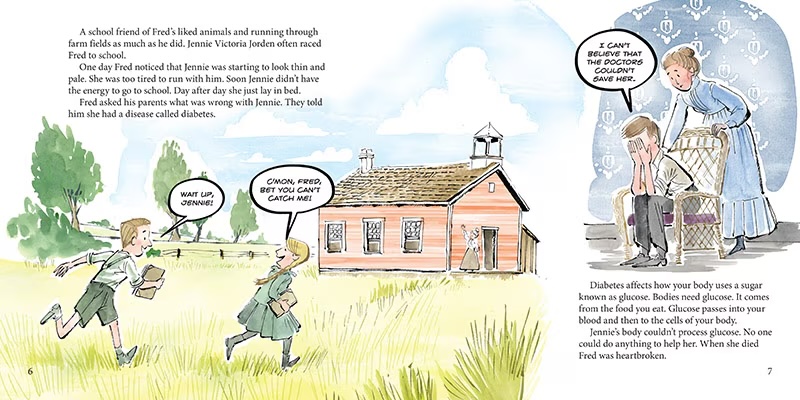
Living on a farm at the turn of the twentieth century would have been fairly typical though Fred was encouraged early on to really study the animals to help determine why they were sick and how to help them get better. However, it was his friendship with Jennie Victoria Jorden, a young diabetic, that probably was most critical to compelling him to consider why diabetics got sick and died and how he might help them.
From Meet Frederick Banting, written by Elizabeth MacLeod, illustrated by Mike Deas
At university, Fred studied medicine and, after working as a doctor in Britain and France during World War 1, he returned to Canada and started a family practice in London, Ontario. He also taught at the nearby university, and it was during his prep for an upcoming lecture on the pancreas, which was known to be involved with diabetes, Fred had an important realization. He took his idea to a professor at the University of Toronto who provided him with a lab and assistant, Charles Herbert Best. Their research into isletin which was renamed to insulin is well established, and the accolades he received, along with others, are firmly rooted in the history books.
From Meet Frederick Banting, written by Elizabeth MacLeod, illustrated by Mike Deas
But Elizabeth MacLeod tells us more about the man and his nature beyond his discovery. He didn't want to make money from his discovery and sold the rights to make the medicine for a single dollar. When he won the Nobel Prize in 1923, he split his prize money with Charley Best. And he continued to work for others, opening a diabetic clinic and helping the Canadian government by conducting research during World War 2. This extraordinary man lived a life of service and Elizabeth MacLeod makes sure to tell his story more completely. (She includes a timeline of his life at the conclusion of her story.)
 
The reason I love the Scholastic Canada Biography books is because I always learn something new. Elizabeth MacLeod goes beyond the obvious or the known and gives us a fuller picture of the individual. Here, Frederick Banting becomes a humanitarian and a researcher, more than just a Nobel Prize laureate or a celebrity to be lauded on a Walk of Fame, though he is both of those. And she tells his story with passion and directness, probably not unlike the man. This is his story and his life, and Elizabeth MacLeod tells it effectively for her audience.
 
That simplicity of message comes through in Mike Deas's illustrations that look like they were effortlessly created, but they are far more than just sketches. In a complex process of creating sketches digitally, with a Wacom tablet and Photoshop, Mike Deas traces them onto watercolour paper and then applies gouache and watercolour paints before using black ink to finish the illustration. But with that process, Mike Deas creates art that is both direct and detailed, has heart and authenticity, and is perfect for a story of a selfless man who worked to help others and not enrich his own life with money or accolades. 
 
Meet Frederick Banting may take longer than a single minute of recounting history, but Frederick Banting deserves more, and Elizabeth MacLeod and Mike Deas have given his legacy that which he is due. They have relayed to young readers that he was a great man and that all his work justifiably earned him the recognition as a great Canadian.
 
• • • • • • •

I know that readers always like to check out more of these books so here is a smattering of volumes from the Scholastic Canada Biography series:
 
Meet Viola Desmond (2018)
Meet Chris Hadfield (2018)
Meet Tom Longboat (2019)
Meet Elsie MacGill (2019)
Meet Willie O'Ree (2020)
Meet Terry Fox (2020)
Meet Thérèse Casgrain (2021)
Meet David Suzuki (2021)
Meet Mary Ann Shadd (2022)
Meet J. Armand Bombardier (2022)
Meet Buffy Sainte-Marie (2023)
Meet Jim Egan (2024) 
Meet Frederick Banting (2025)

December 20, 2024

2024 Lane Anderson Award: Shortlists for Canadian science books


This fall, the finalists for the Lane Anderson Award, a book award that celebrates excellence in Canadian science writing, were announced. The Lane Anderson Award, created and sponsored by the Fitzhenry Family Foundation, is given in two categories, one for adults and the other for young readers. Each winner receives a generous $10,000.
 
The basic criteria for submissions are the following: 
  • The author must be a Canadian citizen or permanent resident of Canada.
  • The book must be published by a Canadian-owned publishing house, have an ISBN, and be available for sale in bookstores in Canada.
  • All entries must be published in English between January 1st, 2023 and December 31st, 2023. 
 • • • • • • •
 
This year, the 2024 Lane Anderson Award Ceremony will be a free event and open to the public though you must register for a ticket through Eventbrite at https://www.eventbrite.com/e/the-lane-anderson-award-ceremony-tickets-1111735323279

Date:        Wednesday, January 29, 2025 
Time:        7-10 PM
Location:  Concourse Event Space, North York Central Library
                   5120 Yonge Street 
                   Toronto, ON 
                   M2N 5N9

 
  • • • • • • •


Congratulations to this year's finalists 
in the Young Reader category
 

Bompa’s Insect Expedition
Written by David Suzuki with Tanya Lloyd Kyi
Illustrated by Qin Leng
Greystone Kids
48 pp.
Ages 4-8
2023
 

Operation Cupcake: How Simple Machines Work
Written and illustrated by Bambi Edlund
Kids Can Press
44 pp.
Ages 7-10
2023
 

Polar: Wildlife at the Ends of the Earth
Written by L. E. Carmichael
Illustrated by Byron Eggenschwiler 
Kids Can Press
48 pp.
Ages 7-11
2023


June 19, 2024

Greetings, Floof!

Written by C. J. Hong
Illustrated by A. J. Smith
Kids Can Press
978-1-5253-0723-2
32 pp.
Ages 3-7
June 2024

A tiny pink fluff ball of an alien called Floof has arrived on our planet and scientific investigator Dr. Greta Goodnote is ready to meet and greet the explorer from Ploof. But it's going to take a little help from readers to really get to know the alien named Floof. 
From Greetings, Floof!, written by C. J. Hong, illustrated by A. J. Smith
First, though, Floof must come out of his spaceship. So, Dr. Greta encourages readers to give him a Ploofian hello by raising their arms and jiggling them. (Lucky we have a scientist to help guide us.) When Floof finally emerges, it's to cuddle a couple of bunnies the reader has pointed out to him. When the rain comes, readers are again enlisted, first to blow about the clouds and then to help a very fluffy Floof to return to his pre-ultra-poofing self. (This requires everything from blowing, and then closing and opening the book, and even shaking it gently.) And when he enjoys his first kiss, Floof is encouraged to pay it forward in his own Ploofian way.
From Greetings, Floof!, written by C. J. Hong, illustrated by A. J. Smith
By making readers part of the story, needing to help greet Floof, to locate animals to cuddle, to blow away rain clouds, to de-poof Floof, and more, C. J. Hong makes Greetings, Floof! an interactive story. While this is generally more difficult with picture books that are read aloud to children, rather than chapter books in which they might make choices of how the story continues, C. J. Hong keeps young readers enthralled, waiting for their next task in helping little Floof out. Not only are they learning empathy and cooperation, but they also see that science is something as basic as building knowledge through observation, experimentation, and application. 
 
American artist A. J. Smith has created an incredibly cute alien in his digital artwork but Floof is still very different. So Ottawa's C. J. Hong's story of the little guy inspires inquiry, coupled with open-mindedness for those who look and speak differently. Because of that, C. J. Hong ticks off all the boxes for a story of science, communication, compassion, and acceptance while demonstrating that kindness can bridge worlds, even planets.
From Greetings, Floof!, written by C. J. Hong, illustrated by A. J. Smith

February 11, 2024

Khadija and the Elephant Toothpaste Experiment

Written by Farah Qaiser and Hajer Nakua
Illustrated by Natalya Tariq
Second Story Press
978-1-772603651
24 pp.
Ages 4-9
February 2024

Today, February 11th, is the International Day of Women and Girls in Science and Khadija and the Elephant Toothpaste Experiment, a book about a little Muslim girl who takes on a big experiment, seems like the perfect picture book to review today. 
From Khadija and the Elephant Toothpaste Experiment, written by Farah Qaiser and Hajer Nakua, illustrated by Natalya Tariq
Khadija is excited to take her parents and little brother Omar to her school to see the science fair. But this isn't a science fair where children display their projects. This is one in which professional scientists discuss their research and demonstrate experiments and do cool things. Khadija is impressed with all the scientists in their lab coats and safety goggles but wonders why not one is wearing a hijab.
From Khadija and the Elephant Toothpaste Experiment, written by Farah Qaiser and Hajer Nakua, illustrated by Natalya Tariq
At the fair, Khadija is given a boxed experiment which she is excited to try, mostly to prove that she could be a true scientist. But the family is expecting many guests for Eid, and she is told to wait. But wait she cannot. So as Amma cooks up delicious foods, Khadija heads into the bathroom armed with some ingredients, including food dye, and her Abba's favourite mug.
From Khadija and the Elephant Toothpaste Experiment, written by Farah Qaiser and Hajer Nakua, illustrated by Natalya Tariq
She follows the directions and is, at first, delighted with the foamy mixture, until it expands beyond the mug and onto the counter and onto the floor. This gaffe gives Khadija's parents an opportunity to talk to her about what it means to be a scientist, including the need for curiosity and patience, and that there is not just one way to be a scientist. In fact, they get her a little something for Eid that gets her started on her own journey to becoming one.
From Khadija and the Elephant Toothpaste Experiment, written by Farah Qaiser and Hajer Nakua, illustrated by Natalya Tariq
Authors Farah Qaiser and Hajer Nakua know about the curiosity that compels a child to become a scientist as this is something which they both achieved. That inquisitiveness is natural to young children. They want to learn and know and try things. I recall my own young niece and nephews who wanted to do "sparimenting" and even arranging a science-based birthday party for one. For some, that curiosity is sadly extinguished when they are led to believe that they cannot "do science" whether because of their gender, their experiences, or something else. Farah Qaiser and Hajer Nakua shows young readers that a little Muslim girl who wants to be a scientist can achieve that dream, because their message in Khadija and the Elephant Toothpaste Experiment is all about opportunity and inclusion. 

Ottawa illustrator Natalya Tariq uses cartoon art to give brightness and innocence to Khadija's story. There's a wide-eyed wonder to the child that is infused in every illustration. From her eager acceptance of the boxed experiment to observing all the different scientists at the fair and to her delight at a very special gift for a budding scientist. Natalya Tariq makes us see Khadija's wonder and interest in science, but also her heritage and her family, and, like the text, reminds us that the two are wholly compatible.

On this International Day of Women and Girls in Science, Khadija and the Elephant Toothpaste Experiment supports Khadija in her ambition to become a scientist, starting with an experiment that any child can undertake (check online for instructions). This can only inspire all children to follow their dreams, whether into science or into the arts.

December 06, 2022

Do You Know Quantum Physics? (Brainy Science Readers)

Written by Chris Ferrie
Text adapted by Brooke Vitale
Illustrations by Chris Ferrie and Lindsay Dale-Scott
Sourcebooks Explore
978-1-7282-6153-9
32 pp.
Ages 4-7
November 2022

The field of quantum physics would seem a challenging STEM topic for adults, much less for children. But one thing Chris Ferrie does very well is distilling down complex scientific ideas into manageable bites and he does the same for quantum physics with his latest in the early reader series called Brainy Science Readers. With clear and concise text and illustrations, and analogies between balls and parts of an atom, Chris Ferrie introduces young readers to atoms, electrons, neutrons, protons, energy, and quanta.
From Do You Know Quantum Physics? by Chris Ferrie, illus. by Chris Ferrie and Lindsay Dale-Scott
STEM books tend to be either extensive middle-grade non-fiction texts or picture books that embed a scientific concept within. Do You Know Quantum Physics? is very different in that it is an early reader devoted to the concept of the quantum theory of the atom at its heart. The illustrations carry the message, but the words are dedicated to explaining what an atom and its component particles are and how electrons gain or lose energy. The vocabulary is appropriate for beginning readers and the repetition of words helps highlight key ideas. Moreover, the digitally-rendered artwork by Chris Ferrie and Lindsay Dale-Scott always matches the text directly, allowing for improved retention of the ideas. Chris Ferrie has not wrapped the learning in a story of a little electron looking for its friends or home. It's just the science of how things work. Because of that, it hits the mark. 
From Do You Know Quantum Physics? by Chris Ferrie, illus. by Chris Ferrie and Lindsay Dale-Scott
The Brainy Science series aims to "improve reading skills while immersing children into scientific theory." (pg. 1) And while quantum physics may not be on many, if any, pre-school through Grade 2 curricula, Do You Know Quantum Physics?, with its simplicity of text, ball analogy and bold illustrations, will be a fabulous introduction to the atom.
From Do You Know Quantum Physics? by Chris Ferrie, illus. by Chris Ferrie and Lindsay Dale-Scott
(Marie Curie even makes a very brief appearance.)

October 27, 2021

Lights Day and Night: The Science of How Light Works

Written by Susan Hughes
Illustrated by Ellen Rooney
Kids Can Press
978-1-5253-0319-7
32 pp.
Ages 5-8
September 2021 

If you're a regular reader of CanLit for LittleCanadians, you'll know that while I do review some non-fiction books, I do so infrequently. It's not that there aren't great non-fiction books out there–there most definitely are–but I tend to find many dry and text-heavy in their efforts to provide quality content for young readers. While many books are organized well and enhanced with colourful illustrations and typical features of non-fiction texts like maps, glossaries and  info boxes, I find that the content can bog down the book. This is not the case with Susan Hughes and Ellen Rooney's Lights Day and Night: The Science of How Light Works. It's informative but text-light and captivating in its organization and storytelling.
From Lights Day and Night by Susan Hughes, illus. by Ellen Rooney
A child and her tuxedo cat enjoy the darkness of a summer evening before witnessing the light that comes from a firefly and the stars. Natural light sources like the sun, volcanoes, lightning and the northern lights are all noted, as is artificial light and the need for some source like electricity or the burning of wood.
From Lights Day and Night by Susan Hughes, illus. by Ellen Rooney
Discussions of the uses of light leads to a focus on the sun and energy, the water cycle, absorption, reflection and refraction, and the eyes, all while the girl and her cat enjoy the outdoors, playing and making observations at their cottage on a lake.
From Lights Day and Night by Susan Hughes, illus. by Ellen Rooney
Susan Hughes gives young readers the basics about light: where it comes from, what it does and how it works, all within the context of a child playing with her feline companion. Readers will learn important words like translucent and retina and artificial, which are bolded and reinforced in a glossary called "Words to Know." But while learning about light, information which is never cumbersome, kids can enjoy natural landscapes, a cute cat, people in activities supported with light such as walking at a crosswalk or hockey game results on a scoreboard, and know that light is part of their lives too. That same mix of science information and story is blended by BC's Ellen Rooney in her artwork, using cut paper, paint, pencil crayons and a computer to create these collages of light and dark and life.

I know teachers and parents will enjoy using Lights Day and Night as a solid introduction to light and its role in our lives but kids will get more out of the educational messages because of Susan Hughes's text and Ellen Rooney's artwork. After all, an idea is more easily absorbed when presented as in a captivating manner–did I mention the instructions for a shadow puppet show are provided?–and with transparency and brightness.  Lights Day and Night does just that.

January 19, 2021

Nature All Around: Trees & Nature All Around: Plants

Yesterday, I had the pleasure of reviewing Nature All Around: Birds, Pamela Hickman and Carolyn Gavin's newest book in Kids Can Press's Nature All Around series, and I was reminded of earlier books that I hadn't reviewed. Here are my reviews of two additional titles published earlier in the series.

🌲🌳🌲🌳🌲🌳🌲🌳🌲
 
Nature All Around: Trees
Written by Pamela Hickman
Illustrated by Carolyn Gavin
Kids Can Press
978-1-77138-804-7
32 pp.
Ages 7-10
2019
 
Nature All Around: Plants
Written by Pamela Hickman
Illustrated by Carolyn Gavin
Kids Can Press
978-1-77138-819-1
32 pp.
Ages 7-10
2020  

As with Nature All Around: Birds, Pamela Hickman and Carolyn Gavin offer children a broad introduction to a group of living things in an illustrated text perfect for the early middle grade reader. They cover life cycles, behaviour, identification, seasonal variation, and unique species, as well as offering an opportunity for learning through activity
From Nature All Around: Trees by Pamela Hickman, illus. by Carolyn Gavin
In Nature All Around: Trees, children will become familiar with the basics of tree morphology (i.e., trunk, bark, roots, crown, leaves, seeds and branches) and the differences between deciduous and evergreen trees. The different types of leaves and their role in photosynthesis and respiration are also covered. Looking at the tree through the seasons, Pamela Hickman details pollination, fruit production, and the making of maple syrup from sap. She also reports on the forest regions of North America, the role of trees as habitat, and tree identification. Still as scientifically accurate as the details are, Nature All Around: Trees is also a celebration of trees and their wondrous role in different ecosystems, and Carolyn Gavin's illustrations of watercolour and gouache honour both the science and the magic. (The joy of colour and shape in the illustration below is just one superb example.)
From Nature All Around: Trees by Pamela Hickman, illus. by Carolyn Gavin
In Nature All Around: Plants, Pamela Hickman discusses flowering and non-flowering plants, life cycles, adaptations to the environment, to attract pollinators and for protection, and the many quirky species and anomalies to the norm. Of course, there is always the activity-based learning which here includes "Beginner Plant-Watching" and growing microgreens.
From Nature All Around: Plants by Pamela Hickman, illus. by Carolyn Gavin
Children are spending a lot more time indoors right now and being out in nature offers a plethora of opportunities for learning, for exercise, for quiet time and for connection. With the Nature All Around series from Pamela Hickman and illustrated by Carolyn Gavin, heading out to take in the natural world and make those worthwhile connections that remind us that we're much more than entities on screens is all the more possible. 
From Nature All Around: Plants by Pamela Hickman, illus. by Carolyn Gavin

 🌲🌳🐛🌲🌳🐛🌲🌳🐛🌲🌳🐛🌲
 
The complete Nature All Around series includes four books to date:
Nature All Around: Trees (2019)
Nature All Around: Bugs (2019)
Nature All Around: Plants (2020) 
Nature All Around: Birds (2020)

December 04, 2018

Out of the Ice: How Climate Change is Revealing the Past

Written by Claire Eamer
Illustrated by Drew Shannon
Kids Can Press
978-1-77138-731-6
32 pp.
Ages 8-12
September 2018

In another life, I did research on the historical record trapped in peatlands in Alberta. Most people would be fascinated to learn that deep within the plant material there are records of volcanic eruptions from thousands of years ago, deforestation and agriculture in the surrounding areas, and more.  Claire Eamer, prolific writer of non-fiction including Inside Your Insides: A Guide to the Microbes That Call You Home (Kids Can Press, 2016) and What a Waste! Where Does Garbage Go? (Annick Press, 2017), brings similar information from the past as it is trapped in frozen water from glaciers, permafrost, and more, now being revealed with the global warming of the Earth's air, ground and water.

Starting with explanations about global warming and how the Earth acts as a greenhouse, Claire Eamer then focuses on specific circumstances under which clues from the past become revealed. There is the 4300 year old stick with a bit of feather and sinew found in ice patches in the Yukon alongside 2400 year old caribou dung, revealing the first organic evidence of the hunting atlatl, a stick used to throw darts. There are more archaeological clues from Norway, spurred on by the Yukon finds, of large groups of people using scaring sticks to funnel herds of reindeer for easy hunting. In 1999, the mummified body of Kwädąy Dän Ts'ìnchį, meaning "long-ago person found", was discovered at the edge of a melting glacier in BC, providing evidence of his age, food eaten, and clothing worn, as well as his ancestry through DNA. The famous Iceman, Ötzi, found in the Ötztal Alps in 1991, is also discussed, as are the Scythians in the permafrost of the Altai Mountains of Asia, the Incan children of Llullaillaco, sacrificed to the gods and buried high in the Andes, and the cave-lion cubs and mammoths discovered in Siberia and Russia.

From Out of the Ice: How Climate Change is Revealing the Past by Claire Eamer, illus. by Drew Shannon

 All these discoveries further our understanding of the people and animals who inhabited these areas, hundreds, thousands and tens of thousands of years ago. With contemporary testing and advances, like radiocarbon dating, and biochemical and DNA analyses, more and more can be learned about them and their world, which Claire Eamer recognizes is our world too.

 "The past is us." (pg. 29)
Drew Shannon, a Toronto illustrator, provides realistic depictions of how these people and animals might have lived, giving context to the circumstances of the artifacts and bodies recovered. A photograph for each story is usually provided but Drew Shannon's illustrations help the reader see beyond the science and into the lives of those left behind and now being exposed. Coupled with information boxes, a glossary, a timeline and references for further study, Out of the Ice: How Climate Change is Revealing the Past becomes a well-organized and informative read that still draws the reader in with its compelling stories of lives lived before, useful for teaching the science of climate change or history and archaeology.
From Out of the Ice: How Climate Change is Revealing the Past by Claire Eamer, illus. by Drew Shannon

October 05, 2018

At the Pond

Written and illustrated by Werner Zimmermann
North Winds Press (Scholastic Canada)
978-1-4431-4287-8
32 pp.
Ages 2-5
September 2018

On Wednesday, At the Pond became a nominee for a Governor General's Literature Award for Children's Book Illustration and today I want to share why this superb book of art is a worthy contender.
From At the Pond by Werner Zimmermann
At the Pond is a counting book at its simplest. One fish...two fish...and upwards to ten. But At the Pond is more art book than concept book. It is a compendium of beautifully rendered paintings that take the reader to see a pond up close and very personal. Every double spread is an opus of the natural world in colour and shape. The depth of realism that reflects the pond's life, botanical and zoological, is dramatic and intimate. From the goldfish to the water lilies, leopard frogs, insects that include water striders and dragonflies, and the great blue heron from whom the pond life scatters, At the Pond is a literary pond study for those for whom ponds are not readily accessible and even for those fortunate to have them in their backyards.
From At the Pond by Werner Zimmermann
Werner Zimmermann blends green and blue watercolour pigments to give life to the pond's water. There's a dynamic component to essentially still waters–ponds are after all defined as bodies of standing water–that comes from the strokes of his brushes and blending of tones, tints and shades. There are seemingly hundreds of greens in Werner Zimmermann's pond. Moreover, his depiction of the living components in the pond are natural and accurate and filled with life. (Watch the flowering of the water lily for evidence of this.)
From At the Pond by Werner Zimmermann
Teachers may well use At the Pond for counting or for STEM lessons, but for me, it's a study in extraordinary art of the natural world, bringing the outdoors in and sharing a glimpse of life At the Pond.