Showing posts with label research. Show all posts

May 04, 2026

Built Like a Bug: How Insects Inspire Everyday Inventions

Written by Anjali Joshi
Illustrated by Kathleen Ng
Annick Press
978-1-834020310
128 pp.
Ages 8–12
March 2026 
 
The natural world has always astounded. From within its plant and animal species, its landforms, its waters, and environmental factors like weather come examples for processes that work for adaptation, communication, farming, and more. In Built Like a BugAnjali Joshi, a science educator, focuses on insects and reveals all the ways they inspire important inventions and developments.
From Built Like a Bug: How Insects Inspire Everyday Inventions, written by Anjali Joshi, illustrated by Kathleen Ng
The table of contents to Built Like a Bug demonstrates the complexity of the book's content. It looks at mosquitoes and cockroaches, spiders and leafhoppers, termites and fireflies, ants, hawk moths, dung beetles, and bees and dragonflies. The assortment of insects is only matched by the contributions they have made to innovative research and development.
From Built Like a Bug: How Insects Inspire Everyday Inventions, written by Anjali Joshi, illustrated by Kathleen Ng
In addition to providing basic scientific information like common and scientific names, life and size, Anjali Joshi highlights key features of their behaviour that should be noted. For example, information on how the mosquito effectively jabs an animal and prevents clotting is being used by researchers to reduce pain from needles and to develop synthetic anti-coagulants.
From Built Like a Bug: How Insects Inspire Everyday Inventions, written by Anjali Joshi, illustrated by Kathleen Ng
Silk from spiders is inspiring researchers to develop sutures for stitches, to deliver medicines, to create bullet-proof materials, and to investigate it as a building material.
From Built Like a Bug: How Insects Inspire Everyday Inventions, written by Anjali Joshi, illustrated by Kathleen Ng
Insects are models for farming, for electricity, for flight, for navigation, for medicine, and so much more. They can inform us about engineering and building robots, as well as about energy efficiency and 
dealing with trash. There is so much information in Built Like a Bug that any reader—or teacher—will be able to get both a broad overview of how insects inspire innovation and the finer points about insects themselves and the research and development they generate. Regardless of the complexity of information, Built Like a Bug is organized so well that it is a pleasure to delve into the material. Tidbits of interesting facts are posted in info boxes called "Bug Bites" and the illustrations by Toronto-based artist Kathleen Ng give colour and details to strengthen the information and to keep the text from becoming overwhelming. Her digital art is specific enough to help convey key information, but it is not so detailed that a middle grade reader would get bored.
From Built Like a Bug: How Insects Inspire Everyday Inventions, written by Anjali Joshi, illustrated by Kathleen Ng
I know kids will enjoy this book, especially those interested in STEM activities, but teachers will adore it. Not only is it a prime example of a non-fiction book for middle-grade readers, offering opportunities for learning and creativity, teachers will appreciate the variety of features, from the glossary, full index, and references to the numerous experiments and activities. Built Like a Bug will give young readers lots to think about and to do, perhaps inspire them to see more within the natural world.
 

September 22, 2025

The Case of the Tagalong Twin (A Gumboot Kids Nature Mystery)

by Eric Hogan and Tara Hungerford (Gumboot Kids Media)
Firefly Books
978-0-2281-0570-1
32 pp.
Ages 3–8
September 2025
 
Scout and Daisy, characters of multiple TV series starring The Gumboot Kids, are off exploring the outdoors yet again and learning about new science concepts. In The Case of the Tagalong Twin, Scout and Daisy have a new mystery to solve and, only by working through a number of clues, will they understand what they are actually seeing.
From The Case of the Tagalong Twin by Eric Hogan and Tara Hungerford
Daisy tells Scout that on her walk over to his place she'd noticed something very odd. She'd noticed someone following in sync alongside her. Scout calls this her tagalong twin and the two retrace her steps to try to solve the mystery of this twin. Even though they don't see this twin on their walk, Scout and Daisy peruse her field notes for clues she may have noticed. Even putting together the clues of the sun, the sidewalk, and Daisy herself, they can't replicate Daisy's tagalong twin. But when the clouds part and the sun shines again, both Daisy and Scout discover they have tagalong twins that show up on the sidewalk.
From The Case of the Tagalong Twin by Eric Hogan and Tara Hungerford
At the library, they discover a science book that teaches them about shadows and how they are formed. 
From The Case of the Tagalong Twin by Eric Hogan and Tara Hungerford
For young children, the concept of shadows and how and when they are created is a complex one. They may or may not notice them—helping children use their senses to make observations is an important part of The Gumboot Kids mysteries—but when they do, they will also notice that shadows don't always appear, that they may change size and shape, and that even lamp lights can produce them. (The appended "Field Notes" will help kids discover more about shadows, as well as introduce them to new words like opaque and light source.) The Gumboot Kids creators Eric Hogan and Tara Hungerford know how to blend science concepts like shadows (or spider webs, tides and woodpeckers) into easy-to-understand terms for young children. And with adorable, felted mice in three-dimensional landscapes—incredibly detailed with tea cups, flowerpots, quilts and books—learning about shadows is easy, engaging, and informative. With Eric Hogan and Tara Hungerford's supplementary notes and a nature craft, The Case of the Tagalong Twin becomes a STEM concept book as well as an art lesson all embedded in a story.
From The Case of the Tagalong Twin by Eric Hogan and Tara Hungerford
Kindergarten and primary elementary teachers would be wise to pick up all the books in The Gumboot Kids Nature Mystery series. (I've posted a list below.) Whether as a lesson starter or a read-aloud, these books will allow teachers to engage children and get them to see their world with new eyes, and nose, and ears... And with their textured, 3D artwork, and tie-in to a popular TV series, The Gumboots Kids will make discovery-based learning the norm for STEM education.
 
 • • • • • • •
 
The Gumboot Kids Nature Mystery series:
The Case of the Vanishing Caterpillar (2019)
The Case of the Story Rock (2019)
The Case of the Wooden Timekeeper (2019)
The Case of the Growing Bird Feeder (2019)
The Case of the Singing Ocean (2020)
The Case of the Buzzing Honey Makers (2020)
The Case of the Shrinking Friend (2021)
The Case of the Hanging Food Catcher (2021) 
The Case of the Tagalong Twin (2025)
The Case of the Buried Treasure (2025) 

June 11, 2025

Meet Frederick Banting (Scholastic Canada Biography)

Written by Elizabeth MacLeod
Illustrated by Mike Deas
Scholastic Canada
978-1-0397-0785-6
32 pp.
Ages 6-10
June 2025 

I get excited with the release of each new addition to the Scholastic Canada Biography, and this is just so with Meet Frederick Banting, which came out last week. Elizabeth MacLeod and Mike Deas collaborate so well that I know that young readers will come away having learned and be inspired by another great Canadian.
 
While many will know the names Banting and Best for their discovery of insulin, the full story of Frederick Grant Banting, born on an Ontario farm in 1891, will be less well known to many. Banting's story, beyond a Heritage Minute of Historica Canada, is far less familiar, though, within his childhood, education, and work beyond the discovery of insulin, he is a man of great accomplishment, humanity, and charity.
From Meet Frederick Banting, written by Elizabeth MacLeod, illustrated by Mike Deas
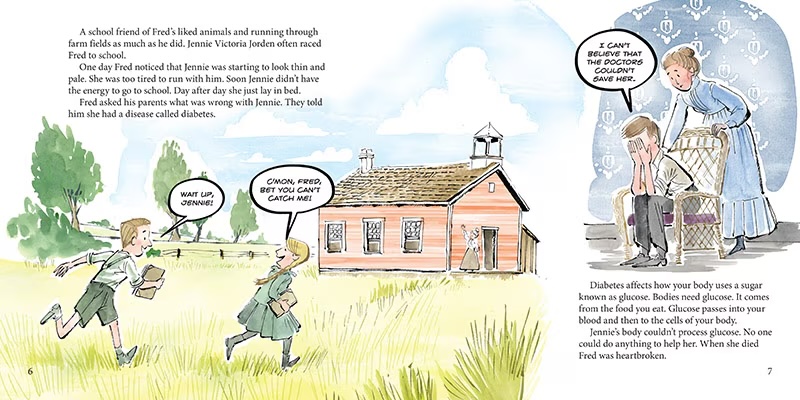
Living on a farm at the turn of the twentieth century would have been fairly typical though Fred was encouraged early on to really study the animals to help determine why they were sick and how to help them get better. However, it was his friendship with Jennie Victoria Jorden, a young diabetic, that probably was most critical to compelling him to consider why diabetics got sick and died and how he might help them.
From Meet Frederick Banting, written by Elizabeth MacLeod, illustrated by Mike Deas
At university, Fred studied medicine and, after working as a doctor in Britain and France during World War 1, he returned to Canada and started a family practice in London, Ontario. He also taught at the nearby university, and it was during his prep for an upcoming lecture on the pancreas, which was known to be involved with diabetes, Fred had an important realization. He took his idea to a professor at the University of Toronto who provided him with a lab and assistant, Charles Herbert Best. Their research into isletin which was renamed to insulin is well established, and the accolades he received, along with others, are firmly rooted in the history books.
From Meet Frederick Banting, written by Elizabeth MacLeod, illustrated by Mike Deas
But Elizabeth MacLeod tells us more about the man and his nature beyond his discovery. He didn't want to make money from his discovery and sold the rights to make the medicine for a single dollar. When he won the Nobel Prize in 1923, he split his prize money with Charley Best. And he continued to work for others, opening a diabetic clinic and helping the Canadian government by conducting research during World War 2. This extraordinary man lived a life of service and Elizabeth MacLeod makes sure to tell his story more completely. (She includes a timeline of his life at the conclusion of her story.)
 
The reason I love the Scholastic Canada Biography books is because I always learn something new. Elizabeth MacLeod goes beyond the obvious or the known and gives us a fuller picture of the individual. Here, Frederick Banting becomes a humanitarian and a researcher, more than just a Nobel Prize laureate or a celebrity to be lauded on a Walk of Fame, though he is both of those. And she tells his story with passion and directness, probably not unlike the man. This is his story and his life, and Elizabeth MacLeod tells it effectively for her audience.
 
That simplicity of message comes through in Mike Deas's illustrations that look like they were effortlessly created, but they are far more than just sketches. In a complex process of creating sketches digitally, with a Wacom tablet and Photoshop, Mike Deas traces them onto watercolour paper and then applies gouache and watercolour paints before using black ink to finish the illustration. But with that process, Mike Deas creates art that is both direct and detailed, has heart and authenticity, and is perfect for a story of a selfless man who worked to help others and not enrich his own life with money or accolades. 
 
Meet Frederick Banting may take longer than a single minute of recounting history, but Frederick Banting deserves more, and Elizabeth MacLeod and Mike Deas have given his legacy that which he is due. They have relayed to young readers that he was a great man and that all his work justifiably earned him the recognition as a great Canadian.
 
• • • • • • •

I know that readers always like to check out more of these books so here is a smattering of volumes from the Scholastic Canada Biography series:
 
Meet Viola Desmond (2018)
Meet Chris Hadfield (2018)
Meet Tom Longboat (2019)
Meet Elsie MacGill (2019)
Meet Willie O'Ree (2020)
Meet Terry Fox (2020)
Meet Thérèse Casgrain (2021)
Meet David Suzuki (2021)
Meet Mary Ann Shadd (2022)
Meet J. Armand Bombardier (2022)
Meet Buffy Sainte-Marie (2023)
Meet Jim Egan (2024) 
Meet Frederick Banting (2025)

May 23, 2023

Gnome is Where Your Heart Is

Written by Casey Lyall
Greenwillow Books (Imprint of HarperCollins)
978-0-06-323982-1
304 pp.
Ages 8-12
May 2023

You believe in aliens, right? Lemon Peabody certainly does, and she's determined to prove that her Grandpa Walt was telling the truth when he claimed he'd met one named Gnemo over thirty years ago. In fact, she's so sure that she's making Project Validation her summer project, even if she must hide it from her father Patrick, a true non-believer, who was humiliated by his father's claims, especially when everyone in the town started putting out green-faced, red-capped garden gnomes. Now, Lemon's parents are insisting that she partake in a normal activity for the summer. So, she and her best friend Marlo join the Junior Forest Rangers because it offers her the opportunity to investigate the very woods where Grandpa famously met Gnemo and chatted with her.

Unbeknownst to Lemon, the Gnar Five, a ship of the Interplanetary Natural Archives Alliance is out on a mission when forced to land on the Isolated Community of IC 525-1 a.k.a. Earth, a planet with restricted access. As Chief Gneelix tries to repair their ship, Captain Gnemo, Commander Gnilsson, Doc Gnog, and Ensign Gnedley attempt to stay under cover of their shields and follow protocols. But the Captain can't inform HQ of their situation because their external comms are down. And though Ensign Gnedley knows he's supposed to follow the emergency measures handbook, he'd joined the Alliance to see the universe. After all, Commander Gnilsson was able to go out and investigate, even returning with a miniature gnome statue that he is convinced speaks to an encounter with the locals, strictly against protocols.  

As Lemon and Marlo and their new friend Rachel, a science fan, pursue the clues to find evidence of the aliens and maybe even meet one, thus vindicating Walt, Lemon knows time is running out. Her grandfather's Alzheimer's is slowing making him more forgetful and agitated, and Lemon would do anything to help him. But Gnedley has his own problems, knowing that he's been seen by the Humans and worried that Captain Gnemo may be hiding a secret. Can both alien and human help each other?
 
Casey Lyall has always given us a good mystery in her Howard Wallace P. I. middle-grade novels and humour in her picture books Inky's Great Escape and A Spoonful of Frogs but in Gnome is Where Your Heart Is she blends that humour with some sci-fi and a solid intergenerational relationship that warms the heart. Gnome is Where Your Heart Is feels like E.T. meets Cocoon meets Star Trek. There's a crew of interplanetary travellers, with a clever captain, a right-hand commander, an acerbic engineer, and an inexperienced ensign. There's a child trying to help their grandparent against their parents' wishes. And there's a trio of friends investigating alien activity. There's fun and wit and angst and resolution. Best of all, there's humour. From the cheeky Gneelix–who, when asked for more power, suggests "Should I get out and push?"–or the irritated Marlo–"Tell me why you broke into my room at rude o'clock in the morning"–there is honest but saucy humour. But could we expect anything less in a story with gnome-looking aliens, magic mushrooms, and scrummy marshmallows? I think not.

For middle-graders who enjoy speculative fiction firmly based in the reality of family and friends, albeit with a cloud of Alzheimer's, and told with humour, distinct characters–both human and not–and the buzz that comes with the unknown, Gnome is Where Your Heart Is checks all the boxes for a lively summer read.