Showing posts with label concept book. Show all posts

July 09, 2026

Cat Shapes

Book cover of "Cat Shapes" by Aidan Cassie shows a cat peeking out of the top of a box
Written and illustrated by Aidan Cassie
Kids Can Press
978-1-5253-1327-1
24 pp.
Ages 1–3
June 2026 
 
Aidan Cassie recognizes that cats can be very different, but she means more than just their sizes, colours, and personalities. Because cats are so curious and playful, they can also produce wonderfully eclectic shapes.
Six different cats swirl
From Cat Shapes, written and illustrated by Aidan Cassie
Aidan Cassie, known for her charming picture books Sterling, Best Fork Dog Ever (2018) and Little Juniper Makes It Big (2019), seems to know cats well. She knows the curious ones who can jump in boxes and take on the shape of a square. She knows that a hungry one may want to jump into a goldfish bowl and become the shape of a circle. There's a fancy cat, a thirsty cat, a sneaky one, and a sleepy one too. And each one becomes the shape of what it enters. But Aidan Cassie knows the best shape that cats become, as do all cat lovers.
An orange cat peers into an empty cardboard box
From Cat Shapes, written and illustrated by Aidan Cassie

An orange cat squeezes into a square box
From Cat Shapes, written and illustrated by Aidan Cassie
Many concept books—those that teach a simple concept like letters, numbers, or colours—can become formulaic. Sometimes the author has a theme and wants the concept to fit into that theme. But Aidan Cassie does not do this. Cat Shapes is more than a book about shapes. Children will learn the basic shapes of square, circle, triangle, oval, rectangle, diamond, and more, but, because it's all based on the silly behaviours of cats, Cat Shapes does more than teach a concept. It delights with its authenticity and humour, speaking to cat lovers young and old. 
A hungry cat eyes a goldfish swimming in its fishbowl
From Cat Shapes, written and illustrated by Aidan Cassie
Aidan Cassie's previous books have shown us the breadth of her illustrative style, but she's matched her digital artwork perfect to a concept book for very young children. There are just enough details to set the scene, whether it's a hungry cat eyeing a goldfish or one hiding in a drawer, so that little ones know what's going on. Even if they don't have cats, young readers will be able to look for the shapes in familiar settings and start to understand why cats do what they do. Cat Shapes may be about identifying common shapes but it's also a quick lesson in cat behaviour.
 
I wonder if the six distinct cats in Aidan Cassie's book are the same six that she names in her dedication because they are so unique. If so, I suspect she's seen a lot of adorable cat action over the years. With Cat Shapes, those cats can now add educators and shape-masters to their accomplishments. Of course, I always knew cats were clever. Cat Shapes just proves it.

June 03, 2026

Stella and Sam ABC

Book cover of "Stella and Sam ABC" by Marie-Louise Gay shows two children and their dog on a beach
Written and illustrated by Marie-Louise Gay
Groundwood Books
978-1-77946-067-7
34 pp.
Ages 0–3
May 2026 
 
This is not just another alphabet book. It's Stella and Sam, Marie-Louise Gay's wonderful siblings from countless books including Read Me a Story, Stella (2013), Stella, Princess of the Sky (2004), and Good Night Sam (2003). Together they share, explore, learn, and bond. Now they're helping others learn the alphabet through their relationship and joyous romps through play.
Illustration from "Stella and Sam ABC" shows two children making snow angels
From Stella and Sam ABC, written and illustrated by Marie-Louise Gay
From apple picking to 
moon-watching to 
exploring the jungle
every day is a new adventure 
for Stella and Sam. 
Do you want to join them? Let's turn 
the page!
With that first page, Marie-Louise Gay invites us to watch the two children as they play through the seasons. In winter, there's angel-making, ice-skating, and night-time dreaming ... with owls hooting. In the summer, there's fishing and vegetable gardening. And there's always fun in the house like hiding and seeking, reading, rolling and somersaulting, as well as yawning together (Sam and Fred the dog) before falling asleep. These children do so much that I suspect Marie-Louise Gay could write multiple alphabet books for Stella and Sam.
Illustration from "Stella and Sam ABC" show two children jumping and jiggling like rabbits
From Stella and Sam ABC, written and illustrated by Marie-Louise Gay
Whether together or off on their own, everything they do gives us new letters to learn, new words to identify, and new qualities to fall in love with. Stella and Sam are filled with joy, whether it's watching the moon, bathing with rubber duckies, or slurping some tasty treat. There are nouns and verbs, sounds and more. Marie-Louise Gay shows us that these kids are into everything, both remarkable and ordinary.
Illustration from "Stella and Sam ABC" shows a boy looking for his dog in the tall grass
From Stella and Sam ABC, written and illustrated by Marie-Louise Gay
Young children will definitely learn the alphabet as they read along with Stella and Sam ABC, but they'll also be learning to read. The words are simple and will be meaningful to children. Stella and Sam's activities and actions will all be familiar, and easily replicated which will strengthen young children's learning. And because Marie-Louise Gay always gives us more to love in her art, like hiding rabbits, a stray sock, or a hitchhiking snail, children will be pointing and finding and laughing as they learn.
 
It's so lovely to visit with Stella and Sam again. Even though Marie-Louise Gay has continued to give young readers fabulous picture books (e.g., Short Stories for Little Monsters, 2017); The Three Brothers2020; and I'm Not Sydney!, 2022) even early chapter books, I've missed Stella and Sam (and Fred too). They are sweet and true. They are delightful to watch in their relationship and in their play. They are different and yet similar in their dispositions—their parents or guardians must be extraordinary—and I want more of Stella and Sam. Please. After all, there is still so much of their world to explore—exploring is the x word, as you were probably wondering—and to see through their eyes and their hearts.

February 02, 2026

It's a Mitig!

Written and illustrated by Bridget George
D & M Kids (Douglas & McIntyre)
978-1-771-624817
32 pp.
Ages 3–5
January 2026 
 
Giizis is rising, the day is brand new.
Let's learn some words nature's gathered for you. (pg. 3)
 
So begins Bridget George's It's a Mitig!, a picture book originally published in 2020 and now available as a board book, perfect for a concept book for teaching Ojibwe (Anishinaabemowin) words. 
 
With the rising of the sun (giizis), readers are taken from place to place to meet a variety of animals and plants. From the ashigan (bass) to the gaag (porcupine), Bridget George introduces Ojibwe words. She never uses the words "sun" or "bass" or "porcupine" but the children to whom the text is read will put the visual and textual clues together and determine what these new words mean. And, because she uses short rhyming verse, Bridget George makes the text playful and easy to remember. Moreover, her text is always informative and clear in evoking the name of each subject. For example, the text for a bird tells the reader that, "This animal whistles and lives in a tree. Building a nest, it's a bineshiinh." (pg. 11) Bineshiinh is obviously the Ojibwe word for "bird."
From It's a Mitig!, written and illustrated by Bridget George
Though Bridget George's digital illustrations in The Animals Choose a Leader (written by Richard Wagamese, 2024) and  The Inquisitive Raven (also by Richard Wagamese, 2025) are of a Woodland style, her artwork in It's a Mitig! is less defined as of an Indigenous art style. However, this Anishinaabe author-illustrator continues to embed readers fully in the natural world of trees and acorns, rivers and fish. By pairing new words with familiar natural elements like the moon (dibiki-giizis) or a river (ziibi), Bridget George teaches twelve Ojibwe names with informative and bright art.
From It's a Mitig!, written and illustrated by Bridget George
While the original book includes a glossary page with a pronunciation guide, these are not included in this edition of It's a Mitig! But, for a concept book, they are not really necessary. This is a board book, so most likely read by an older reader to a young child. Those to whom the book is read will pick up on the words by listening and looking at the pictures, not by reading them themselves. And they will learn these words. Whether these children are Anishinaabe or not, there will be learning of new words, and it will happen with colour, bright shapes, and descriptive rhyme.
From It's a Mitig!, written and illustrated by Bridget George

January 17, 2026

Oakley's Great Canadian Adventure (The Secret Lives of Squirrels)

Written and illustrated by Nancy Rose
Nimbus Publishing
978-1-77471-468-3
32 pp.
Ages 4–9
October 2025 
 
Nancy Rose has been telling stories with her red squirrel friends for almost a decade, with Oakley appearing about five years ago to help teach concepts of letters and numbers (Oakley the Squirrel: The Search for Z: A Nutty Alphabet Book [2021] and Oakley the Squirrel: Camping 1, 2, 3!: A Nutty Numbers Book [2023]). Now Oakley is ready to take on the country of Canada and see what it has to offer.
From Oakley's Great Canadian Adventure, written and illustrated by Nancy Rose
In defined double-page presentations of an illustration based on a photographed diorama opposite a page of text titled with the province or territory visited, a quaint verse about Oakley's experience, and an info box of additional details, Nancy Rose takes her sciurine friend cross-country. Readers are taken from east to west and then north to ensure all areas are represented.
From Oakley's Great Canadian Adventure, written and illustrated by Nancy Rose
Oakley visits tourist attractions like the lighthouse at Peggy's Cove, Hopewell Rocks in New Brunswick, and the Badlands of Drumheller. He builds an igloo in Nunavut, goes on a polar bear tour in Churchill, and hikes the trail in Cathedral Grove in British Columbia. He sees and does a lot, and young readers will learn about the diversity of landforms, flora, fauna, weather, and adventures to be had across Canada. But also important are the notes Nancy Rose always adds about the Indigenous Peoples of the province or territory, and some history of the land and its people. As an introduction to Canada, Oakley's Great Canadian Adventure is rich in content and curious in its presentation.
From Oakley's Great Canadian Adventure, written and illustrated by Nancy Rose
Often called "the squirrel lady" because of her viral photos of squirrels, Nancy Rose has segued that venture into telling stories with her elaborate outdoor dioramas. She creates them with found materials and entices her friend Oakley—earlier it was Mr. Peanuts from The Secret Lives of Squirrels (2016)—with peanuts. By blending her crafting and photography interests with the natural world, Nancy Rose has given us a series of whimsical stories and concept books that will attract young readers and, here in Oakley's Great Canadian Adventure, teach them about our country.
From Oakley's Great Canadian Adventure, written and illustrated by Nancy Rose
  

September 22, 2025

The Case of the Tagalong Twin (A Gumboot Kids Nature Mystery)

by Eric Hogan and Tara Hungerford (Gumboot Kids Media)
Firefly Books
978-0-2281-0570-1
32 pp.
Ages 3–8
September 2025
 
Scout and Daisy, characters of multiple TV series starring The Gumboot Kids, are off exploring the outdoors yet again and learning about new science concepts. In The Case of the Tagalong Twin, Scout and Daisy have a new mystery to solve and, only by working through a number of clues, will they understand what they are actually seeing.
From The Case of the Tagalong Twin by Eric Hogan and Tara Hungerford
Daisy tells Scout that on her walk over to his place she'd noticed something very odd. She'd noticed someone following in sync alongside her. Scout calls this her tagalong twin and the two retrace her steps to try to solve the mystery of this twin. Even though they don't see this twin on their walk, Scout and Daisy peruse her field notes for clues she may have noticed. Even putting together the clues of the sun, the sidewalk, and Daisy herself, they can't replicate Daisy's tagalong twin. But when the clouds part and the sun shines again, both Daisy and Scout discover they have tagalong twins that show up on the sidewalk.
From The Case of the Tagalong Twin by Eric Hogan and Tara Hungerford
At the library, they discover a science book that teaches them about shadows and how they are formed. 
From The Case of the Tagalong Twin by Eric Hogan and Tara Hungerford
For young children, the concept of shadows and how and when they are created is a complex one. They may or may not notice them—helping children use their senses to make observations is an important part of The Gumboot Kids mysteries—but when they do, they will also notice that shadows don't always appear, that they may change size and shape, and that even lamp lights can produce them. (The appended "Field Notes" will help kids discover more about shadows, as well as introduce them to new words like opaque and light source.) The Gumboot Kids creators Eric Hogan and Tara Hungerford know how to blend science concepts like shadows (or spider webs, tides and woodpeckers) into easy-to-understand terms for young children. And with adorable, felted mice in three-dimensional landscapes—incredibly detailed with tea cups, flowerpots, quilts and books—learning about shadows is easy, engaging, and informative. With Eric Hogan and Tara Hungerford's supplementary notes and a nature craft, The Case of the Tagalong Twin becomes a STEM concept book as well as an art lesson all embedded in a story.
From The Case of the Tagalong Twin by Eric Hogan and Tara Hungerford
Kindergarten and primary elementary teachers would be wise to pick up all the books in The Gumboot Kids Nature Mystery series. (I've posted a list below.) Whether as a lesson starter or a read-aloud, these books will allow teachers to engage children and get them to see their world with new eyes, and nose, and ears... And with their textured, 3D artwork, and tie-in to a popular TV series, The Gumboots Kids will make discovery-based learning the norm for STEM education.
 
 • • • • • • •
 
The Gumboot Kids Nature Mystery series:
The Case of the Vanishing Caterpillar (2019)
The Case of the Story Rock (2019)
The Case of the Wooden Timekeeper (2019)
The Case of the Growing Bird Feeder (2019)
The Case of the Singing Ocean (2020)
The Case of the Buzzing Honey Makers (2020)
The Case of the Shrinking Friend (2021)
The Case of the Hanging Food Catcher (2021) 
The Case of the Tagalong Twin (2025)
The Case of the Buried Treasure (2025) 

September 19, 2025

I'm Longer Than You!: An Epic Contest of Measurement

Written and illustrated by Carolyn Fisher
Kids Can Press
978-1-5253-1294-6
48 pp.
Ages 5–8
September 2025 
 
With school just getting back into the swing of things, I've been on a bit of a non-fiction run lately. But there's so many wonderful books out there, for different young audiences, to inform and entertain that there is no shortage of new books to review. I'm Longer Than You is a different kind of math picture book in that it focuses on measurement and comparisons for the early reader kids at school i.e., Kindergarten to Grade 3.
From I'm Longer Than You!, written and illustrated by Carolyn Fisher
In Carolyn Fisher's new picture book—she has previously illustrated a number of books for others like Summer Feet and Weeds Find a Way, as well as written and illustrated her own including Cells: An Owner's Handbook—a Supersaurus dinosaur and a blue whale argue about which animal is the longest. What's the easiest way to determine who's right? An inchworm suggests measuring them. So, the little worm gets to work.
From I'm Longer Than You!, written and illustrated by Carolyn Fisher
But after 12 hours of measuring the blue whale–it's 1300 inches long—it's time for it to pupate and leaves the two competitors at a loss. In comes the centipede who measures exactly one centimeter. Now the Supersaurus and the blue whale, salivating for the lunch the winner would get, wait for the centipede to do its work. Twelve hours later, the Supersaurus is also measured but in centimeters. With a little math and conversion between units, the contest is resolved.
From I'm Longer Than You!, written and illustrated by Carolyn Fisher
What a fun way to introduce measurement, systems of measurement, comparison and conversion between units! Carolyn Fisher has found a way to tell a story—and a funny one at that with the contest between two humongous animals—and introduce several math concepts that might be hard to grasp easily. Measuring is a complex concept, and she takes it from its most basic, i.e., how to measure, through the different ways people measure things and what units to use and then to conversion. As such, I'm Longer Than You! can be used for our youngest readers just being introduced to units of measurement to middle graders who are learning conversion.
From I'm Longer Than You!, written and illustrated by Carolyn Fisher
As a non-fiction book, I'm Longer Than You! is anything but dry. It's educational but quirky in its delivery of information. With her illustrations which are hand-drawn on a tablet, Carolyn Fisher makes this a true picture book, albeit an information book embedded in a story. Her art is colourful and bold, and the organization of information, whether it's the true rendering of the inchworm and centipede's sizes or the decision tree to pick appropriate units based on size—after all, using an inchworm or a centipede for these enormous animals was unwieldy—is accessible and presented with clarity and playfulness.
 
I know primary teachers will love using this book to introduce the concept of measurement, but it will be an entertaining starter for any lessons on measurement. Kids will love the contest and comparing animals—this could be a great scaffolding story for lessons on the diversity of living things—but they'll get a fabulous introduction to measurement and some related math concepts like conversion between metric and imperial units. It's a win-win for the Supersaurus, the blue whale, and the kids who get to read or hear the story in I'm Longer Than You!

March 19, 2025

Ins and Outs

Imagined by Elizabeth Withey
Illustrated by Salini Perera 
Orca Book Publishers
978-1-4598-3835-2
32 pp.
Ages 3-5
March 2025 
 
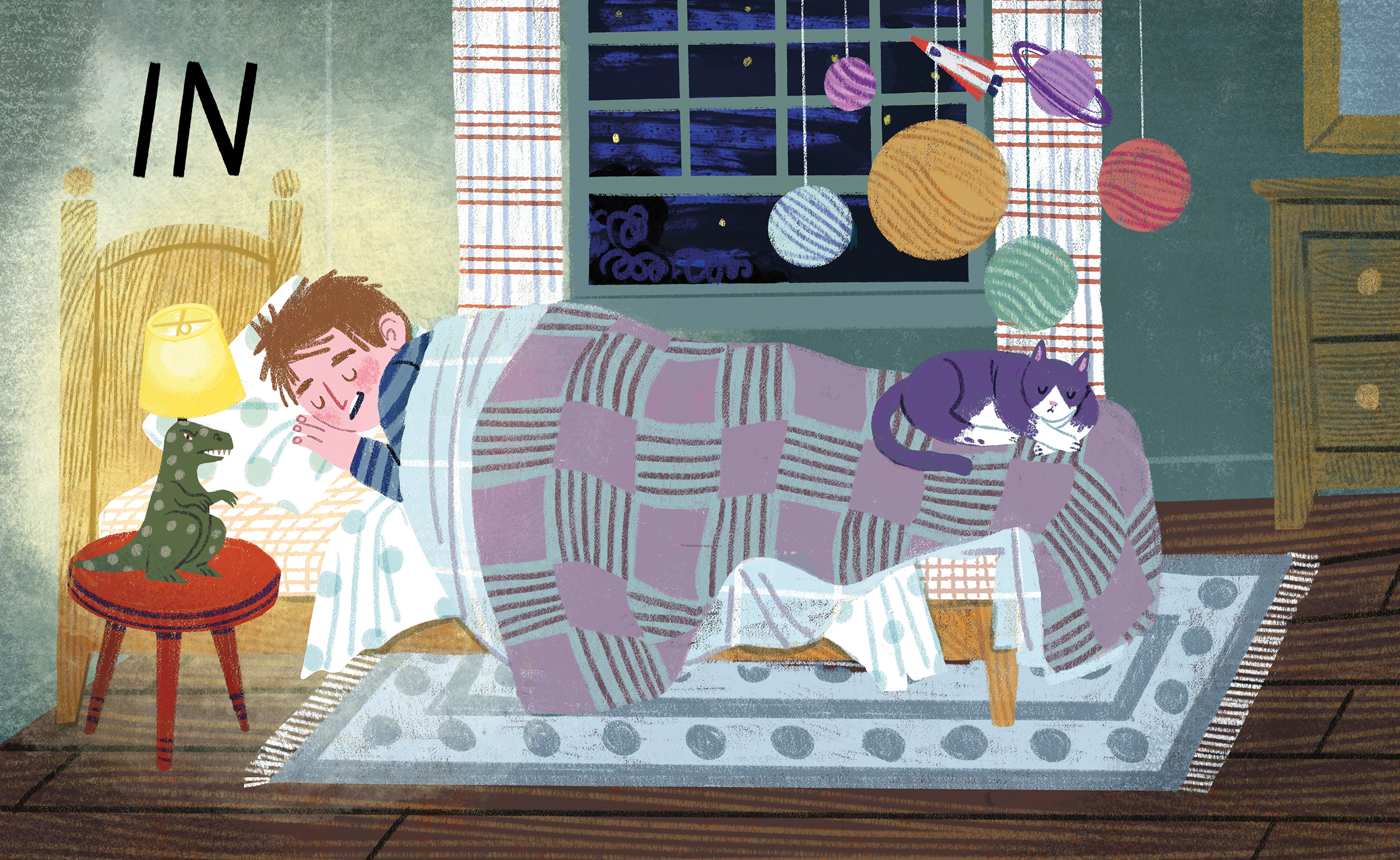
You'll notice that, instead of indicating Elizabeth Withey as the author above with the words "Written by," I've repeated the words "Imagined by" as they appear on the front cover of Ins and Outs. This is because Ins and Outs is primarily a concept book that reinforces the idea of positioning i.e., being in and out. The text is limited to two words: "in" and "out." But Elizabeth Withey, a Calgary author, journalist and visual artist, doesn't need more words. She has envisioned fabulous pairings of circumstances that many children will recognize to easily pick up on the concepts of in and out.
From Ins and Outs, imagined by Elizabeth Withey, illustrated by Salini Perera
The first combination of in and out involves a child snug in bed, in the house, while outside the bedroom window a cat prowls in the dark and a luna moth takes flight. From a school yard to cycling on the street, playing in a garden or with a playground parachute, a diverse group of children show things that happen outside and inside, and in and out of a wide variety of places and things.
From Ins and Outs, imagined by Elizabeth Withey, illustrated by Salini Perera
Elizabeth Withey gives young children many opportunities to grasp the concept of "in" and "out" from both obvious and not-so-obvious scenarios. The "inside" and "outside" are the obvious like the children who are standing outside the school or the cat that exits the bedroom to head outside. But Elizabeth Withey has also imagined cold breath going in and condensed exhalation going out, and a nail in the road that will soon be "in" a bike tire and allow air out. The use of a hearing aid to allow sound in and the use of sign language to allow words out is a one of the most thought-provoking of circumstances. As such, the learning of the concept of in and out becomes an interactive read with every double-page spread offering chances to find more and more examples than the most obvious.
From Ins and Outs, imagined by Elizabeth Withey, illustrated by Salini Perera
Because the text is so sparse, the illustrations must provide much of the basis for the learning of the concept, and artist Salini Perera's digital illustrations provide that basis handsomely. She ensures that the big idea of "in" or "out" is evident but then provides little details that enhance the messaging about the concept. With art lively both in content and form, Salini Perera, whose illustrations were reviewed in Beautiful You, Beautiful Me, helps children see the ins and outs of our world.
From Ins and Outs, imagined by Elizabeth Withey, illustrated by Salini Perera
It's different to read a concept book that isn't a board book, especially one that focuses on such a basic concept. But I guess all concepts are basic until you understand them.  Still, Elizabeth Withey and Salini Perera have imagined a refreshing way to teach the idea of position and get children to think even more deeply about how it can be demonstrated in the most unusual of activities.

November 21, 2024

Folk Art Animal Sounds

Artwork by Barry Colpitts
Words by Carol McDougall and Shanda LaRamee-Jones
Nimbus Publishing
978-1-77471-334-1
26 pp.
Ages 0-2
October 2024
 
Like their earlier board books Maud Lewis 1 2 3 and Maud Lewis Colours, authors Carol McDougall and Shanda LaRamee-Jones base their concept books on the art of the East Coast, bringing culture and colour to teaching numbers, colours or, as here, animal sounds. This time the illustrations are the art of Nova Scotian folk artist and carver Barry Colpitts.
From Folk Art Animal Sounds, artwork by Barry Colpitts, text by Carol McDougall and Shanda LaRamee-Jones
Thirteen animals are depicted in simple double-spreads that focus on a carving, the animal's name, and the sound it makes. The animals include the rooster, pig, fox, goose, cat, fish, eagle, cheetah, sheep, peacock, bear, dog, and whale. While the text is rudimentary–it is a concept book–there are a few less familiar sounds like those for the fox, peacock, and whale. And though the sounds themselves are depicted in large and boldly coloured letters, the stars of the book are the folk carvings of Barry Colpitts.
From Folk Art Animal Sounds, artwork by Barry Colpitts, text by Carol McDougall and Shanda LaRamee-Jones
Barry Colpitts's sculptures are joyous in their colours and shapes. The animals are easily recognizable and adorably cute, especially when he adds secondary animals to their backs. For example, the dalmatian has a cat on its back which in turn has a bird on its back. Barry Colpitts keeps the colours of the animals both realistic and fanciful, helping young children to both recognize the creatures and be amused by them.
From Folk Art Animal Sounds, artwork by Barry Colpitts, text by Carol McDougall and Shanda LaRamee-Jones
Folk Art Animal Sounds is a unique concept book, teaching young children the sounds that animals make. The text is simple and will be easily repeated and then read by preschoolers.  But, beyond the animal sounds, Folk Art Animal Sounds builds on the folk art collection of Barry Colpitts and exposes very young kids to a traditional art form. The book is as beautiful as any coffee table book about art, and I suspect art lovers will enjoy it as much as the children learning the utterances of familiar animals.

July 19, 2024

Bunny Loves Beans

Written by Jane Whittingham
Pajama Press
978-1-77278-301-8
24 pp.
Ages 2-5
April 2024
 
Concept books tend to be simple because they are trying to push learning of a new concept like the alphabet or numbers. But Jane Whittingham has taken concept books to a new level with Bunny Loves Beans, giving our young children a book about colours, foods, and animals. And it's all told with loads of bold and colourful photographs. Bunny Loves Beans, in Pajama Press's trademark padded hardcover with rounded corners and extra-heavy paper, will be a pleasure to read over and over and over again as those little ones learn new concepts and become encouraged to read for themselves.
From Bunny Loves Beans by Jane Whittingham
 In a series of double-page spreads of photographs of animals and children with foods, Jane Whittingham, whose earlier picture books include Wild One, Queenie Quail Can't Keep Up and A Good Day For Ducks, introduces a colour, always in bold font, and an animal, also in bold font, before connecting to the child, with the emphasis on the word "me." The pattern to the text, as well as the emphasis on only colours, the animal and the child will allow the young reader to pick up on the concepts being introduced so that they may ultimately connect words they hear with words they see. It's very clever and multilayered without the confusion that can arise with melding too many concepts together. Moreover, by using sensory words with which children will be familiar, like sweet, crunchy, squishy and drippy, the concept learning becomes even better embedded.
From Bunny Loves Beans by Jane Whittingham
The colours taught are orange, gold, white, black, pink, yellow, blue, red, and green, and the animals associated with the foods of those colours are the groundhog, bee, monkey, fox, puppy, parakeet, chipmunk, pony, and bunny. With an overlying message of healthy food being colourful and good for everyone, Jane Whittingham's Bunny Loves Beans teaches a lot.
Healthy colors,
vibrant colors,
Yummy in my tummy colors– 
Colors for the animals,
And colors for me!
From Bunny Loves Beans by Jane Whittingham
Bunny Loves Beans is a great introduction to colours and foods and to show children that they are connected to other animals who also partake in those healthy foods. Better yet, even if the child can't read yet, the learning can be reinforced independently by using the endpapers which depict various colours with foods, some in addition to those in the main text, to help them make those same connections. Bunny Love Beans will teach the concepts but also encourage little ones to start reading by making connections with words, colours, foods, and animals, and always relate it back to them. If they didn't like beans or carrots before, they might just want to eat them now.

April 15, 2024

A Flock of Gulls, a Chorus of Frogs


Art by Roy Henry Vickers
Text by Robert "Lucky" Budd
Harbour Publishing
978-1-990776502
28 pp.
Ages 2-6
April 2024 
 
Roy Henry Vickers and Lucky Budd have taken young children on learning experiences into the natural world along the Pacific coast through their First West Coast Book series since 2017. Through colour and rhyme, shape and textured words, kids have been introduced to the concepts of the alphabet (A is for Anemone), animal sounds (Raven Squawk, Orca Squeak), numbers (One Eagle Soaring), colours (Sockeye Silver, Saltchuck Blue) and more. Now they will graduate to a higher concept, that of animal groupings, something with which many adults still struggle to name correctly. (FYI, it's a clowder of cats, and a murder of crows, just to name a few.) But Roy Henry Vickers and Lucky Budd keep us on the West Coast to revisit many animals they'd introduced in earlier books. 
From A Flock of Gulls, a Chorus of Frogs, art by Roy Henry Vickers, text by Lucky Budd
In easy rhyme, Lucky Budd gives us the terms for groups of orcas and seals, jellyfish and eagles, elk and foxes. They are animals of the air, of the water and of the land.
A jumble of jellies is called a bloom.
Shoals of dolphins zip and zoom.
The words are few, perfect for a concept book, with the grouping name in bold text for easy spotting. And yet, even with few words, Lucky Budd gives us movement and spirit. He carries us to play with the sea otters and fly with the gulls and geese. The text is truly evocative of a natural setting teeming with life, even quiet, resting life. And we learn.
From A Flock of Gulls, a Chorus of Frogs, art by Roy Henry Vickers, text by Lucky Budd
As always, it's Roy Henry Vickers's art that elevates the amazing text to the divine. With limited colours and spot-gloss in each spread, Roy Henry Vickers's takes us to a natural world of beauty and relationship, between environment and animal. His Northwest Indigenous art style is rich with formlines that give shape to heads and tails, wings and appendages. Even when those lines are at their simplest, as in the earth of foxes or the galaxy of sea stars, they hold forms that are distinct and evocative of heart.
From A Flock of Gulls, a Chorus of Frogs, art by Roy Henry Vickers, text by Lucky Budd
This may be a board book and a concept book that is aimed at our youngest children, but A Flock of Gulls, a Chorus of Frogs could more accurately be intended for all ages. Its small size may disqualify it as a coffee table book but, between the information that is relayed through simple rhyme and the expressive illustrations that exhibit page after page of incomparable art, this book could easily spark discussion and uplift a room or library beyond a lovely teaching tool.

• • • • • • •

First West Coast Book series, to date

June 14, 2023

Maud Lewis Colours

Artwork by Maud Lewis
Words by Shanda LaRamee-Jones and Carol McDougall
Nimbus Publishing
978-1-77108-878-7
24 pp.
Ages 0-4
June 2023

Concept books such as this one are created to help teach our very young children basic concepts like colours and numbers. The vehicle by which that teaching happens is what separates the basic from the sublime. With the artwork of Canadian folk painter Maud Lewis providing the foundation for this board book, concept teaching goes from elemental to elevated.
From Maud Lewis Colours, art by Maud Lewis, words by Shanda LaRamee-Jones and Carol McDougall
Maud Lewis's life in rural Nova Scotia was one of hardships and isolation. But her art was joyous and that's what is seen in Maud Lewis Colours. Because the artist used whatever paint she could scrounge up, her colours are intensely vibrant but harmonious in a balanced way. It's the kind of art that will captivate children while teaching them white, red, orange, yellow, green, blue, pink, purple, brown, and black. For each colour, one of Maud Lewis's paintings is displayed with text printed on the opposite page of contrasting colour.  Nova Scotian writers Shanda LaRamee-Jones and Carol McDougall had a great number of pieces of art from which to choose because all Maud Lewis's are colourful, but the authors' selections ensured a wonderful cross-section of her art. There are landscapes of purple hills, green grass and blue water, many animal paintings from a white cat to brown oxen and yellow birds, and wagons, sleighs and even a Model T car. There's a little bit of everything but mostly a lot of boldness of paint–appropriate for a concept book on colours–and a celebration of Nova Scotia from both the past and the present.
From Maud Lewis Colours, art by Maud Lewis, words by Shanda LaRamee-Jones and Carol McDougall
I know Maud Lewis Colours is a concept book for very young children but for when they're a little older and for those who share it with them, it is also a beautiful introduction to a Canadian artist–there is a double spread dedicated to "one colourful artist" with information about her–and an invitation to see colour in their own lives.
From Maud Lewis Colours, art by Maud Lewis, words by Shanda LaRamee-Jones and Carol McDougall

 
There is an earlier book, Maud Lewis 1, 2, 3 (Nimbus, 2017), that would be a fitting accompaniment to Maud Lewis Colours for teaching basic but colourful concepts.
Maud Lewis 123 (Nimbus, 2017)
Maud Lewis Colours (Nimbus, 2023)