Showing posts with label Anishinaabe. Show all posts

February 02, 2026

It's a Mitig!

Written and illustrated by Bridget George
D & M Kids (Douglas & McIntyre)
978-1-771-624817
32 pp.
Ages 3–5
January 2026 
 
Giizis is rising, the day is brand new.
Let's learn some words nature's gathered for you. (pg. 3)
 
So begins Bridget George's It's a Mitig!, a picture book originally published in 2020 and now available as a board book, perfect for a concept book for teaching Ojibwe (Anishinaabemowin) words. 
 
With the rising of the sun (giizis), readers are taken from place to place to meet a variety of animals and plants. From the ashigan (bass) to the gaag (porcupine), Bridget George introduces Ojibwe words. She never uses the words "sun" or "bass" or "porcupine" but the children to whom the text is read will put the visual and textual clues together and determine what these new words mean. And, because she uses short rhyming verse, Bridget George makes the text playful and easy to remember. Moreover, her text is always informative and clear in evoking the name of each subject. For example, the text for a bird tells the reader that, "This animal whistles and lives in a tree. Building a nest, it's a bineshiinh." (pg. 11) Bineshiinh is obviously the Ojibwe word for "bird."
From It's a Mitig!, written and illustrated by Bridget George
Though Bridget George's digital illustrations in The Animals Choose a Leader (written by Richard Wagamese, 2024) and  The Inquisitive Raven (also by Richard Wagamese, 2025) are of a Woodland style, her artwork in It's a Mitig! is less defined as of an Indigenous art style. However, this Anishinaabe author-illustrator continues to embed readers fully in the natural world of trees and acorns, rivers and fish. By pairing new words with familiar natural elements like the moon (dibiki-giizis) or a river (ziibi), Bridget George teaches twelve Ojibwe names with informative and bright art.
From It's a Mitig!, written and illustrated by Bridget George
While the original book includes a glossary page with a pronunciation guide, these are not included in this edition of It's a Mitig! But, for a concept book, they are not really necessary. This is a board book, so most likely read by an older reader to a young child. Those to whom the book is read will pick up on the words by listening and looking at the pictures, not by reading them themselves. And they will learn these words. Whether these children are Anishinaabe or not, there will be learning of new words, and it will happen with colour, bright shapes, and descriptive rhyme.
From It's a Mitig!, written and illustrated by Bridget George

September 18, 2024

The Hawk Shadow

Written by Jan Bourdeau Waboose
Illustrated by Karlene Harvey
Kids Can Press
978-1-5253-1084
32 pp.
Ages 4-7
September 2024
 

When Serenity's older brother, Big Ed, decides to go fishing with his shiny new store-bought rod, she tags along with the hand-made one of spruce and moose sinew that her father has given her. But, though Big Ed is focused on the fishing he will do, Serenity's focus is elsewhere.
From The Hawk Shadow, written by Jan Bourdeau Waboose, illustrated by Karlene Harvey
As the two head out along Big Ed's fishing path to the river, Serenity revels in all the wonders of the natural world, from the sun and the singing robin, to a raven and some chokecherries. Big Ed may walk faster than Serenity but, even as she dawdles, he watches out for her. He also teaches her about their cultural beliefs from why the river is called Hawk River, the value of the cedar tree, and more.
From The Hawk Shadow, written by Jan Bourdeau Waboose, illustrated by Karlene Harvey
But when they start fishing and Serenity is distracted by a Red-Tailed Hawk that circles around her, and then leaves and returns, she realizes that he wants her to follow him. Fortunately, she does and finds that a little sister's help is needed.
From The Hawk Shadow, written by Jan Bourdeau Waboose, illustrated by Karlene Harvey
It's always a treat to read a Jan Bourdeau Waboose picture book. It's been far too long since her The Spirit Trackers (illustrated by François Thisdale) and it's lovely to revisit a sibling relationship that is embedded in an Indigenous community. The Hawk Shadow may be considered an Indigenous story–Jan Bourdeau Waboose is First Nation Anishinaabe of the Ojibway Bear Clan–but it also speaks to the interactions of an older brother and younger sister, an appreciation for the natural world, and a mindfulness to it and the messages within. Serenity is like her brother's shadow, following him, listening to his teachings, asking him questions, and ultimately freeing him from a dangerous situation. If she hadn't been mindful of him and of her surroundings, including listening to the Hawk, the siblings' outing may have had a far worse outcome. Jan Bourdeau Waboose shows us that even though  Serenity is watching and listening to everything around her, and is ostensibly distracted from her brother's words and quicker step, she is fully engaged. It's a lesson in being wholly present in place and with people.

Karlene Harvey, who has illustrated several other picture books including Melanie Florence's Kaiah's Garden, is a Tsilhqot'in and Syilx illustrator who respects the Indigenous basis for the story without highlighting any of the major styles such as the Woodland Style.  The realism of the Hawk's morphology is blended with the bold and the bright of the characters as they journey and fish but Karlene Harvey still adds light touches to remind readers of the community from which Big Ed and Serenity were born. In addition to the glorious end papers of beaded flowers, there's Big Ed's beaded bear paw medallion necklace and the bead work on Serenity's collar.
From The Hawk Shadow, written by Jan Bourdeau Waboose, illustrated by Karlene Harvey
Here's to listening, seeing, and being a part of something, whether it be a sibling relationship, the natural world, or a community. There is always much to learn and appreciate, even from the shadows.

March 13, 2023

Biindigen! Amik Says Welcome

Written by Nancy Cooper
Illustrated by Joshua Mangeshig Pawis-Steckley
Owlkids Books
 978-1-77147-515-0
32 pp.
Ages 3-7
March 2023
 
It may be a reunion of beavers, but Amik's little sister Nishiime is a little anxious. What should she expect from all these beavers coming from far and wide?
From Biindigen! Amik Says Welcome by Nancy Cooper, illus. by Joshua Mangeshig Pawis-Steckley
From the East and the far West, from the North and the South, Amik's cousins arrive and are welcomed. They bring gifts from their regions, whether a woven headband or berries in a basket, all generous and all received with gratitude. But Nishiime is nowhere to be found.
From Biindigen! Amik Says Welcome by Nancy Cooper, illus. by Joshua Mangeshig Pawis-Steckley
As the beavers go looking for Nishiime, Amik asks the deer, fish, fox, and otters if they've seen her. Though none have seen her, they all acknowledge the help that the beavers' activities have fortuitously provided them. Whether it's being able to reach the leaves of felled trees, or channels to swim in, a bridge to cross, or feeding in shallow waters created by dams, all the animals are appreciative.
From Biindigen! Amik Says Welcome by Nancy Cooper, illus. by Joshua Mangeshig Pawis-Steckley
It's not until the cousins are preparing to head home that Nishiime comes out of hiding, revealing the reason for her apprehension, and recognizing it as unfounded.

Using beavers to tell her tale, Nancy Cooper reminds us that, though we might come from different places and have different families, we are more alike than we might expect. Nishiime almost misses out on meeting her beaver cousins because of her fears; fortunately, she finally recognizes that though they might wear different markings, jewelry, and clothes, and all have different names–Amik is Anishinaabe, Amisk is Cree, Gopit is Mi'kmaq, Amicos is Algonquin, Kigiaq is Inuktitut, Qowut is Ayajuthum and Tsyennìto is Kanyen-kéha Mohawk–they are all beavers. Moreover, Amik and her family have been making everyone feel welcome, including the different species of animals. In a story about diversity and acceptance of differences, Nancy Cooper also reminds us of the interrelationship of living things. The message of connectedness and acceptance may be subtle and very organic, but it is convincing. 
 
The Woodland illustrations of Joshua Mangeshig Pawis-Steckley, an Ojibwe artist, take us into that woodland to see these stylized animals in lush beaver habitats of land and water. From forests of birch and poplar, to dammed waters below striking sunsets of orange and turquoise, the artwork of Joshua Mangeshig Pawis-Steckley, whose earlier book Mii maanda ezhi-gkendmaanh/This is How I Know made an enormous splash with its Woodland style, brings an appreciation of the natural world of the beaver and other animals. Still, Joshua Mangeshig Pawis-Steckley always reminds us with small details like beaded bracelets, a Mi'kmaq peaked cap or a medicine pouch that this is a story based in Indigenous cultures and its teachings are even more profound because of its heritage.
 
Biindigen! Amik Says Welcome is a fresh picture book in language (a glossary of Anishinaabe and other words is included) and art, and its messages about acceptance and gratitude will make it a welcome addition to any bookshelf.

April 26, 2021

Treaty Words: For As Long As the Rivers Flow

Written by Aimée Craft
Illustrated by Luke Swinson
Annick Press
978-1-77321-496-2
60 pp.
Ages 10+
March 2021

At a size of 17 cm x 12 cm (6.75" x 4.75"), Treaty Words: For As Long As the Rivers Flow is a small book. But its small size belies the depth of lesson and sharing about relationships with the land and water that Indigenous Peoples have and what a treaty really means.
From Treaty Words: For As Long As the Rivers Flow by Aimée Craft, illus. by Luke Swinson
A girl and her Mishomis (grandfather) sit by the kitchi sipi (great river), where he'd lived all his life, on the land, in the bush and on the river. Though she'd grown up in the city, she has always considered the land home. This is where he'd taught her to listen to the land and remind her of her responsibilities to it and the water and to their stories.
From Treaty Words: For As Long As the Rivers Flow by Aimée Craft, illus. by Luke Swinson
He tells her of the original treaty, with their grandfather sun and grandmother moon working with mother, the earth, to create life. The agreement to work together, known as aagooiidiwim for the Anishinaabe, is the basis for collaborations with all nations, whether deer, human or other, to ensure respect and find solutions to always honour the treaty.
From Treaty Words: For As Long As the Rivers Flow by Aimée Craft, illus. by Luke Swinson
We were given the ability to learn from our relatives on this earth about their treaty relationships and through what we call natural law, or earth's law. (pg. 50)
As I read Aimée Craft's words, I wanted to make sure that I fully respected their profound meaning, evocative of culture and history, and ever enduring. An Anishinaabe-Métis lawyer and professor from Treaty 1 in Manitoba, Aimée Craft crafts her words from a place of understanding, both of people and place and time, taking the lessons from her elders and seeing their place in making treaties then and now. The magnitude of treaty words is never in question.
This is why the Treaty is for as long as the sun shines, the grass grows, and the river flows. (pg. 23)
The reverence of Treaty Words: For As Long As Rivers Flow comes through in Aimée Craft's words, resonant and weighty, steadfast and dynamic. Luke Swinson, an Anishinaabe illustrator who is a member of the Mississaugas of Scugog Island First Nation, could have attempted to match that weightiness with complex and detailed artwork but he chose better. His lines create the necessary movement, from and to place and time, to carry the same messages. Digitally created to reflect and honour the natural environment of water, land and sky, Luke Swinson takes us to the place in which treaties were and are made and demand awe and deference. 

Don't let the small size of Treaty Words: For As Long As the Rivers Flow mislead you into believing this book is anything but very, very big and important. Its lessons that relationships are the basis for making treaties are everything and should help us all understand how to ensure those relationships are sound, fair and lasting.

February 20, 2019

Surviving the City

Written by Tasha Spillett
Illustrated by Natasha Donovan
HighWater Press
978-1-55379-756-2
56 pp.
Ages 13+
November 2018

Though of different Indigenous heritage, Dez, who is Inninew, and Miikwan, who is Anishinaabe, are more like sisters than best friends. They completed a year-long Berry Fast together and have been important supports as Dez worries about the health of her kokum with whom she lives and Miikwan struggles with the loss of her missing mother.
From Surviving the City by Tasha Spillett, illus. by Natasha Donovan
Walking everywhere in the city, the two girls are seen among blue spirits of Indigenous women watching over them while scary black shadows partner with some men to encroach on their spaces and safety.  When Dez sees her grandmother with the social worker at their house, she is fearful of being sent to a group home. So Dez walks away, her phone battery draining, and ends up sleeping on a park bench, watched over by the spirits of murdered Indigenous women but vulnerable to the predators of white men shadowed by monsters.
From Surviving the City by Tasha Spillett, illus. by Natasha Donovan
When Miikwan does not hear from Dez for several days, she is scared that her best friend may be lost as her own mother was. After talking to the elder of the school's culture room, Miikwan agrees to participate in a march to recognize missing women, girls and two-spirit persons.

Fortunately, while Miikwan helps support her community in a march that attends to those who have been lost, Dez is helped by another Indigenous woman to the Ka Ni Kanichihk Indigenous centre and the two are ultimately reunited.
From Surviving the City by Tasha Spillett, illus. by Natasha Donovan
With extensive notes, including statistics and references, about murdered and missing Indigenous women, girls and two-spirit people, Tasha Spillett takes Dez and Miikwan's story from very personal to big picture. But don't be deceived that this story is anything less than personal.  It may reassure that the spirits of those missing and murdered are always there to guide and protect, and that there are those on this earth who want to help but the ubiquity of glowing blue spirits and shadowy monsters suggests that the stories of those missing and murdered and the families left behind are still too common. Sitting on a park bench should not be an invitation for assault. Being followed and in fear for your safety because of your heritage should not have become the norm for girls like Miikwan and Dez. But sadly Tasha Spillett reveals the very real worries of Indigenous women, girls and two-spirit persons go beyond the everyday concerns and expand into those about personal safety and loss of home and family.
From Surviving the City by Tasha Spillett, illus. by Natasha Donovan
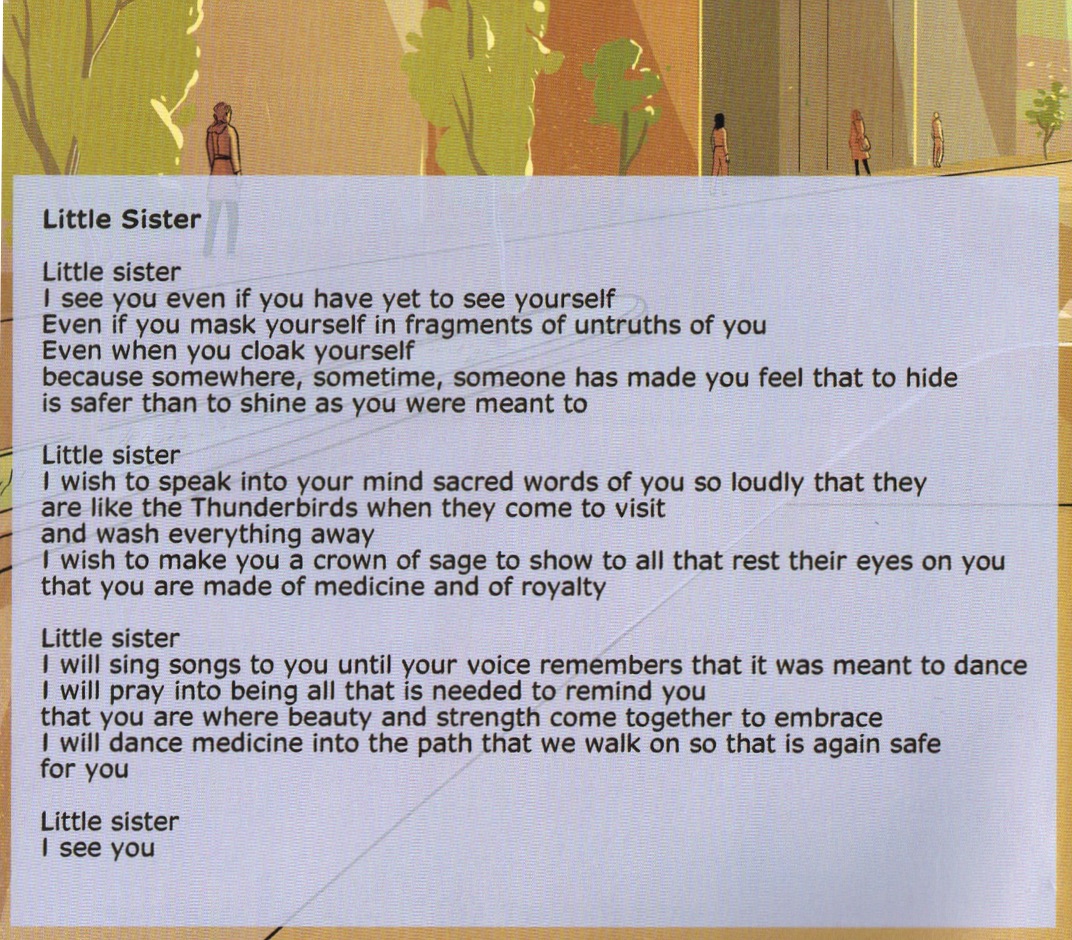
Author Tasha Spillett is of Nehiyaw and Trinidadian ancestry and dubs herself as a PhD student by day and a poet by night. Relevantly she begins Surviving the City with a poem titled "Little Sister" which, with poignant words, notes the starkness and vulnerability of being a young Indigenous woman but offers support, hope, and recognition.

Métis artist Natasha Donovan likewise focuses on the teen realities of Dez and Miikwan, from school to home and in between but overlays it with the supernatural blanket of spirits. The starkness of the city is conspicuous, with colour and brightness only evident when the teens honour their cultures and people and each other.

Surviving the City is not a happy-ending story of everything working out. It's a story about reality for far too many Indigenous women, girls and two-spirit persons who are negatively targeted rather than honoured for being just as they are. But, with Tasha Spillett and Natasha Donovan telling the story of Dez and Miikwan, reality is brought to the light and little sisters are seen.

August 07, 2018

Fire Song

Written by Adam Garnet Jones
Annick Press
978-1-55451-977-4
232 pp.
Ages 14+
March 2018

Maybe the game is rigged and the only way to win is by giving up. (pg. 115)

So much about Shane's life hurts that it's hard to find the faith he needs to help endure it.  It should be full of hope and promise. He's finishing his final year of school and anticipating a move to Toronto for post-secondary. He's smart, given the nickname of "College".  He has a pretty girlfriend, Tara, who adores him. But much is a facade because underneath it all, Shane is a mess of grief, confusion and guilt.

Fire Song begins the day of the memorial for Shane's younger sister Destiny who took her own life six weeks earlier. His mother Jackie is despondent, unwilling to leave Destiny's room, even with the constant ministrations of elder Evie. Fortunately, his Anishinaabe reserve community, the only home he's every known, is tight and supportive.
His heart beats under this ground and the roots of the trees spread through his lungs. (pg. 14)
But Shane has secrets and burdens that are disturbing his potentially bright future. He has just learned that his funding for school isn't available from his reserve because he is registered with his father's reserve, though his father is long passed and Shane never lived there. School wants a hefty deposit but Jackie hasn't worked since Destiny's death. Moreover, the roof on their house is disintegrating and, though the materials are in at the store to repair it, his family does not have the money for both the roof and his schooling. But Shane's most emotional struggle comes with balancing his growing sexual relationship with David, Evie's grandson, and his public romantic involvement with Tara, a teen eager to find a new life away from an abusive father and a private writer of introspective prose and poetry.
How can it be
That the smell of home and
the smell of lonely are the same? (pg. 70) 
As Shane tries to keep a roof over their heads and prompt his mother into action, hide his relationship with David while craving it desperately, make some money in a community with few opportunities, and grieve the loss of his sister, his life continues to fray and threaten his future. It's all about choices and not one of them is easy.

Adam Garnet Jones tells Shane's painful story in such expressive prose and poetry, the latter courtesy of Tara's writing, that the reader is carried on a wave from anguish to heartbreak to misery. Shane's story is a tragedy on so many levels: family, school, community, love. But, in each of those circumstances, there are still slivers of buoyancy: a mother who loves him but has abandoned him in her grief; acceptance to school in Toronto, though the money is not at hand; a community of friends who support Shane but would not accept his being a two-spirited person; and a boy and a girl who love him but confound his life's plan.  Adam Garnet Jones may not pretty up Shane's story but he does bring a fitting conclusion to it. I won't tell you if the roof gets fixed or if Shane goes to school in Toronto or if he chooses David or Tara, but I can tell you that things get worse before they get better but better they do. With acceptance of his choices and the life he needs, Shane survives another day to love and be loved.

•••••••••••••••••••••

Fire Song is based on a film by the same name, written and directed by Adam Garnet Jones and produced by Fire Song Films Inc. and Big Soul Productions Inc. I encourage readers to check out the trailer for Fire Song which premiered at TIFF in 2015.

Retrieved from YouTube at https://youtu.be/1HyRNI9kKkA on August 6, 2018. 
Uploaded by TIFF Trailers on August 13, 2015.

December 22, 2017

The Spirit Trackers

Written by Jan Bourdeau Waboose
Illustrated by François Thisdale
Fifth House Publishers
978-1-92708-311-6
32 pp.
Ages 4-8
November 2017

It's been far too long since the CanLit world has welcomed a book from Jan Bourdeau Waboose, a First Nation Anishinaabe of the Ojibway Bear Clan of northern Ontario.  Adding to her stunning collection of picture books which includes SkySisters, Morning on the Lake and Firedancers, Jan Bourdeau Waboose's telling tale of Ojibway traditions and the relationship between children and their uncle is breathtakingly illustrated by François Thisdale, award-winning artist of The Stamp Collector, Missing Nimâmâ, and French Toast.  The Spirit Trackers is a magnificent story in words and art, melding together First Nations and an intergenerational relationship with legends and spirits and the wonder of children.
Illustration by François Thisdale 
used in The Spirit Trackers by Jan Bourdeau Waboose
Two cousins are awed by the stories told by their uncle of their clan, the Moose Clan, and their heritage of extraordinary trackers but it's the story of the Windigo that truly captures their attention.  His story of the Wandering Night Spirit of Winter is a warning to the boys. 
"Watch out for the Windigo on a winter night.  It has a heart of ice, and its teeth are like steel.  It will eat anything in its way!" 
"Even the best Trackers disappear in Windigo's footsteps."
In the night, the boys are awakened by a Thump! Bang! and, upon seeing a black shadow cross the window, are convinced the Windigo has visited their uncle's house.  The next day, however, evidence in the snow and on a tree compel the two to put their tracking skills to work.  But far from the house, hearing a sad cry that "slices the air like a trapper's knife" the two are immobilized with terror.  It may not be the Windigo but the boys demonstrate the aptitude in tracking and their reverence for the natural world, especially for an animal they know to honour.

Jan Bourdeau Waboose infuses her atmospheric text with the companionship of family and an appreciation for traditions and legends of First Nations. Because of that, an occasion of storytelling becomes more; it becomes a lesson in caution and curiosity and heritage. Tom and Will are apt students at their Uncle's knee, listening, hearing and learning.  Resplendent in snow, the frigid medium of trackers, The Spirit Trackers is an appropriate visual and textual read for the winter season.  Artist François Thisdale makes sure that his illustrations transport readers to that frosty season and to a life of snowshoes, moosehide clothing, and ravens.  Combining photographs, drawings and paint with digital imagery, François Thisdale lends a supernatural essence to the story, perfect for a pair of boys already spooked by their disquietude about the Windigo but determined to follow the path of their tracker ancestors into the unknown winter stillness shattered by a haunting cry.
Illustration by François Thisdale 
used in The Spirit Trackers by Jan Bourdeau Waboose
Whether you believe in the Windigo is irrelevant.  The boys believe, as does their Uncle, and in the stillness and cold of winter, it's a story, like The Spirit Trackers, that has much to teach.

❅❅❅❅❅❅

The illustrations included in this review are derived from illustrator François Thisdale's Facebook page at Thisdale illustration.

August 11, 2015

Sometimes I Feel Like a Fox

Written and illustrated by Danielle Daniel
Groundwood Books
978-1-55498-750-4
36 pp.
Ages 4-7
August 2015

Danielle Daniel may have written and illustrated Sometimes I Feel Like a Fox to “encourage her young son to connect with his Aboriginal roots” (author bio on book jacket) but the book’s wisdom reaches far beyond the Anishinaabe tradition of totems, inspiring all children to look within and find their own strengths of wisdom, vulnerability, determination, curiosity and more.

In four-line free verses, Danielle Daniel depicts twelve totem animals by identifying the animal, its characteristics, and its purposeful deeds.  From the bravery of the bear to the cleverness of the fox, the author-illustrator represents a child as each totem, with respect and admiration, directing them to help “identify with the positive character traits of animals that may be familiar to them” (Author’s Note; pg. 33) while still emphasizing the interconnectedness of all living things.

As a mixed-media artist (and another upcoming children’s book illustrator I will need to add to my growing lists of youngCanLit illustrators’ Who’s Who!) Danielle Daniel delivers wonderfully textured art of boys and girls in the masks +/- costumes of animal totems (as possible) standing before unique wallpapers of stripes, flowers and patterns.  Her palette is subtle in peaches, turquoises, mustard and taupes but powerful enough to stand out.  While moving with timidity, or joy, or seriousness, bravado or hesitancy, the children model a range of animal totems that reveal more about themselves, though apparently hiding their facial expressions.
Sometimes I feel like an owl,
Intuitive and discreet.
I fly across the dark night sky,
Always watching and listening.
(pg. 16)
Sometimes I Feel Like a Fox is lovely and captivating and can so easily reach beyond the gorgeous artwork and natural similes to draw readers into discussions of family and clans, of spirit guides and of introspection and self-awareness.  An amazing feat for “just” a little picture book.