Showing posts with label Tasha Spillett. Show all posts

August 23, 2024

We Are the Medicine (Surviving the City, Vol. 3)


Written by Tasha Spillett
Illustrated by Natasha Donovan
Coloured and lettered by Scott B. Henderson
HighWater Press
978-1-77492-110-4
64 pp.
Ages 12–18
August 2024
 
The Indigenous teens that Tasha Spillett introduced in the first two books in her Surviving the City series, illustrated by Natasha Donovan, are set to graduate from high school and they're thinking about their futures. But how can they look forward when the remains of 215 children are revealed at a former residential school in BC? What future is there when the injustices of the past continue to be disclosed, and discrimination and wrongs persist in new forms?
From We Are the Medicine, written by Tasha Spillett, illustrated by Natasha Donovan, coloured and lettered by Scott B. Henderson
Now that Dez has accepted themself as a Two-Spirit person and is in a relationship with Kacey, and Miikwan is dating Riel, the teens are enjoying stronger connections with others and in their community. But when the unearthing of hundreds of unmarked graves of children at a former residential school makes the news, the impact on the teens, particularly Riel, is palpable. Speaking in their school's sharing circle with Elder Geraldine, they express their fears, dismay, hurts, and anger. Miikwan wants to help Riel as he lashes out, but Elder Geraldine recognizes the "We have a right to feel angry. We just have to find something to do with that energy so it doesn't harm us or anyone else." (p. 10)
From We Are the Medicine, written by Tasha Spillett, illustrated by Natasha Donovan, coloured and lettered by Scott B. Henderson
With Riel trying to find a way to turn his anger into something healing, they come up with the idea of a powwow for people to gather safely–it's still a time of masking and social distancing–to honour those whose young lives were taken from them. But when Riel is drawn to a protest nearby and his Afro-Indigenous cousin Ginebig follows him, it's Ginebig who is accosted by the police, as is Riel who comes to his defense. It is there, in jail, that Riel, after dreaming of the spirits of those children from the residential school, realizes that they themselves are the medicine for healing.

From We Are the Medicine, written by Tasha Spillett, illustrated by Natasha Donovan, coloured and lettered by Scott B. Henderson
Tasha Spillett takes on a lot of important social justice issues in We Are the Medicine, including residential schools, truth and reconciliation, police violence, monuments that are reminders of systemic racism, and more. It's a lot. But, just as they are issues that Indigenous people have been forced to experience historically and now, Tasha Spillett blends them authentically for these teens, who come from different places and narratives. Some are reminded of their own losses, like Riel whose brother Wayne was murdered by the police, or Dez whose beloved Granny had endured abuse at a residential school. They are understandably confused and angered and stymied by questions about why things have happened and are still happening, and how to make a difference and heal. The healing, for the past and for now, is imperative for them if they are to have a future for themselves and for others to make for themselves.

It's a new day. Let's do something good with it. (p. 15)
 
Natasha Donovan's illustrations, coloured and lettered by Scott B. Henderson, honour the characters in their diversity. Their experiences, at school, in relationships, with family and in the city, are distinct and reveal how they approach challenges and injustices. They may be different, but none are wrong. Natasha Donovan lets us see these teens in their struggles and their joys, from the harshness of police violence, told in sharp shapes and crushing colours, to the spirits who watch over the kids in muted blues. There's real darkness and sorrow in the news of the graves of residential school children and joy and colour in powwow regalia and in the gardening of medicinal plants. Natasha Donovan's art sets the mood and serves Tasha Spillett's story.

Dez and Miikwan and their friends carry heavy loads of history, family, fears, and abuse. The city has not made it easy for them. But their supports are growing, and they are finding ways to move forward, though never forgetting their pasts or that of their ancestors. Fortunately, they will heal and they will survive because the medicine comes from them.
 • • • • • • •
 
Surviving the City series
From the Roots Up (2020)
We Are the Medicine (2024)


February 20, 2019

Surviving the City

Written by Tasha Spillett
Illustrated by Natasha Donovan
HighWater Press
978-1-55379-756-2
56 pp.
Ages 13+
November 2018

Though of different Indigenous heritage, Dez, who is Inninew, and Miikwan, who is Anishinaabe, are more like sisters than best friends. They completed a year-long Berry Fast together and have been important supports as Dez worries about the health of her kokum with whom she lives and Miikwan struggles with the loss of her missing mother.
From Surviving the City by Tasha Spillett, illus. by Natasha Donovan
Walking everywhere in the city, the two girls are seen among blue spirits of Indigenous women watching over them while scary black shadows partner with some men to encroach on their spaces and safety.  When Dez sees her grandmother with the social worker at their house, she is fearful of being sent to a group home. So Dez walks away, her phone battery draining, and ends up sleeping on a park bench, watched over by the spirits of murdered Indigenous women but vulnerable to the predators of white men shadowed by monsters.
From Surviving the City by Tasha Spillett, illus. by Natasha Donovan
When Miikwan does not hear from Dez for several days, she is scared that her best friend may be lost as her own mother was. After talking to the elder of the school's culture room, Miikwan agrees to participate in a march to recognize missing women, girls and two-spirit persons.

Fortunately, while Miikwan helps support her community in a march that attends to those who have been lost, Dez is helped by another Indigenous woman to the Ka Ni Kanichihk Indigenous centre and the two are ultimately reunited.
From Surviving the City by Tasha Spillett, illus. by Natasha Donovan
With extensive notes, including statistics and references, about murdered and missing Indigenous women, girls and two-spirit people, Tasha Spillett takes Dez and Miikwan's story from very personal to big picture. But don't be deceived that this story is anything less than personal.  It may reassure that the spirits of those missing and murdered are always there to guide and protect, and that there are those on this earth who want to help but the ubiquity of glowing blue spirits and shadowy monsters suggests that the stories of those missing and murdered and the families left behind are still too common. Sitting on a park bench should not be an invitation for assault. Being followed and in fear for your safety because of your heritage should not have become the norm for girls like Miikwan and Dez. But sadly Tasha Spillett reveals the very real worries of Indigenous women, girls and two-spirit persons go beyond the everyday concerns and expand into those about personal safety and loss of home and family.
From Surviving the City by Tasha Spillett, illus. by Natasha Donovan
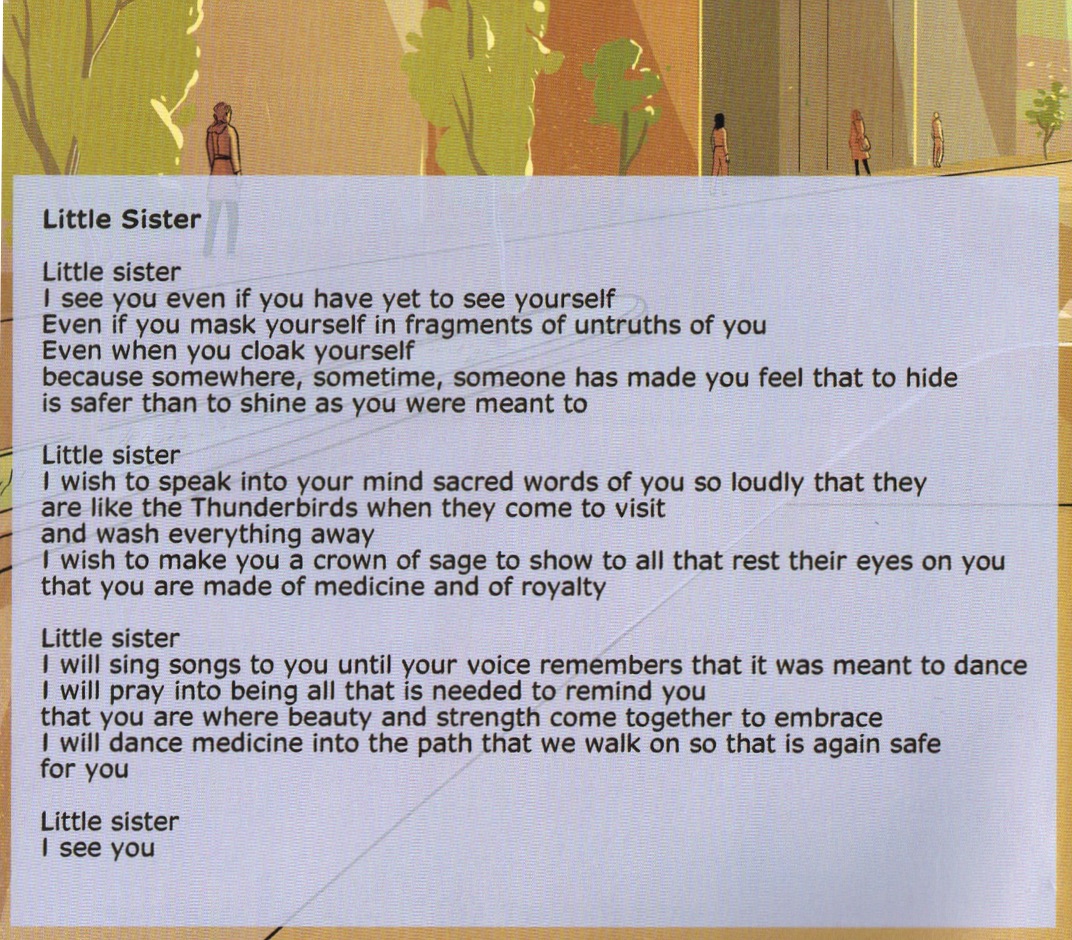
Author Tasha Spillett is of Nehiyaw and Trinidadian ancestry and dubs herself as a PhD student by day and a poet by night. Relevantly she begins Surviving the City with a poem titled "Little Sister" which, with poignant words, notes the starkness and vulnerability of being a young Indigenous woman but offers support, hope, and recognition.

Métis artist Natasha Donovan likewise focuses on the teen realities of Dez and Miikwan, from school to home and in between but overlays it with the supernatural blanket of spirits. The starkness of the city is conspicuous, with colour and brightness only evident when the teens honour their cultures and people and each other.

Surviving the City is not a happy-ending story of everything working out. It's a story about reality for far too many Indigenous women, girls and two-spirit persons who are negatively targeted rather than honoured for being just as they are. But, with Tasha Spillett and Natasha Donovan telling the story of Dez and Miikwan, reality is brought to the light and little sisters are seen.