Showing posts with label Scott B. Henderson. Show all posts

August 23, 2024

We Are the Medicine (Surviving the City, Vol. 3)


Written by Tasha Spillett
Illustrated by Natasha Donovan
Coloured and lettered by Scott B. Henderson
HighWater Press
978-1-77492-110-4
64 pp.
Ages 12–18
August 2024
 
The Indigenous teens that Tasha Spillett introduced in the first two books in her Surviving the City series, illustrated by Natasha Donovan, are set to graduate from high school and they're thinking about their futures. But how can they look forward when the remains of 215 children are revealed at a former residential school in BC? What future is there when the injustices of the past continue to be disclosed, and discrimination and wrongs persist in new forms?
From We Are the Medicine, written by Tasha Spillett, illustrated by Natasha Donovan, coloured and lettered by Scott B. Henderson
Now that Dez has accepted themself as a Two-Spirit person and is in a relationship with Kacey, and Miikwan is dating Riel, the teens are enjoying stronger connections with others and in their community. But when the unearthing of hundreds of unmarked graves of children at a former residential school makes the news, the impact on the teens, particularly Riel, is palpable. Speaking in their school's sharing circle with Elder Geraldine, they express their fears, dismay, hurts, and anger. Miikwan wants to help Riel as he lashes out, but Elder Geraldine recognizes the "We have a right to feel angry. We just have to find something to do with that energy so it doesn't harm us or anyone else." (p. 10)
From We Are the Medicine, written by Tasha Spillett, illustrated by Natasha Donovan, coloured and lettered by Scott B. Henderson
With Riel trying to find a way to turn his anger into something healing, they come up with the idea of a powwow for people to gather safely–it's still a time of masking and social distancing–to honour those whose young lives were taken from them. But when Riel is drawn to a protest nearby and his Afro-Indigenous cousin Ginebig follows him, it's Ginebig who is accosted by the police, as is Riel who comes to his defense. It is there, in jail, that Riel, after dreaming of the spirits of those children from the residential school, realizes that they themselves are the medicine for healing.

From We Are the Medicine, written by Tasha Spillett, illustrated by Natasha Donovan, coloured and lettered by Scott B. Henderson
Tasha Spillett takes on a lot of important social justice issues in We Are the Medicine, including residential schools, truth and reconciliation, police violence, monuments that are reminders of systemic racism, and more. It's a lot. But, just as they are issues that Indigenous people have been forced to experience historically and now, Tasha Spillett blends them authentically for these teens, who come from different places and narratives. Some are reminded of their own losses, like Riel whose brother Wayne was murdered by the police, or Dez whose beloved Granny had endured abuse at a residential school. They are understandably confused and angered and stymied by questions about why things have happened and are still happening, and how to make a difference and heal. The healing, for the past and for now, is imperative for them if they are to have a future for themselves and for others to make for themselves.

It's a new day. Let's do something good with it. (p. 15)
 
Natasha Donovan's illustrations, coloured and lettered by Scott B. Henderson, honour the characters in their diversity. Their experiences, at school, in relationships, with family and in the city, are distinct and reveal how they approach challenges and injustices. They may be different, but none are wrong. Natasha Donovan lets us see these teens in their struggles and their joys, from the harshness of police violence, told in sharp shapes and crushing colours, to the spirits who watch over the kids in muted blues. There's real darkness and sorrow in the news of the graves of residential school children and joy and colour in powwow regalia and in the gardening of medicinal plants. Natasha Donovan's art sets the mood and serves Tasha Spillett's story.

Dez and Miikwan and their friends carry heavy loads of history, family, fears, and abuse. The city has not made it easy for them. But their supports are growing, and they are finding ways to move forward, though never forgetting their pasts or that of their ancestors. Fortunately, they will heal and they will survive because the medicine comes from them.
 • • • • • • •
 
Surviving the City series
From the Roots Up (2020)
We Are the Medicine (2024)


February 21, 2023

A Blanket of Butterflies: The Spirit of Denendeh, Volume 1

Written by Richard Van Camp
Illustrated by Scott B. Henderson
Colours by Donovan Yaciuk
HighWater Press
978-1-77492-040-4
56 pp.
Ages 12 +
2022 
 
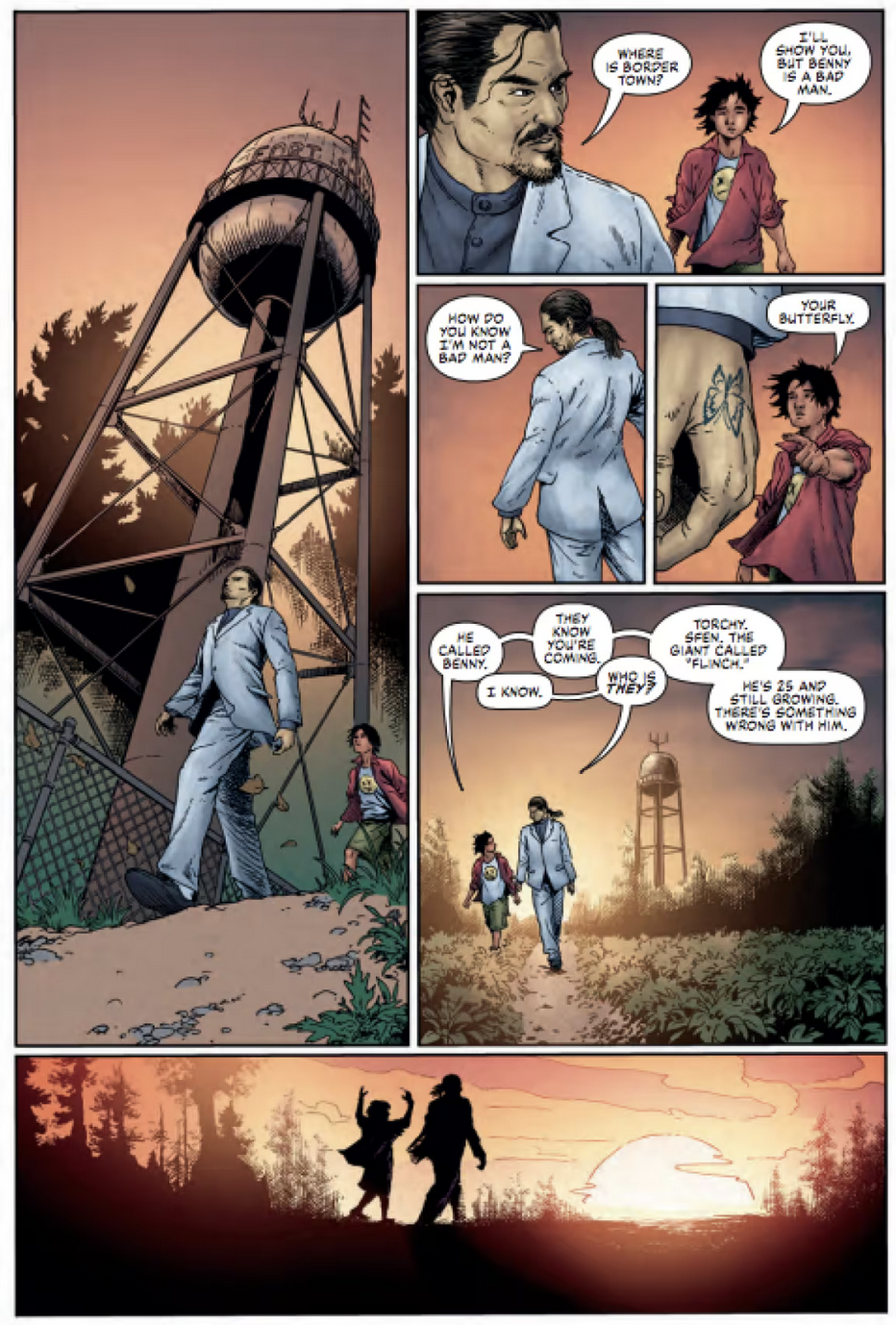
When Shinobu arrives in the Northwest Territories to reclaim his family's samurai armour housed at the Fort Smith museum, he learns that the sword has gone AWOL after Benny, the last museum manager, gambled it away. Sonny, a Tłı̨chǫ Dene boy who was at the museum, offers to take Shinobu to Benny's residence, though Sonny warns that the man will undoubtedly be supported by a trio of thugs named Torchy, Sfen and Flinch. 
From A Blanket of Butterflies by Richard Van Camp, illus. by Scott B. Henderson, coloured by Donovan Yaciuk
Not surprising Shinobu is attacked and, though he valiantly defends himself, he is left almost dead. Sonny and some friends take the man to Sonny's grandmother's house. Though Shinobu's extensive tattoos  frighten Sonny's Ehtsi, she tends to his wounds. With Sonny's support for "the butterfly man"–because of his butterfly tats–and a visitation from the spirit of Sonny's sister, Sonny's grandmother wants to know more. Shinobu tells her he is from Nagasaki, Japan and she realizes the connection their people have with the Japanese linked to the atomic bombing of 1945. She relates this in terms of a powerful bird being fed black eggs and "a fire so bright it left only their shadows on what was left of their homes" (pg. 24).
From A Blanket of Butterflies by Richard Van Camp, illus. by Scott B. Henderson, coloured by Donovan Yaciuk
Shinobu tells them the story of the creation of the sword by his 2 times great grandfather and his need to reclaim it before the August full moon. Because that full moon was that very night, the three head out together to Benny's. Again they are set upon but Sonny's grandmother is a formidable woman whose words stop the thugs. And with words and memories, as well as a blanket for Benny, Sonny's Ehtsi finds a connection between the men and the opportunity for benevolence.
From A Blanket of Butterflies by Richard Van Camp, illus. by Scott B. Henderson, coloured by Donovan Yaciuk
Originally published in 2015, A Blanket of Butterflies has been reissued with full colour, additional background information and cultural context. Still the story is fresh as an intersection of two cultures, one Indigenous and the other Japanese, and how they connect both on a historical and a more personal level. Richard Van Camp, Tłı̨chǫ Dene from Fort Smith NWT, has borrowed from his youth a story of an unlikely suit of samurai armour but he has developed it into a far greater story by asking a series of What If? questions. Sadly, how that suit was lost from a Japanese family is undoubtedly tied to the theft and seizure of the possessions of those interned. Still, Richard Van Camp doesn't emphasize that part of the story but rather the connections that both the Indigenous and Japanese communities have experienced through a history of loss and the substance of family. 

There is a darkness to this story because of that history and that loss. And that darkness comes through in Scott B. Henderson's illustrations, expertly coloured by Donovan Yaciuk. The artwork plays up the conflict that converts remarkably to connection both in its action, expression and colour.

The Spirit of Denendeh tells stories of the People of that land and A Blanket of Butterflies gives us glimpses into the natural and supernatural elements of those lives. I suspect that when Volume 2,  As I Enfold You in Petals, releases in April of this year, there will be another story from Denendeh, the Land of the People, again rooted in reality and upholding a legacy of kinship.

May 25, 2021

Sugar Falls: A Residential School Story (10th Anniversary Edition)

Written by David A. Robertson
Illustrated by Scott B. Henderson
Colours by Donovan Yaciuk
HighWater Press
978-1-55379-975-7
48 pp.
Ages 14-18
May 2021 

In my family, silence has been the currency of injustice.
~ Senator Murray Sinclair, Foreword to Sugar Falls
 
Too many of the truths about injustices perpetrated against Indigenous peoples have been hidden, suppressed and ignored. With the original publication of Sugar Falls: A Residential School Story in 2011, some of those truths were told, based on the true story of Betty Ross, Elder at Cross Lake First Nation. Today with the release of this tenth anniversary edition of Sugar Falls, I hope even more readers are ready to hear those truths.
 
When a present-day class is given an assignment to look at the residential school system, with strict instructions to approach Elders with respect and an offering, Cree student April offers to introduce Daniel to her Kōkom, an Elder who survived it but whose story even April had not heard.
From Sugar Falls by David A. Robertson, illus. by Scott B. Henderson, colours by Donovan Yaciuk
April's Kōkom takes them into her round room "with all the sacred medicines and within the star blanket of the four directions" (pg. 4) where she would be safe. She prepares by wearing traditional attire, holding an eagle feather and doing a cleansing before she begins her story.

Abandoned at age five into the winter's cold by her own mother who had survived the residential school system, she is found and brought up as a daughter and sister in a loving family. A few years later, after he has a vision of darkness in her future, her father takes her to Sugar Falls where he teaches her to feel the beat of their hearts as drums in rhythm with that of the falls, and that "The beat of the drum represents the strengths of our relationships, between our ancestors, our traditions with Mother Earth, and with each other" (pg. 13) and that remembering this would keep her strong.
From Sugar Falls by David A. Robertson, illus. by Scott B. Henderson, colours by Donovan Yaciuk
Strength is what she will need when soon a grim priest comes and drags her away from that love and comfort to an ominously-large institution where Sister Marie scrubs at her skin and cuts her long hair. There Betsy meets Flora and begins an endless routine that includes prayer and chores and classes. Sadly there is also the abuse, a crack against the knuckles, a slap or a kick for speaking Cree, and the sexual abuse by the priest to whom the girls would close their minds and numb their bodies and pretend the visits were nightmares to be left in the night.

From Sugar Falls by David A. Robertson, illus. by Scott B. Henderson, colours by Donovan Yaciuk
Though Betsy can see across the water and envision home, she has made a promise to her father to be good and listen, so when Flora and a couple of other girls escape across the water, she remains behind. But Flora's death steels Betsy until one day "All I wanted to see was my family again, to wake up from the nightmare and have them by my side." (pg. 34) She walks into the water and remembers Sugar Falls. She is dragged back from the water but her resolve has returned and "no matter what they did to me, I held onto myself, my language and my spirit." (pg. 38)
 
From Sugar Falls by David A. Robertson, illus. by Scott B. Henderson, colours by Donovan Yaciuk
Betsy endured that place for several more years, and later attended high school in Winnipeg. She also changed her name to Betty to honour her friend Helen Betty Osborne who would be murdered.
I did it to keep her memory alive. My story, her story are stories that we should never forget, no matter who we are, they are important to all of us. (pg. 39)
Governor-General award-winning author David A. Robertson does so much in the telling of Sugar Falls. He honours Betty Ross by giving her story new life so that more will know of her courage and resilience and that of so many who endured and those who did not at the hands of a brutal system that never should have happened. Generations later, Indigenous people continue to live in the aftermath of that horrific injustice and with each story told, the silence is broken a little more, allowing an opportunity for justice to manifest.  By giving voice to Betty to speak of her past, from abandonment to loving family and residential school nightmare, and those of her granddaughter and non-Indigenous friend to hear her story from their own perspectives, David A. Robertson lets us see Betty as a survivor with heart, strength and compassion.

Because this is a graphic novel, less needs to be said in text and more can be carried by the artwork, and illustrator Scott B. Henderson and colourist Donovan Yaciuk take on their task with reverence and empathy. The despair of life at the residential school is clear in the starkness and gloom of the shapes, lines and colours of those scenes, with Scott B. Henderson and Donovan Yaciuk saving the brightness for outdoor scenes with family and the contemporary settings of school and Kōkom's home. It was clear where the lightness in Betty's life is, past and present.

Today, with the release of David A. Robertson's tenth anniversary edition of Sugar Falls, there is a new opportunity for the world to listen and see this story, to silence the silence and give survivors of the residential school system, both those who lived it and those whose legacy it is, a chance to tell their stories and have them remembered.

April 06, 2021

Road Allowance Era (A Girl Called Echo, Vol. 4)

Written by Katherena Vermette
Illustrated by Scott B. Henderson
Colour by Donovan Yaciuk
HighWater Press
978-1-55379-930-6
48 pp.
Ages 10-14
April 2021
 
In the aftermath of the Northwest Resistance, the focus of the third book in Katherena Vermette's A Girl Called Echo graphic novel series, the accidental time traveller Echo returns to 1855 to join her ancestors and other Métis and witness the execution of Louis Riel and the sustained persecution and discrimination of her people.
From Road Allowance Era by Katherena Vermette, illus. by Scott B. Henderson, colour by Donovan Yaciuk
Though Louis Riel had advocated for the Métis' rights to land granted to them, most scrips entitling them to land in the Red River area have not been honoured. So Echo joins them in returning to Manitoba, hopeful that the agents now set up would ensure that land deeds would be issued to them.

From Road Allowance Era by Katherena Vermette, illus. by Scott B. Henderson, colour by Donovan Yaciuk
But the discrimination that they have faced all along continues, with their scrips only exchanged for a few dollars and provisions. So the Métis head to Ste. Madeleine where they hope they might rebuild their community.

Time slipping back to the present, Echo's teacher speaks of the unsettling of the Métis and their need to squat on unused Crown lands called road allowance land. Later, though they'd lived there for decades, they are often driven off with violence. Echo's anger at the injustice is palpable though her friend Micah sees the fortitude of their people who were able to withstand so much and still survive.

From Road Allowance Era by Katherena Vermette, illus. by Scott B. Henderson, colour by Donovan Yaciuk
Still she witnesses much destruction and sadness as the Métis are displaced and then refused the opportunity to buy the land on which they had built lives. 

We are the free people, mon amie. We built this place and we will always be here. No matter what they have done to us, we're still here. We know we will survive. (pg. 38)

From Road Allowance Era by Katherena Vermette, illus. by Scott B. Henderson, colour by Donovan Yaciuk
Her existence reminds them of that survival, with her ancestors pointing out that they are always within her as there is "blood memory, bone memory" (pg. 29) of their sorrows and their strengths. "Go home and be the future" (pg. 40) is what she is told.

The story of the Métis is heartbreaking, as Echo has learned from her time slips into the past. History class and homework rile her, as they should for anyone with a sense of justice. But Katherena Vermette doesn't just let Echo wallow in anger or distress. She helps her accept that anger as valid but see the strength of her people and the change that has happened for each generation. 
 
Scott B. Henderson's illustrations take us smoothly between past and present, clearly depicting a contemporary Echo and her immediate family and friends versus her ancestors in their settings of prairie scenes of wagons and tipis, and dismal government buildings like courts and land offices. There is an authenticity in his characters that acknowledge the hardships but allude to the joys and colour of Métis culture. Coloured by Donovan Yaciuk, there is a sense of brightness at the edges of the past and the present that lay bare much about what was and is.
From Road Allowance Era by Katherena Vermette, illus. by Scott B. Henderson, colour by Donovan Yaciuk
This is the way to learn history, from those who lived it and those who came from them. Though the horrors of the past might offer extraordinary teachable moments, they also point forward, to a future that offers more hope with each generation. The present may still be troubled with discrimination as land claims continue to be challenged but, as Scott B. Henderson's final illustrations shows us, Echo has her family, past and present, behind her.

• • • • • • •
The whole series A Girl Called Echo offers unique opportunities to teach and learn about Métis history. I encourage teachers to examine the whole series.
Pemmican Wars (2017)
Northwest Resistance (2020)
Road Allowance Era (2021)

January 16, 2019

Red River Resistance (A Girl Called Echo Vol. 2)

Written by Katherena Vermette
Illustrated by Scott B. Henderson
Colour by Donovan Yaciuk
HighWater Press
978-1-55379-747-0
49 pp.
Ages 10-14
November 2018

Echo Desjardins's story began in Pemmican Wars (HighWater Press, 2017), the first  volume of Katherena Vermette's A Girl Called Echo graphic novel series. Echo is a thirteen-year-old Métis girl placed in foster care, dealing with her new circumstances when she repeatedly time slips onto the prairies of the early 19th c. Métis as they hunt bison and are thrust into the Pemmican Wars.  Red River Resistance continues Echo's story, this time plunging the teen into the famous altercation of 1869-1870.
From Red River Resistance by Katherena Vermette, illus. by Scott B. Henderson, col. by Donovan Yaciuk
As their teacher, Mx. Francois, begins their lesson on the selling of seven million acres by the Hudson Bay Company to Canada, Echo is transported to the Red River colony in 1869 where she witnesses land surveyors, on behalf of the Crown and Dominion of Canada, confronted by Louis Riel and others for trespassing on Métis land. Though Echo returns to the present day to sign up for the Indigenous Student Leadership group and continue with her daily activities, she is transported multiple times to the Red River settlement where the Métis resistance progresses from the taking of Upper Fort Garry through the organizing of a provisional government and the attacks after the trial and execution of Thomas Scott.
From Red River Resistance by Katherena Vermette, illus. by Scott B. Henderson, col. by Donovan Yaciuk
Though the history of the Red River Resistance of 1869-1870 is well documented in the timeline provided at the conclusion of the book, along with a map and the 1870 Métis Bill of Rights, telling the basics of that conflict in a graphic novel format, emphasizing the illustrations with limited dialogue, is clever as it leaves room for discussion and enquiry.  Moreover, because Katherena Vermette embeds Echo's own life of struggles in the basics of the resistance, Red River Resistance becomes more an echo of fitting in amidst conflict than simply teaching history. With Scott B. Henderson's illustrations, coloured by Donovan Yasiuk, the story is fuller. It is realistic but goes beyond an illustrated encyclopedic entry. It reveals an inclusivity of people and story and takes the perspective away from the history textbooks and into that of the people who endured the injustices and strife thrust upon them.
From Red River Resistance by Katherena Vermette, illus. by Scott B. Henderson, col. by Donovan Yaciuk
••••••••••••••••••••••
Volume 3 in the series, Northwest Resistance, is set for a November 2019 release.