Showing posts with label foster care. Show all posts

April 28, 2023

The Woman and Her Bear Cub

Adapted and retold by Jaypeetee Arnakak
Illustrated by Dayna B. Griffiths
Inhabit Media
978-1-772274660
36 pp.
Ages 3-6
April 2023
 
Many children take it upon themselves to adopt animals they believe have been abandoned. They do it with the best of intentions, though sometimes without regard for the bigger picture. The Woman and Her Bear Cub is a traditional Inuit story of such a fostering but with the wisdom that comes with living in conjunction with the natural environment and not overriding it.
From The Woman and Her Bear Cub by Jaypeetee Arnakak, illus. by Dayna B. Griffiths
A child and her mother are out on the ice hunting when they discover a polar bear cub stranded behind some broken ice. The mother wisely looks for tracks and evidence that the mother bear is nearby but can find none, so they help the cub from its location and take it home.
From The Woman and Her Bear Cub by Jaypeetee Arnakak, illus. by Dayna B. Griffiths
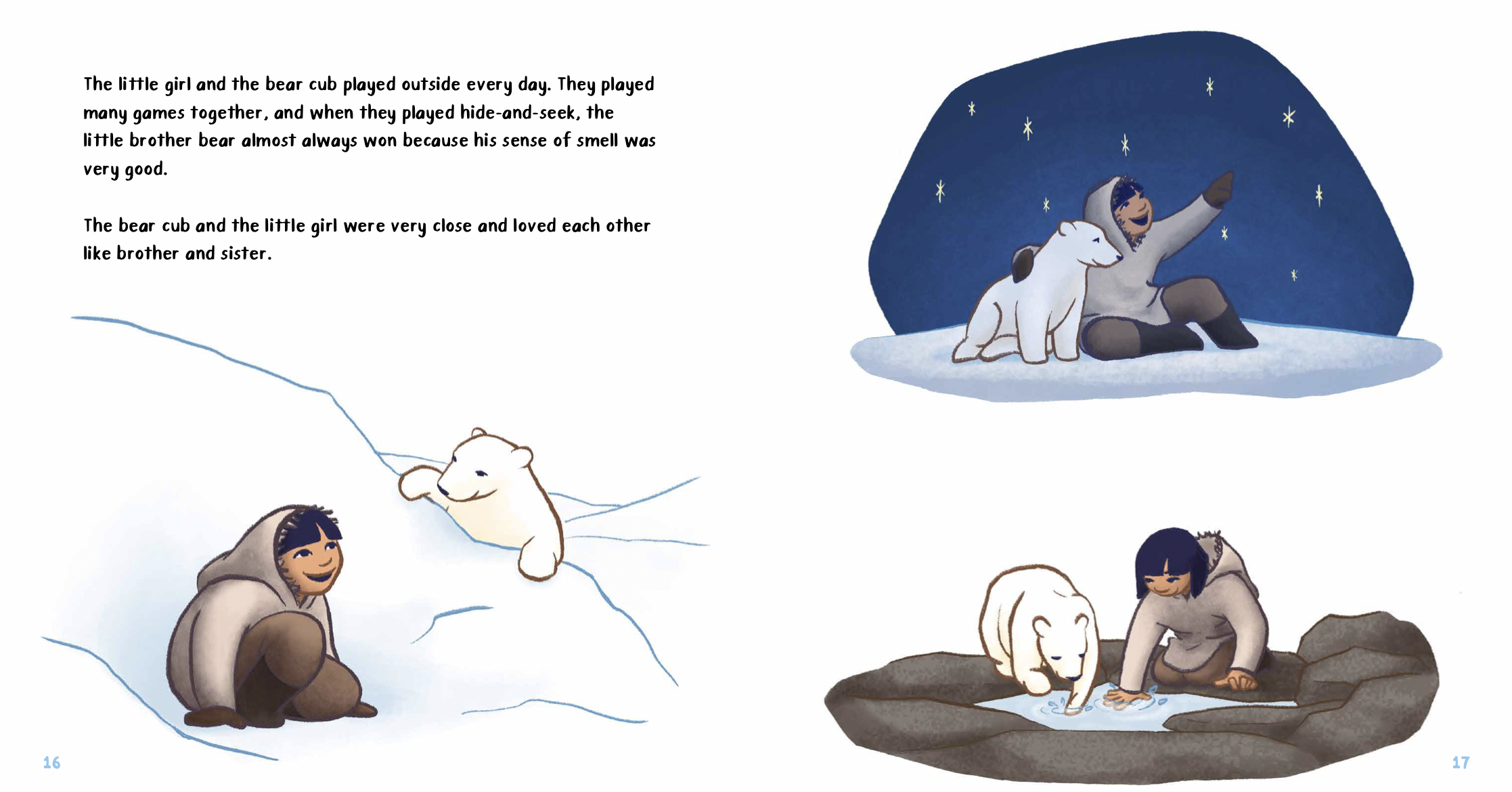
The child calls the cub her baby brother and their bond is as strong as siblings. They spend time together, playing and such, with the bear becoming an integral part of their family, even bringing back seals and fish that he has caught for them.
From The Woman and Her Bear Cub by Jaypeetee Arnakak, illus. by Dayna B. Griffiths
But when the cub is no longer a baby bear, and he becomes so big that the others in the village are concerned, the mother prepares her child for the time he would have to leave them. Still, it isn't until her brother bear returns from hunting one day with his own mother that the mother and child are able to say goodbye.
From The Woman and Her Bear Cub by Jaypeetee Arnakak, illus. by Dayna B. Griffiths
Jaypeetee Arnakak is a multi-talented Inuit linguist, translator, educator, and writer who grew up in Clyde River on Baffin Island. He has edited a collection of traditional stories from oral recordings of Inuit Elders and adapted several into picture books. The Woman and Her Bear Cub is one such traditional story and one that tells of compassion for living things and letting go when the time is right. There is no willful removal of a wild animal to provide companionship or entertainment. Neither is there a selfishness to take and keep what does not belong to them. The mother and her child give sanctuary to a lost bear cub only until he is reunited with his mother. It's not about their needs but about his needs. 

That quietness of purpose and landscape is portrayed in the illustrations of The Woman and Her Bear Cub by artist and designer Dayna B. Griffiths of Toronto. By creating art that appears stark, with a restrained palette of blue, white, and grey-brown, Dayna B. Griffiths makes the Arctic landscape of blue sky and white snow dotted with an occasional qarmaq (dwelling) very powerful. As such, the interjection of a white bear and grey-brown-clad people, with the occasional dog of both grey and white, in that landscape makes them both an important and insignificant focus.

As with most traditional stories, even those that may take on fantastical proportions, there is a germ of truth, and I suspect this one is based in reality. Adopting a lost animal and caring for it until care is no longer necessary is a story for all times. Here, a polar bear and an Arctic landscape may make this story unique, but its premise is grounded in the authenticity of compassion for those in need and dictated only by the one most affected. It is a lesson in selflessness and benevolence and a true reflection of the graciousness of Inuit values.

October 24, 2022

Anne: An Adaptation of Anne of Green Gables (Sort Of)

Written and illustrated by Kathleen Gros
Quill Tree Books (HarperCollins)
978-0-06-305766-1
304 pp.
Ages 8-13
October 2022
 
This is not L. M. Montgomery's Anne of Green Gables. Sure there is an Anne, a Marilla, a Matthew, Diana and Gilbert. But this is a new Anne, a contemporary one, and one with her own story. And, it's a story that might resonate a little more with young readers today.
From Anne: An Adaptation of Anne of Green Gables (Sort Of) by Kathleen Gros
When Matthew Cuthbert comes by the case worker's office to pick up their foster child, he's surprised to meet twelve-year-old Anne Shirley, a child much older than the one he and his sister Marilla had intended to foster. Although Anne, a consummate writer and doodler, sees herself as "in between being an outsider and belonging" (pg. 2), she's delighted to go to the Avon-Lea, the apartment building where Matthew is a handyman. Marilla, an accountant, may want child services to look into the placement–a server crash may have caused the mismatch–and appear cool towards Anne but she generously buys her a sketchbook and takes her shopping for clothes.

Matthew and Marilla introduce her to a number of the residents of the Avon-Lea, including Mr. Barry, Marilla's boss, who lives with his wife and daughters Diana and Minnie in the penthouse, and Rachel Lynde, a woman who comments on Anne's red hair and gets an earful from the girl. Diana and Anne become fast friends, hanging out in the nearby ravine, before the beginning of their Grade 7 year at Carmody Middle School.
From Anne: An Adaptation of Anne of Green Gables (Sort Of) by Kathleen Gros
At school, she meets Ruby and Josie but also Gilbert who teases her relentlessly, even getting her in trouble. It's only when she makes it clear to him that as a foster kid being labelled as a troublemaker could get her moved, that he takes responsibility. Still school is also where she joins the Carmody Zine Club, an extracurricular that gives her an venue for her creativity.
From Anne: An Adaptation of Anne of Green Gables (Sort Of) by Kathleen Gros
Of course, this is an adaptation of Anne of Green Gables so we know that there have to be a number of unfortunate events, though these definitely have a contemporary feel. There is the hair-dying incident, a visit to a fancy restaurant with Diana's Great Aunt Josephine, a misunderstanding about being asked to the dance, and a dare. And there's an unexpected and heartwarming crush between two friends.
Maybe life is just a cycle of forgiving and accepting forgiveness–if we let ourselves listen and change. (pg. 262)
It's tough to write an adaptation that is fresh and unparalleled by staying somewhat true to the original but Kathleen Gros has done it. Just as she did with Jo: An Adaptation of Little Women (Sort Of) (2020), Kathleen Gros has updated the story of Anne Shirley, keeping the essence of the characters and their relationships and key events, but taking them all into a contemporary setting which might be more familiar to young people. As beloved as Anne of Green Gables is globally, most young readers today would not be familiar with the clothes, classroom or domestic activities of that book. However, they will recognize classroom practices of whiteboards and computers, living in apartment buildings, and introducing themselves with their pronouns. Moreover, by enveloping that modern story in a graphic novel format, Kathleen Gros has introduced a new generation of readers to Anne, including those who would never have picked up the classic story of the red-haired orphan who goes to live at Green Gables. Today's young readers will appreciate a story of getting in trouble at school when being teased or bullied, hiding their feelings, and trying to fit in. But beyond that, Kathleen Gros gives us wisdom and reassurance that there are people that will steer them right and support them in their struggles. 

Fans of Anne of Green Gables will love this new story and new format while revisiting a favourite character and recalling the events that made Anne so memorable. But those unfamiliar with the classic story will still love meeting Anne and her new family and friends and cheer her on as she makes a new life, perhaps with a few missteps along the way. It's Anne 2.0 in all her colours.

• • • • • • •
 
Check back tomorrow, the official release date for Anne: An Adaptation of Anne of Green Gables (Sort Of), for my interview with author-illustrator Kathleen Gros.
• • • • • • •

August 04, 2022

Jasper's Road

Written by Susan White
Acorn Press
978-1-773660981
164 pp.
Ages 8-12
May 2022

There are families by birth and those by invention. And sometimes, because of the families of birth, better families are created from disparate parts. The story of Jasper's Road is about such families.
 
When Jasper's Road begins, a large extended family is gathering to celebrate Amelia's day. Amelia Walton, who passed five years earlier, started taking in kids after she was struck with a neurological disease which motivated her to become a recluse. Opening her home to more than 100 kids over the years, for short- or long-terms, Amelia Walton left her mark with her heart, her wisdom, and her compassion. Now each year, many of those she fostered along with their own families gathered to share food, memories and trivia as Amelia would have liked.

Thirteen-year-old Jasper, who'd come to Amelia as a baby and now was part of Jodie and Zac Williams's family, had always felt welcomed but, because of a recent fostering of fourteen-year-old Jake Turner by his Aunt Rachel and Uncle Ryan, Jasper is feeling more vulnerable, especially about a facial abnormality that Jake ridicules as "Zipper Lip." But as Jasper tries to figure out how to deal with Jake, Jake himself is struggling with finding himself as a part of yet another foster family and without his little brother Tommy. Then near tragedy strikes and Jake forces Jasper and Jasper's 12-year-old brother Anderson to lie. Add to that the COVID-19 pandemic and the April 2020 mass killing in Nova Scotia and it would seem that everyone has some baggage that they're carrying around that confuses and confounds their relationships with partners and with their families, foster and birth.

New Brunswick writer Susan White, who has written YA and middle grade books including The Year Mrs. Montague Cried, winner of the Ann Connor Brimer Award, brings us into a complicated world of foster children, past and present, as they struggle and learn to make lives for themselves in the context of ever-changing relationships. Whether from abandonment or abuse, neglect or health concerns–including death of a parent–children enter foster care for a variety of reasons and just as varied is the care that they may receive. Some will find forever homes through adoption while others will bounce from one residence to another. In Jasper's Road, those fortunate enough to be taken in by Amelia Walton and subsequently by her "heirs" became part of something significant. And while it took me awhile to figure out all the characters and their relationships, including which were biological or otherwise, I realized it really didn't matter. Susan White gave us a rich community much like the one Amelia endeavoured to create, both complex and natural, saving herself and others in the process, and building something bigger than just a joining of individuals.

While this journey down Jasper's Road is complete, for now, I suspect that there are more travels ahead for Jasper, Jake, Tommy and their families, perhaps in New Brunswick or not, and I really hope that Susan White takes us down a few more of those roads by gifting us with their stories too.

May 13, 2021

Thanks A Lot, Universe

Written by Chad Lucas
Amulet Books (Abrams)
978-1-4197-5102-8
288 pp.
Ages 10-15
May 2021 

Thanks a Lot, Universe is the story of two boys, both coming to terms with new realities. While they are as different as they appear on the cover, the two are both looking for and finding their true selves, with or without the help of the universe.

Told in the alternating voices of thirteen-year-olds Brian Day and Ezra Komizarek, Thanks a Lot, Universe parallels the stories of the two Halifax boys as they become true friends, and maybe more, though the plot is very much driven by the shy and socially anxious Brian. On the day of his thirteenth birthday, Brian learns via letter that his father has left–the police are after him for his role in "cannabis production and distribution"–and his mother, distraught, attempts suicide, though Brian finds her in time to save her.
We'd thought everything was fine. We hadn't known the world was ending. (pg. 16)
Because the whereabouts of their father is unknown and their mother is hospitalized, Brian and his 9-year-old brother Richie are sent to the foster home of grandparents-like Gordon and Emma Wentzell. Still being questioned by Sergeant States of the police about his father, and now dealing with social worker Kate Evans and the incessant attempts at Mrs. Wentzell to engage him, as well as bullying by Victor MacLennan at school, Brian gets absolutely no respite from his social anxiety, dealing with strangers everywhere.

Meanwhile, Ezra is dealing with his changing relationship with his best friend Colby Newcombe who is in the throws of first love and hanging with a new group which includes Victor. Fortunately Ezra still has his older half-sister Natalie and friends Ty and Kevan with whom he can talk and help him sort out his feelings, including about girls or not.
There are people we hang around because it's comfortable or convenient or safe, then there are our people. When you find them, you'll know the difference. (pg. 48)
Though Ezra knows the quiet Brian from basketball, it's not until the two connect over music briefly on a bus ride, that Ezra begins to really notice him. So when Brian runs away with his brother, Ezra joins up with Brian's teacher's son, Gabe Clelland and his girlfriend Brittany, to find them.
Life is probably doing to kick you right in the junk someday, B-Man. This is all the fatherly wisdom I've got. Brace yourself and kick right back. (pg. 84)
Finding Brian and Ritchie is only half of the story. What happens after the boys are found is a new story, with Brian establishing new supports and the means to divert his Super Awkward Weirdo Syndrome–SAWS is his term for his social anxiety–and Ezra admitting his feelings about his new friend and acting on them with heart and gentleness.
 
In his debut novel, Chad Lucas has given young readers a new way of seeing. As readers, we see the anxiety of family trauma, coming out, and regular teenage angst but Chad Lucas has made us see beyond the surface and look a little deeper into what we think we know. Brian is seen as the quiet kid, perhaps a little weird, even by himself, but beneath that front is a complicated young man who is dealing with so much more: making sense of his own disorder, worrying about a mother with a mental illness, angry with a father involved in illegal activities, and agonizing over a broken family, which may or may not be repairable. But when you're only thirteen and you're left to repair that family without having the supports necessary to do so, it's overwhelming. Most of his peers only see him as different and, though there are adults who can see his need for help, Brian's anxiety doesn't allow him to ask for it. Ezra, on the other hand, is comfortable in his own skin, with his friends and family, but he too is dealing with something new. In his head, he ruminates about his attraction to boys and with whom he might be able to share that. But taking a chance on talking about it with someone else, whether family, friend or crush, is still a risk. 
 
Fortunately, sometimes the universe gives you what you need. Through an alignment of circumstances, Brian and Ezra find each other and give each other something they need, whether a push, a pull, or just a hand. It's all good, or at least better. Sometimes that's all the universe can give you.
 
• • • • • • •
 
Look for my interview with author Chad Lucas tomorrow.
 
• • • • • • •

September 10, 2020

The King of Jam Sandwiches

Written by Eric Walters
Orca Book Publishers
978-1-4598-2556-7
312 pp.
Ages 8-12
September 2020

This was a difficult story for me to write because it's so personal. Many of the things I've written about are from my life. The question I'm already being asked is, How much of this is true? The answer is simple–too much and not enough. 
(From Author's Note

So begins The King of Jam Sandwiches, the story of thirteen-year-old Robbie whose familial circumstances have compelled him to take on adult responsibilities and worries far beyond his years, reminding all readers that even the most unbelievable of situations can be a child's reality.

Since his mother and grandparents have passed, Robbie only has his father, a man whose erratic behaviours shout of bipolar disorder, swinging between fears for his imminent death, hoarding food supplies and disappearing for days. Though he has an Uncle Jack and Aunt Cora, Robbie is always told that he'll be going into foster care if anything happens to his dad. So Robbie is the one steady element in his family. He cares for his dog, Candy; he does the laundry, if there's detergent; he peels potatoes when he gets home from school; and he works part-time at a butcher shop, though his father doesn't want him taking food, as charity, from the kindly Mr. and Mrs. Priamo. But Robbie does more than just endure and persevere. He makes plans and he has ambition.  Working hard to earn good grades and save his money, Robbie has a plan to get out from under his father and escape, ultimately going to university.
If you're broken and you know it, you have to get up every day and work harder and longer than everybody else if you want to get anywhere. (pg. 298)
Then Robbie meets Harmony, a new student. An enigma of brashness and hopelessness, Harmony is living with her newest foster family and counting on being reunited with her mother who has been in and out of rehab.  While Robbie feels that he has to prove himself, Harmony accepts his daily jam sandwiches as tasty, not humiliating; helps him buy some new, though heavily discounted, clothes that fit; and finds a way for him to do something fun like basketball. Robbie may not want to admit to anyone that they are poor and that his father is a negligent parent, feeling like this is the life he deserves, but Harmony, in her convoluted style, makes sure that he knows otherwise. 

I am loathe to call The King of Jam Sandwiches a coming-of-age story because, sadly, Robbie and Harmony have been adults for years.  They've carried burdens that children should not. They are the parents in their lives, looking after the adults who have failed to be parents. They live disquieted lives, never knowing when danger might arise or when the flimsy stability they've create for themselves might dissipate. And Eric Walters establishes that precariousness of reality from the onset and throughout The King of Jam Sandwiches. There is no respite from the poverty or the instability. There is only survival, physical and emotional, and the reader's hope that Robbie and Harmony get through it. (The author's "Post Note" reassures that they do.)

The King of Jam Sandwiches is a tough read because no one wants to think about children suffering. But The King of Jam Sandwiches is reality for many children, and while telling us about his own childhood wrapped in Robbie's story, Eric Walters has given voice to children who, like Robbie, don't think they deserve better or that they count. They do. They are the royalty of their own realities and, if they can get the support they need and want, they may even come to recognize that,
"You already are somebody." (pg. 115) 

December 09, 2019

My Story Starts Here: Voices of Young Offenders

Written by Deborah Ellis
Groundwood Books
978-1-77306-121-4
224 pp.
Ages 13+
October 2019
Reviewed from advance reading copy


Deborah Ellis's opening words "There but for the grace of God go I" from John Bradford are prophetic ones that resonate throughout her latest young adult non-fiction book as young offenders, recent and not, and others unmask family histories, criminal offences and misdeeds, judgements and outcomes. They are stories that could be anyone's but these are their own voices, told as they lived or recall, and they deserve to be heard.

Over twenty young people, named only by their first name and age, were interviewed by Deborah Ellis, a process which she explains in her introduction. Their stories include domestic abuse, poverty, addictions, bullying, foster care, loss, mental health struggles and family dysfunction. Their stories are as diverse as the individuals profiled and we learn a lot about each person beyond the crimes that drove them into the criminal justice system. But there are the crimes, from theft to assault, vandalism and arson, and trafficking of drugs and weapons. Still Deborah Ellis gives these young people the opportunity to explain. To explain where they came from, what they were thinking, what they were feeling, and how justice may or may not have been served. Many are hopeful, trying to see beyond their pasts and their pains and their crimes, and make futures for themselves and their families for which they might be proud. They're not perfect, but then none of us are, and some minimize their responsibilities for choices made while others own their decisions and circumstances.
I don't know if I'll ever get rid of the pain I'm carrying. Maybe I can turn it into something not so heavy. (Lindy, 19)
But Deborah Ellis does more than just give voice to these young offenders. She offers background information about anger, foster care, abusive relationships, witnessing abuse, restorative justice and the importance of a high school diploma. In a question accompanying each young offender's story, she makes the reader think about how they might address the issues which these young people have experienced and makes suggestions about how to make things better in her "Taking Steps" sections. Still the best advice often comes from the young people themselves.
That little thing that's in the back of your head, that says, "Don't do this!"? Listen to it the first time. (Beth, 19)
In addition to the twenty plus young people she highlights, Deborah Ellis also gives voice to past offenders and those who work with young offenders–these are each identified as a "Voice of Experience"–and family members of offenders. Their perspectives, from the distance of time and the other side of the justice system and from the heartfelt viewpoint of family, give different frames of reference to the hardships with which these young people have been dealt or are dealing. 

Deborah Ellis has always sought justice in letting those whose voices are rarely heard speak freely. From Three Wishes (2004) and Off to War (2008) to Kids of Kabul (2011) as well as Looks Like Daylight (2013), Deborah Ellis has let us hear what Palestinian and Israeli children, children affected by AIDS, soldiers' children, Iraqi refugees, and Indigenous kids have to say. She holds true what Maya Angelou acknowledges so eloquently in I Know Why the Caged Bird Sings: "There is no greater agony than bearing an untold story inside you."

With My Story Starts Here, Deborah Ellis has released the untold stories of young offenders and hopefully provided them with another step forward to healing.

September 29, 2019

Just Lucky

Written by Melanie Florence
Second Story Press
978-77260-104-6
248 pp.
Ages 13-18
September 2019

Though the beginning of her life was less than stable, born of a gambling-addicted mother (hence Lucky’s unusual first name) with a crack habit, much of Lucky Robinson’s fifteen years were spent in a loving home with her grandparents. But, when her grandmother’s dementia advances rapidly after Grandpa’s death, Lucky’s life takes a staggering turn that disconnects her from the support and security she's always known.

Though Lucky is aware that Grandma’s forgetfulness is becoming serious, she is unprepared for the fire Grandma accidentally starts. But at the hospital, the Children’s Aid Society is called to take responsibility for the underage Lucky as Grandma receives care. Sadly even a phone call to her ghost of a mother brings nothing except clarity that Lucky is well rid of a woman more concerned about her boyfriend and the proceeds from the potential sale of Lucky's grandparents' house. As such, Lucky begins the complex journey into the foster care system.

Her first foster placement is with the hyper-religious Mary and Robert Wilson and their teen son Bobby. Lucky tries to be accommodating, submitting to Mary’s requirements for chaste dress, the saying of grace before meals and homeschooling. But a threat within requires Lucky defend herself both with a knife and with the truth to those who refuse to acknowledge inappropriate behaviours by those entrusted with her care. The consequence is that child care worker Cynthia drags victimized Lucky to a second home.

With her new living accommodations with foster parents Sarah and Edward and teens Jake and Charlie, Lucky begins to feel a little luckier. Though home is more stable and welcoming, Lucky must contend with racism and bullying at school at the hands of Elyse who has her sights on Jake and sees his interest in Lucky as competition. Victimized again for being Indigenous, and for defending Charlie, a boy from the Dominican, Lucky is expelled, steering her to yet another foster family but also to the school she attended with best friend Ryan.

Though Lucky continues to hold onto the hope that she will be reunited with her grandmother who has both good and bad days, when Grandma is moved to a care facility, Lucky starts to wonder whether she has any luck at all and may ever again have a place of home where she will feel safe.

Melanie Florence who touched us with her award-winning picture books Stolen Words (Second Story Press, 2017) and Missing Nimâmâ (Clockwise Press, 2015) takes a simple germ of an idea–that of a child in foster care–and makes it in bigger story, as it should be. Entering foster care is a life-altering experience from which some children may or may not recover.  As in her earlier picture books about residential schools and missing and murdered Indigenous women, the story is simple but the message monumental. Not all lives are easy and picture perfect and Lucky's certainly is not. Not all foster homes are great or horrible.  Not all foster families are caring, though that is their mandate. Lucky's story evolves from a tragedy that snowballs into overwhelming disaster. Though I’m sure, as the saying goes, it could have been far worse, Lucky's story, which is one of trial and hardship, does end with some semblance of good fortune and contentedness, perhaps even hope for a happy ending.

January 16, 2019

Red River Resistance (A Girl Called Echo Vol. 2)

Written by Katherena Vermette
Illustrated by Scott B. Henderson
Colour by Donovan Yaciuk
HighWater Press
978-1-55379-747-0
49 pp.
Ages 10-14
November 2018

Echo Desjardins's story began in Pemmican Wars (HighWater Press, 2017), the first  volume of Katherena Vermette's A Girl Called Echo graphic novel series. Echo is a thirteen-year-old Métis girl placed in foster care, dealing with her new circumstances when she repeatedly time slips onto the prairies of the early 19th c. Métis as they hunt bison and are thrust into the Pemmican Wars.  Red River Resistance continues Echo's story, this time plunging the teen into the famous altercation of 1869-1870.
From Red River Resistance by Katherena Vermette, illus. by Scott B. Henderson, col. by Donovan Yaciuk
As their teacher, Mx. Francois, begins their lesson on the selling of seven million acres by the Hudson Bay Company to Canada, Echo is transported to the Red River colony in 1869 where she witnesses land surveyors, on behalf of the Crown and Dominion of Canada, confronted by Louis Riel and others for trespassing on Métis land. Though Echo returns to the present day to sign up for the Indigenous Student Leadership group and continue with her daily activities, she is transported multiple times to the Red River settlement where the Métis resistance progresses from the taking of Upper Fort Garry through the organizing of a provisional government and the attacks after the trial and execution of Thomas Scott.
From Red River Resistance by Katherena Vermette, illus. by Scott B. Henderson, col. by Donovan Yaciuk
Though the history of the Red River Resistance of 1869-1870 is well documented in the timeline provided at the conclusion of the book, along with a map and the 1870 Métis Bill of Rights, telling the basics of that conflict in a graphic novel format, emphasizing the illustrations with limited dialogue, is clever as it leaves room for discussion and enquiry.  Moreover, because Katherena Vermette embeds Echo's own life of struggles in the basics of the resistance, Red River Resistance becomes more an echo of fitting in amidst conflict than simply teaching history. With Scott B. Henderson's illustrations, coloured by Donovan Yasiuk, the story is fuller. It is realistic but goes beyond an illustrated encyclopedic entry. It reveals an inclusivity of people and story and takes the perspective away from the history textbooks and into that of the people who endured the injustices and strife thrust upon them.
From Red River Resistance by Katherena Vermette, illus. by Scott B. Henderson, col. by Donovan Yaciuk
••••••••••••••••••••••
Volume 3 in the series, Northwest Resistance, is set for a November 2019 release.

February 20, 2018

Ophelia

Written by Charlotte Gingras
Illustrated by Daniel Sylvestre
Translated by Christelle Morelli and Susan Ouriou
Groundwood Books
264 pp.
Ages 14+
March 2018

Ophelia is what she calls herself, though her peers at high school have affixed the label of "rag girl" on her.  But Ophelia, like Shakespeare's tragic character, is much more than she appears.  She is a complex teen, overridden with fears and anger and anxiety and isolation that goes far beyond the teen angst label many use to underplay overwhelming personal issues.  

Ophelia's story, past and present, is told in letters to an author, Jeanne D'Amour, who visited Ophelia's school and gifted the teen with an ink-blue notebook. The unsent letters reveal Ophelia's crushing worries of abandoned children; of being seen as ugly; of her struggles at school; of being alone or of finding love; of a mother who had been undeclared unfit once, forcing Ophelia into foster care, and could be again; of never knowing her father; and of her sexuality, especially as she harbours trauma from an incident of childhood sexual abuse.  
I don't love anyone for real, Jeanne.  If I dive down, down to my very depths, all I find is dark and hard.  Nothing alive. (pg. 122)
But when Ophelia, a girl who goes out at night and tags walls with oil-pastel broken hearts, discovers an abandoned building with walls on which she might express herself artistically, everything changes.  She soon learns that her workshop had previously been discovered by another marginalized teen, a new student and fat young man who decides to call himself Ulysses.  The two work out a schedule so that they do not have to interact, and Ophelia can continue to work on her art–first an "upside-down girl" as a depiction of her namesake, then an empowered "right-side-up girl" and more–while Ulysses endeavours to dismantle an old van he has named Caboose, hopeful of setting it to rights so he could take it on a long journey. 

Ophelia is still overpowered by her anger and worries but the innocuous Ulysses subtly begins to share his own fears and pains and finds a way to connect with Ophelia.
He'd defused my suicide-bomber belt with his chocolate bars and calming voice. (pg. 86)
Similarly Ophelia's artwork begins to have a positive impact on the two teens, enabling them to become the warriors she creates on the walls.  But can those shifts in Ophelia and Ulysses be sustained and carry them through a violent invasion into their safe space as well as their emerging sexualities?

Ophelia is a powerful book of a teen's struggles, a deep and insightful introspection of her shattering anger and apprehension.  Though Ophelia writes with the chaotic musings of a young person in trauma, alternating recollections of the past, with current struggles and anticipation of the future, there is a lifeline of progression from out-of-control angst to increasing self-reflection and empathy to self-acceptance and empowerment that is so real that it is visceral.
From Ophelia 
by Charlotte Gingras 
illus. by Daniel Sylvestre
I am so pleased that Groundwood Books has brought Ophélie (Courte Echelle, 2008), the original French-language novel from Governor General-award winning author Charlotte Gingras, to English readers through this translation by Christelle Morelli and Susan Ouriou.  Emboldened with the artwork of Montréaler Daniel Sylvestre, readers will catch glimpses of the fury and anxiety of Ophelia in her sketches and tags as they bear witness to her progress.  But it is the voice of Ophelia, heartfelt and agonized, as she verges on implosion and explosion, as well as that of Ulysses struggling with his own issues, that need to be heard and heeded by young readers and those who care for them.  There may not be a happy ending but there is hope for better.

October 06, 2017

The Disappearance

Written by Gillian Chan
Annick Press
978-1-55451-983-5
197 pp.
Ages 12+
September 2017

The who of the disappearance is Jacob but the why and where and how are answers that the police are  trying to extract from his group home roommate Mike McCallum, a teen who obviously has something to hide and is pleased to do so.  

It's pretty hard for Mike to stay under everyone's radar.  He's a big guy and his face is massively disfigured after his mother's boyfriend Danny brought a cleaver down on it.  Still Mike's internal scarring, from the death of his little brother Jon by Danny's drunken hand, is far worse.  Taken from his mother, a woman who regrets Danny being in prison, Mike has been in foster care for three years before he ends up at Medlar House.  There amongst the foster kids he meets the enigmatic Jacob, a boy who'd been found beaten up and unconscious in Dundas Valley Conservation Area and rarely speaks and shuts down in body and spirit when overwhelmed.  But when Jacob finally speaks to Mike it is to tell him that Jon has been there and has told Jacob about his death and more.

As Mike learns the routines of Medlar House and the personalities of the other kids, especially keeping an eye on the vicious Paddy and his lackey Matt, the fearful Adam and the victimized Jacob, he finds his role changing from thug to protector.  In his own way, Mike is trying to right his own wrong i.e., not saving Jon. But before he can really help, Jacob is exposed to far greater danger and horrific bullying that compels Mike to try to find a happy ending for this boy.  What he learns, with the help of Adam, is as mysterious as Jacob himself.

Without spoiling Gillian Chan's extraordinary plot twist, I can say that The Disappearance includes a supernatural element that has never been handled as eloquently as it has here. It is unexpected and unique and wholly convincing. (I want to share.  Really I do.  But I can't.) Still, even beyond her fantastic plot, Gillian Chan creates rich characters–Mike, Jacob, Adam, Chaz, Paddy, and others–that carry this story of hurts.  What has happened to Mike and Jacob is tragic.  Their lives have been destroyed by vicious and uncaring people whose choices superseded benevolence.  Even the charity granted the boys is tempered by the personalities of those involved: some do-gooders, some lazy, others greedy and some, like Chaz, compassionate and effective.  All they can do is endure and hopefully survive.  Without giving the reader a fairy tale ending of rainbows and sunshine, Gillian Chan resolves the story with realism and justness and the anticipation that sometimes you can save another.

```````````````````````````

The launch for The Disappearance is tomorrow in Hamilton.  Do go if you're in the area.  Details are provided here.

December 07, 2016

Saving Stevie

Written by Eve Richardson
Red Deer Press
978-0-88995-540-0
228 pp.
Ages 14-17
November 2016

When her obnoxious older sister Tiff gives birth to Stevie, it's thirteen-year-old Minto who delivers him, so it’s not surprising that the girl feels bonded to the baby.  But when her sister disappears and her mother has an accident that sends her to hospital and rehab, the decision is made to put Stevie in foster care, and Minto refuses to let it happen.  In a planned escape, she packs up two and a half-month-old Stevie in a sling beneath her mother’s winter coat and, with a laundry bag laden with formula, diapers, food and her sketchbook, heads out across a ravine to Shacktown, a menagerie of shelters constructed from dumped garbage.

     I could, this moment, change my mind, go back inside, make it unreal.  And lose Stevie. 
     Or cut, and keep him. (pg. 15)

There Minto asks for shelter from Dawn, an Aboriginal young artist, who lives with her large dog Niijii in the make-shift neighbourhood.  Amidst the odd assortment of characters are the older Ginger and her nineteen-year-old son Matthew; the hyper Palma who speaks of her own baby, Janine, whom she’d given up to care; Palma’s “sister” Cass;  the handsome Damian to whom Minto is attracted; an older, one-armed dump diver Scrap; and a couple of jerks, Lex and Cody.  Everyone has their own way of surviving life on the edge, including prostitution, but Dawn sells her art and encourages Minto in her drawing, helping to sell some of her doodle designs as cards.

When Dawn has to leave to help her suicidal brother, leaving behind Niijii who has appointed himself Stevie’s canine guardian, Minto must ensure she can keep Stevie safe, fed, and clean, a tall order in such precarious circumstances.  When survival is the priority for all, it’s hard to know whom to trust, especially when desperation dictates much.  Too soon Minto learns she’ll have to save Stevie from far more than foster care.

Saving Stevie is a raw initiation into life in the tenuous urban neighbourhoods hidden in plain sight and those who make them their homes.  Minto may be distressed by her situation i.e., the possibility of losing Stevie and feel the need to react by running away with the baby, but she learns soon enough that there are worse places to be.  Eve Richardson pens a story of desperation and action that reveals that the grass isn’t always greener on the other side of the ravine.  In fact, it’s pretty darn scary, even if there are a few friends around to mitigate the apparent hopelessness. Eve Richardson is especially good at giving Minto voice, a voice that is both young and mature, vulnerable and strong, with her heart and head working together to save Stevie.  As a debut, Saving Stevie is an accomplished story, hopefully a portent of more YA from Eve Richardson whose own voice takes us into places we need to see but rarely do.

–––––––––––––––––––––––––––––––––––––––

The book launch for Saving Stevie takes places tomorrow in Toronto. Details are posted here.

March 01, 2016

Elliot

by Julie Pearson
Illustrated by Manon Gauthier
Translated by Erin Woods
Pajama Press
978-1-927485-85-9
32 pp.
Ages 5-8
For release March 2016

As soon as I read Elliot, I knew it was something very, very special.  And then I learned that Elliot was a translation (capably handled by Pajama Press' Managing Editor Erin Woods) of a 2014 French-language picture book from Les 400 coups that had already won Le Prix du livre jeunesse des Bibliothèques de Montréal for 2015.  Its subtlety and poignancy ensures its sure status as a winner in English as well!

Elliot is a young rabbit with lots of spirit.  But when he cries, or yells, or misbehaves, like all children are want to do at some point, his parents do not understand his needs.  They seek help as caring parents might and a social worker named Thomas comes and takes Elliot to live with another family “until his parents learned how to take better care of him.”

Everything is different with this new family but best of all they understand when Elliot is hungry, upset or needs attention.  And things are better when Elliot’s parents come to visit, so much so that eventually they are ready to take Elliot home again.  But, when things don’t change at home, Elliot is sent to another family.  Though he gets to visit with his parents, Elliot is told by Thomas that his “parents could never take care of him, because they did not know how.

But Thomas helps find Elliot a “a forever, forever family”,  one that does more than just understand him, because they love him.

Elliot is a heartfelt story about finding one’s true family, the one that will love and care for you forever. It might be a foster family, it may be the family you’re born into, or it might be the one that ultimately adopts you, as Elliot is fortunate to find.  But Julie Pearson embues the story of Elliot with an underlying sadness, for Elliot who is being a child and for his parents who try to do the best they can for him but can't quite manage it.  And Manon Gauthier’s subtle collages of muted colours, save for Elliot’s red striped shirt, express that sadness and the grayness of tenuous family so movingly.  I defy anyone to read Elliot and not cry for the emotional hardships Elliot braves and cheer for the rosy blush of happiness (with a splash of red text) that comes when Elliot becomes part of a new family.

There are very few picture books that I want to clutch a little tighter and hold onto in my heart a little longer.  Elliot is one that has touched me so.
From Elliot (pg. 27) by Julie Pearson

September 11, 2013

The Silent Summer of Kyle McGinley

by Jan Andrews
Great Plains Teen Fiction
978-1-926531-68-7
200 pp.
Ages 12-15
2013

This year in January I had the pleasure of introducing Jan Andrews at the Ontario Library Association's SuperConference as winner of the 2012 Silver Birch Express Award for her book When Apples Grew Noses and White Horses Flew: the Tales of Ti-Jean (Groundwood, 2011), stories starring Quebec’s traditional folktale hero. I emphasized that Jan Andrews is foremost a storyteller, able to weave tales in text and spoken word for all audiences, sharing cultures and wisdom, entertaining and teaching. While her first foray into young adult fiction may not be what many would judge as a storyteller's story, The Silent Summer of Kyle McGinley is very much a tale in that it teaches, it exposes, it shares, and it entertains. It opens one's eyes. Isn't that what every good story should do?

Kyle McGinley is a fifteen-year-old boy who, on the way to his latest foster home, makes a drastic decision that gives him a feeling of control, something he has lacked since his mother died and his abusive father abandoned him at age 8.
"I, Kyle McGinley, have given up on talk of any kind." (pg. 7)
The talk he gives up is the out-of-his-mouth kind, starting with his newest social worker and his new foster parents, Jill and Scott, consultants that work out of their rural home. But Kyle still does a lot of talking in his head with two significant voices that cohabit there: his father's bold and italicized abusive comments, and the helpful, encouraging italicized suggestions of a scientist he calls Ingen.

Strangely, on a large property with a barn, stream, trails, cattle, a deep pit, and a swamp of lifeless trees, Kyle admits to himself that he's "never been less frightened in my life." (pg. 66) That is, until Jill and Scott hear via the social worker that Kyle's dad has engaged a lawyer to help him reconnect with Kyle. That sends Kyle into a tailspin that has him twisting both with the memories of his father's abuse and with the chance to have a father in his life again. Jill and Scott seem to be pretty cool, letting him sleep out in the loft of the barn, making a space for himself, driving the tractor and then letting him care for a little crow that has been physically abused and abandoned too. But Kyle barely knows them and he's been been through enough types of parenting –abusive, negative, negligent, excessive– to anticipate their rejection of him. Sadly, Kyle doesn't recognize caring.

Like Kyle, the little crow whom he names Lady C is just an avian version of the teen: frightened, flightless by abuse, abandoned and speechless, though the thoughts are clearly there. His heart goes out to Lady C, bringing her into his loft and his life, engaging with her in ways that he cannot with others, yet. Jan Andrews draws on the parallels between Lady C and Kyle, and Kyle and Jill, using expressive dialogue (I know it seems strange considering Kyle doesn't speak aloud) to draw you into Kyle's head and heart. And the uncertainty about the issues with which Jill seems to be dealing and about Kyle's dad's potential for positive change will keep readers wondering and apprehensive and hopeful.

Jan Andrews gives Kyle a distinct voice that stirs and startles, never letting the reader completely understand how the boy thinks. Fortunately, without wrapping up the story with a predictably saccharine ending, Jan Andrews allows Kyle to find, in his own time, his voice, a home and himself.

March 04, 2013

Shadow Girl

by Patricia Morrison
Tundra Books
978-1-77049-290-5
217 pp.
Ages 9-13
2013

A recurring theme in many books I've read in the past year and a half has been the abandonment of children, whether by choice, by accident, or by misfortune.  There was Fostergirls by Liane Shaw (Second Story Press, 2011); The Tiffin by Mahtab Narsimhan (Dancing Cat Books, 2011);  No Ordinary Day by Deborah Ellis (Groundwood Books, 2011); Middle of Nowhere by Caroline Adderson (Groundwood Books, 2012); I'll Be Home Soon by Luanne Armstrong (Ronsdale, 2012); and  A Tinfoil Sky by Cyndi Sand-Eveland (Tundra, 2012). Yet as predominant as this theme may be, each of these books, as does Shadow Girl by Patricia Morrison, takes a unique perspective on being without one's parents.

In December of 1963, Jules is only eleven years old but has become very self-sufficient living without a mom (who left when she was 4) and with a dad who has a serious drinking problem.  Though Jules will not acknowledge that her dad is an alcoholic until much later in the book, she believes that she knows how to keep things relaxed so he won't drink and what to expect when he does.  She makes most of her meals herself (when there's food in the house) and tries to keep things clean and tidy to prevent her dad from getting angry because he is a mean drunk.  But, calling her a "bloody stinking leech" (pg. 30) for being hungry and asking for more food isn't half as bad as him throwing food and dishes and pulling out the phone or staying away overnight.  Luckily Jules finds refuge in her bedroom where she likes to make blanket forts that help her feel secure.  And she loves to visit the local Zeller's toy department where she sits and reads or plays and now knows the two employees, Mrs. Adamson and Francis.  

But when dad doesn't come home for days, and she's left alone to fend for herself, Jules vacillates between anger and frustration aimed at anyone or anything ("I hate you, house, as much as you hate me! Stupid walls.  Stupid brown carpet.  Smelly, old kitchen.  I hate you!"; pg. 58), guilt and making resolutions (e.g., "Oh, dad, I'm sorry.  I won't do it again.  I won't ask for anything.  I'll leave you alone.  Just come back.  Please!"; pg. 59) to disqualifying herself, feeling worthless, non-existent, or crazy (e.g., "How can a stranger be like this to me? To Jules, the stinking weirdo?"; pg. 66)  But even with Jules trying to hide her dad's absence, Mrs. Adamson picks up on her sadness and learns some of the story, calling in the Catholic Children's Aid.

So, just days before Christmas, Jules enters temporary foster care while the Catholic Children's Aid attempts to find her father.  When he contacts them, Jules finds herself facing even greater challenges, negotiating between the inequitable treatment at her foster family's house, and her dad and his uncertain role in her life.

While there are some moments of surprising delight for Jules, her story is not a happy one, but it certainly is not a unique one.  She is a child who has had to grow up too fast and become responsible for herself, albeit without the maturity and financial support needed to be successful.  While everyone purports to want to help her, most of them have placed some limitations on that help, whether it be because of constraints dealing with time, money, or emotional engagement.  For all she has endured, Jules is still a young girl who must imagine happiness and unconditional love but even that is becoming more and more difficult.
How am I going to get through all the years of being a kid and getting pushed around?  How am I going to make it?  (pg. 182)
Patricia Morrison is able to get inside Jules' head and provide her with the confusing thoughts of a child in turmoil and at risk.  Jules' self-talk shows her confusion in finding the right voice that would keep her safe and worthy of love.  She's a multiple personality (probably like most of us), trying to decide which one personality will be the most successful: the brash girl who willingly skips school and hangs out at Zeller's; the girl who hides in her blanket fort and lacks the substance to be more than a shadow; or just a young girl who can enjoy childish pursuits, like skating and playing with dolls, as well as accept the affection of others.  As I said, Jules' story in Shadow Girl does not necessarily end on a happy note, but Patricia Morrison does allow Jules to come out from her vague Shadow Girl status and gather the substance and texture to become a daughter, a sister and a friend, and completely real.

July 29, 2012

I'll Be Home Soon

by Luanne Armstrong
Ronsdale Press
978-1-55380-180-1
200 pp.
Ages 10+
Available September, 2012

Gritty girls have become the new heroes of popular fiction and movies, ready to take on any foe, physically, strategically or emotionally.  Though their challenges may be contrived in the lines of speculative fiction filled with vampires, game-makers, werewolves, and other contenders, these protagonists compel the readers to cheer for them, regardless of the horrific circumstances, countless deaths and violent outcomes.  But, these heroes have nothing on thirteen-year-old Regan of Luanne Armstrong's I'll Be Home Soon.

Regan's less-than-comfortable life has become even grittier since the disappearance of her mother, Joanie Anderson, who goes out on an evening job to make a few extra dollars and does not return.  For the first few weeks, Regan uses the money her mother left for food and continues going to school and even her kung fu classes, though unable to pay.  But things get more desperate when she's scrounging for food out of garbage bins, when there's no money for laundry and when she spends most of her time watching for her mom, staying under the radar of her teachers, the local street youth worker and the police.  While she finds solace in the discipline of kung fu at the dojo and the caring of the kung fu master, Sifu, Regan's sole friend is Mike, a sixteen-year-old homeless busker, who encourages her to go to the police, still keeping her updated on anything that he hears on the street.

Though Mike seems a casual acquaintance, someone who Regan seeks out when she needs help, he becomes instrumental in helping track her mother, as well as keep Regan safe.  After visiting Clayton, the man whose poker party Regan's mom worked, Regan unwisely checks out the player, George Miller, with whom her mother has apparently gone off.  But, George Miller is less than gracious, alleging that Regan's mom stole money from him, and tries to grab Regan, even sending men to pursue her.   After brief stays at the tent city of Ramona and other homeless people, at a group home, and at the home of a grandmother she hadn't seen for years,  Regan is being threatened by George and his goons to reveal where her mother, who has apparently stolen millions, is hiding.

While there is no evidence of a romance between Regan and Mike, they seem to be forging a strong bond founded in their mutual admiration for the resilience and caring each demonstrates.  He shares his squat, sleeping bag and family history with her, even putting himself in danger, although he claims, "I'm good at staying uninvolved" (pg. 98) because becoming part of a "we" causes hurt.  Thankfully, Mike's repeated efforts to discover more about Regan's mother, plus the attentions of Sifu, Reg McDermid, a researcher on street youth, and a female cop, help resolve the mystery of Regan's mom's disappearance and reestablish Regan's and her mom's lives, even improving upon them.

Regan is not a character, because Luanne Armstrong has not written I'll Be Home Soon as a piece of fiction; it reads like a retelling of a few months in a young girl's life.  Regan is a young girl who, by nature of unprecedented circumstances, must make some hard choices that test her fortitude and survival skills, including knowing who to trust and not to trust.  Luanne Armstrong does an incredible job of leading the reader from subplot to subplot, looking for resolution, never setting up simple answers, whether it be the rescue of Regan's mom or a perfect happy ending for Mike and Regan.  For example, Luanne Armstrong could have wrapped up I'll Be Home Soon with all the homeless becoming homed, bad guys caught and jailed, and every less-than-sympathetic person redeeming themselves.  She does not.  What she does do is far more satisfying, demonstrating that coming home may be everyone's aspiration but where that home is or the nature of that home is not always so easily defined or even recognized.

June 10, 2012

The Prisoner of Snowflake Falls

Written by John Lekich
Orca Book Publishers
978-1554699780
280 pp.
Ages 11+
2012

Reviewed from ebook 
978-1554699803

If I had to be the victim of a crime, I'd hope to be burgled by a thief like fifteen-year-old Henry Thelonius Holloway. Even though he knows how to pick a lock and the other arts of thieving courtesy of his Uncle Andy and cronies, Henry would probably only borrow the car (and return it with gas), steal food only to prevent starvation, never steal anything of great sentimental value, and even tidy up my breakfast dishes. After all, how many thieves do you know who, rather than take a wad of bills from an envelope earmarked for a graduation gift, add a couple of bucks to increase the fund? Exactly. Henry is one of a kind. He's very principled, neat, and compassionate, even if he is a thief.

Unfortunately, Henry is also young and an orphan. After his mother died from cancer when he was nine years of age, he lived with his Uncle Andy and then Uncle Andy's friends when Uncle Andy went to prison. But when everyone who could care for him is also in prison or has taken off, Henry finds the means to live in a treehouse, supplementing his meagre existence with visits to his regular "benefactors" for food and such. It's only when Henry slips up in a ruse to reassure his uncle (who keeps tabs on him from prison) that he is alright that Henry is sent to Snowflake Falls' Second Chance program.

Placed in the care of the Wingates, Henry becomes part of a chaotic family of oddities.  Harrison Wingate is the very particular owner of Wingate's department store, desperate to keep the store from going under, courtesy of Biggie's Bargin Barn. His wife, Theodora, tirelessly and unobtrusively, works to keep the family happy and the surfaces of their home scrubbed from Oscar's markings. Oscar, not yet three, is known as a screamer and is delighted to share his voice with his new roommate (until the renovations on the guest room are completed). Finally, there is eleven-year-old Charlotte, a brilliant and big-hearted manic talker who is anxious to do good for others, including sharing her budding hair-cutting skills on Henry.

With his schedule of an early morning paper route (shamelessly conducted on Charlotte's small pink bike), work at Top Kow Burgers as the Grease Pig, volunteering (not) to read to Mr. Harley Howard, the near-blind and elderly richest man in town, and regular visits for counselling by Ms Penelope Pendergast, the Home Economics teacher, Henry should have no trouble keeping out of trouble. And, with so many people involved in his life now, including the friendly strangers of Snowflake Falls, Henry can't seem to find the means or heart to escape, yet.

Compelled by Henry's letters, Uncle Andy heads to Snowflake Falls when released from prison, and everything changes. Joining thieves Cookie Collito and Wally Whispers, Uncle Andy plans on one last job, with Henry's help: robbing the whole town. With so much of himself invested in his new town (and so many in Snowflake Falls invested in him), Henry finds himself looking for ways to avoid hurting those for whom he cares. By breaking his rule about forming attachments with people or places, he has put himself in an awkward position. Prison would have been so much easier.

John Lekich's characters in The Prisoner of Snowflake Falls are the treasures that readers look for in great fiction. They are unique and true to themselves, good or bad, and evolving.  Oscar may have been the downfall of the Second Chancers that came before Henry, but the little guy melts Henry's heart (or maybe he just shattered it with his excessive decibel output, snore or scream). Charlotte verges on being an annoyance but she is desperate to seem normal and be accepted, the humble goal of many of us. It's similar for George who believes acceptance will come through distinction. Theodora, Harrison, Harley and the others are more of the people with whom we share our lives, just quirkier and more of themselves. As for Henry, our seemingly self-assured teen, he has been a work in progress from the time before his mother became ill. He's astute enough to recognize what pleases others and what disappoints them, whether it is his mother, his uncle or the Wingates. Henry's compassion, though often masked, makes him heroic, enduring the loneliness of losing his mother and being untethered, while still able to see the emotional needs of others often before his own physical needs. Perhaps as his uncle proclaims, "Puzzles are a lot like life.  Once everything fits into place, there's nothing left to discover."  That's why Henry is still a work in progress.  While I had been hopeful for Henry to accept Snowflake Falls as his home, rather than his prison, John Lekich chose an alternate ending. Appropriately, even as The Prisoner of Snowflake Falls ends, I wonder how much of Henry is still to be discovered.

May 24, 2012

Voiceless

by Caroline Wissing
Thistledown Press
978-1-897235-98-0
241 pp.
Ages 14+
2012


Even before Annabel becomes voiceless, her life is tenuous, though virtually tethered to the very mother who causes its deficiencies.  Abandonning Annabel at age 5 for a boyfriend, leaving her to be rescued by the police and to move in with Granny, Annabel's mother pops in intermittently, always with ephemeral cheer and a new boyfriend and the promise to return for her daughter.  Unfortunately, the last time Annabel sees her mother, during the Christmas holidays of her Grade 7 year, is the night Mama and new beau Julian ransack Granny's apartment looking for money and Granny is murdered.

Voiceless now, Annabel goes into foster care and is placed at the Noble Spirit Farm and Horse Sanctuary of Mary and Bobby Gervais.  While becoming a foster child can be the beginning of more transience, Annabel's placement provides her with some comfort, especially with a rescued horse, Jett.  Now being called Ghost, Annabel joins other foster children at the farm: Tully, a teen boy with dwarfism; Char, a street-wise young prostitute; and Big Jerome, an Ojibwa teen whose little brother killed himself with a rifle carelessly stored by his negligent, alcoholic parents. But the arrival of Graydon Fox (whose history is unclear) and the sexual relationship he and Ghost form leads Ghost away from the farm, into the savage, drink- or drug-addled world of Graydon's acquaintance, Cooper.

Annabel/Ghost's world is gritty and dangerous, evoked well by Caroline Wissing's text.  Profanities, alcohol, drugs, sex, prostitution, rape, theft, abuse and arson are all part of the fabric of Annabel/Ghost's life.
"The room was abuzz with people going about the individual business, everyone with their drunk or drugged out tunnel vision, caring only about themselves." (pg. 151)
Imagine believing that "Going to a dance felt like suicide to me" (pg. 121) or that "I felt like I was walking around in a prison full of dead eyes" (pg. 100).  The few tender instances are so fleeting that it's unbelievable that Ghost has only lost her voice, not her essence.  But that essence is still always present, knowing and doing the right thing instinctively though problematic.  Annabel/Ghost finds a way to get the police involved in investigating Cooper, without involving herself.  Moreover, while others around her were using drugs, Ghost will not use them, afraid of becoming her mother.  And when Francine, an unpleasant girl sleeping with Cooper becomes pregnant and Cooper performs an ad hoc abortion, Ghost finds a way to get Francine to the hospital. 

Voiceless is not an easy read.  It's not a coming of age story in which a girl learns who she is and develops into that person, although that does essentially happen for Annabel.  But Voiceless provides greater messages, offering the reader the evidence that voicelessness (or blindness or paraplegia or any other disability) is not in itself the tragedy. The tragedy is in the context.  Ghost may be voiceless but she is substantive and never stronger than when she is voiceless.  Annabel finds the means to communicate and right wrongs without the spoken word, ultimately letting her voicelessness propel her to a future in which she has a say, guaranteeing her a happier life, finally.