Showing posts with label racism. Show all posts

March 17, 2025

The One and Only Question

Written by Norma Charles and Andrea Charles
Illustrated by Ken Daley
Groundwood Books
978-1-77306-965-4
32 pp.
Ages 4-8
March 2025 
 
Most children starting at a new school worry a bit, or a lot. They know what they've experienced previously, good or bad, and project in onto the next school, worrying that it could be worse or at least not as good as the last school. The worry and anticipation can be heartbreaking. But if that worry is wrapped up in remembered racism, it can be multiplied and overwhelm, and that first day might be envisioned as the worst day ever. Zeke does just this.
From The One and Only Question, written by Norma Charles and Andrea Charles, illustrated by Ken Daley
For Zeke, his great worry is that he will be called the "N-word" as he'd heard at his old school. And getting ready for that first day seems to herald the worst day possible. He can't wear his favourite shirt. He can't find his hair pick. The cat doesn't want him to leave. And it's raining.
From The One and Only Question, written by Norma Charles and Andrea Charles, illustrated by Ken Daley
When he finally gets on the bus, it's stuffy and smelly. And, although one boy stares at him, no one speaks to Zeke. Once in his class, a hot portable, his teacher demands all the students' attention and has no patience for Zeke's nervousness. Every moment, he anticipates hearing the N-word, "But nothing happens...yet."
From The One and Only Question, written by Norma Charles and Andrea Charles,  illustrated by Ken Daley
After lunch, the kids run around the track. When he's approached by one boy, Zeke waits for that horrific word, even balling up his hands into fists. But Jay only tells Zeke that he's really fast for a nine-year-old. And on the bus ride back, there's a new driver, a man of colour, who greets the boy and asks about his first day, and Zeke gets an invitation from Jay to join him playing basketball. With that, Zeke's outlook flips, hopeful that...
Tomorrow could be even better.
He just knows it.
Stories like this are heartbreaking, knowing that young children of colour hear racial slurs levelled against them at school where they should feel safe. For Zeke to anticipate the worst is more than disappointing. It's tragic. And it's even more so because it's based on the experience of Norma Charles' and Andrea Charles' grandson and son. The text of The One and Only Question conveys with such poignancy Zeke's apprehension for a horrible day, even at a new school where everything should feel fresh. Instead of expecting goodness, new friends, and positive beginnings, his viewpoint and mood are fearful, and cannot help but cloud every interaction he has, from riding the school bus or eating his lunch, to playing outside. He anticipates "the worst day ever" and understandably sees everything through that lens. But Norma Charles and Andrea Charles also give Zeke the opportunity to pull back that fatalism and see a positive interaction when someone reaches out to him and then when others do the same. He's not rooted in the belief that things will only be horrible. He sees around his fears and looks at these interactions from a different perspective and sees what he likes. That's both courageous and strong.
 
I don't know if Ken Daley's African-Caribbean roots helped him connect with the child in Norma Charles's and Andrea Charles's story, but he shows us a boy whose worry is deep and his experiences with racism palpable. Ken Daley, who also illustrated I Am Cherished and Granny's Kitchen, gives us a boy whose body language expresses his anger, his despair, his fear, and finally his relief and even joy. The art keeps the colours around Zeke bright and bold, like the strength that is within the boy, though around him it might be raining or dull or worrisome.
From The One and Only Question, written by Norma Charles and Andrea Charles,  illustrated by Ken Daley
I'm very pleased that no one ever used the N-word in The One and Only Question, though I'm not naive enough to think it's not a common slur heard by Black children and adults. (Norma Charles and Andrea Charles include ideas for students, caregivers, and teachers on how to handle racism and bullying.) But Zeke demonstrates how past trauma with that smear can impact all future dealings. Thankfully some new people in his life demonstrated that he doesn't have to worry about hearing it from them, and he can begin to enjoy the positives that can come from new beginnings.

September 25, 2024

Little Moons

Written by Jen Storm
Illustrated by Ryan Howe
Coloured by Alice RL
Lettered by Nickolej Villiger
HighWater Press
978-1-774921074
64 pp.
Ages 12–18
September 2024
 
Little Moons is a story of great loss. It's also a story of family and connection, even after loss. Sadly, it's also a story based too much in reality.
From Little Moons, written by Jen Storm, illustrated by Ryan Howe, coloured by Alice RL, lettered by Nickolej Villiger
Reena lives on the reserve with her mom, Andrea, 15-year-old sister Chelsea, young brother Theo and grandmother Koko. The kids' dad, Anthony, also lives there though Mom and Dad are not together anymore. Mom works tirelessly at traditional bead work which Chelsea learned to do, beading her own regalia after her woman's ceremony. 
 
And then Chelsea does not return from going shopping after school. Even with a community helping in the search and getting news out via social media and with involvement of the police, she is not found. The seasons come and go and still no Chelsea. 
From Little Moons, written by Jen Storm, illustrated by Ryan Howe, coloured by Alice RL, lettered by Nickolej Villiger
But what changes is the family. While Reena tries to connect with Chelsea, wearing her regalia to a Pow Wow, beading, and watching flickering lights that may mean Chelsea's spirit is around, Mom has gone beyond her depression and has headed to the city. First, it's just for a break but then she decides to move there. 
"I don't want to live and die on the Rez." (p. 23)
From Little Moons, written by Jen Storm, illustrated by Ryan Howe, coloured by Alice RL, lettered by Nickolej Villiger
Mom may think this will work to alleviate her grief, meeting new people, getting a non-Indigenous boyfriend–who is both a jerk and racist–and getting a job away from the Rez but Dad convinces her to let the kids remain with him. And Theo reveals to Reena that he sees ghosts that look like little moons, and that "Sister" has told him that she's sorry.

When Chelsea's bag is found buried in the forest near the highway, the family finds a way to connect with each other and to follow their traditions "to light her way to the other side." (p. 52)
From Little Moons, written by Jen Storm, illustrated by Ryan Howe, coloured by Alice RL, lettered by Nickolej Villiger
Little Moons may be another story of another missing or murdered Indigenous woman but it's not just another story. Jen Storm, an Ojibwe writer from Couchiching First Nation, has put her own experiences with a loved one who went missing and was later found dead into her story. She witnessed the range of expressions of grief and guilt and coping that family and friends showed. Most just do their best with what they have available and with what is familiar. Running away, looking for answers, insulating from others, these are just some ways, and Jen Storm does not judge. She just shows what it can be like. But she always shows that there is solace in spirituality and in traditions. Theo, based on Jen Storm's own son, is reassured when he connects with Chelsea who approaches him via his toys and the orbs that he sees. Reena buries medicine pouches, burning her cut braid in the sacred fire, and more. We all know there is no one way to grieve but it all changes when it is a missing and then presumed murdered Indigenous woman. Connecting with their sacred traditions and each other worked for this family.
From Little Moons, written by Jen Storm, illustrated by Ryan Howe, coloured by Alice RL, lettered by Nickolej Villiger
A lot of talent went into the creation of the graphics for Jen Storm's story. Saskatoon's Ryan Howe has created people and places that reflect the reserve on which this family resides, as well as the city to which Andrea moves. He gives us a family of a wise elder, a young and playful child, a forlorn Reena, and a restless Andrea, as well as a present but reserved Anthony. We see a community that sits around a fire but will take to social media when needed. He's given us the traditional and the urban, and his concepts of people and place evoke both the familiar and the less familiar. Ryan Howe's artwork is brought to life by the colouring of Alice RL, a non-binary Ojibwe artist living in Winnipeg, and the lettering of comic book artist and illustrator Nickolej Villiger of Lethbridge. Without these, the book would not be the graphic novel that is both heartrending and uplifting. There is no happy ending but there is still family and traditions that bind and elevate.

May 22, 2024

A Song for the Paper Children

Written by Christopher Tse
Plumleaf Press
978-1-7388-9828-2
52 pp.
Ages 9+
May 2024
 
 
A Song for the Paper Children
is a tribute to early Chinese immigrants, some of whom came to Canada after the Chinese Exclusion Act was passed to severely restrict their entry. These “paper children,” courageous men and women, endured legislated racism, financial hardship, and frequent acts of violence and discrimination, but they followed in the footsteps of their predecessors to lay the foundation for a Chinese Canadian community today that is vibrant, resilient, and here to stay.
 
 
With this preface, slam poetry artist Christopher Tse introduces the background for his poem and book about the stories of Chinese Canadians who endured and thrived under challenging circumstances of racism, economic hardship, exclusionary government policies and more. Christopher Tse tells their stories with admiration and respect, and makes it a true song, a composition of historical relevance.
From A Song for the Paper Children, by Christopher Tse
Christopher Tse's poem is a tribute to his own family. He remembers his Gung Gung (maternal grandfather) and relatives toiling in his Quebec restaurant, "his smile tired bright" (p. 12). How did they manage knowing that they were not wanted, that they were not meant to succeed or put down roots?
We were never meant to make home from ashes, 
to find kin from the masses. (p. 17)
From A Song for the Paper Children, by Christopher Tse
Peppering his poem with photographs of people and documents as well as drawings, Christopher Tse instills a gravitas to his works which are already deeply evocative of time and place. Surprisingly, much of it comes from asking questions. How did they feel? What did they think? What was the cost? Are they heard now? Christopher Tse makes the reader think and feel. It is the feeling of heartbreak for mistreatment and abuses, of awe for resilience and endurance, and of astonishment that these stories happened.
From A Song for the Paper Children, by Christopher Tse
There is hurting in much of A Song for the Paper Children but that hurting is always bonded to courage and tenacity. From generations who witnessed anti-Asian signage to families destroyed by exclusionary practices like the Chinese Head Tax and the Chinese Immigration Act, there has been discrimination against and negation of their contributions  by virtue of their heritage alone. With A Song for the Paper Children, Christopher Tse gives voice of empowerment through his recognition of Chinese Canadians past and present and applauds them.
From A Song for the Paper Children, by Christopher Tse
I hope that there will be an opportunity for Christopher Tse to record a performance of A Song for the Paper Children. There is an obvious emphasis or tone to his poem that is evident in the choice of font and colour as well as placement of text, but I suspect that the cadence of a performance would be compelling. For his words and their stories to come together in one dynamic presentation would be another step forward towards reconciliation.

May 08, 2023

Kimiko Murakami: A Japanese-Canadian Pioneer (Trailblazing Canadians)

Written by Haley Healey
Illustrated by Kimiko Fraser
Heritage House
978-1-77203-431-8
32 pp.
Ages 4-8
May 2023
 
It's Asian Heritage Month and I am pleased to present this picture book about Kimiko Murakami: A Japanese-Canadian Pioneer whose story of courage, resilience, and determination, along with a ganbaru spirit, propelled her to make a good life for herself, her family, and others.
From Kimiko Murakami: A Japanese-Canadian Pioneer by Haley Healey, illus. by Kimiko Fraser
Kimiko Murakami was born in a coastal village outside of Vancouver and moved with her family to Salt Spring Island when she was five. There the family fished and then farmed, raising chickens and fruits and vegetables. When she married, she and her husband and children continued to work on the farm. That is, until World War II came, and all people of Japanese heritage were removed from their homes and interned at various camps both in BC and in Alberta.
From Kimiko Murakami: A Japanese-Canadian Pioneer by Haley Healey, illus. by Kimiko Fraser
These times were difficult for Kimiko and her family, yet she never gave up, determined to be guided by the Japanese word "ganbaru" which means "to push through hard times and never give up." Through horrible living conditions and hard work and multiple relocations, Kimiko kept up her ganbaru spirit. 

Once WWII ended and they were still not allowed to return home, Kimiko's family opened a restaurant in Alberta, determined to save their money and return to Salt Spring Island. It took 12 years since they'd left to finally return, but return they did. Still, their land and belongs were gone, long ago sold, and racism was widespread. Nevertheless, Kimiko kept her ganbaru spirit while she and her family rebuilt the life that had been taken from them.
From Kimiko Murakami: A Japanese-Canadian Pioneer by Haley Healey, illus. by Kimiko Fraser
While this is essentially an illustrated biography, Kimiko Murakami: A Japanese-Canadian Pioneer goes beyond the facts of Kimiko Murakami's life. Haley Healey may include a historical timeline from Kimiko's birth in 1904 to her death in 1997 but the author delves deeper, focusing on Kimiko's spirit and what enabled her to endure the hardships involved with the detention of Japanese Canadians. In fact, Kimiko and her family didn't just endure. They persevered and rose above the injustice of discrimination and maltreatment to regain the life they had earned and lost. Moreover, they remembered. And with those memories came a fundamental need to help others who also struggled. BC's Haley Healey tells us Kimiko's story but, more than that, she tells us about her.

BC artist Kimiko Fraser, who uses a variety of media in her work including watercolour, digital, ink and tea, was inspired by original images of the Murakami family from archives and museums. But her artwork goes beyond photorealism, as she depicts the heart of a family as they face uncertainty and persecution and still show strength and ganbaru. It's there in the faces and the way they hold themselves. So, Kimiko Fraser could emphasize the greys and browns of a challenging life of work and struggle, but she also gives the story colour with a hopeful branch of cherry blossoms, fruits and vegetables, and peonies. As Haley Healey does with her words, Kimiko Fraser does with her art, going beyond the worst and including the best.

I suspect that Kimiko Murakami's story is better known on Salt Spring Island and in BC than other parts of Canada but, with Kimiko Murakami: A Japanese-Canadian Pioneer, her story can be appreciated far and wide for Asian Heritage Month and always.

April 17, 2023

I Am Not a Ghost: The Canadian Pacific Railway

Written by David Bouchard with Zhong-Yang Huang
Illustrated by Sean Huang
Plumleaf Press
 ‎978-1-778242816
40 pp.
Ages 7-12
May 2023
 
While the building of the Canadian Pacific Railway in the 1880s was considered an achievement in connecting eastern Canada with British Columbia, its history is clouded in infamy. From its treatment of Chinese workers to the expulsion of First Nations from their lands, the construction of that national railway is a bigger story and one made up of many. I Am Not a Ghost is one story.
From I Am Not a Ghost by David Bouchard with Zhong-Yang Huang, illus. by Sean Huang
Granddaughter, you and your children must know this story, and you must remember. (pg.9)
 
As a grandfather remembers, he recalls the hardship of finding work in China and leaving his family to find a better life. But what he found were tireless working conditions, hunger, cold and the bigotry that had the white men calling every Chinese man by the name Johnny. Still, he persisted, hopeful of a prosperous future, eventually saving enough money to send for his wife and son.
From I Am Not a Ghost by David Bouchard with Zhong-Yang Huang, illus. by Sean Huang
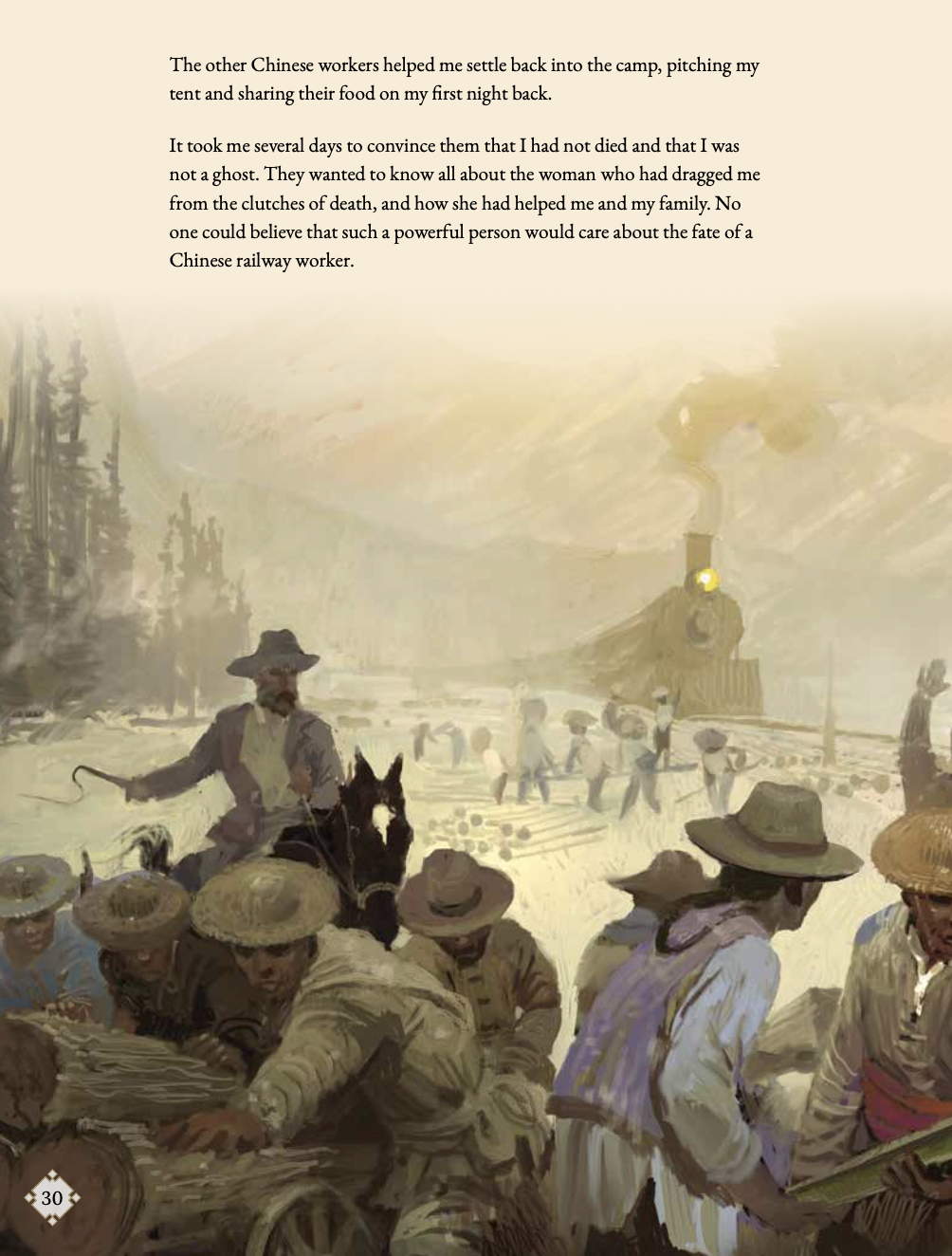
When he falls ill, laying in the snow as if already dead, and is ignored by the foreman, Lady Amelia Douglas, the visiting wife of the late Governor of BC, comes to his aid and demands he be taken to her home in Victoria. Although the men at the camp tell his family he has died, Mrs. Douglas gets him medical attention and, once she learns of his family days later, brings them to him. After several weeks, his family returns to Chinatown and he to the railway.
From I Am Not a Ghost by David Bouchard with Zhong-Yang Huang, illus. by Sean Huang
But, upon his return, his countrymen are aghast, convinced they are seeing a ghost. He has to persuade them with the words of the book's title that he is not a ghost and recounts the goodness and compassion of Mrs. Douglas, a Métis woman, who was their friend like other Indigenous people. 
 
Because of the kindness of Mrs. Douglas, he was able to survive the building of the railway, build a business and extend kindness to other Chinese immigrants, helping to grow a compassionate and vibrant community.
From I Am Not a Ghost by David Bouchard with Zhong-Yang Huang, illus. by Sean Huang
Non-fiction books that teach history, especially those used in schools, tend to be verbose and comprehensive, skimming over many topics, using dense text, and leaving no memorable impression. I Am Not a Ghost is not such a text. By focusing on the immigrant experience of one Chinese Canadian in the 1880s, Victoria's David Bouchard with Regina's Zhong-Yang Huang effectively place young readers into the treacherous life of working on the railway as a Chinese immigrant in the 1880s. The toil, the racism, and the unfairness of conditions and treatments all speak to oppression and perseverance in that oppression. The story of this man is heartbreaking and very real, as is the true story of the building of the railway and Mrs. Douglas with her  compassionate nature. ("Historical Notes" at the end of the book give further details about the context for the story of I Am Not a Ghost.)
 
With the seriousness of the story and the realism of a historical narrative, the art of Sean Huang adds to the story, taking us from frozen landscapes of workers in canvas tents or collapsed in snowbanks, to the opulence of a fine lady's Victorian home, to the busyness of countless workers on the railway. Combining both a heaviness and lightness to his brushstrokes and the classic palette of old masters, Sean Huang takes us into the past of David Bouchard and Zhong-Yang Huang's story, and tells a history where a man is disregarded because of his heritage and taken for dead because he might not have mattered enough to be helped.

If you're a teacher of Canadian history for young people and want a fresh take on the building of the railway, I Am Not a Ghost provides a very personal story that goes beyond the placement of that last spike and reminds us that achievements are often on the backs of others who should be recognized and their stories told.

September 21, 2022

The Book of Elsie (Orca Currents)

Written by Joanne Levy
Orca Book Publishers
978-1-4598-3424-8
160 pp.
Ages 9-12
RL 2.8
August 2022

With the upcoming Jewish holiday of Purim–that commemorates the salvation of the Jewish people against the evil Haman in 5th c. BCE  Persia, as told in the Book of Esther–Elsie Rose-Miller is buzzing with excitement. For her synagogue's Purim party, she's planning on going as the fierce Queen Esther. Abba, her father, is a theatre costume designer and he's helping with her dress. But when her other dad who is on the temple's board learns that the party will have to be cancelled because of finances, Elsie jumps into action, emulating the strong Queen Esther, determined to save the party and the synagogue.

Rallying Rabbi Alisha and members of their Sunday school, Elsie suggests selling tickets to the Purim party and extending sales beyond their temple. It would seem that everyone is on board and sales are going well, especially with some hamantaschen cookies (recipe appends the book!) to accompany the tickets. But community outreach becomes a little tricky, particularly when approaching strangers, and Elsie and her best friend Grace must contend with antisemitism and racism respectively. Worse yet, when a hate crime is perpetrated against the synagogue, a cancelled Purim party may be the least of their worries.

Joanne Levy has written several middle grade novels where she enlightens young readers about Jewish traditions and the community (e.g., Sorry For Your Loss, The Sun Will Come Out) but this may be the first in which she tackles antisemitism and hate crimes against the Jewish community. That's a heavy topic but Joanne Levy embeds it in a story about courage and communities rather than focusing on the violence or the brutality of offensive remarks. Both Elsie, a Jewish child, and Grace, a person of colour, are exposed to the hate but their histories with that hate are different and, as such, their immediate responses may be different. They both recognize the ignorance involved; however, as part of communities of caring individuals, they see beyond the fear and sadness–"Hate has never solved any problems" (pg. 130)–and work to make things better. 

The story line is strong, encompassing social justice and Jewish traditions, tolerance and inclusivity. But the writing is persuasive, especially as Joanne Levy has written it as a hi-lo (high interest-low reading level) book, thereby reaching a wider audience with her story. As part of the Orca Currents series, The Book of Elsie may be geared to middle graders who are reading below grade level but it's actually opened up the opportunity for younger readers, middle graders and even teens who are striving to read to get a compelling story with a contemporary theme. In a time when hatred is voiced openly on social media and threatens many communities, The Book of Elsie reminds us that there is goodness out there and, with a little courage and determination, it can overcome everything.

February 01, 2021

Kid Sterling

Written by Christine Welldon
Red Deer Press
978-0-889956162
432 pp.
Ages 10+
August 2020 

If Sterling Crawford had a soundtrack to his life, it would be ragtime and the blues. It would lift him up and mirror his lows, get him through the tough times and celebrate the highs. It would remind him of trains and rivers, work and family. And he would be known to the music world as Kid Sterling.

In the early 1900s, Sterling Crawford is just a ten-year-old boy living in New Orleans with his Momma and his seventeen-year-old brother Syl, shining shoes on Basin Street and dreaming of playing his horn for the King, Buddy Bolden.
...the notes from Buddy's cornet were cannonballs that shook Sterling's bones, the tone clear and pure, teasing and lusty, till he felt himself lifted up and away, a catfish on a hook. (pg. 19)
As much as Sterling wants to play music and learn how to write it, life is not as straightforward as he might wish. Even recognizing the threats and discriminatory limitations imposed on him by his black heritage, Sterling dreams of more, just as Syl does. But Syl who has instructed Sterling to never reveal them to be brothers, whether to pass himself off as white or to simply protect Sterling, goes beyond playing drums to make a better life. He works for a local gangster, gambles, and involves himself in other nefarious activities, even stealing money that Sterling had been saving for a new horn. With a strained relationship, Sterling and Syl head to Plaquemine for a cousin's birthday celebration and a musical gig for Syl. But everything shatters when Syl is forced to protect them from assault by a white man. The two separate and only Sterling returns to New Orleans where he is eventually arrested for assault.

Being sent to Captain Jones's Colored Waifs Home for Boys, Sterling feels like it's the end of the road for him.
A distant bugle sounded the end of the day. He figured his whole life was just like that bugle–out of tune. All his young life, his mother had sung to him, called him in to supper, to chores, to his bedtime. As he waited for sleep, he conjured the sound of her rich voice, humming those bluesy tunes to wrap him in safety and love. But memories brought him no comfort. Tonight, he had only loneliness and sour notes to call him to slumber. (pg. 233)

Still, Sterling learns more about himself and about music, even how to "...make some harmony out of the sour" (pg. 287). And there is a lot of sourness that pervades Sterling's life. Bad things, like notes on the wind, keep finding their way to him. He makes the best choices he can given the circumstances. Sometimes they work and sometimes they don't. And sometimes it doesn't matter. In the end, it's still his story, and Christine Welldon tells it with authenticity and compassion.

Because Christine Welldon's background is as a non-fiction writer (e.g., Everyone Can Be a Changemaker, Reporter in Disguise, The Children of Africville, and Lifelines: The Lanier Phillips Story), you can be assured that Kid Sterling is a carefully and thoroughly researched book. Though Sterling himself is a fictionalized character, Buddy Bolden, Clarence Williams, Captain Jones and Armand Piron as well as others (Christine Welldon provides background on them at the conclusion of her book) were very real men who shaped Sterling's life and undoubtedly those of real individuals. But by embedding a fictionalized young African American boy in a true representation of New Orleans at the beginning of the 20th century, Christine Welldon can build her story on him and his world without limitation. She can tell of the horrific racial discrimination from Sterling and his peers' perspectives, seeing how justice was served up based on the colour of skin. She can weave in the music of the day and how it was played and learned and disseminated. She can reveal how fear could dry up the music for Sterling, and how fear for self, family and friends impacted living.
If his life were like a music book of stories, Sterling felt as strong as the spine that bound and divided it down the center. One part was finished, its pages full. The rest contained empty notation lines, waiting to be filled. (pg. 406)
If Kid Sterling was a piece of music, it would be a hymn of pain and promise, hope and struggle. But that hymn should portend better, for Sterling and others whose lives were never given full voice. Let that new song stay true now and forever.

February 18, 2020

Meet Willie O'Ree (Scholastic Canada Biography)

Written by Elizabeth MacLeod
Illustrated by Mike Deas
Scholastic Canada
978-1-4431-7561-6
32 pp.
Ages 5-9
January 2020

Though there is still time to read this illustrated biography for Black History Month, Meet Willie O'Ree will become one of those books that will be a go-to story about civil rights, athleticism and perseverance that will resonate throughout the year.
From Meet Willie O'Ree by Elizabeth MacLeod, illus. by Mike Deas
Willie O'Ree was born on October 15, 1935 in Fredericton. By the time he was 5, he was already skating and playing hockey, though he liked all sports, including baseball, tennis, volleyball, rugby and swimming, and enjoyed school. Though the kids in his neighbourhood all played together regardless of skin colour, Willie and other black people had to deal with discrimination. But Willie knew that things had to change, and when, at thirteen, he defied the racist requirement that blacks get their hair cut outside the barbershop, he took an important step in saying "No" to discrimination.
From Meet Willie O'Ree by Elizabeth MacLeod, illus. by Mike Deas
Though a great hockey player, Willie also played baseball, even trying out for Milwaukee's minor league team. But, travelling in the Deep South, Willie was disgusted by the racism he endured at hotels, on buses and most everywhere, so he was pleased when he was let go and able to return to Canada and play hockey. He started playing in 1952 and made his way through different and progressively better leagues. However, when playing for a major junior league team, Willie took a puck in the eye and was blinded. Still, he never told his team, fearing it would prevent his rise to the NHL.
From Meet Willie O'Ree by Elizabeth MacLeod, illus. by Mike Deas 
Willie became the first black player in the NHL, playing for the Boston Bruins. He still endured racist comments from opposing players but he fought back. He was traded several times and ended up in pro leagues other than the NHL but he didn't retire until he was forty-three, and then went on to work for the NHL's Diversity Task Force, helping to encourage children of colour to play hockey.
From Meet Willie O'Ree by Elizabeth MacLeod, illus. by Mike Deas
The accolades and honours Willie O'Ree received were numerous but probably none as great as his induction into the Hockey Hall of Fame in 2018.
Willie reached his goal of playing in the NHL by believing in himself. He worked hard, even when he faced racism and serious injuries. And he never gave up on his dream. (pg. 29)
Author Elizabeth MacLeod and illustrator Mike Deas probably had a tough job telling Willie O'Ree's incredible story. From his childhood and experiences with racism to his athletic career with its ups and downs and more racism, Willie O'Ree endured much, accomplished more and persevered always. His story is one of effort and determination, and Elizabeth MacLeod makes sure to tell as much of his story as possible, including a timeline with photographs at the end of the story.

Mike Deas's illustrations, which are a blend of digital art with gouache, watercolour and ink, are animated, showing a kid with a love of sports and a young man determined to play a sport he loved. Though the art is cheerful, it finds a way to demonstrate Willie O'Ree's experiences with racial discrimination and hardship related to his injury without ever trivializing either.
 
It was a pleasure to meet Willie O'Ree, a pioneer of black achievement in hockey and a hero of sports dreams. 
•••••••••

With Meet Willie O'Ree, the Scholastic Canada Biography series now includes five volumes.

February 07, 2020

Tickled Pink: How Friendship Washes the World with Color

Written by Andrée Poulin
Illustrated by Lucile Danis Drouot
Pajama Press
978-1-77278-104-5
32 pp.
Ages 4-7
February 2020 


I'm tickled pink by any book that supports diversity and acceptance of differences as the norm so I'm especially thrilled about a picture book that supports this message in as subtle and eloquent a way, as well as playful, as Tickled Pink: How Friendship Washes the World with Color.

When Zac the zebra and Poncho the panda are playing and Filippo the flamingo asks if he can join them, he is told that he is too pink, a colour which gives Poncho a headache. But when Filippa asks his parents, they tell him pink is the colour of kindness and happiness. So Filippo tries again.

From Tickled Pink: How Friendship Washes the World with Color by Andrée Poulin, illus. by Lucile Danis Drouot

From Tickled Pink: How Friendship Washes the World with Color by Andrée Poulin, illus. by Lucile Danis Drouot
Zac and Poncho are now rude to Filippo, telling him they don't want him to play and that "Pink doesn't mix with black and white." His grandmother shows him with her paints how wrong that idea is. So Filippo adds some black and white paint to his body and asks politely again. But, of course, Zac and Poncho continue to make excuses, about pink being the colour for babies who cry and princesses who are fussy.

From Tickled Pink: How Friendship Washes the World with Color by Andrée Poulin, illus. by Lucile Danis Drouot

Though Filippo gets support from his family, it's input from his shy peer, Ludo the lemur, that makes things right for Filippo.  Ludo recounts to Filippo all the wonderful things that come in pink: shrimp, salmon, bubble gum, cherry blossoms, begonias, peonies, petunias, and roses. And Ludo, who is black and white, says he would be pleased to play with Filippo. That play includes adding a little pink paint to the sleeping zebra and panda, who are not pleased, but also to other animals who are "tickled pink to go pink."

From Tickled Pink: How Friendship Washes the World with Color by Andrée Poulin, illus. by Lucile Danis Drouot
The story in Tickled Pink is far from black and white. It goes beyond a story of excluding those who are different. It demonstrates how much we all want to be included.  Filippo could have thrown up his wings and said, "Fine, I don't want to play with you, Zak and Poncho" but he didn't. He questioned his parents and his grandmother and his sister, all to help him grasp what being pink meant. But bullying and intolerance are incomprehensible, especially when "reasons" are given to explain the intolerance. I'm glad Andrée Poulin gave Filippo a quiet and insightful friend in Ludo who proves that it's not the black-and-white animals that lack understanding, but just one zebra and one panda. (Okay, there may be others out there, there always are, but it's clear that it's not all black-and-white animals.) For intolerance to be eliminated, everyone needed to see beyond the colours.

Artist Lucile Danis Drouot keeps her palette, until the very end, black, white, gray and pinks to emphasize the separation that Zak and Poncho highlight but she adds a playfulness in her animals' activities–vine-climbing, soccer, volleyball, and badminton–that embeds the message in gentleness and whimsy. A final spread resplendent in pinks brightens the world in happiness and friendship.

Like any racism or discrimination, the zebra and the panda could have arbitrarily chosen an attribute other than colour, such as non-feathered vs. feathered, or four-legged vs. two-legged.  But, like so many who discriminate, they chose colour. Fortunately, there are so many who don't see the colour, only the substance, and infuse our world with goodness and acceptance.

September 29, 2019

Just Lucky

Written by Melanie Florence
Second Story Press
978-77260-104-6
248 pp.
Ages 13-18
September 2019

Though the beginning of her life was less than stable, born of a gambling-addicted mother (hence Lucky’s unusual first name) with a crack habit, much of Lucky Robinson’s fifteen years were spent in a loving home with her grandparents. But, when her grandmother’s dementia advances rapidly after Grandpa’s death, Lucky’s life takes a staggering turn that disconnects her from the support and security she's always known.

Though Lucky is aware that Grandma’s forgetfulness is becoming serious, she is unprepared for the fire Grandma accidentally starts. But at the hospital, the Children’s Aid Society is called to take responsibility for the underage Lucky as Grandma receives care. Sadly even a phone call to her ghost of a mother brings nothing except clarity that Lucky is well rid of a woman more concerned about her boyfriend and the proceeds from the potential sale of Lucky's grandparents' house. As such, Lucky begins the complex journey into the foster care system.

Her first foster placement is with the hyper-religious Mary and Robert Wilson and their teen son Bobby. Lucky tries to be accommodating, submitting to Mary’s requirements for chaste dress, the saying of grace before meals and homeschooling. But a threat within requires Lucky defend herself both with a knife and with the truth to those who refuse to acknowledge inappropriate behaviours by those entrusted with her care. The consequence is that child care worker Cynthia drags victimized Lucky to a second home.

With her new living accommodations with foster parents Sarah and Edward and teens Jake and Charlie, Lucky begins to feel a little luckier. Though home is more stable and welcoming, Lucky must contend with racism and bullying at school at the hands of Elyse who has her sights on Jake and sees his interest in Lucky as competition. Victimized again for being Indigenous, and for defending Charlie, a boy from the Dominican, Lucky is expelled, steering her to yet another foster family but also to the school she attended with best friend Ryan.

Though Lucky continues to hold onto the hope that she will be reunited with her grandmother who has both good and bad days, when Grandma is moved to a care facility, Lucky starts to wonder whether she has any luck at all and may ever again have a place of home where she will feel safe.

Melanie Florence who touched us with her award-winning picture books Stolen Words (Second Story Press, 2017) and Missing Nimâmâ (Clockwise Press, 2015) takes a simple germ of an idea–that of a child in foster care–and makes it in bigger story, as it should be. Entering foster care is a life-altering experience from which some children may or may not recover.  As in her earlier picture books about residential schools and missing and murdered Indigenous women, the story is simple but the message monumental. Not all lives are easy and picture perfect and Lucky's certainly is not. Not all foster homes are great or horrible.  Not all foster families are caring, though that is their mandate. Lucky's story evolves from a tragedy that snowballs into overwhelming disaster. Though I’m sure, as the saying goes, it could have been far worse, Lucky's story, which is one of trial and hardship, does end with some semblance of good fortune and contentedness, perhaps even hope for a happy ending.

September 05, 2019

Our Future: How Kids are Taking Action

Written and illustrated by Janet Wilson
Second Story Press
978-1-77260-103-9
32 pp.
Ages 7-12
September 2019
Together, we want to show that everyone can do something for our future and that together, as a world family, we can solve these problems.
With that hopeful message, Janet Wilson begins her latest non-fiction book about young activists who are working to make a difference.

In each double-spread, Janet Wilson dedicates original art and story to one warrior for world justice and then also mentions two other influencers who have taken on a similar cause. In the breathtaking mixed media technique of hot wax painting–applying layers of hot beeswax mixed with resin and oil colour–Janet Wilson depicts young activists in rich landscapes of place and triumphs. Her art is deep in texture and colour, luxuriant in its content and in its composition. 
From Our Future: How Kids are Taking Action by Janet Wilson
Canada's Autumn Peltier from Wiikwemkoong Unceded Territory on Manitoulin Island is profiled for her advocacy for clean drinking water for her community which supported the work of her aunt, Water Walker Josephine-ba Mandamin.  Stella Bowes and Marcus Deans are also showcased for their work to ensure water quality in Canada and elsewhere.

American Jaelun Parkerson encouraged his youth football team to emulate Colin Kaepernick's taking of the knee to protest racism and police brutality while Hebh Jamal organized protests against Islamophobia and Claudette Colvin's actions in 1955 helped end bus segregation in Alabama.

In Indonesia, sisters Melati and Isabel Wijsen organized themselves to get plastic bags banned where they live, and Edgar Edmund Tarimo and Hannah Testa have both taken action to combat plastic pollution at home and globally.
We youth may only be 25 percent of the world's population but we are 100 percent of the future. 
(Melati and Isabel Wijsen, pg. 11)
From Our Future: How Kids are Taking Action by Janet Wilson
Jesse Thompson fought against discrimination leveled against him as a transgender hockey player and Ke'Shon Newman has spoken out against the prevalence of gun violence in America.
"Our voices are LOUD. Our voices are CLEAR. And, our voices are about to change HISTORY."
(Ke'Shon Newman, pg. 25)
From Our Future: How Kids are Taking Action by Janet Wilson
These are young leaders who are fighting against pollution, climate change, against cruelty to animals, in support of those struggling in war-torn countries and seeking refuge. They are fighting gun violence, bullying and supporting mental health. They live in Canada and the U.S. as well as in Kenya, Hong Kong, New Zealand, Indonesia, Colombia and elsewhere. Their stories are as diverse as their issues of concern and their homelands. It becomes evident that there is much in our world that needs fixing and that there are many young people around the globe who are willing to step up and take action.

With Our Future: How Kids are Taking Action, Janet Wilson has added new stories to her impressive series (see other titles in this series below) regarding laudable young people who recognize their obligation to do something to make the world a better place than the one they have inherited. Kudos to them for putting themselves out there and encouraging others to do the same, and to Janet Wilson for shining a light on their extraordinary efforts.

Our Earth: How Kids are Saving the Planet (2010)
Our Rights: How Kids are Changing the World (2013)
Our Heroes: How Kids are Making a Difference (2014)
Our Future: How Kids are Taking Action (2019)

March 06, 2018

The Marrow Thieves

Written by Cherie Dimaline
Dancing Cat Books/Cormorant
978-1-77086-486-3
231 pp.
Ages 14+
2017
Poisoning your own drinking water, changing the air so much the earth shook and melted and crumbled, harvesting a race for medicine. (pg. 47)
This is the world in which Frenchie is trying to survive.  After his father had gone with the Council to the Southern Metropolitan City, hopeful of enacting some change, and their mom passed, it was just Frenchie and his older brother Mitch evading the Recruiters, truancy officers seeking Indigenous people to place in their new version of residential schools.  Seems that, though all were highly impacted by the stresses of water shortages, climatic shifts and conflict, non-Indigenous people lost the ability to dream and sought out Indigenous Peoples for their bone marrow as a source for that ability.  What actually happened in the schools, though, was the stuff of rumours and nightmares.

When Mitch sacrifices himself to the Recruiters to save Frenchie, the teen heads north and joins a  group headed by a man named Miigwans and the Elder Minerva, along with teens Chi-Boy and Wab, twelve-year-old twins Tree and Zheegwon, and a young boy Slopper and seven-year-old RiRi.  Along with a new arrival, Rose, the mixed group of Cree, Métis and more, from the east coast and the west lands and everywhere in between, work to stay safe, learn "old-timey" skills like hunting and homesteading but also language which has been lost.  Each comes with their own creation story, framing their lives with the scars of their histories and the jewels of their heritage.  How they will outrun their pasts and those who seek to harm them while making some future in a world gone terribly wrong can only be told by those telling the story and dreaming.

While the environmental degradation alone could result in the dystopia of The Marrow Thieves, it is but a fraction of the agony of the world Cherie Dimaline has created.  It is a world that has gone beyond decline and into catastrophic collapse.  The heinous racism against Aboriginal Peoples coupled with the carnage perpetrated against them is terrifying but not unfamiliar.  By telling this story in a dystopian world set decades into the future, Cherie Dimaline tells much more about the past.  Still, within that horror, there is a wisdom of self and others, a pocket of compassion and understanding that might be the only hope.
"...running only works of you're moving towards something, not away. Otherwise, you'll never get anywhere." (pg. 217)
Moreover, Cherie Dimaline tells it with such depth of feeling and imagery that The Marrow Thieves becomes a lyrical epic.
Out here stars were perforations revealing the bleached skeleton of the universe through a collection of tiny holes. And surrounded by these silent trees, beside a calming fire, I watched the bones dance.  This was our medicine, these bones, and I opened up and took it all in. And dreamed of north. (pg. 9)
The accolades for The Marrow Thieves have been robust and far-reaching.  They include winning the 2017 Governor General for Young People's Literature and the 2017 Kirkus Prize; a nomination for the Forest of Reading's White Pine Award; selection as The Globe and Mail Best Book; and most recently selection for CBC's 2018 Canada Reads battle of the books. The Marrow Thieves deserves each honour and more as does its creator Cherie Dimaline for weaving a cautionary story of sorrow and history with a future that still has a sliver of reverie.