Showing posts with label Japanese internment. Show all posts

October 10, 2023

Shizue's Path

Written by Mark Sakamoto
Illustrated by Rachel Wada
HarperCollins
978-1-44346-459-8 
48 pp.
Ages 5-8
September 2023
 
You need to know your darkness to know your light.

This is a story from history of history. It's a history too many lived and one which should not have happened and should never happen again. Still, it is a story of resilience and courage that arose from discrimination.
From Shizue's Path, written by Mark Sakamoto, illus. by Rachel Wada

Shizue, now an elderly woman, welcomes her granddaughter to hear her story. Though her memory may be less than reliable about some things, Shizue remembers vividly her father heading out to fish and worrying about his safe return. He always reassured her.

When I am on the water, I am the water. I am clear. I am flowing. I am finding a path forward. Someday you will, too.

But then everything changes with the onset of World War II.

A war from far across the ocean washed up on our new country’s shore. 
First came the anti-Asian leagues and their protests. Then Japanese Canadians had their homes and businesses taken away and Shizue's family was relocated to the prairies. It was years before Shizue was able to return to school, and longer, not until after the war, before the family was able to return home. Still, it was not the same.
From Shizue's Path, written by Mark Sakamoto, illus. by Rachel Wada
Again, Japanese Canadians were being threatened, this time with deportation to Japan. Shizue, now a young woman attending the University of Toronto, finally saw that there were those, particularly Rabbi Abraham Feinberg, who would speak against the unfair treatment of Japanese Canadians and promote messages of peace, not hate. She took from them lessons of compassion and courage that set on her own true path.
From Shizue's Path, written by Mark Sakamoto, illus. by Rachel Wada
Mark Sakamoto, author of Forgiveness: A Gift from My Grandparents, an adult fiction book that won the CBC Canada Reads in 2014, has taken a personal story–that of his aunt–and made it one of calm triumph over adversity. Shizue learned well from her father about seeing her path, to follow "Shikata ga nai" (trans. "It cannot be helped; you must carry on.") and from others like Rabbi Feinberg to create her own ripples of courage and compassion, wisdom and goodness. The stories of Japanese Canadian internment are plentiful, each providing a different perspective and context–see Mira and Baku, Naomi's Road, Torn Apart: The Internment Diary of Mary Kobayashi, Vancouver, British Columbia, 1941 and Stealing Home for just four examples–and Mark Sakamoto gives us yet another one, taking young readers along Shizue's Path from childhood to young woman and grandmother. And he gives us her story with a poetry of depth of emotion and wisdom. He makes her story beautiful, even in its darkness, just as artist Rachel Wada does.

Vancouver's Rachel Wada's first illustrated book, The Phone Booth in Mr. Hirota's Garden (written by Heather Smith), won the Elizabeth Mrazik-Cleaver Canadian Picture Book Award for 2020, and her success with showing the weightiness of the story with the beauty of people and place is again evident in Shizue's Path. The gravity of Shizue's family's situation because of the anti-Asian racism and the lightness that comes with reading, family, and evidence of kindness are all demonstrated in Rachel Wada's art. She uses line and colour effectively to take us on that journey of adversity and comfort, through darkness into light, triumphant with wisdom and compassion.

Just as Shizue learned from her father and others about how to be resilient and show compassion, so will young readers for whom internment may or may not be an unknown concept. Shizue's Path demonstrates that Shizue could move through hardships and take important lessons from those who had the courage to share.

October 06, 2023

Mira and Baku

Written by Sara Truuvert
Illustrated by Michelle Theodore
Annick Press
978-1-77321-756-7
44 pp.
Ages 4-7
September 2023

Mira can think of nothing other than her birthday is days away and her father is not with her and her mother. Will he miss her birthday for the first time ever? Perhaps with her imaginary friend Baku, a creature of Japanese mythology who is said to eat nightmares, Mira can find her father.
From Mira and Baku, written by Sara Truuvert, illus. by Michelle Theodore
But, as consequential as the issue of an absentee father is for a child, there is greater depth to Sara Truuvert's story because Mira and her mother are being detained at an internment camp. It's the 1940s when Japanese Canadians were forced to relocate, losing homes and businesses, and separating families. But Mira does not know all this. What she knows is that her father received a letter and then he was gone, and that Mira and her mother are now confined to an isolated community of internees, mostly women and children. 
From Mira and Baku, written by Sara Truuvert, illus. by Michelle Theodore
Still Mira holds on to the good things from before, especially the stones she and her father collected which she keeps in a sock. She remembers finding stones with him and the stories that came with them. There's the stone that turns green when wet that he'd melodramatically presented to Mira's mother. There's the glittery white one that came from a box of fresh salmon her dad was unpacking for his store.
From Mira and Baku, written by Sara Truuvert, illus. by Michelle Theodore
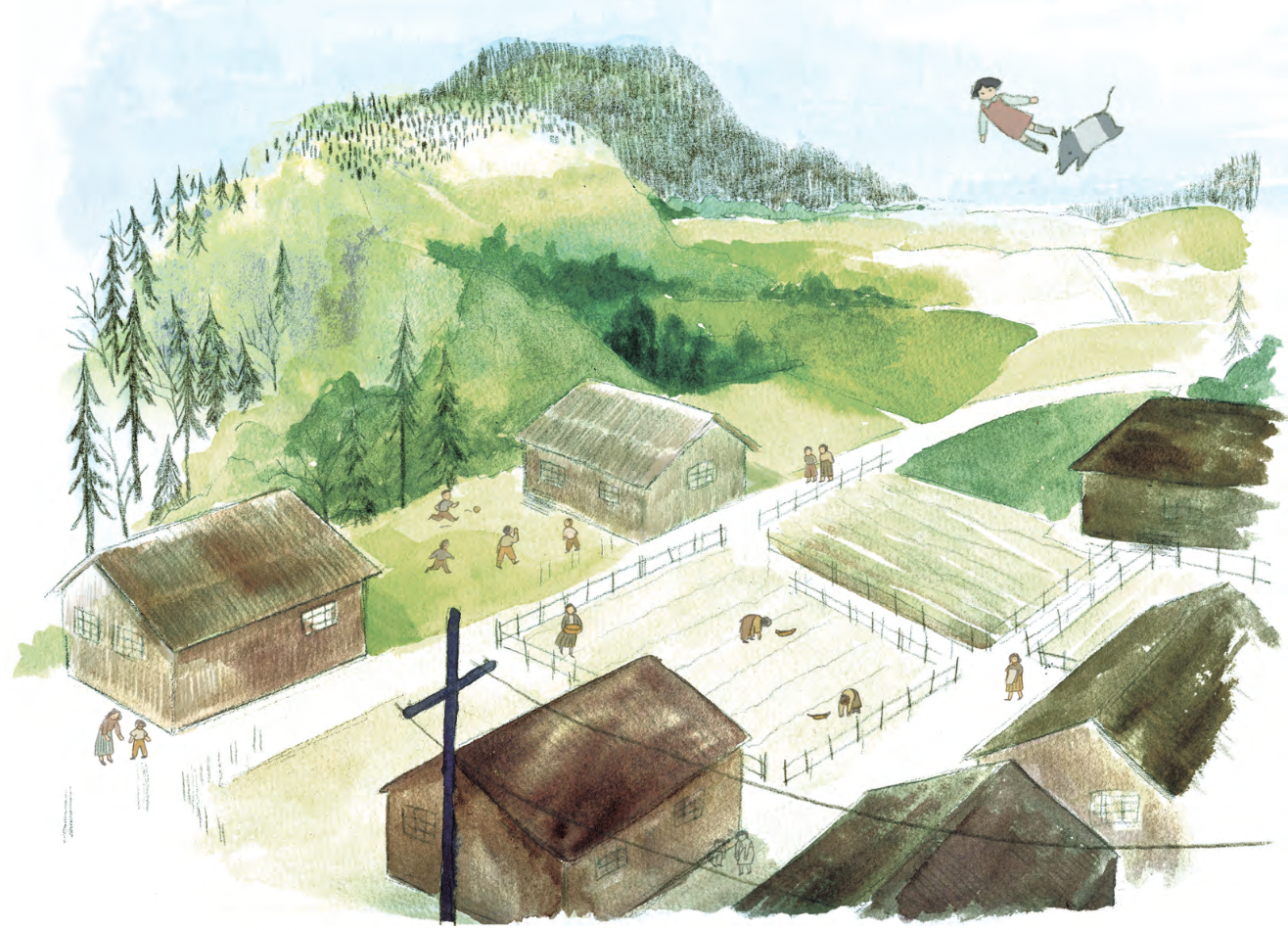
Worried her father has forgotten about her, Mira flies away with Baku to look for him. Together, she and Baku visit the family business, now deserted, and their old house. Disappointed in not finding her father, she begins to give up hope. And though she doesn't get exactly what she wants for her birthday, the day brings a surprise that reassures and reinforces the connection she has with her father.

Without making this a story of the Japanese internment, debut author Sara Truuvert has written a story that embodies the hardship and loss experienced by Japanese Canadians because of that unjust treatment. Sara Truuvert gives us the unique perspective of a child wishing to see her father on her birthday, as she always had, and coping with that anguish by creating an imaginary friend from a mythological creature. Baku, who is a hybrid creature of parts of an elephant, rhino, cow, bear, and tiger, allows Mira to speak her worries, feel her sadness, and imagine better. Baku gives her the opportunity to do something in a situation where she can do nothing. As such, Sara Truuvert's approach is sensitive and yet very complex, allowing Mira to be a child in a very grave situation and offer her hope through her imagination and memory.
From Mira and Baku, written by Sara Truuvert, illus. by Michelle Theodore
 That sensitivity is seen in the illustrations of Edmonton artist Michelle Theodore, who gives us the historical perspective of the internment, both of the camp where Mira and her mother live, as well as the work camp where her father has been incarcerated, and reminiscences of the family's life before internment. Memories from before are presented in pale yellows, appropriate considering how faint they might seem to Mira. The camps themselves are dreary and utilitarian, and Michelle Theodore keeps the best for the world outside the camps and for Mira's stones. The forests over which Mira and Baku fly are green and lush, and her stones are multicoloured. Within those elements, there is true spirit that will vitalize Mira, with a little help from her imaginary friend who is both soulful and calming.

Sara Truuvert provides an author's note that delves into the internment of Japanese Canadians as well as an appeal to reject fear of those who are different. With Mira and Baku, Sara Truuvert and Michelle Theodore give young readers an opportunity to see the misjudgments from our history and how children may be impacted. They also offer the promise that relief can come in an unexpected form, including imaginary.

May 08, 2023

Kimiko Murakami: A Japanese-Canadian Pioneer (Trailblazing Canadians)

Written by Haley Healey
Illustrated by Kimiko Fraser
Heritage House
978-1-77203-431-8
32 pp.
Ages 4-8
May 2023
 
It's Asian Heritage Month and I am pleased to present this picture book about Kimiko Murakami: A Japanese-Canadian Pioneer whose story of courage, resilience, and determination, along with a ganbaru spirit, propelled her to make a good life for herself, her family, and others.
From Kimiko Murakami: A Japanese-Canadian Pioneer by Haley Healey, illus. by Kimiko Fraser
Kimiko Murakami was born in a coastal village outside of Vancouver and moved with her family to Salt Spring Island when she was five. There the family fished and then farmed, raising chickens and fruits and vegetables. When she married, she and her husband and children continued to work on the farm. That is, until World War II came, and all people of Japanese heritage were removed from their homes and interned at various camps both in BC and in Alberta.
From Kimiko Murakami: A Japanese-Canadian Pioneer by Haley Healey, illus. by Kimiko Fraser
These times were difficult for Kimiko and her family, yet she never gave up, determined to be guided by the Japanese word "ganbaru" which means "to push through hard times and never give up." Through horrible living conditions and hard work and multiple relocations, Kimiko kept up her ganbaru spirit. 

Once WWII ended and they were still not allowed to return home, Kimiko's family opened a restaurant in Alberta, determined to save their money and return to Salt Spring Island. It took 12 years since they'd left to finally return, but return they did. Still, their land and belongs were gone, long ago sold, and racism was widespread. Nevertheless, Kimiko kept her ganbaru spirit while she and her family rebuilt the life that had been taken from them.
From Kimiko Murakami: A Japanese-Canadian Pioneer by Haley Healey, illus. by Kimiko Fraser
While this is essentially an illustrated biography, Kimiko Murakami: A Japanese-Canadian Pioneer goes beyond the facts of Kimiko Murakami's life. Haley Healey may include a historical timeline from Kimiko's birth in 1904 to her death in 1997 but the author delves deeper, focusing on Kimiko's spirit and what enabled her to endure the hardships involved with the detention of Japanese Canadians. In fact, Kimiko and her family didn't just endure. They persevered and rose above the injustice of discrimination and maltreatment to regain the life they had earned and lost. Moreover, they remembered. And with those memories came a fundamental need to help others who also struggled. BC's Haley Healey tells us Kimiko's story but, more than that, she tells us about her.

BC artist Kimiko Fraser, who uses a variety of media in her work including watercolour, digital, ink and tea, was inspired by original images of the Murakami family from archives and museums. But her artwork goes beyond photorealism, as she depicts the heart of a family as they face uncertainty and persecution and still show strength and ganbaru. It's there in the faces and the way they hold themselves. So, Kimiko Fraser could emphasize the greys and browns of a challenging life of work and struggle, but she also gives the story colour with a hopeful branch of cherry blossoms, fruits and vegetables, and peonies. As Haley Healey does with her words, Kimiko Fraser does with her art, going beyond the worst and including the best.

I suspect that Kimiko Murakami's story is better known on Salt Spring Island and in BC than other parts of Canada but, with Kimiko Murakami: A Japanese-Canadian Pioneer, her story can be appreciated far and wide for Asian Heritage Month and always.

February 20, 2016

Heart of a Champion: Book launch (Burnaby, BC)

Join

Ellen Schwartz


author of 

for the launch of her newest
middle-grade novel!


Join her and publisher


Tundra Books
an imprint of Penguin Random House

for the launch of

Heart of a Champion
by Ellen Schwartz
Tundra Books
978-1-77049-880-8
257 pp.
Ages 9-12
March, 2016

on

Sunday, March 13, 2016

2 p.m. (PST)

at

Nikkei National Museum & Cultural Centre
6688 Southoaks Crescent
Burnaby, BC

The book is described as follows on the Penguin Random House web page for the book:
Ten-year-old Kenny (Kenji in Japanese) worships his older brother, Mickey (Mitsuo), a baseball hero whose outstanding performance on the Asahi baseball team has given him fame and popularity. Despite Kenny's suspected heart condition, he is determined to practice secretly with Mickey so he, too, can one day try out for the Asahi. But world events soon overtake life in this quiet community. When Japan attacks Pearl Harbor in 1941, everything for Kenny and his family spirals out of control: schools are closed, businesses are confiscated, fathers are arrested and sent to work camps in the BC interior and mothers and children are relocated to internment camps. When Mickey is arrested for a small act of violence, Kenny manages to keep his family's spirits up, despite the deplorable conditions in camp. Coming across a "vacant" field covered with scrap wood, broken shakes and torn tar paper, Kenny gets permission to clear it and convert it into a baseball field. One by one, the boys in the camp pitch in, and the work gives purpose to their long days. Kenny's persistence, hard work and big dreams shape the teen he is to become in this story of happiness found despite all odds.
Retrieved from http://penguinrandomhouse.ca/books/250703/heart-champion#9781770498822 on February 20, 2016.


March 04, 2012

Torn Apart: The Internment Diary of Mary Kobayashi, Vancouver, British Columbia, 1941

by Susan Aihoshi
Scholastic Canada
978-0-439-94660-5
209 pp.
Ages 8-13
2012

In Torn Apart: The Internment Diary of Mary Kobayashi, Mary turns twelve and looks forward to the simple pleasures of playing tennis with her friends, Sachiko, Maggie and Ellen; going to Girl Guides and Guide camp; attending baseball games with her family; and earning some money for a new bike by berry-picking in Surrey.  Although there is a war going on overseas, her life is filled with the simple joys of childhood and the caring of her large family: Mama and Papa; Geechan (her grandfather); older brothers Tad and Mike; older sisters Kay and Emma; and annoying little brother, Harry.  But soon, small changes impose on her reality.

At school, where they now do "war work" (e.g., sewing, knitting, map-reading, first aid), Mary endures occasional racial slurs, while the older members of her family acquiesce to carrying their registration cards with them.  The veiled prejudice aimed at Japanese-Canadians becomes more public after the December 7 bombing of the American military base at Pearl Harbor and Canada's declaration of war on Japan the following day.  Regardless of their citizenship, beliefs, desire to join Canada's military, or reputations, the Japanese-Canadians watch as their Japanese-language newspapers are shut down, their fishing boats seized by the navy, and secure jobs lost. While the older members of her family experience firsthand the discrimination of Canada's government and society, Mary notes what is happening but continues to enjoy a life rich in friendships and family.

However, the consequences of Japan's activities overseas, including seizing Hong Kong and later Singapore, bring a new round of governmental actions aimed at fraying the freedoms of Canada's Japanese, like requiring them to surrender their cars, radios and cameras; follow a dawn-to-dusk curfew; move to "relocation centres"; and concede to being rounded like Mary's Geechan and sent to work camps in the Rockies and elsewhere.  With Geechan's leaving, the fabric of Mary's family begins to rip, and slowly they become separated: Mike gets orders to work on a road crew; Tad volunteers for work in northern Ontario; the RCMP take Papa; and Emma, Kay and Mary are sent to the ghost town of New Denver, while Mama remains in Vancouver with a hospitalized Harry. 

While reading this newest addition to Scholastic Canada's Dear Canada series, I agonized over the cumulative losses endured by Mary and her family.  But, after finishing my reading, I know that Susan Aihoshi was correct in emphasizing the Torn Apart nature of the Japanese-Canadian story.  Like a strong furoshiki, able to heft great loads, the Kobayashi's are strong because of their connections, as a family, to each other and to their communities, Japanese and Canadian.  But, the challenges of fear and ignorance strive to weaken the fabric, ripping it unceremoniously with Geechan's departure, and more so with each separation.

Susan Aihoshi appropriately uses Mary's voice to express the experience of the Japanese-Canadians during the latter half of World War II.  Mary is neither as naive and oblivious as young Harry, who wants to play war and the board game "Yellow Peril", nor succumbing to the life-altering demands of an ignorant government.  But, she witnesses the perplexing about-turn of an ill-informed society and she tries to keep her reality intact.  Luckily, small kindnesses and thoughtful support slowly weave the frayed threads of that furoshiki together again.  Though never the same as the original, the mending offers some hope for re-creating the family tapestry, perhaps with new threads of different hues and composition.


N.B. Susan Aihoshi includes a wealth of historical notes and graphics to enhance and reference Mary's fictional tale.