Showing posts with label separation. Show all posts

July 10, 2024

See You Later, Alligator!

Written by Lana Button
Illustrated by Noémie Gionet Landry
Scholastic Canada
978-1-4431-9885-1
32 pp.
Ages 3-8
July 2024
 
A lot of kids have anxiety about school. It's being away from home, it's being without the comfort of family, it's a day of unknowns, and it's a day of other's expectations that need to be met. Flora is not necessarily fearful of school but it sure is nice to be with her family and dog, and leaving that to enter a school of strangers isn't very easy.
From See You Later, Alligator!, written by Lana Button, illustrated by Noémie Gionet Landry      
When Flora's moms drop her off at school, getting Flora to get past the gate and into the school yard becomes a monumental feat. It would seem that, though Flora thinks going to school is easy-peasy, she continues to be drawn back to them and her dog for one last hug, or one more kiss, or another goodbye wave. With each rhyming phrase for goodbye–who knew there were so many?–Flora continues to be distracted from joining her classmates in the school yard.
From See You Later, Alligator!, written by Lana Button, illustrated by Noémie Gionet Landry
Some may think that Flora is anxious about school but I suspect it has more to do with wanting to be close to her family than not being at school. She's not crying or complaining about an upset stomach or misbehaving; she just obviously loves her family. It may be a "See you later, Alligator!" and a "Take care, Polar Bear!" and even a "See you soon, Raccoon!" plus extra hugs and kisses and elbow bumps and more before she enters the school, but she does, and is happy to be among her classmates.
 
If you have a little one starting school for the first time, or a young child returning to school after summer holidays, there may be some hesitancy but a reading of Lana Button's See You Later, Alligator! will reassure them that many children feel some unease at leaving the comfort of home for the classroom. In addition to writing a wonderful collection of picture books (e.g., What If Bunny's Not a Bully?, My Teacher's Not Here! and Raj's Rule (For the Bathroom at School)), Lana Button is an early child educator and knows young children and their fears, worries, expectations, and more. As such, she has always aimed her books for their needs, and See You Later, Alligator! is just another stellar example of understanding and addressing how children perceive and react with regards to school and how to best address their needs.
From See You Later, Alligator!, written by Lana Button, illustrated by Noémie Gionet Landry
Noémie Gionet Landry, an illustrator (and doctor!) from New Brunswick, is a new name for me but she is no newcomer to children's book illustration. Her digital artwork has an ease and brightness to it, seeing young children with their animal backpacks, colourful clothing, and diversity in everything about them. Noémie Gionet Landry makes sure that every child will recognize themselves somewhere in See You Later, Alligator! and will find the familiar in its setting and story. She brings the visual to Lana Button's story, ensuring children will appreciate it at a personal level.

Summer vacations may have just started for many children but September (or August or whenever) is around the corner and See You later, Alligator! will be just as important as pencil crayons and a new backpack to starting the year off right. Help your young children see that going to school can be easy-peasy once they get in the door.

October 06, 2023

Mira and Baku

Written by Sara Truuvert
Illustrated by Michelle Theodore
Annick Press
978-1-77321-756-7
44 pp.
Ages 4-7
September 2023

Mira can think of nothing other than her birthday is days away and her father is not with her and her mother. Will he miss her birthday for the first time ever? Perhaps with her imaginary friend Baku, a creature of Japanese mythology who is said to eat nightmares, Mira can find her father.
From Mira and Baku, written by Sara Truuvert, illus. by Michelle Theodore
But, as consequential as the issue of an absentee father is for a child, there is greater depth to Sara Truuvert's story because Mira and her mother are being detained at an internment camp. It's the 1940s when Japanese Canadians were forced to relocate, losing homes and businesses, and separating families. But Mira does not know all this. What she knows is that her father received a letter and then he was gone, and that Mira and her mother are now confined to an isolated community of internees, mostly women and children. 
From Mira and Baku, written by Sara Truuvert, illus. by Michelle Theodore
Still Mira holds on to the good things from before, especially the stones she and her father collected which she keeps in a sock. She remembers finding stones with him and the stories that came with them. There's the stone that turns green when wet that he'd melodramatically presented to Mira's mother. There's the glittery white one that came from a box of fresh salmon her dad was unpacking for his store.
From Mira and Baku, written by Sara Truuvert, illus. by Michelle Theodore
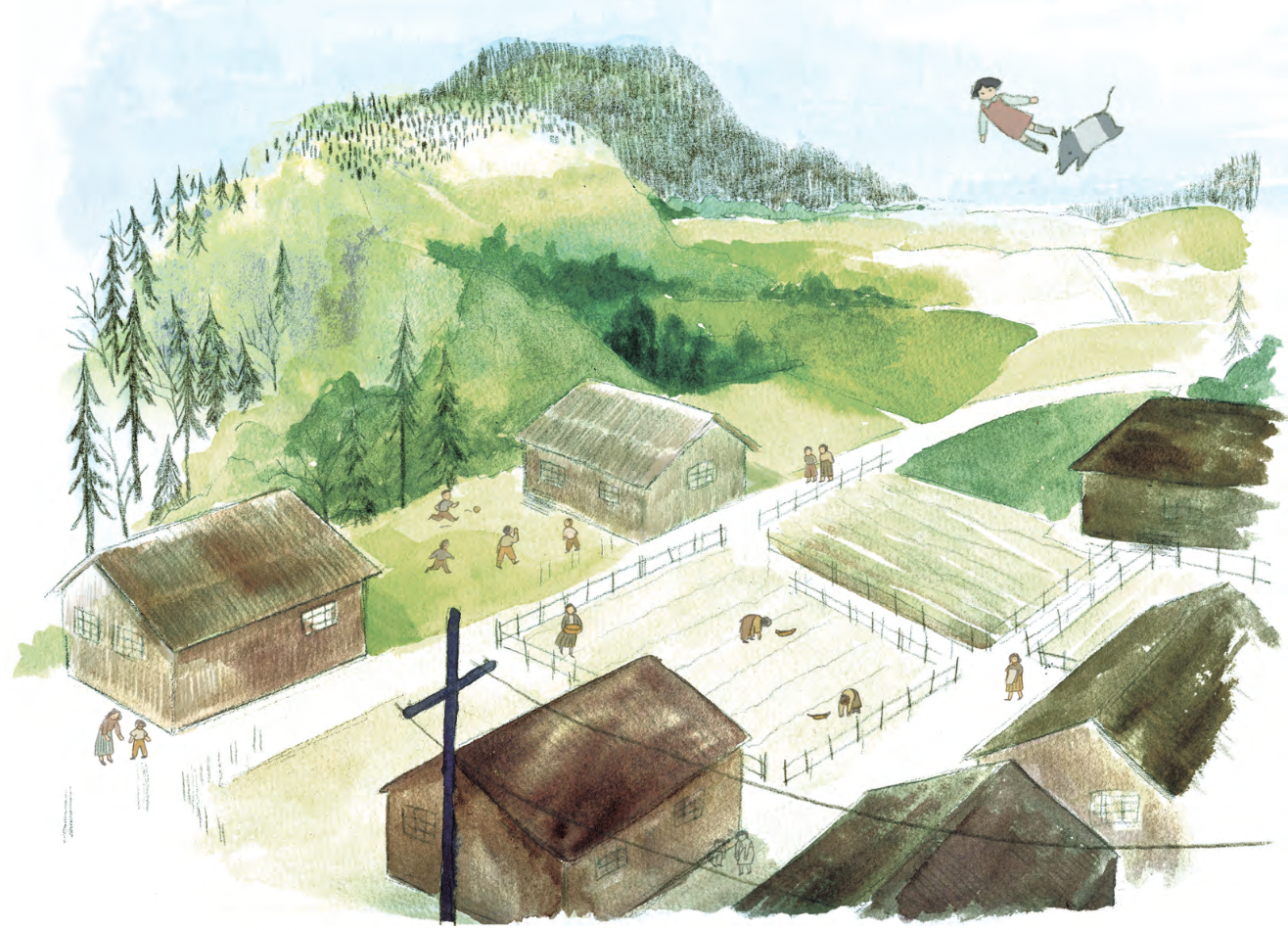
Worried her father has forgotten about her, Mira flies away with Baku to look for him. Together, she and Baku visit the family business, now deserted, and their old house. Disappointed in not finding her father, she begins to give up hope. And though she doesn't get exactly what she wants for her birthday, the day brings a surprise that reassures and reinforces the connection she has with her father.

Without making this a story of the Japanese internment, debut author Sara Truuvert has written a story that embodies the hardship and loss experienced by Japanese Canadians because of that unjust treatment. Sara Truuvert gives us the unique perspective of a child wishing to see her father on her birthday, as she always had, and coping with that anguish by creating an imaginary friend from a mythological creature. Baku, who is a hybrid creature of parts of an elephant, rhino, cow, bear, and tiger, allows Mira to speak her worries, feel her sadness, and imagine better. Baku gives her the opportunity to do something in a situation where she can do nothing. As such, Sara Truuvert's approach is sensitive and yet very complex, allowing Mira to be a child in a very grave situation and offer her hope through her imagination and memory.
From Mira and Baku, written by Sara Truuvert, illus. by Michelle Theodore
 That sensitivity is seen in the illustrations of Edmonton artist Michelle Theodore, who gives us the historical perspective of the internment, both of the camp where Mira and her mother live, as well as the work camp where her father has been incarcerated, and reminiscences of the family's life before internment. Memories from before are presented in pale yellows, appropriate considering how faint they might seem to Mira. The camps themselves are dreary and utilitarian, and Michelle Theodore keeps the best for the world outside the camps and for Mira's stones. The forests over which Mira and Baku fly are green and lush, and her stones are multicoloured. Within those elements, there is true spirit that will vitalize Mira, with a little help from her imaginary friend who is both soulful and calming.

Sara Truuvert provides an author's note that delves into the internment of Japanese Canadians as well as an appeal to reject fear of those who are different. With Mira and Baku, Sara Truuvert and Michelle Theodore give young readers an opportunity to see the misjudgments from our history and how children may be impacted. They also offer the promise that relief can come in an unexpected form, including imaginary.

June 12, 2023

Malaika, Carnival Queen

Written by Nadia L. Hohn
Illustrated by Irene Luxbacher
Groundwood Books
978-1-77306-850-3
32 pp.
Ages 4-8
May 2023
 
Malaika, whom Nadia L. Hohn introduced us to in Malaika's Costume (and revisited with Malaika's Winter Carnival and Malaika's Surprise), is always joyous with colour and exuberance. But it's family that brings her the most happiness. In Malaika, Carnival Queen, family is no less important but there is an element of grief that is wrapped in that familial warmth.
From Malaika, Carnival Queen by Nadia L. Hohn, illus. by Irene Luxbacher
Malaika lives with her Mummy, her new father Papa Fred, her Grandma, her new sister Adèle and new baby brother. But she's dreaming of a man carrying a basket of fruit, handing her a mango. Malaika believes it a dream about her father and her mother confirms it. Grandma gives Malaika a photo of her daddy working on a fruit farm with a message "To Malaika, my likkle one." He'd come to Canada before them to work on a farm, but he'd become ill and passed away without them.
From Malaika, Carnival Queen by Nadia L. Hohn, illus. by Irene Luxbacher
They decide it's important for Malaika to learn more about her father, so they take a trip to the farm where he'd worked, meeting some men who'd worked with him. They speak of his love for his daughter and his dream to make a carnival like back home. Malaika is invited to be the Carnival Queen for their upcoming harvest festival to which she agrees.

Malaika is ready with her carnival peacock dress, but she has a plan to make the parade extra special and ensure that "home" is at the heart of the event.
 
Malaika, Carnival Queen is an involved story but at its heart it's about family and home. Malaika has a family, but she has lost her birth father and needed to know more about him. With him showing up in her dreams, it was time to learn more. Nadia L. Hohn gives us the Malaika whom we've grown to love through her earlier books but in Malaika, Carnival Queen we are introduced to another side of her, that which has experienced loss. With Malaika's father as a migrant worker, Nadia L. Hohn opens the discussion with children about families who are separated through immigration, particularly because of farm work. Though the story of migrant farm workers is one of hardships, that's not the story that Malaika, as the daughter of one, needed to hear. She needed to connect with her father through his coworkers and through a carnival, and Nadia L. Hohn does that for the little girl. 
From Malaika, Carnival Queen by Nadia L. Hohn, illus. by Irene Luxbacher
That connection of family and place comes through Malaika's creation of a carnival flag of home. It's a banner of colour and heart and memory, and all those are depicted in Irene Luxbacher's illustrations. The artwork, created in gouache, soft pastels and found papers, gives the story both a softness of purpose and a quilting of connection. Those media are perfect for a story of loss and finding connection but also making connection. Irene Luxbacher, who has illustrated all four of the Malaika books, gives the colour and the boldness of a child with high spirits, but she also gives us tenderness for the loss felt by Malaika and others as well as a collage-feel that comes from kinship.

As Malaika grows older, Nadia L. Hohn shows us more sides to the little girl and her family, but she always keeps her as one with sensitivity. She may be a carnival queen but she's also a daughter, a granddaughter, a sister, and a friend, all which make her truly impressive and inclusive.
• • • • • • •

Malaika's Winter Carnival (2017)

May 25, 2017

Stay

Written by Katherine Lawrence
Coteau Books
978-1-55050-681-5
128 pp.
Ages 9+
April 2017

Stay is a simple middle-grade novel in its length, its form and its story.  But within those few pages and free verse form is a powerful story of a family in transition and a young girl’s need to make a family from its pieces, adopting a few more bits as required.

With her dead twin brother Billy as her sounding board,

My twin is buried in a wooden box
lined with white silk
soft as dandelion fluff, the stuff I blow
to the wind, to you,
Billy.
(pg. 1)

pre-teen Millie attempts to survive the “family squalls” that have sent her father first to the basement and then to his own apartment. After helping to rescue a starving dog, Millie’s desperate longing for a dog becomes an obsession that pervades her days and nights.

Is love like a tree leaf that browns and drops to the ground? If I had a dog, I would love my puppy evergreen. (pg. 30)

But the two-residences situation is a stumbling block to getting a dog–Dad’s building has a no-animals policy and Mum refuses to be responsible when Millie and her older sister Tara are away–as well as to the copacetic custody of the girls, especially after Mom goes off on a weekend with her new love interest and Dad forgets it’s his weekend with his daughters.  Though Millie is convinced she will be saddled with a “companion named Baggage” for the rest of her life, a chance encounter with the compassionate Mrs. Irene Tootoosis, who’d adopted the dog Millie and her friend had saved, and an unexpected cancer diagnosis brings the family together in a new configuration.

Three tents, two canoes, one pup
sounds like a family.
(pg. 115)

Though the plot of Stay is relatively straightforward, Katherine Lawrence’s writing is not.  An accomplished writer of several books of poetry for adults, Katherine Lawrence pens a novel in verse so profound and complex in its voice and subtle in its story that rereading Stay will be necessary to appreciate all the nuances.  She gives Millie the freedom to obsess about a dog, talk to her dead brother (and play soccer against his headstone), sneak reading of her mother’s cell phone texts, and  be a good friend, while still looking to reconstruct her family as it was or as it might be.  Stay may be a quick read but it’s one that should not be hurried.  As Millie might attest, staying with it is definitely the preferred option, though it might be a lesson that needs to be learned both by dogs and people.


(A version of this review was originally written for and published in Quill & Quire, as noted in the citation below.)

Kubiw, H. (2017, June). [Review of the book Stay, by Katherine Lawrence]. Quill & Quire, 83 (5): 35.

April 13, 2017

The Banana-Leaf Ball

Written by Katie Smith Milway
Illustrated by Shane W. Evans
Kids Can Press
978-1-77138-331-8
32 pp.
Ages 8-12
April 2017

Most picture books are thirty-two pages in length but packing a story that includes escape from war, near starvation, separation from family, life in a refugee camp, and troubles with gangs into those few pages is an accomplishment.  The Banana-Leaf Ball’s story has all of that and even reconciliation and hope for the future.
From The Banana-Leaf Ball 
by Katie Smith Milway 
illus. by Shane W. Evans
When Deo Rukundo and his family are driven from their farm by war in Burundi, the child becomes separated from them.  Rescued by a fisherman, Deo is taken to Lukole, a refugee camp in Tanzania.  The camp which is not dissimilar from a village with a marketplace and school also has limited resources like water and food and the presence of gangs.  Deo tries to avoid Remy, a gang leader, who steals and bullies but especially after Remy  steals some of Deo’s carefully worked banana twine for the banana-leaf ball he makes and hides away.  When a man arrives with a coveted leather soccer ball and puts the teams into Shirts and Skins to encourage a game,  Deo is made a captain and Remy is on his team.  With a little teamwork and a lot of encouragement, all the boys, Deo and Remy included, are able to put away their differences and learn a bit about playing soccer, making banana-leaf balls, and becoming friends.
From The Banana-Leaf Ball 
by Katie Smith Milway 
illus. by Shane W. Evans
The Banana-Leaf Ball is Kid Can Press’ newest addition to its CitizenKid series of books and Katie Smith Milway’s fourth book in the series. Like its predecessors, it’s a story of empowerment that comes from dire circumstances but told in terms of the children who rise above.  Though most young readers will have no first-hand knowledge of being driven out of their homes by war and separated from family, as well as living in a refugee camp, many will understand the conflict with a peer that pervades daily existence.  The message that play and sport can override that conflict and provide the basis for inclusiveness is a positive one that children the world over need to know.  To further that message, The Banana-Leaf Ball includes notes about the real Deo and an amazing section called “How Kids are Learning to Trust and Include Others” which includes links to relevant organizations and descriptions of games to foster working together.
From The Banana-Leaf Ball 
by Katie Smith Milway
 illus. by Shane W. Evans
Award-winning American illustrator Shane W. Evans (Underground: Finding the Light to Freedom, We March, and The Way a Door Closes) who primarily works in pen and ink and oils with computer lends a simple power to the story.  The illustrations are weighty but energetic with the strife of escape and bustle of life in a refugee camp.  Colour and shape and even size help convey Deo’s situation, dark and shadowy when escaping and isolated, while bright and larger, coming to life when playing soccer.

Through words and art, The Banana-Leaf Ball continues to fulfil CitizenKid’s mandate of inspiring global citizenship but, by basing it on a true story, it also demonstrates the potential for good to come from bad and the importance of empathy, teamwork and resilience to further that good.


••••••••••••••••••••••••••••••••

Check out Kids Can Press' book trailer for this new book:

The Banana-Leaf Ball - A New CitizenKid Book
Uploaded to YouTube by KidsCanPressMovies on March 28, 2017.

April 08, 2016

The Finding Place

Written by Julie Hartley
Red Deer Press
978-0-889-95533-2
244 pp.
Ages 10-14
September 2015

Thirteen-year-old Kelly, the narrator of The Finding Place, knows only that she’d been found outside a village school in Yangshuo, China before she’d been taken to an orphanage from which her parents adopted her at a few months of age. Other than being Chinese by birth, Kelly knows little of her beginnings and herself.  But this was always okay with her, until her dad leaves.  Not knowing why he left, where he was, and if he was coming back, Kelly is left filling in the blanks of that story with various possibilities, all that make her mom the bad guy.  Moreover, Kelly is starting to feel lost, unaware of who she truly is.
My Canadian identity came from my parents but, with Dad gone, how much of that was left? (pg. 44)
Like a typical teen, Kelly lashes out at her mother, Auntie Lou and best friend Raziel whenever they question her about what she’s thinking or doing.  Not surprising that Mom wants to find a way to connect with Kelly, so she plans a March break trip to China, hoping that it will help Kelly clarify some things about her birth place and ultimately herself.

But Mom’s debilitating headaches often leave Kelly alone and exploring–without permission–outside the hotel.  At times, she feels Chinese, empowered by trying out her Mandarin and being understood, and participating in a Tai Chi activity in a park.  But then the confusion returns.
Back in the lobby of our hotel, I stood for a moment among the American business peple and the western tourists with their cameras slung around their necks, and I thought, where do I belong? Here, where everyone except the desk staff looks like my parents, but thinks and speaks the way I do? Or out there in the real China where everyone looks like me, even though I can’t understand a single word they say? (pg. 110)
Her mom’s annoyance and anger with Kelly reveals her plan to move them from Toronto to Brantford to live with her Auntie Lou, giving them a fresh start.  Kelly is devastated, believing that her father would never come home then, disregarding the countless emails she’s sent him without response.

Their arrival in Yangshuo, ever closer to her finding place i.e., the spot where she’d been abandoned, brings them in contact with other parents picking up their adopted children, including a Toronto woman Clare whom Kelly met at the Bejing hotel and was adopting a child from the very orphanage that Kelly had resided in before her own adoption.

But, just like life, things do not run smoothly. Clare’s baby, Phoenix, is ill and may be kept from adoption; Mom did not apply for permission to visit the orphanage; and Kelly, who’d been convinced that her mother had been keeping her dad away, learns the real reason for his absence.  A life-threatening situation finally helps Kelly realize what she has in the way of an identity and that what seems like an end might just be a beginning.

I have always believed that every child should be able to see themselves somewhere in the books, hence the push for diversity in literature.  The Finding Place opens up that door to children who became part of new families through international adoption, here specifically from China.  Kelly’s story and perhaps that of Clare and Phoenix may or may not be similar to those of other girls adopted from China but it provides a starting place for filling in the blanks of their adoption and heritage.  Julie Hartley’s rigourous research (an interview with Julie Hartley at the end of the book will attest to this) provides a more complete background for Kelly’s story, though The Finding Place is still much more than a story of a child’s adoption.  It’s her story, absolutely, but it’s of finding herself: her beginnings, her place as a daughter, friend and niece, and as a part of a broken family.  Her struggles with self-determination and self-acceptance are the greater story of The Finding Place, though China does become the finding place by definition in a far greater manner than mother and daughter probably could ever have imagined.

August 21, 2014

Dance of the Banished

by Marsha Forchuk Skrypuch
Pajama Press
978-1- 927485-65-1
288 pp.
Ages 12+
August 22, 2014

Dance of the Banished is an old tale.  It's the familiar love story in which two young people are separated, here by family, distance and war.  But, sadly, it's also the story of prejudice, fear, and injustice, and the subsequent torment that intensifies that separation.  Dance of the Banished may be an old story in its foundations, but its context is wholly unique, expertly researched and penned by award-winning author Marsha Forchuk Skrypuch.

Our story begins in 1913 Anatolia (now essentially the republic of Turkey), a nation of Christians, Muslims and Alevis, an ancient group with a unique Islamist belief system.  When Ali, a young Alevi Kurd, unexpectedly immigrates to Canada with his married brother Yousef, he leaves behind his betrothed, Zeynep, another Alevi Kurd, giving her a notebook in which to write him until they are together again.  Having planned to go together once they'd saved enough money, Zeynep knows Ali's mother has orchestrated this separation, and refuses to wait for him, though she gifts him with her blue evil eye necklace to keep him safe.

Though both Ali and Zeynep record their experiences in their matching notebooks, providing the basis for this book, neither is communicating directly with the other.  In fact, hearing nothing from Ali and no longer feeling a part of her community, Zeynep follows visiting Protestant missionaries to the city of Harput, hopeful of improving her lot in life, including getting an education.  Though the lifestyles of the Christian North Americans and Armenians in their Western clothing and the Turkish Muslims differ significantly from her own, Zeynep appreciates this diversity, learning and helping the Reverend John Emmonds and his wife Lenore at the hospital and at their simple home.

With much strife in Europe at the beginning of 1914, the Ottoman army is becoming more oppressive to the Alevis and the Armenians, raiding villages, taking whatever they choose, and finally, when Austria-Hungary and Germany declare war on Russia, threatening death to those who attempt to escape the draft or those who help them.  Within a few months, the Alevis are starving, and the Armenians are being murdered en masse.  Zeynep watches and listens, documenting all she witnesses in her notebook; in fact, she begins recording everything for the American Consul, Leslie Davis, who plays a significant role in saving the lives of many.

Meanwhile, with the declaration of war in 1914, Ali and Yousef, like all foreigners, are let go from their jobs in Brantford Ontario. Rounded up as Turkish "enemy aliens", Ali and Yousef, along with many others, are shipped to the wilderness of Kapuskasing.  Still in a minority, the Alevis are forced to cut majestic trees, contrary to Alevism, and endure the never-ending discrimination, even within the camp.

On different sides of the world, Zeynep and Ali continue to honour their beliefs and heritage, though choosing to think beyond themselves, all the while wondering about the other, their safety and potential for reunion.

Spotlighting little known historical injustices has become a trademark for Marsha Forchuk Skrypuch, her desire to enlighten and disclose indicative of her own integrity and search for equity.  From the Armenian genocide (The Hunger, 2001; Nobody's Child, 2003; Daughter of War, 2008), to the Ukrainian Holodomyr (Enough, 2004), the treatment of Ukrainians during World War II (Stolen Child, 2010; Making Bombs for Hitler, 2012; Underground Soldier, 2014) and the Vietnamese War orphans (Last Airlift, 2012; One Step at a Time, 2013), Marsha Skrypuch ensures that transgressions, even atrocities, from our histories are not forgotten.

By creating legitimate characters in her fiction who bring varied and personal perspectives to the situations experienced and who speak through their questions and confusions and convictions, Marsha Skrypuch can tell the whole story, not just the public one.  In Dance of the Banished, we listen to Alevi Kurds and Armenians in both Canada and Anatolia, to those with family and those without, to the Turks shamed by the actions of their government and those complicit in the horrors, to Canadians who stood guard at internment camps and those who recognized the discrimination for what it was. Consequently, her readers submit to understanding the big picture, not necessarily the pretty, sanitized one.  And we are grateful for that opportunity and bold honesty.

Dance of the Banished reveals truths from Canada and Asia Minor that some may prefer to leave forgotten or hidden, but Marsha Skrypuch's words and heart tell us that we can trust her to tell it right and well, as she does so eloquently here and always.

<><><><><><><><><><><>
Today, across Canada, one hundred commemorative plaques are being unveiled to recognize the internment of "enemy aliens" such as Ali in camps across Canada.  Check the map of all sites at the Ukrainian Canadian Civil Liberties Foundation here to attend one close to your location at 11 a.m. local time.

<><><><><><><><><><><>
Check back tomorrow for a guest post by author Marsha Forchuk Skrypuch who answers questions about Dance of the Banished for readers of CanLit for LittleCanadians.