Showing posts with label Michelle Theodore. Show all posts

September 28, 2025

Never Silent: A Hiroshima Survivor's Story

Written by Setsuko Thurlow and Kathy Lowinger
Illustrated by Michelle Theodore
Annick Press
978-1-77321-985-1
64 pp.
Ages 11+
August 2025 
 
Setsuko Thurlow née Nakamura was born in Kojijn-machi, an eastern part of Hiroshima, in 1932. Her family had been samurai, and she'd had a rich childhood of family and education before the war came. With it, everything changed.
From Never Silent: A Hiroshima Survivor's Story, written by Setsuko Thurlow and Kathy Lowinger, illustrated by Michelle Theodore
As happened worldwide, daily life had to accommodate the threat of attack and the rationing to support military efforts. Hiroshima, a bustling city, was an important transportation and industrial hub and, with its port, it became a critical military harbour. Young children were sent away, food was rationed, and the people were encouraged to make sacrifices for "the glory of the country." (p. 25) As a thirteen-year-old, Setsuko and other girls were recruited to decode messages. August 6, 1945 was her first day as a decoder. She was at army headquarters in Hiroshima when the first atomic bomb was detonated on their city.
From Never Silent: A Hiroshima Survivor's Story, written by Setsuko Thurlow and Kathy Lowinger, illustrated by Michelle Theodore
Setsuko Thurlow's recollections of being buried in the rubble of a collapsed building, helping the countless burned and blinded, being reunited with some family and watching others suffer and die are horrific. And as a child, she lived this horror. Her parents set an unimaginable example of fortitude and courage. Still when those who had survived began to experience mysterious illnesses and die, there was new grief and confusion.
From Never Silent: A Hiroshima Survivor's Story, written by Setsuko Thurlow and Kathy Lowinger, illustrated by Michelle Theodore
Setsuko Thurlow's story does not end with the bombing of Hiroshima. She speaks of the aftermath including Japan's surrender and the occupation by U.S. and British Commonwealth forces, and the call for the abolition of nuclear weapons by herself and other Hibakusha (Japanese for explosion-affected persons) and activist groups worldwide.
 
The story of the bombing of Hiroshima and also Nagasaki is not an easy one. With so much suffering and devastation, any discussion would be brimming with tragedy, emotional distress, and worse. This story is even more so because it is told from the perspective of Setsuko Thurlow, herself a survivor. But Setsuko Thurlow and Kathy Lowinger go beyond the bombing itself and give the reader history of Hiroshima, of World War II, and of Setsuko Thurlow's activism and the awarding of the Nobel Peace Prize to the International Campaign for the Abolishment of Nuclear Weapons (ICAN) with which she is involved. (She delivered the Nobel lecture upon receiving the prize.) 
From Never Silent: A Hiroshima Survivor's Story, written by Setsuko Thurlow and Kathy Lowinger, illustrated by Michelle Theodore
While much of Never Silent: A Hiroshima Survivor's Story is illustrated with countless photographs and images of newspapers and other documents, Edmonton's Michelle Theodore provides artwork that elevates the book from documentation to personal. She uses ink and watercolour markers to create sombre and evocative illustrations that depict both deeply personal and deeply poignant scenes. Her focus is on the Japanese setting and people, but all converges on what they are experiencing whether it be childhood joy, distress with tragedy, or compassion.
 
The 80th anniversary of the dropping of the atomic bomb on Hiroshima was commemorated this past August which is when this book was released. Because many of the Hibakusha are elderly, their stories are precious recollections to inform us and encourage action for peace. Setsuko Thurlow's story in Never Silent gives us a unique perspective but also a comprehensive one by embedding it in the history of Hiroshima, World War II, and the peace movements against nuclear weaponry. It is a touching and enlightening read, and it is one we would be wise from which to learn.

October 06, 2023

Mira and Baku

Written by Sara Truuvert
Illustrated by Michelle Theodore
Annick Press
978-1-77321-756-7
44 pp.
Ages 4-7
September 2023

Mira can think of nothing other than her birthday is days away and her father is not with her and her mother. Will he miss her birthday for the first time ever? Perhaps with her imaginary friend Baku, a creature of Japanese mythology who is said to eat nightmares, Mira can find her father.
From Mira and Baku, written by Sara Truuvert, illus. by Michelle Theodore
But, as consequential as the issue of an absentee father is for a child, there is greater depth to Sara Truuvert's story because Mira and her mother are being detained at an internment camp. It's the 1940s when Japanese Canadians were forced to relocate, losing homes and businesses, and separating families. But Mira does not know all this. What she knows is that her father received a letter and then he was gone, and that Mira and her mother are now confined to an isolated community of internees, mostly women and children. 
From Mira and Baku, written by Sara Truuvert, illus. by Michelle Theodore
Still Mira holds on to the good things from before, especially the stones she and her father collected which she keeps in a sock. She remembers finding stones with him and the stories that came with them. There's the stone that turns green when wet that he'd melodramatically presented to Mira's mother. There's the glittery white one that came from a box of fresh salmon her dad was unpacking for his store.
From Mira and Baku, written by Sara Truuvert, illus. by Michelle Theodore
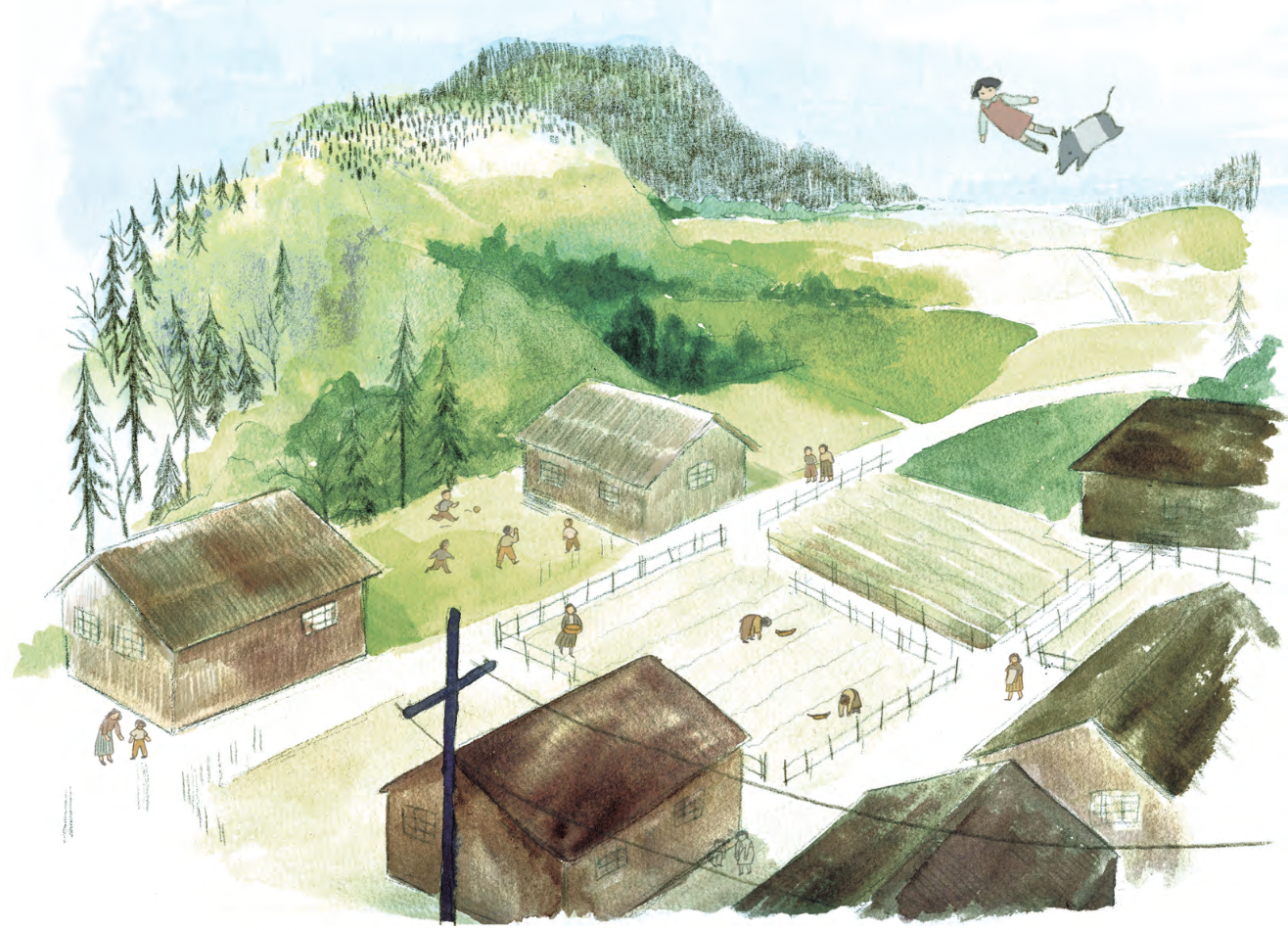
Worried her father has forgotten about her, Mira flies away with Baku to look for him. Together, she and Baku visit the family business, now deserted, and their old house. Disappointed in not finding her father, she begins to give up hope. And though she doesn't get exactly what she wants for her birthday, the day brings a surprise that reassures and reinforces the connection she has with her father.

Without making this a story of the Japanese internment, debut author Sara Truuvert has written a story that embodies the hardship and loss experienced by Japanese Canadians because of that unjust treatment. Sara Truuvert gives us the unique perspective of a child wishing to see her father on her birthday, as she always had, and coping with that anguish by creating an imaginary friend from a mythological creature. Baku, who is a hybrid creature of parts of an elephant, rhino, cow, bear, and tiger, allows Mira to speak her worries, feel her sadness, and imagine better. Baku gives her the opportunity to do something in a situation where she can do nothing. As such, Sara Truuvert's approach is sensitive and yet very complex, allowing Mira to be a child in a very grave situation and offer her hope through her imagination and memory.
From Mira and Baku, written by Sara Truuvert, illus. by Michelle Theodore
 That sensitivity is seen in the illustrations of Edmonton artist Michelle Theodore, who gives us the historical perspective of the internment, both of the camp where Mira and her mother live, as well as the work camp where her father has been incarcerated, and reminiscences of the family's life before internment. Memories from before are presented in pale yellows, appropriate considering how faint they might seem to Mira. The camps themselves are dreary and utilitarian, and Michelle Theodore keeps the best for the world outside the camps and for Mira's stones. The forests over which Mira and Baku fly are green and lush, and her stones are multicoloured. Within those elements, there is true spirit that will vitalize Mira, with a little help from her imaginary friend who is both soulful and calming.

Sara Truuvert provides an author's note that delves into the internment of Japanese Canadians as well as an appeal to reject fear of those who are different. With Mira and Baku, Sara Truuvert and Michelle Theodore give young readers an opportunity to see the misjudgments from our history and how children may be impacted. They also offer the promise that relief can come in an unexpected form, including imaginary.