Showing posts with label historical fiction. Show all posts

June 08, 2026

Still Alive (Kidnapped From Ukraine, Book 3)

Book cover of "Kidnapped From Ukraine: Still Alive" by Marsha Forchuk Skrypuch shows two girls in winter jackets with a destroyed city behind them
Written by Marsha Forchuk Skrypuch
Scholastic Press
978-1-5461-0457-5
320 pp.
Ages 8–12
April 2026 
 
 
While the war on Ukraine by Russia continues to this day, Marsha Forchuk Skrypuch is ready to resolve the story of twins Dariia and Rada Popkova. The story that began with Dariia's perspective on the attack and invasion of Ukraine in Under Attack (2025) after the girls' separation, and that led to Rada's story in Standoff (2025) comes full circle with a story that brings families together. They are still alive and fighting for themselves, each other, and their country.
 
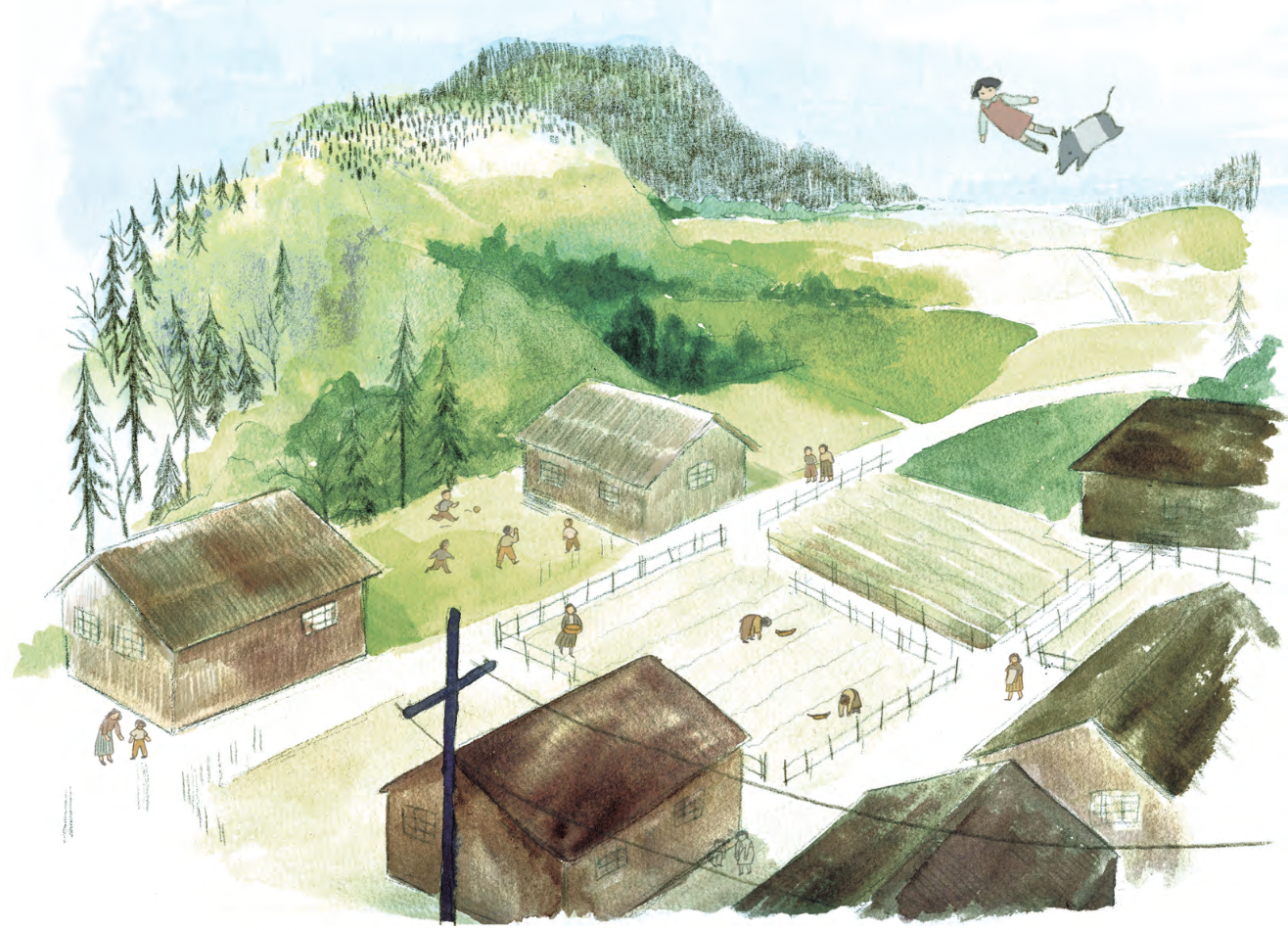
Still Alive begins in November of 2022 with Rada and her mom living in a ski village in the Carpathian Mountains. Mom works as a manicurist at the Hotel Karpaty, and they are preparing to move into their prefab home in a new refugee area in nearby Prytulok. They receive unexpected messages from Dariia, who has been "adopted" by a Russian family in a Moscow suburb, with details about her "new" name and birthday, as well as those of other Ukrainian children who had been kidnapped to Russia. So begins their fight to get Dariia and the other children back to Ukraine.
 
With the help of Save Ukraine, a Ukrainian charitable organization whose initiatives includes rescue and reunification of children taken from Ukraine, Mom and Rada and their new family of friends get to work trying to find families of others so that they might rescue as many as possible. But it's an arduous task as all must be done legally, finding legal guardians, obtaining powers of attorney, and more.
 
The second part of the story comes after Dariia is rescued and comes to live with Mom and Rada. She may be back with much of her own family—the whereabouts of her soldier father are still unknown—but she must navigate a new reality. She and Rada may be twins but they have always been different. With the traumas that they have endured, it's not just being together like it had been. Here's healing that has to happen but still with the mission to help their country. In fact, they do even more. They find a way to...
...take a shattered world and make it into something beautiful. (pg. 273) 
A series titled Kidnapped From Ukraine does not intimate a story of joy.  Of course, a story based in the ongoing war on Ukraine could be nothing less than horrific. While Marsha Forchuk Skrypuch is an author who tells real stories, she is also one who handles them with sensitivity, aware that there is a way to tell an impactful story and still offer reassurance. With Still Alive, Marsha Forchuk Skrypuch remind us that this war is not over, and that people are still suffering. Rada's question about the senselessness of this war—"How much hate does it take to kill your neighbour with missiles aimed at churches, children, hospitals?" (pg. 43)—resonates throughout the book as Ukrainians consider atrocities, new or repeated. Their reactions are as diverse as their experiences but their resolve to do what they can—build drones, sew camouflage nets, feed abandoned animals—to save Ukraine is unmistakable. 
 
The Kidnapped From Ukraine trilogy may be disheartening in the nature of its story, but Marsha Forchuk Skrypuch heartens it by comforting young readers with a narrative of families, made and found, and hope for a new future.
 
Standoff (2025)
Still Alive (2026)

June 01, 2026

Looking at the Sky: How Dr. Janusz Korczak Fought for Children's Rights

Book cover of "Looking at the Sky: How Dr. Janucz Korczak Fought for Children's Rights," written by Amanda West Lewis, illustrated by Abigail Rajunov
Written by Amanda West Lewis
Illustrated by Abigail Rajunov
Kids Can Press
978-1-5253-1024-9
80 pp.
Ages 8–12
June 2026 
 
Illustration from "Looking at the Sky: How Dr. Janucz Korczak Fought for Children's Rights" with a quote from Dr. Korczak
From Looking at the Sky: How Dr. Janucz Korczak Fought for Children's Rights, written by Amanda West Lewis, illustrated by Abigail Rajunov
In the early 1920s, Izaak Dembinski is living with his Mama, and sisters Chana, Zofia and Sara in Warsaw, Poland. Izaak's father was a soldier who'd died before Izaak was born. The family's life is one of austerity but there are moments of togetherness that brings respite from everything. But when Mama dies from tuberculosis, seven-year-old Izaak goes to Dom Sierot (which means Home for Orphans), while his sisters go to work at a laundry and a store. 
Illustration from "Looking at the Sky: How Dr. Janucz Korczak Fought for Children's Rights" showing family's life in 1922 Warsaw
From Looking at the Sky: How Dr. Janucz Korczak Fought for Children's Rights, written by Amanda West Lewis, illustrated by Abigail Rajunov
Unlike the orphanages of many fictionalized stories, Dom Sierot gives Izaak opportunities. Under the directorship of Dr. Korczak, Izaak is able to receive health care, schooling, time for play, and safety. He gets food with meat which he hadn't had for ages and he is allotted a bed and a small dresser. He learns the value of doing chores and about justice at the weekly children's court. Compared to his sisters, whom Izaak gets to visit on weekends, and who work so hard for so little, Izaak is experiencing a childhood of stability, of care, and of learning.
 
When he is released from Dom Sierot at age fourteen and is anxious about what he will do next, Dr. Korczak advises him that... 
We can give you only one thing: hope. Hope of a better life, a life of truth and justice. (pg. 47)
Regardless of how difficult their lives have been, Izaak's sisters have saved carefully so that he might travel to Canada to stay with their mother's sister and to continue his schooling and get a good job. With the life lessons he has learned from Pan Doctor and matron Pani Stefa, Izaak has learned how to work hard and how to deal with people, and succeed. But when Hitler invades Poland in 1939, Izaak finds it near impossible to keep connected them and his sisters.
Illustration from "Looking at the Sky: How Dr. Janucz Korczak Fought for Children's Rights" shows life in the orphanage
From Looking at the Sky: How Dr. Janucz Korczak Fought for Children's Rights, written by Amanda West Lewis, illustrated by Abigail Rajunov
Looking at the Sky is based on the remembrances of a former Dom Sierot child whom Amanda West Lewis befriended. While Izaak and the other children in the story are fictional, their experiences would have been very real. And Dr. Janusz Korczak, a man who founded several orphanages in Warsaw, one Catholic and one Jewish, published stories for children, had a national radio program, and gave hope to many through his good  work, was quite authentic. Looking at the Sky tells his story through that of a child who might have been at Dom Sierot and who may have been blessed with the caring and life lessons extended to him there. By telling Dr. Korczak's story from the perspective of one who benefited from his kindness and compassion, Amanda West Lewis makes Looking at the Sky less of a biography and more of a tribute to an extraordinary man.
Illustration from "Looking at the Sky: How Dr. Janucz Korczak Fought for Children's Rights" shows life in the orphanage
From Looking at the Sky: How Dr. Janucz Korczak Fought for Children's Rights, written by Amanda West Lewis, illustrated by Abigail Rajunov
Abigail Rajunov is an American illustrator who embeds the mood of Izaak and Dr. Korczak's story through her use of colour and line. Her palette is very limited and subdued. It is primarily sepia tones for a hard but routine life. Blacks and greys are reserved for the worst of situations—like travel to Treblinka—while bits of blue bring the infrequent joys of cheerful skies, new clothes, or a fresh bed. Abigail Rajunov makes us feel Izaak's story, not just show us it.
 
Perhaps Looking at the Sky gives us but a glimpse into the remarkable legacy of Dr. Korczak—his reputation as a pediatrician, author, educator, and children's rights advocate could fill books—but it is a personal and tender look at how the man influenced and inspired others with his warmheartedness and his insight. And, with Amanda West Lewis's appended note and bibliography, young readers can look beyond to learn more about this great man.

January 14, 2026

Standoff (Kidnapped From Ukraine, #2)

Written by Marsha Forchuk Skrypuch
Scholastic
978-1-5461-0454-4
288 pp.
Ages 8–13
October 2025
 
As it had been for me reading Under Attack, the first book in Marsha Forchuk Skrypuch's Kidnapped From Ukraine series, delving into Standoff was a challenge. I knew to expect a sensitive but authentic story about the Russian invasion of Ukraine in 2022, but I also knew that it would be emotionally demanding of me because of my heritage. It was. But it was also eloquent and inspiring and well worth the read.
 
In the earlier Under Attack, readers are introduced to the Popkov family: dad Ivan who worked at the Azovstal steel plant in Mariupol, mom Yaroslava who worked at a nail salon, and twelve-year-old twin sisters Dariia and Rada. When the first attack occurs in February of 2022, Dariia and her mom are separated from Rada and their dad. The first book covers Dariia's perspective and experiences, while Standoff is told from Rada's point of view from the onset of the first attack. While Dariia and their mom find shelter at a salon and other commercial buildings, Rada and her dad head to the steel plant with its extensive bunkers, and from which he will join up with the Territorial Defense . With the wise words, "Be brave but not stupid" (pg. 42), her dad leaves Rada in the care of the Yanin family: Mr. Yanin, an engineer; his son Viktor, a classmate of Rada's; and his nine-year-old daughter Alina. (Mrs. Yanin was killed in the attack on their apartment building.)
 
Each day is a scramble for food, clothing, water, heat and more. Still, the make-shift family connects with another family when Rada meets Lesia Stepanova. Lesia is sheltering in another bunker at the plant with both her grandmothers (Baba and Babushka), her sister-in-law Maiia, and Lesia's baby nephew Oleh. Lesia's mother is also in the Territorial Defense, while Lesia's older brother is in Moscow on a business trip. After they attempt to evacuate Mariupol during a ceasefire—which the Russians failed to observe—they add nine-year-old Mychailo Voron and a woman named Svetlana Boyko to their little group.
 
Their lives become a series of routines to help them get through each day, whether it is doing lessons, or toileting, or preparing and sharing their meager provisions. Hope comes with the promise of a ceasefire—more than once—though the Russians are quick to apprehend and attempt to transport Ukrainians to Russia. It's only when the Red Cross, the UN, and other international observers and aid are involved that those efforts are stymied.
 
Life is tenuous. On the inside of the plant, Rada and her new family struggle and worry and grieve. Outside, their challenges are both the same and different: worried for their loved ones, grappling with a lack of resources, terrified of being injured or killed, and never knowing whom they could trust. 
 
The attack and war on Ukraine has sadly been part of the news cycle for almost four years, but for many it is a story from "over there." Marsha Forchuk Skrypuch's stories, both Under Attack and Standoff, take a distant conflict and make it personal. This isn't happening faraway to people we don't know. It's happening to children, to the elderly, to parents, and to shopkeepers, neighbours, and people we care about. We feel their horror, recognize their anxieties, grasp their grief, and acknowledge their needs to hold on to whatever might offer comfort, whether a cat or a Motanka doll. Whether it's a middle grader reading this book and stunned by the horrific circumstances that Rada and her families, born and made, endure, or an older reader who understands the cruelty of others and the grief of loss, Standoff will hit hard. But Marsha Forchuk Skrypuch knows how to tell a story of immense tragedy by pairing it with resilience, affection, and hope. Even the title of the third book in the series, which releases in April, tells us that there is more to the twins' stories and, even with more hardships and loss, they endure. 
 
For an authentic and very personal perspective on the war in Ukraine, Marsha Forchuk Skrypuch offers a story of Ukrainians from Mariupol and what they saw and felt when the Russians attacked. She even offers more background in her "Author's Note" and the Q & A with which she appends Standoff, helping young people gain greater understanding about the events and the history behind the Russian invasion. We can only hope that with awareness comes understanding, and with time there will be a favourable resolution for the people of Ukraine.  
 
 • • • • • • •
 
Under Attack (January, 2025)
Standoff (October, 2025)
Still Alive (April, 2026)
 

November 04, 2024

Unsinkable Cayenne

Written by Jessica Vitalis
Greenwillow Books (HarperCollins)
978-0-06-331445-0
304 pp.
Ages 8-12
October 2024
 
 
But in middle school
there are two choices:
fit in
or
stand out. (p. 69) 
 
It's 1985 and Cayenne has always lived a nomadic life with her Mom and Dad and now six-month-old sibs Sossity and Bear. They've travelled throughout the U.S. in their van, living off Dad's small disability check from the VA, with Mom homeschooling Cayenne. Cayenne knows that some people may look down on them for being poor and living a hippie lifestyle, but she feels a closeness with her family, especially when she plays her harmonica and Dad plays his guitar and Mom dances, even though Mom has been distracted with the babies. Still Dad decides to settle them down in a Montana town where he's gotten a job at the sawmill, and Cayenne feels like it's where they finally belong and maybe she can feel normal, even if Mom isn't necessarily happy. 
I agreed to this move.
I did not agree 
to sell my soul. (p. 31) 
Still Cayenne is all in. At Sandstone Middle School, Cayenne is determined to make friends. She's keen on the popular girls who play flute in band but she's not quite up to their skills and she is separated from them while she learns the instrument. And though she isn't eager to attach herself to a "loser," she is befriended by Dawn, an awkward girl who is always reading, wearing outfits that reflect her reading, and who plays drums. She also meets Tiff, a popular chatterbox of a girl from art class, who lives on the wealthy side of town. And then there's Beau, a new boy whom Cayenne met while walking their dog, George. Cayenne is smitten and when others suggest that Beau likes her, Cayenne is sent into a tizzy of how to act and what to say. So, as Cayenne desperately tries to fit in, choosing with whom to associate and hide the reality of her family's circumstances, things become even more tenuous. Fitting in becomes even harder when you don't feel like you have the means to belong, whether the money, the family, the clothes, the opportunities, anything. 

Jessica Vitalis, whose earlier middle-grade books The Rabbit's Gift, The Wolf's Curse, and Coyote Queen made quite a splash, doesn't just give us a novel about pre-teen angst. She gives us a story enfolded in many layers of storytelling which add context and insight into Cayenne's own life. From their Titanic-themed social studies unit in which they learn of the disparities between first- and third-class passengers, particularly with respect to their survival, and Cayenne's love of birds and her knowledge of their behaviours, Unsinkable Cayenne goes beyond a kid trying to fit in with her new classmates. She's trying to fit in to her life, her new one and the one she has always had with her family, and she sees it through multiple lenses. She is the new kid but also a poor kid and a kid whose family is atypical in their circumstances. They might not have money to replace her holey shoes and the electricity might have to be turned off to save for rent money, but they also don't have a phone or a TV. Cayenne doesn't complain or see it as a problem; it's just different. Her perspective is both insightful and revealing, and Jessica Vitalis does not sugar-coat their poverty with a happy ending or lottery winning or change in financial circumstances. She makes and keeps it real.
 
The writing is exceptional. Unsinkable Cayenne, told in free verse, flows through Cayenne's days at school and her thinking about her life with vigour and subtlety.
I don't understand why the amount of money
someone has determines how much they are worth. (p. 182)
Jessica Vitalis tells a story for middle-grade readers but with sophistication and lyricism. She's given us a real kid who not only exemplifies the famous Unsinkable Molly Brown of Titanic fame in her tenacity and humble beginnings but also in seeing others beyond class and wealth.

September 01, 2024

Anne of the Library-on-the-Hill

Written by Catherine Little
Illustrated by Sae Kimura
Plumleaf Press
978-1-7381-6524-7
32 pp.
 Ages 6-10
August 2024 

This year we will commemorate the 150th anniversary of the birth of Lucy Maud Montgomery, the author of Anne of Green Gables. There will be several titles released to observe this anniversary, some fiction, some non-fiction, and Anne of the Library-on-the-Hill celebrates Anne of Green Gables with a wholly fictionalized story about another little girl named Anne, with an "e" of course.
 
Anne, of Anne of the Library-on-the-Hill, lives with her parents in Toronto, and regularly visits the Wychwood Library with her father, an artist. This library which she calls Library-on-the-Hill is a special place for her and father, and they both relish the plethora of books they borrow. Her mother is more of an industrious woman who worries that too much imagination might not be helping Anne.
From Anne of the Library-on-the-Hill, written by Catherine Little, illustrated by Sae Kimura
Then World War I arrives, and Father must leave home to serve. His absence, monumental in itself, results in additional changes to the household, with Mother taking on laundry work and no time to take Anne to the Library-on-the-Hill for books. Fortunately, one of Mother's customers, Mrs. Mary Beal shares her own children's old books with Anne. And when a new Library-on-the-Hill is opened, Anne's Mother ultimately gives Anne permission to visit it on her own.
From Anne of the Library-on-the-Hill, written by Catherine Little, illustrated by Sae Kimura
Sadly, the family receives bad news about Father from Vimy Ridge. Missing her father terribly, Anne is comforted when her mother shares a special book that Anne's father had gifted her early in their marriage. Yes, it is Anne of Green Gables, published in 1908.
From Anne of the Library-on-the-Hill, written by Catherine Little, illustrated by Sae Kimura
There's still more that happens to the Anne of Catherine Little's story, including an encounter with the famous author herself, but suffice it to say that our Anne takes wisdom from Lucy Maud Montgomery's Anne that supports her through life's good days and bad.

I believe the nicest and sweetest days
are not those on which anything very
splendid or wonderful or exciting happens
but just those that bring simple little
pleasures, following one another softly,
like pearls slipping off a string
.”
                                                                           ~ From Anne of Green Gables
 
Our two Annes, that of Lucy Maud Montgomery's story and that of Catherine Little's, share some commonalities though their stories are completely different. They both had father figures who encouraged their passions for imaginative endeavours and maternal figures who were more pragmatic. The women weren't mean; they were just prudent. Not surprising that Matthew and Anne's father both had soft spots for their Annes and defended them tactfully to the women in their lives. Beyond the characters themselves, Catherine Little intersperses her story with known experiences from Montgomery's life including her friendship with Mary Beal and attending an event that included Nellie McCLung. By borrowing elements of Anne of Green Gables to feed her story of Anne of the Library-on-the-Hill, Catherine Little pays homage to the much beloved story while giving us a whole new story. If you didn't know about Anne of Green Gables –though Catherine Little provides plenty of background information about Anne and L. M. Montgomery to get you caught up–this Anne and her library and her life would still captivate.

The art of Anne of the Library-on-the-Hill has been created by Sae Kimura, who also illustrated Catherine Little's earlier books, Twelve in a Race and Dragon's Dilemma. Using a variety of media, including acrylic, gouache, watercolour, and pencil crayon, Toronto's Sae Kimura gives an ethereal sense to Anne of the Library-on-the-Hill, which works well for a story set in the mid-late 1910s to early 1920s. The reality of Anne's life is never in question but the richness of her imagination and passion for life is always evident, in the colours of her surroundings, in the brightness of her reading, and the joy she derives from being with her father, visiting the library, and more.
From Anne of the Library-on-the-Hill, written by Catherine Little, illustrated by Sae Kimura
Celebrate Anne of Green Gables and Lucy Maud Montgomery by reading a picture book that honours both while creating something that is wholly its own. With Anne of the Library-on-the-Hill, Catherine Little and Sae Kimura remind us of the anchor that reading can be in a child's life and also the pillar that Anne of Green Gables is in both the CanLit world and internationally.

July 03, 2024

Plague Thieves

Written by Caroline Fernandez
DCB Young Readers
978-1-77086-732-1
208 pp.
Ages 9–12
May 2024
 
It's 1665 and twelve-year-old Rose lives with her parents and sixteen-year-old brother Lem above their spice shop in London, England. Though Lem hates working in the shop, instead sneaking off to join his delinquent friends, Rose loves helping her father out, learning about spices for cooking, medicines, and cleaning. And then "the sickness crept into London." (p. 5) When Mother comes back from the market with flea bites and takes to her bed, Father closes the shop and sends the children to stay there. Via notes, he instructs Rose to collect ingredients for him so that he might create a medicinal oil to heal Mother. But his efforts are to no avail and Mother dies. Before Father also succumbs to the illness they should not name aloud, he gives Rose the recipe for an oil he believes will protect them. He tells them all the ingredients but one, though Rose knows what it is. They are instructed to place the oil on a handkerchief and set it over their noses and mouths as a mask. His last warning is to not to tell anyone about the oil and to do whatever they must to survive.
 Steal. Trade. Survive. (p. 18)
When they have left, Father burns the shop, and the two young people are truly homeless. With but a few coins and some silver spoons to trade, Rose and Lem each take one of the three bottles of oil she has made from Father's recipe and bury the third beneath a bridge where they also find shelter for themselves. And so begins their lives on the streets of London, finding any means to survive, including becoming thieves. That is, until Lem does not return one night. Now Rose is alone, evading anyone who recognizes her as the daughter of the spice merchant who was rumoured to know the cure for the Great Plague.

Rose builds a new life on the street with others who have lost jobs or homes because of the plague and are now struggling as she is to survive. Among these displaced persons are Elizabeth and her five-year-old daughter Clove; Amon, the son of a trader from Shanty Town; and two former farmhands Cinn and Cal. Rose doesn't know whom she can trust but she does know to avoid the black-clad man with the strange bird mask whom she calls the beast and who always seems to be around plague houses. 

From the mundane life of household chores, working with her father, and the drudgery of life in 1665 London, Rose's life becomes one of a dubious nature, never knowing whether there will be food, whether there will be shelter, who might be dangerous, and, worse of all, if they will be able to evade the plague itself. Accompanying Rose as she navigates arduous roads of grief and fear and desperation, young readers will get a very good idea about the historic hardships of an epidemic of which little was known, during which all actions were driven by fear. Caroline Fernandez tells Rose's story as an edge-of-your-seat read, keeping us wondering the whole time. We know there won't be a happy ending–it is the time of the Great Plague of London after all–but Caroline Fernandez invests us in Rose and other characters, most notably Amon, hopeful that they will survive and find some light out of the darkness. She definitely gives the atmosphere of anxiety and even despair, but she doesn't overdo it, never frightening the reader with the circumstances but instead helps us understand what life would have been like in 1665 London both before and during the Great Plague. With Plague Thieves, Caroline Fernandez has given us a spell-binding read that captivates but also enlightens about a time in which bleakness was almost inescapable.

November 01, 2023

The Little Books of the Little Brontës

Written by Sara O'Leary
Illustrated by Briony May Smith
Tundra Books
978-0-7352-6369-7
40 pp.
Ages 5-9
October 2023
 
This is the story of four siblings who lived about 200 years ago. Their names were Charlotte, Bramwell, Emily, and the youngest was Anne. After their mother had died, as well as their two older sisters, they lived with their father, their Aunt Bramwell, a housekeeper named Tabby, and many pets. And they loved to read and tell stories.
From The Little Books of the Little Brontës, written by Sara O'Leary, illustrated by Briony May Smith
They read everything they could, from novels and poetry, to geography, the dictionary, and the Bible. And when they weren't reading, they were making up stories, creating characters, and acting out plays. And they wrote their own little books to share with each other. What a special gift to have a sister who would paint pictures and hand-stitch pages and give their lives a happily-ever-after. When Bramwell received a set of toy soldiers, which he shared with his sisters, they created even smaller books that would fit into the hands of the toy soldiers. These books were tiny but the worlds within were colossal.
They contain continents and oceans, love stories and battles. There are heroes and antiheroes. And sometimes those who die in one story are brought back to life in another.
Their little books and their stories sustained them and inspired them all to write, taking them to new worlds.
From The Little Books of the Little Brontës, written by Sara O'Leary, illustrated by Briony May Smith
The Little Books of the Little Brontës is not necessarily an illustrated biography of the four Brontë siblings though it does contain key biographical information about their home, the people in their lives, and their occupation with writing and books. But Sara O'Leary has not written this picture book to tell their biographies. She has written it to speak to the power of storytelling and the imagination to sustain us through challenges. There is much still left to tell of the Brontës' stories but those details can just as easily be discovered through research. Like the power of the Brontës' stories, Sara O'Leary takes the reader to see a different world, one in which travel to unknown places is possible, in which struggles are won, and in which lives may be happier, easier, and more exciting. That's the true story of the stories that the Brontës told. Their stories comforted them and fostered their creativity.

Briony May Smith, a British illustrator, uses mixed media to take us into the long-ago world of the Brontë children. She gives their world both historical accuracy but a sweetness of siblings reliant on each other for support and love. The softness of her pencil and digital media take away the austerity of the Brontës' lives and makes them rich in family and togetherness and, of course, literary creativity.
From The Little Books of the Little Brontës, written by Sara O'Leary, illustrated by Briony May Smith
I have reviewed a number of Sara O'Leary's earlier books (including When I Was Small, 2011; A Family is a Family, 2016; Night Walk, 2020; and  Percy's Museum, 2021) and, regardless of the story, there is a gentleness in her storytelling. It's in the choice of her words and the structure of her phrasing and in the choices she makes to tell or not tell. The timeline that appends The Little Books of the Little Brontës cannot help but speak to the losses the Brontës experienced in their short lives–the four who are featured in this book all passed in their 20s or 30s–but, though Sara O'Leary mentions the loss of the children's mother and their older sisters, she makes this story about the wonders of books and storytelling.

The Little Books of the Little Brontës will surely inspire young readers to delve a little deeper into the history of the Brontës but also to create their own little books–instructions provided–and find the wonder in making worlds for themselves and others.
From The Little Books of the Little Brontës, written by Sara O'Leary, illustrated by Briony May Smith

October 23, 2023

Endgame: The Secret Force 136

Written by Catherine Little
Illustrated by Sean Huang
Plumleaf Press
978-1-738898244
32 pp.
All ages
October 2023

This is a picture book. But Endgame: The Secret Force 136 is more than a picture book. It's a story within a story with another story. There's an intergenerational story which segues into a story from World War II that is framed by the playing of a game of Chinese chess that is depicted as an actual battle in illustrations. It may sound complicated and yet it all works.
From Endgame: The Secret Force 136, written by Catherine Little, illus. by Sean Huang
A child regularly visits his great-grandfather Tai Gong with his mother and is gifted with his elder's Chinese chess set on his tenth birthday. The boy enjoys learning the new game, called Xiangqi or elephant chess, with its two battling armies of generals, advisers, elephants, chariots, cannons, and soldiers, but he can never win over his Tai Gong.  Tai Gong advises him:
“You have to plan ahead, Alex,” Tai Gong replied. “As I have told you many times, slow down and plan your strategies. Focus on the big picture.”
From Endgame: The Secret Force 136, written by Catherine Little, illus. by Sean Huang
During one visit, Tai Gong shows Alex some faded photographs he keeps in his wallet. The photos show groups of men, some in uniforms, and Tai Gong says he needs to tell Alex about the stories of these photos. As he recalls discrimination he and other Chinese Canadians endured, many still felt the need to fight for their country during World War II. Though they were rejected initially, when the enemy occupied much of Southeast Asia, they were accepted into Secret Force 136 for special missions. And though he speaks of dangerous situations, Alex's tai gong is convinced it was all worth it because of the progress that happened upon their return. It was all about the endgame, something he hopes to impart to his great-grandson as they play Xiangqi.
From Endgame: The Secret Force 136, written by Catherine Little, illus. by Sean Huang

There is a history lesson in Endgame: The Secret Force 136, and Catherine Little provides extensive historical notes about the racial discrimination Chinese Canadians faced, about the Secret Force 136 including bios of several of the team's members, and about the impact of the Chinese Canadian war effort. While her focus may be on the history, as shared through a boy's interaction with his great-grandfather, she also embeds in the playing of the ancient game of Xiangqi which she also highlights in her appended notes. This could have been a very dry exposé of a WWII special operation but by tying the story of the strategies employed in a game of chess with the memories of an elderly Chinese Canadian, Catherine Little makes the story more personal. This is his story, and he speaks of it because he knows of it. And he learned valuable lessons for war but also for life but now he can share that strategizing so that his great-grandson may also benefit.

The realism of the child's interactions with his great-grandfather and his Tai Gong's experiences are depicted well in the lush paintings of Saskatchewan artist Sean Huang who takes readers from a contemporary setting to that of World War II and also to a time when warriors wore lamellar armour and carried spears. Because the story is one based in history, it's appropriate that Sean Huang maintains that realism so that a young reader might visualize their own interaction with a grandparent, or asking about the past, or looking to understand who is in photos. (The illustration of the Tai Gong's hands and the photographs is so lifelike that it will be immediately familiar and evocative of age and nostalgia.)

Players of chess and other games often speak of the endgame as the final stage and Alex learns about the perspective he must take to have a successful endgame. But his Tai Gong knows that there are many endgames in life, those final steps that can lead to success, to progress, and to resolution. His life has had many endgames and while they may or may not have always felt triumphant, they were surely noteworthy, if not for him then for others.

October 06, 2023

Mira and Baku

Written by Sara Truuvert
Illustrated by Michelle Theodore
Annick Press
978-1-77321-756-7
44 pp.
Ages 4-7
September 2023

Mira can think of nothing other than her birthday is days away and her father is not with her and her mother. Will he miss her birthday for the first time ever? Perhaps with her imaginary friend Baku, a creature of Japanese mythology who is said to eat nightmares, Mira can find her father.
From Mira and Baku, written by Sara Truuvert, illus. by Michelle Theodore
But, as consequential as the issue of an absentee father is for a child, there is greater depth to Sara Truuvert's story because Mira and her mother are being detained at an internment camp. It's the 1940s when Japanese Canadians were forced to relocate, losing homes and businesses, and separating families. But Mira does not know all this. What she knows is that her father received a letter and then he was gone, and that Mira and her mother are now confined to an isolated community of internees, mostly women and children. 
From Mira and Baku, written by Sara Truuvert, illus. by Michelle Theodore
Still Mira holds on to the good things from before, especially the stones she and her father collected which she keeps in a sock. She remembers finding stones with him and the stories that came with them. There's the stone that turns green when wet that he'd melodramatically presented to Mira's mother. There's the glittery white one that came from a box of fresh salmon her dad was unpacking for his store.
From Mira and Baku, written by Sara Truuvert, illus. by Michelle Theodore
Worried her father has forgotten about her, Mira flies away with Baku to look for him. Together, she and Baku visit the family business, now deserted, and their old house. Disappointed in not finding her father, she begins to give up hope. And though she doesn't get exactly what she wants for her birthday, the day brings a surprise that reassures and reinforces the connection she has with her father.

Without making this a story of the Japanese internment, debut author Sara Truuvert has written a story that embodies the hardship and loss experienced by Japanese Canadians because of that unjust treatment. Sara Truuvert gives us the unique perspective of a child wishing to see her father on her birthday, as she always had, and coping with that anguish by creating an imaginary friend from a mythological creature. Baku, who is a hybrid creature of parts of an elephant, rhino, cow, bear, and tiger, allows Mira to speak her worries, feel her sadness, and imagine better. Baku gives her the opportunity to do something in a situation where she can do nothing. As such, Sara Truuvert's approach is sensitive and yet very complex, allowing Mira to be a child in a very grave situation and offer her hope through her imagination and memory.
From Mira and Baku, written by Sara Truuvert, illus. by Michelle Theodore
 That sensitivity is seen in the illustrations of Edmonton artist Michelle Theodore, who gives us the historical perspective of the internment, both of the camp where Mira and her mother live, as well as the work camp where her father has been incarcerated, and reminiscences of the family's life before internment. Memories from before are presented in pale yellows, appropriate considering how faint they might seem to Mira. The camps themselves are dreary and utilitarian, and Michelle Theodore keeps the best for the world outside the camps and for Mira's stones. The forests over which Mira and Baku fly are green and lush, and her stones are multicoloured. Within those elements, there is true spirit that will vitalize Mira, with a little help from her imaginary friend who is both soulful and calming.

Sara Truuvert provides an author's note that delves into the internment of Japanese Canadians as well as an appeal to reject fear of those who are different. With Mira and Baku, Sara Truuvert and Michelle Theodore give young readers an opportunity to see the misjudgments from our history and how children may be impacted. They also offer the promise that relief can come in an unexpected form, including imaginary.

October 03, 2023

We Belong Here

Written by Frieda Wishinsky
Illustrated by Ruth Ohi
North Winds Press (Scholastic Canada)
978-1-4431-9403-7
32 pp.
Ages 6-8
October, 2023  
 
Eve Bloom hated being called a greenhorn especially since, although she'd been born in another country, she'd lived here since she'd been little. She often found solace, and the privacy to cry, at a special place on a high rock in the park.
From We Belong Here, written by Frieda Wishinsky, illustrated by Ruth Ohi
When a new boy, Mark Nakamura, comes to her school, he is ridiculed for being Japanese. Eve goes to his defense to stop the bullies and takes him to her special rock. In gratitude, he gives her a small turtle he'd carved. Together the two enjoy imaginative storytelling and talk about their families. They became fast friends, spending time at the back of Eve's parents' store, Bloom's Delicious Foods, and at Mark's apartment. 
From We Belong Here, written by Frieda Wishinsky, illustrated by Ruth Ohi
But then Mark's father, a craftsman with wood, loses his job at the factory because a customer didn't want a Japanese man to make his furniture. Moreover, Eve's parents are shaken when a faulty shelf almost injures a customer who threatens that no one will shop there with a new market opening nearby. By bringing their families together, both the Blooms and the Nakamuras get what they need: support, work, customers, and the welcome that says they are appreciated in their community.
From We Belong Here, written by Frieda Wishinsky, illustrated by Ruth Ohi
We Belong Here may seem like a simple story of children and families of two different cultures, Jewish and Japanese, helping each other to be accepted by their community. But, because of Frieda Wishinsky and Ruth Ohi's back stories, We Belong Here is a much bigger story and one of great historical and contemporary relevance. The need to belong and be accepted is universal. And to not be accepted because of arbitrary qualities like place of birth, religion, language, physical differences, and such is unacceptable. But, differences are what create us and bond us. They improve our lives by opening our minds and our hearts. And with that comes understanding, compassion, and harmony. When Frieda Wishinsky and Ruth Ohi brought Eve and Mark and their families together, they could confront the prejudice both head on and discreetly. Whether challenging those who mistreat a classmate or supporting someone by hiring them for a work project, these efforts remind everyone that strength and courage come with compassion, not force.

This is a story borne of deeply personal stories. As readers will learn tomorrow in my interview with Frieda Wishinsky and Ruth Ohi, their connections are very real and make the story even more personal. But the way they tell the story, readers will not be left with remembering the nastiness but instead smell the rugelach in Eve's family's store, feel the smoothness of Mark's carvings, and appreciate the coming together of people to shop, to work, to play. Through Frieda Wishinsky's sincere words, I hear friendship, and through Ruth Ohi's art, I see kindness in a different time. Together they are melded into one story, one lesson in compassion, and one to uplift and reassure that intolerance can be overcome.
 
• • • • • • •
 
For a little something extra about We Belong Here, check back tomorrow for my interview with author Frieda Wishinsky and illustrator Ruth Ohi.
• • • • • • •

April 17, 2023

I Am Not a Ghost: The Canadian Pacific Railway

Written by David Bouchard with Zhong-Yang Huang
Illustrated by Sean Huang
Plumleaf Press
 ‎978-1-778242816
40 pp.
Ages 7-12
May 2023
 
While the building of the Canadian Pacific Railway in the 1880s was considered an achievement in connecting eastern Canada with British Columbia, its history is clouded in infamy. From its treatment of Chinese workers to the expulsion of First Nations from their lands, the construction of that national railway is a bigger story and one made up of many. I Am Not a Ghost is one story.
From I Am Not a Ghost by David Bouchard with Zhong-Yang Huang, illus. by Sean Huang
Granddaughter, you and your children must know this story, and you must remember. (pg.9)
 
As a grandfather remembers, he recalls the hardship of finding work in China and leaving his family to find a better life. But what he found were tireless working conditions, hunger, cold and the bigotry that had the white men calling every Chinese man by the name Johnny. Still, he persisted, hopeful of a prosperous future, eventually saving enough money to send for his wife and son.
From I Am Not a Ghost by David Bouchard with Zhong-Yang Huang, illus. by Sean Huang
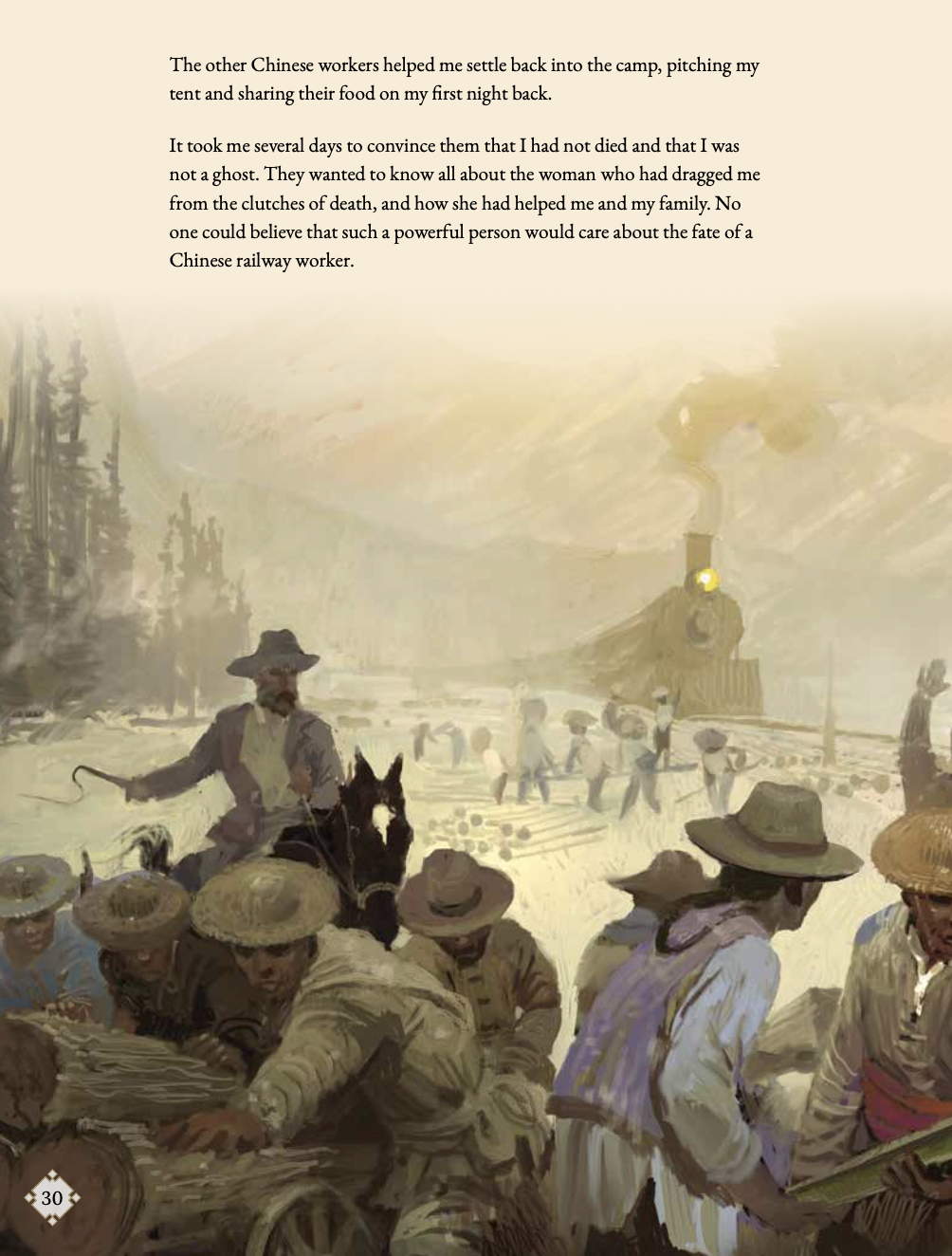
When he falls ill, laying in the snow as if already dead, and is ignored by the foreman, Lady Amelia Douglas, the visiting wife of the late Governor of BC, comes to his aid and demands he be taken to her home in Victoria. Although the men at the camp tell his family he has died, Mrs. Douglas gets him medical attention and, once she learns of his family days later, brings them to him. After several weeks, his family returns to Chinatown and he to the railway.
From I Am Not a Ghost by David Bouchard with Zhong-Yang Huang, illus. by Sean Huang
But, upon his return, his countrymen are aghast, convinced they are seeing a ghost. He has to persuade them with the words of the book's title that he is not a ghost and recounts the goodness and compassion of Mrs. Douglas, a Métis woman, who was their friend like other Indigenous people. 
 
Because of the kindness of Mrs. Douglas, he was able to survive the building of the railway, build a business and extend kindness to other Chinese immigrants, helping to grow a compassionate and vibrant community.
From I Am Not a Ghost by David Bouchard with Zhong-Yang Huang, illus. by Sean Huang
Non-fiction books that teach history, especially those used in schools, tend to be verbose and comprehensive, skimming over many topics, using dense text, and leaving no memorable impression. I Am Not a Ghost is not such a text. By focusing on the immigrant experience of one Chinese Canadian in the 1880s, Victoria's David Bouchard with Regina's Zhong-Yang Huang effectively place young readers into the treacherous life of working on the railway as a Chinese immigrant in the 1880s. The toil, the racism, and the unfairness of conditions and treatments all speak to oppression and perseverance in that oppression. The story of this man is heartbreaking and very real, as is the true story of the building of the railway and Mrs. Douglas with her  compassionate nature. ("Historical Notes" at the end of the book give further details about the context for the story of I Am Not a Ghost.)
 
With the seriousness of the story and the realism of a historical narrative, the art of Sean Huang adds to the story, taking us from frozen landscapes of workers in canvas tents or collapsed in snowbanks, to the opulence of a fine lady's Victorian home, to the busyness of countless workers on the railway. Combining both a heaviness and lightness to his brushstrokes and the classic palette of old masters, Sean Huang takes us into the past of David Bouchard and Zhong-Yang Huang's story, and tells a history where a man is disregarded because of his heritage and taken for dead because he might not have mattered enough to be helped.

If you're a teacher of Canadian history for young people and want a fresh take on the building of the railway, I Am Not a Ghost provides a very personal story that goes beyond the placement of that last spike and reminds us that achievements are often on the backs of others who should be recognized and their stories told.