Showing posts with label reading. Show all posts

May 19, 2025

Sam

Written by Eric Walters
DCB
978-1-770867949
228 pp.
Ages 9-14
May 2025 
 
She was strong. She didn't give up. She didn't take crap from anybody. I liked that. And all she really wanted was a place to call home. I understood that better than I even would have wanted. (p. 133)
 
The "she" of whom fourteen-year-old Sam Reid speaks is Anne of Green Gables, and, along with support from a select group of new acquaintances, the boy with red hair and a matching temper has a lot to learn and especially from L. M. Montgomery's 1908 fictional character.
 
Sam may be a smart kid, but it doesn't stop him from letting his temper get the better of him. When confronted with a shopkeeper trying to rip $10 off of him and having to stand up against the high school's quarterback, who ends up with a broken nose, Sam knows he should have kept his cool. But things get worse when Sam is accosted in a school bathroom and fights back, leaving Cody, the quarterback, with a concussion.
...there's no question that I have a temper, but that's only because people are always doing things to provoke me. (p. 9) 
With no family–his parents were killed in a car crash by a drunk driver four years earlier–and foster parents who don't want him back, he is sent to the Johnson Juvenile Center, a detention facility for those younger than 18 who were awaiting trial or those already convicted and serving sentences less than 18 months. Sam would be at the Johnson Juvenile Center, a.k.a. the Gables, for at least 5 weeks while he is assessed before heading to court. While his social worker Jenna Williams is keen to help, his court-appointed lawyer Mr. Turner is challenged, especially when additional charges of fraud and theft are brought by the shopkeeper, and everyone seems disappointed that the local football hero would be out of commission. 

At the Gables, Sam must deal with a nasty guard Mr. Roberts who insists on calling Sam "Red" and is just waiting for the chance to write him up for poor behaviour, bad attitude, and more. There's also a convicted "long-timer" Bruce who seems to have it out for Sam after an innocent mistake of sitting at the wrong dining table ends with Sam shooting off his mouth again.
Why did people keep coming at me and why wasn't I smart enough to shut up and move on when they did? (p. 64)
Thankfully Sam has some good people on his side trying to help him be the best version of himself. There's his roomie Nigel, a smaller guy who is in for throwing a chair at someone; Mrs. Martinez, their English teacher; Kate, a kind-hearted guard; and his psychologist, Dr. McEnny. Now if Sam could only stop seeing everything and everyone as a threat or a challenge and use his smarts–and he is very intelligent–to help himself. 
Sometimes smart can't overcome circumstances, situations, and tragedy. (p. 128)
Things start to change for Sam when Mrs. Martinez assigns Nigel and Sam each a book on which they will prepare a report, and Sam gets Lucy Maud Montgomery's Anne of Green Gables, hoping he'll find some interesting parallels with his own life. If he can just get past his outrage and humiliation, especially when he sees that Anne is a redhead like he is, Sam may be able to use his potential and discover his strength to find hope.
 
For lovers of L. M. Montgomery's Anne of Green Gables, the parallels between Anne's life and that of Sam will be evident, even though their differences in time and circumstances are significant. (In fact, an assignment Sam completes for Mrs. Martinez focuses on these very parallels.) Eric Walters is very subtle in his homage to Montgomery and her red-haired character, though his "Author's Note" suggests an extraordinary depth of admiration for the author and her book. This is abundantly evident in his appreciation for her words–quotes from Anne of Green Gables are cited often and always fitting–and the themes of persevering life's challenges and finding hope against tragedy and adversity. Eric Walters makes us believe in Sam. The young teen may not be completely likeable at the beginning of Sam but he's a kid who has had a lot of hard knocks. His temper, which may or may not be as a result of his circumstances, and I don't mean the colour of his hair, is an entity with which he has a relationship, good or bad. It's in his learning about that anger and his recognition that he has been able to keep it in check that almost releases him from it and allows Sam to grow. While he initially thinks Anne is almost delusionally optimistic, he too starts to acknowledge the positives of things that once appeared to only be difficult. 

Sam has had a tough life, bouncing from foster homes and receiving homes, never being offered a true home since the death of his parents. But, as horrific as going to a juvenile center must be, the Gables becomes a place of salvation for Sam, as Green Gables was for Anne, helping him acquire a support system as tough as any loving family and teaching him the strength he has always had to overcome that which seems formidable. With kind souls and kindred spirits, Sam's life goes beyond "a perfect graveyard of buried hopes" as Anne declares at the beginning of Anne of Green Gables, to one of possibilities.

January 20, 2025

Recommended Reading

Written by Paul Coccia
Zando Young Readers
978-1-63893-149-2
320 pp.
Ages 12-17
January 2025
 
Seventeen-year-old Bobby Ashton has got a plan for the perfect summer before college. He's got plans for a perfect job, the perfect boyfriend, and more. The problems with planning everything down to the last second is that "it only takes one second to throw it all off." (p. vii)
 
All goes amiss when Bobby's big-gesture proclamation of love for his crush Truman becomes a streamed fiasco of broken glass and more, landing Bobby and his mother Cass in the office of Little Elm College's Dean Perez. Bobby loses his job at Campus Books, is removed from his freshman liaison gig for the Big Summer Reading Festival, and he could lose his scholarship and even his admission. His grand gesture was an epic fail, but Bobby is nothing except determined and resilient. His mother, a renowned but retired artist, makes a deal with the Dean to create a sculpture for the college out of the broken glass, and Bobby promises to stay out of trouble.
 
First thing Bobby does is get his Uncle Andy, a friend of Cass's, to let him work at his bookstore Corner Books, a  run-down bookstore that mostly carries used books. And with that new endeavour, the plan for The Summer of Bobby (AKA Bobby Ashton's Plan for the Perfect Summer Before College) begins to transform. Everything Bobby thought he needed for the perfect summer, from the job and the boyfriend to his fashion and achievements, start to change. His tasks may start off as seemingly manageable, like playing nice with crotchety Gladys at the bookstore to overhauling Corner Books to bring in more customers, but Bobby is nothing but persistent. And his new reputation as the Book Whisperer, the young man who knows just the right book for each person, helps make things happen.
 
One of the bookstore visitors Bobby meets is Luke, a college student, with whom he becomes friends. But Bobby knows that after his romantic fiasco, Dean Perez had warned him off of boys, telling him that, "Adolescent crushes will still be there after you graduate." (p. 10) That doesn't stop Bobby from doing a little matchmaking with others, like Luke's roommate Jerome and Mya, the coffee shop girl, his mom and Andy, and even best friend Wanda and a gamer called chickn-backflip. Will it be enough romance for Bobby, affectionately called Casanova by Luke a.k.a. the love Grinch, or will Bobby find himself falling for the least romantic guy around?
 
If you're a book lover, you'll adore Recommended Reading for its literary references and bookshop character. If you're a romantic, you'll fall in love with the dreamy Bobby and his efforts to help others connect, and find his own true love, albeit circuitously. If you appreciate reading about characters that are real, dealing with issues of missteps that need to be corrected and of body image and self-acceptance, while being fanciful and hopeful, then Paul Coccia's Recommended Reading is recommended for you. Paul Coccia, whose earlier books include I Got You Babe, Leon Levels Up, On the Line (co-written with Eric Walters) and The Player, gives us teens who are authentic in their feelings, whether it be their fears or loves, relationships or insecurities. These teens haven't got it all figured out, yet, but they are looking for ways to understand themselves and how they fit in with others. There are no easy fixes–are there any in life for anyone?–but they're trying. Bobby is looking for love and to have a positive impact on his community. He makes mistakes but he connects with people, whether through his book recommendations or through his sensitivity. And he does so with personality–and lots of book and movie references–and an awesome fashion sense.
 
Bobby may be the Book Whisperer but he's also the guy you want to have in your corner to cheer you on, help you find love, and to appreciate yourself. And with Recommended Reading, Paul Coccia gives readers the opportunity to fall in love with Bobby.

November 06, 2024

Two Tales of Twenty-Six: Liam and the Letters, Walter and the World

Written by Stephanie Simpson McLellan
Illustrated by Mike Deas
Red Deer Press
978-0-88995-746-6
64 pp.
Ages 6–8
November 2024
 
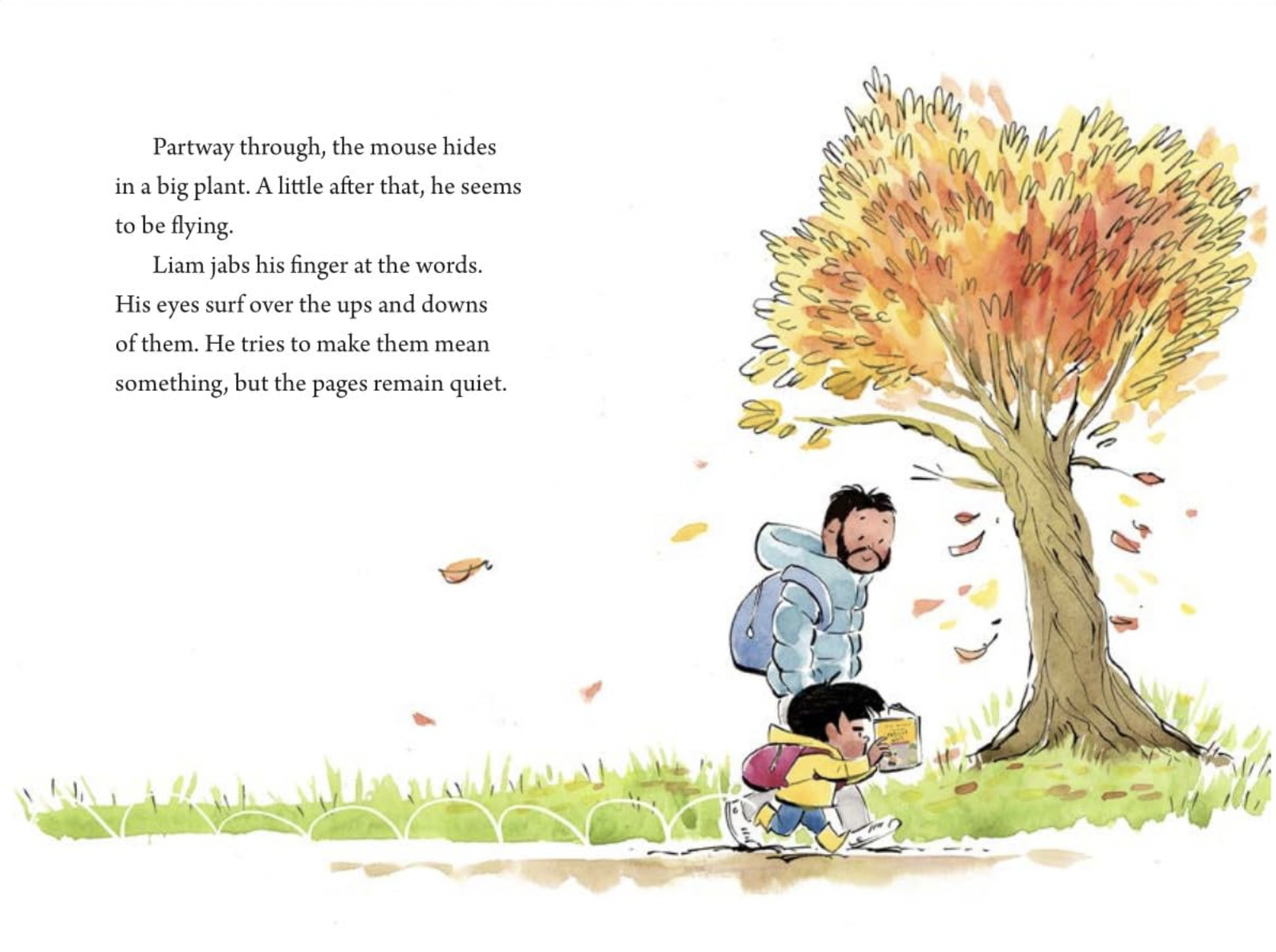
Like all skills, literacy develops at its own pace for the learner. For some children, the step between seeing shapes and deciphering into letters and then words comes earlier. For others, whether because of readiness or learning disability or even opportunity, the ability to read may come later. For Liam, it's not coming fast enough, especially when he has a charming book about a mouse and a bunch of cats–his family has cats!– and he wants to know what's happening.
From Two Tales of Twenty-Six: Liam and the Letters, written by Stephanie Simpson McLellan, illustrated by Mike Deas
In Liam and the Letters, a little boy is charmed by a book about a mouse and a lot of cats. He gets a lot of information from the illustrations, but he wants to know what's actually happening "but the random lines and loops of the letters stretch across the page like fences." (Liam and the Letters, p. 5) In fact, a sample of letters look a lot like those almost indecipherable text-based captchas and spell out "You Can't Come In" and could refer to the mouse and the outside world to which he is eager to visit or to Liam and his reading.
From Two Tales of Twenty-Six: Liam and the Letters, written by Stephanie Simpson McLellan, illustrated by Mike Deas
Liam is getting frustrated as fall turns to winter and he even throws his book away into the snow. But he retrieves it and makes a plan. After all, twenty-six letters is a lot. One letter at a time is manageable. 
One letter at a time could turn impossible into possible. (Liam and the Letters, p. 15)
From Two Tales of Twenty-Six: Liam and the Letters, written by Stephanie Simpson McLellan, illustrated by Mike Deas
So, he starts with the L and the A, letters from his name and ones that he recalls learning about at school. He's frustrated but with time he picks up on the W in the "Walk" sign on his way to school and the R on a cereal box. By spring, he's learned the letters and the weird-looking letters become readable.
 
Now, he can read the story that the reader can also read, simply by turning the book over. Walter and the World is the story of the mouse and the cats that Liam could not read. Walter the mouse has his own issues, with twenty-six cats whom he must evade if he's going to explore the outside world. Both Liam and Walter have twenty-six entities standing between them and what they crave, whether reading or an opportunity for exploration. Their stories may be different, but they are connected and ultimately even linked.
From Two Tales of Twenty-Six: Walter and the World, written by Stephanie Simpson McLellan, illustrated by Mike Deas
A tête-bêche book, which is also a flip book, has two stories in one book which you access by flipping it over. But Stephanie Simpson McLellan's book is not just two different stories. They are two linked stories with a child trying to read the other story. I don't think it matters which story is read first. If they read Liam's story first, they will get a perspective of what it means to look at a book and be frustrated at being unable to read it. But they will also get the satisfaction, as Liam gets, when he can put letters together into words and make sense of the story the reader can now read too. On the other hand, if they read Walter's story first, they'll be charmed by a cat-and-mouse story like no other and feel like they know a secret about the book that Liam cannot read when they read the second story. The order of the reading of the flip book does not matter here; it's the connection that matters.
 
Flip books can be problematic for libraries, particularly for cataloguing, but Two Tales of Twenty-Six will not be so. It will just be a fuller story, told from two different layers, that of a story character and that of a reader. For each, Stephanie Simpson McLellan who is a star of storytelling–my particular faves are The Christmas Wind and The Sorry Life of Timothy Shmoe–gives us a character who is faced with a challenge of twenty-six and tackles it with strategy and perseverance and ultimately success. It's two feel-good stories in one package.
 
To make it even more enticing for early readers–other than giving them a story with which they will be familiar–Two Tales of Twenty-Six is illustrated by Mike Deas, giving these young readers the graphic support to help them read and understand their reading. Mike Deas's art uses a blend of gouache, watercolour, ink, and digital tools to both support and enhance the stories, giving Liam the reader a starting point for his reading, and the reader of Two Tales of Twenty-Six the colour and the magic to make understanding possible and worthwhile.
 
I'm usually not enamoured with tête-bêche books but Two Tales of Twenty-Six is more than the sum of its parts and that's why it's extraordinary. It's a book that is geared to its audience perfectly, encouraging our youngest children in their reading, especially if they are frustrated, and allowing them to see themselves in a story while taking a step up in their reading from picture books.
• • • • • • •
 
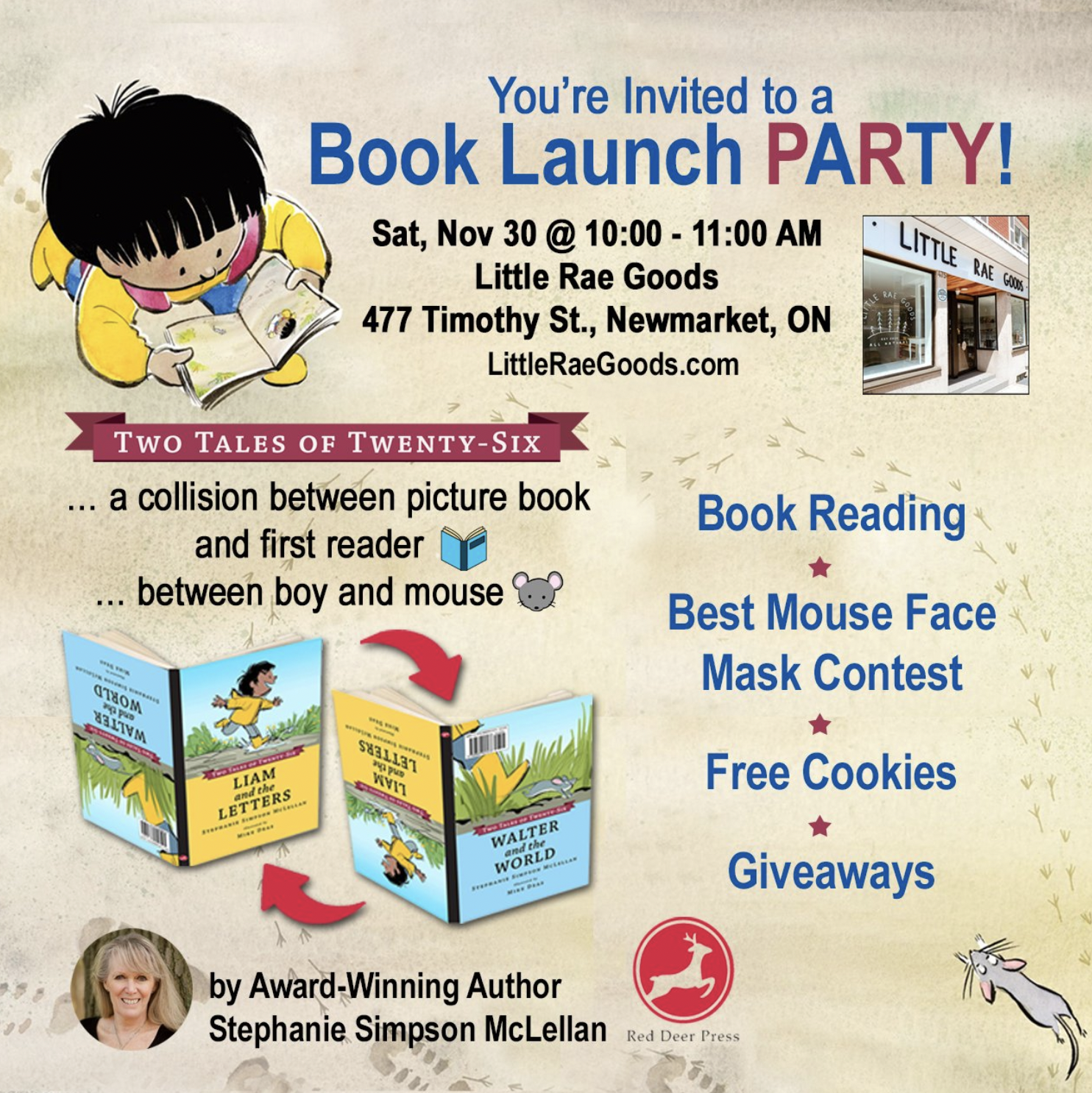
I'm very pleased to tell you about the book launch party for Two Tales of Twenty-Six
 
that will be held on

Saturday, November 30, 2024
 
from 10–11 a.m.
 
at

Little Rae Goode
477 Timothy St.
Newmarket, ON
 
 
This book launch will include:
 
• a book reading
 
• a contest for best mouse face mask

• free cookies

• giveaways

and

• book signing by the author Stephanie McLellan


September 09, 2024

I Want to Read All the Books: Book launch (Toronto, ON)

 Debbie Ridpath Ohi
author and illustrator

 
is launching her new picture book!
 
I Want to Read All the Books
Written and illustrated by Debbie Ridpath Ohi
Simon & Schuster Books for Young Readers
978-1481416306
48 pp.
Ages 4-8
September 17 2024


Book launch will take place on
 
Tuesday, September 24, 2024
 
at 7 PM 
(doors open at 6:30 PM)
 
at
 
TYPE Junction
2887 Dundas Street West
Toronto, ON


September 01, 2024

Anne of the Library-on-the-Hill

Written by Catherine Little
Illustrated by Sae Kimura
Plumleaf Press
978-1-7381-6524-7
32 pp.
 Ages 6-10
August 2024 

This year we will commemorate the 150th anniversary of the birth of Lucy Maud Montgomery, the author of Anne of Green Gables. There will be several titles released to observe this anniversary, some fiction, some non-fiction, and Anne of the Library-on-the-Hill celebrates Anne of Green Gables with a wholly fictionalized story about another little girl named Anne, with an "e" of course.
 
Anne, of Anne of the Library-on-the-Hill, lives with her parents in Toronto, and regularly visits the Wychwood Library with her father, an artist. This library which she calls Library-on-the-Hill is a special place for her and father, and they both relish the plethora of books they borrow. Her mother is more of an industrious woman who worries that too much imagination might not be helping Anne.
From Anne of the Library-on-the-Hill, written by Catherine Little, illustrated by Sae Kimura
Then World War I arrives, and Father must leave home to serve. His absence, monumental in itself, results in additional changes to the household, with Mother taking on laundry work and no time to take Anne to the Library-on-the-Hill for books. Fortunately, one of Mother's customers, Mrs. Mary Beal shares her own children's old books with Anne. And when a new Library-on-the-Hill is opened, Anne's Mother ultimately gives Anne permission to visit it on her own.
From Anne of the Library-on-the-Hill, written by Catherine Little, illustrated by Sae Kimura
Sadly, the family receives bad news about Father from Vimy Ridge. Missing her father terribly, Anne is comforted when her mother shares a special book that Anne's father had gifted her early in their marriage. Yes, it is Anne of Green Gables, published in 1908.
From Anne of the Library-on-the-Hill, written by Catherine Little, illustrated by Sae Kimura
There's still more that happens to the Anne of Catherine Little's story, including an encounter with the famous author herself, but suffice it to say that our Anne takes wisdom from Lucy Maud Montgomery's Anne that supports her through life's good days and bad.

I believe the nicest and sweetest days
are not those on which anything very
splendid or wonderful or exciting happens
but just those that bring simple little
pleasures, following one another softly,
like pearls slipping off a string
.”
                                                                           ~ From Anne of Green Gables
 
Our two Annes, that of Lucy Maud Montgomery's story and that of Catherine Little's, share some commonalities though their stories are completely different. They both had father figures who encouraged their passions for imaginative endeavours and maternal figures who were more pragmatic. The women weren't mean; they were just prudent. Not surprising that Matthew and Anne's father both had soft spots for their Annes and defended them tactfully to the women in their lives. Beyond the characters themselves, Catherine Little intersperses her story with known experiences from Montgomery's life including her friendship with Mary Beal and attending an event that included Nellie McCLung. By borrowing elements of Anne of Green Gables to feed her story of Anne of the Library-on-the-Hill, Catherine Little pays homage to the much beloved story while giving us a whole new story. If you didn't know about Anne of Green Gables –though Catherine Little provides plenty of background information about Anne and L. M. Montgomery to get you caught up–this Anne and her library and her life would still captivate.

The art of Anne of the Library-on-the-Hill has been created by Sae Kimura, who also illustrated Catherine Little's earlier books, Twelve in a Race and Dragon's Dilemma. Using a variety of media, including acrylic, gouache, watercolour, and pencil crayon, Toronto's Sae Kimura gives an ethereal sense to Anne of the Library-on-the-Hill, which works well for a story set in the mid-late 1910s to early 1920s. The reality of Anne's life is never in question but the richness of her imagination and passion for life is always evident, in the colours of her surroundings, in the brightness of her reading, and the joy she derives from being with her father, visiting the library, and more.
From Anne of the Library-on-the-Hill, written by Catherine Little, illustrated by Sae Kimura
Celebrate Anne of Green Gables and Lucy Maud Montgomery by reading a picture book that honours both while creating something that is wholly its own. With Anne of the Library-on-the-Hill, Catherine Little and Sae Kimura remind us of the anchor that reading can be in a child's life and also the pillar that Anne of Green Gables is in both the CanLit world and internationally.

July 13, 2023

Monster vs. Boy

Written by Karen Krossing
Charlesbridge
978-1-62354-356-3
240 pp.
Ages 10+
July 2023
 
...people believe the strangest things, especially when they're scared or upset. I think the stories people share are part truth and part not-truth. The hard part is figuring out which is which. (pg. 126)
This is a story about a boy and a monster. Yes, a real monster that lives in his closet. I know you'll say that monsters don't exist but in the town of Morsh (from "monstrous marsh") where 11-year-old Dawz lives with his little sister Jayla with their uncle Pop, there is a history of monster sightings. Problem is that Dawz hasn't really seen the monster because he doesn't go into that large bedroom closet. Still, his fears about it are very real, especially as the kids were abandoned by their mother after she got weird, talking about a monster with yellow feathers and a scorpion tail.

As Karen Krossing tells her story from two perspectives, we know Dawz is right about a monster living there. Mim is small, with purple scales, gray fur, two hearts, several horns, and she can release smoke and ash from her nostrils. She loves the nest she has built among the boxes and bags. Most of all, she loves when the grown-up opens a book and tells a story from it. She thinks it's absolutely magical.
Books were powerful. Wonders dwelled inside them. Wonders that Mim was missing, alone in her dusty closet. (pg. 6)
But Mim didn't understand how something in the book turned into a story told aloud. She had a book in her nest, and nothing happened when she opened it. Her aim was to learn how to make the book work for her.

But Dawz and Mim's status quo is disturbed when Pop decides to clean the closet and excavate some aprons Dawz's mom had made long ago for the annual Baker's Brawl baking contest which she used to enter with her brother and which Dawz now entered with his best friend Atlas. When Mim tries to scare them away, Dawz realizes that only he can see and hear her. With her nest eliminated–"Her world had cracked open... (pg. 41)"– Mim ventures out, grabbing a pillowcase, a sock, and a book, and finds herself pursued by Dawz and company, including Ronny the pest control guy and Officer Rashmi.

As Mim befriends a cat she calls Raar and struggles to find a new nest, deal with her hunger and her surprising growth, Dawz and Thea, one of Atlas's moms, cope with their injuries from encounters with Mim. It takes a while but both Dawz the Horrible, as Mim calls him, and Mim will need to find their way back to each other in order to alleviate their fears, understand their needs, and appreciate the other for whom they are.

While some readers may pick up Monster vs. Boy because of the promise of a horror story, Karen Krossing's latest middle-grade novel is more a reflection of what we see and fear in others before we know them. Dawz has a lot of baggage because of what he remembers of his mother before she abandoned them and, with his nightmares of monsters, he has essentially created one that lives in his closet. On the other hand, Mim knows the comfort of her closet nest and has no interest in the outside except for the opportunity to hear the stories that come from books. When forced out, she tries to make connections, such as with the cat, but finds herself drawn back to the familiar even if it makes her nervous. Because neither understands the other, until the end, they interpret their actions as threatening or horrible and try to prevent further dangers to themselves. There's much learning about themselves and others as the two go from monster vs. boy to monster and boy.

But beyond the conflictual theme of her story, Karen Krossing also reminds us of the magic of books and reading. Whether being a writer who puts words to paper or a listener who has the words read aloud to them, the process of reading is miraculous, taking us from the mundane to the fantastic. Even the text of a recipe, which Dawz reads to Mim, enthralls her. It's the translation of letters to words to meaning that elevates books from paper and ink to the extraordinary, and even a purple-scaled monster knows this. 

So, open your own closet and see what opportunities there are for new learnings and relationships. Taking a chance on the unknown may be trepidatious but the rewards can be so un-horrible.

September 13, 2021

The Undercover Book List

Written by Colleen Nelson
Pajama Press
978-1-77278-187-8
224 pp.
Ages 8-12
September 2021 

With the departure of her best friend Sienna to a new home and school, Jane McDonald is not looking forward to her Grade 7 year. But a literary mystery and an undercover friend-making activity may be what she needs to help make the year tolerable. Maybe even more.

In alternating voices and chapters of twelve-year-olds Jane and Tyson, Colleen Nelson brings together two kids with very divergent views on reading. Jane is a voracious reader, a passion she has shared with her best friend Sienna. But, with her dad already posted overseas as a Chief of Staff for a peacekeeping mission and now Sienna moving far away, she is feeling empty. Still Sienna has left her a clue that she hopes will help her friend find other reader friends. Giving Jane the code name X, Sienna initiates the Undercover Book Club by which Jane can leave notes and book recommendations and connect with others. 

The note is found by Tyson, a non-reader and prankster, who discovers the note when sent to the library for a book while he waits for the principal to discipline him. Tyson is not a reader. In fact, he can't even take books of the library since he has not returned some from last year. But when this Mutant-Z aficianado gamer has his Xbox taken away and has nothing else to do, he sneaks out the book in which the first note is found, recommends a book he remembers his teacher reading, and starts on his own reading journey.

Tyson knows X is Jane but she has no idea he's Y. As the two begin an unlikely book friendship, and Jane and her Kid Lit Quiz team struggle to reorganize after Sienna's departure, the Undercover Book Club is born, each reading new books and talking about their choices and learning more about themselves. As they compile a list of extraordinary books–with shout-outs to Canadian authors Kenneth Oppel, David A. Robertson, Monica Hughes and Susin Nielsen among others–it's a journey of self-discovery and self-development and it's all courtesy of reading.

Readers know the richness that stories can bring into their lives. We meet new friends, travel to different places and times, and we learn.  By bringing together a reader and non-reader, Colleen Nelson, an astute writer and undoubtedly understanding teacher, has written about every child out there. The ones that love books will always find something to read but can get so much insight from the perspectives of others. Those that haven't become readers yet often just need the scaffolding of the right book or the right person to bring them to reading. With the Undercover Book Club, Tyson and Jane both find their people among those they would have dismissed originally and enrich their lives beyond just reading.

Colleen Nelson has a natural skill at giving young readers characters who are real, though not always likeable at first, and who are able to change with their experiences and perspectives. It's her characters who have always driven her stories, whether they are in her picture books (e.g., Teaching Miss Muddle, 2020), middle grade (e.g., Harvey Comes Home, 2019) or young adult novels (e.g., Sadia, 20018), and give her plots the foundation for exploration of topics from bullying to abandonment, abuse and empowerment. By letting us see Jane and Tyson from different perspectives and responding to common scenarios, they become even more real.
Thanks for seeing me for who I am. And who I wanted to be, even if I didn't know it. (pg. 258)
For the reluctant reader who doesn't know they're a reader yet and for those who will consume this story with gusto, The Undercover Book List is for them. From its fabulous cover–easily identifiable as that of illustrator Scot Ritchie–through Colleen Nelson's irresistible text and appended notes about authors and books to check out, The Undercover Book List brings reading out from under its nerd status into a mainstream social avocation it can be.

📘📘📘📘📘📘📘

Tomorrow I'll post about Colleen Nelson's hybrid (limited in-person and online) book launch for The Undercover Book List on Friday, September 17, 2021.

📘📘📘📘📘📘📘

March 31, 2021

The Librarian's Stories

Written by Lucy Falcone
Illustrated by Anna Wilson
POW! Kids Books
978-1-576879450
32 pp.
Ages 4-8
February 2021
 
Though many young readers will recognize the name L. M. Falcone as the writer of supernatural mysteries like Walking with the Dead (Kids Can Press, 2005), Lucy Falcone has recently pursued writing emotionally-charged picture books like I Didn't Stand Up (Clockwise Press, 2018) that remind that what really counts, like justice and compassion. In The Librarian's Stories, it's humanity and literacy.
From The Librarian's Stories by Lucy Falcone, illus. by Anna Wilson

Though life in this town was once a typical one for children of play and birthdays, the greyness of war settles over the community in which a library is destroyed, scattering pages, words and letters out and away. Life is now one lived in fear, of long lines for water, of cold rooms without electricity, and sparse food availability.
 
Then one day there are spoken words sprinkled in the air from the local square. Papa may call the librarian who sits there reading aloud foolish but they stop to listen.
From The Librarian's Stories by Lucy Falcone, illus. by Anna Wilson
Without much food and only the cold and grey as backdrop, the child joins others watching from their own windows and tucked into doorways and against walls, all listening.

Her words carry me back...

Briefly, the boy remembers his birthday, with balloons and kites and even birds flying.
From The Librarian's Stories by Lucy Falcone, illus. by Anna Wilson
But even as he and other children and adults listen, the reality of their lives, from the danger of standing in open windows, tanks in the streets, barbed wire and marching soldiers, encroaches back in. Still the librarian returns and reads aloud.
From The Librarian's Stories by Lucy Falcone, illus. by Anna Wilson

Eventually the soldiers are gone and the town repairs itself, including the child helping by reading aloud himself. But the best thing to help the goodness return is the rebuilding of that library.
From The Librarian's Stories by Lucy Falcone, illus. by Anna Wilson
War and conflict bring hardship and destruction but it is often seen in terms of shortages, deaths and injury, and the ruination of structures. But Lucy Falcone reminds us that the extinguishing of hope offered through literacy can be just as traumatic. The librarian knows the power of words to renew and enliven, and her perseverance and determination herald the new spirit for the town. By choosing to show us what is impactful for a child, Lucy Falcone gives a perspective that is elementary but profound by contrasting the darkness of conflict with the light of literacy.
 
New Zealand illustrator Anna Wilson similarly accentuates the anguish of a community in strife with the brightness of children and the luminosity of stories. In The Librarian's Stories, she gets the tone right for transitioning the story from one of the grim reality of war to one of hope and brightness, and her depiction of darkened letters fractured from the library's ruins and of blue or white words wafting from a reading are especially telling.
 
Most readers know the healing capacity of books and words but The Librarian's Stories reminds us that they can do much to restore communities from trauma as well.  Without words, without stories, without reading, we are all desolate.

February 15, 2021

Firefly: Virtual Book Launch

 
Join author
  
 Philippa Dowding
 
Photo by Andrea Gutsche


for the launch 
 
of her newest middle grade novel

Firefly
Written by Philippa Dowding
DCB
978-1-77086-598-3
200 pp.
Ages 9-12
February 2021
on

Tuesday, March 2, 2021
 
6-7 p.m. (EST)
 
via Zoom
 
 
Register for this free online event
at
 
 
 I'm pleased to announce 
that I will be interviewing Philippa Dowding about Firefly 
so please come and check out the launch

• • •
This event is sponsored by 
 
publisher DCB/Cormorant Books
 
and
 
Another Story Bookshop
 
with 
 
Thunder Thighs Costumes
 (***There's a chance to win a few costume rental!!!***) 


• • • • • • • 
 
For a taste of Firefly, do check out Philippa Dowding's book trailer and reading of an excerpt from the book for a taste of what the book launch will offer.
 
Firefly Book Trailer
Uploaded to YouTube by Philippa Dowding on October 7, 2020.
 
 
Philippa Dowding Reads from FIREFLY, about a carrot costume ...
Uploaded to YouTube by Philippa Dowding on February 10, 2021.

January 12, 2021

Goldibooks and the Wee Bear

Written by Troy Wilson
Illustrated by Edwardian Taylor
Running Press Kids
978-0-7624-9620-4
32 pp.
Ages 4-8
January 2021
 
When Goldibooks and her reading-loving parents head to the library to exchange their books, they spot a wee bear that the girl thinks is adorable. Though her parents caution her away because adult bears can be protective of their young, she needn't have worried as the cub is just desperate to find something to read.
 
From Goldibooks and the Wee Bear by Troy Wilson, illus. by Edwardian Taylor
When the wee bear comes across the humans' cottage, he can't resist peeking in and is elated to spot three packed bookshelves. As in the story of Goldilocks and the Three Bears, upon which Troy Wilson has based his story, the wee bear tries out the books on each case. Of course, Mom's are too hard, and Dad's are too soft, but Goldi's are just right.

From Goldibooks and the Wee Bear by Troy Wilson, illus. by Edwardian Taylor
Similarly, the wee bear looks for a comfy spot to read and finally finds that Goldi's chair is just right, though he does have a bit of a fumble with it. So he tries the beds because what better place to read, right? And as every reader knows, when gets comfortable reading, he falls asleep.
 
From Goldibooks and the Wee Bear by Troy Wilson, illus. by Edwardian Taylor
When the family returns from the library, they are shocked to see the mayhem with their books, and their chairs, and beds. Just as Goldibooks discovers the wee bear who knows he shouldn't have trespassed, his bear parents show up, distressed that he didn't stay away from the wee human whose parents could be dangerous if you get near their kids. (Sounds familiar, doesn't it?)

From Goldibooks and the Wee Bear by Troy Wilson, illus. by Edwardian Taylor
But books can do so much to help us overcome fears and discrimination, and soon enough the wee ones, human and bear, have encouraged their families to enjoy reading together.
 
By writing this story as a fractured fairy tale, Troy Wilson is able to incorporate important messages about reading and the coming together of cultures in a familiar narrative that kids will love. They'll know where the story should go—i.e., the first is too hard, the next is too soft and the last is just right—but they won't exactly know where Troy Wilson will take them. And by blanketing the story about a little bear who wants to read and parents who want to protect their young, even if their fears are unfounded, Troy Wilson gives us more to the story than just respecting other's stuff. 

American Edwardian Taylor's cartoon illustrations, with his apple-cheeked characters and fairy-tale setting of forests and cottages, keep the story light and cheerful. Even when the wee bear causes a bit of damage and the bears and humans meet, his colours and shapes add whimsy and brightness.
 
Goldibooks and the Wee Bear, Troy Wilson's second fractured fairy tale (Little Red Reading Hood and the Misread Wolf  in 2019 was his first) among his rich collection of picture books, releases today. With it, Troy Wilson is becoming a stand out in twisting a classic tale into a more contemporary and more meaningful story for teaching and entertaining young readers.

September 03, 2020

I Do Not Like Stories

Written by Andrew Larsen
Illustrated by Carey Sookocheff
Owlkids Books
978-1-77147-378-1
32 pp.
Ages 3-7
September 2020

Like many children, this child has very definite preferences, especially about the types of stories he likes. Actually he is more adamant about the types of stories he doesn't like than those he likes. But does he really know what he doesn't like?

From I Do Not Like Stories by Andrew Larsen, illus. by Carey Sookocheff
From waking up to his cat pawing his face to getting dressed, feeding his fish, heading to school and participating in his school day, the child is reminded about all the stories he doesn't like i.e., stories about fish and buildings, numbers and fruit, and buses and bikes. As the day goes on, everything remind him of the stories he doesn't like.

From I Do Not Like Stories by Andrew Larsen, illus. by Carey Sookocheff
But as the boy relates all the stories he does not like, his cat, a lovely tuxedo, lives those stories. The boy doesn't like stories about numbers or letters but his cat races by a parking meter and surprises the postal carrier with his bag of mail. The boy languishes over his lunch fruit and thinks about how much he does not like stories about apples or pears or peaches or plums while his feline friend visits a fruit stand, toppling produce after a dog chases it away. For each experience for which the child recounts his dislike of stories, his cat is creating its own stories about that same set of circumstances. From trees to going home and doing things, the boy dislikes the stories and the cat lives them.

From I Do Not Like Stories by Andrew Larsen, illus. by Carey Sookocheff


In the end, the boy relents that he might like a story about a cat.

Without establishing the fact that the child has been wrong all along and that he, in fact, does like stories, Andrew Larsen delivers that message with a tongue-in-cheek approach. It's like a parent who smiles, knowing that the child who insists that they don't like something will like it once they try it. It's accepting a child's assertions as true but allowing for leeway in the actuality of those pronouncements. By allowing the child to come to that realization himself, Andrew Larsen takes the adult out of the equation and makes it all about the growth of the child in learning what he might like for himself.

As in her earlier books (see What Happens Next, Wet and Buddy and Earl for other samples), Carey Sookocheff's illustrations play on the author's important message and elevates it with subtlety of colour and line for greater impact. Her artwork plays on that juxtaposition of child and cat, what one affirms and the other experiences. Same circumstances but different perspectives and appreciation for those circumstances. Carey Sookocheff's minimalist palette, primarily pale blue-greys with splashes of yellow and orange, keeps the reader focused on the darkest elements of her illustrations: the cat and the child's head. So, while it is the child's head only that has decided what he doesn't like, it's the whole cat that lives life, pursuing adventures and involving itself in its day fully.

For any child who cannot see beyond a pervasive opinion that may or may not be valid, I Do Not Like Stories will make them think twice and perhaps even consider a different perspective to the story.

From I Do Not Like Stories by Andrew Larsen, illus. by Carey Sookocheff