Showing posts with label alphabet. Show all posts

June 03, 2026

Stella and Sam ABC

Book cover of "Stella and Sam ABC" by Marie-Louise Gay shows two children and their dog on a beach
Written and illustrated by Marie-Louise Gay
Groundwood Books
978-1-77946-067-7
34 pp.
Ages 0–3
May 2026 
 
This is not just another alphabet book. It's Stella and Sam, Marie-Louise Gay's wonderful siblings from countless books including Read Me a Story, Stella (2013), Stella, Princess of the Sky (2004), and Good Night Sam (2003). Together they share, explore, learn, and bond. Now they're helping others learn the alphabet through their relationship and joyous romps through play.
Illustration from "Stella and Sam ABC" shows two children making snow angels
From Stella and Sam ABC, written and illustrated by Marie-Louise Gay
From apple picking to 
moon-watching to 
exploring the jungle
every day is a new adventure 
for Stella and Sam. 
Do you want to join them? Let's turn 
the page!
With that first page, Marie-Louise Gay invites us to watch the two children as they play through the seasons. In winter, there's angel-making, ice-skating, and night-time dreaming ... with owls hooting. In the summer, there's fishing and vegetable gardening. And there's always fun in the house like hiding and seeking, reading, rolling and somersaulting, as well as yawning together (Sam and Fred the dog) before falling asleep. These children do so much that I suspect Marie-Louise Gay could write multiple alphabet books for Stella and Sam.
Illustration from "Stella and Sam ABC" show two children jumping and jiggling like rabbits
From Stella and Sam ABC, written and illustrated by Marie-Louise Gay
Whether together or off on their own, everything they do gives us new letters to learn, new words to identify, and new qualities to fall in love with. Stella and Sam are filled with joy, whether it's watching the moon, bathing with rubber duckies, or slurping some tasty treat. There are nouns and verbs, sounds and more. Marie-Louise Gay shows us that these kids are into everything, both remarkable and ordinary.
Illustration from "Stella and Sam ABC" shows a boy looking for his dog in the tall grass
From Stella and Sam ABC, written and illustrated by Marie-Louise Gay
Young children will definitely learn the alphabet as they read along with Stella and Sam ABC, but they'll also be learning to read. The words are simple and will be meaningful to children. Stella and Sam's activities and actions will all be familiar, and easily replicated which will strengthen young children's learning. And because Marie-Louise Gay always gives us more to love in her art, like hiding rabbits, a stray sock, or a hitchhiking snail, children will be pointing and finding and laughing as they learn.
 
It's so lovely to visit with Stella and Sam again. Even though Marie-Louise Gay has continued to give young readers fabulous picture books (e.g., Short Stories for Little Monsters, 2017); The Three Brothers2020; and I'm Not Sydney!, 2022) even early chapter books, I've missed Stella and Sam (and Fred too). They are sweet and true. They are delightful to watch in their relationship and in their play. They are different and yet similar in their dispositions—their parents or guardians must be extraordinary—and I want more of Stella and Sam. Please. After all, there is still so much of their world to explore—exploring is the x word, as you were probably wondering—and to see through their eyes and their hearts.

July 30, 2025

T Is for Terry: An ABC of Courage

Written by Denise Dias
Illustrated by Noémie Gionet Landry
North Winds Press (Scholastic Canada)
978-1-0397-0679-8
32 pp.
Ages 3–8
July 2025 
 
Terry Fox's story of his cancer and of his Marathon of Hope is one that is firmly established in Canadian history. When he embarked on his cross-country run in 1980 in support of cancer research, he could not have imagined the impact his story and his undertaking would have on the world. For us, he was a champion and a warrior. And now his story is told in such a way that our youngest children, perhaps those who will still be having this book read to them, will understand who he was and what he accomplished. 
From T is for Terry, written by Denise Dias, illustrated by Noémie Gionet Landry
Denise Dias who is involved with the Terry Fox Foundation tells Terry's story using the alphabet as her guide. She begins pre-diagnosis with Terry enjoying play with his siblings and sports. With the letter C, readers learn that Terry became ill and had the courage to face losing part of one leg. (Thank you, Denise Dias, for not making Cc for cancer.) Then there is his treatment and his training, but the text is all about the positives: the dream, the effort, his friends, and his gratitude. 
From T is for Terry, written by Denise Dias, illustrated by Noémie Gionet Landry
With the letter H, Denise Dias begins Terry's Marathon of Hope, still always emphasizing the positives of the kindness people showed him, the pride they felt sharing in his marathon, and the example he was by inspiring people everywhere to carry on his dream. Sure, there were some details about his shoes and how tired he was, but the highlights of T is for Terry is the young man and his worthwhile efforts to help others who were sick through fundraising for cancer research.
From T is for Terry, written by Denise Dias, illustrated by Noémie Gionet Landry
T Is for Terry is a complete illustrated biography for young children, introducing them to this extraordinary young man and his mission in a way that is not scary and very inclusive.  Denise Dias may keep the text inspiring rather than disheartening but she gives everything to his story so it is thorough. What Denise Dias leaves out in the text New Brunswick's Noémie Gionet Landry includes but with care. Her digital artwork blends realism with cheerful illustrations that both inform and amuse. We see Terry and other cancer patients receiving chemo treatment, the solitude of his running through all kinds of weather, and his distinctive running gait. We also see the landscapes of Canada that Terry ran through, from the Atlantic Ocean through forests and neighbourhoods. Noémie Gionet Landry keeps the story but makes it more Terry.
 
I am often wary of themed alphabet books as they can seem contrived, trying to fit a story into the alphabet. T Is for Terry is not forced in its alphabetical storytelling. Terry's story is complete as an illustrated biography in T Is for Terry; it just happens that it is told with the use of the alphabet to organize information. With great honesty and philanthropy, Denise Dias tells how Terry Fox and his Marathon of Hope united a nation and committed us to working to fund cancer research. With all author royalties being donated to the Terry Fox Foundation—in fact, the text and illustrations copyrights are held by the Terry Fox Family—Denise Dias furthers that support now and in perpetuity. By encouraging discussions through T Is for Terry, I hope that teachers and parents will grab this book and further the support for the Terry Fox Foundation and the good work they do, and thus move us all closer to finding all the cures for cancer.

November 06, 2024

Two Tales of Twenty-Six: Liam and the Letters, Walter and the World

Written by Stephanie Simpson McLellan
Illustrated by Mike Deas
Red Deer Press
978-0-88995-746-6
64 pp.
Ages 6–8
November 2024
 
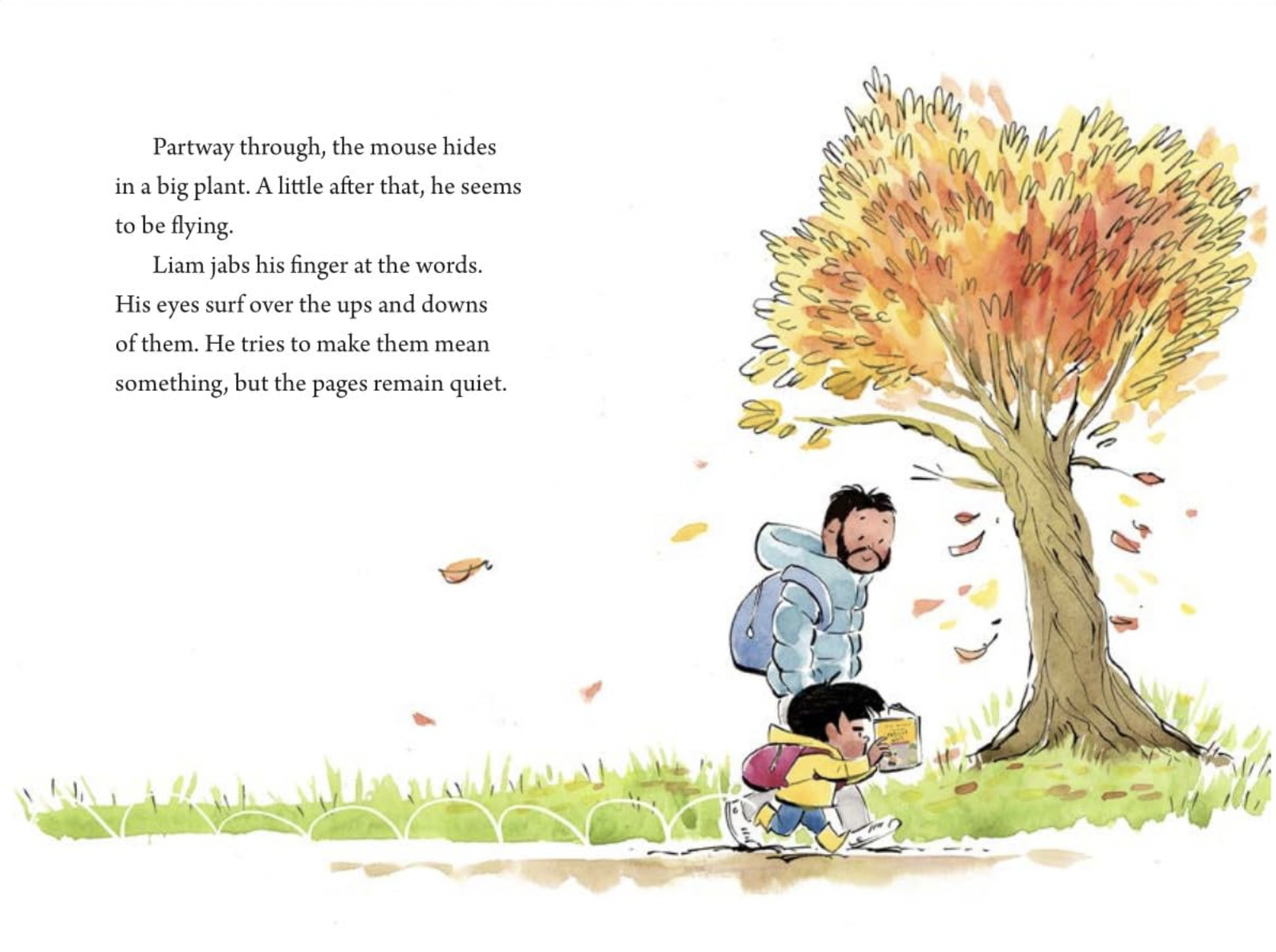
Like all skills, literacy develops at its own pace for the learner. For some children, the step between seeing shapes and deciphering into letters and then words comes earlier. For others, whether because of readiness or learning disability or even opportunity, the ability to read may come later. For Liam, it's not coming fast enough, especially when he has a charming book about a mouse and a bunch of cats–his family has cats!– and he wants to know what's happening.
From Two Tales of Twenty-Six: Liam and the Letters, written by Stephanie Simpson McLellan, illustrated by Mike Deas
In Liam and the Letters, a little boy is charmed by a book about a mouse and a lot of cats. He gets a lot of information from the illustrations, but he wants to know what's actually happening "but the random lines and loops of the letters stretch across the page like fences." (Liam and the Letters, p. 5) In fact, a sample of letters look a lot like those almost indecipherable text-based captchas and spell out "You Can't Come In" and could refer to the mouse and the outside world to which he is eager to visit or to Liam and his reading.
From Two Tales of Twenty-Six: Liam and the Letters, written by Stephanie Simpson McLellan, illustrated by Mike Deas
Liam is getting frustrated as fall turns to winter and he even throws his book away into the snow. But he retrieves it and makes a plan. After all, twenty-six letters is a lot. One letter at a time is manageable. 
One letter at a time could turn impossible into possible. (Liam and the Letters, p. 15)
From Two Tales of Twenty-Six: Liam and the Letters, written by Stephanie Simpson McLellan, illustrated by Mike Deas
So, he starts with the L and the A, letters from his name and ones that he recalls learning about at school. He's frustrated but with time he picks up on the W in the "Walk" sign on his way to school and the R on a cereal box. By spring, he's learned the letters and the weird-looking letters become readable.
 
Now, he can read the story that the reader can also read, simply by turning the book over. Walter and the World is the story of the mouse and the cats that Liam could not read. Walter the mouse has his own issues, with twenty-six cats whom he must evade if he's going to explore the outside world. Both Liam and Walter have twenty-six entities standing between them and what they crave, whether reading or an opportunity for exploration. Their stories may be different, but they are connected and ultimately even linked.
From Two Tales of Twenty-Six: Walter and the World, written by Stephanie Simpson McLellan, illustrated by Mike Deas
A tête-bêche book, which is also a flip book, has two stories in one book which you access by flipping it over. But Stephanie Simpson McLellan's book is not just two different stories. They are two linked stories with a child trying to read the other story. I don't think it matters which story is read first. If they read Liam's story first, they will get a perspective of what it means to look at a book and be frustrated at being unable to read it. But they will also get the satisfaction, as Liam gets, when he can put letters together into words and make sense of the story the reader can now read too. On the other hand, if they read Walter's story first, they'll be charmed by a cat-and-mouse story like no other and feel like they know a secret about the book that Liam cannot read when they read the second story. The order of the reading of the flip book does not matter here; it's the connection that matters.
 
Flip books can be problematic for libraries, particularly for cataloguing, but Two Tales of Twenty-Six will not be so. It will just be a fuller story, told from two different layers, that of a story character and that of a reader. For each, Stephanie Simpson McLellan who is a star of storytelling–my particular faves are The Christmas Wind and The Sorry Life of Timothy Shmoe–gives us a character who is faced with a challenge of twenty-six and tackles it with strategy and perseverance and ultimately success. It's two feel-good stories in one package.
 
To make it even more enticing for early readers–other than giving them a story with which they will be familiar–Two Tales of Twenty-Six is illustrated by Mike Deas, giving these young readers the graphic support to help them read and understand their reading. Mike Deas's art uses a blend of gouache, watercolour, ink, and digital tools to both support and enhance the stories, giving Liam the reader a starting point for his reading, and the reader of Two Tales of Twenty-Six the colour and the magic to make understanding possible and worthwhile.
 
I'm usually not enamoured with tête-bêche books but Two Tales of Twenty-Six is more than the sum of its parts and that's why it's extraordinary. It's a book that is geared to its audience perfectly, encouraging our youngest children in their reading, especially if they are frustrated, and allowing them to see themselves in a story while taking a step up in their reading from picture books.
• • • • • • •
 
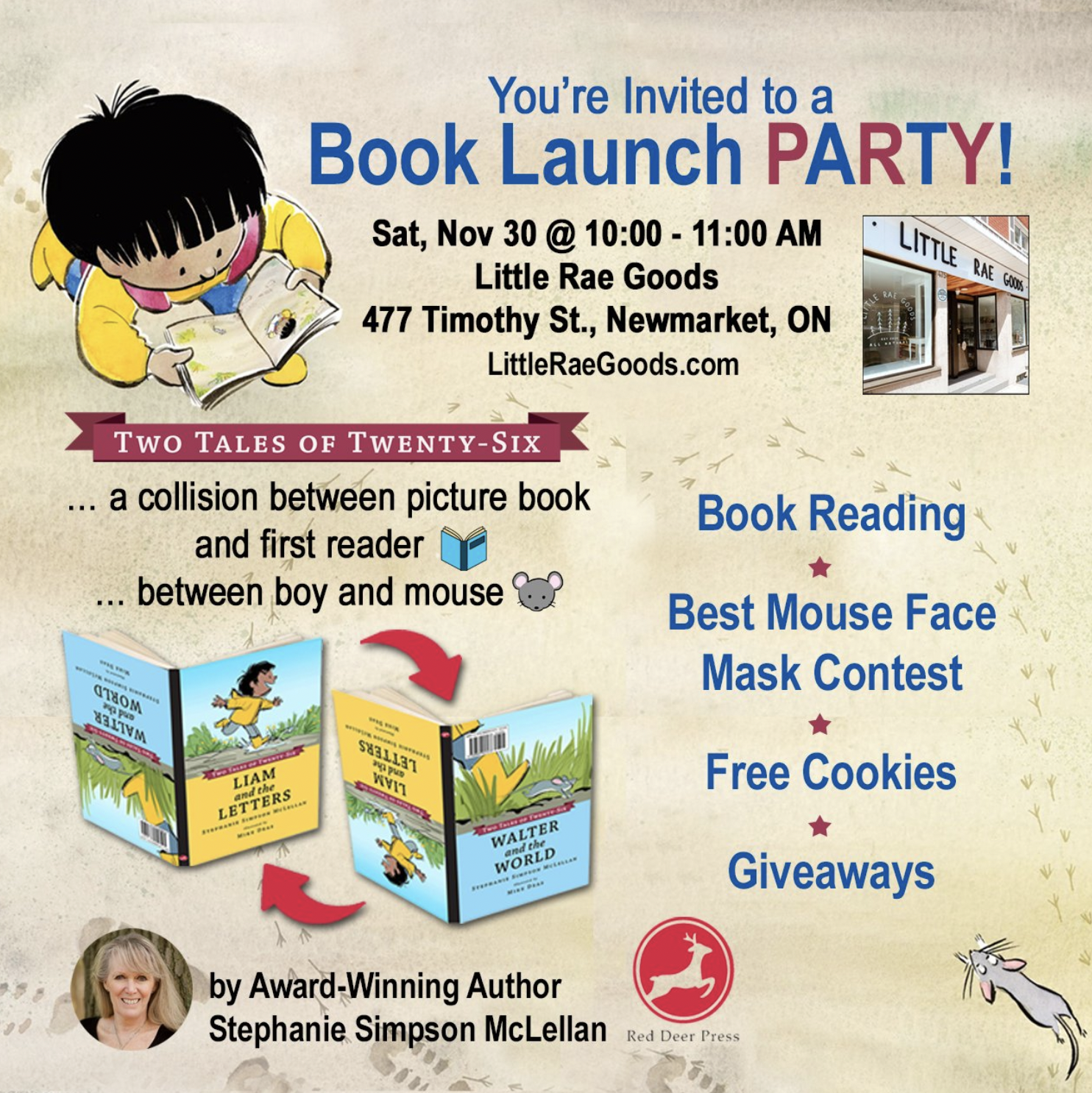
I'm very pleased to tell you about the book launch party for Two Tales of Twenty-Six
 
that will be held on

Saturday, November 30, 2024
 
from 10–11 a.m.
 
at

Little Rae Goode
477 Timothy St.
Newmarket, ON
 
 
This book launch will include:
 
• a book reading
 
• a contest for best mouse face mask

• free cookies

• giveaways

and

• book signing by the author Stephanie McLellan


September 20, 2024

ABCs for a Peaceful Me: A Mindfulness Seek-and-Find Book

Written by Shelly Becker
Illustrated by Dan Yaccarino
Abrams Appleseed
978-1-419772719
40 pp.
Ages 3-7
August 2024 
 
I think many people believe anyone can write a concept book such as an alphabet book, not unlike every celebrity who thinks writing a picture book is a piece of cake. After all, everyone knows that alphabet so finding a bunch of words on a single theme should be easy. It's not if it's done well. And by making her book about mindfulness and incorporating a seek-and-find element, Shelly Becker makes ABCs for a Peaceful Me take on an important mental health practice while making it fun for young children.
 
From ABCs for a Peaceful Me, written by Shelly Becker, illustrated by Dan Yaccarino
The book begins with the following directive:
Feel  your breath move in and out.
Feel the peaceful energy.
Focus on the here and now...
and just BE.
Then, for each letter, a child is doing something that will give them an opportunity to focus and be in the moment. In each case, it's a single verb or verb phrase, allowing the reader to interpret and expand on the term to make it what they need. It could be to breathe or connect, to nurture or observe, and to visualize or wait. 
 
Finally, children are encouraged to...
Rise to your highest heights.
Embrace the sparkling star that you are,
Shine your one-of-a-kind light...
and just BE.
From ABCs for a Peaceful Me, written by Shelly Becker, illustrated by Dan Yaccarino
While an adult might read this book from A to Z, as well as the "Author's Note", the reading of this book should be approached differently for a child. Shelly Becker knows this, providing a discussion about how to do a "Mindful Reading" of the book, and how to conduct a "Five Senses Mindfulness Treasure Hunt." This book could become a whole teaching unit on being mindful, incorporating lessons on health and well-being, on the science of making observations and using the five senses to do so, on visual literacy to look for details within each illustration that begin with each letter, and so much more. ABCs for a Peaceful Me may be intended for young children but I believe it will be valuable tool for reducing stress for all.
From ABCs for a Peaceful Me, written by Shelly Becker, illustrated by Dan Yaccarino
Dan Yaccarino, an American author and illustrator, has collaborated with Shelly Becker on a number of picture books, but his digital artwork in ABCs for a Peaceful Me works especially well in a concept book. There is a simplicity that mirrors both the peaceful nature of the book and the alphabetical nature of the text. Dan Yaccarino uses colours and shapes that are both bold and reassuring, quite an accomplishment.
From ABCs for a Peaceful Me, written by Shelly Becker, illustrated by Dan Yaccarino
Some of the words in ABCs for a Peaceful Me are big. Words like appreciate, journey and uplift, but mindfulness is a big concept. The book may be aimed at the very young but the not-so-young will certainly appreciate its worth too.

September 14, 2023

The Imaginary Alphabet

Written and illustrated by Sylvie Daigneault
Pajama Press
978-1-77278-299-8
64 pp.
Ages 5-10
September 2023
 
Though Sylvie Daigneault describes The Imaginary Alphabet in her preface as a work that started during the pandemic lockdown, she recognizes that it is a book of playfulness and unbounded imagination. It might have been a gift to have this luscious picture book to entertain children during that tenuous time, but its joyful art and interactive nature will be a welcome read anytime.
From The Imaginary Alphabet by Sylvie Daigneault
Based on the 26 letters of the alphabet, Sylvie Daigneault has created a book of hidden pictures within. For each letter, all works of art themselves, there is a fantastical illustration filled with items that begin with that letter, as well as a quirky phrase that alludes to some of those hidden items. For example, A, a botanical piece of acorns, is accompanied with the phrase Agile Alligators Attempting an Arabesque, pointing at the alligators and the arabesque they are performing. But there are more A words to be found, like the accordion, an albatross or two, an anchor, apples, and an axe. There are even more A items and Sylvie Daigneault generously provides lists for each letter at the conclusion of her book.
From The Imaginary Alphabet by Sylvie Daigneault
The text, like the art, is sophisticated, and children may need some adult participation to help them find all the items depicted for that letter. For example, the cover art, taken from the letter F, may have little ones finding the frog, the ferrets, the fan, the fairies, and the fire but I suspect the fascinator, fern and the flounce might be more challenging for them to pick out. For that reason, I think The Imaginary Alphabet shouldn't be limited to five- to ten-year-olds, as indicated, but a gorgeous and captivating book for all ages. (For art lovers, I could see keeping The Imaginary Alphabet on a coffee table for guests to peruse, which they will be drawn to do, when it's spotted.)
From The Imaginary Alphabet by Sylvie Daigneault
The Imaginary Alphabet is extraordinary in its art and its premise. Sylvie Daigneault, originally from Montreal and now of Toronto, has gone beyond the illustrations she created for books like The Good Garden: How One Family Went from Hunger to Having Enough and C is for Canada, and exploded into a new realm of art for children's books. Very reminiscent of Wallace Edwards's fanciful and extravagant art, Sylvie Daigneault goes all out in her pencil illustrations, giving textures and form to the incredible, and making The Imaginary Alphabet a literary feast of everything, from animals and plants to foods and landscapes. It's beyond a concept book and a search-and-find book. It's an art book that will inspire discussions, inquiry, and exploration of Sylvie Daigneault's craft, and make readers smile for lemurs with lollipops, the overdramatic ocelots, and the unicycle-riding unicorn, and that's only L, O, and U.

February 13, 2023

A is for Anne

Written by Mo Duffy Cobb
Illustrated by Ellie Arscott
Pownal Street Press
978-1-778124549
24 pp.
Ages 0-3
For release February 28, 2023
 
A is for Anne is a concept book that is ever so Canadian, set in the late 1800s and on Prince Edward Island, and offering an opportunity to learn the alphabet and a historical perspective of our world. From horse-drawn carriages to games and activities, A is for Anne takes us into a different time and place.
From A is for Anne by Mo Duffy Cobb, illus. by Ellie Arscott
Some of the letter designations are simple enough, like A is for Anne, who waits by the train, and B is for Brown, a horse with a mane. Young children will understand and appreciate the I is for ice cream and J is for July but many of the references are far more esoteric, requiring a knowledge of L. M. Montgomery's Anne of Green Gables novel–"M is for Matthew, the real reason we're here" and "N is for natural, a father so dear"– or include sophisticated and dated terms like "decree," and "cordial." This does not take away from the elegance of A is for Anne, but I think it extends its readership to all ages, from the very young who are learning their alphabet to older readers who have already read Anne of Green Gables.
From A is for Anne by Mo Duffy Cobb, illus. by Ellie Arscott
Mo Duffy Cobb, co-founder of PEI's boutique publisher Pownal Street Press, captures all the nuances of Anne's story from the child's arrival in Avonlea to her relationships with Marilla, Matthew, Diana, and Gilbert. She takes readers into Anne's enthusiasm for the island's beauty from its poplar trees by a stream, the blossoming cherry trees, and yellow skies tinged with pink, and her joie de vivre for the potential of her new life. Mo Duffy Cobb shares with us Anne's foibles and her heart. And she does it all in polished rhymes, giving rhythm to her refined text.
From A is for Anne by Mo Duffy Cobb, illus. by Ellie Arscott
Though not from PEI, illustrator Ellie Arscott delivers the reader to Anne's home in place and story. From its landscape and its people and the story of the freckled child looking for a home, Ellie Arscott's watercolours with ink depict a world of softness, of place and people. The pace of life is slower than today and simpler in scope but full in sentiment and connection, as is the original story.

I know that parents and teachers will first see A is for Anne as the alphabet board book that it is, but I hope that others will see it as a tribute to the classic story, giving us both rhyme and art to see Anne and her creator from a different perspective.

October 17, 2022

Santa ABC

 
Written and illustrated by George Fewster
Collins
978-1-443466059
26 pp.
Ages 3-7
October 2022 

Santa definitely has an important job but is that all that he's about? Does he do any other jobs? What does he feel?  In this playful board book, George Fewster takes children–though older readers will enjoy it just as much–through the ABCs of Santa in all his forms.
From Santa ABC by George Fewster
From an astronaut and barista, to Viking and zombie, George Fewster shows us a multitude of active and feeling Santas. Santa may be wearing an ninja outfit or dancing to disco or experiencing ennui and hanger–hunger and anger–but Santa is always still Santa, adorned in red with candy cane-striped props and spreading his "Ho Ho Ho" greeting.
From Santa ABC by George Fewster
Author-illustrator George Fewster takes Santa into the 21st century, engaging in contemporary activities and interests that many children will recognize, even if it's only through their families or teachers. And while they'll be learning the alphabet, the objective of this kind of concept book, they'll learn a few words and definitely smile at this talented Christmas character.
From Santa ABC by George Fewster
They'll especially smile at George Fewster's illustrations. His bold colours and clean lines will be much appreciated by young readers. Because of the unmistakable depictions–except for Ennui Santa–Santa ABC can become a guessing game, as well as an alphabet activity, a visual literacy lesson and more. Perhaps that's why, though Santa ABC is a concept book in board book format aimed at our youngest readers, it will be just as entertaining for older children. If you're a parent of a young child or a Kindergarten teacher or ECE, Santa ABC will definitely meet its goal of playful learning of the alphabet, especially with a favourite theme of Christmas and Santa. (George Fewster has a colouring page and word search based on the book at https://www.georgefewster.com/morestuff.) But, teachers of older students could benefit from using Santa ABC as a template for fun alphabet activities, with students creating their own alphabet books based on Santa or other characters, especially when challenged with coming up with a theme such as feelings, or sports, or history. The possibilities are endless, as George Fewster has demonstrated.
From Santa ABC by George Fewster
Whether your children are learning the alphabet or would love a lively romp through a menagerie of whimsical Santas, George Fewster's debut picture book will be a fun lead-in into the holiday season and lesson launcher for all.

April 08, 2022

West Coast Wild ABC

Written by Deborah Hodge
Illustrated by Karen Reczuch
Groundwood Books
978-1-773066219
26 pp.
Ages 0-3
May 2022
 
Concept books are valuable vehicles for teaching concepts like the alphabet. But most become dreary listings of themed objects, especially for the very young, that trudge through 26 letters without any heart or atmosphere.  Deborah Hodge and Karen Reczuch's West Coast Wild ABC does not belong with those humdrum tomes. This board book has substance in both the content of its words and art, being both relevant culturally, ecologically and geographically.

From West Coast Wild ABC by Deborah Hodge, illus. by Karen Reczuch

For children who live on the West Coast, West Coast Wild ABC will engage them with familiar words and images, taking them through natural landscapes of forests, shorelines and water. There are fish and eagles, sandpipers and whales. There are plants like huckleberries and kelp, weather of rain and sunshine, and geographical features like the Pacific Ocean and phenomena like tides.
From West Coast Wild ABC by Deborah Hodge, illus. by Karen Reczuch

And, with everything, there is activity. There is shimmering and clinging, roaring and stinging, swishing and drifting. Even with elements that are relatively static like plants, there is towering and ripening. Life is happening on the West Coast and Deborah Hodge has seen it and Karen Reczuch has illustrated it.
From West Coast Wild ABC by Deborah Hodge, illus. by Karen Reczuch
The collaboration between Deborah Hodge and Karen Reczuch has helped young readers across our country visit the Pacific coast in earlier books in the West Coast Wild series: West Coast Wild, West Coast Wild Babies, and West Coast Wild at Low Tide. As with the others, the landscape of the picture book is the West Coast but it goes beyond space and presents a strong STEM foundation in ecology. Living things and their relationships with their environment and each other are paramount, as is ensuring they remain healthy and flourishing, as evidenced by the life they display in West Coast Wild ABC. Deborah Hodge may use few words–only two or three for each letter except the concluding "z"–but she spotlights each letter appropriately for our youngest children. A noun and a verb is all it takes for each to represent the West Coast properly and teach the alphabet. Similarly, Karen Reczuch may have illustrated each alphabet letter's page with simplicity in mind of her audience but she gives us the detail and realism that takes us to those shores and into the water and forest. I didn't know what a velella velella was before West Coast Wild ABC but Karen Reczuch depicts the morphology of the sail jellyfish, as well as the quillback rockfish, cougar, xiphister and others, so well that it becomes recognizable, and, by giving each living thing context, from a nest or tidal, Karen Reczuch also gives teachers and parents the basis for STEM lessons.

If you live on the West Coast, then West Coast Wild ABC will be almost a guidebook for young children with a opportunity for learning the alphabet by making connections to home. And if you don't live on the Pacific side of our country, West Coast Wild ABC lets you visit vicariously and open discussions about new places and the similarities and differences that come with a rich diversity of environments.

July 14, 2021

T. Rexes Can't Tie Their Shoes

Written by Anna Lazowski
Illustrated by Steph Laberis
Doubleday Books for Young Readers
978-0-593-18138-6
40 pp.
Ages 3-6
June 2021

Let's have some alphabet fun because it's something we can all do with T. Rexes Can't Tie Their Shoes from Winnipeg's Anna Lazowski.
From T. Rexes Can't Tie Their Shoes by Anna Lazowski, illus. by Steph Laberis
For little ones who lament all the things they can't do, Anna Lazowski reassures them that they are keeping good company with so many members of the animal kingdom.
But you’re not alone!
My dear friend, it is true:
Some things are hard—for animals too!
A hopscotching horse or kung fu kangaroo?

From T. Rexes Can't Tie Their Shoes by Anna Lazowski, illus. by Steph Laberis
Then from alligators who can't pick apples and cheetahs who can't chew gum to zebras who can't go zip-lining, young readers are introduced to a variety of animals and words in this alphabet concept book. Totally not-boring, Anna Lazowski provides the laughs of animals attempting everything from gymnastics to opening umbrellas, making waffles or staying quiet in the library. There's a quetzal and a xenops (I know you wondered about the "Q" and "X" animals) and an urchin, vampire bat and yak. There's the raccoon, horse and seahorse. From across the globe and across phyla, the animals in T. Rexes Can't Tie Their Shoes amuse with their inabilities. 
From T. Rexes Can't Tie Their Shoes by Anna Lazowski, illus. by Steph Laberis
But, lest young readers focus on the hilarity of what these creatures can't do, Anna Lazowski encourages with the fun of trying and even provides an insightful summary of the extraordinary abilities of these same animals in an appendix she introduces with "And look at all the amazing things animals CAN do!"
From T. Rexes Can't Tie Their Shoes by Anna Lazowski, illus. by Steph Laberis
The digitally-rendered illustrations by Steph Laberis, who is sadly not Canadian, could wallow in the despair of what these animals cannot do. They don't. Their cartoon nature brings an effervescence of colour and line, making trying look like fun. There's no shaming here for animals who can't do stuff.

I know teachers will love using T. Rexes Can't Tie Their Shoes to teach the alphabet to young children but it would also be a great picture book for extending literacy into concepts like math words or geography by having older children replicate the book's style. After all, the humour of T. Rexes Can't Tie Their Shoes may come from what animals can't do but its message is still about trying and learning to see what is possible.

June 14, 2021

A is for Anemone: A First West Coast Alphabet

Illustrated by Roy Henry Vickers
Text by Robert Budd
Harbour Publishing
978-1-55017-947-7
28 pp.
Ages 2-6
June 2021

Don't be fooled by A is for Anemone's genre as a concept book into believing it is a simply book that "just" teaches the alphabet. A is for Anemone is so much more. In the hands of master collaborative duo Roy Henry Vickers and Robert Budd, A is for Anemone is a wonder of the sounds and textures of the West Coast, revealed through breathtaking art and rhythmic text.
 
From A for anemone to Q for the quillback fish and finally Z for the snoring of a sleeping grizzly, A is for Anemone rejoices in the animals, plants and waterways of the West Coast, taking young readers onto and into the water, along on hikes and into the air.
From A is for Anemone, illus. by Roy Henry Vickers, text by Robert Budd
There are dogfish and urchins, geese and humpbacks. There are islands and mountain peaks, rainbows and sunsets. There are totem poles and paddlers, fishboats and clamdiggers. And everywhere, there is art.
From A is for Anemone, illus. by Roy Henry Vickers, text by Robert Budd
Robert Budd keeps the text short–most statements are only 5 to 6 words–but impactful, sharing with readers the sensory nature of the West Coast and its elements, both natural and man-made.  Whether it's "Jellies waltz in watery swirls" or "Totem poles tell our stories," Robert Budd walks us into the West Coast, letting us spy on the beauty found in its heritage, its natural history and its landscapes.
From A is for Anemone, illus. by Roy Henry Vickers, text by Robert Budd
Artist Roy Henry Vickers brings that West Coast spirit into colour and shape with his illustrations. His digitally-rendered art is saturated with the vivid colours of rainbows, sunsets and vegetation and the duskiness of overcast skies and cool waters. From mountain ranges and coastal spits to oceans teeming with life, Roy Henry Vickers welcomes us to his West Coast. But in addition to the evident illustration that celebrates the West Coast, Roy Henry Vickers's art is embedded with spot-gloss illustrations that add a glow and textural element to each. There are the multiple totem poles on the "T" page and fish and birds and more throughout the book that invite the reader to touch and feel and discern forms not easily seen. With this spot-gloss art, Roy Henry Vickers has imbued the concept book with more than just the alphabet or the West Coast. He has shared with us his First Nations ancestry and artistry. (Do check out his gallery at https://royhenryvickers.com/.)
From A is for Anemone, illus. by Roy Henry Vickers, text by Robert Budd
Roy Henry Vickers and Robert Budd's First West Coast books are always a treat for teaching important first concepts like animals, numbers, colours, sounds, and now letters to young children. However, because of the sensory journey that young readers are taken on, the learning is elevated, carrying them over the water and land and into the air to truly see the West Coast as they read or listen.
 
A is for Anemone (2021)

December 05, 2019

AlphaBit: An ABC Quest in 8-bit

Written by Chronicle Books
Illustrated by Juan Carlos Solon
Chronicle Books
978-1-4521-7030-5
36 pp.
Ages 2-5
August 2019

Most concept books like those that teach the alphabet struggle to find a unique theme on which to hang that instruction.  But AlphaBit is like no other alphabet book, embedding the teaching of the letters and words that start with those letters in some classic video/arcade game scenarios. It's a trip down memory lane for many and, for young children, it will a new and fresh design motif that links with technology without the complications.
From AlphaBit, illus. by Juan Carlos Solon
For each of the twenty-letters, displayed in large yellow font, common words like apple, banana and castle are posted in a text box. Chronicle Books may have created the lists of words for each letter, but it is Toronto's Juan Carlos Solon, video and gaming artist as well as illustrator, who gives the context for the words. The illustrations, reminiscent of old video games, display indoor and outdoor settings to showcase the words and more. Up to six words may be listed but many more words are illustrated for children to discover. For example, for the letter B, the words bird, bed, banana, buttons and barrels are posted but in the illustration, children will also find books, bowl, bookcase, bell, and bear.
From AlphaBit, illus. by Juan Carlos Solon
The pixel art, so much like the old 8-bit devices, is currently very trendy. You can find online pixel art generators and apps that help anyone create pixelated art. But Juan Carlos Solon goes beyond just illustrating "things" and designs complex scenes in which those alphabet objects are inserted, all based on a quest. From the first double-spread for letters A and B which depicts where the protagonist lives, to stepping outside and discovering a treasure map, our hero embarks on a quest to locate a diamond. There are obstacles from robot enemies and rope walkways over swamps, to ghosts and invaders. And as our hero advances, reaching the diamond, the story finishes off with an X-cellent! Yay! Zoiks! Or does it? Is the quest ever really over?
From AlphaBit, illus. by Juan Carlos Solon
Since everything old–or should I say retro?–is new again, young kids will love sitting down with AlphaBit as much as the adults who will be reminded of Pac-Man, Donkey Kong and Space Invaders from forty plus years ago. I don't know if young children will be familiar with these classic video games but if the Press Start font and Juan Carlos Solon's graphics don't get them curious about them, then hopefully they'll at least enjoy a quest of alphabet discovery.