Showing posts with label early reader. Show all posts

July 20, 2026

Scaredy Squirrel Scared Silly (Scaredy's Nutty Adventures, Book 4)

Book cover of Scaredy Squirrel Scared Silly by Melanie Watt depicts a squirrel in a protective robot costume carrying a pumpkin labelled as a friendly jack-o'-lantern and wearing an emergency fanny pack.
Written and illustrated by Mélanie Watt
Tundra Books
978-1-77488-884-1 (pb)
84 pp.
Ages 4–8 
July 2026
 
I didn't get a chance to review this book of Scaredy's Nutty Adventures when it was released as a hardcover in 2024, so I'm pleased to review it now that a paperback edition was just released this month. When Scaredy Squirrel was first released in 2006, he became a beloved character. Mélanie Watt brought us a little squirrel who was overwhelmed, seeing threats everywhere. Now the star of his own animated series, as well as picture books and this early reader graphic novel series, Scaredy Squirrel is a much beloved character to helps young children see beyond their worries by laughing with him.
A cartoon squirrel lists off a few of things that terrify him, like haunted houes, mummies, witches, crows, Frankensteins, ghosts and vampire bats.
From Scaredy Squirrel Scared Silly, written and illustrated by Mélanie Watt
In Scaredy Squirrel Scared Silly, Mélanie Watt shares five short graphic stories about Scaredy and his relationship with Halloween. In the first chapter, titled "October 31st," our sciurine friend is actually looking forward to the un-scary aspects of the holiday. He likes the decorations and the lighting, but he's terrified of haunted houses, crows, vampire bats, and more. So, he's happy to stay in his cheerfully decorated tree, along with some unusual preventative measures.
A cartoon squirrel show his rabbit friend that he has bug spray for scary bugs, caution tape for mummies, a laser pointer to distract Frankensteins, while they stand outside his tree home decorated for Halloween.
From Scaredy Squirrel Scared Silly, written and illustrated by Mélanie Watt
The next stories have Scaredy planning a cute, but not scary pumpkin carving activity with his friends, working on his costume, considering going trick-or-treating—hard candy, gummy worms, and chocolate all have drawbacks—before heading out in search of candy apples.
A squirrel in a robot costume speaks to his costumed friends about how he'll spray a witch with water and do a card trick if needed
From Scaredy Squirrel Scared Silly, written and illustrated by Mélanie Watt
It may seem a little early to be thinking of Halloween, but I suspect there are many for whom the holiday is a big deal and who are already planning their costumes and parties. Whether you get Scaredy Squirrel now in anticipation of the holiday or keep it to read in October, Scaredy Squirrel Scared Silly will give young children a lot of laughs about his wacky but legitimate worries. Scaredy Squirrel may seem like an excessive bundle of anxiety, but he emulates the many children who have misgivings and fears about the familiar and the unknown. With a lighthearted approach and quirky and colourful illustrations, Mélanie Watt will let children see that many anxieties can be lessened and even alleviated with some friendly intervention and a new perspective.
A cartoon squireel screams, "Pumpking Zombies! Ahh!!!" at seeing two pumpkin-headed characters
From Scaredy Squirrel Scared Silly, written and illustrated by Mélanie Watt
Mélanie Watt's Scaredy Squirrel will always charm. She has created him as sweetly guileless—check out his toothy grin—and oddly expressive. And with detailed illustrations that give young readers much to enjoy, from costumes to decorated homes, readers will be looking forward to their own nutty Halloween adventure and all that it entails.
 
🎃 🎃 🎃 🎃 🎃 
 
This is Book 4 in Scaredy's Nutty Adventures series. Here are all published titles:
Book covers of "Scaredy Squirrel in a Nutshell," "Scaredy Squirrel Gets a Surprise," "Scaredy Squirrel Gets Festive," and "Scaredy Squirrel Scared Silly"
Scaredy Squirrel in a Nutshell (2021)
Scaredy Squirrel Gets a Surprise (2022)
Scaredy Squirrel Gets Festive (2023)
Scaredy Squirrel Scared Silly (2024) 

June 16, 2025

Steve, a Rare Egg

Written and illustrated by Kelly Collier
Kids Can Press
978-1-5253-1300-4
64 pp.
Ages 6-9
June 2025 
 
Steve the Horse, being the pretty exceptional horse that he is (Steve, a Pretty Exceptional Horse), has starred in a number of picture books but now is being introduced to young readers in an early graphic novel series, of which Steve, a Rare Egg is the second. It's just another way for author-illustrator Kelly Collier to shine a light on this remarkable and unique and singular character. Steve is not just a horse. He's a headliner.
From Steve, a Rare Egg, written and illustrated by Kelly Collier
Steve is just trotting along, singing as he does, when he spots some remnants of a party in a trash can. There's cake and a party hat, and then he's distracted by an errant red balloon trapped beneath a stick. It's red and intriguing and Steve calls it fabulous, though his friends Gopher and Bob the Raccoon warn him to be careful. But it's Steve and his argument that it's a law that nothing fabulous is dangerous overrides all. Soon the friends are trying to name it, study its form and figure out what it is. And Steve is taking control and ownership of a red balloon he decides is an egg. In fact, it's a very rare Thingamabob Horse Egg and its parents must be found.
From Steve, a Rare Egg, written and illustrated by Kelly Collier
But until the parents are found, they must babysit this rare egg. That includes putting it down for a nap before Steve's "snuggum-wuggums becomes a cranky-panky." (p. 29) Young readers will know it's a balloon but will laugh as Steve decides that his rare egg is about to hatch and he's going to help nurture it, even incubate it, like a "mama horse-chicken." (p. 48) It's not until the inevitable happens that Steve accepts that the red thingamabob was not egg. But will Steve accept that his scientific process of observations and hypotheses and conclusions might not be the strongest?
From Steve, a Rare Egg, written and illustrated by Kelly Collier
Kelly Collier makes a simple discovery of an unknown object into an informal science experiment with a wild result. Steve and his friends make observations, hypothesize about the red thing's nature and even give it a name, and, based on those premises, Steve concludes what is needed to happen. Unfortunately, he is mistaken–something Steve rarely accepts–but turns it around to see himself in an ever-positive light. Surprisingly, it's Steve's antics that make Bob the best comedic foil, getting laughs with his composure and his insight. Steve's egocentricity–he always knows best–bring on the laughs but, with Bob and Gopher's as counterpoint, the story of Steve, a Rare Egg is hysterical. Steve is gullible and self-interested, but his pals show more insight and guide him to see different perspectives on the same circumstances. Steve may race ahead with all his ideas, but they rein him in as much as they can to keep him safe emotionally and physically.
 
The story of Steve, a Rare Egg is a funny one and it's all the better with Kelly Collier's digital artwork. She keeps her illustrations uncluttered so that Steve and his friends and the balloon, with only a few key embellishments, like a nest, a blanket and some lost posters, are the focus. That red balloon and the trio tasked to monitor it are everything. Even her choice of colours draw the eye to the white horse and the red balloon, the protagonists (?) of the story.  
 
Through her illustrations and dialogue, Kelly Collier gives young readers a story of colour and humour, and so many laughs, and even a bit of the scientific method. With a horse and a balloon, it's a rare combination but it's one that is successful in its silliness.
 
• • • • • • •
If you want to read more about Steve the Horse and his antics, both in picture book or in early graphic novel, or pre-order his upcoming story, here is a bit about the books in the series:
 
Picture books: 
 
Early graphic novels:
Steve, a Rare Egg (2025)
Steve, Born to Run (coming Sept. 2025)
 

February 05, 2025

Steve, a Pretty Exceptional Horse

Written and illustrated by Kelly Collier
Kids Can Press
978-1-5253-1299-1
64 pp.
Ages 6-9
September 2024
 
We all want to feel special at some point. For some, having a shining moment is enough. For others, like Steve the Horse, it's all about being the centre of attention and perceived as exceptional. Thing is, what makes him exceptional?

Author-illustrator Kelly Collier first introduced Steve in her picture books A Horse named Steve (2017) and Team Steve (2018) but this time Steve gets to show off his exceptionality in this first of an early graphic novel series. (The next books in the series, Steve, a Rare Egg and Steve, Born to Run, are slated for release in June and September respectively.) With a little more story and a lot more illustrations, Kelly Collier gives Steve the opportunity to shine, sort of.
From Steve, a Pretty Exceptional Horse, written and illustrated by Kelly Collier
While hanging with his bestie Bob, the raccoon, Steve witnesses the grandeur of a peacock when it spreads its feathers. Steve, ever the self-absorbed horse, asks Bob, "I know I'm special, Bob, but am I exceptional?" Unfortunately, Bob's reply, citing Steve's nice coat and ability to run fast, isn't sufficient to allay Steve's concerns. 
From Steve, a Pretty Exceptional Horse, written and illustrated by Kelly Collier
But when Steve discovers a golden horn that he can tie onto his head, he believes it will be just the thing to make him exceptionally beautiful. Still, when he approaches his friends to recognize his exceptionality, they seem unimpressed. (It doesn't help that the horn is starting to creep off his head until it's hanging under his chin.) And then the horn is lost.

How is Steve supposed to feel special without his golden horn? And will he still be special if his friends find their own ways to stand out?
From Steve, a Pretty Exceptional Horse, written and illustrated by Kelly Collier
While Kelly Collier could have made Steve tiresome with his self-centeredness, she actually makes him more lovable than annoying. He just wants to stand out. Problem is that he wants to always be seen as exceptional. It's all about him. Still, there are moments of caring for others, like helping Bob reach the apples high in the trees. Steve might not like it but he's a lot like everyone, showing moments of the extraordinary and a lot of ordinary. So, Kelly Collier's Steve will help young children see the flaws of ego when it gets in the way of supporting others. She also brings attention to Steve's friends who, similarly, choosing to be extraordinary, are willing to copy the horse's head decoration with their own, using everything from an acorn to a branch or a leaf.  

As an early graphic novel, Steve, a Pretty Exceptional Horse, has the right elements for encouraging reading. It's got terrific illustrations that are both simple and detailed enough that everyone and everything is recognizable, thereby allowing kids to focus on meaning and enjoying the humour. While there are subtle messages about being egocentric and being a follower, Kelly Collier will just get kids reading and laughing in a pretty exceptional story.

December 16, 2024

The Inside Scouts Help the Strong Cheetah

Written by Mitali Banerjee Ruths
Illustrated by Francesca Mahaney
Acorn (Scholastic)
978-1-338-89504-9
64 pp.
Ages 5-7
October 2024
 
Our intrepid inside-the-body explorers from The Inside Scouts Help the Kind Lion and The Inside Scouts Help the Brave Giraffe are back to help another animal with a body ailment.
From The Inside Scouts Help the Strong Cheetah, written by Mitali Banerjee Ruths, illustrated by Francesca Mahaney
Sanjay and Viv, the children who can shrink down and go inside animals to help them feel better, discover that the cheetah has a leg cramp. Explaining it as a muscle that is stuck and will not relax, the two grab their gear and head out to meet Zora the cheetah. Zora explains how she'd been running when her leg started to hurt, and she had to stop. (This may be familiar to many young readers.) They carry her to their Care Lab and head inside Zora for a "little poke."
From The Inside Scouts Help the Strong Cheetah, written by Mitali Banerjee Ruths, illustrated by Francesca Mahaney
Inside Zora, Sanjay and Viv pass through the fur, the skin and into the muscle, all appropriately depicted. The kids reach the muscle, described as made of bigger and smaller ropes and surrounded by a sleeve (connective tissue), and locate where the ropes are bunched up i.e., the cramp. With the help of a few nifty tools, they repair the muscle and head out. As a pain-free Zora returns to the wild, they advise her to rest, and stay hydrated.
From The Inside Scouts Help the Strong Cheetah, written by Mitali Banerjee Ruths, illustrated by Francesca Mahaney
With a couple of information pages called "Fun Facts about Muscles," describing how muscles work in our bodies, including the use of terms like skeletal muscles, fibers and connective tissue, Mitali Banerjee Ruths informs while telling a sweet story about kids who help others. She's got a great blend of animals, kids, compassion and STEM to make the Inside Scouts a valuable and charming addition to Acorn's early reader books. And by focusing on an injury or ailment that any child might experience, some common and others less so, Mitali Banerjee Ruths's Inside Scouts will help kids understand and be comforted.
From The Inside Scouts Help the Strong Cheetah, written by Mitali Banerjee Ruths, illustrated by Francesca Mahaney
The illustrations by New England's Francesca Mahaney have the right chemistry of biology and art. She keeps her shapes bold and distinct and surprisingly defined as necessary for a book that looks at the body structures. As a primer for health and the body, The Inside Scouts Help the Strong Cheetah shows the strong collaboration between Francesca Mahaney's art and the story of Mitali Banerjee Ruths, working like the body itself: distinct parts supporting and integrating.
 
I don't know if there will be more books in the series but, with plenty of injuries and body functions to delve into, the Inside Scouts would have heaps of helping to do. And by helping an assortment of animals, Sanjay and Viv are helping young children understand their own bodies and what can go wrong without taking them into circumstances like hospitals and doctors' offices which have the potential to cause anxiety. With these characters just trying to do good and using fabulous tech to do it, children get a playful but informative look at their own bodies.
 
 • • • • • • •
 
The Inside Scouts Help the Strong Cheetah (2024)

November 06, 2024

Two Tales of Twenty-Six: Liam and the Letters, Walter and the World

Written by Stephanie Simpson McLellan
Illustrated by Mike Deas
Red Deer Press
978-0-88995-746-6
64 pp.
Ages 6–8
November 2024
 
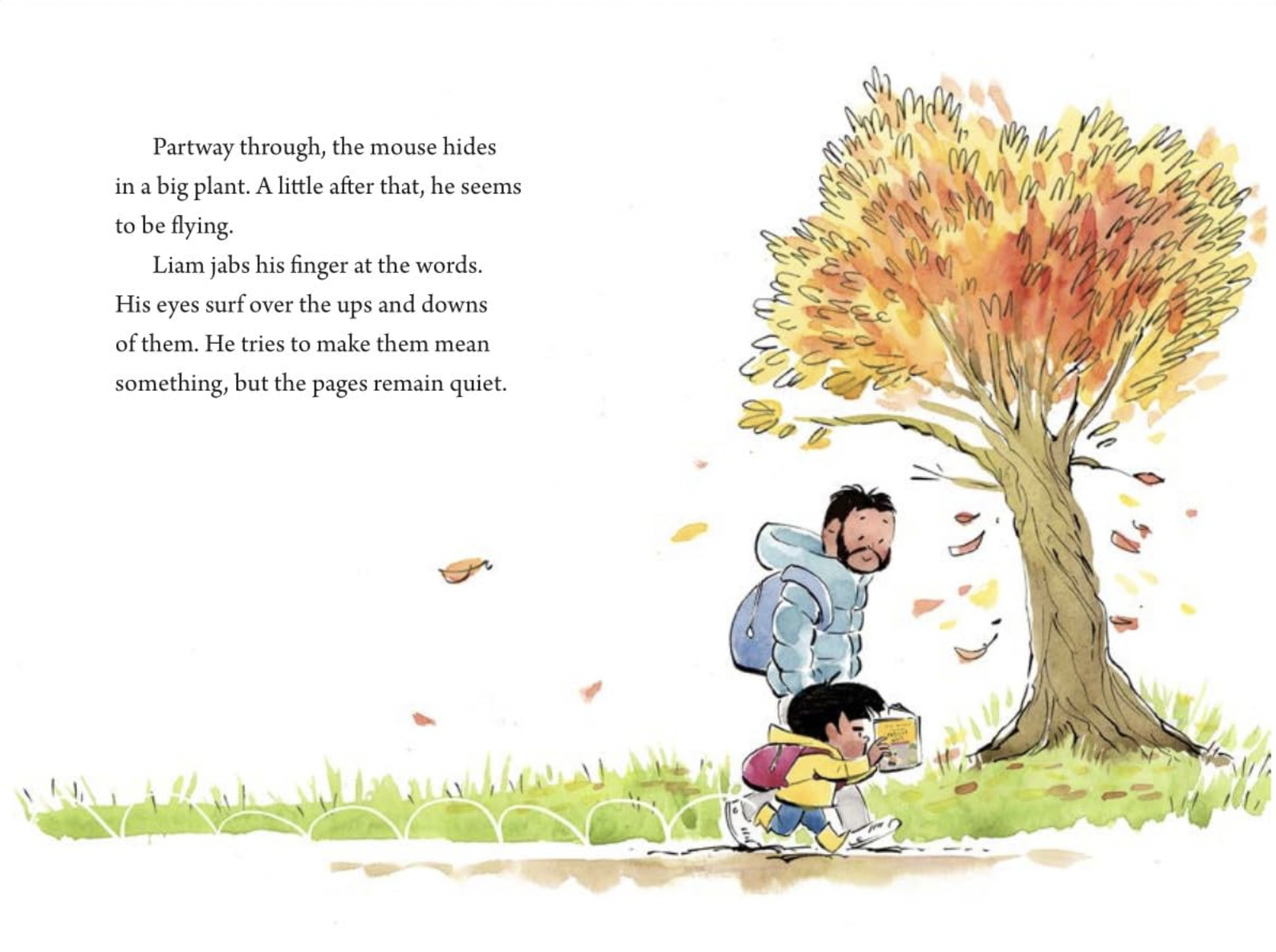
Like all skills, literacy develops at its own pace for the learner. For some children, the step between seeing shapes and deciphering into letters and then words comes earlier. For others, whether because of readiness or learning disability or even opportunity, the ability to read may come later. For Liam, it's not coming fast enough, especially when he has a charming book about a mouse and a bunch of cats–his family has cats!– and he wants to know what's happening.
From Two Tales of Twenty-Six: Liam and the Letters, written by Stephanie Simpson McLellan, illustrated by Mike Deas
In Liam and the Letters, a little boy is charmed by a book about a mouse and a lot of cats. He gets a lot of information from the illustrations, but he wants to know what's actually happening "but the random lines and loops of the letters stretch across the page like fences." (Liam and the Letters, p. 5) In fact, a sample of letters look a lot like those almost indecipherable text-based captchas and spell out "You Can't Come In" and could refer to the mouse and the outside world to which he is eager to visit or to Liam and his reading.
From Two Tales of Twenty-Six: Liam and the Letters, written by Stephanie Simpson McLellan, illustrated by Mike Deas
Liam is getting frustrated as fall turns to winter and he even throws his book away into the snow. But he retrieves it and makes a plan. After all, twenty-six letters is a lot. One letter at a time is manageable. 
One letter at a time could turn impossible into possible. (Liam and the Letters, p. 15)
From Two Tales of Twenty-Six: Liam and the Letters, written by Stephanie Simpson McLellan, illustrated by Mike Deas
So, he starts with the L and the A, letters from his name and ones that he recalls learning about at school. He's frustrated but with time he picks up on the W in the "Walk" sign on his way to school and the R on a cereal box. By spring, he's learned the letters and the weird-looking letters become readable.
 
Now, he can read the story that the reader can also read, simply by turning the book over. Walter and the World is the story of the mouse and the cats that Liam could not read. Walter the mouse has his own issues, with twenty-six cats whom he must evade if he's going to explore the outside world. Both Liam and Walter have twenty-six entities standing between them and what they crave, whether reading or an opportunity for exploration. Their stories may be different, but they are connected and ultimately even linked.
From Two Tales of Twenty-Six: Walter and the World, written by Stephanie Simpson McLellan, illustrated by Mike Deas
A tête-bêche book, which is also a flip book, has two stories in one book which you access by flipping it over. But Stephanie Simpson McLellan's book is not just two different stories. They are two linked stories with a child trying to read the other story. I don't think it matters which story is read first. If they read Liam's story first, they will get a perspective of what it means to look at a book and be frustrated at being unable to read it. But they will also get the satisfaction, as Liam gets, when he can put letters together into words and make sense of the story the reader can now read too. On the other hand, if they read Walter's story first, they'll be charmed by a cat-and-mouse story like no other and feel like they know a secret about the book that Liam cannot read when they read the second story. The order of the reading of the flip book does not matter here; it's the connection that matters.
 
Flip books can be problematic for libraries, particularly for cataloguing, but Two Tales of Twenty-Six will not be so. It will just be a fuller story, told from two different layers, that of a story character and that of a reader. For each, Stephanie Simpson McLellan who is a star of storytelling–my particular faves are The Christmas Wind and The Sorry Life of Timothy Shmoe–gives us a character who is faced with a challenge of twenty-six and tackles it with strategy and perseverance and ultimately success. It's two feel-good stories in one package.
 
To make it even more enticing for early readers–other than giving them a story with which they will be familiar–Two Tales of Twenty-Six is illustrated by Mike Deas, giving these young readers the graphic support to help them read and understand their reading. Mike Deas's art uses a blend of gouache, watercolour, ink, and digital tools to both support and enhance the stories, giving Liam the reader a starting point for his reading, and the reader of Two Tales of Twenty-Six the colour and the magic to make understanding possible and worthwhile.
 
I'm usually not enamoured with tête-bêche books but Two Tales of Twenty-Six is more than the sum of its parts and that's why it's extraordinary. It's a book that is geared to its audience perfectly, encouraging our youngest children in their reading, especially if they are frustrated, and allowing them to see themselves in a story while taking a step up in their reading from picture books.
• • • • • • •
 
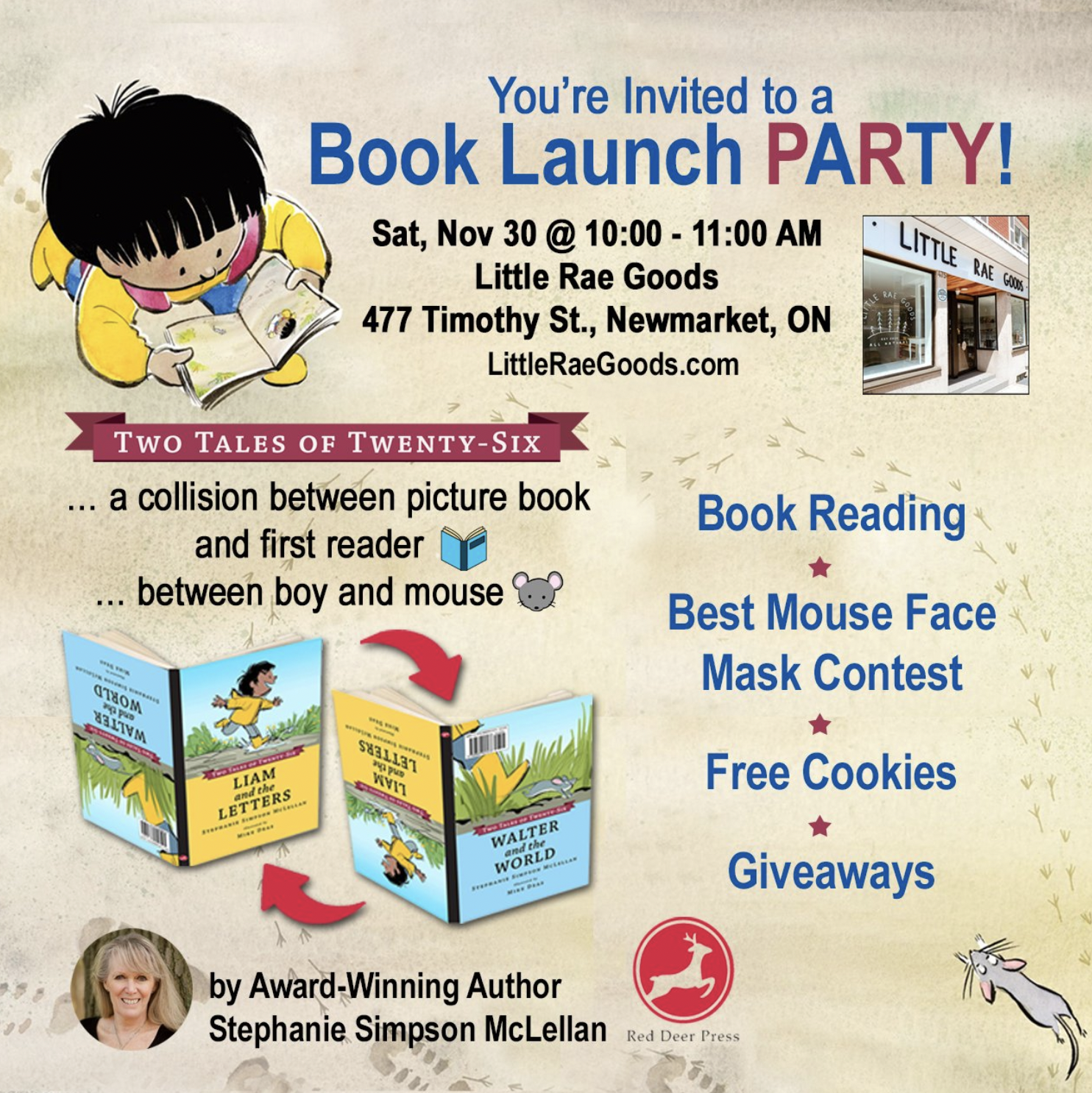
I'm very pleased to tell you about the book launch party for Two Tales of Twenty-Six
 
that will be held on

Saturday, November 30, 2024
 
from 10–11 a.m.
 
at

Little Rae Goode
477 Timothy St.
Newmarket, ON
 
 
This book launch will include:
 
• a book reading
 
• a contest for best mouse face mask

• free cookies

• giveaways

and

• book signing by the author Stephanie McLellan


October 01, 2024

Puffin and Penguin

Written by Helaine Becker
Illustrated by Kevin Sylvester
Kids Can Press
978-1-5253-0654-9
80 pp.
Ages 6-9
October 2024
 
Who knew that Puffin's life would change so much when his mom got a new job at the United Avian Nations in New Stork City?! But a move from Iceland to their new home in Brookloon must also include the making of new friends, so there is that. 
From Puffin and Penguin, written by Helaine Becker, illustrated by Kevin Sylvester
At his new school, Puffin is introduced to a diverse group of students, from Eaglet the nervous Nellie; King Penguin, the cool kid; Screech Owl,the coding whiz; and Canada Goose, the fashionista. When his teacher, Ms. Grey, buddies Puffin up with Penguin, it's not a perfect match. Penguin already has so many responsibilities and activities that taking on one more, especially the enthusiastic Puffin for whom he has little time, is just too much.
From Puffin and Penguin, written by Helaine Becker, illustrated by Kevin Sylvester
 Initially Puffin is annoyed about being abandoned and with everyone calling him a "funny-looking lil' penguin" (p. 27) but his father advises him that there's no need "to get so hot under the feathers" (p. 29) and to give his new classmates a bit of "puffin pedagogy." (p. 31)
 
So Puffin hatches a plan–lots of fun word play in Puffin and Penguin–to inform his classmates about himself and puffins and to make some new friends by joining the Drama Club. But his efforts come across as bragging and he realizes he often comes on too strong and appears to be trying too hard. Still when there's a glitch with the lighting during the performance of "King Midas and the Golden Pinkie," it's Puffin's fluorescent beak that saves the day. 
From Puffin and Penguin, written by Helaine Becker, illustrated by Kevin Sylvester
Puffin and Penguin has this amazing blend of science–who knew puffins' beaks fluoresced?–and word play and humour and plain old fun. Helaine Becker's story of two birds who are unlikely buddies shows young readers ways to make friends and to accept differences. And by telling her story with a plethora of puns, Helaine Becker actually makes you laugh while demonstrating ways to be a friend and make a friend while being true to yourself. (Puffin makes it clear, for example, how much he dislikes being called Puffy.)
 
And then there's Kevin Sylvester's artwork that adds even more humour. From making Penguin truly look overextended and weary to Puffin ranting about Penguin's neglect and Puffin's "Too Cool for School" backpack–highly relevant for a bird coming from Iceland–Kevin Sylvester's cartoon illustrations tell more about the story, intensifying the fun and revealing more about the characters than words alone could. 
From Puffin and Penguin, written by Helaine Becker, illustrated by Kevin Sylvester
Because it's an early reader graphic novel, Puffin and Penguin has to work for younger readers in the 6 to 9-years-old audience, giving them more than a picture book but less than a middle grade novel. But Helaine Becker and Kevin Sylvester have found a perfect combo of message and medium, giving readers a relatable story of moving to a new place and making friends with the chuckles and brightness of an illustrated book. Puffin and Penguin is a perfect bundle of everything to entertain and even inform. They don't need more Penguin and Puffin to complete their story but I think young readers would be delighted if Helaine Becker and Kevin Sylvester would take us on a few more adventures with our new avian friends. Do I see a cultural exchange in their future perhaps?

June 21, 2024

The Inside Scouts Help the Brave Giraffe (The Inside Scouts #2)


Written by Mitali Banerjee Ruths
Illustrated by Francesca Mahaney
Acorn (Scholastic)
978-1-338-89501-8
64 pp.
Ages 5–7
June 2024
 
Sanjay and Viv, the Inside Scouts who can shrink down and go inside animals to help them feel better, are on their second case with a giraffe who cannot eat because her tummy feels sick. So, to discover what is stuck in her gut, the two friends approach Sabeena the giraffe to see if they can help.
From The Inside Scouts Help the Brave Giraffe, written by Mitali Banerjee Ruths, illustrated by Francesca Mahaney
After a few questions about when Sabeena started to feel ill–after eating her lunch of leaves–the two learn from an embarrassed Sabeena that, in addition to not wanting to eat, she can't poop. Thankful for the info, the Inside Scouts suit up and jump into her mouth to travel down the esophagus into her stomach. (For details about the digestive system, there is a "Fun Facts about the Gut" that describes the parts (including how to pronounce them) and its workings.)
From The Inside Scouts Help the Brave Giraffe, written by Mitali Banerjee Ruths, illustrated by Francesca Mahaney
But the stomach looks clear so the two raft down into the intestines with its walls with "pink fingers" where they find a ball of thorns, undoubtedly the cause of Sabeena's discomfort. With a blast tool and a net, they trap the offending mass, moving themselves back out with sticky grips until Sanjay and Viv are burped out of Sabeena. 
Inside Scouts go inside together.
When animals need help,
we help them get better! (p. 54)
From The Inside Scouts Help the Brave Giraffe, written by Mitali Banerjee Ruths, illustrated by Francesca Mahaney
When Mitali Banerjee Ruths, MD, introduced The Inside Scouts series earlier this year with The Inside Scouts Help the Kind Lion, I was hooked. She based her story on two friends, both of colour, who worked with animals, health, and tech to do good. The stories are light, perfect for an early reader, but informative, drawing readers in with their rhyming superhero chants, their internal adventures, and wild tech. Coupled with Francesca Mahaney's digital art, the stories are colourful, a little whimsical–see Sabeena shyly "going" behind a bush once her gut is working again–and bold while never complicated.
From The Inside Scouts Help the Brave Giraffe, written by Mitali Banerjee Ruths, illustrated by Francesca Mahaney
With Sanjay and Viv around to help explain personal health issues, young readers will never need to be embarrassed about asking questions to help them understand their bodies. With Book 3, The Inside Scouts Help the Strong Cheetah, set for a fall release, it looks like there will be more learning happening, inside and out.
 
 • • • • • • •

The Inside Scouts Help the Kind Lion (February 2024)
The Inside Scouts Help the Brave Giraffe (June 2024)
The Inside Scouts Help the Strong Cheetah (October 2024)

June 12, 2024

Willa and Wade and the Way-Up-There

Written by Judith Henderson
Illustrated by Sara Sarhangpour
Kids Can Press
978-1-5253-0842-0
40 pp.
Ages 5–7
June 2024
 
Willa is an ostrich and Wade is a penguin, and though they are both birds, neither can really fly though they would really love to. So, they ponder "the distance between the here and the there." (p. 6) And since they seem to have a good grasp of basic science of flight, they consider what it would take to set themselves aloft.
From Willa and Wade and the Way-Up-There, written by Judith Henderson, illustrated by Sara Sarhangpour
First, Willa considers the concept of lift, while Wade wonders about velocity. How to get lift? How to ensure speed? They try ballet because ballet makes you light on your toes. No luck with flight. Then they try pogo sticks but it wasn't until sliding downhill that the two experienced a brief lift off the ground.
From Willa and Wade and the Way-Up-There, written by Judith Henderson, illustrated by Sara Sarhangpour
Next, they consider liftoff. That requires them to jump off a cliff. Of course, they become airborne, but it is, of course, temporary. It's not until they apply some scientific principles to their problem solving and engineer something that the two feel the magnificence of the way-up-there.
From Willa and Wade and the Way-Up-There, written by Judith Henderson, illustrated by Sara Sarhangpour
Judith Henderson, who has given us stories including the Big Words Small Stories series and This is a Dog Book!, knows how to give us the subtle humour with understated plots. Willa and Wade and the Way-Up-There is sweet and playful and emphasizes determination and camaraderie without flagrant slapstick humour or irreverence. Instead, Judith Henderson tells a story that invites early readers to think outside the box when problem solving. With digital illustrations by Toronto's Sara Sarhangpour, Willa and Wade and the Way-Up-There keeps its light tone and the focus on the two friends. Because everything is so understated, from the text, the art, and the messaging, young readers will just be entertained, pleased with their ability to read a book that is a step up from picture books–in their estimation, anyway–and still be given the opportunity to think about how they approach a dilemma or question that doesn't have an obvious answer. And it might also make them think about flight and concepts like lift and speed.

The way-up-there that Willa and Wade aspire to enjoy is not unlike the many ambitions we all have and, if two flightless birds can find a way to fly, then we can do our best to aim high and find solutions too.
 

April 30, 2024

Otis & Peanut: Forever and Ever

Words by Naseem Hrab
Drawings by Kelly Collier
Owlkids Books
978-1-77147-497-9
80 pp.
Ages 6-8
April 2024 
 
Like the classic early readers about Frog and Toad, Otis and Peanut have many stories to tell. The unlikely friendship of the long-haired guinea pig (Otis) and the naked mole rat (Peanut) is fodder for three more stories in Otis & Peanut: Forever and Ever that cover everything from cake to memories, gardening and absent sisters.
From Otis & Peanut: Forever and Ever, written by Naseem Hrab, illustrated by Kelly Collier
In the story titled "The Cake," Peanut surprises Otis with a luscious three-layer strawberry cake based on his sister Pearl's recipe. Though Peanut wants to dig in, Otis wonders what they are celebrating. Apparently, Peanut's answer of "celebrating cake with cake" doesn't cut it and is determined to save it for a special occasion. But would there ever be a good enough reason to eat cake?
From Otis & Peanut: Forever and Ever, written by Naseem Hrab, illustrated by Kelly Collier
The second story, "The Dream," has Peanut at home enjoying a breakfast of toast and jam when he discovers his last jar of strawberry jam made by Pearl. After eating, he is inspired to plant some strawberry seeds his sister had given him. After watching some kids play in the sprinkler and dreaming of when he and Pearl did the same, Peanut retrieves his own sprinkler to water his garden but to also reminisce and enjoy.

"The Collection" is Naseem Hrab's final story for Otis & Peanut: Forever and Ever, and says more about memories than the earlier chapters. While Peanut grieves the loss of his sister Pearl and finds himself remembering her in everything from baking to eating and playing, it is Otis who helps him to see the value in keeping memories as tangible objects. Otis himself keeps scrapbooks of memories and demonstrates to Peanut that, no matter how important the memories are, sometimes you can forget them. So, Peanut finds a way to keep his own memories, both happy and sad, safe and make new memories with his friend.
From Otis & Peanut: Forever and Ever, written by Naseem Hrab, illustrated by Kelly Collier
There is a gentleness to Naseem Hrab's stories of Otis and Peanut that invites young readers to see their own lives within the stories of the guinea pig and the mole rat. Children will be familiar with celebrating with cakes, planting a garden, playing in a sprinkler, and keeping bits and bobs of photos, ticket stubs, etc. as memories. They'll also know what it is to be a friend and have a friend. So, by nature of these stories, not only will they practise their reading and make connections between text and illustrations, they'll be making meaningful connections between the story and their own lives, learning about empathy, acceptance, cooperation and more.

Kelly Collier, who illustrated the first Otis & Peanut book, uses the same colour palette of turquoise and chartreuse with splashes of pink as she did in the first. It works to keep the overall effect uncomplicated but focused. Whether it's the cake or the jam and the garden or the keeping of memories, one emphasis is evident and not the background of detailed characters and settings or the jibber jabber of extraneous text. Together Kelly Collier and Naseem Hrab remember who their audience is and ensure that their reading and storytelling needs are met.

Because children have so much happening in their lives, whether it's a daily occurrence like picking clothes or reading books, or special events like a birthday party or performing at a recital, there are loads of stories that Naseem Hrab and Kelly Collier can share through Otis and Peanut. Whether it's to teach them about being a good friend, or to reflect the young lives of these readers, Otis and Peanut are there, as are we, to watch and learn. 

Otis & Peanut: Forever and Ever (2024)