Showing posts with label fears. Show all posts

July 20, 2026

Scaredy Squirrel Scared Silly (Scaredy's Nutty Adventures, Book 4)

Book cover of Scaredy Squirrel Scared Silly by Melanie Watt depicts a squirrel in a protective robot costume carrying a pumpkin labelled as a friendly jack-o'-lantern and wearing an emergency fanny pack.
Written and illustrated by Mélanie Watt
Tundra Books
978-1-77488-884-1 (pb)
84 pp.
Ages 4–8 
July 2026
 
I didn't get a chance to review this book of Scaredy's Nutty Adventures when it was released as a hardcover in 2024, so I'm pleased to review it now that a paperback edition was just released this month. When Scaredy Squirrel was first released in 2006, he became a beloved character. Mélanie Watt brought us a little squirrel who was overwhelmed, seeing threats everywhere. Now the star of his own animated series, as well as picture books and this early reader graphic novel series, Scaredy Squirrel is a much beloved character to helps young children see beyond their worries by laughing with him.
A cartoon squirrel lists off a few of things that terrify him, like haunted houes, mummies, witches, crows, Frankensteins, ghosts and vampire bats.
From Scaredy Squirrel Scared Silly, written and illustrated by Mélanie Watt
In Scaredy Squirrel Scared Silly, Mélanie Watt shares five short graphic stories about Scaredy and his relationship with Halloween. In the first chapter, titled "October 31st," our sciurine friend is actually looking forward to the un-scary aspects of the holiday. He likes the decorations and the lighting, but he's terrified of haunted houses, crows, vampire bats, and more. So, he's happy to stay in his cheerfully decorated tree, along with some unusual preventative measures.
A cartoon squirrel show his rabbit friend that he has bug spray for scary bugs, caution tape for mummies, a laser pointer to distract Frankensteins, while they stand outside his tree home decorated for Halloween.
From Scaredy Squirrel Scared Silly, written and illustrated by Mélanie Watt
The next stories have Scaredy planning a cute, but not scary pumpkin carving activity with his friends, working on his costume, considering going trick-or-treating—hard candy, gummy worms, and chocolate all have drawbacks—before heading out in search of candy apples.
A squirrel in a robot costume speaks to his costumed friends about how he'll spray a witch with water and do a card trick if needed
From Scaredy Squirrel Scared Silly, written and illustrated by Mélanie Watt
It may seem a little early to be thinking of Halloween, but I suspect there are many for whom the holiday is a big deal and who are already planning their costumes and parties. Whether you get Scaredy Squirrel now in anticipation of the holiday or keep it to read in October, Scaredy Squirrel Scared Silly will give young children a lot of laughs about his wacky but legitimate worries. Scaredy Squirrel may seem like an excessive bundle of anxiety, but he emulates the many children who have misgivings and fears about the familiar and the unknown. With a lighthearted approach and quirky and colourful illustrations, Mélanie Watt will let children see that many anxieties can be lessened and even alleviated with some friendly intervention and a new perspective.
A cartoon squireel screams, "Pumpking Zombies! Ahh!!!" at seeing two pumpkin-headed characters
From Scaredy Squirrel Scared Silly, written and illustrated by Mélanie Watt
Mélanie Watt's Scaredy Squirrel will always charm. She has created him as sweetly guileless—check out his toothy grin—and oddly expressive. And with detailed illustrations that give young readers much to enjoy, from costumes to decorated homes, readers will be looking forward to their own nutty Halloween adventure and all that it entails.
 
🎃 🎃 🎃 🎃 🎃 
 
This is Book 4 in Scaredy's Nutty Adventures series. Here are all published titles:
Book covers of "Scaredy Squirrel in a Nutshell," "Scaredy Squirrel Gets a Surprise," "Scaredy Squirrel Gets Festive," and "Scaredy Squirrel Scared Silly"
Scaredy Squirrel in a Nutshell (2021)
Scaredy Squirrel Gets a Surprise (2022)
Scaredy Squirrel Gets Festive (2023)
Scaredy Squirrel Scared Silly (2024) 

April 18, 2026

Best Friend, Worst Bully: Based on a True Story

Written and illustrated by Mei Yu
Union Square Kids
978-1-4549-5993-9
144 pp.
Ages 7–10
April 2026 
 
This is the story of friends, or it was until it wasn't. But that's the thing about friendships: they are dynamic. They change with circumstances both self-controlled and unplanned. It's why they are the source of much joy but also carry the potential for despair, as a young Mei Yu learns.  
From Best Friend, Worst Bully, written and illustrated by Mei Yu
Mei Yu wants to be best friends with Maggie forever. Along with Sophie, Maggie's best friend before Mei came along, Mei is hopeful that she'll have lifelong friends. But when Maggie moves away, Mei and Sophie become new friends, hanging out at Mei's house—though Mei is super embarrassed by her mother's heavily accented English that makes everything sound a little weird—shopping together, and more. Still, when Ella and Rola, two older girls in their split class, become jealous of Mei's drawing ability, they approach Sophie, convincing her that she can be cool like them if she does what she's told in dealing with Mei.
 
And though she's reluctant at first, Sophie is pleased to be more popular with the older girls and rudely snubs Mei. Mei's Happy Meter—one of the graphic meters she uses to depict her emotions—shatters. She discusses it with her sidekick Meiow as she's too scared to talk to anyone else about the bullying. But even though she feels completely alone, Eve and Izzy, two girls from another class, tell her they've had the same experiences with Ella and Rola, particularly their "bathroom game." After inviting Mei to be their friend, they advise her to just ignore Sophie and her fellow bullies. 
From Best Friend, Worst Bully, written and illustrated by Mei Yu
But then Sophie and her "friends" escalate their bullying, phoning Mei's home and leaving horrible messages. Determined to deal with the bullies, Mei uses her artistic talents to express her feelings, and expose Sophie, Ella, and Rola in her own way. 
From Best Friend, Worst Bully, written and illustrated by Mei Yu
I'm sad to think about all the kids out there targeted by bullies. For Mei and her friends, they are picked on for being talented, or tall, wearing glasses or liking hearts. The reasons bullies attack others are countless and meaningless. But when they involve more people, steal friends away, intrude on your home life, cause fear and sleepless nights, it's not "just" bullying. It is persecution. And for Mei Yu, main character and author-illustrator who debuted with her Silver Birch Express award-winning Lost and Found, that bullying is overwhelming and very realistic. And thank you, Mei Yu, for not giving us an unimaginable ending where all is right between Mei and Sophie. There was still forgiveness, but it is sheltered in the safety that Mei has in her art, in her new friends, and in her family. And in her understanding of what bullying is all about.
. . . and then I realized that bullies are silly! They can pick on anyone because of anything! (pg. 120)
Mei Yu's story is based on her own experiences, and her advice, to be strong and be yourself, will resonate with young readers, many of whom will have experienced or witnessed bullying. Coupled with Mei Yu's charming artwork—check out her YouTube channel for videos on her drawing—Best Friend, Worst Bully will speak to young readers with empathy for the bullying they have seen and with colour and cheer for the friendships they enjoy. Best Friend, Worst Bully is the best outcome coming from the worst situation.

February 23, 2026

Ellis on Guard

Written by Sal Sawler
Illustrated by Nandita Ratan
Second Story Press
978-1-77260-444-3
24 pp.
Ages 6–8
February 2026 
 
Ellis had so many worries that if they wrote them all down, the list would wrap around their house three times. (pg. 2) 
That single line explains a lot about how Ellis conducts themself. It's not what defines them—they are far more than their worries—but they are a child who makes a lot of decisions based on those concerns. And Ellis is worried about a lot of things, from meeting new people to catching colds, and losing their puppy Peanut. To their benefit, Ellis notices a lot, because they are always aware or worried that danger is present.
From Ellis on Guard, written by Sal Sawler, illustrated by Nandita Ratan
When Ellis sees a poster about a missing dog named Walter, their worries are intensified. They become Big Worries. Now they have to worry about a dognapper, about Peanut being taken, and where Peanut might go. So, Ellis devises a plan to catch the dognapper with a trap. But now there are more worries because they needs supplies from the Creepy Closet and the Frightening Forest, and they have to talk to the Noisy Neighbor. With some support from Peanut and their mom, Ellis creates a trap. But what Ellis finds is that there is more to discover than a dognapper. There is more beyond worries. In fact, there is goodness.
From Ellis on Guard, written by Sal Sawler, illustrated by Nandita Ratan
Sal Sawler, the Nova Scotia writer of When the Ocean Came to Town (Nimbus, 2023), seems to understand a child's worries and how they can spiral out of control to the point at which they impact activities and thought. Worries are protective. They are there to help us avoid injury, dangerous circumstances, and bad people. Whether it's our own traumas or those of our ancestor, our bodies remember. But when they misremember, seeing peril everywhere, life is negatively impacted, and this is especially concerning for children. This child obviously knows some strategies for dealing with their anxieties like making a plan, putting on imaginary armour, or asking for help, but worries can be inescapable when they overwhelm. Still Sal Sawler sensitively takes Ellis in small steps from worrisome to attentive beyond the worries. Once Ellis realizes that they can do good, they put aside the worry and step up to be the protector they envision themself to be. I think kids would gain from discussions of how Ellis changes their outlook and sets aside a worry, perhaps helping to cope with their own concerns and see the positives where they exist.
From Ellis on Guard, written by Sal Sawler, illustrated by Nandita Ratan
Nandita Ratan is a Vancouver-based artist whose digital art keeps with the playful rather than the threatening nature of worries. Even when Ellis fears monsters or a dognapper or a  Spiky Shrub, Nandita Ratan does not make it scary. Instead, she makes the child's fears simple but embedded in the realism of a dark closet or a shaded forest. She keeps most of the illustrations light and colourful, never terrifying, and thus helps to convey the message that worries can be dispelled by not catastrophizing and with a change in perspective.
 
While Ellis on Guard is not a how-to story about dealing with worries, it is a picture book that might help a few children understand their own worries. Child have worries, as do the rest of us, and some of those worries don't disappear because we will them to do so. It might be enough for children to learn that there are positive thoughts that can help prevent over-the-top worries that anticipate the worst and turn things around enough to do good and see goodness beyond the worries.
 
 • • • • • • • 
 

September 28, 2024

Dad, I Miss You

Written by Nadia Sammurtok
Illustrated by Simji Park
Inhabit Media
978-1-77227-482-0
40 pp.
Ages 9-12
August 2024
 
Dad, I Miss You is a conversation that only takes place in the minds of a father and son as the boy is returned, again, to a residential school, leaving his father, mother, and two-year-old sister behind. It is a heartbreaking exchange that never takes place in person but tells us so much about the family and what they went through.
From Dad, I Miss You, written by Nadia Sammurtok, illustrated by Simji Park
As a young boy recalls catching a fish, having learned from his father, his father watches his son out the window, also thinking about how proud he is for feeding the family and sure the boy will be a good provider for his own family when he is a man.
From Dad, I Miss You, written by Nadia Sammurtok, illustrated by Simji Park
When the child hears the plane that will transport him far from his home, in his mind he tells his dad that he doesn't want to go back there. Hearing the same plane, his father is hopeful that it will be over soon if the boy just does what they say. After all, "They said it will be better this way." (p. 9)
 
And as the boy packs his things, he wishes that his dad would stop them from taking him and not to let them take his baby sister too. His dad has the same worries about his daughter.
From Dad, I Miss You, written by Nadia Sammurtok, illustrated by Simji Park
As the boy is taken away and endures the horrors of residential school, from the cold and lack of food to punishment and loss of language, his father keeps hope that his child is learning and will be home soon. But things are different when he returns home. Thankfully there is still love and acceptance and the wisdom to understand what he may be going through.
I know you've forgotten some parts of yourself, but after some time, you'll find yourself again. (p. 37)
Every story that speaks to the residential school experiences of Indigenous families is heartbreaking. But Nadia Sammurtok approach of getting into the unspoken thoughts of both son and father remind us of the emotional toll on both parents and children. While the son knows what he must live with at the school, from hunger and abuse, loss of culture and homesickness, his father does not know. The boy's family has been told a sanitized and misleading version of what his child will learn and do, but without first-hand accounts they cannot know what happens there. Still, as both father and son show stoicism, revealing their feelings and thoughts only to themselves, Nadia Sammurtok shows us the depth of their connection. They think about similar things but from different perspectives and readers can only hope that this connection will sustain their relationship through the hardships of a child taken away to residential school. (As the story is based on Nadia Sammurtok's own family history of residential school separation, we hope that they found strength in that connection.)
From Dad, I Miss You, written by Nadia Sammurtok, illustrated by Simji Park
Simji Park, an artist based in England and the Netherlands, uses pencil and watercolours to create scenes of great heart and feeling. Just as the dialogue between father and son is repressed, Simji Park's illustrations are subdued, using soft tones and quiet lines to depict simple scenes of home and school. She still conveys the muted comfort of home and the angst of the residential experience, but she does so with hushed ambience, reflecting the unspoken dialogue between father and son.

Every book that speaks about the tragedy of families separated when Indigenous children were forced into residential schools is unique and revealing. By focusing on the unspoken thoughts of a parent and a child, Nadia Sammurtok makes us see something a little different. The bond between a parent and a child is stretched and almost severed and yet there is hope that there is enough resilience to reunite and strengthen. Dad, I Miss You is a story of tragedy but also one of the capacity of family to reconnect and prevail.
 
• • • • • • •
Teaching about the residential school experiences is a challenging one for teachers and parents. A QR code appended to the book links to downloads of educational support materials. 
• • • • • • •

June 27, 2024

Storytime with Franklin: A Collection of Six Favorites

Written by Paulette Bourgeois
Illustrated by Brenda Clark
Kids Can Press
978-1-5253-1293-9
184 pp.
Ages 3–8
May 2024
 
The Franklin books in my school library were well worn, much loved and a favourite of young readers and their families and teachers for the lessons he learned. Now those books don't need to get worn so fast or misplaced with others because six have been amalgamated into a lovely collection in hardcover. Storytime with Franklin will become its own favourite.
From Storytime with Franklin, written by Paulette Bourgeois, illustrated by Brenda Clark
The six stories covered in Storytime with Franklin are:
  • Franklin in the Dark
  • Franklin Goes to School
  • Franklin's New Friend
  • Franklin Rides a Bike
  • Franklin Goes to the Hospital
  • Franklin Says I Love You
In the first story, Franklin is afraid of crawling into his small dark shell so he drags it behind himself. He learns that other animals, like a lion, a bird, a duck, and a polar bear, have their own fears. With the help of a nightlight, he can face his fear head on. 
From Storytime with Franklin, written by Paulette Bourgeois, illustrated by Brenda Clark
When Franklin is ready to go to school, he is excited but also nervous, especially when he worries that he can't do some of the things his friends can. But, that nervous tummy ache disappears when his teacher shows Franklin that he can do some wonderful things already and would learn new things.

Franklin's New Friend is a very timely story about meeting a new friend who is very different from you. When a moose family moves into the neighbourhood, Franklin is scared because they are all so big. And when Moose comes to school and the teacher buddies Franklin up with Moose, Franklin is relieved when Moose doesn't speak or play with them. Franklin must learn that just because Moose is big doesn't mean he's mean or scary. In fact, he learns that they have common grounds that would eventually make his new friend into a special friend.
From Storytime with Franklin, written by Paulette Bourgeois, illustrated by Brenda Clark
Riding a bicycle without training wheels is a big challenge for little ones, so many will understand Franklin's reluctance to go for bike rides with his friends who can already ride bikes without help. But realizing that they all had things they had to learn and struggle with, whether swimming or rollerblading or baseball, it encourages Franklin to persevere too.

Franklin Goes to the Hospital is a story written by author Sharon Jennings who has written numerous stories based on Paulette Bourgeois's character Franklin. In this story, Franklin must have an operation when he injures his shell during a game of soccer. While everyone tells him how brave he is, Franklin doesn't feel very brave. Kindly Dr. Bear reassures him that "Being brave means doing what you have to do, no matter how scared you feel." (p. 143)
From Storytime with Franklin, written by Paulette Bourgeois, illustrated by Brenda Clark
The final story in the collection, Franklin Says I Love You, has Franklin anxious about how he might show his mother how much he loves her as a birthday gift. But how could he do so without a fancy gift? 

Franklin the Turtle is highly recognizable both from his demeanor, his actions, and his appearance, and that's all courtesy of Paulette Bourgeois and illustrator Brenda Clark. Both have created an iconic character who has been adapted into several animated TV series and whose learning has been used as examples for parents and teachers worldwide. Though it's been almost 40 years since he first appeared in 1986, his stories are as fresh and necessary now as ever. That's because Paulette Bourgeois understands young children's fears and apprehensions and has written stories to alleviate or, at the very least, mitigate them. The stories encourage children who are fearful of the unknown, the unexpected, the embarrassing, and the mundane to see their fears from different perspectives and give themselves opportunities to resolve those issues with independence.
 
Brenda Clark's illustrations, some prepared here with assistance from other artists including Shelley Southern, Muriel Hughes Wood, and Dimitrije Kostic, have always been bold in colour and familiar in setting. Franklin and his friends may be animals but they are also children who draw and play, have friends and family, worry and wonder and love. They are the children who are reading these books.
 
It's lovely to visit with Franklin again and be reminded of the valuable lessons he shares through just being young and learning. Storytime with Franklin becomes a play date with a familiar friend: companionable, reassuring, enlightening, and always joyous.

July 13, 2023

Monster vs. Boy

Written by Karen Krossing
Charlesbridge
978-1-62354-356-3
240 pp.
Ages 10+
July 2023
 
...people believe the strangest things, especially when they're scared or upset. I think the stories people share are part truth and part not-truth. The hard part is figuring out which is which. (pg. 126)
This is a story about a boy and a monster. Yes, a real monster that lives in his closet. I know you'll say that monsters don't exist but in the town of Morsh (from "monstrous marsh") where 11-year-old Dawz lives with his little sister Jayla with their uncle Pop, there is a history of monster sightings. Problem is that Dawz hasn't really seen the monster because he doesn't go into that large bedroom closet. Still, his fears about it are very real, especially as the kids were abandoned by their mother after she got weird, talking about a monster with yellow feathers and a scorpion tail.

As Karen Krossing tells her story from two perspectives, we know Dawz is right about a monster living there. Mim is small, with purple scales, gray fur, two hearts, several horns, and she can release smoke and ash from her nostrils. She loves the nest she has built among the boxes and bags. Most of all, she loves when the grown-up opens a book and tells a story from it. She thinks it's absolutely magical.
Books were powerful. Wonders dwelled inside them. Wonders that Mim was missing, alone in her dusty closet. (pg. 6)
But Mim didn't understand how something in the book turned into a story told aloud. She had a book in her nest, and nothing happened when she opened it. Her aim was to learn how to make the book work for her.

But Dawz and Mim's status quo is disturbed when Pop decides to clean the closet and excavate some aprons Dawz's mom had made long ago for the annual Baker's Brawl baking contest which she used to enter with her brother and which Dawz now entered with his best friend Atlas. When Mim tries to scare them away, Dawz realizes that only he can see and hear her. With her nest eliminated–"Her world had cracked open... (pg. 41)"– Mim ventures out, grabbing a pillowcase, a sock, and a book, and finds herself pursued by Dawz and company, including Ronny the pest control guy and Officer Rashmi.

As Mim befriends a cat she calls Raar and struggles to find a new nest, deal with her hunger and her surprising growth, Dawz and Thea, one of Atlas's moms, cope with their injuries from encounters with Mim. It takes a while but both Dawz the Horrible, as Mim calls him, and Mim will need to find their way back to each other in order to alleviate their fears, understand their needs, and appreciate the other for whom they are.

While some readers may pick up Monster vs. Boy because of the promise of a horror story, Karen Krossing's latest middle-grade novel is more a reflection of what we see and fear in others before we know them. Dawz has a lot of baggage because of what he remembers of his mother before she abandoned them and, with his nightmares of monsters, he has essentially created one that lives in his closet. On the other hand, Mim knows the comfort of her closet nest and has no interest in the outside except for the opportunity to hear the stories that come from books. When forced out, she tries to make connections, such as with the cat, but finds herself drawn back to the familiar even if it makes her nervous. Because neither understands the other, until the end, they interpret their actions as threatening or horrible and try to prevent further dangers to themselves. There's much learning about themselves and others as the two go from monster vs. boy to monster and boy.

But beyond the conflictual theme of her story, Karen Krossing also reminds us of the magic of books and reading. Whether being a writer who puts words to paper or a listener who has the words read aloud to them, the process of reading is miraculous, taking us from the mundane to the fantastic. Even the text of a recipe, which Dawz reads to Mim, enthralls her. It's the translation of letters to words to meaning that elevates books from paper and ink to the extraordinary, and even a purple-scaled monster knows this. 

So, open your own closet and see what opportunities there are for new learnings and relationships. Taking a chance on the unknown may be trepidatious but the rewards can be so un-horrible.

June 09, 2023

ThunderBoom

Written by Jack Briglio
Illustrated by Claudia Dávila 
Kids Can Press
978-1-5253-0496-5
128 pp.
Ages 9-12
May 2023
 
Going to the Santa Claus parade is a tradition that many families enjoy, even if they might worry about safety in the huge crowds. For Logan's family, those fears are far greater because Logan is nonverbal. So when Logan dashes away to see something and gets separated from his family, it is a scary situation for all. Thankfully ThunderBoom is around to help.
From ThunderBoom by Jack Briglio, illus. by Claudia Dávila
As the family prepares for their trip into the city for the parade, it becomes evident that Logan communicates with his parents and older sister Izzy in his own way. He uses hand and body actions, and occasionally speaks the first letter of the words he wants to say, and they get him. He loves playing with his tablet and he loves trains. And he's Mister Social speaking to everyone on the train. But he also is unaware of the dangers that might befall him when he's excited. Logan might understand that he's being told to listen more carefully but that doesn't stop him from bolting from his family when he wants a closer look at the parade.

He soon realizes he's in an uncomfortable situation, faced with a group of clowns. But when faced with a stressful situation, Logan's imagination kicks in to protect him. (Illustrator Claudia Dávila demonstrates this with a white haze that appears and displays Logan's thoughts in yellow boxes.) So Logan envisions himself as ThunderBoom, a superhero who can stomp his way into protection. Still, after getting away from the monstrous clowns, he finds a new dilemma to solve: the little girl he'd met on the train has lost her teddy bear and her parents. ThunderBoom springs into action once again.
From ThunderBoom by Jack Briglio, illus. by Claudia Dávila
After several more heroic adventures, Logan is finally reunited with his family, though he does have some moments of insight that his issues with discerning who is friend or foe, and hence his consequent reactions, may be him misunderstanding situations, just like others misunderstand him.

This may not be Jack Briglio's first book, but I suspect it's his most personal, as his "Author's Note" confirms. But that also means that his character Logan is more real, and Logan's alter ego of ThunderBoom evenmore genuine. Logan, modelled after Jack Briglio's son who has Angelman syndrome, has a great many fears and finds solace in his imagined superhero ThunderBoom for protection. He has found ways to communicate with his family but his ability to connect with others is limited, especially when he's anxious about those interactions. Thankfully his cheerful disposition seems to help him make friends, and also allies, who will help him become more independent and successful when he encounters challenges, whether it's a yappy dog or getting separated from his family.
From ThunderBoom by Jack Briglio, illus. by Claudia Dávila
The message from Jack Briglio is more about Logan's ability to successfully meet those challenges in his own way, whether it's using an imagined superhero or asking for help from others. Everyone is faced with challenges, but we all need to find strategies to confront and overcome those obstacles or hardships. Logan's strategy works for him –I do wonder what really happened to those clowns and baton twirlers he fights off–though he has undoubtedly learned other skills from his family to approach his difficulties with patience and confidence. He's just a kid who is learning, and Claudia Dávila's digital illustrations–appropriately using superhero colours of yellow and red, though subdued, like Logan himself–make him as real as Jack Briglio's characterization and story.

ThunderBoom tackles a lot of important issues, not the least of which is coping with challenges. Giving Logan a voice, both in ThunderBoom the superhero and ThunderBoom the book, Jack Briglio may help other children find their own voices. Moreover, with ThunderBoom  providing us with insight into individuals with Angelman syndrome and the families that love and support them, the story is an act of courage itself, much like that shown by the superhero depicted within.

April 05, 2023

Standing on Neptune

Written by Valerie Sherrard
DCB
978-1-77086-687-4
160 pp.
Ages 13+
April 2023

Brooke Wells's story begins with an important line:

…this is about what happened (pg. 1)

But the seventeen-year-old explains that it’s only a moment in her story, not her whole story. It's less than a week, in fact, but a monumental one of a secret, hidden beneath the facade of being a daughter, a sister, a girlfriend, a friend and a classmate. It's a moment and one that may, or may not, change her life.
 
x + y = -5 is the equation Brooke envisions for her situation on the Monday of her story. What this means is she and her boyfriend Ryan had sex and now her period is five days late. Standing in Neptune is primarily her story, told in free verse, as she comes to terms with what it means, who to tell, and what to do. While she grapples with the shock and enormity of the possibility of a pregnancy, Brooke is almost frozen in place, telling only Ryan and only in the briefest of terms. She sees his panic, his anger, his fear, and even hope, and, instead of supporting each other, Brooke becomes more aloof and distant. 

Her bestie Emma knows something is up, but Brooke lies, worried that Emma may let her secret slip. Brooke's nine-year-old brother Kevin can also see that she is distracted, but she denies it and lies to him as well. Her thoughts are her only support, though she finds a convenient distraction in a science project on Neptune. As she learns about the frozen planet, she finds parallels to her own situation, like how it was detected mathematically and what is visible and not visible.
Our shared truth, I suspect, is that
it too has secrets, hidden beneath
what can be seen.      (pg.79)
Like Neptune, with so much more to it than the obvious, Brooke is more than her relationships with others. She is more than Ryan's girlfriend or Emma's friend. She is holding in a secret that might impact her whole life. Or will it? The frozen blue planet of Neptune with its orbiting moons is easily recognizable but, like Brooke, there is much beneath the surface that is unknown. And, until she knows the truth, i.e., is she pregnant or not, she is frozen with inaction, with hesitancy to share, and projecting a facade that all is normal.
Perhaps I am simply frozen in place, afraid of
facing things, of
getting it wrong.      (pg. 99)
Novels in free verse are one of my favourite genres, packing so much emotion and storytelling in few but well-chosen words, structured for meaning. Valerie Sherrard, whose earlier novel in verse Counting Back from Nine (2013) was nominated for a Governor General's Literature Award for children's text, knows how to use the genre to tell gripping stories. She takes us into the thoughts of teens as they contend with issues of teen pregnancy, shaky friendships, blended families, insecurities, and self-awareness. There's a lot going on in Brooke's head, more than she reveals to others, and Valerie Sherrard lets us hear Brooke's thoughts. Though Ryan's point of view is occasionally shared in excerpts of prose, it is Brooke we hear. It's her perspective that is paramount in Standing on Neptune. Whether she is pregnant or not, or right or wrong in her choices is irrelevant. They are hers. And as she studies Neptune and sees herself as a lone planet with moons that orbit her, perhaps someday being torn apart by her gravitational force, Brooke still knows she's part of something far greater.

December 23, 2022

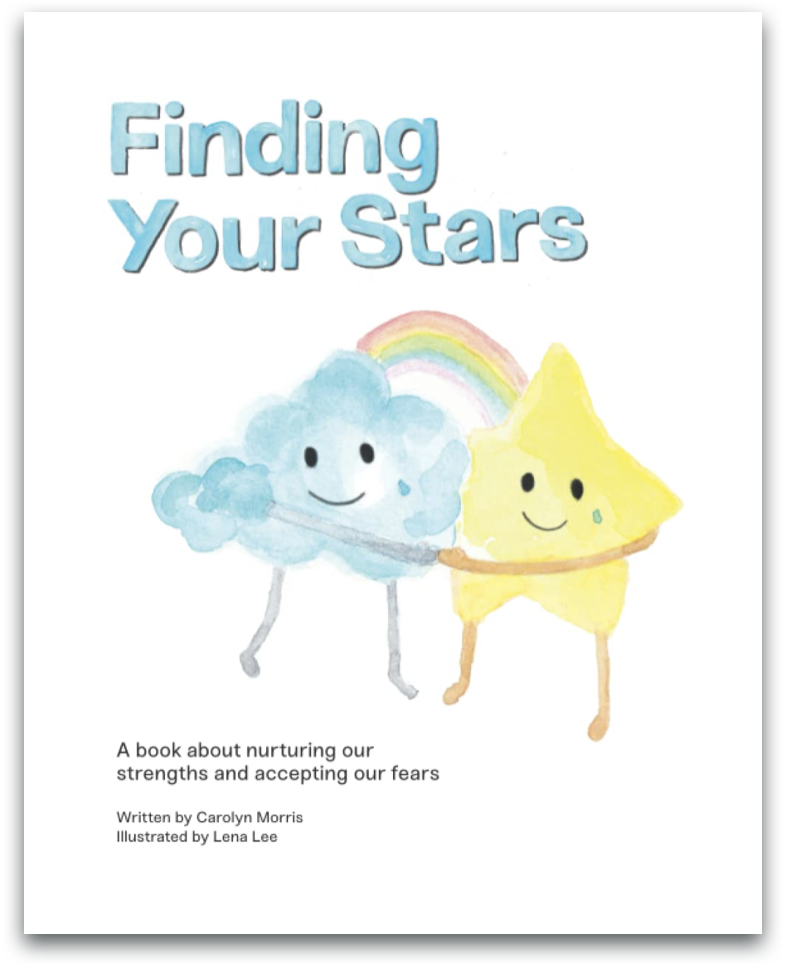
Finding Your Stars

Written by Carolyn Morris
Illustrated by Lena Lee
978-1-7778356-0-6
38 pp.
Ages 3-8
November 2022

 May you be gentle with your clouds and generous with your stars.
 
With those wise words in her dedication, author Carolyn Morris begins her rhyming story to help children see that the strengths and positives in their lives will sometimes be accompanied or even overshadowed by challenges and weaknesses. Both are part of who we are.
We each have stars
inside that glow.
They're special skills
and games we know.
From Finding Your Stars by Carolyn Morris, illus. by Lena Lee
But, sometimes we fall, or we fail, and clouds move in. 
Your clouds are worries,
flaws and fears.
They cover your stars
in gloom and tears.
From Finding Your Stars by Carolyn Morris, illus. by Lena Lee
Young children will understand about clouds covering up their stars. They know what it's like to feel less than shiny. Whether it's because of a friendship gone wrong, a test failed, or family disappointments, the stars and the clouds get into a tug of war. Carolyn Morris suggests that whatever the child focuses on will become stronger. (There's a sweet tug-of-war game between a blue cloud and a golden star in which the cloud cheers its win.) By focusing on the clouds, even if only to dispel them, you give them power to spread "their fears, their faults, their pain." Acknowledging them is fine–"But, if you greet the storm, then spin, back to your stars"–but you should turn back to the stars who will help lift you up. And as you're lifted, you see more stars.
So don't forget how
bright you are,
Embrace your clouds,
then shine those stars.
Most of us get mired in our worries and fears. It's human nature to focus on the negatives because they're consuming. If things are going well, you don't attend those aspects because they aren't of concern. But Toronto author Carolyn Morris isn't necessarily telling us to ignore those "clouds"; instead she's suggesting that it's okay to acknowledge them but then focus on the positives as these are the things that will help you come out from the shadow of the clouds. The message is a simple one but, by creating an analogy with stars and clouds, Carolyn Morris helps kids see that trying to get rid of the clouds is impossible and that the stars will not always be shining. However, you can enjoy the shine of the stars and give the clouds a rest to float on by, which they will almost always do.
From Finding Your Stars by Carolyn Morris, illus. by Lena Lee
Lena Lee who illustrated Finding Your Stars gives the story an ephemeral quality with watercolours and pale colours, reminding young readers graphically that clouds are unenduring. They may reappear intermittently and perhaps infrequently but they are transitory. The bolder stars, on the other hand, stick around a lot longer. I like that neither the clouds nor the stars are aggressively negative or positive; they just are. That is very much like the clouds and stars in our lives. Seldom are the clouds so onerous that they cannot be put aside temporarily or so threatening to our stars that they cannot be managed. And children need to see that they often have the capacity to find their stars.

Here's to everyone finding their stars and weathering the clouds as they come and go.
 
⭐⛅⭐⛅⭐⛅⭐⛅⭐⛅ ⭐
 
Additional resources, including printable colouring pages, are available at findingyourstars.com and would be handy for parents and teachers who want to help young children.

October 25, 2021

Hello, Dark

Written by Wai Mei Wong
Illustrated by Tamara Campeau
Pajama Press
978-1-77278-221-9
32 pp.
Ages 4-7
October 2021

Tomorrow's release of Wai Mei Wong and Tamara Campeau's picture book Hello, Dark may herald the use of a new strategy for young children to help them cope with their fears of the dark. After all, the dark will always be there and if there's a way to make friends with it, it's certain to make bedtime and sleep time much easier.

From Hello, Dark by Wai Mei Wong, illus. by Tamara Campeau
After a child has been put to bed, he sits on his bed, facing his closet and begins a conversation with the dark. Starting with a cordial "Hello, Dark," he begins to recite what he knows of the dark, such as that it creeps in when the sun goes down and keeps him wide awake and worrying. He knows of the creaks and the sounds it makes, hiding everything in its shadows and making him feel helpless and alone. But tonight the boy is determined that things will be different.
I'm tired of being afraid of you.
Tonight, can we talk?

From Hello, Dark by Wai Mei Wong, illus. by Tamara Campeau
Now the child recounts all the good things that the darkness helps to happen, from animals like the fox and the owl that feel safe in the shadows and the moon and stars that can only shine when in the darkness.

Thinking that maybe the dark isn't scary but really just lonely, the boy offers to be its friend. He suggests that they talk about happy things, play imaginary games–the dark makes a good shadow pirate–count sheep, breathe, and listen to music, many strategies offered to help all of us fall asleep. But by making the dark his partner in those strategies, the child removes the dark from a sleep-inhibiting role and truly makes it a friend.
 
From Hello, Dark by Wai Mei Wong, illus. by Tamara Campeau
Too many parents and teachers dismiss children's fears of the dark by telling them that there's nothing to be afraid of. Sadly, that does not eliminate the fear. By addressing a child's fear as something tangible, even as a dark amorphous form, Wai Mei Wong has let this child have his fear and helps him, and every child who reads this book, to cope with it. He is every child and so his solutions to deal with the dark could also belong to every child. Moreover, by having him try a variety of strategies from breathing to listening to music, using his imagination and self-soothing through talk, Wai Mei Wong offers children opportunities to make friends with the dark for themselves.

Artist Tamara Campeau could have given the night the eerie nature that many children attribute to it but this deeply-coloured book is anything but dark. Tamara Campeau, who recently illustrated the gorgeous Grandfather Bowhead, Tell Me a Story, uses rich blues and purples to evoke the night but permeates the child's room with the primary colours, even if subdued in a lack of light. From his pajamas and bed covers to growth chart and books, everything that is familiar to him is always there, even if the dark is too, and reassures children that all those much-loved playthings and familiar bedroom items will still be there in the morning. 

If you know a child who struggles with the night, Hello, Dark will offer them more than one way to cope with being left in a room without light, the greatest of which is embracing the darkness as a companion, not villain.

October 12, 2021

Little Moar and the Moon

Written by Roselynn Akulukjuk
Illustrated by Jazmine Gubbe
Inhabit Media
978-1-77227-299-4
28 pp.
Ages 4-7
October 2021
 
Unless you've lived in a far northern community, you can't imagine the impact of day length on daily activities, especially around the summer and winter equinoxes.  But for little Moar, the fall is particularly concerning with the earlier onset of the night after a summer of full days.

Like most kids after school, little Moar and his friends like to play. But little Moar is always wary of being out too late, cognizant of the ever-darkening sky. You see, while many children are afraid of the dark, little Moar is afraid of the moon.
Whenever he looked at the moon, he saw a face. The face looked like it was giving him a half-smile, and that scared him.
From Little Moar and the Moon by Roselynn Akulukjuk, illus. by Jazmine Gubbe
So with the sky getting a little darker, he says goodbye to his friends and heads home. But another group of friends invite him to play a game of tag and he decides he can sneak in a game before it's too late. However, having so much fun, he loses track of time and, seeing the sky even darker, decides he must head home right then.
From Little Moar and the Moon by Roselynn Akulukjuk, illus. by Jazmine Gubbe
But on the way home, he encounters his cousin feeding his uncle's ten sled dogs. When he asks for little Moar's help, the boy relents, wanting to be helpful. Still the darkness comes as it does and little Moar runs into his uncle's house for shelter. How will the little boy make it home safely if the moon is always watching him?
From Little Moar and the Moon by Roselynn Akulukjuk, illus. by Jazmine Gubbe
Roselynn Akulukjuk, who gave young readers The Owl and the Lemming (2016), again takes us into Nunavut, not for a legend but instead for a quintessential experience for children: dealing with the impact of day length. Many kids love to play outside after school and most don't stay outside so long that they have to worry about the impending darkness. But when the darkness comes early as it does in the far north, making it home before the sun has set is crucial, especially for young who might be fearful of the darkness. Still little Moar isn't afraid of the darkness as much as he's apprehensive about the moon and the face his imagination perceives in its contours. Many cultures have lore associated with the pareidolic image of a face in the moon so little Moar's fear of this entity is not atypical. Many see a pair of eyes and a mouth in that natural satellite. Thankfully Moar's mother can reassure him that what he's seeing are contours and shadows but will he believe her?

Darkness can be frightening but Jazmine Gubbe, an illustrator, concept artist and animator, gives a warmth to that twilight and dusk, using the softness of pinks, greens and purples to transition to rich darker blues of the night. Her colours evoke place and time, bringing us to a Nunavut community in the fall, cool in temperature and vibrant in its activity of play and people. 

Fears are fears, whether in the short days of Nunavut or an urban setting in southern Canada. But for little Moar, his fear is based in his natural environment, not created from frightening graphics on visual media or elsewhere. His fear may not dissipate immediately with the wise words of his mother–fears are unfailingly stubborn–but knowing that he could outplay the moon with some careful maneuvers will surely go a long way to putting that moon in its place, far, far away from Moar.