Showing posts with label acceptance. Show all posts

January 24, 2026

The Bear Fairy

Written by Paul Coccia
Illustrated by Fred Blunt
Tundra Books
978-1-77488-558-1 
40 pp.
Ages 3–7 
Releases February 17, 2026
 
Adorable is an adjective I usually use for puppies and kittens, beautiful babies, and sweet children. But now I can use it for bear fairies. Or, at least, the Bear Fairy of Paul Coccia's debut picture book. He may not be the dainty fairy of many tales, but he twinkles with his own brilliance.
From The Bear Fairy, written by Paul Coccia, illustrated by Fred Blunt
Spencer is a red-curled and bespectacled boy who is determined to catch a fairy. He constructs a fairy door in a tree, a daisy chain, and even a box-and-stick trap. His blue-haired friend Mariah is convinced that fairies are only attracted to beautiful little girls like her. 

Surprisingly, it's a littered potato chip bag that ultimately draws a fairy. More surprising is that it is a bear fairy with pink wings and wearing a pink dress. Though he wishes to leave—the chip bag is empty after all—Spencer convinces the Bear Fairy to stay so the boy can show him to Mariah. They spend a day of playing in the park, racing remote cars, and watching TV, with plenty of. snacks. The Bear Fairy may be lots of fun, but he also has his own quirks which Spencer must accommodate, like his tardiness when getting ready.
. . . I'm still sprucing up—
90 percent of being a fairy 
is in the looks, you know. 
It's not all magic dust and 
fluttering around! (pg. 25)
From The Bear Fairy, written by Paul Coccia, illustrated by Fred Blunt
 But when Spencer presents the Bear Fairy to Mariah, herself festooned in a pink dress with pink wings, the girl declares that he's not any of the things expected of a fairy. Worse, she insists emphatically that he's a crummy old fairy because he's pudgy, hairy, and not beautiful.
From The Bear Fairy, written by Paul Coccia, illustrated by Fred Blunt
Spencer will not allow her to slander his fairy and defends the Bear Fairy as the perfect fairy he is.
 
Paul Coccia has a knack for giving us important stories, but always with a lightness that helps soften less than fortunate circumstances. However, his earlier books have all be been for middle grade readers (e.g., On the Line [written with Eric Walters], 2022; I Got You Babe, 2023; Leon Levels Up, 2024) and young adult novels (e.g., Cub, 2019; The Player, 2021; Recommended Reading, 2025). Now, young readers, and those who read to them, can experience that same mastery in storytelling with The Bear Fairy. Not only do we get a story of stereotypes—yes, there are fairy stereotypes—and accepting others as they are, we get humour, cheeky puns, and adorableness. Paul Coccia has given the Bear Fairy, Spencer, and Mariah voices that make them true in their characters. They offer hope that all may be accepted, eventually.
From The Bear Fairy, written by Paul Coccia, illustrated by Fred Blunt
Fred Blunt, a Welsh illustrator, must have a touch of the whimsy himself judging by the art credit that identifies his work as created "with cheap paper, pencils, tatty brushes, ink and a computer." His materials may be downplayed, but his art is nothing but lofty and animated like the Bear  Fairy himself. Fred Blunt keeps the bear fairy cheeky, while Spencer and Mariah are both ordinary and off-the-wall, and creates upbeat landscapes both indoors and outside. There's the colour of wonder, and the lines and shapes of jocularity and fun.
 
I'm glad I met the Bear Fairy, just as Spencer surely is. So what if his fairy is pudgy and hairy? He's also fluffy and cuddly and beautiful. (Those are Spencer's assertions, and I concur.) He's perfect just as he is. And I thank Paul Coccia for introducing us to the Bear Fairy who exemplifies all of us. We are as we are, sometimes seen as the best and sometimes seen as less than perfect. And if we don't fit some stereotype because of our gender, age, appearance, or abilities, then that's on those who reinforce those impressions. We're perfect for those who accept us as we are.

October 06, 2025

Together: A Book about Community

Written and illustrated by Elise Gravel
North Winds Press (Scholastic Canada)
978-1-0397-1283-6
40 pp.
Ages 6–9
October 2025
 
As Canadians head into their Thanksgiving weekend, many will be thinking about the concept of community. What is a community? Why should we have communities? Do I have a community? How do I make a community? While a big concept in general, community will be a vague concept for young children. They might know the benefits of community, but grasping the nuances of community may be more challenging. Thankfully, Elise Gravel, author-illustrator of concept books like It's My Brain! (2024),  It's My Body! (2022), and Everybody! (2021), is heartily up for that challenge.
 
From Together: A Book about Community, written and illustrated by Elise Gravel
In Together: A Book about Community, Elise Gravel begins with statements about living in groups because it makes us feel safe and wanted. She show her colourful monsters helping those in need with medical attention, or sharing their food with those without, or lending a hand as needed. She even depicts one monster helping another who is being bullied for being different. The message is clear: Together we are better, safer, and happier.
From Together: A Book about Community, written and illustrated by Elise Gravel
Still, Elise Gravel is realistic in accepting that we don't always like other people, whether it is because they make us feel inadequate or unsafe. But, by rectifying injustice, sharing, and helping others, we build communities that are strong and safe and in which everyone feels respected.
From Together: A Book about Community, written and illustrated by Elise Gravel
Elise Gravel's little monsters again help young children understand a challenging concept like community. It's clear that her message is that we all belong and, with that belonging, comes strength and goodness. She doesn't make Together: A Book about Community a preachy book about getting along with others—although that message is clear—or how to make a community. Instead, Elise Gravel presents it as something to consider. In other words, if you help build community, these are the great things that happen for you and others. And because Elise Gravel's monsters are so adorable and completely unscary, as well as diverse in so many ways, the idea is demonstrated with delightful humour and unusual clarity. Togetherness has never been so much fun or so understandably constructive.
From Together: A Book about Community, written and illustrated by Elise Gravel

August 12, 2024

I Am Cherished

Written by Onome Ako
Illustrated by Ken Daley
North Winds Press (Scholastic Canada)
978-1-4431-9449-5
32 pp.
Ages 6-8
August 2024 
 
For many kids, starting at a new school can be exciting but also trepidatious. Kikelomo, a child full of colour and brightness, is very excited about making new friends. But her first experience with sharing her name becomes less of welcoming and more of distress when she hears her classmates' reactions.
From I Am Cherished, written by Onome Ako, illustrated by Ken Daley
As the kids in the class introduce themselves in a circle, calling back each other's names to learn them and to welcome them, Kikelomo can't wait to share. But when they giggle and tell her that her name is weird and not normal and too long, the child is left in tears.
From I Am Cherished, written by Onome Ako, illustrated by Ken Daley
At home, her Nigerian Mommy and her Mohawk Nation Daddy remind her of her heritage and that her name means a child who is cherished. Recalling all the ways in which she has felt cherished, from having a bedtime story read to her, or singing in Yoruba with her grandma, or playing with her cousins, Kikelomo is invigorated to appreciate her name.
From I Am Cherished, written by Onome Ako, illustrated by Ken Daley
At school the next day, when the class joins for their circle, Kikelomo tells everyone what her name means and the ways her family make her feel cherished.
Calling me by my name reminds me of what it means.
With that admission, Kikelomo opens the door for others to share how they got their names, including Mr. Santos whose first name is Elvis, and for them to practise saying her name and reminding her that she is cherished at school as well as home.
 
Children can be unintentionally cruel when they are faced with something different, whether it be a name or food or activity. It is more a reflection of what they can't do, like say an unfamiliar name, then that they don't like something. Unfortunately, the recipients of that harshness–Kikelomo in this case–will be hurt, until a connection can be made that brings the two together. Brilliant little Kikelomo, with her courage to speak up and share her name's story, invites them to know her story and share their own. By letting the children make a connection through the sharing of their names, Nigerian-born Toronto author Onome Ako makes them all belong and brings back Kikelomo's bright light. No matter what a child's story is, from whence they came, or what language they speak, or what they look like, they all belong, and their differences just make for a richer community. I hope that Morenike, Onome Ako's daughter and the inspiration for the book, had as positive a resolution, i.e., the making of many friends, as Kikelomo does once they learned the melodic and expressive nature of her name.
 
Ken Daley, an illustrator born in Cambridge, Ontario, keeps the brightness of Kikelomo and lets it shine throughout the story. Ken Daley's digital art uses the full spectrum of colours, giving us a story of sunshine and joy, never letting Kikelomo's disappointment tarnish her story. That blip of dejection is fleeting and cancelled through the love of her family.
 
Kikelomo's story would be a lovely introduction for a first day of school class, to share naming traditions and perhaps even bridge to discussions of family and heritage. If Onome Ako and Ken Daley's book I Am Cherished helps even one child make a connection with another child unlike themselves, it will be gratifying as a first day of school read.

July 08, 2024

Jacinta's Orderly World

Written by Margaret Sullivan
Illustrated by Scot Ritchie 
Plumleaf Press
978-1-73889827-5
32 pp.
Ages 3-7
May 2024
 
We  all like to have our things where can find them. For some, like Jacinta, having routines and things in order makes all the difference to having her day so smoothly. But then she meets someone who does things a little differently and still makes it work for them.
From Jacinta's Orderly World, written by Margaret Sullivan, illus. by Scot Ritchie
Jacinta likes order in her life, whether it's how her socks are organized in a drawer or using an egg carton to house her 12 most special rocks. (She's also very good at repurposing objects.) That control over what she does and how she does it brings her contentment. But outside of her control, things are always different and sometimes difficult.
From Jacinta's Orderly World, written by Margaret Sullivan, illus. by Scot Ritchie
Jacinta finds it stressful when her grandmother comes over to babysit and throws off Jacinta's order. Doesn't Grandma Nancy know that the cereal and cookie boxes are organized according to the colour spectrum ROY G BIV? And what is she supposed to do with the new stuff Grandma Nancy brings that don't fit in to her organization scheme?
From Jacinta's Orderly World, written by Margaret Sullivan, illus. by Scot Ritchie
But a trip to Kenny's garage to pick up their car gives Jacinta a new perspective. Without knowing it, she finds the beauty of her order in the chaos outside of her home. Whether it's the rainbow she discovers in spilled oil or a tiny mouse that resides in Kenny's garage, Jacinta finds that she can appreciate that which initially seems disorganized.
 
Margaret Sullivan, a poet and writer from Salt Spring Island, shares her experiences of seeking comfort in organizing her room via Jacinta whose own quest for order gives her satisfaction. Growing up in a military family who often moved locations, Margaret Sullivan found stability in the organization of her own space. Most young children feel a lack of control in their lives, having their activities from eating to sleeping, learning and play dictated by the adults in their lives so for Jacinta to be able to exercise some level of authority over her surroundings is important.  But, while Margaret Sullivan could have made Jacinta an anxious child, she made her one who appreciates order but could see beyond that which appears disorganized. She gives us a character that is multi-dimensional, who knows what she likes and how to get it but is open to others who may want something different.
From Jacinta's Orderly World, written by Margaret Sullivan, illus. by Scot Ritchie
Scot Ritchie's illustrations depict both the order and the chaos effectively and with kindness. His art shows the complexity of colour in our lives but also that it's up to us how we live with all that colour. He makes sure we don't see Jacinta's life as anything less than full. She doesn't live in a world of black and white, or even grays. Her life has everything she needs and likes and she still is able to look beyond herself. Her openness to new experiences and to the needs of others demonstrates that the richness of her life reaches beyond herself.

I like Jacinta. She's a cool kid. I like how she organizes and repurposes objects and how she opens her heart. She could have closed herself off to protect herself from that which might disturb her but, from her grandmother and mishaps and meeting Kenny, Jacinta takes it all in stride to find a way to cope. In fact, she does better than cope. She finds a way to appreciate them all. Life can be jumbled but Jacinta shows us that there is a way to see within and beyond and give it an order that works for us.

December 23, 2022

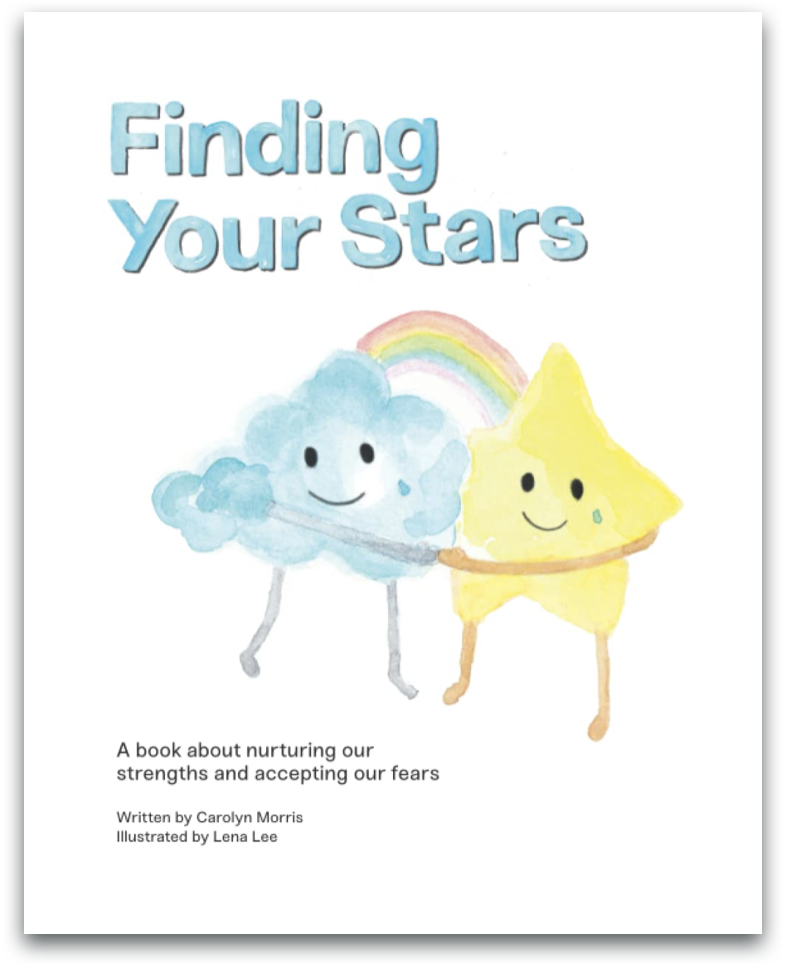
Finding Your Stars

Written by Carolyn Morris
Illustrated by Lena Lee
978-1-7778356-0-6
38 pp.
Ages 3-8
November 2022

 May you be gentle with your clouds and generous with your stars.
 
With those wise words in her dedication, author Carolyn Morris begins her rhyming story to help children see that the strengths and positives in their lives will sometimes be accompanied or even overshadowed by challenges and weaknesses. Both are part of who we are.
We each have stars
inside that glow.
They're special skills
and games we know.
From Finding Your Stars by Carolyn Morris, illus. by Lena Lee
But, sometimes we fall, or we fail, and clouds move in. 
Your clouds are worries,
flaws and fears.
They cover your stars
in gloom and tears.
From Finding Your Stars by Carolyn Morris, illus. by Lena Lee
Young children will understand about clouds covering up their stars. They know what it's like to feel less than shiny. Whether it's because of a friendship gone wrong, a test failed, or family disappointments, the stars and the clouds get into a tug of war. Carolyn Morris suggests that whatever the child focuses on will become stronger. (There's a sweet tug-of-war game between a blue cloud and a golden star in which the cloud cheers its win.) By focusing on the clouds, even if only to dispel them, you give them power to spread "their fears, their faults, their pain." Acknowledging them is fine–"But, if you greet the storm, then spin, back to your stars"–but you should turn back to the stars who will help lift you up. And as you're lifted, you see more stars.
So don't forget how
bright you are,
Embrace your clouds,
then shine those stars.
Most of us get mired in our worries and fears. It's human nature to focus on the negatives because they're consuming. If things are going well, you don't attend those aspects because they aren't of concern. But Toronto author Carolyn Morris isn't necessarily telling us to ignore those "clouds"; instead she's suggesting that it's okay to acknowledge them but then focus on the positives as these are the things that will help you come out from the shadow of the clouds. The message is a simple one but, by creating an analogy with stars and clouds, Carolyn Morris helps kids see that trying to get rid of the clouds is impossible and that the stars will not always be shining. However, you can enjoy the shine of the stars and give the clouds a rest to float on by, which they will almost always do.
From Finding Your Stars by Carolyn Morris, illus. by Lena Lee
Lena Lee who illustrated Finding Your Stars gives the story an ephemeral quality with watercolours and pale colours, reminding young readers graphically that clouds are unenduring. They may reappear intermittently and perhaps infrequently but they are transitory. The bolder stars, on the other hand, stick around a lot longer. I like that neither the clouds nor the stars are aggressively negative or positive; they just are. That is very much like the clouds and stars in our lives. Seldom are the clouds so onerous that they cannot be put aside temporarily or so threatening to our stars that they cannot be managed. And children need to see that they often have the capacity to find their stars.

Here's to everyone finding their stars and weathering the clouds as they come and go.
 
⭐⛅⭐⛅⭐⛅⭐⛅⭐⛅ ⭐
 
Additional resources, including printable colouring pages, are available at findingyourstars.com and would be handy for parents and teachers who want to help young children.

December 19, 2022

Who's Hockey?: A 'Hockey is for Everyone' Book about Acceptance

Story by Jeff McLean
Drawings by Nicola Pringle
Words by Terri Roberts
Game Seven Media
978-1-7773056-0-4
40 pp.
Ages 4-9
November 2022

The question may be Who's Hockey? but the answer is "Everybody!"

Cam and her family have just moved, again, and, though each move is a new adventure, it's also a challenge, especially with leaving behind her hockey team and finding new friends with whom to play. The first morning at the new house, Cam and her dog Gordie are outside promptly, dragging her net and sticks and gear out onto the basketball court in the park. But it's just the two of them and she's ready to head home after shouting out "Doesn't anyone play hockey around here?" and hearing crickets.
From Who's Hockey? by Jeff McLean and Terri Roberts, illus. by Nicola Pringle
But, from her back yard, Lidia hears Cam and when Cam mentions she's looking for hockey, Lidia asks, "Who's Hockey?" Cam proceeds to tell Lidia, and also her little brother Cooper, about the greatest game on earth and they help Cam recruit a few more players in the park.
From Who's Hockey? by Jeff McLean and Terri Roberts, illus. by Nicola Pringle
Soon they almost have two full teams, but no one knows about hockey or how to hold a stick or play. Cam is happy to teach them everything about her favourite game and Gordie is happy to be part of the action.
From Who's Hockey? by Jeff McLean and Terri Roberts, illus. by Nicola Pringle
It's a full day of learning and fun and making new friends. If Who's Hockey? shows readers anything, it's that hockey can be for anyone and everyone and sometimes fitting in means sharing what you like as much as conforming to what others are all about. 

The story of Who's Hockey? comes from former pro hockey player Jeff McLean–co-creator with Dean Petruk of PRIDE hockey tape– with Newfoundland's Terri Roberts putting it to words. The basis for it are the principles of the NHL of which acceptance of all who love the game is but one. Cam offers anyone the opportunity to learn to play the game regardless of age, size, backgrounds, and abilities. It's about having fun and playing together. Alberta illustrator Nicola Pringle makes sure that everyone is included and accepted. Whether right-handed or left-handed, a person of colour or not, wearing glasses, a hijab, or a ball cap, all are welcomed and encouraged to be part of a team and have fun. There is joy in the playing and there's joy in the story of Who's Hockey?, ensuring that young readers will get the positive message about opening themselves up to new things and new people for the opportunity for good things to happen.

September 16, 2022

Harvey Takes the Lead: Guest review

This review was prepared by Gr. 9 student Bronte L.
 
Written by Colleen Nelson
Illustrated by Tara Anderson
Pajama Press
978-1-77278-240-0 
288 pp.
Ages 8-12
May 2022

In Colleen Nelson’s book, Harvey Takes the Lead, Maggie and her friend Austin and their adventurous dogs Harvey and Bertie (respectively) volunteer at Brayside Retirement home. But there is much worry at the home with its new management, rules, and the possibility of Harvey’s dismissal as a comfort dog. For one couple, Mr. and Mrs. Kowalski, there is even more anxiety as Mrs. Kowalski is sick in hospital and her husband is anxious for her return, especially with the upcoming Valentine's Day dance. Ever the good listener, Austin does his very best to help the senior cope by listening to accounts of how the couple met in their youth.

Meanwhile, Maggie and Austin have troubles of their own, mostly dealing with friends and school. Maggie is dealing with not getting the part she wanted in her school play and instead getting the role of the understudy to Ndidi, a girl who Maggie doesn't think deserves the lead. Austin, on the other hand, is too embarrassed to tell his best friend that he can't afford to go on a school trip. And Harvey? He's determined to drive out the rodent nest at Brayside, even if it means breaking a few rules.

Harvey Takes the Lead by Colleen Nelson is a good fit for readers in grades 3-6, but can certainly be enjoyed by people of all ages. It's a heartwarming story about balancing school, family and friends, and giving second chances. The short chapters alternate between perspectives of Maggie, Austin, and Harvey, giving you a look at each of their unique  experiences. Every single character has a vibrant personality and backstory, including Harvey and Bertie, the beloved canines!

Out of 10, I would give Harvey Takes the Lead a 9. If you think retirement homes are dull, you certainly have not heard about Brayside! I absolutely loved the spunk and courage of the seniors, and Maggie and Austin were such relatable and likeable characters. It is far from the genres I usually read, but I enjoyed it a whole lot more than I thought I would! The story was fast paced, and the short chapters made it a quick and enjoyable read. After finishing this book, you’ll want nothing more than to have a chat with the Brayside residents over coffee and Mrs. O’Brian’s blueberry muffins! 
 
~ Written by Bronte L.
 
• • • • • • • 
 
Harvey Takes the Lead (2022)

December 30, 2021

Catalina

Written and illustrated by Lori Doody
Running the Goat, Books & Broadsides
978-1-927917411
40 pp.
Ages 3-7
August 2021
 
If I have to close out the year with one book with a positive message, let it be Lori Doody's Catalina, a picture book about acceptance and adaptation. Isn't that one that needs to be told as we enter a second year of a pandemic? And it all comes from a tale of a cat and three puppies.
From Catalina by Lori Doody
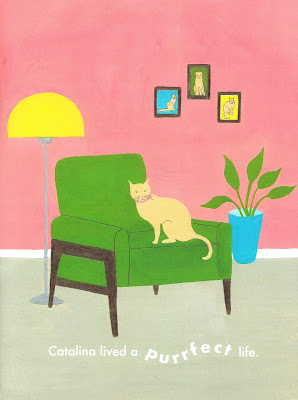
Catalina is a contented cat. She's happy in that she loves her life as it is. Her life is her own. She eats, plays and sleeps when and where she wants. Of course, there are times when she's a little lonely when her people aren't at home and she's alone but still "Catalina lived a purrfect life." And then everything changes.
From Catalina by Lori Doody
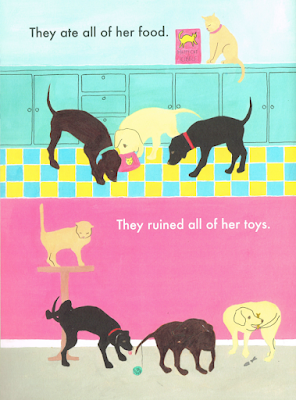
Her people bring home three Labrador Retriever puppies. Catalina is not amused. They are everywhere in her house: where she eats, what she plays with and where she sleeps. They're bigger than her, louder than her and rambunctious. She just can't get away from them and she doesn't like the way she feels: crooked (Newfoundland-speak for in a bad mood, according to the glossary).
From Catalina by Lori Doody
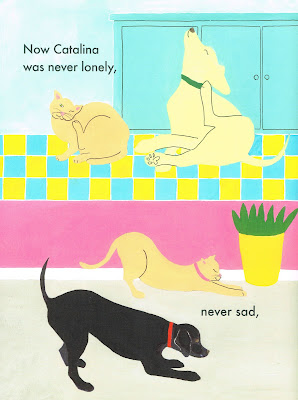
And then she notices a few things. The pups are willing to share with her and keep her company and she was no longer lonely.

Lori Doody gives us a quaint story of introducing new pets into a household already established for another. Many pet owners know the potential difficulties of doing so, whether with the same or different species. Catalina was content with the status quo even if there were things missing for her, like friends. It wasn't until she met the new dogs that she realized what it was that was missing in her life: companionship. But Lori Doody has given us more than a story about a cat and three dogs. In her folk art style, Lori Doody has given us a metaphor for accepting change and adapting to it, even if the benefits cannot be perceived initially. Catalina thought her life was "purrfect." It wasn't though. That became obvious once she embraced the Labs as there to stay, and she gained friends, playmates, cuddle buddies and more. If she'd closed herself off from the unfamiliar, she would have never realized the gifts the puppies brought into her life.

It's a simple story: cat meets dogs, cat is annoyed with dogs, cat learns to love dogs, and everybody is happy. But Lori Doody tells it as a lesson in colour and affection. She does it with softness of line, a landscape of patterns, and the warmth of a hospitable palette. As Catalina learned to love something new, so should we try when presented with something new. Different is not always bad, as we may anticipate. It's just different, and, as Catalina learns, it may even be wonderful.

August 13, 2021

The House Next Door

Written and illustrated by Claudine Crangle
Groundwood Books
978-1-77306-368-3
44 pp.
Ages 3-6
August 2021 
 
This is the story of a house, one house in an open field of long grasses. It stands alone but secure, standing its ground, whatever the winds and snows and rain may blow in. But when other houses blow in, how will the house respond?
From The House Next Door by Claudine Crangle
When the little red-roofed house with a red door and blue shutters first notices two other houses, far off but in his periphery, he ensures the back and side shutters are bolted tight so that only his grassy land is visible.
From The House Next Door by Claudine Crangle

Putting on those domestic blinders does work for a number of years but then the construction of a road tears a gash through the middle of his field. 
Soon they began moving in.
They lined up along the road.
And the road began branching into more
roads.
And more of them arrived.
Row upon row of blank faces stared back at the little house.

The suburbs had arrived and were upon his doorstep with their countless faceless houses. His response? He shuts his front shutters and waits in the dark.

From The House Next Door by Claudine Crangle
Occasionally he peeks outside but all he sees are more and more of those anonymous structures. So the house stays dark and still. After winter and spring pass into summer, he sees something a little different when he glances outside. He sees some colour and even a yellow house with a curtain waving out of an open window. In the dark the curtains reveal a golden light within. This is all it takes for the little house to open its shutters the next day to uncover a real neighbourhood of diverse homes.
 
Toronto author-illustrator Claudine Crangle's story of urban sprawl changing the landscape is really an allegory about shuttering oneself off from change and opening oneself to new possibilities. Though living harmoniously with others around you is not always easy (I was reminded of Norman McLaren's 1952 NFB short film "Neighbours"), perhaps what was worse for the little house was change. He did not know what to expect having never had neighbours and, rather than adapt, he shuts himself off. A little courage and recognition of the familiar help him feel safe enough to open the door, or rather the shutters, to the unfamiliar and see brightness where only anonymity once was.
 
The illustrations were created with paint and a variety of materials including cardboard and paper but also found objects and those scavenged from recycling bins. There's asphalt shingles, fabric and red wooden discs. By bringing life from waste, Claudine Crangle lets her artwork further the idea that there can be beauty and hope in the unlikeliest of places.
 
I know that The House Next Door is recommended for ages 3 to 6, undoubtedly because of its ease of readability, but I hope that parents and teachers will see the value in reading this book with older children. There's an important lesson here for all about anticipating the worse because it's different or unexpected to only discover that the worry is often worse than the reality.

July 26, 2021

This is a Dog Book!

Written by Judith Henderson
Illustrated by Julien Chung
Kids Can Press
978-1-5253-0493-4
40 pp.
Ages 4-7
June 2021

Gertrude Stein may have written that "A rose is a rose is a rose" but this bunny is working very hard to convince a community of dogs that he isn't. Isn't a bunny, that is.

From This is a Dog Book! from Judith Henderson, illus.by Julien Chung
From the outset, a red stripe-shirted rabbit is told by an enormous dog who spans most of a double-spread that he cannot be part of this book because it's a book about dogs and he is a bunny. And so, the bunny begins to try to convince an assortment of dogs that he is a dog. Though they enjoy the biscuits he brings, they decide to test his doggy-ness.

From This is a Dog Book! from Judith Henderson, illus.by Julien Chung

He is asked to prove he can run and catch a ball, wag his tail, and put on the puppy-dog eyes, performing admirably. And though he gets waylaid with thoughts of treats like lettuce, cauliflower and brussels sprouts, he's always ready to distract his investigators with biscuits.
Ummm...Do you mind if we come back to that question later?
 
In the meantime, may I interest you in a cookie?
From This is a Dog Book! from Judith Henderson, illus.by Julien Chung

Despite his reluctance to undertake in the important doo-doo test, the bunny passes, especially after answering one critical question about being a friend. 
 
Montrealer Judith Henderson, best known for her Big Words Small Stories series, uses dry humour to poke fun at a familiar need to fit in and be included. This bunny just wants to be part of the dog book and proving he's a dog is the only way. While the dogs may have him jumping through hoops–it's only a pun–to prove himself, This is a Dog Book! speaks to our common inclination to be part of a community and participate in that community with others. It also speaks to the efforts many will go to in order to become accepted and the anguish of not being so. This singularity of purpose focuses the story and the art.  So it's not surprising that Julien Chung, also from Montreal, keeps his illustrations, which were rendered digitally, very economical. Except for a few splashes of red, as in the bunny's shirt, a ball, and a biscuit box, the book essentially comprises of black-and-white illustrations of the dogs and a bunny. (Oh, there is one more animal that shows up, still black-and-white though.) Yet, Julien Chung allows us to see a rich and diverse community of dogs: large ones, fuzzy ones, and short-legged ones. Even with few lines, it's evident there's a poodle, a dachshund, and a Shar-Pei. So while the bunny fits in physically–he's just an animal with a small tail, large feet and long ears–he's still seen as a different species. That is, until he isn't. Judith Henderson and Julien Chung let us see that it's not our differences upon which we should focus, it's our similarities that will ultimately unite us.

Now, about the cow...

June 09, 2021

Oddbird

Written and illustrated by Derek Desierto
Feiwel & Friends
978-1-250-76531-4
32 pp.
Ages 2-6
May 2021
 
When a grey-feathered little bird finds his way to a community of colourful birds who preen and avoid cooling off in a pool for fear of blemishing their appearances, he is chagrined to see his own blandness for the first time. Though he finds a solution, ultimately it's what's inside of him that will unite him with the other birds.

From Oddbird by Derek Desierto
Finding a lovely blue pool in the jungle on a sweltering hot day, a little grey bird is perplexed why the birds surrounding it aren't in the water cooling off. When he dips his toes in, though, the other birds finally notice him.
"He has no color," said one bird.
"Are those even feathers?" said another.
All the birds agreed that Oddbird didn't belong there.
From Oddbird by Derek Desierto
To the screeches of "Out!" and with tears, the little bird flies off. Noticing how much colour there is in the jungle, he fashions himself a fabulous display of colours. When he returns, the other birds are mesmerized by his appearance, showering him with compliments and recognition.
From Oddbird by Derek Desierto
Emboldened with new confidence, the little bird heads to the diving board before plunging into the cooling pool. So happy is he to enjoy the water that he doesn't noticed that all his colourful "feathers" have fall off. The other birds certainly notice, but they also observe how refreshing the pool looks and jump in, disregarding the water's impact on their own appearances.
From Oddbird by Derek Desierto
This is Vancouver's Derek Desierto's debut picture book as an author and illustrator, having previously illustrated for others (e.g., Juno Valentine and the Magical Shoes), but I hope there will be more. I think Derek Desierto was meant to tell stories. His tale of a little unadorned bird feeling out of place in a community of flashy and multi-coloured birds speaks to all of us who feel out of place and try to find ways to fit in. But by fitting in, the little bird gains the confidence to actually accept his colouring as it is and encourage others to enjoy a world beyond the superficial and to look inside to see what really counts.
 
By harmoniously intertwining his messages of self-acceptance and diversity with his vibrant digitally-rendered art, Derek Desierto has made Oddbird even more inspiring. Children know how much they want to fit in and unfortunately they know how often it's based on what they look like and what clothes they wear. With the boldness of his art, colourful and textured with patterns and expressive in shape and form–those eyes shout fear, distress, awkwardness and joy– Derek Desierto draws children into the story and helps them see that fitting in is sometimes more about being oneself than how others see you. Though the little grey-feathered bird may feel like his absence of colour makes him an oddity, his differences are what actually add the colour to this community and that inclusivity is the foundation for connectedness.

January 27, 2021

Oh My Gods!


Written by Stephanie Cooke and Insha Fitzpatrick
Illustrated by Juliana Moon
Houghton Mifflin Harcourt
978-0-358-299523
208 pp.
Ages 8-12
January 2021
 
When her mother has to relocate to curate a gallery show, thirteen-year-old Karen is sent to stay with her father, Zed, a man she barely knows, in Mt. Olympus.
From Oh My Gods! by Stephanie Cooke and Insha Fitzpatrick, illus. by Juliana Moon
She's surprised by his extravagance, from the carriage drawn by horses in winged costumes at the airport, to her multiple rooms at his mansion, at ordering every type of pizza imaginable since he doesn't know what she likes, and even the wrist corsage he gets her for her first day at Mt. Olympus Junior High. Not only is her dad the mayor of Mt. Olympus, he's the dean of her school. The man is ubiquitous, as well as charming and wealthy.
From Oh My Gods! by Stephanie Cooke and Insha Fitzpatrick, illus. by Juliana Moon
Karen is shown around the school by a really fast guy, Hermes, who introduces her to the different groups, from the Titans football team, to the Fates, random Jeff and the kids of the Mythbusters group who take Karen under their wing. There's the bright Tina who offers to catch her up; the kindly Dita; the guitar-playing Pol; and his sister Art who is wicked with a bow and arrow. 
From Oh My Gods! by Stephanie Cooke and Insha Fitzpatrick, illus. by Juliana Moon
When a boy is turned to stone in the library where Karen and Tina are studying, the group meet at a local diner and peruse a book on Monsters and Mythological Creatures, suggesting that a Gorgon might be at work. Karen is flummoxed by their earnestness, convinced they must be part of a LARPing group, that is, until they reveal themselves to be the gods and goddesses Apollo (Pol), Athena (Tina), Aphrodite (Dita), and Artemis. Learning that her father is a god as well, and that Karen may be a demigoddess whose powers could come in at puberty, all the weirdness of her new situation makes some sense.
From Oh My Gods! by Stephanie Cooke and Insha Fitzpatrick, illus. by Juliana Moon
But, there's still the mystery of the boy turned to stone which escalates when Pol is similarly transformed and there is a worry that Karen's arrival may be related to these bizarre crimes.

While fitting in to a new school, making new friends, and establishing a relationship with a previously-absentee father may be familiar circumstances for some young people, Karen's new life is anything but. By telling Karen's coming-of-age story in a world based on the immortals of Greek mythology, Toronto author Stephanie Cooke and American author Insha Fitzpatrick have added a playful dimension to this graphic novel.  Everything is a little more fantastic, from the characters and their abilities–details are provided in "Karen's Mythology Notes!!!" at the book's conclusion–to Karen's naive accounting for the weirdness she perceives–like centaurs as drama students really committed to their craft–and the inclusion of so many elements of Greek mythology. Every new reveal, like the diner called Ambrosia and the Fates literally bumping into Karen and her friends and saying "We didn't see this coming" (pg. 123), is cheeky and entertaining. While the illustrations by Brazilian digital artist Juliana Moon have given Karen and her friends the normalcy of young teens with their backpacks, clothes and hair, she also embeds it in the mythological Mt. Olympus and makes it realistic.  

I've just learned that this is a series–yay!–and Oh My Gods! is just OMGs #1. The next book, titled The Forgotten Maze, is due out in January 2022, and this is particularly welcome as Stephanie Cooke and Insha Fitzpatrick have left us with an impending adventure starring Jeff and a maze, as well as with wanting to know if and how Karen discovers her powers as a demigoddess.