Showing posts with label strengths. Show all posts

June 22, 2023

What If I'm Not a Cat?


Written by Kari-Lynn Winters
Illustrated by Kelly Collier
Kids Can Press
978-1-5253-0553-5
32 pp.
Ages 4-7
June 2023

Donkey was a cat. He knew he was a cat because all the clues were there. Farmer came into the barn and called out to her kitty cats so that had to include Donkey. Donkey strutted like a cat, he licked his fur, and enjoyed cuddling. And the little things he couldn't do like enjoy cat food, climb trees or catch mice were just some of the things he needed to learn still.
From What If I'm Not a Cat?, written by Kari-Lynn Winters, illus. by Kelly Collier
But then Donkey climbs up on Farmer's lap and hears, "Donkey, you're acting like a cat!" Donkey starts to rethink his attributes relative to the cats and asks himself, "What if I'm NOT a cat?"
From What If I'm Not a Cat?, written by Kari-Lynn Winters, illus. by Kelly Collier
The cats try to help. Some are convinced that Donkey is a cat and, while others begin to question their own identities, there are those who offer suggestions about what Donkey might truly be. Devastated with his identity crisis, he ventures out alone, into the loneliness beyond the farm. When he discovers a kitten in danger from a fox, Donkey helps save the little feline while uncovering some wonderful new things about himself.
From What If I'm Not a Cat?, written by Kari-Lynn Winters, illus. by Kelly Collier
For anyone who has ever questioned their identity and place, from family member to gender, What If I'm Not a Cat? recognizes that fitting in is less about being exactly the same and more about being part of something that feels right. Writer Kari-Lynn Winters has tackled the topic of fitting in and labelling of identities before (see French Toast and Good Pirate, both from 2016) but the farcical nature of a donkey who accepts himself as a cat makes What If I'm Not a Cat? both zany and effective in its messaging. Donkey only begins to question himself when others start to do the same. It's only when he feels accepted completely for both his similarities and differences that Donkey becomes Don-kitty and everything feels right again.
 
Kelly Collier, author-illustrator of A Horse Named Steve and Team Steve, gives her digitally-rendered illustrations a cheekiness of character. Kari-Lynn Winters gives us the story, but Kelly Collier most definitely gives us the characters, from Donkey who always seems to have a spring in his step–except when depressed–to the cats who are playful, diverse and saucy. There's a perfect balance of content and context that comes from a brilliant collaboration between Kari-Lynn Winters and Kelly Collier.

If What If I'm Not a Cat? teaches readers anything, it's that fitting in is not dependent on being the same as everyone else. Fitting in comes with self-acceptance. So, even if you're not a cat–which is pretty cool–you still belong.

December 23, 2022

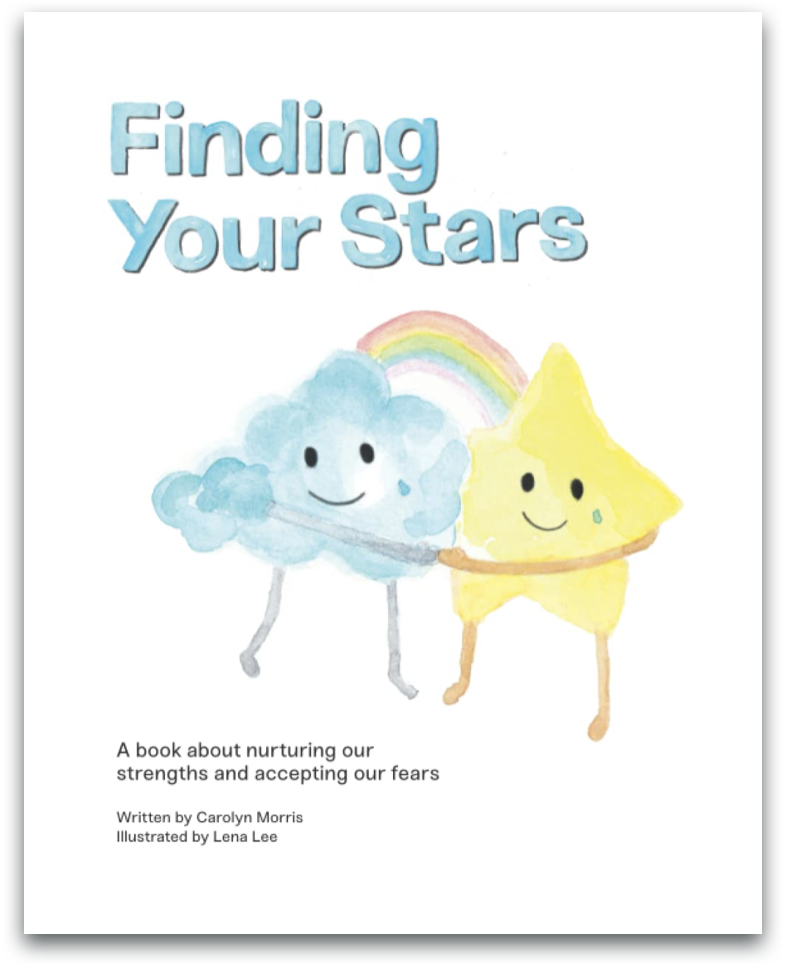
Finding Your Stars

Written by Carolyn Morris
Illustrated by Lena Lee
978-1-7778356-0-6
38 pp.
Ages 3-8
November 2022

 May you be gentle with your clouds and generous with your stars.
 
With those wise words in her dedication, author Carolyn Morris begins her rhyming story to help children see that the strengths and positives in their lives will sometimes be accompanied or even overshadowed by challenges and weaknesses. Both are part of who we are.
We each have stars
inside that glow.
They're special skills
and games we know.
From Finding Your Stars by Carolyn Morris, illus. by Lena Lee
But, sometimes we fall, or we fail, and clouds move in. 
Your clouds are worries,
flaws and fears.
They cover your stars
in gloom and tears.
From Finding Your Stars by Carolyn Morris, illus. by Lena Lee
Young children will understand about clouds covering up their stars. They know what it's like to feel less than shiny. Whether it's because of a friendship gone wrong, a test failed, or family disappointments, the stars and the clouds get into a tug of war. Carolyn Morris suggests that whatever the child focuses on will become stronger. (There's a sweet tug-of-war game between a blue cloud and a golden star in which the cloud cheers its win.) By focusing on the clouds, even if only to dispel them, you give them power to spread "their fears, their faults, their pain." Acknowledging them is fine–"But, if you greet the storm, then spin, back to your stars"–but you should turn back to the stars who will help lift you up. And as you're lifted, you see more stars.
So don't forget how
bright you are,
Embrace your clouds,
then shine those stars.
Most of us get mired in our worries and fears. It's human nature to focus on the negatives because they're consuming. If things are going well, you don't attend those aspects because they aren't of concern. But Toronto author Carolyn Morris isn't necessarily telling us to ignore those "clouds"; instead she's suggesting that it's okay to acknowledge them but then focus on the positives as these are the things that will help you come out from the shadow of the clouds. The message is a simple one but, by creating an analogy with stars and clouds, Carolyn Morris helps kids see that trying to get rid of the clouds is impossible and that the stars will not always be shining. However, you can enjoy the shine of the stars and give the clouds a rest to float on by, which they will almost always do.
From Finding Your Stars by Carolyn Morris, illus. by Lena Lee
Lena Lee who illustrated Finding Your Stars gives the story an ephemeral quality with watercolours and pale colours, reminding young readers graphically that clouds are unenduring. They may reappear intermittently and perhaps infrequently but they are transitory. The bolder stars, on the other hand, stick around a lot longer. I like that neither the clouds nor the stars are aggressively negative or positive; they just are. That is very much like the clouds and stars in our lives. Seldom are the clouds so onerous that they cannot be put aside temporarily or so threatening to our stars that they cannot be managed. And children need to see that they often have the capacity to find their stars.

Here's to everyone finding their stars and weathering the clouds as they come and go.
 
⭐⛅⭐⛅⭐⛅⭐⛅⭐⛅ ⭐
 
Additional resources, including printable colouring pages, are available at findingyourstars.com and would be handy for parents and teachers who want to help young children.

August 25, 2021

Burt the Beetle Doesn't Bite!


Written and illustrated by Ashley Spires
Kids Can Press
978-1-5253-0146-9
56 pp.
Ages 5-8
June 2021

While I may be cursing the mosquitoes and horseflies that are biting right now, award-winning author-illustrator Ashley Spires is showing her appreciation for the wealth of insect species inhabiting backyards and in particular a ten-lined June beetle called Burt.

From Burt the Beetle Doesn't Bite! by Ashley Spires

Showcasing Burt's attributes from his feathery antennae ("It's a style choice") to his all-natural furry belly, Ashley Spires introduces us to the insect often called a watermelon beetle. But when Burt notes the superpowers of ants, hawk moths, termites and stink bugs, he struggles to recognize what makes him so amazing. He tries to wink, tap dance, climb walls and fly but usually ends up on his back with legs flailing in the air. 

From Burt the Beetle Doesn't Bite! by Ashley Spires

But like any child looking to identify their own strengths rather than focusing on their weaknesses, Burt perseveres and finds his sticky legs and his huggable nature a gift to some insects trapped in a spider web.

From Burt the Beetle Doesn't Bite! by Ashley Spires
With colourful humour such as calling a spider web "fancy bum string" (pg. 43) and bold illustrations that are both charming and surprisingly accurate (except for their faces, of course), Ashley Spires teaches, entertains and grabs readers' attentions. There may be countless books about insects but Burt the Beetle Doesn't Bite! educates without droning on about insects' defining characteristics like habitat, eating, and reproduction. Instead kids will learn about the ten-lined June beetle but also about ants and dragonflies, the Australian tiger beetle, hawk moths, echolocation, spraying of toxins and more. And if that's not enough, the end papers display "cards" depicting insects according to their superpowers from "Super Stingy" and "Super Bright Bum" to "Super Annoying" (that's the mosquito!) and "Super Deadly Farts." Finding out what insect matches its superpower will be half the fun of Burt the Beetle Doesn't Bite!
From Burt the Beetle Doesn't Bite! by Ashley Spires
Ashley Spires has always known how to entertain us with her graphic novels and picture books, having won the hearts of young readers with Binky the Space Cat (see my review of Binky Takes Charge, 2012) and inspired them with The Most Magnificent Thing (2014) and The Thing Lou Couldn't Do (2016). Now with Burt the Beetle Doesn't Bite!, she teaches, informing kids about insects in a colourful and playful way that camouflages the learning. That, and her illustrations and her humour must be her superpowers and I'm so glad she uses them for good.

🐞 🐞 🐞 🐞 🐞

A downloadable activity package from Kids Can Press is available at https://www.kidscanpress.com/sites/default/files/products/assets/BurtTheBeetleDoesntBite_2685_activity.pdf

June 08, 2020

Fast Friends

Written by Heather M. O'Connor
Illustrated by Claudia Dávila
Scholastic Canada
978-1-4431-7040-6
32 pp.
Ages 3-8
June 2020

With a play on words and a story of  friendship beyond differences, Heather M. O'Connor helps children see the importance of focusing on our commonalities which connect us rather than that which might separate us.

From Fast Friends by Heather M. O'Connor, illus. by Claudia Dávila
Tyson is a boy who likes to do everything fast: run, eat, work. It often gets him in trouble with his teacher and classmates who might not appreciate the spills he causes or the impatience he has for them. When new girl Suze joins the class, in her shiny red wheelchair and helmet, Tyson notices how her eyes are drawn to his picture of a red race car and how interested she is in his books about fast jets and cheetahs. But, though he repeatedly volunteers to walk with her at recess, the teacher continues to pick others who either ignore her or put her to sleep. 
From Fast Friends by Heather M. O'Connor, illus. by Claudia Dávila
When Tyson sees Suze being raced to the playground with her older sister and taking delight in their fast play, Tyson knows how to bring out Suze's laughter and joy at school, if just given the opportunity.
From Fast Friends by Heather M. O'Connor, illus. by Claudia Dávila
Though the reading level for Fast Friends might direct this picture book to children of ages 3-8, I think it's really one for all ages. It's for adults who disregard those children who are far too active for quiet activities. Moreover, though we must always ensure that play and learning and fun should never put anyone at risk, we don't always need to treat children with special needs as fragile or something other than children. Fast Friends is also for children who are excluded from activities because they don't recognize how they might be perceived. Tyson doesn't see that his actions are impacting others and can't connect his recess solitude with those circumstances. Most of all, the story is for everyone to recognize that all children are different, in their play and their learning, and placing preconceived ideas about what constitutes safe or effective play and learning does a disservice to all.

Heather M. O'Connor captured my attention with her gripping hi-lo novel Betting Game (Orca, 2015) about sports betting in soccer. In Fast Friends, she also deals with a seldom-discussed issue, the subtle discrimination of both hyper children and those with special needs. Most people, adults and children both, would never intend to exclude or negate the needs of these children but it happens thoughtlessly, though with the objective of protecting children. Still Heather M. O'Connor's words tell the story without condemnation or judgment, only emphasizing Tyson's recognition of what Suze enjoys. In fact, Claudia Dávila's art fills in the blanks for young readers, giving them opportunities to practise their visual literacy skills. Do they notice the titles of the books Tyson is reading and sharing with Suze? Can they read the expressions on the faces of Tyson and Suze and their classmates and teachers? How does Claudia Dávila demonstrate how fast Tyson likes to move? The blend of subtle text with bold art will draw young readers to the story and help them learn that fast friends may come from immediate connections as well as some speedy action.
From Fast Friends by Heather M. O'Connor, illus. by Claudia Dávila

November 21, 2018

Team Steve

Written and illustrated by Kelly Collier
Kids Can Press
978-1-77138-932-7
40 pp.
Ages 4-8
September 2018

Let's face it: Steve the Horse, introduced in Kelly Collier's A Horse Named Steve (Kids Can Press, 2017), is a bit of a narcissist. It's all about him. In his first book, he wanted to be seen as exceptional among the animals, oblivious to the strengths of others, seeing them as ordinary. Now, in Team Steve, Steve is looking forward to winning yet another race-a-thon, knowing how extraordinary he is as a runner.
From Team Steve by Kelly Collier
But the rules of the race have changed and Steve is put on a relay team with Duck, Turtle and Snail. Steve is perplexed as to how they are to win when "A duck waddles, a turtle walks and a snail ... is a snail!"  Even as each of his teammates suggests that he could coach them, sharing his expertise, he ignores their suggestions until he comes up with the same idea they've been proposing. Problem is that Steve is all about Steve, so his coaching is not about his teammates but about himself. Among his pearls of coaching wisdom, he advises Turtle to lift his hooves (?), Snail to eat three bowls of oats a day and Duck to stretch its neck.
From Team Steve by Kelly Collier
On the day of the race-a-thon, it's Turtle, Snail and Duck who surpass all expectations and pass their race competitors, while it is Steve who loses the race for them. Too busy congratulating himself on coaching his team to a victory, he delays in running his stretch of the race and the other teams tie to win.  Still it's his teammates that help him overcome his embarrassment before Steve is back applauding himself for helping the other teams win.
From Team Steve by Kelly Collier
Oh, Steve. He is such a self-centred horse, always focusing on his own needs and wants and how he is perceived by others. He is totally unconcerned with others except as they relate to him.  Kids will laugh themselves silly at the foolishness of Steve's need for attention and glory knowing that he is the centre of his own distress.  If Team Steve teaches anything it's that teamwork requires cooperation and listening to others, but it's a lesson Steve still needs to learn. Fortunately, Kelly Collier has created some great characters, including Bob the raccoon who organizes the race and the teams, to help Steve see beyond himself. Her characters, so suggestive in their expressions and body language, demonstrate their own frustration with the equine, as well as their curiosity and pleasure. Moreover, Kelly Collier does this with a very limited palette of beiges with black and white.

Steve may not be the most collaborative but his intent, like his emotional support for his teammates, is honest. Perhaps that's why, even when he messes up, like we all do, they forgive him and help him find acceptance of the situation. And with friends to help, everyone, even Steve, is a winner.

July 18, 2017

What's My Superpower?

Written by Aviaq Johnston
Illustrated by Tim Mack
Inhabit Media
978-1-77227-140-9
32 pp.
Ages 4-7
July 2017

Every child wants to fit in but also wants to excel at something.  Nalvana is no different. But while she enjoys playing outdoors and riding her bike in her "small town where winter is always longer than summer" (pg. 2), she thinks about having superpowers and wears a yellow blanket and snowmobiling goggles as her costume.
From What's My Superpower? 
by Aviaq Johnston 
illus. by Tim Mack
But, when she sees her friends doing extraordinary things, which she always commends them on, like running fast or flying through the air, sculpting with snow and stone or holding their breath underwater, Nalvana is perplexed by her own lack of superpower.  Over and over again, she tells her mother about her friends' amazing strengths and asks what hers might be.  Her mother, unruffled, encourages Nalvana to be patient, sure that her superpower will be revealed in time.
From What's My Superpower? 
by Aviaq Johnston 
illus. by Tim Mack
Just as might be expected, Nalvana's superpower was always evident.  It is as natural as breathing for her so she just needed to have it pointed out.  Fortunately, her mother can see the truly gifted child Nalvana is.
From What's My Superpower? 
by Aviaq Johnston 
illus. by Tim Mack
Ensuring that Nalvana's superpower is not one of the athletic or other overt skills that are normally so admired in our current society that revere celebrity and personality, Aviaq Johnston has made her story one of inclusivity, not exclusivity.  Everyone has a superpower if we look beyond winning awards and competitions.  Everyone has a strength or two that sets them above the rest.  And Nalvana's superpower truly makes her a superhero to others.

Aviaq Johnston's story about Nalvana is also about her milieu which is the basis for her experiences.  The little girl compares Davidee's speed to a Ski-Doo or to the wind on a blizzardy day, and expounds on Joanasie's snow sculpting and inuksuk building similar to his dad's skill as a carver.  Her Arctic home is as unique as the young girl in its offerings.  Tim Mack embeds Nalvana's story in that community, right down to her husky puppy.  And though the palette of turquoise blue-green, golds and salmon may appear more southwestern than northern, it's plays up the natural world in which Nalvana's journey of discovery takes place.

I may not tell you the answer to Nalvana's question of What's My Superpower? but suffice it to say it is something remarkable and terrific, and her mother, her friends and now readers will all know what it is.

March 27, 2017

Breaking Faith

Written by E. Graziani
Second Story Press
978-1-77260-024-7
328 pp.
Ages 13+
March 2017
Reviewed from advance reading copy

For most people, turning points help define them in terms of before and after.  They are sparks of tragedy or ecstasy that depress or elevate, twisting the trajectories of lives onto paths unpredicted.  For Faith Emily Hansen, her turning points began with those of her mother, Lacey, but when her own begin to accumulate, they lead her down paths that are both random and dangerous, and sadly all her own.

Life for Faith’s family has never been easy.  Her mother had been devastated when her husband Simon had died, leaving her with a two-year-old daughter Constance.  She tried to get on with her life, moving back in with her criticizing and argumentative mother Dot, and even getting involved with two different men and having Faith a year later and Destiny two years after that.  Still Lacey’s life is tenuous at best, and out of control at worst.  Although her love for her children is evident–including coming to Faith's rescue when the four-year-old becomes an innocent victim in a horrific act of violence–she leaves them when Faith is just seven, moving to Toronto and making promises she'll never keep.

When Constance moves in with her other grandmother, the affluent Josephine, Faith is left to mother her younger sister and navigate her own Darkness, ever difficult as she is overwhelmed with sadness and anger, hurt and loneliness.  And she is just a child.  As they all deal with Lacey’s spiral into drug use, Faith yearns for normal but is unable to make choices that support that.  Even some counselling and making friends with Norma and Ishaan in middle school can't keep Faith from eventually breaking and heading to a life on the streets of Toronto and into using heroin, eventually hitting rock bottom.
"And my soul was broken–I'd lost Faith.  Lost hope. Lost my belief in my own destiny." (pg. 264)
The story that E. Graziani tells with heart-breaking power and poignancy is devastating in its sadness and bleakness.  Though Faith's reactions are her own, the circumstances of her life were thrust upon her by a mother with her own addiction and mental health issues, by a random act of violence and by familial circumstances which burden her and for which she, as a child, was unprepared emotionally and physically.  Even happiness was a burden.
"And the feeling of constantly being on edge, walking on eggshells, and feeling guilty (though outlandish as that may seem) if I felt a positive emotion." (pg. 17)
But, though Faith sees little positive in her life, she is the poster child for the Bob Marley quote she repeats throughout: "You never know how strong you are until being strong is your only choice."
The reader may be hopeful that, since it is a nineteen-year-old Faith who is writing about the events and conditions that led her to a point where she needs to be rescued, Breaking Faith must have a happy ending i.e., she survives to write her story.  But I don't think there are any happy endings here.  As the Afterword by psychiatrist Dr. Vimala Chinnasamy states, Faith's story is not an uncommon one, one in which mental illness and addiction are perceived as emotional weaknesses and for which inadequate support, both within the family and outside, is provided, thus contributing to the tragedy.  And Breaking Faith is a tragedy of Shakespearean proportions.  The only saving grace is that Faith survives these chapters of her life and that E. Graziani provides a deep look into a life we need to witness so that we might walk with the Faiths of this world before we need to pull them up and rescue them or worse.

~~~~~~~~~~~~~~~~~~~~~

Check out the next post for details of the book launch for Breaking Faith this Sunday at A Different Drummer Books in Burlington, ON


May 28, 2016

Good Pirate

by Kari-Lynn Winters
Illustrated by Dean Griffiths
Pajama Press
978-1-927485-80-4
32 pp.
Ages 5-8
May 2016

Kari-Lynn Winters and Dean GriffithsBad Pirate (Pajama Press, 2015), winner of the 2016 Rainforest of Reading Award, is back and Augusta Garrick is still trying to fit in with the pirates of her father’s crew.  In Bad Pirate, she had difficulties emulating the sauciness, boldness and selfishness of the sea dogs her father, Captain Barnacle Garrick, revered, and now it seems she’s just too fancy!
From Good Pirate by Kari-Lynn Winters, 
illus. by Dean Griffiths

As much as she appreciates tidiness, cleaniness and fancy baubles, she’s considered a liability when the pirates go off on a raid.  But when the crew is caught by Captain Fishmonger and his feline Tuna Lubbers, it’s the finely-scented Augusta who saves the day and proves that she’s as rotten, sneaky and brainy as necessary to be a Good Pirate.

The text is saucy and spicy and flavoured with pirate-speak, as befits a hearty swashbuckling yarn, but it’s all in good fun and brimming with joviality.  Still amidst all that merriment, so much like Kari-Lynn Winters herself, is an important message about being true to oneself and appreciating differences as strengths.  And, again, Dean Griffiths illustrates with richly detailed pirate ship sets and characters which are dogs and cats of all variety.  Kids will delight in identifying the different breeds and who’s wearing what and trying out the “pirate talk” and “nautical talk” which peppers the story and is defined in the endpapers.  Arr, Good Pirate is a good time with a hearty–both deep and enthusiastic–message packaged in the fanciest scurvyiest of art.
From Good Pirate by Kari-Lynn Winters, 
illus. by Dean Griffiths