Showing posts with label compassion. Show all posts

February 23, 2026

Ellis on Guard

Written by Sal Sawler
Illustrated by Nandita Ratan
Second Story Press
978-1-77260-444-3
24 pp.
Ages 6–8
February 2026 
 
Ellis had so many worries that if they wrote them all down, the list would wrap around their house three times. (pg. 2) 
That single line explains a lot about how Ellis conducts themself. It's not what defines them—they are far more than their worries—but they are a child who makes a lot of decisions based on those concerns. And Ellis is worried about a lot of things, from meeting new people to catching colds, and losing their puppy Peanut. To their benefit, Ellis notices a lot, because they are always aware or worried that danger is present.
From Ellis on Guard, written by Sal Sawler, illustrated by Nandita Ratan
When Ellis sees a poster about a missing dog named Walter, their worries are intensified. They become Big Worries. Now they have to worry about a dognapper, about Peanut being taken, and where Peanut might go. So, Ellis devises a plan to catch the dognapper with a trap. But now there are more worries because they needs supplies from the Creepy Closet and the Frightening Forest, and they have to talk to the Noisy Neighbor. With some support from Peanut and their mom, Ellis creates a trap. But what Ellis finds is that there is more to discover than a dognapper. There is more beyond worries. In fact, there is goodness.
From Ellis on Guard, written by Sal Sawler, illustrated by Nandita Ratan
Sal Sawler, the Nova Scotia writer of When the Ocean Came to Town (Nimbus, 2023), seems to understand a child's worries and how they can spiral out of control to the point at which they impact activities and thought. Worries are protective. They are there to help us avoid injury, dangerous circumstances, and bad people. Whether it's our own traumas or those of our ancestor, our bodies remember. But when they misremember, seeing peril everywhere, life is negatively impacted, and this is especially concerning for children. This child obviously knows some strategies for dealing with their anxieties like making a plan, putting on imaginary armour, or asking for help, but worries can be inescapable when they overwhelm. Still Sal Sawler sensitively takes Ellis in small steps from worrisome to attentive beyond the worries. Once Ellis realizes that they can do good, they put aside the worry and step up to be the protector they envision themself to be. I think kids would gain from discussions of how Ellis changes their outlook and sets aside a worry, perhaps helping to cope with their own concerns and see the positives where they exist.
From Ellis on Guard, written by Sal Sawler, illustrated by Nandita Ratan
Nandita Ratan is a Vancouver-based artist whose digital art keeps with the playful rather than the threatening nature of worries. Even when Ellis fears monsters or a dognapper or a  Spiky Shrub, Nandita Ratan does not make it scary. Instead, she makes the child's fears simple but embedded in the realism of a dark closet or a shaded forest. She keeps most of the illustrations light and colourful, never terrifying, and thus helps to convey the message that worries can be dispelled by not catastrophizing and with a change in perspective.
 
While Ellis on Guard is not a how-to story about dealing with worries, it is a picture book that might help a few children understand their own worries. Child have worries, as do the rest of us, and some of those worries don't disappear because we will them to do so. It might be enough for children to learn that there are positive thoughts that can help prevent over-the-top worries that anticipate the worst and turn things around enough to do good and see goodness beyond the worries.
 
 • • • • • • • 
 

October 20, 2025

The Gift of Words

Written and illustrated by Peter H. Reynolds
Orchard Books (Scholastic)
978-1-339-00034-3 
40 pp.
Ages 4–8
October 2025 
 
While most of Canada still hasn't seen snow since last winter, and many are still ramping up their decorations and party plans for Halloween, there will be some who are starting to think about the winter holiday season. Jerome, Peter H. Reynolds's lexicographer from The Word Collector (2018), is inspired to collect some holiday words, sure that he will find words of hope and of joy that he might share with those he loves. What he finds is surprising.
From The Gift of Words, written and illustrated by Peter H. Reynolds
With his bright yellow notebook and accompanied by his dog Ekko, Jerome checks out words posted throughout his town. Words like "Buy" and "Sale" and "Low Low Prices" do not inspire the good feelings he'd hoped to find. 
These words left Jerome feeling cold.
From The Gift of Words, written and illustrated by Peter H. Reynolds
When he looks beyond the shops, he finds even more distressing words. There's the newsstand where headlines scream about war, poverty, and disasters. And the people he encounters are demanding and hating on the weather and frustrated with others.
 
Jerome's solution is to share inspiring words rather than find new ones. After all, he is a curator of words. So, finding a joyful assortment, he packs up several large bags and pulls them on his sled to the downtown park. There he invites others to join him in decorating a tree with positive words and messages.
 
A word collector's tree.
A tree of hope.
A tree of dreams. A tree of wishes. 
 
From The Gift of Words, written and illustrated by Peter H. Reynolds
Soon the tree is festooned with words of positive actions like "Smile" and "Listen," and of feelings like "Joy," as well as messages like "We can make more light together" and "Together we can." With that tree, with those words, and with his community, Jerome is able to share and help others participate in the gift of words.
 
Peter H. Reynolds has always be a fabulous patron of goodness, inspiring young readers with his picture books that promote self-expression (Happy Dreamer, 2017), love (All We Need Is Love and a Really Soft Pillow!, 2023), empowerment and activism (Say Something!, 2019), creativity (The Dot, 2023), and so much more. With The Gift of Words, Peter H. Reynolds not only promotes a lexicon of heartfelt words and messages, but he also makes us stop and think about the unpleasant communications with which children are bombarded daily. Sadly, there is much of this troubling content, especially during the holidays when commercialism and selfishness abound. Thankfully, Peter H. Reynolds addresses it with a lover of words and that child's pursuit of finding joy in the season. 
From The Gift of Words, written and illustrated by Peter H. Reynolds
Still, the overall feeling of The Gift of Words is one that uplifts. It's one of community and positivity. And Peter H. Reynolds gives us all the children and community participating in making things right. Everyone has the opportunity to be included and to contribute. And all you see is joy in their faces and in their activity. Peter H. Reynolds gives us colour and kinship through his characters and his whimsical tree of hope, dreams, and wishes.
 
Get your students and children in the right holiday spirit with a reading of The Gift of Words and thinking about their own inspiring holiday words—Scholastic has a couple of activity sheets here to help—before the holiday season starts, and the toy and tech commercials begin to bombard them. Help them find the goodness within their community and their place in contributing to it. Help them make this holiday season one of heartfelt sentiment that might sustain them throughout the year.

Activity sheets available for The Gift of Words at Scholastic (https://www.scholastic.com/site/peter-reynolds.html)

April 23, 2025

The Bigfoot Field Guide to Campers (and Other Mysterious Creatures)

Written and illustrated by Jami Gigot
Kids Can Press
978-1-5253-1263-2
36 pp.
Ages 4-7
Releases May 2025
 
Ah, the mysterious Bigfoot. Mythical beast or elusive recluse? Whatever it is, many fear an encounter with the massive creature. But what if it encountered us? Does it have a similar perspective?
From The Bigfoot Field Guide to Campers (and Other Mysterious Creatures), written and illustrated by Jami Gigot
In its field guide to mysterious creatures, Bigfoots believe that there "is one species that is so dangerous, and so treacherous, that Bigfoots have come to fear them above all others..." It's the nasty camper. Ever since campers invaded the home of the Bigfoots with their click-flashers, and moved their rock collections, peed in their gardens and contaminated their waters, Bigfoots have been forced to move deeper into the forests. But the Bigfoots have a guide to help each other deal with these troubling visitors. 
From The Bigfoot Field Guide to Campers (and Other Mysterious Creatures), written and illustrated by Jami Gigot
First step for Bigfoots is identification, easily accomplished by hairless faces and limbs, odours and noises. Once identified, the aim is to avoid being seen. In the case of the Bigfoot giving this advice, everything goes awry when a young camper spots the Bigfoot as he spots her. Guideline #3 recommends camouflage if spotted but he's kind of big, and the child finds him. And though he tries to remain calm and play dead–these are Guidelines #4 and #5–her tickling makes it difficult to remain secretive. 

Bigfoot knows to never eat a camper's food or let them use their click-flasher on you and to never let their guard down on a camper–they are NOT warm and cuddly creatures–but things take a turn when the camper becomes distressed recognizing the absence of the other campers. Can Bigfoot follow all the guidelines, or will he be able to show kindness to an upset child who sees a friend in the big guy and not a monster?
From The Bigfoot Field Guide to Campers (and Other Mysterious Creatures), written and illustrated by Jami Gigot
Vancouver's Jami Gigot may have meant this picture book as a tongue-in-cheek look at how we perceive the mythical Bigfoot but by turning it around and helping us see how Bigfoots may perceive us, Jami Gigot gives us a lesson in tolerance and kindness. It starts as a story of conflict between Bigfoots and campers, but it flips and opens up into a story of acceptance. Both Bigfoot and the child see beyond their fears and misconceptions and find something special that is mutually beneficial. 

Jami Gigot, who also wrote and illustrated Star Boy: Inspired by the Life and Lyrics of David Bowie, Imagination Vacation, and The World in Our Backyard, keeps the simplicity that would come of a homemade field guide. Her art, rendered in coloured pencil and digital paint, keeps a sweetness to Bigfoot–he looks more scared of the camper than she does of him– as well as to the goofy, young campers who may not have learned to be intolerant or fearful of others who are different from them. 

Whether Bigfoot or a camper, there may be a surprise in the woods for you. Be prepared with compassion and tolerance and you might just have an unexpected encounter with a new friend. But shhh! Let's keep that a secret.

April 14, 2025

The Warmest Blanket in the World

Written by Tamara Levine
Illustrated by Ellie Arscott
Second Story Press
978-1-77260-410-8
24 pp.
Ages 6-8
February 2025 
 
While most of us are already thinking about the warmth of spring and summer, there will be many, particularly the elderly, for whom the change of seasons will not necessarily bring that which would warm their fingers and toes. For those with poorer circulation and other health issues, particularly those associated with aging, cold feet and hands can be problematic. And young Frida wishes she could do something to help her amazing great-grandmother Ama who says she feels like she lives in a refrigerator.
From The Warmest Blanket in the World, written by Tamara Levine, illustrated by Ellie Arscott
Frida enjoys visiting her great-grandmother as much as the older woman relishes seeing the child, telling her each time, "Do you know you've made my day? You're one special kid!" Ama tells Frida stories about her life and the importance of women fighting for their rights. (Frida even attended a protest with Ama once.) They sing songs together and they snuggle under her blanket. But even that blanket doesn't keep Ama warm enough. So, Frida gets some advice from her mom, her grandmother and her aunt.
From The Warmest Blanket in the World, written by Tamara Levine, illustrated by Ellie Arscott
Frida recalls what she'd learned of muskoxen which reminds her aunt, a knitter, of a mill in Nisku, Alberta where Tanis, an Inuk woman from NWT, prepares qiviut, the wool that comes from muskoxen. This wool is said to be the warmest in the world. 
From The Warmest Blanket in the World, written by Tamara Levine, illustrated by Ellie Arscott
Frida writes Tanis and explains how much she loves her great-grandmother and how much Ama has done to make things better for girls and women. Now Frida wants to help her. The response she gets is far greater than some skeins of wool.
From The Warmest Blanket in the World, written by Tamara Levine, illustrated by Ellie Arscott
There are a lot of layers to Tamara Levine's story of The Warmest Blanket in the World. There is a sweet intergenerational relationship between Ama and Frida. There is a story of activism and doing good and supporting the rights of others, particularly women and girls. There is also a story of compassion and sharing. And there's the story of the muskoxen and how the Inuit have spun the wool of these Arctic animals into yarn and clothing. That's a lot of stories, and Ottawa's Tamara Levine weaves them all together in a story of family. This is more than a story of a blanket. It's about who needs what, who can help, and why we should help. 

Ellie Arscott, who illustrated the award-winning Night Walk, keeps the lightness of family and the warmth of a blanket and affection in her artwork, done in watercolour and ink. There is realism, when she depicts the muskoxen on the tundra and in the sepia images of suffragettes fighting for the right to vote. But there is a quaintness in the patterns of blankets and bed linens, in the calico cat and in the coziness of their homes. Ellie Arscott keeps it all bright and homey.
 
The Warmest Blanket in the World is a tender story of family and kindness. It's wrapped in qiviut and embedded with affection and humanity. It doesn't get any more warm-hearted than that.

January 25, 2025

Life in the Wild: The Collected Adventures of the Bear, the Moose and the Beaver


Written and illustrated by Nicholas Oldland
Kids Can Press
978-1-5253-1292-2
200 pp.
Ages 4-8
September 2024

Nicholas Oldland's Bear, Moose and Beaver have returned and they're in an amazing collection of six previously published books so young readers won't just be introduced to these characters but really get to know them.

The six stories included in this collection are Big Bear Hug, Making the Moose Out of Life, The Busy Beaver, Up the Creek, Walk on the Wild Side, and Hockey in the Wild. Playing up some fun puns, Nicholas Oldland truly takes us into the wild lives of his trio of friends.
From Life in the Wild, written and illustrated by Nicholas Oldland
Big Bear Hug is a story of how a bear loves to give hugs to everyone and everything but most especially trees. But when a man with an axe arrives to chop down one of the most beautiful trees, the bear has other ideas.
From Life in the Wild, written and illustrated by Nicholas Oldland
Making the Moose Out of Life has a moose who starts to wonder if he's missing out on life and decides "to take life by the antlers." (p. 49) Instead, a sailing misadventure leads to new experiences, a new friend, and the catalyst for courage to try new things.
 
A very busy but careless beaver learns the error of his ways when hospitalized after a tree-felling mishap in The Busy Beaver. However, his rehabilitation for his injuries gives him the opportunity to make right his mistakes.
From Life in the Wild, written and illustrated by Nicholas Oldland
Up the Creek's tale focuses on the three friends learning to cooperate on a canoeing trip filled with disasters and bickering. It is only through teamwork that the bear, moose and beaver can survive.
 
The theme of cooperation is revisited in Walk on the Wild Side when a mountain hike becomes a competition that becomes dangerous.
From Life in the Wild, written and illustrated by Nicholas Oldland
Finally, in Hockey in the Wild (reviewed here in 2020), the trio anticipate the start to their hockey season on the ice but patience is necessary to keep themselves safe to enjoy their winter pastime.
 
In all these stories, Nicolas Oldland infuses his characters with honest friendships while they learn lessons in patience, cooperation, teamwork, compassion and more. And he does so by example, not by preaching. Nicholas Oldland ensures that each animal is unique, quirky in their own ways, and yet willing to change when needed to help others and help themselves grow as individuals.
From Life in the Wild, written and illustrated by Nicholas Oldland
Teachers and parents may love the stories for the important lessons Nicholas Oldland imparts but kids will adore them for the silliness of these very realistic stories–who hasn't had a competition with a peer or sibling that ended in disaster?–and Nicholas Oldland's digital art. The simplicity of the shape and lines of his characters and settings make everything easily recognizable but it's the details in the expressiveness of his characters' faces and gestures that will be more relatable and still very cute. Whether chagrined at a capsized canoe or standing in a bathing suit on an ice-covered lake, the bear, moose and beaver emote according to all life's circumstances and tell children that they know how they feel.
 
Nicholas Oldland offers readers a great opportunity to take a comprehensive walk on the wild side with the bear, the moose and the beaver in Life in the Wild because whether it's winter or summer, spring or fall, there's always something happening, including ways to live in the not-so-wild.

October 23, 2024

The Animal People Choose a Leader

Written by Richard Wagamese
Illustrated by Bridget George
D & M Kids (Douglas and McIntyre)
978-1-77162-418-3
32 pp.
All ages
October 2024
 
The Animal People Choose a Leader, a picture book based on a short story, is something special. It's obvious from a first glance at the cover. First, there's the author, the late Richard Wagamese, one of Canada's greatest treasures to literature and an Ojibway writer from the Wabaseemong First Nation. Best known for his novels, stories and memoirs, Richard Wagamese had never published a picture book. Illustrated by Bridget George, an Anishinaabe author and illustrator from Kettle and Stony Point First Nation, The Animal People Choose a Leader offers a story, a lesson or five, and beauty.
From The Animal People Choose a Leader, written by Richard Wagamese, illus. by Bridget George
Long ago when only the Animal People inhabited the earth, they decided they needed to choose a leader. And though they spoke of the many attributes needed, from strength and wisdom, to pride and power, they could not decide how to choose until squirrel Ajidimo suggests a race. Horse, Buffalo, Cougar, and Wolverine are all in, convinced that their strengths, whether it be speed or stamina or stealth or something else, would help them win. 
 
It is decided that they would race four times around the lake with Eagle watching from above to count laps. Then Waabooz, the rabbit, decides to race too though everyone suspects that her small size would not help her succeed.  Horse, Buffalo, Wolverine, and Cougar take off, but Waabooz waits and then slowly hops away.
From The Animal People Choose a Leader, written by Richard Wagamese, illus. by Bridget George
As the four primary contenders race to complete their laps, Waabooz takes her time, determined to enjoy the challenge by taking in the land's beauty and considering her paths by smell and observation. Even when the others complete their first laps, Waabooz is far behind, refusing to stop even when Eagle suggests she can't possibly win. Her response?
"It is not honouring the challenge to stop now," she said. "It is a noble pursuit and it asks everything I have."
From The Animal People Choose a Leader, written by Richard Wagamese, illus. by Bridget George
But as Wolverine, Horse, Buffalo, and Cougar go to complete their last lap, Waabooz discovers each unable to continue because of an obstacle or exhaustion or some challenge from which they cannot extract themselves. It is only with the wisdom of Waabooz and her guidance in getting them to work together that the five contenders for leader are able to complete the race together.
 
The Animal People Choose a Leader may share similarities with many other cultural stories in which a race to choose a winner does not turn out as expected but this story goes beyond one of humility and ingenuity. Waabooz is the unlikely winner, and this is obvious to all. But Waabooz has not accepted the challenge to win it. She has taken it on as a worthwhile endeavour, claiming that "It can never be a struggle to engage in a noble cause." Even when the animals complete the race and Waabooz is chosen as leader, her response is not expected. Her intent was to learn which she did. But she shared her wisdom with others so that they might understand what a struggle truly is and how to get out of one's own way. Most of all they learned that when they help each other, they all succeed.

Richard Wagamese's lessons in mindfulness and appreciation of the natural world–"You discover much when you learn to look at things"–extends to those of compassion and empathy, seeing how we can create barriers to our own progress, whether through rushing in or not trusting others or refusing to see something from a different perspective. Wise Waabooz, through Richard Wagamese's insight, firmly embedded in Indigenous voice and culture, gives the reader, young and old, understanding that could help us lead and follow.

Bridget George's Woodland style of art, rich in earthy tones and organic lines of movement, boosts Richard Wagamese's text to story book so simply and yet profoundly, matching the importance of the story with solemn graphic representation. The consequence of his words are reflected in the depth of Bridget George's illustrations, taking it from children's picture book to a tale that can be shared with all.
 
This would be a lovely book to gift anyone at the holidays. From the story within, the Woodland style art, and even the luxurious textured cover, The Animal People Choose a Leader would be a welcome addition to any school or library, public or personal, and one that could be treasured by all. With its timeless lessons and opportunity to appreciate Richard Wagamese's words once more, The Animal People Choose a Leader is an uncontested winner.

February 03, 2024

Still My Tessa

Written by Sylv Chiang
Illustrated by Mathias Ball
North Winds Press (Scholastic Canada)
978-1-4431-9623-9
32 pp,
Ages 4-8
January 2024
 
Evelyn is both perplexed and worried. The older child she has always known as her sister is now telling her that they aren't her sister, or her brother. Tessa is her sibling. What does that mean? Is Evelyn even Tessa's sister?
From Still My Tessa, written by Sylv Chiang, illustrated by Mathias Ball
Evelyn sees that Tessa is not herself. Evelyn wants to play with Tessa and take them out of their dark room and make them smile again but she doesn't know how. When she writes a note to the "Best Sister Ever!" Tessa explains to Evelyn that they are not her sister, or her brother, but prefers to be called Evelyn's sibling. They do some stuff together but it's obvious that Tessa is growing up and their interests have changed. They are also burdened with educating Evelyn about their pronouns (they/them/their) and dealing with those who assume they know what Tessa's pronouns must be.
From Still My Tessa, written by Sylv Chiang, illustrated by Mathias Ball
Evelyn wants to learn and she does. After a week, she's using Tessa's preferred pronouns and almost gets a smile from her sibling. But when the family goes for a bike ride, Tessa is again challenged by those who assume their gender is female. Evelyn has no problem informing people they meet that Tessa is her sibling, recognizing that if she can adapt to Tessa's pronouns in a week, others can learn as well. And when their parents introduce Evelyn as a girl and Tessa as non-binary, Tessa's smile finally returns.
From Still My Tessa, written by Sylv Chiang, illustrated by Mathias Ball
The premise behind Still My Tessa goes beyond just recognizing that we should all feel comfortable with the pronouns by which we are addressed. It also recognizes that young children might have to learn about pronouns and being non-binary but that this can be learned with the right teaching. Teacher Sylv Chiang (she/her) finds a sibling relationship the perfect vehicle for addressing the use of pronouns. As a little sister who obviously adores Tessa, Evelyn just wants them to be the sibling with whom she can play and make happy. And by modelling what's she's learned, Evelyn can help teach others what is appropriate for Tessa and all of them. 
 
Illustrator Mathias Ball (he/they) may have had to struggle with enlightening others about their preferred pronouns, and, as such, their depictions of Tessa are truly authentic, reflecting what a child struggling to understand and accept and advocate for themselves with their non-binary status and pronoun preferences would feel. Evelyn is a happy child whose biggest worry is who will play with her, while Tessa is filled with angst. Whether it is becoming a teenager, already a struggle for many, or understanding their non-binary nature, Tessa projects that burden, rarely cracking a smile or venturing from their room and from beneath their headphones. Still, Mathias Ball doesn't make them sullen or angry, but they do make them introspective and solemn. That doesn't mean the illustrations are anything but bright and cheerful and inclusive, ensuring that Tessa and Evelyn both see the joys of their world.

Accepting how we would like to be addressed is an important part of our identities. But it isn't always easy for others to accept the appropriate pronouns or gender designations (even nonconforming ones). Still Evelyn demonstrated that learning can happen and doesn't have to change her relationship with Tessa, except by also becoming their ally now. With a little instruction–Sylv Chiang offers some help understanding of what it means to be non-binary, how to use pronouns, and how to become an ally. With compassion and clarification, every young child can learn to use the correct pronouns as Evelyn did for her sibling and help others to do the same. (And Still My Tessa may even help a few parents learn how to becomes allies for their children.)

January 19, 2024

Zander Stays

Written by Maureen Fergus
Illustrated by Scot Ritchie
Pajama Press
978-1-77278-296-7
36 pp.
Ages 4-7
October 2023
 
Zander is a goose, a lovely white goose with bright orange legs and an orange bill. He's like the other geese except for this autumn when Zander decides to stay. While the other geese pack up to fly south for the winter, Zander decides he's going to try something different this year.
From Zander Stays, written by Maureen Fergus, illustrated by Scot Ritchie
After his compadres have left, Zander enjoys new endeavours like jumping in leaf piles, and racing the wind. He may be alone, but he never feels lonely. But then winter arrives. He's advised by a squirrel that he should prepare for winter by collecting and storing nuts. Too bad he doesn't eat nuts. The other animals have their own advice for surviving the winter, but none seem to quite work for Zander. And though he enjoys his first encounter with snow, he soon realizes that he is at a disadvantage, and there is no one to help him.
From Zander Stays, written by Maureen Fergus, illustrated by Scot Ritchie
Miraculously, when Zander is about to give up, a little girl named Grace finds him and shows him what she does to survive the winter. Finally, Zander finds some adaptive techniques that work for him. And won't he have some wonderful stories to tell his friends when they return!
From Zander Stays, written by Maureen Fergus, illustrated by Scot Ritchie
While it might not be recommended that wild geese like the snow goose not migrate as they normally would, Maureen Fergus has actually created a STEM story about migration and adaptation by having Zander stay. (Her "Author's Note" provides worthwhile information for young readers about how different animals adapt and what hibernation and migration mean.) It might be exciting to try something new but not migrating became a dangerous undertaking for Zander and one that he only survived with human help. With warm shelter and food, Zander learned from Grace that winter could be enjoyed but only with respite from the challenging conditions. Moreover, her compassion for Zander saves him, reminding children to be mindful of the needs of animals and their welfare.
From Zander Stays, written by Maureen Fergus, illustrated by Scot Ritchie
Scot Ritchie has illustrated both picture books and non-fiction texts (e.g., Federica; Dinos Driving; Follow That Map!; If You Can Dream It, You Can Do It; On the Line) and as such has demonstrated a deftness of touch for creating sweet and yet realistic artwork. In Zander Stays, Scot Ritchie gives us identifiable red squirrels, bats, a bear, a rabbit, and geese, but placed them in landscapes of lake shores, sunsets, and even a cozy home garnished with a fireplace, scattered winter clothing, artwork, and food. Any child reading this book will know the cool autumns of fallen leaves, the snowy cold winter days, and the warmth of being inside from Scot Ritchie's artwork. By using ink and digital watercolour art to give substance to Maureen Fergus's story, Scot Ritchie keeps it gentle–a story of a goose that might not survive the cold of winter definitely needs a light touch–and engaging, while still reminding us that survival is still an issue for animals in winter.
 
As different parts of Canada experience their own cold spells this winter,  help young children understand the basics of adaptation, about migration, and about animal welfare, while cheering for a silly goose who was fortunate to survive the winter with a little help from a friend.

May 25, 2023

The Skull: A Tyrolean Folktale (Canadian Edition)

Written and illustrated by Jon Klassen
Candlewick Press
978-1-5362-2337-8
112 pp.
Ages 6-9
July 2023

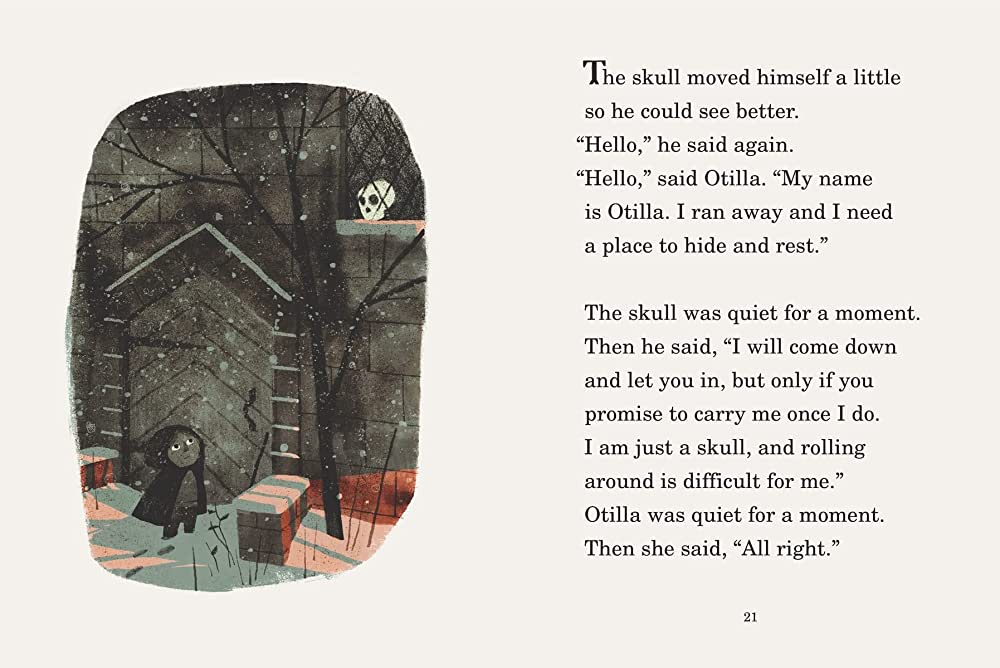
Once upon a time there was a little girl named Otilla who ran away in the dark and cold of a winter night. She heard her name being called but could not tell the source. As she struggled, even falling in the snow, scared and crying, she reaches the end of the woods and finds a large, old house with a skull in the window.
From The Skull by Jon Klassen
When she asks for shelter, the skull agrees but only if she will carry him because he is tired of rolling everywhere. (It did take him a long while to open the door for her.) Inside, he shows her around, including a garden room, a dungeon with a bottomless pit, a magnificent ballroom, and a great room in which he'd enjoyed tea by the fire under his portrait.
From The Skull by Jon Klassen

Before they head to bed, he warns her that a headless skeleton comes around looking for him, but he doesn't want to go with the skeleton. Otilla devises a plan. As the two sleep in a lovely bed, the skeleton appears, shouting, "GIVE ME THAT SKULL. I WANT THAT SKULL." (pg. 61) Otilla grabs the skull and carries it to the tower balcony, the skeleton chasing them all the way. Standing back, she lets the skeleton look over the edge before pushing it off.

But Otilla is a clever girl, and she knows that that may not be the end of the skeleton, so she finds a way to make sure it never comes back, and, in doing so, finds herself a new home.
From The Skull by Jon Klassen
If it weren't for the fact that there is no ghost, I would call this a ghost story. It's the kind of story that could be told around a campfire or at a sleepover or on Halloween. But, because The Skull is also from Jon Klassen, it has dry humour, remarkable artwork, and a touch of sweetness. The humour comes in dark playfulness, like Otilla feeding the skull pears and tea that go right through him but which he still enjoys. And the graphic and ink artwork in quintessentially Jon Klassen: dark and sombre with limited splashes of grey green and peach. From the chilling forest to the monolithic house of shadows and stone, Jon Klassen sets The Skull in places of gloom. Yet he pulls out some tenderness for both Otilla and the skull.  She, who has run away from an unknown situation, is able to connect with a skull who needs her help as much as she needs his. She carries him around like a stuffed animal, both respectful and comfortable, and she puts him to sleep so that she can take care of the skeleton's broken bones. There may be a skeleton and a skull and a creepy house and a scared little girl, but The Skull is more than a ghost story. It's one of reciprocity and compassion. With reciprocity comes connection and with connection comes benefit. And, with that, comes a happy ending.

May 16, 2023

The Magic Cap

Written by Mireille Messier
Illustrated by Charlotte Parent
Milky Way Picture Books
978-1-990252-21-1
32 pp.
Ages 4-7
May 2023 
 
Oh, to have a magic cap that could fix everything! 

When Isaura and Arlo's pet hedgehog, Crispin, falls ill, the two children do everything to make him feel better. "They made him his favorite slug soup, brewed pots of cucumber tea, and even took turns rocking him for hours under the moonlight." Isaura is convinced that if they could find a gnome, it could heal Crispin. But how to lure a gnome?
From The Magic Cap by Mireille Messier, illus. by Charlotte Parent
Because food is rare, they give up the last of their milk to lure the gnome. Heading into the woods, they place the milk out and wait. And they wait and they watch. The bowl of milk becomes very popular, with visits from a deer, a squirrel, a badger, a frog, a fox, a boar and even an insect. Sadly, all the milk is gone, and no gnome has visited it.
From The Magic Cap by Mireille Messier, illus. by Charlotte Parent
The next day, hungry and with no food to offer, the two head out to search for some food, and, though they collect numerous berries, a hungry frog eats them all and leaves only a red-capped mushroom. So, with a lone mushroom as incentive, the children wait. And wait. And then they nap, along with all the animals who'd been keeping them company.
From The Magic Cap by Mireille Messier, illus. by Charlotte Parent
As they sleep, a red-capped gnome appears and is quite taken with the mushroom that offers shelter from the rain. In exchange, she leaves them two gold coins. Though that will help sustain them for a very long time, it won't help poor Crispin who is still unwell and shivering.
From The Magic Cap by Mireille Messier, illus. by Charlotte Parent
Unbeknownst to them, while they're out looking for something to warm their friend, a gnome offers its red cap to a bird to take down to the listless hedgehog. When the children return, still disappointed at never spotting a gnome, they are delighted to see Crispin wearing a jaunty red cap and feeling much better.
From The Magic Cap by Mireille Messier, illus. by Charlotte Parent
This is a picture book that will charm in every way. From the heartfelt wish of hungry children to heal their friend, to the numerous undetected gnomes that populate the woods, and animals who are community to Isaura and Arlo and Crispin, Mireille Messier's story feels like a fairy tale, and not the kind that scares. Mireille Messier's stories always have heart but here she gives us children living independently in the woods, managing with what little they have, and problem-solving how to heal their dear pet. And she gives us the magic and the happy ending. With a sweet story about benevolence, The Magic Cap is the best kind of fairy tale.

Bringing colour and shape to Mireille Messier's story are Charlotte Parent's coloured pencil illustrations. The detail and lushness of the art, from patterned clothing and quilts to verdant forest rife with textures of leaves, flowers and wildlife, takes the story from the page to a cottage in the woods where magic happens. 

We may not all have access to a magic cap that can heal, but Mireille Messier and Charlotte Parent's The Magic Cap can still transport us to a place where kindness prevails, community gathers, and small, mythological beings delight and do good.
 
• • • • • • • 

The French-language edition, Le Bonnet Magique (comme des géants, 2023), is also available.