Showing posts with label Candlewick Press. Show all posts

May 25, 2023

The Skull: A Tyrolean Folktale (Canadian Edition)

Written and illustrated by Jon Klassen
Candlewick Press
978-1-5362-2337-8
112 pp.
Ages 6-9
July 2023

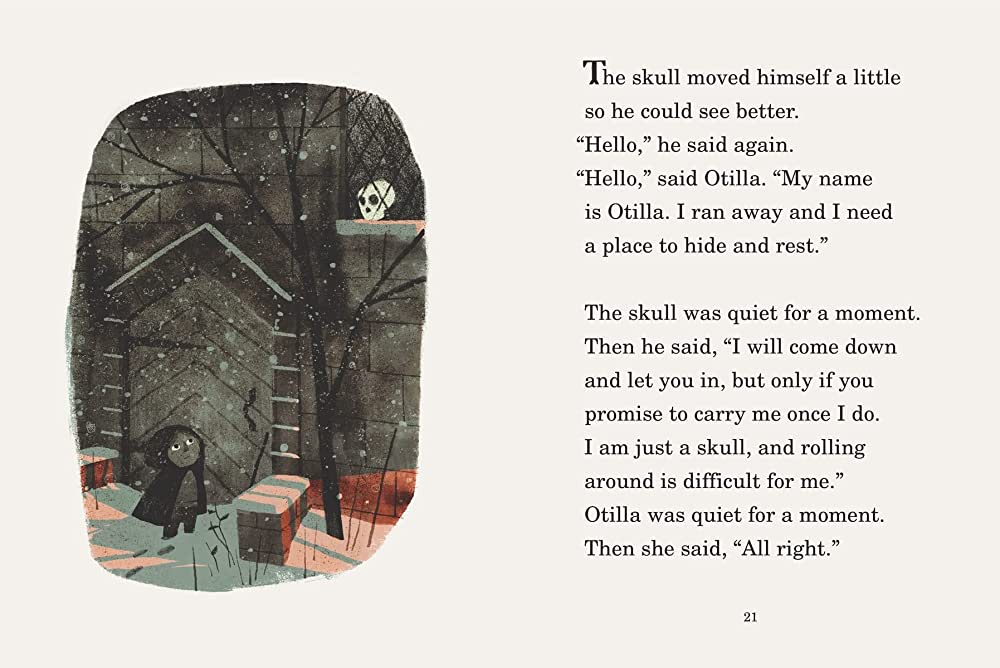
Once upon a time there was a little girl named Otilla who ran away in the dark and cold of a winter night. She heard her name being called but could not tell the source. As she struggled, even falling in the snow, scared and crying, she reaches the end of the woods and finds a large, old house with a skull in the window.
From The Skull by Jon Klassen
When she asks for shelter, the skull agrees but only if she will carry him because he is tired of rolling everywhere. (It did take him a long while to open the door for her.) Inside, he shows her around, including a garden room, a dungeon with a bottomless pit, a magnificent ballroom, and a great room in which he'd enjoyed tea by the fire under his portrait.
From The Skull by Jon Klassen

Before they head to bed, he warns her that a headless skeleton comes around looking for him, but he doesn't want to go with the skeleton. Otilla devises a plan. As the two sleep in a lovely bed, the skeleton appears, shouting, "GIVE ME THAT SKULL. I WANT THAT SKULL." (pg. 61) Otilla grabs the skull and carries it to the tower balcony, the skeleton chasing them all the way. Standing back, she lets the skeleton look over the edge before pushing it off.

But Otilla is a clever girl, and she knows that that may not be the end of the skeleton, so she finds a way to make sure it never comes back, and, in doing so, finds herself a new home.
From The Skull by Jon Klassen
If it weren't for the fact that there is no ghost, I would call this a ghost story. It's the kind of story that could be told around a campfire or at a sleepover or on Halloween. But, because The Skull is also from Jon Klassen, it has dry humour, remarkable artwork, and a touch of sweetness. The humour comes in dark playfulness, like Otilla feeding the skull pears and tea that go right through him but which he still enjoys. And the graphic and ink artwork in quintessentially Jon Klassen: dark and sombre with limited splashes of grey green and peach. From the chilling forest to the monolithic house of shadows and stone, Jon Klassen sets The Skull in places of gloom. Yet he pulls out some tenderness for both Otilla and the skull.  She, who has run away from an unknown situation, is able to connect with a skull who needs her help as much as she needs his. She carries him around like a stuffed animal, both respectful and comfortable, and she puts him to sleep so that she can take care of the skeleton's broken bones. There may be a skeleton and a skull and a creepy house and a scared little girl, but The Skull is more than a ghost story. It's one of reciprocity and compassion. With reciprocity comes connection and with connection comes benefit. And, with that, comes a happy ending.

June 15, 2022

A Day for Sandcastles


Written by JonArno Lawson
Illustrated by Qin Leng
Candlewick Press
978-1-5362-0842-9
48 pp.
Ages 4-8
May 2022
 
JonArno Lawson has the words, as his picture books like The Playgrounds of Babel and  Leap! have demonstrated, but he doesn't need the words. As his award-winning Sidewalk Flowers and now A Day for Sandcastles show us, his storytelling can go beyond text and, with the skill of an amazing artist like Qin Leng, a story rich in characters, activity and feeling is told.

From A Day for Sandcastles by JonArno Lawson, illus. by Qin Leng

It's a day at the beach for this family of five. As they disembark from a bus, mum and dad coming up the rear, the three children race to through the grassy dunes, arms raised in cheer. There's a red-haired girl in a red-striped bathing suit, and older brother in navy patterned board shorts and a small child in green T-shirt and yellow shorts. Having found the remnants of a washed out sandcastle, they retrieve their pails and shovel and begin to work on their own.
 
But, as focused as they are on their creative endeavour, beach life teems around them. There are the swimmers and the sunbathers, the runners and the volleyball players. There are older women and toddlers, lovers walking hand-in-hand, and friends taking selfies. And there's also the splash of water and a wind-blown sun hat that damage their multi-castle structure with moat, compelling them to take a break and join their parents for lunch.
From A Day for Sandcastles by JonArno Lawson, illus. by Qin Leng
The children, though, are determined and look to rebuild their sandcastle. Together they fill buckets, mould turrets and dig out shapes. Even a toddler who sits herself down in the midst of their creation does not deter them from their work and adding flourishes of shells, twigs and other found objects.
From A Day for Sandcastles by JonArno Lawson, illus. by Qin Leng

But time and a tide wait for no one, and the children's numerous efforts must ultimately be left behind as they take their weary and sun-kissed bodies back to the bus for the trek back home.

For those who know the pleasure of a day at the beach, whether outside their own door or a bus ride away, A Day for Sandcastles is a day of possibilities. It's a day filled with play and family togetherness, cooperative fun and creative building. It's enjoying the positives and accepting the setbacks as natural and moving forward–or backward from the tide!–to dream of what sandcastles might be. JonArno Lawson gives us a full day at the beach with the companionship of siblings and the quiet but never-failing support of parents. He gives us the promise of a wide-open day as they step from the bus and the satisfying fatigue of a day well lived. We're there for the lapping cool water, the mild frustration of an errant sunhat, and the warmth of the sun on our backs. It's a day bursting with life and JonArno Lawson has given it to us without words.

Of course, without Qin Leng's watercolour and ink artwork, we couldn't envision this beach or these children on this day. Her media are perfection for a day at beach, giving us the fluidity of splashing water, the summer bustle of a diverse group of people and animals on a beach, and the heat of a sun warming sand and people. Qin Leng's skilled artistry transports us to this beach with this family and these strangers to share in a day of outdoor recreation.

There is far too much in A Day for Sandcastles to share in a single review. It will be up to you to visit that beach with your own children, students or family, and discover the minutiae of one day with these people at this one beach to build your own sandcastles, with sand or otherwise.

February 02, 2022

Hat Cat

Written by Troy Wilson
Illustrated by Eve Coy
Candlewick Press
978-1-5362-1366-9
32 pp.
Ages 4-8
February 2022
 
In a charming little house with a garden rich in trees and plants lived an old man. He loved the squirrels that visited him. In fact, he liked to feed them by placing peanuts in his tweed bucket hat and welcoming the squirrels to sit upon it to feast.
From Hat Cat by Troy Wilson, illus. by Eve Coy
 One day, he'd laid his checked hat down on the bench beside him and a kitten found its way beneath. Appropriately he named the cat Hat. The old man loved Hat. He fed it, played with it and stroked it, welcoming it into his home completely. But the one thing he would not do was allow Hat to go outside. Between not wanting to lose the little cat and not wanting his beloved squirrels to be chased away or hurt, the old man would not allow himself to let Hat outside. And so, Hat stayed inside, longingly looking outside.
From Hat Cat by Troy Wilson, illus. by Eve Coy
Day after day, the old man and Hat and the squirrels had their routine. And then one day, the elderly man did not feed Hat or play with it. Days went by before other people came to feed Hat and talk to him. And on one of those days, Hat slips out. 
From Hat Cat by Troy Wilson, illus. by Eve Coy
What happens when Hat gets outside and when the old man happily returns is the true tale of Hat Cat and one that speaks of companionship and trust.

I've been captivated by multiple books by Troy Wilson (e.g., Goldibooks and the Wee Bear; Little Red Reading Hood and the Misread Wolf; Liam Takes a Stand) and Hat Cat has done the same. As a cat lover and a feeder of backyard red squirrels, I can empathize with the older man's desire to keep both safe and welcomed at his home. They enrich his life with the company they provide and he is given purpose with the care-giving he accords them. Those mutual relationships are so endearing but also tenuous, as seen when the elderly man is ostensibly taken ill and unavailable to both Hat and the squirrels. As a reader, I became anxious for the little cat when days went by without the older man tending to it and was relieved when first alternate caregivers attended the home and Hat and then the man returned. And with that, both Hat and the man have learned that taking a chance on something different is sometimes worth it.
 
Hat Cat is illustrated by England's Eve Coy who provides the charming landscapes of home and garden for the older man, Hat and the squirrels. The settings delight with colour and warmth, the house filled with homey plants, books, furniture and artwork, and the garden lush with planters, flowers and more. It's a place we'd all love to visit and where a man, a cat and some squirrels have made a home.
 
Young readers may recognize a grandparent or elderly neighbour in Hat Cat and the tender relationships between a man and the animals, both domestic and wild, for which he cares. I hope they also see the goodness of caring for others, furred or not, as worthwhile and enriching for all, and something to which we should all aspire. The rewards are certainly priceless.

April 16, 2021

Interview with Jon Klassen, author-illustrator of The Rock from the Sky

The Rock from the Sky
Written and illustrated by Jon Klassen
Candlewick Press
978-1-5362-1563-2
96 pp.
Ages 4-8
April 2021
 
After yesterday's review of Jon Klassen's picture book, The Rock from the Sky, I had the pleasure of interviewing the author-illustrator about his newest creation. Here is that Q & A.

Jon Klassen, author-illustrator of The Rock from the Sky

HK:  Between the little hats worn by Turtle and Armadillo, and the rock hanging in the air, I suspect that you’re a fan of the surrealist artist René Magritte.  Is this actually the case or is there another influence that inspires your art?

Jon Klassen:  I am a Magritte fan for sure – I don’t think I used to be, but I’ve come around – though the hats and the rock have other sources too. The bowler hats I think do a few jobs, referentially – Magritte, but also Laurel and Hardy, since I think of these stories as kind of like little comedy skits, and also Samuel Beckett’s Waiting for Godot. I’m not positive they wore bowler hats in that, but it feels like they did, and Beckett’s work generally has been a big deal for me. The rock itself is very Magritte, I agree, though there’s a weird reference for that one too – the first Edward Gorey drawing I remember seeing was on the cover of an edition of The 39 Steps by John Buchan and it’s just a drawing of a huge rock hanging in the sky over a flight of stairs going down a cliff, and it had a really big effect on me. I still love that drawing.

 
HK:  Was the germ of an idea from which The Rock from the Sky arose Magritte’s work The Castle of the Pyrenees or  something else altogether?
 
Jon Klassen:  I think it actually arose mostly from a talk I heard Alfred Hitchcock give on the nature of suspense, and how you could make an interesting scene out of a group of people sitting around a table talking about something very boring if you had told the audience ahead of time that there was a bomb under the table that would go off in 5 minutes. I enjoy drawing characters doing next to nothing, but I need some sort of setup that gives me permission to have pictures like that, so the rock from the sky was my “bomb under the table.” I really have been drawing rocks for like 15 years just hoping there will be a story for them some day. The back cover of the book, and the spreads where it’s just the rock in the sky, are kind of why I started the book in the first place.

 
HK:  Though there are only three characters–Turtle, Armadillo and Snake–and minimal dialogue and action, they are clearly distinct, especially Turtle and Armadillo. Why choose a turtle, an armadillo and a snake for your characters in The Rock from the Sky?
 
Jon Klassen:  They were kind of intuitive choices. I wanted this book to kind of connect with the other books I’d done, almost like the bit players from those books that finally got to put on their own show. The turtle was useful, practically speaking, since he moves slowly and it helps contrast with the rock falling. The armadillo-type guy just looks kind of humble, but also I think of him as kind of a man alone, out in the sticks a little more, so maybe he’s wise that way, kind of knowing. The snake just made me laugh. Snakes scare me badly in real life, so making him mute and kind of unknown to us was the best I could do. Also, he doesn’t get a bowler hat. I think he would have wanted one but there were only two so he had to settle for the beret.

 
HK:  Although we don’t actually know the source of the rock other than the sky, there is a suggestion that it is other-worldly. Why use a rock then, something so commonplace and familiar, rather than an unrecognizable structure, similar to the alien creature?
 
Jon Klassen:  I like the word “rock,” firstly, and as I say I really like drawing them. It’s such a blunt thing, and there’s no questions about it. If it was some kind of otherworldly structure, there would be all sorts of problems to solve that I wouldn’t know how to solve. It kind of reminds me of what I read about the making of 2001: A Space Odyssey where they had all these initial complicated ideas for what some kind of alien beacon would look like, but in the end they kind of had to admit there was no knowing, and the black monolith they finally used became almost a visual admission of that. We just don’t know. 

HK:  The book is divided into five parts which is different from your earlier picture books. While each chapter progresses the story, from the rock’s arrival and the animals’ interactions with it until the ending, each part still tells its own tale. It reminds me of I Want My Hat Back, This is Not My Hat, and We Found a Hat, which were written as three different books but are linked.  Did you write The Rock from the Sky as individual stories ever or were they always destined to be part of one? 
 
Jon Klassen:  I wrote the first story on its own, but kind of knowing that, even if I solved it, it was going to be too light to justify a whole book. But when it was done, I had these three characters who I knew something about, and I had a rock sitting there, and I wanted to see what the next little while felt like after it showed up, even if it didn’t do anything. The idea that their lives just kept going and their relationship problems just kept puttering along in the face of this thing, and all that it implied, was fun to think about. Cause you kind of have to keep going. What else are you going to do?


HK:  Though your humour is incredibly sophisticated in its layering and messaging, kids get it, even if differently from adults. Do you find yourself rethinking how you present a story to make sure it’s accessible for all or do you endeavour to always match the audience for which the book is slotted?
 
Jon Klassen:  I sort of ride the middle between myself and the kids, I think. If I’m interested, or laughing, or whatever I’m hoping will happen to an audience, that’s about the best I can hope for, and then the job isn’t so much to think about what they’re going to take out of it, but what they’ll understand, event-wise. Clarity in the words and the pictures, so that even little kids are given a good shot at least getting what’s physically going on, is a big goal and takes up a lot of my time. But past that I don’t find I’m very good at adjusting for different audiences or guessing who is going to get what.

 
HK:  The audience suggested for The Rock from the Sky is for readers of ages 4 to 8. I think that the book is sophisticated enough for older readers. In fact, I could even see it becoming one of those classics like Where the Wild Things Are or The Little Prince that were written for children but revered by adults who derive deeper meaning from the text and art. For whom did you write The Rock from the Sky?
 
Jon Klassen:  That is a very very nice thing to say. I do always hope that adults will like the books too, or at least understand what interested me about making them. You don’t want anyone to think you were bored. Who I have in my head when I’m making them I think is sort of a murky mixture, kind of ghosts fading in and out. It’s me now, it’s me as maybe a second or third grader, which is when I remember a lot of these books really connecting, but it’s also friends I had then, my brothers as they were then, my parents. I remember being kind of a ham at family reunion dinners and things like that, and that table was about 25 people, and I probably think of that size crowd at a maximum. That’s the room I know how to play to, even if everyone would rather just be eating.

 
HK:  Your art is described as created digitally with watercolours. Do you start with watercolour and then work with it digitally or are some images digitally rendered? Essentially what I’d like to know is where you start and how your progress to end up with such austere but powerful illustrations.
 
Jon Klassen:  Any austerity comes from the roughs, I think. My stories kind of live and die based on characters facing a certain way or walking from one spot to another one, and that has to be clear so I try not complicate it, visually. The roughs are all big shapes and big decisions, so I can have fun inside those shapes later but I know what their job is going to be also. I’m not looking for the final rendering of anything to carry the story, or the book, it’s just there to make it look better and hopefully add to the mood. Once the roughs are done and I know where everything is going to go, I do a lot of versions of the separate pieces - the skies, the ground, the rocks, the characters, and try and allow for happy accidents in there, knowing I can control things later. Then I just pick out my favourite ones and assemble them on the page. The digital part comes in when everything is on the page together and I want to make it all look cohesive. It’s a very relaxing way to work, usually, because there’s no phase that seems super high stakes, and I really enjoy enhancing or subduing all the weird things the paint does, but minding that it doesn’t take over or distract from the story, either.

 • • • • • • •
 
Interviewing Jon Klassen has been such a treat for me. 
I've admired his work since the publication of his first book 
I Want My Hat Back 
released in the month prior to this blog's inception.
I continue to be impressed by the depth of his work 
and this interview supports the validity of that assessment. 
 
So, many thanks to Jon Klassen for responding to my questions.


Thanks also to Sarah Dunn
Marketing and Publicity Director at ZG Stories,
for facilitating this interview.

April 15, 2021

The Rock from the Sky

Written and illustrated by Jon Klassen
Candlewick Press
978-1-5362-1563-2
96 pp.
Ages 4-8
April 2021
 
With his characteristic grim humour and understated but commanding illustrations, Jon Klassen returns with a new extended picture book (96 pages) to take on a story of fate, pride and connection. It is both of our world and not.
 
From The Rock from the Sky by Jon Klassen
In a series of five separate stories, each numbered and titled, Jon Klassen chronicles the interactions between a turtle, an armadillo, a snake and a rock. In the first, The Rock, the hat-wearing turtle–Jon Klassen does like his hats– has positioned himself at his favourite spot beside a rose-coloured flower. Though the reader can see, in the next double-spread, a massive rock suspended in the air, Turtle is oblivious. When Armadillo, in his own bowler, comes along and gets a bad feeling, he checks out a spot farther away beside a leafy stem where the beret-wearing Snake joins him. As Turtle shouts at them that his spot is better, approaching them to be heard, the massive rock drops onto Turtle's favourite spot.

From The Rock from the Sky by Jon Klassen
In The Fall, Turtle has climbed up upon the rock and fallen off onto his back. As can happen to any turtle, he is stuck, but he refuses to acknowledge to a concerned Armadillo that he had been climbing or that he had fallen. Moreover, he refuses the very help he requires.

I never need help.
OK.

What are you doing?
I came to take a nap.
It is nice under here.
You can take a nap
too, if you want.
There is just enough 
room for two.

No. I am not tired.
OK.

As such, the two acquaintances remain in place, with Turtle wide awake and stuck on his back, and still stubbornly refusing help, while Armadillo naps.
 
The third story, The Future, has contemplative Armadillo thinking about the future and what might grow and become of the area around the rock. But his imagination reveals a one-eyed, multi-legged creature as tall as the rock, sending out laser waves and blasting a flower into a charred mess before Turtle decries that...
I don't want to imagine into the 
future with you anymore.
Ever pensive, Armadillo ponders the beauty of the setting sun when Turtle approaches him and Snake in The Sunset. Shouting from far away, Turtle demands to know what they're doing. Of course, he cannot hear their responses so he just comes closer and closer until he misses the sunset completely, never stopping to notice it.
From The Rock from the Sky by Jon Klassen
Feeling disregarded by the sleeping Armadillo and Snake in No More Room, the final chapter in The Rock from the Sky, Turtle leaves, affronted by their apparent rejection. Turtle suggests that perhaps he will go away and never come back, shouting at them to ensure they hear him. Thinking they still cannot hear him, he approaches while repeating his message. However, Armadillo and Snake are quite awake now, seeing the strange creature behind the oblivious Turtle. Once again, Turtle has no idea what a close call he's going to have.
From The Rock from the Sky by Jon Klassen
Though there is much simplicity in the dialogue between Turtle and Armadillo–Snake does not speak–Jon Klassen uses subtle distinctions to embed more meaning in the story of the three acquaintances, perhaps even friends, who are as different in attitude and intention as a turtle, an armadillo and a snake might be. Through font colour and capitalization, Jon Klassen differentiates between his characters and the nature of their voices. He portrays Turtle as a proud and even tedious character who sees little beyond himself, never wanting to look anything but capable. Armadillo, on the other hand, is imaginative and attentive, both insightful and considerate while never arrogant. And Snake? He just is, taking things at face-value. Armadillo is the quiet leader, Snake the congenial follower, and Turtle the naive but self-important simpleton. Their fates and their connection with each other are what give The Rock from the Sky their stories.

Of course, Jon Klassen's distinction is in his artwork, having won the Governor General's Award for Children's Illustration, as well as the prestigious Caldecott and Kate Greenaway Medals. The Rock from the Sky is no less distinguished than his earlier award-winning books, especially those whose stories he penned like This is Not My Hat. The art, created digitally with watercolours, is authoritative. It is both organic, in line and shape and most definitely colour, but also otherworldly, importing the surreal or perhaps alien, to help us see better how things truly are.

I know many people think picture books are only for children but The Rock from the Sky is so sophisticated in its art and wry storytelling that I encourage it be read by all. It has a wicked tongue-in-cheek story about seeing what is in front of you, or above you, and ahead of you, and about listening to make sure you don't miss the obvious. I hope I was able to see and hear adequately to experience the true nature of Jon Klassen's extraordinary tale.

✪ ✪ ✪ ✪ ✪ ✪ ✪

I'm so excited to announce that tomorrow I'll be posting an interview I had with author and illustrator Jon Klassen about The Rock from the Sky. It was a thrill to get his perspective on his inspirations for The Rock from the Sky and to learn more about the process by which he created his new book. Do check back tomorrow for this special posting.

✪ ✪ ✪ ✪ ✪ ✪ ✪

September 15, 2020

Make Your Mark Gallery: A Coloring Book-ish

Written and illustrated by Peter H. Reynolds
Candlewick Press
978-1-536209310
96 pp.
Ages 4-8
September 2020

From Peter H. Reynolds, the author-illustrator whose first book, The Dot (2003), inspired today's International Dot Day, comes a new book to foster and celebrate creativity. Make Your Mark Gallery, a sort of colouring book, inspires the creator in all of us to take up the pen or pencil or paint and be our own muses.

With these encouraging words,

Peter H. Reynolds gives young readers and artists the frames and nudges to get them creating. In a series of picture frames, starting squiggles and word suggestions like "Dragon-ish," the author-illustrator provides the platform for young artists to develop their own gallery, complete with artist information box on the back of each.

From Make Your Mark Gallery by Peter H. Reynolds

Even better, each page is edged with perforations so that any and every piece of art can be removed for curation on a wall, refrigerator or other gallery space. 

From Make Your Mark Gallery by Peter H. Reynolds

With a plethora of shapes and backgrounds, suggestions and creator space, Peter H. Reynolds has given children a blank canvas without giving them the void of a completely blank page and encourages them to start imagining a world of their own art. Dragons, clouds, snakes and fruit bowls optional.

From Make Your Mark Gallery by Peter H. Reynolds

September 16, 2019

The Starlight Claim: Q & A with author Tim Wynne-Jones

 The Starlight Claim
Written by Tim Wynne-Jones
Candlewick Press
978-1-5362-0264-9
240 pp.
Ages 13+
September 2019

On September 10, 2019,  Tim Wynne-Jones's newest YA thriller, The Starlight Claim, was released and I reviewed it here on CanLit for LittleCanadians.

As the book will launch over the next few weeks here in Ontario including tonight in Toronto, I had the pleasure of interviewing author Tim Wynne-Jones about his book.

Enjoy the writing revelations Tim Wynne-Jones shares with us here about The Starlight Claim.


HK:  The Starlight Claim is an action-packed novel that includes characters from your earlier book The Maestro. However, rather than following The Maestro’s protagonist Burl, you chose to focus on Nate, Burl’s sixteen-year-old son. Why choose to make The Starlight Claim an intergenerational sequel?

TWJ:  A great question and one that made me laugh. For years readers have asked me what happened to Burl, since I leave it kind of hazy at the end of The Maestro. They also often want to know what happened to Burl’s evil dad. Mostly, they hope something awful! So what took me so long to write a sequel? Life – that’s what. Anyway, by the time I finally got around to writing this book, it had been twenty-four years – long enough for Burl to have a sixteen-year-old of his own. And I couldn’t resist letting Nate (named after the Maestro, himself, of course) brave his way up to Ghost Lake, alone. 


HK:  The Maestro was published in 1995. How difficult was it to write a sequel over 20 years after the original book? Were there some obstacles that you found impossible to overcome?

TWJ:  Some books are harder to write than others, taking two or three years. This book was the other kind. I was SO happy to return to the same magical setting as The Maestro, with the added dimension of making it late winter. This story not only addresses what happened to Burl and his dreadful father but also looks at a true story about my own “Ghost Lake” and the ramifications of a haunting tragedy. It was a dream to write, full of built-in conflict and very high stakes.


HK:  At its heart, The Starlight Claim is all about conflict: conflict within, as Nate struggles with his guilt over a friend’s death; conflict with others, as he eludes criminals and grapples with family dramas; and conflict with a landscape of epic beauty and unyielding hurdles.  Surprisingly, though Nate is dealing with all those tensions, he is an amazingly grounded young man. He is smart enough to accept fear but keeps his head and more than survives.  How did you conceive of him, especially knowing where his father came from?

TWJ:  Well, first of all, thank you for your kind words. Luckily, Nate is his father’s son and if you know Burl, you know what a resourceful soul he was, even as a kid. And Nate has all the savvy and inner strength of his father. And I do have to add, here, that he’s modeled on a good friend who has been kind enough to let me fictionalize his own story. Make no mistake, this is a work of fiction, but Nate’s grounded personality is very much a reflection of a real person. The person I’d most want to have handy if I was ship wrecked on a deserted island!  


HK:  While Nate is very much in the present, dealing with nefarious characters in a remote setting, struggling for his own survival, the past is everywhere.  It’s in the history of the camp, in his knowledge of his grandfather and in his memories of his friend Dodge.  What does The Starlight Claim tell us about the role of the past in the now and perhaps in the future?

TWJ:  The past is always with us. And I think never more so than when we lose someone that matters a great deal to us. Especially if you have to grapple with the fear of your own complicity, real or imagined, in the tragedy. It seems fitting, somehow, that as Nate travels up to the lake, burdened by a sorrow even heavier than the pack on his back, he should venture into the world of the past, so to speak, where his grandfather lurks. He says at one point, while he’s on the train heading up to the family camp that he’s travelling backward through his father’s history, stop by stop. So you’ve put your finger on an underlying theme.   


HK:  Japheth Starlight advised Burl in The Maestro that “You made the mess–you clean it up. That’s the way you become master of your own destiny” and it seems all the men in Burl’s family demonstrated that they learned this lesson to various degrees, even the repugnant Calvin Crow. How do you think Cal finally recognized this wisdom?

TWJ:  When readers talk to me about Calvin Crow they just about growl. That makes me so happy; the truth is -- I think any writer will tell you – writing the “bad guy” is so much more interesting than writing any other character. Cal is my “favourite” bad guy! That said, he’s human. Aren’t we all! So, I needed to find what made him tick. There is nothing so shallow as a bad guy who is just plain bad. We are all motivated by things that happen in our lives. There was something of this in a monologue of Cal’s in The Maestro and I wanted to expand upon it. I think that novels are often about redemption. I wanted to give him another chance.
    

HK:  As the story progresses, the reader realizes Dodge, the friend whose death Nate is  haunted by, is not the person Nate has held him up to be in his memory.  Moreover, Cal has his own issues with how he remembers things with his own son. What do their stories tell us about the capacity for memory to reflect something other than reality?

TWJ:  These are profound questions, Helen, thank you. One of the fondest wishes any writer can have is that the reader who cares to dig deep will find things to think about. I will defer to the wonderful English writer, Aidan Chambers, who has said this: “My personal conviction is that we are not changed by our experience, as common wisdom has it. What changes us are the stories we tell about our experience…” This is important: it’s not that we “make up stories” about our lives and therefore fictionalize them – another word for lying! It’s more to the point that we shape the experience into something tellable. We all do it. Have you ever had the experience of telling someone a family story within earshot of a sibling, who immediately jumps in and says, “That’s not the way it happened!”? That’s what I’m talking about; we see the world from our point of view. The delight of being a writer is imagining all kinds of points of view. 


HK:  The Maestro was a middle grade novel written for young readers ages 11 and older whereas The Starlight Claim is recommended for a slightly older audience, 13+. What in this new book prompted the publisher to propose that The Starlight Claim is more appropriate for a YA audience?

TWJ:  I’m not privy to that kind of decision-making, but I would guess it’s the addition of hardened and violent criminals to the mix. I think that any eleven-year-old who loves adventure stories will love this book – I sure would have when I was that age. And to be frank, they’ve probably seen a lot worse characters, in movies that get a PG rating. 


HK:  I could see continuing Burl and Nate’s stories, perhaps Burl’s after The Maestro but before The Starlight Claim, and both of their stories after The Starlight Claim. Would you consider this and why or why not?

TWJ:  Hmm, that’s a good question, as well. I’d have to say it’s unlikely, at this point. I don’t naturally steer toward sequels. That said, I’ve written two trilogies in my life: The “Zoom” picture books and my Rex Zero middle grade novels. They lent themselves really well to follow-ups. It took me twenty-five years to write a sequel to The Maestro. Maybe in another twenty-five years… But I never say never.


Many thanks to Tim Wynne-Jones
for again gracing CanLit for LittleCanadians with an interview
and providing insights into his newest novel and its writing.

Thank you also to publicist Winston Stilwell
for facilitating this endeavour.

••••••••••••••••••••

Best wishes to Tim Wynne-Jones on The Starlight Claim,
a story that I'm sure will capture all readers,
whether fans of thrillers or YA or great literature of any genre.


(And don't forget tonight's launch in Toronto and also in Kingston and Ottawa. Sadly Perth's was yesterday. Details here.)

September 10, 2019

The Starlight Claim

Written by Tim Wynne-Jones
Candlewick Press
978-1-5362-0264-9
240 pp.
Ages 13+
September 2019


Nathaniel Crow is a sixteen-year-old boy who is looking forward to a few days away at his family's remote cabin during March break. Though he and friends Dodge Hoebeek and Paul Jokinen had planned this trip a year ago, having been well-schooled by Nate's father Burl how to work and repair the snowmobile, to clear snow from the solar panels, what to do if they encounter any trouble, and more, the trip becomes a solo endeavour of survival and gumption for Nate, one that will bring him face-to-face with his past in more ways than one.

From the onset of The Starlight Claim, Nate is tormented by nightmares of his friend Dodge who is presumed dead after he with younger brother Trick and father Art Hoebeek had attempted to cross a lake in November to deliver a propane fridge to their neighbouring cabin. With Dodge missing and haunting his dreams with guilt about Nate not joining them and perhaps preventing their dangerous venture, and Paul getting grounded, it's only Nate who goes up to the Crow camp, hopeful of perhaps finding Dodge or just proving himself more gutsy than he feels.

But when Nate arrives at the camp, an arduous journey by the Budd Car train and snowshoe, he discovers a couple of scary dudes making themselves at home in the Crow cabin. He can't even head up to the abandoned shack of old miner Japheth Starlight–the only spot where cell connectivity is possible–because it's evident they're using it for the same purpose. Instead Nate holes up in the Hoebeek camp and, discovering Dodge's drone, attempts to send a message home via an airborne cell phone, while planning his escape to catch the Budd Car the following day.
By this time tomorrow night, he'd be sleeping in his own bed. All he had to do was hang tight. Nothing was going to go wrong. Nothing else. (pg. 75)
Sadly, Nate's plans are thwarted by a third man, arriving by snowmobile, who advises Nate not to go near the Crow cabin, and takes away his skis and snowshoes. Though the lout who hides behind his mask tries to help Nate out somewhat, he's holding back some secrets and seems to know more about Nate, the two men and even Dodge than he will admit. That is, until Nate reveals what he has learned through his own surveillance and observation. Then it's a cat-and-mouse game for Nate to evade some ruthless criminals and stay safe while putting to rest a few ghosts.

Though The Starlight Claim refers to characters from Tim Wynne-Jones's Governor General award-winning middle-grade novel The Maestro (1995), it can be considered both a stand-alone story and an intergenerational sequel. It may follow the story of the son of The Maestro's protagonist and draw on a history that has impacted, though not limited, its main characters, but The Starlight Claim is still Nate's story. With Burl–whose own survival is told in The Maestro–as Nate's virtual mentor, reminding the teen how to handle most indoor and outdoor difficulties, Nate plays a steady hand and head throughout The Starlight Claim. He is his father's son and a young man who deserves to persevere.
"You remember yourself, son," Burl had said... (pg. 129)
Though most of the story takes place over the course of just a few days, it is peppered with memories of Nate and Dodge's time at the lake and what is known to have happened to Dodge and his brother and father. In this way, Tim Wynne-Jones reminds us how much our past experiences create our present. But never, never, never is it suggested that our pasts determine how our lives will turn out. If that was the case, Burl would have been an abusive father, an inconsiderate husband, and worse, and Nate would have learned the same from his dad. Instead we meet an incredible young man who is clever and resourceful and compassionate and makes very good choices, unlike Dodge and Burl's father.

The thriller aspect of Tim Wynne-Jones's The Starlight Claim will hook young adult readers with its bad guys and good guys and those who walk the blurred line between the two, while others will be grabbed by the mystery embedded in a family drama. Regardless of why they pick it up, teens will be riveted by the psychological journey of Nate as he balances what he knows, what he's been told and what he learns as he confronts an unyielding northern Ontario winter landscape and those who seek to claim what is not rightfully theirs.

Look for my interview with author Tim Wynne-Jones next Monday (September 16, 2019) as he answers questions about The Starlight Claim, creating an intergenerational sequel, and the power of the past and memory.

August 23, 2019

The Starlight Claim: Book launches (Perth, Toronto, Ottawa and Kingston, ON)

It's not a sequel but it shares commonalities with

Tim Wynne-Jones's
Governor General award-winning novel

The Maestro
Written by Tim Wynne-Jones
 Groundwood
231 pp.
Ages 11+
1995

and it is launching this fall.


Join author Tim Wynne-Jones

for multiple launches of his new #YA psychological thriller

The Starlight Claim
Written by Tim Wynne-Jones
Candlewick Press
978-1-5362-0264-9
240 pp.
Ages 13+
September 2019

on

Sunday, September 15, 2019
1-3 p.m.

The Book Nook and Other Treasures
60 Gore Street East
Perth, ON

•••

Monday, September 16, 2019
 6 -8 p.m.

Ben McNally Books
366 Bay Street
Toronto, Ontario

•••

Thursday, September 19, 2019
7-9 p.m.

Books on Beechwood
35 Beechwood Avenue
Ottawa, ON

•••

Thursday, October 3, 2019 
7-9 p.m.

Novel Idea Bookstore
156 Princess Street
Kingston, Ontario


Fast-paced, evocative, and intensely suspenseful, Tim Wynne-Jones’s latest psychological thriller finds a teenager setting his wits against the frigid wilderness and a menacing crew of escapees.

Four months after his best friend, Dodge, disappeared near their families’ camp in a boat accident, Nate is still haunted by nightmares. He’d been planning to make the treacherous trek to the remote campsite with a friend — his first time in winter without his survival-savvy father. But when his friend gets grounded, Nate secretly decides to brave the trip solo in a journey that’s half pilgrimage, half desperate hope he will find his missing friend when no one else could. What he doesn’t expect to find is the door to the cabin flung open and the camp occupied by strangers: three men he’s horrified to realize have escaped from a maximum-security prison. Snowed in by a blizzard and with no cell signal, Nate is confronted with troubling memories of Dodge and a stunning family secret, and realizes that his survival now depends on his wits as much as his wilderness skills. As things spiral out of control, Nate finds himself dealing with questions even bigger than who gets to leave the camp alive. 

Retrieved from https://www.penguinrandomhouse.ca/books/611957/the-starlight-claim-by-tim-wynne-jones/9781536202649 on July 15, 2019.

March 06, 2019

Circle

Written by Mac Barnett
Illustrated by Jon Klassen
Candlewick Press
978-0-7636-9608-5
48 pp.
Ages 4-9
March 2019

Young readers met Circle and her friends Square and Triangle in Mac Barnett and Jon Klassen's earlier books in the Shape trilogy, Triangle (Candlewick, 2017) and Square (Candlewick, 2018), but now it's Circle's turn to reveal herself. In each of the books, the shape at its centre have dealt with personal issues of trust and self-confidence and, above all, friendship, and now Circle finds herself similarly challenged in this final book in the Shape trilogy.
From Circle by Mac Barnett and Jon Klassen


Circle and her friends Square and Triangle are playing a game of hide-and-seek near Circle's waterfall but she insists that they cannot hide behind the waterfall. But Triangle chooses to do just that and Circle slips in behind the falls to find him.
From Circle by Mac Barnett and Jon Klassen
It is very dark in the cavern behind the falls but, as Circle goes in farther, calling out to Triangle, it becomes pitch black. Only Circle's eyes are visible until a second pair appears. As Circle chastizes Triangle for his rule-breaking and disregard for his friends, the second pair of eyes remains silent. Finally Circle apologizes for her rant and tells Triangle that they love him, just as a third pair of eyes appear behind Circle with Triangle's voice thanking Circle for her declarations. Then things get a little harried as the two realize the third set of eyes does not belong to their friend, though in hindsight, Circle recognizes something highly relevant.
"You know," she said, "that shape in the dark might
not have been bad. It might have been a good shape.
We just could not see it."
From Circle by Mac Barnett and Jon Klassen
Let's talk about the subtlety of message which is perfectly understated for the very young for whom this board book was written. Kids will know about playing and rules and friends and getting frustrated and angry and then taking all back. They'll know about being afraid of the dark and confronting their fears. But, while Circle speaks to all that, in the hands of that dynamic duo of American Mac Barnett and Canadian Jon Klassen, it also speaks to larger issues of forgiveness and tolerance. Big concepts for a little book but presented in such a sophisticated way that it will permeate any barrier.
From Circle by Mac Barnett and Jon Klassen
There is a quietness to Jon Klassen's earthy illustrations, created with a combination of coloured pencils, gouache and crayons, evoking the natural setting for the stories of the three shape friends. Like the rocks and the cavern and the shapes themselves, the illustrations have substance but are not oppressive, while giving hints of harmony and freshness with the touches of mint green for Circle's waterfall. It's so easy to fall into Jon Klassen's art and swim around, even if in the pitch darkness of the deepest depths of that cavern.

I am sorry to see this trilogy end but I am ever hopeful that the partnership of Mac Barnett and Jon Klassen will continue, as it should, to add to the canon of picture books that tell powerful stories with distinction and without preaching.
Shape trilogy by Mac Barnett and Jon Klassen

February 13, 2019

I Want My Hat Back

Written and illustrated by Jon Klassen
Candlewick Press
978-1-5362-0757-6
40 pp.
Ages 3-8
New edition for release March 2019

With the release of this new board book edition of Jon Klassen's award-winning I Want My Hat Back, I am pleased that I can review this gem and introduce new readers to this delightful story. Originally published in 2011, a year before I started this blog, I missed out on reviewing Jon Klassen's first picture book, though I remember well sharing it with little ones.
From I Want My Hat Back by Jon Klassen
A bear has lost his hat and seeks it by asking a fox, a frog, a rabbit, a turtle, a snake, and an armadillo, "Have you seen my hat?" Their answers are varied, some confused, some preoccupied, and some defensive but all are negative. Ever polite, even helping a turtle to climb a rock, the bear often replies with a "Thank you anyway."
From I Want My Hat Back by Jon Klassen
It's not until a deer asks the bear what the hat looks like that he realizes he did see his hat. Mystery solved but what will bear do to get his hat back?
From I Want My Hat Back by Jon Klassen
Those who've read this book will all remember the twist that I Want My Hat Back takes and those who have not are in for a surprise but one that requires little ones to read the clues. From a series of repetitive enquiries to the revelation of the theft and finally the bear's response, both evident and not, I Want My Hat Back propels the reader from beginning to end, with subtle but dark humour that suggests consequences for actions.

In I Want My Hat Back, as well as in its sequels This is Not My Hat (Candlewick, 2012) and We Found a Hat (Candlewick, 2016), Jon Klassen beguiles with his simple but characteristic illustrations of animals and their landscapes. But the simplicity is hardly unsophisticated. It may be more reminiscent of folk art with its clarity of line and austere backgrounds but the art is punchy, just like the story. Bear may get his hat back but it's not a happy ending for the rabbit. Be prepared. Life is like that. And isn't grand that there are those like Jon Klassen who recognize that children's books don't need to be sugar and unicorns to be exceptional and appreciated?
Jon Klassen's hat trilogy