Showing posts with label JonArno Lawson. Show all posts

June 15, 2022

A Day for Sandcastles


Written by JonArno Lawson
Illustrated by Qin Leng
Candlewick Press
978-1-5362-0842-9
48 pp.
Ages 4-8
May 2022
 
JonArno Lawson has the words, as his picture books like The Playgrounds of Babel and  Leap! have demonstrated, but he doesn't need the words. As his award-winning Sidewalk Flowers and now A Day for Sandcastles show us, his storytelling can go beyond text and, with the skill of an amazing artist like Qin Leng, a story rich in characters, activity and feeling is told.

From A Day for Sandcastles by JonArno Lawson, illus. by Qin Leng

It's a day at the beach for this family of five. As they disembark from a bus, mum and dad coming up the rear, the three children race to through the grassy dunes, arms raised in cheer. There's a red-haired girl in a red-striped bathing suit, and older brother in navy patterned board shorts and a small child in green T-shirt and yellow shorts. Having found the remnants of a washed out sandcastle, they retrieve their pails and shovel and begin to work on their own.
 
But, as focused as they are on their creative endeavour, beach life teems around them. There are the swimmers and the sunbathers, the runners and the volleyball players. There are older women and toddlers, lovers walking hand-in-hand, and friends taking selfies. And there's also the splash of water and a wind-blown sun hat that damage their multi-castle structure with moat, compelling them to take a break and join their parents for lunch.
From A Day for Sandcastles by JonArno Lawson, illus. by Qin Leng
The children, though, are determined and look to rebuild their sandcastle. Together they fill buckets, mould turrets and dig out shapes. Even a toddler who sits herself down in the midst of their creation does not deter them from their work and adding flourishes of shells, twigs and other found objects.
From A Day for Sandcastles by JonArno Lawson, illus. by Qin Leng

But time and a tide wait for no one, and the children's numerous efforts must ultimately be left behind as they take their weary and sun-kissed bodies back to the bus for the trek back home.

For those who know the pleasure of a day at the beach, whether outside their own door or a bus ride away, A Day for Sandcastles is a day of possibilities. It's a day filled with play and family togetherness, cooperative fun and creative building. It's enjoying the positives and accepting the setbacks as natural and moving forward–or backward from the tide!–to dream of what sandcastles might be. JonArno Lawson gives us a full day at the beach with the companionship of siblings and the quiet but never-failing support of parents. He gives us the promise of a wide-open day as they step from the bus and the satisfying fatigue of a day well lived. We're there for the lapping cool water, the mild frustration of an errant sunhat, and the warmth of the sun on our backs. It's a day bursting with life and JonArno Lawson has given it to us without words.

Of course, without Qin Leng's watercolour and ink artwork, we couldn't envision this beach or these children on this day. Her media are perfection for a day at beach, giving us the fluidity of splashing water, the summer bustle of a diverse group of people and animals on a beach, and the heat of a sun warming sand and people. Qin Leng's skilled artistry transports us to this beach with this family and these strangers to share in a day of outdoor recreation.

There is far too much in A Day for Sandcastles to share in a single review. It will be up to you to visit that beach with your own children, students or family, and discover the minutiae of one day with these people at this one beach to build your own sandcastles, with sand or otherwise.

August 14, 2019

The Playgrounds of Babel

Written by JonArno Lawson
Illustrated by Piet Grobler
Groundwood Books
978-1-77306-036-1
32 pp.
Ages 5-10
August 2019

From JonArno Lawson, the author of the award-winning Sidewalk Flowers (illustrated by Sydney Smith, Groundwood, 2015), comes another important story about differences and communication that demonstrates we are far less disparate than appearances may suggest.
From The Playgrounds of Babel by JonArno Lawson, illus. by Piet Grobler
The story begins with a kerchief-clad woman telling a story to a group of children. Her language, in the hand-drawn speech bubbles, is a series of lines, dots, and shapes. One boy translates for his friend, who clearly does not understand the woman, and so begins an updated version of the Tower of Babel biblical story. The dark-haired translator shares how at one time everyone spoke the same language until they attempted to build a tower to reach God. In response, God sent a dragon to destroy the tower and confounded their speech into many different languages. The boy's fair-haired friend interjects about not believing in God and knowing there's no dragon in the story but his friend persists. He focuses his story, or rather the woman's story, on two girls who suddenly cannot speak to one another.
From The Playgrounds of Babel by JonArno Lawson, illus. by Piet Grobler
Amidst their crying at this turn of events, the girls hug and realize that the songs they'd sung before could be the commonality they need. Though the words are different, they now "had a way to translate, because they knew they were singing exactly the same thing in two different languages."
From The Playgrounds of Babel by JonArno Lawson, illus. by Piet Grobler
Author JonArno Lawson explains the origins of his story in his Author's Note and, while it has a personal foundation from his own childhood and from the inquisitiveness of his own daughter, The Playgrounds of Babel extends far beyond these sparks. It speaks to the opportunities our differences provide to make our world richer not weaker. Throughout the story, a variety of languages are "spoken" from the birds who speak in terms of berries or caterpillars and snakes who speak in Ss as well as backward Ss. Everyone has a language that may be different from another but still allows them to communicate. Even in the world from which the boys and storyteller speak, there is more than just the words. There is imagination and the need to suspend disbelief and to see that God could whistle for a dragon to return to the heavens.

South African artist Piet Grobler provides the illustrations that blend harshness with wonder in a story within a story. I like that the contemporary setting from which the boys and the storyteller speak is dark and stark, until the end, and the world of the two girls is colourful and diverse. It reminds us that the storyteller brings the richness of colour to a story, even if it's one based in conflict or difficulty. Using watercolour and ink (including the dip pen to produce lines of varying thickness), Piet Grobler contrasts the two worlds and changes the reader's perspective repeatedly.

The Playgrounds of Babel has a powerful message about communication and differences but it's also about telling stories and realizing that anything can be real if we believe.

September 26, 2017

Leap!

Written by JonArno Lawson
Illustrated by Josée Bisaillon
Kids Can Press
978-1-77138-678-4
32 pp.
Ages 3-7
September 2017

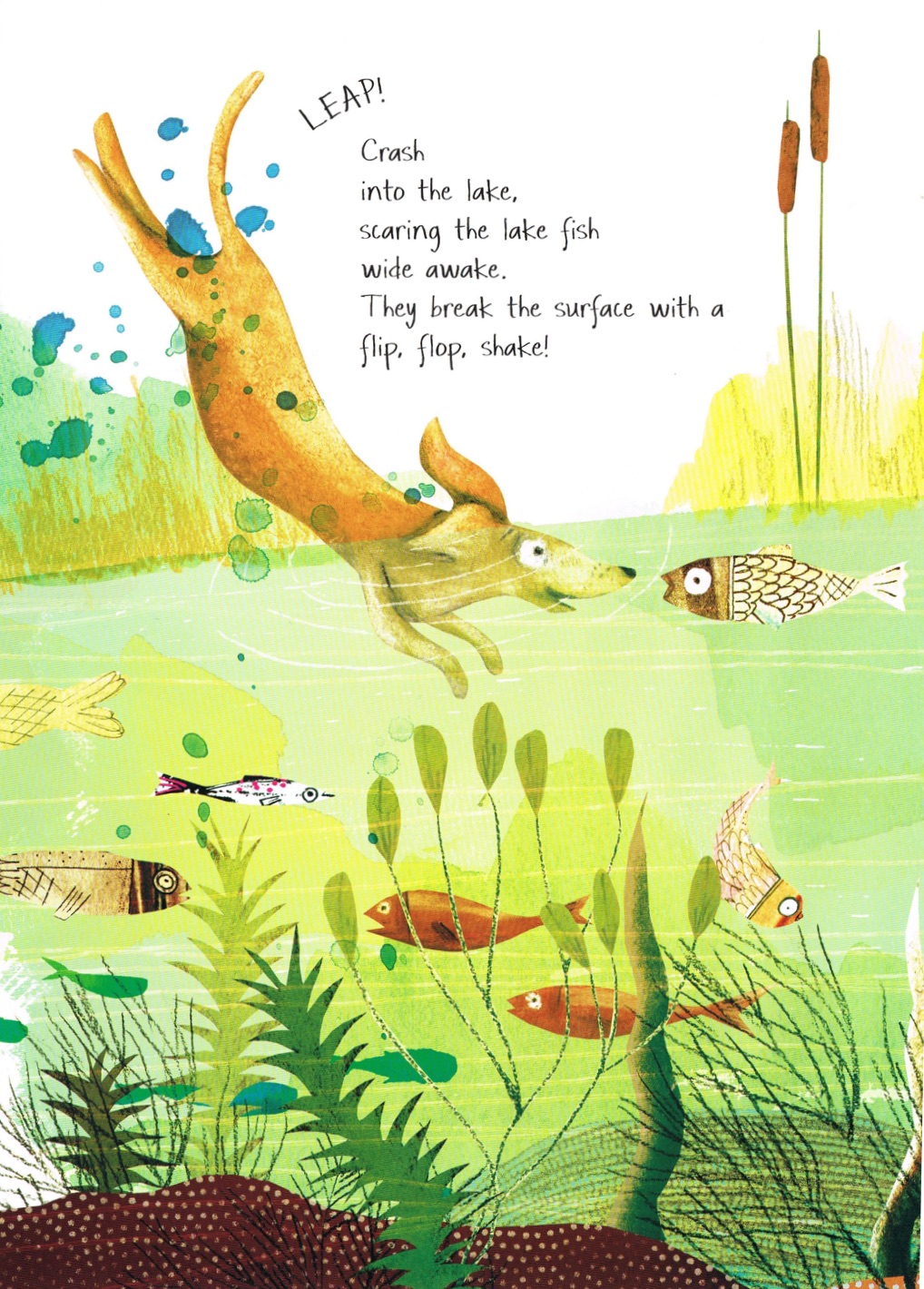
In a chain of events that begins with a flea, a series of animals that also includes a grasshopper, a rabbit, a dog, fish, a bullfrog and a horse cause leaping into, onto, and more in response.  But JonArno Lawson, whose stories Sidewalk Flowers (Groundwood, 2015) and Uncle Holland (Groundwood, 2017) have been reviewed here on CanLit for LittleCanadians, goes beyond this faunal domino effect and creates a living organism of movement in sophisticated poetry.
From Leap! 
by JonArno Lawson 
illus. by Josée Bisaillon
With each new LEAP!, JonArno Lawson plunges the young reader into a new environment with active vocabulary and emotional responses. 
LEAP!
Land!
Twist and spin!
The bunny bounds out
as the clouds roll in.
A dog gets a whiff
and barks at the wind –
bouncing, bouncing, springing
  and lunging!
Down the bank that dog goes
  plunging.
Gambol, lurch to 
LEAP!
In her signature collage style of cut-outs, watercolours, pencils and more, Josée Bisaillon produces multiple land and aquatic landscapes for JonArno Lawson's jumping, splashing, bounding creatures.  There are microcosms beneath bright flowers in cheery meadows and lakes filled with dozens of species of plant and fish, and a fenced farmyard with trees. From one to another to the next and back, Josée Bisaillon takes the reader down and over, under and above, seeing this natural world from all perspectives.
From Leap!
by JonArno Lawson 
illus. by Josée Bisaillon
For teachers who love a circular story that ends where it begins, Leap! is a treat, especially for the exquisite language and elaborate illustrations.  But I believe parents will find Leap! to be the perfect bedtime read for young ones who've been doing their own leaping all day.  In true poetic style, JonArno Lawson finds the word that rhymes with "leap" and brings closure to a day of activity.
From Leap! 
by JonArno Lawson 
illus. by Josée Bisaillon

April 05, 2017

Uncle Holland

Written by JonArno Lawson
Illustration by Natalie Nelson
Groundwood Books
978-1-55498-929-4
32 pp.
Ages 4-7
April 2017

Oh, Uncle Holland, he is a scamp! From the time he was a child (and not yet an uncle), Holland was always getting into trouble.  Seems Holland, one of three boys born to Palmer and Ella Lawson (note the last name connection to the author), liked helping himself to pretty things.  After being caught by the police for the thirty-seventh time (!), Holland is given the choice of jail or the army. Though his mother and brothers are devastated, his father "decided to spend the rest of this life watching his fish swim around in his fish tank" because "Fish can't disappoint me." (pg. 11) His mother takes some solace that her son, though a thief, was never a liar.  Holland chooses the army.

From Uncle Holland 
by JonArno Lawson 
illus. by Natalie Nelson
At the southern location to which Holland is sent, there are many splendid and tempting things like palm trees, parrots, flowers and exquisite fish but none he can slip into his pockets.  So Holland chooses to capture the beauty of the fish in paintings, even making some money selling this art. But when he sends money home, his parents are concerned about the origin of that money.  Fortunately, he is able to tell them truthfully that the money was not stolen but instead that he had learned that he could sell pictures of pretty things since "Not everything that's pretty can be stuffed in your pockets."(pg. 30)

You know there's probably more to this story than told here by JonArno Lawson, the author behind the wildly successful Sidewalk Flowers (illustrated by Sydney Smith; Groundwood, 2015), especially since his Author's Note explains that Holland was his Uncle Holland.  But Uncle Holland, the book, is still able to tell a story, caution children about stealing and telling lies, and provide reassurance that one can turn things around.  Okay, we know that you can't turn everything around (some illnesses, death, legal issues, etc.) but I think children would be comforted to know that sometimes you'll get a second chance (even thirty-seven of them) to make things right, though family might appear to turn their backs on you.

American illustrator Natalie Nelson's art, collages of mixed media, are both mischievous and sobering, not unlike Holland's situation.  There is gravitas associated with his infamous acts, often illustrated in neutral shades of black and greys, with only smidgens of colour in tears and fish in water.  Not until Holland is in the southern climes, witnessing beauty that must remain because he cannot squirrel it away, that the colours become vibrant and the art more playful.
From Uncle Holland 
by JonArno Lawson 
illus. by Natalie Nelson
Every family has a relative or two (or many) with incredible stories, some nefarious, some ridiculous, but we don't always like to share those embarrassing anecdotes.  That's unfortunate because they can be, like Uncle Holland, amusing learning and character-building opportunities. Thank you, JonArno Lawson, for choosing to share yours with young readers.

October 10, 2016

The Hobo's Crowbar: Book launch (Toronto)

Join the award-winning author 
of Sidewalk Flowers (Groundwood, 2015)
 JonArno Lawson 

and

visual artist Alec Dempster

for the launch of their new book

The Hobo's Crowbar
Text by JonArno Lawson
Woodcuts by Alex Dempster
The Porcupine's Quill
 9780889843998
96 pp.
All ages
October 2016

on 

Sunday, October, 16, 2016

from 2-4 p.m.

at

Maizal
133 Jefferson Avenue
Toronto, ON

This illustrated book of poetry is described, as follows, at The Porcupine's Quill website:
The latest wacky and wonderful collection of children’s poetry, Governor General’s Award winner JonArno Lawson’s The Hobo’s Crowbar presents a world of word botchers and bird watchers, of vile versifiers and vigilante interventionists, of nobodies and somebodies, big guys and small fries. Lawson’s world is one of logic and language, of wit and words, of contradictions and conundrums, but it is also a world in which looking and learning go hand-in-hand, with laughter never far behind. 
The book is as fun to see as it is to say, and vibrant woodcuts by artist Alec Dempster are a perfect accompaniment to Lawson’s poems. Together, they help to expose the highs and lows of life, and celebrate goofiness, absurdity and the profound truth of human experience.

March 02, 2015

Sidewalk Flowers

Written by JonArno Lawson
Illustrated by Sydney Smith
Groundwood Books
978-1-55498-431-2
32 pp.
Ages 4-7
For release March, 2015


On a walk from the grocery store with her distracted father, a young girl in a red-hooded jacket gathers an assortment of flowers–a dandelion, an aster, a vetch, heal-all–that poke their way through the sidewalk cracks.  Unlike her father whose focus is often on his cell phone, the little girl notices everything: a dead sparrow, a man sleeping on a bench, a dog on a lead.  Using the flowers she collects, the child finds a way to commemorate, cheer and share with those she knows and doesn't.

Sidewalk Flowers is a wordless picture book, which has the feel of a graphic novel with multiple frames and black-and-white illustrations and occasional splashes of colour.  This format works to emphasize the sombre landscape of normalcy so that the girl's flower gifts are beacons of life, like scattering seeds of joy. Author JonArnoLawson ensures that the young girl's efforts are initially depicted in high contrast to her surroundings but then they are augmented with her arrival home where her joyful scatterings are the norm, while illustrator Sydney Smith appropriately uses coarse and bold lines for the encompassing milieu, softening and colouring those elements that are significant to the young girl's journey and her light-heartedness.

 A story of a child's compassionate and playful activities in the overloaded and unavailable world in which most of us work and live, Sidewalk Flowers reminds us that, when we stop and smell the flowers along the way, we can improve the lives of others as well.