Showing posts with label music. Show all posts

January 06, 2026

To Be With You

Words by Dave Gunning
Illustrated by Meaghan Smith
Nimbus Publishing
978-1-77471-405-8
32 pp.
Ages 3–7
September 2025 
 
Based on Canadian singer-songwriter Dave Gunning's song of the same title, To Be With You is a love song. It's the love of a dog for their child, and the unbreakable bond that connects them every moment of every day and every night.
From To Be With You, words by Dave Gunning, art by Meaghan Smith
In very simple rhyming text that young children will adore and repeat easily, the song (listen to it here) speaks to different dogs spending time with their children: playing, sleeping, eating together, going for walks, and touching. Its refrain, "All I want is to be with you," repeats over and over again, though the children and dogs vary. There's a girl in a wheelchair hugging a dog as big as herself, and a dachshund excited for a walk with their child who wears yellow rain gear. There's a girl with a leg brace running through a wildflower meadow with a large floppy dog, and a husky-like dog chasing bubbles that a small boy is blowing. All children are here as are all the dogs that bring them companionship, love, and safety. And Dave Gunning's words make it clear that,
All I want is to be with you
All day long and all night too
All I want is to be with you
All I want is to be with you 
From To Be With You, words by Dave Gunning, art by Meaghan Smith
Much of the sweetness in To Be With You comes from Meaghan Smith's illustrations. She may also be an East Coast singer-songwriter, but her art is what defines this book. (The first book I've reviewed that included her art was It Snowed (2025) which she wrote and illustrated.) She brings great softness and affection to her art. Most notably, though, we notice that we rarely see the child's full face. The emphasis is on each dog, speaking to the child about what they are feeling, demonstrating exuberance, love, and togetherness with every flick of a tail, tongue hanging out, and eyes wide open anticipating their next moment together. Meaghan Smith makes the story, and Dave Gunning's words, about the dog, and it's a joyous perspective.
From To Be With You, words by Dave Gunning, art by Meaghan Smith
For the child who loves their dog, and who loves them right back, To Be With You will become a lovely accompaniment to a bedtime routine, a walk in the park, or a wind-down song before a nap. Moreover, the words could just as easily be a love song between a parent and child—do listen to the song (link here again) because its melody is very catchy—and could become a new lullaby to share  in your home.

November 19, 2025

The One About the Blackbird

Written by Melanie Florence
Illustrated by Matt James
Tundra Books
978-1-774882665
40 pp.
Ages 4–8
October 2025 
 
I don't know which song is the one about the blackbird, but I've been humming Paul McCartney's song from the Beatles' White Album ever since I read this picture book, and I could see why it had such an impact on young Jack. This is the story of Jack and the music that imbued his family life, and the connection he made with it and his grandfather. 
From The One About the Blackbird, written by Melanie Florence, illustrated by Matt James
Jack recalls being a kid with music all around at home, whether his grandfather was playing one of his many instruments—sax, guitar, trumpet, keyboard, drums—or spinning an LP from his extensive collection. The day his grandfather agrees to teach him to play the guitar, especially his favourite song, the one about the blackbird, Jack is thrilled. But, playing the song as well as his grandfather does not come instantly.
He struck the strings wildly, almost dropping the guitar at the loud, tuneless BROOOONG that honked out of the instrument. (pg. 15)
From The One About the Blackbird, written by Melanie Florence, illustrated by Matt James
Though it is hard, Jack perseveres and can finally play the song and others. And when he is older and leaves home, Jack plays for crowds worldwide. 
 
When Jack returns home, his grandfather has forgotten how to play that favourite song and even that he'd given his old guitar to Jack. But, when Jack plays the song for him, reconnecting the two to each other and their past, his grandfather remembers it as "the one about the blackbird."
 
Earlier this week, I reviewed a book about music bridging generations, and now we have another about the power of song to connect across time. But Melanie Florence, whose earlier picture books emphasize connections between young people and their Indigenous family (e.g., Missing Nimâmâ, 2015, Stolen Words, 2017, and Kaiah's Garden, 2024), makes music the bond between a grandfather and their grandchild. First, that bond comes from the grandfather sharing his love of music with a child, and then a grown man reminding his elderly grandfather of that bond. Regardless of who was teaching about the music, the message that, "If it was easy, everyone would do it" is repeated, both encouraging and uniting. Melanie Florence helps us see that change does not mean loss, just a reconfiguration that can be just as rich as the original.
From The One About the Blackbird, written by Melanie Florence, illustrated by Matt James
Matt James, illustrator of award-winning books including I Know Here (Laurel Croza, 2010), The Northwest Passage (Stan Rogers, 2013), and When the Moon Comes (Paul Harbridge, 2017), gets deeper into that relationship with his acrylic artwork that also includes textured elements. Whether the boy is hanging out with his grandfather, struggling to hold a guitar, or showing his grandfather how to move his fingers into position, Matt James makes us feel the effort of their attachment. The emotion in their struggles and their joys jump from the page, reflected in their faces, their body language, and their actions. 
 
Like the blackbird of that song, the boy, and later young man, learned to fly. He learned to take flight in song and in life, gathering knowledge at the feet of one who knew how. And when that knowledge wanes, as happens with time and age, that grandson helps his beloved grandfather hear the song again.

November 17, 2025

Levi's Gift

Written by Kathy Stinson
Illustrated by Ellie Arscott
Nimbus Publishing
978-1-77471-498-0
32 pp.
Ages 3–7
November 2025 
 
Kathy Stinson's latest picture book, beautifully illustrated by Ellie Arscott, tells the story of Levi, a boy who loved to play his violin while his brother Ezra played the accordion. But that was before the war came, and Levi and his family are forced from their home. The yellow star on Levi's shirt tells us more of his tragedy. By the time he is sixteen, the war is over, and his family is gone, as is his home. But he dreams of getting a violin again and making music.
From Levi's Gift, written by Kathy Stinson, illustrated by Ellie Arscott
Frugality and hard work help him buy a violin again and he "poured his great sadness about all he had seen and all he had lost in the war." (pg.9) With time, he emigrates, marries and has a child for whom he plays the beloved Brahm's "Lullaby" that he'd played with his brother. For many years, Levi plays his violin, but when his hands grow stiff and it becomes difficult to play, he stores his violin away.
 
When a call goes out for donations of used musical instruments for a school, Levi hesitantly decides to take his violin out of storage and give it away. When he receives a letter from a little girl who invites him to visit her at her school, Levi learns that his violin and the music played on it have the capacity to heal in many ways.
From Levi's Gift, written by Kathy Stinson, illustrated by Ellie Arscott
Kathy Stinson, award-winning author of picture books, non-fiction, and middle-grade and YA novels, has a lovely connection with stories of the violin (e.g., The Man with the Violin, 2013; Dance with the Violin, 2017), and Levi's Gift is another wistful story of those touched by music and the playing of the violin. But, with Levi's Gift, Kathy Stinson also reminds us of the many losses that happened during the war. For Levi, that violin was more than just an instrument. It was a connection to his past, to his family, to happy times, and more. It was a joyful connection to a time before. To give up his violin, even to a worthy cause, was a challenge for Levi. Yet, that gift begat a new one, with Levi making a new connection and one that related to his past. I was tearful realizing how Levi's story had come full circle with different characters, with a different violin, and in a different place, but with quiet consequence and subtle benevolence. 

Ellie Arscott, who illustrated Night Walk (Sara O'Leary, 2020), A is for Anne (Mo Duffy Cobb, 2023), and The Warmest Blanket in the World (Tamara Levine, 2025), has a lightness to her artwork that works well with gentle stories such as Levi's Gift. Ellie Arscott uses paint and pencil to give context for Kathy Stinson's words, showing us more than just people and place. She gives the reader history and ancestry as well as story, and there's much tenderness reflected in her illustrations. Levi may be an elderly man but making connections with his past and with others is what elevates him. Ellie Arscott's  use of pastel colours, particularly blues and pinks, keeps that softness of feeling and story.
From Levi's Gift, written by Kathy Stinson, illustrated by Ellie Arscott
Through their words and art, Kathy Stinson and Ellie Arscott remind us that music and generosity contribute and communicate beyond the immediate. You never know when a simple act of giving can touch another and in unexpected ways. For Levi, it is magical, even spiritualistic. (Once you see his reaction to the girl's playing of the violin, you'll understand.) I could see Levi's Gift being based on a true story, but, even if it isn't, this story offers hope that sometimes that which is lost returns in a different way to reconnect us to the past and to complete us in the now.

October 27, 2025

Songs for Ghosts

Written by Clara Kumagai
Penguin Teen Canada
978-1-774882825
399 pp.
Ages 14+
August 2025 
 
Reviewed from audiobook
Penguin Random House Canada Audio 
Narrated by Kenichiro Thomson and Susan Momoko-Hingley  
 
Each story from the past is one for the future. (p. 368)

There are two stories in Song for Ghosts. From different times and different places, these two stories run parallel until they converge. How they converge and why comes from the blending of music with family and the supernatural and Japanese culture. And in the end, a Japanese-American teen learns more about himself from a young Japanese woman from a century earlier. 
 
The story of seventeen-year-old Adam is a contemporary one. He hangs with friends—though he did just have a bad breakup with his boyfriend Evan—plays the cello, goes to Japanese school on Saturdays, and spends time with his family: stepmom Kate, baby half-brother Benny, and Dad when he's not away on military business which is often lately. The second story comes into play when Adam discovers an old book of letters in a wooden box with Japanese writing on it. Thinking it might be connected to his Japanese mom who passed when he was a baby, Adam begins to read the dated letters from a young woman who writes to her recently deceased Obasama (grandmother). And when a ghost begins to appear in his house, Adam is both terrified and intrigued. He wants answers, so he looks to the diary.
 
In this diary of letters, the young woman, who lives in Nagasaki, plays the biwa, a Japanese lute important in storytelling, and begins to take lessons from a blind biwa hōshi. Soon the diary writer is playing for ghosts in order to appease them. Meanwhile, her uncle decides it is time for her to marry, and, though not a man he has selected, she is courted by an American lieutenant. The connection she makes with him, and with his associate Mr. S–, changes the trajectory of her life. And when Adam is approved for a homestay in Nagasaki, he expands his search for information on the diary writer and her story. 
 
Songs for Ghosts, recently nominated for the White Pine award of the Forest of Reading, is a far more involved story than I can possibly recount here. First, Clara Kumagai immerses the reader, through both the diary writer's letters and Adam's visit to Japan, in the richness of Japanese stories and music, and of Japanese history, and of its culture from food to festivals. There is also romance, both for the diary writer and for Adam, though their relationships are complicated. Third, there is much to learn about Adam and his family, both in the U.S. and in Japan, and the bonds he has with them. Needing to learn more about his mother's family takes him to learn more about himself. Finally, I haven't even mentioned the correspondence of Adam's story and that of the diary writer to Puccini's Madama Butterfly. Even with all these distinct storylines and plot elements, Clara Kumagai is subtle and elegant in wrapping them together across time and place, and bringing Adam and the diary writer as well as other characters to merge in a satisfying and redemptive way. As such, readers as well as the ghosts who want to be remembered are appeased.

September 24, 2025

There's a Song in the Forest

Written by Jennifer Britton
Illustrated by Jillian Thalman
Nimbus Publishing 
978-1-77471-403-4
24 pp.
Ages 3–7
September 2025 
 
If you've seen the videos of forest bathing, i.e., the Japanese practice of immersing oneself in a forest as a mindfulness exercise, then you will understand the premise of There's a Song in the Forest. But more than just being part of those forests, Nova Scotia's Jennifer Britton helps readers to experience the full breadth of music that can be heard within.
From There's a Song in the Forest, written by Jennifer Britton, illustrated by Jillian Thalman
Jennifer Britton invites us to tag along with her trio of walkers and . . .
If you listen, and quiet your mind . . .
If you block out the busy and the bustle
You'll be surprised by what you can find. 
From There's a Song in the Forest, written by Jennifer Britton, illustrated by Jillian Thalman
Everything you see in the canopy and on forest floor and hear in the leaves and twigs becomes a symphony. And who adds to that symphony? There's the geese and the wood thrush, the owls and the loons, and the rocks and the water, and they all contribute to song of the forest. They whisper and tinkle, hum and harmonize. Closer to the sea, there is the boom and crash of the drumming waves. It just takes being attentive to the "beauty of rhythm and melody" to hear the music of the forest.
 
Jennifer Britton, a teacher and musician as well as an author, speaks to the songs of nature with the language of music. (She appends her story with a list in "Musical words found in this book" including melody, percussion, and metronome.) And those with an ear for music undoubtedly have a good ear for the sounds of the natural world. But children for whom a walk in a forest is a novelty or for whom an urban landscape is the norm, There's a Song in the Forest might give them pause the next time they visit a park or a forest. Jennifer Britton encourages them to pause and listen to the quiet that really isn't as hushed as expected. When they become aware of the sounds, they will be privy to a melodic secret that is both varied and full, and giving of serenity, not unlike Jennifer Britton's rhyming text.
There's a secret that lies in the treetops
One that's hidden away, out of sight.
A symphony played under canopy leaves
Through the shadows that dapple with light. 
Her words calm while they hearten and that is what Jillian (Alisa) Thalman's illustrations do but with colour and shape and texture. Jillian Thalman uses a variety of techniques in the book's artwork including cut-paper collage, watercolours, pencil crayon and even digital means, and that undoubtedly explains the depth of her artwork. She gives us landscapes of stillness and sound, movement and restfulness. And the colours! Whether it's in the middle of a forest or alongside the ocean or sitting by a nighttime campfire, Jillian Thalman makes everything strikingly beautiful and eye-catching.
From There's a Song in the Forest, written by Jennifer Britton, illustrated by Jillian Thalman
As someone who enjoys the practice of forest bathing and mindfulness pursuits, There's a Song in the Forest spoke deeply to me. But even for those for whom a walk in the woods is unfamiliar, Jennifer Britton and Jillian Thalman will tempt them with words and art to find the music in nature, hopefully with a visit to a natural area but, if not, by finding it wherever they can.

March 11, 2024

The Club

Written by Eric Walters
DCB
978-1-77086-734-5
264 pp
Ages 9–12
March 2, 2024
 
It's the start of their Grade 8 year, and Jaxson and best friend Logan are looking forward to making their final year in middle school an epic one. While Logan is all about basketball, Jaxson is driven by playing his trumpet. But then a new girl, Liv Parker, joins their school. Though Jaxson sort of kind of has a girlfriend, Samantha, Liv is an extraordinary trumpet player, and she and Jax are thrown together, in a good way.

When the music teacher, Ms. Hooper, auditions the students for the senior band, she knows that Liv and Jax are going to be the stars of the band and hopefully take them to the city championship, finally. In fact, she wants them to play a duet for the first school assembly just days away. To prepare, the two have to meet after hours at each other's homes. Though their households are very different, with Liv and her mom Jenn, a cybersecurity expert, living in an immaculate big house with a grand piano, Jax and his mom Ali, an artist and art history prof, live in a cluttered house filled with colour and stuff. Still, the two teens find they have a lot in common, including their music, love of sushi, and ways of thinking. Moreover, when asked about their dads, they both acknowledge that subject as "complicated." 

But soon things get even more complicated for both of them. When Samantha learns how much time Jax is spending with the new girl, she feels threatened and he can't convince her that they're only friends. Still, with all their rehearsing for assemblies and solos, Jax and Liv are spending more time at each other's houses, and by chance, their moms are becoming friends. But with that friendship, personal details are shared, and Jenn and Ali begin to wonder whether the kids share more than just a virtuosity with the trumpet.
 
The theme of family is a common one in contemporary stories, with families that were once deemed traditional now being seen as just one of a myriad of forms that families can take. Whether a family has a mom and dad like Logan's, or is a single-parent household like Jax's or Liv's, or like those reconfigured through divorce or loss, a family is a family is a family, and Eric Walters recognizes that families come in all shapes and sizes and are all natural. What makes them families is the love and respect that is given and received within that construct. And regardless of how that family was created, whether through sperm donation, a heterosexual marriage, adoption, or one of countless other ways people enter others' lives, it is valid and valuable if family members choose for it to be so. (Thankfully the kids' moms give them some choice about whether to explore their paternal heritage and never compel them to embrace DNA as the ultimate basis for family.) 

Blood makes you related but it doesn't make you family. (p. 176)
Fortunately for Jax and Liv they would probably always have become family, regardless of their DNA. Just as Logan and Jax always considered themselves brothers, Liv and Jax were already simpatico because of their love of the trumpet and music. The DNA just made their relationship official and genetically solid.
 
Eric Walters's Afterword tells the reader that the story of The Club was inspired by a true story of half-siblings discovering each other through their DNA. Their story, like that of Jax and Liv, was one of positive connection. For the kids in The Club, there is no conflict or expectation that they must embrace strangers as family. For those two kids, it happens organically. But without the support of their core family, related or not, neither teen would've been secure enough to welcome others in and put themselves out as they become part of a larger club.

The story of The Club could be happening anywhere in the world. The circumstances are not uncommon, and with access to DNA and ancestral records, it's becoming more frequent that genetic relatives are being linked. But Eric Walters makes this less about the process and more about the outcomes and what they mean for these kids. Their worlds have changed and in a good way. I do wonder about those circumstances for which "new" family connections may not be positive or welcome but that would be another story. In The Club, Eric Walters gives us a story of being a family, discovering family, and making family. For Jax and Liv, they are able to strengthen what is already there with those who were previously unrecognized and make for a new type of familial association.

January 26, 2024

Night of the Living Zed: Q & A with authors Basil Sylvester and Kevin Sylvester

Recently, I reviewed Basil Sylvester and Kevin Sylvester's newest middle grade novel, Night of the Living Zed, a sequel to their wildly successful The Fabulous Zed Watson!

Night of the Living Dead
Written by Basil Sylvester and Kevin Sylvester
HarperCollins Canada
978-1-4434-6920-3 
256 pp.
Ages 8-12
Released January 16, 2024
 
 
Today, it gives me great pleasure to post a Q & A I did with authors Basil Sylvester and Kevin Sylvester about their new book. 

 
Authors Basil Sylvester and Kevin Sylvester
 
• • • • • • •
 
HK:   Congratulations on Night of the Living Zed. It’s another great mystery embedded with the supernatural and notable characters. Did you experience any challenges in writing a sequel to The Fabulous Zed Watson!?
 
Kevin Sylvester:  We knew the characters well, so writing scenes with Zed and Gabe and the crew was fun. The toughest part, I think, was making it a different mystery with a different feel. I love escape rooms, so used those as inspiration for the types of codes our intrepid duo would have to crack. Then when Basil started writing the letters that lie at the (literal) heart of the story, the emotional side of the mystery began to just fall in place. After that, it felt like the challenge was paying due respect to the type of hidden relationship many people had to have (and still do) to be accepted.
 
Basil Sylvester:  Echoing what my co-author said. We wanted to have a story that doesn’t feel like we wrote it just to bring back characters we liked. There had to be something new. I really like the way the two books compliment (complement? Oh dear) each other. Fabulous Zed Watson had a lot of travel, so it was fun to write a sequel where they are mostly in one place. We also worked hard to make sure you could read it without having read the first one, sort of like a classic mystery series like Sherlock Holmes stories or similar. 

 
HK:   How does your collaboration work? Do you each write one chapter or section of the story, or do you write together?
 
Kevin Sylvester:  In the first book we split up a lot of the work by theme – so related chapters on a specific part of the mystery, or location for that clue, might fall to me. Basil would write the scenes, such as the border scene, where Zed has to face some real fear and discomfort.  But we’d always read the whole thing out loud to make sure there was a consistency of tone and voice. So by the end the whole book was truly a co-written work. We even collaborate on the illustrations.
     This time, I think, was more “both of us at the same time” writing with essentially the same result. But Basil wrote and researched the letters the kids discover… and those are beautiful.

Basil Sylvester:  the first book was much more methodical—we made the best outline I’ve ever made in my life, by far, haha. Then we split up and came back together to write everything out. Night of the Living Zed was a stranger creature. We did a lot more writing side by side but also writing alone—I wrote the letters completely without input, for instance, but as Kevin said, the best part is reading out loud. You instantly get a sense of what works and what doesn’t, especially in the jokes and banter.
 
 
HK:   Plotting any story can be challenging but I wonder if plotting a mystery is especially so. Did you plot out the whole mystery from the outset or did you develop it one step at a time, perhaps with each new room that Zed and Gabe encounter in Glyndebourne Manor?
 
Kevin Sylvester:  We had a general idea a good year before we started writing… so the idea was always cooking in our heads.  Then we tried to decide how the reveal would happen from the presumed mystery (spending three days in a spooky house) to the true mystery (who was Charlotte and why did she build this bizarre house?). So there are two layers happening all the time. I would say that was more fun than tough to figure out. 
     The frustrating part is always when you think you have a good bit and then look at it later, or have someone else look at it, and say the code didn’t make sense, or wasn’t revealed to the reader in a way that they could also solve the mystery. So we tried to make sure that all the clues are there, so that the reader can either go “I saw that coming” or “oh! Now I see what the code was!”. Both offer a fun payoff.

Basil Sylvester:  Oh my gosh I found this really hard to do! I’m not a big mystery reader—I love middle grade mysteries, but I don’t read like Janet Evanovich kind of things—so I really struggled with making stuff plausible and consistent. Kevin is old hat at mysteries so he really helped but making escape room puzzles that made sense and that I hoped the readers would be able to pick up clues on was the hardest part of this book. Also plotting with a co-writer can be hard, especially getting on the same page about the hard and fast rules of the contest. We were working in Scrivener, which allows for research and planning docs, so we made sure to write out the rules early on and referred to them often!


HK:   Though many might not see it, Night of the Living Zed
is a celebration of romantic love. Although the two romances had very different outcomes being from different times, they were both triumphant in their own ways. Why did you choose to include these romances in the story?

Kevin Sylvester:  Basil is the best one to answer this, but I will say that I am always intrigued by stories where someone builds something as a living memory of someone, or to honour them.  
     Think Citizen Kane, the Taj Mahal… my Apartment 713.

Basil Sylvester:  Honestly, Sam and Jo were some of my favourite characters in the first book, so I wanted to bring them back. And their wedding sort of works as a plot device for Zed and Gabe to specifically need money, encouraging them to go for the Gylndebourne contest. In terms of the other romance, I loved the idea of a multi-layered mystery. We sort of have that with the first book, where Zed is looking for the manuscript, and along the way they discover a whole supportive community in some unexpected places, showing us that the world is ready emotionally for Taylor’s book.
     In Night of the Living Zed, I wanted to pay homage to historical romantic relationships that weren’t read as such for a long time. I also love the idea that a spooky scary haunted house is actually not scary at all, but beautiful. That it’s just misunderstood, like the romance itself. So I wanted to have layers of meaning, as any good ghost story should.

 
HK:   Music, particularly opera, is a significant element of the story, directing Zed and Gabe’s solving of the mystery of Glyndebourne Manor, but the broad knowledge of opera needed is certainly not derived from Wikipedia. Moreover, your acknowledgements suggest that you both have some appreciation for opera. Are you both opera buffs or did one inspire the other or did someone else boost your awareness of this theatre form?

Kevin Sylvester:  We both love opera, but don’t expect us on the Saturday Afternoon at the Opera quiz anytime soon. I’m partial to Italian operas. Rigoletto and the Barber of Seville get a lot of play in my house. But I also love the Magic Flute… and one of my fave experiences was seeing Maurice Sendak’s sets for the Hansel and Gretel a few years back.

Basil Sylvester:  I mean, growing up with the parents I had, it was inevitable. My dad loved opera and played it ever since I was a kid. So that made me … tolerate it. Then I went to university and took a class on Russian opera and fell in love with Eugene Onegin, Boris Godunov, The Nose…I even let Kevin put some Wagner in this one.

 
HK:   I’m a big fan of humour and Night of the Living Zed is filled with it, from puns and wordplay to silliness and blunders. Do you each have your own specialty when it comes to embedding humour in the story, whether through voice or actions?

Kevin Sylvester:  We are a family of joke-tellers and punsters. This includes our immediate family and friends. So the scenes with back-and-forth dialogue and jokes is a glimpse into the dining room of our houses on any gathering. Noisy. Boisterous. Snarky. Then Basil and I test-drive the jokes on eachother to make sure they work.

Basil Sylvester: I’m not as good at jokes, but growing up, especially at my grandparents’ houses, it was jokes zinging across the dinner table at breakneck speed, so I was always trying to keep up. I’m better at comebacks, so Kevin will often start riffing and then I join in. We are also tough critics, so we would cut jokes if only one of us was laughing. I would say I lean more towards silly gestures, and Zed is fun to write because they are very boisterous and always moving.

 
HK:   I know the book was released in January but it’s going to be a popular story come October with its Halloween theme. Zed obviously goes big for Halloween, ensuring the best neighbourhood Halloween with a pre-Halloween inspection at all homes. Is Halloween as big a deal in the Sylvester house as it is for Zed?

Kevin Sylvester:  All I can say is that you can go back and look on my Facebook page where we do a themed Halloween porch each year. This year was a haunted construction site. Last year was Scar-bucks coffee shop. The year before that was a haunted greenhouse… you get the idea. Christmas is great, and man do I need bright lights by late December, but dressing up and playing make-believe? Halloween can’t be beat.

Basil Sylvester: We never did Halloween-O-Ween, but it is 100% inspired by our love of Halloween and our dedication to creative and fun porch displays every year. It’s also a holiday that really resonates with me, since you can dress up and be someone else and get creative, which was a great outlet for me figuring out my identity in a low-stakes and fun way.

 
HK:   The illustrations add much to the story, just as they did in Kevin’s Neil Flambé series. I recognize Kevin’s style but wonder if Basil is also an artist and contributed to the art in Night of the Living Zed.

Kevin Sylvester:  Yes. Certainly in the sense that we work on the illustrations together. I’m often drawing as we write and read passages out loud. Basil is my immediate art director and continuity officer (need to make sure Zed is wearing the same sweater in connected timelines). Also, Basil is in charge of the lettering on the spine and covers.
 
Basil Sylvester:  I’m not an illustrator but I do consider myself a creative person. I like crafts and DIY. As Kevin says, I’m the first art editor and can be pretty critical. He shows me all his illustrations before submitting them and I often have notes. I also came up with the ideas for both covers, and did the silly hand lettering on the covers and spine.

From Night of the Living Zed, written by Basil Sylvester and Kevin Sylvester, illustrated by Kevin Sylvester
HK:   My favourite illustration of Zed is the one on page 68 when they are in their pumpkin onesie. Do you each have a favourite illustration of Zed from Night of the Living Zed?

Kevin Sylvester:  SPOILERS…. My fave is the one of Hyacinth as she’s about to turn the faucet on the final challenge. She looks both anticipatory and a little fearful. After all they’ve been through, and learned, will this prove to be the right decision? Or will everything come crashing down?
     It’s quiet and active at the same time.

Basil Sylvester:  I love this question! I really like the one where they’re excited to say hi to the ghost. But the pumpkin onesie is great too. Also any illustration where they have their coffin backpack. I have a friend who has one and I messaged them the second they posted a picture of it, asking if I could include it for Zed in the book because it was just so perfect!

 
HK:   Now that we know that The Fabulous Zed Watson! will not be a stand-alone and that Zed and Gabe are becoming known for solving mysteries, are there plans for additional books beyond Night of the Living Zed?

Kevin Sylvester:  Hmmmmm. We are always ready to cook up new missions for Zed and the gang. But that is, of course, a team decision involving a lot of people. If enough kids read the books and want more… I’m willing and able!

Basil Sylvester:  Who can say? It’s not off the table. We have a lot of fun writing these, so I hope you have as much fun reading as we do writing!


I've so enjoyed reviewing Night of the Living Zed and learning more of Basil Sylvester and Kevin Sylvester's experiences with writing this sequel to The Fabulous Zed Watson!

Many thanks to Basil Sylvester and Kevin Sylvester for answering my questions about Night of the Living Zed. And thanks also to Rebecca Silver, Senior Publicist at HarperCollins Canada, for facilitating this interview and sharing a review copy of Night of the Living Zed.
 

January 17, 2024

Night of the Living Zed

Written by Basil Sylvester and Kevin Sylvester
HarperCollins Canada
978-1-4434-6920-3 
256 pp.
Ages 8–12
January 16 2024
 
Sure, everyone gets ready for Christmas. There's the tree decorating, the shopping, the baking. But what about the "super-duper-stupendousest of all holidays" (p. 3): Halloween! Zed Watson, star of Basil Sylvester and Kevin Sylvester's highly-acclaimed first collaboration The Fabulous Zed Watson! (2021) is all about Halloween, so it's going to be a shame if they miss it because they're heading out of town with best friend Gabe to solve the mystery of Glyndebourne Manor, the house once owned by the rich and famous opera costume and set designer, Charlotte Scherrer. But it's all in support of a good cause: getting a reward that could help elevate the upcoming nuptials of Gabe's sister Sam and partner Jo.

So, determined to spend the required 3 days and 2 nights in the supposedly-haunted house and search for Charlotte's treasure, Zed and Gabe set off on October 29, hopeful of solving the mystery before Halloween. Well, Zed is convinced of it. Gabe is less sure about it, but the operatic flavour of decorations in Charlotte's century-old, 4-storey house gets him interested. Things become more complicated when the rules state that they must move from room to room but never exiting through the door they entered. Only by solving complicated clues related to Charlotte's life and memorabilia do Zed and Gabe have any chance of making it through this challenge. Of course, there's also the ghosts and copious booby traps to trick them, so solving the mystery is a lot less obvious than finding a pile of gold.
 
With humour and compassion, the two friends, face each challenge head on. They carefully scrutinize curious rooms filled with opera collectibles, they construct maquettes, they read personal journal entries, and they piece together Charlotte's life to help them uncover hidden means of egress. But, as long as the ghosts don't impede their progress and they don't runaway, they've got a good chance to find...something?

Night of the Living Zed has all the colour of Basil Sylvester and Kevin Sylvester's first book, The Fabulous Zed Watson!, but it's a fresh new mystery with a different set of characters. Readers will be pleased to visit again with the quirky Zed and Gabe, a pair of young friends with strong but different personalities.  There's non-binary Zed who approaches life at break-neck speed, enthusiastic about vampires and ghosts, eager to interact with the supernatural, and lover of all things Halloween. Gabe is less forward, but still fascinated by and knowledgeable about opera and plants, and loves playing the piano and wearing multi-pocketed clothes. And he's a little ghost-shy. In addition to a host of regulars, like Ph. D. candidates Sam and Jo, and a plethora of named inanimate objects–there's Sam's vehicle Carssandra, Zed's stuffed jackalope Aloysius, and their pumpkin nightlight Willoughby–readers meet Bertie and Hyacinth who are Charlotte's relatives, and a pair of treasure seekers called Soraya and Dean (often called Dan by Bertie).

The characters are wacky and the dialogue between them is priceless. It's this humour, including their gaffes that take Night of the Living Zed from mystery to a romping good time. From doing their Halloween-O-ween inspection–and learning Mrs. Gianelli is upgrading from licorice sticks to candy bars–or Gabe explaining to Zed that "i.e." is Latin for "Id est" and they answer, "You dest? What's a 'dest'?" (p. 80), there's a rich but underlying humour that will make readers smile and laugh out loud. And then there's the mystery. It is not easily solved, neither by Zed and Gabe nor the readers, so we have to hang in through all the ups and downs, and twists and turns, to get our "Aha!" moment.

I know it's a long way off until Halloween–maybe we can look at January as pre-pre-pre-Halloween-O-ween–but a mystery is a great read anytime, and Night of the Living Zed is a great one. With their open heart and enthusiasm for life and for exploring the unknown, Zed can take us and Gabe along on any new adventure they want, ghosts or no ghosts.
 
 •
 
The Fabulous Zed Watson (2021)
Night of the Living Zed (2024)
 

July 10, 2023

When Rubin Plays

Written and illustrated by Gracey Zhang
Orchard Books (Scholastic)
978-1-338-64826-3
56 pp.
Ages 4-8
July 2023
 
In a small town by a rain forest, there is an orchestra. Rubin's sister Isabel plays in this orchestra, and Rubin would listen through the open windows of their rehearsal space. The music is inspirational and uplifts Rubin. When he asks the maestro if he can play too, Rubin is handed a violin. But the sounds that come out of it when Rubin plays are screechy and howly, and the other young musicians snicker.
From When Rubin Plays by Gracey Zhang
Rubin is instructed by the maestro to practise so that he might be able to play with the rest of the orchestra. First the boy practises quietly at the back of the room. Then, when everyone leaves, he takes himself deep into the forest to practise. Still his violin is "shrill and uneven." But soon he is surrounded by cats who follow his playing, replying to his music with their own howling. 

Back and forth they went, their sounds a leaping crescendo deep into the night.

From When Rubin Plays by Gracey Zhang
When he returns next to the practice room, the young musicians offer Rubin some tips and he continues to play at the back of the room.  But at night, he plays with passion for his feline audience who perform their own music.

When the orchestra gives a concert, Rubin joins them, though he plays "too quietly, too small." But when Isabel encourages him to play, he does so, and an unexpected feline display of sound and dance brings the human audience to their feet. In a musical merger of orchestra, audience, cats and Rubin, harmony and connection are achieved.

From When Rubin Plays by Gracey Zhang
Author-illustrator Gracey Zhang based her story on an image that she had of a boy playing a violin to cats. Learning of a centuries-old history of baroque classical music in small Bolivian towns, Gracey Zhang blended the two into When Rubin Plays. Her story melds the richness that music brings to a child and to a community of both humans and felines while focussing on the passion of a young boy for learning an instrument. Rubin's music might need some refinement but his determination to play, even when only cats are his audience, is paramount. Ultimately, his persistence elevates his playing to connect the boy with the rest of the orchestra and with his audiences, as well as enabling his audiences to connect with each other.

The interactions of child with the music as well as for his listeners is dynamic, and Gracey Zhang's illustrations, primarily ink and paint, lend movement to that dynamism. There's the sounds of the violin playing and the cats' responses to the music that are full of life, but then Gracey Zhang also gives everything the colour of vitality. There is an energy to the musicians, to the people, to the animals that supersedes any skill or lack thereof, and it comes through in the brightness of colours in the clothing and the diversity of felines. When Rubin Plays is a book of life and connection to music and others.

Whether Rubin plays for the cats, with the orchestra, for an audience of people, or for the joy it brings him, there is passion. It's the enthusiasm that comes with finding something that touches you. Rubin's music, whether screechy or melodic, is always full of passion and reminds us all to follow our hearts, even when others may see, or hear, it differently.

June 05, 2023

Meet Buffy Sainte-Marie (Scholastic Canada Biography)

Written by Elizabeth MacLeod
Illustrated by Mike Deas
Scholastic Canada
978-1-4431-9612-3
32 pp.
Ages 6–10
May 2023

I can't think of a more accomplished person to highlight during National Indigenous History Month and every month than Buffy Sainte-Marie. Though many know her as a singer-songwriter and young readers may be familiar with her Silver Birch-nominated book Tâpwê and the Magic Hat (2022), this latest illustrated biography from Elizabeth MacLeod and Mike Deas testifies to Buffy Sainte-Marie's varied and good work.
From Meet Buffy Sainte-Marie by Elizabeth MacLeod, illus. by Mike Deas
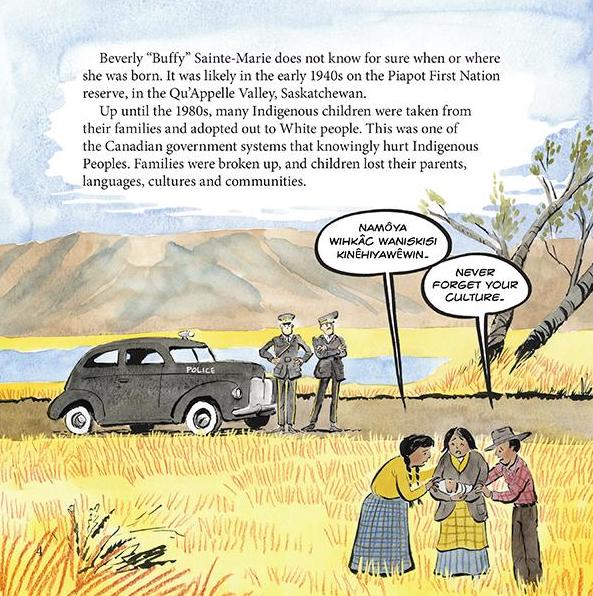
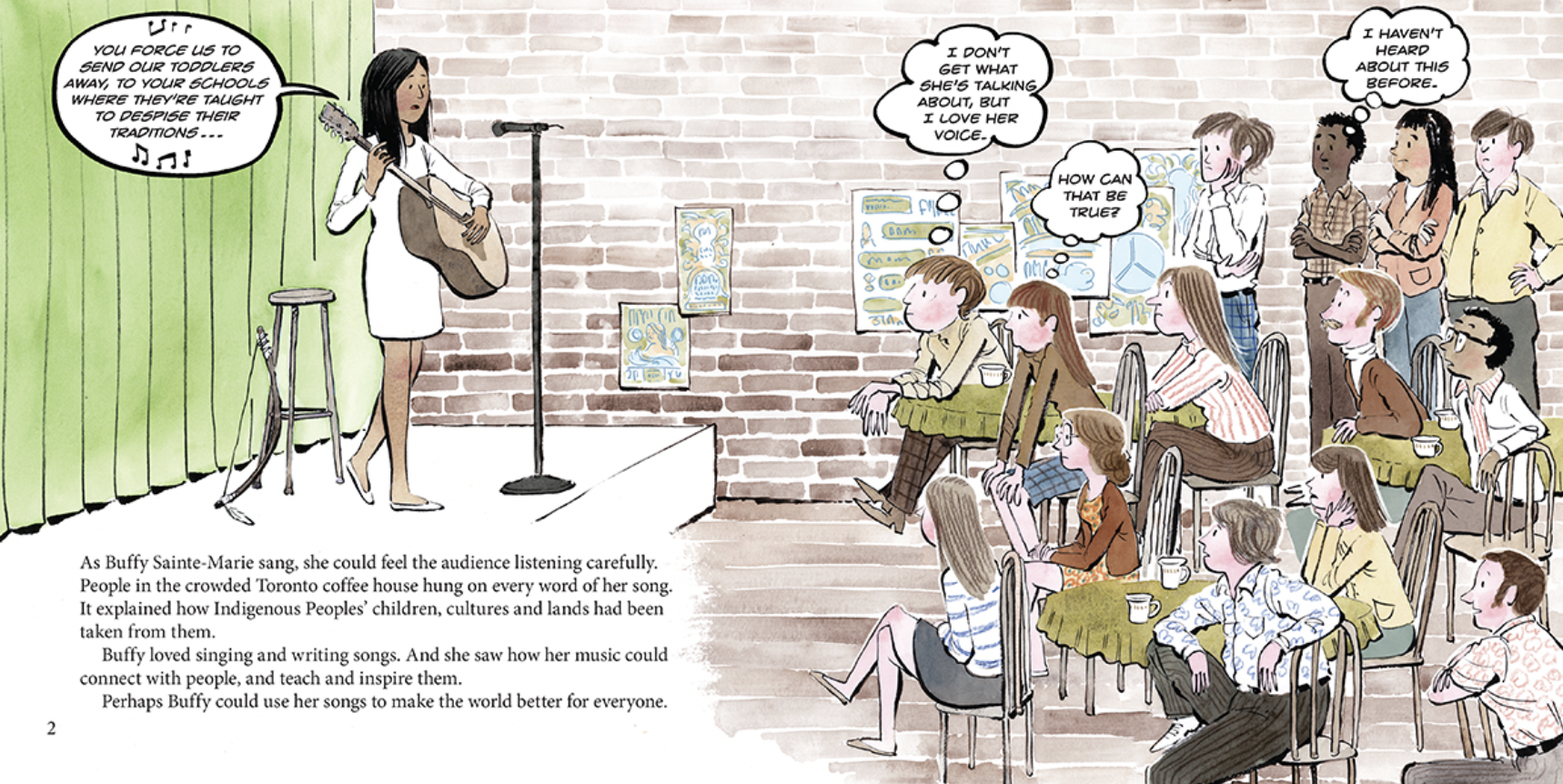
Buffy Sainte-Marie was probably born in the 1940s on the Piapot First National reserve in Saskatchewan but was taken and adopted by the Sainte-Maries of the northeastern U.S.A. Her childhood, often spent alone, was filled with music, with Buffy starting to play the piano at age 3, and learning music by ear. At 16, she taught herself to play guitar, and, while at university, she started playing at small clubs and then larger ones. After graduation, she became a full-time musician.
From Meet Buffy Sainte-Marie by Elizabeth MacLeod, illus. by Mike Deas
As her songs were garnering much attention, from her "Universal Soldier" as a protest song, and "Until It's Time for You to Go" as recorded by countless famous artists, she was noticing how Indigenous roles were depicted on the screen. When she was asked to take a lead rode in an episode of "The Virginian," she maintained the need to hire Indigenous actors for Indigenous roles, leading the action for diversity.
From Meet Buffy Sainte-Marie by Elizabeth MacLeod, illus. by Mike Deas
Her other initiatives included starting the Nihewan Foundation for Native American Education which supported Indigenous teens going to university. She has spoken globally about Indigenous Peoples to further understanding. And even though her music was snubbed in the late 1960s and 1970s by radio stations and more for her political messages, she persevered, continuing to extend her activism to championing the rights of Indigenous Peoples. Along the way she won an Oscar, made several important appearances on "Sesame Street," and used new technology for creating visual art and music. She lent her support to the Idle No More movement and was awarded everything from the Polaris Music Prize to Junos and the Spirit of Americana/Free Speech in Music Award.

With her art fuelling her activism, whether it involved Indigenous Peoples, anti-war protests, missing and murdered Indigenous women, or shelter animals, Buffy Sainte-Marie's story in Meet Buffy Sainte-Marie will provide inspiration to young readers. She defies labelling as she is everything from a singer and a songwriter to a humanitarian, a protester, a teacher, a speaker, an advocate, and more. But by letting her heart and passions lead her, she has accomplished so much and done so much good work
Using the power of positivity, Buffy shares her messages with her songs and through art, education and the organizations she supports. Buffy teaches that we can all work together to help make the world a better place. (p. 29)
Elizabeth MacLeod makes sure that readers will learn about Buffy Sainte-Marie's achievements–a timeline of key events appends the illustrated story–but also about her spirit, and her spirit is great, both broad and deep. Buffy uses it, with her voice in music and art, to educate, to mobilize to action, to inspire, and to give voice. Mike Deas's artwork, which involves gouache and watercolour paints and ink, along with digital tools, supports the story with detailed illustrations from Buffy's personal and professional life, from childhood to the 2020s. He takes her story from being taken from her Cree parents as a baby to performing on stage with a red dress–a symbol of missing and murdered Indigenous women. With that, Mike Deas carries readers through nine decades of Buffy Sainte-Marie living and performing and inspiriting. 

There are many stirring reads of important Indigenous activists and leaders but, as an illustrated biography, Meet Buffy Sainte-Marie gives us a comprehensive and unequivocal depiction of an amazing woman, a woman of talents, of courage, of conviction and of spirit. The story, as the woman, touches, and impresses.
 
• • • • • • 

Scholastic Canada Biography series by Elizabeth MacLeod and Mike Deas:
 
Meet Thérèse Casgrain (2021)
Meet David Suzuki (2021)
Meet Buffy Sainte-Marie (2023)