Showing posts with label activism. Show all posts

April 22, 2026

Gone Forever?: Places to See (and Save) Before They Disappear (Orca Think)

Written by Erin Silver
Illustrated by Xulin Wang
Orca Book Publishers
978-1-4598-4098-0
96 pp.
Ages 9–12
February 2026 
 
Reviewing Erin Silver's latest non-fiction book, Gone Forever?: Places to See (and Save) Before They Disappear on Earth Day seems fitting. On a day on which we celebrate our Earth and how to protect it, we have much to learn from a book about global locations threatened by climate change.
From Gone Forever?: Places to See (and Save) Before They Disappear, written by Erin Silver, illustrated by Xulin Wang
Erin Silver, who has written countless books of non-fiction including Good Food, Bad Waste (2023), Mighty Scared: The Amazing Ways Animals Defend Themselves (2024), and Plant Attack (2025), takes on the challenging topic of climate change. However, by taking the perspective of showcasing key locations, from the Arctic to the Pacific Islands and the Amazon rainforest, Erin Silver speaks less of generalities and more to familiar sites and places people live. 
From Gone Forever?: Places to See (and Save) Before They Disappear, written by Erin Silver, illustrated by Xulin Wang
The book is organized into four major chapters:
  1. Major Meltdown
  2. Cue the Waterworks
  3. Under Fire
  4. Life on Earth
The first looks at the impacts of global warming on the ice caps in Antarctica and in the Arctic. The impacts examined go beyond the ice sheets and glaciers, and into the water, the krill, polar bears, and more. Insights from those who visit those locations are shared, as are suggestions about helping to combat climate change.
From Gone Forever?: Places to See (and Save) Before They Disappear, written by Erin Silver, illustrated by Xulin Wang
The next chapter looks at changing weather patterns, which cause more rain and severe storms in some areas, resulting in places being flooded, and sinking and shrinking. Mitigation with mangroves and engineering are just two approaches. Other areas will get drier, which could lead to food insecurity. A Q & A with a climate architect reveals much about solutions to this aspect of global warming. 
From Gone Forever?: Places to See (and Save) Before They Disappear, written by Erin Silver, illustrated by Xulin Wang
The next chapter examines the fires in California and in British Columbia, while the final chapter looks at the threat to biodiversity, focusing on the Amazon rainforest and the Galá
pagos Islands. As in the earlier chapters, there are interviews, including with a climate adventurer and a biologist, info boxes called "The Info Express" with interesting tidbits,  and always assurances that activism can help. Completing this book are a comprehensive glossary and lists of resources for young people to access.
 
Erin Silver delivers a thorough examination of how climate change is affecting our world. And, though she makes it a global discussion, her research brings it closer to home, even if it's not our home specifically. It's a personal look at how global warming is impacting everyone and everywhere. That means it's up to everyone to do something, anything. With numerous photographs and Toronto's Xulin Wang's bold and colourful digital art, Gone Forever?: Places to See (and Save) Before They Disappear takes the reader around the world to see evidence of climate change. But with text and art combined, the message is not one of hopelessness but rather one of expectancy and action. And on this Earth Day, Gone Forever?—note the question mark—has a productive message to share.

April 14, 2025

The Warmest Blanket in the World

Written by Tamara Levine
Illustrated by Ellie Arscott
Second Story Press
978-1-77260-410-8
24 pp.
Ages 6-8
February 2025 
 
While most of us are already thinking about the warmth of spring and summer, there will be many, particularly the elderly, for whom the change of seasons will not necessarily bring that which would warm their fingers and toes. For those with poorer circulation and other health issues, particularly those associated with aging, cold feet and hands can be problematic. And young Frida wishes she could do something to help her amazing great-grandmother Ama who says she feels like she lives in a refrigerator.
From The Warmest Blanket in the World, written by Tamara Levine, illustrated by Ellie Arscott
Frida enjoys visiting her great-grandmother as much as the older woman relishes seeing the child, telling her each time, "Do you know you've made my day? You're one special kid!" Ama tells Frida stories about her life and the importance of women fighting for their rights. (Frida even attended a protest with Ama once.) They sing songs together and they snuggle under her blanket. But even that blanket doesn't keep Ama warm enough. So, Frida gets some advice from her mom, her grandmother and her aunt.
From The Warmest Blanket in the World, written by Tamara Levine, illustrated by Ellie Arscott
Frida recalls what she'd learned of muskoxen which reminds her aunt, a knitter, of a mill in Nisku, Alberta where Tanis, an Inuk woman from NWT, prepares qiviut, the wool that comes from muskoxen. This wool is said to be the warmest in the world. 
From The Warmest Blanket in the World, written by Tamara Levine, illustrated by Ellie Arscott
Frida writes Tanis and explains how much she loves her great-grandmother and how much Ama has done to make things better for girls and women. Now Frida wants to help her. The response she gets is far greater than some skeins of wool.
From The Warmest Blanket in the World, written by Tamara Levine, illustrated by Ellie Arscott
There are a lot of layers to Tamara Levine's story of The Warmest Blanket in the World. There is a sweet intergenerational relationship between Ama and Frida. There is a story of activism and doing good and supporting the rights of others, particularly women and girls. There is also a story of compassion and sharing. And there's the story of the muskoxen and how the Inuit have spun the wool of these Arctic animals into yarn and clothing. That's a lot of stories, and Ottawa's Tamara Levine weaves them all together in a story of family. This is more than a story of a blanket. It's about who needs what, who can help, and why we should help. 

Ellie Arscott, who illustrated the award-winning Night Walk, keeps the lightness of family and the warmth of a blanket and affection in her artwork, done in watercolour and ink. There is realism, when she depicts the muskoxen on the tundra and in the sepia images of suffragettes fighting for the right to vote. But there is a quaintness in the patterns of blankets and bed linens, in the calico cat and in the coziness of their homes. Ellie Arscott keeps it all bright and homey.
 
The Warmest Blanket in the World is a tender story of family and kindness. It's wrapped in qiviut and embedded with affection and humanity. It doesn't get any more warm-hearted than that.

August 08, 2024

Momma's Going to March

Written by Jennifer Maruno
Illustrated by Vivian Rosas
Groundwood Books
978-1-77306-551-9
32 pp.
Ages 3-6
August 2024

Protest marches have long been a part of history. They are a kind of activism that can inspire change. In a series of vignettes through different periods of time, Jennifer Maruno and Vivian Rosas show us protest marches that brought mother and child out to fight for positive societal change. 
 
In  the first spreads, a mother and her daughter prepare signs for their march for freedom. It's a march for a myriad of civil rights, from voting and integrated schools and decent housing. It's a 1960s march by Black Americans for recognition of their equal rights and the racial discrimination they continued to endure.
From Momma's Going to March, written by Jennifer Maruno, illustrated by Vivian Rosas
Then in the late 1970s, a child and her momma, both dressed in white, join a march for equality, advocating for the ERA (Equal Rights Amendment), emboldened to fight for equal rights for women, from voting to employment. 
From Momma's Going to March, written by Jennifer Maruno, illustrated by Vivian Rosas
There's a pro-peace and anti-war march, sadly one which we must repeat with each new conflict. There is one advocating for clean water in Indigenous communities, and another for the environment by initiating a global climate strike. In each case, a mother and child head out to march to encourage positive change.
From Momma's Going to March, written by Jennifer Maruno, illustrated by Vivian Rosas
Jennifer Maruno's message of "march, March, MARCH" is loud and clear, and she adds to that message with notes about what makes a march, like signs and clothing, flags and banners, as well as identifying the historical marches represented in her story. In each case, her emphasis is on the relationship between mother and child, with one inspiring the other to do good by fighting for something important. It may be promoting social justice or bringing attention to causes too often neglected or unanswered but it's always about doing something. Whether it's walking or carrying a sign, riding in a wagon or shouting slogans, these mommas and their ones are community activists at a grass roots level.

Vivian Rosas, the Toronto artist who also illustrated Queer History A to Z: 100 Years of LGBTQ+ Activism, seems to have found a social justice niche for her art, though I suspect her style is equally effective across all genres. Her digital illustrations, though, strongly support diverse communities, depicting people of all ages, ethnicities, races, abilities, and more, making for inclusive marches and encouraging empowerment. Moreover, Vivian Rosas's vibrant colours and strong shapes lend themselves to Jennifer Maruno's messaging about standing up and marching for important causes.
 
Mommas, and Pappas and little sisters and big brothers and everyone, have always marched to do right and make people see and hear what needs to be done. Now, with Jennifer Maruno and Vivian Rosas's story of Momma's Going to March, young readers can see the big impact a little marching can kickoff.

July 24, 2024

Faker

Written by Gordon Korman
Scholastic
978-1-338826753
224 pp.
Ages 8–12
July 2024
 
As Dad always says, the intersection of too much money and too little know-how is the sweet spot of our family business. (p. 2)
That family business is conning rich people out of their money and Trey and Arianna's father is a master. The con always changes, just like their names and locations, but the kids, Trey who is now 12 and Arianna who is 10, have always been part of the operation. It's often Trey who makes the connections with worthy marks when he is sent to exclusive boarding schools, but Arianna is desperate to prove her worth too. Although Dad and the kids are a strong unit–Mom left when they were very young–Trey is always sorry when they must do a "Houdini" and disappear. He likes having friends and being part of something other than a family scam.

After returning from their latest Caribbean holiday after a necessary Houdini, Dad takes them to Boxelder, Tennessee where they become Davis Kirkwood II (Dad who is known as Junior), Trey is Davis Kirkwood III (get it? - Trey for three), and Arianna is Aryana Kirkwood (same first name, different spelling). They have a house in the exclusive The Pointe neighbourhood and the kids will be going to regular school. Before Dad has even devised a scam, Trey is making a connection with Logan Romano, a neighbourhood kid whose parents are art dealers. Never to be outdone, Arianna brings home Micah Zabrachian whose parents own the largest home around. Finally, Dad comes up with a scam that may be the Big Kahuna: an amazing electric vehicle that can go 1000 miles on a single charge. He calls it El Capitan and gets a guy he knows–Dad knows a guy for everything–to create El Capitan from parts of a Tesla and other cars. It may not do what he's telling everyone it can, but it's gorgeous and attention-grabbing and people want in on the investment.

Meanwhile, Trey is fitting in nicely at Boxelder Middle School and has even joined YAAP, the Youth Alliance for Albion Pond, an environmental group headed by Kaylee Novak who lives in the less-affluent community of Albion. He's a little smitten with Kaylee, whose father is Trey's social studies teacher, so he's happy to help support the remediation of Albion Pond.

But then things go awry when Dad has incidentally selected the location of Albion Pond as the future home of El Capitan's first, and fictional, factory. Trey may know the company isn't real, but Kaylee certainly doesn't and YAAP's fight suddenly moves in a different direction.

How does Trey support "the family business" and still have a cohort of friends, albeit one that will be abandoned when Dad calls the next Houdini? And what of Arianna whose petulance at not being considered a full partner is becoming exasperating? And then there's the emails from I.C. All that suggest the scam has been discovered. 

What a story! Trey is an average kid who wants to have friends and be liked, play sports and be appreciated by his family. He's often torn by the ethics of what his Dad does but he's not exactly in a position to challenge it. The cons are what feed them and provide for them. But Trey is starting to question things more, mostly courtesy of Mr. Novak's lessons on ethics and Trey liking Kaylee, but he knows no other life than that of the scam. Gordon Korman, the master of middle-grade novels with heart and humour, never makes us judge Trey's family though. The reader knows theft by con artists is wrong, but Faker is less about the criminality and more about the ethics of balancing family and what's right and wrong. Gordon Korman makes us empathize with Trey's dilemma–personally I found his younger sister more of a problem than the con–recognizing the familiar need to fit in. Trey may not realize he's becoming popular in his own right but he's a nice guy and fitting in might just become a problem for a kid who's not supposed to make real connections with people, only fake ones.

Faker is a fabulously real story of a middle-grade kid caught between a rock and a hard place who finds out that things aren't always as they appear. His dad may be responsible for much of the deception but, when you're loyal to a person whose vocation is to rip-off people, it's hard to know what's right or wrong. Fortunately, even at age 12, Trey finds a way to see past the fakery and come out from that uncomfortable position and ascend to a place of decency.

June 17, 2024

Meet Jim Egan (Scholastic Canada Biography)

Written by Elizabeth MacLeod
Illustrated by Mike Deas
Scholastic Canada
978-1-4431-9725-0
32 pp.
Ages 6-9
May 2024
 
I didn't know who Jim Egan was. But, like all Elizabeth MacLeod and Mike Deas's books in this illustrated biography series from Scholastic Canada, Meet Jim Egan gives readers the opportunity to be introduced to extraordinary Canadians and learn of their historical impact in civil rights, athletics, science, business, the arts, activism, and more. With a season of Pride starting in June for several Canadian provinces, including the two in which Jim Egan lived, it is only fitting to celebrate the life of this LGBTQ+ activist now.
From Meet Jim Egan, written by Elizabeth MacLeod, illustrated by Mike Deas
Jim Egan was born in 1921 Toronto. He enjoyed many things, like science and nature and reading, but he figured out that he liked boys, not girls. When he had to leave school at age sixteen, rather than pursue a career in medicine, he took on a variety of jobs, from farm work and working in a lab, to joining the merchant marines during World War II. It was during this last endeavour, travelling around the world to transport soldiers and supplies, that Jim Egan discovered places where gay men could gather and be themselves. For the first time, he realized he was not alone in his feelings for other men.
From Meet Jim Egan, written by Elizabeth MacLeod, illustrated by Mike Deas
But, in many parts of the world, and certainly in Canada at that time, being gay was illegal. Fearing arrest and rejection from their families, their friends, their employers, and even landlords, many kept this part of their lives secret. But there were places where they could feel safe, and it was at one such place in 1948 that Jim Egan met his future life partner Jack Nesbit.

As a reader, Jim had always realized the discrimination that gay people endured but he was especially unhappy with the hurtful language used against LGBTQ+ people. He started writing letters to magazines and papers to educate them about gay people. It took a few years before his writing would be published but he got people talking and thinking about them. This started his activism and fight for gay rights, including his biggest fight: the right for equality in spousal recognition for gay couples. Gay people could not marry, adopt children, or receive government financial support like old age security as spouses. After being together with Jack for almost 40 years, Jim knew they had a new fight on their hands.
From Meet Jim Egan, written by Elizabeth MacLeod, illustrated by Mike Deas
Although the two men had been together for over 50 years when they died in 2000, they never saw the landmark changes that Jim's activism pushed to happen, like making same-sex marriage legal in 2005. Still, Jim Egan's drive for equal rights for gay people was instrumental in making others aware of gay people and their right to equality.

From Meet Jim Egan, written by Elizabeth MacLeod, illustrated by Mike Dea

Elizabeth MacLeod may give us the salient facts of Jim Egan's life, from his birth and employment, as well as milestones in LGBTQ+ history in Canada–see the timeline of his life complete with photographs–but she always keeps the heart of the man and his drive for equality at the center of his story. It is clear that Jim Egan was a passionate and sensitive individual who cared deeply for his partner and for equal rights for gay persons, and he had the determination to try to make things happen. Without his efforts, people would not have had the conversations about gay people and the baby steps towards legal equality would not have been possible.
 
As always, Mike Deas's illustrations keep a lightness to a life's story that is rife with struggles. His technique of blending digital with traditional media–sketches created digitally were painted with watercolour and gouache on watercolour paper and inked with black lines–easily takes us from a farm to the city, from the 1940s to the late 1990s. We see communities of gay people together but separate, embraced but also shunned, as well as the worlds in which Jim Egan lived and fought for his right to be himself and with his partner.
 
Meet Jim Egan is another wonderful addition to Elizabeth MacLeod and Mike Deas's Scholastic Canada Biography, now totalling thirteen books. As always, they've introduced us to a significant Canadian whose story reminds us that doing the right thing for yourself and others may not be easy or always fruitful but it's always the best thing to do.
 
Meet Viola Desmond (2018)
Meet Chris Hadfield (2018)
Meet Tom Longboat (2019)
Meet Elsie MacGill (2019)
Meet Willie O'Ree (2020)
Meet Terry Fox (2020)
Meet Thérèse Casgrain (2021)
Meet David Suzuki (2021)
Meet Mary Ann Shadd (2022)
Meet J. Armand Bombardier (2022)
Meet Buffy Sainte-Marie (2023)
Meet Jim Egan (2024)


February 26, 2024

Ary's Trees

Written by Deborah Kerbel
Illustrated by Sophia Choi
Fitzhenry & Whiteside
978-1-55455-509-6
32 pp.
Ages 5-8
October 2023
 
On March 21, the world will recognize the United Nations-designated International Day of Forests. Sadly, no matter how long forests have been around, in their different forms around the world, there are still those who might take a lesson from Ary and her friends about the importance of forests and see beyond what they can do for us and what we should do to ensure their constancy.
 
From Ary's Trees, written by Deborah Kerbel, illustrate by Sophia Choi
When their island home is longer viable, Ary's father goes searching for a new home, and finds it in a flourishing island.
As they begin to prepare the island for their new community, Ary, who delights in the trees, begs him, "Please don't cut too many this time."
She closed her eyes and took a deep breath. The air smelled green. Leaves swished overhead as the tree covered her with a blanket of cool shade. How she'd missed that sound!
Not surprising, with every "chop-chop of busy axes," Ary's heart aches. And though she is assured by her father that, "There are lots to spare," she sees that more and more are being cut, for building, and then for crops, and to construct boats, and then because everyone wants more, more, more.
From Ary's Trees, written by Deborah Kerbel, illustrated by Sophia Choi
Ary is bereft for and with the trees. As the palm trees are cut, brown tears rain down. And when the people can't be bothered cutting, they burn down the trees.

Ary is furious, and some of her friends join her in protest. Still, no one listens. They are but children and know not of what they speak, apparently. Ah, but an island without trees suffers. The land crumbles, the structures crack and splinter, and there is no relief from the sun. Ary's father and the other adults choose to find a new island. Ary and a handful of friends find a different solution, one borne of loyalty and regeneration.

Deborah Kerbel's story of environmental responsibility is still one that needs to be heard and empowered in all. Ary's Trees reminds us that it may be the children who will be the ones to change the attitude of their own generation and the subsequent ones, especially when their elders are not getting it. Ary sees the truth, that thinking that "a little bit more (cutting) won't make a difference" is flawed, that "The trees are here for our use" is selfish and short-sighted, and that the trees are their friends and worthy of consideration and charity.

Though I've reviewed many of Deborah Kerbel's books, from picture books like Snow Days and Before You Were Born (still my go-to book for expectant parents) to middle-grade novels like My Deal with the Universe to her YA (e.g., Under the Moon), this is my first opportunity to review a book illustrated by Toronto's Sophia Choi. Also a surface pattern designer, Sophia Choi creates art that speaks of bold colours and shapes, whether it be palm trees or flowers in the understories, or tree stumps and birds. There's a folk-art vibe to her art that speaks of a natural world that will mesmerize and delight, but that also will be missed when gone.
From Ary's Trees, written by Deborah Kerbel, illustrated by Sophia Choi
Whether you read Ary's Trees with your children or students for International Day of Forests, or save it for World Tree Day on June 28th, or for Earth Day on April 22, or to teach a science curriculum, Deborah Kerbel and Sophia Choi's picture book will demonstrate that trees are more than just a producer of materials for human consumption. Trees are living entities that can provide shade and soil stability, habitat, and food, and provide oxygen while absorbing carbon dioxide. As they live, so do we. Fortunately, the youngest inhabitants of the island, Ary and her friends, were able to realize that we humans have an interrelationship with trees, and all living things, and if we sustain them, then they will help sustain us. (Still a lesson too many developers and even politicians haven't learned.)
 

June 05, 2023

Meet Buffy Sainte-Marie (Scholastic Canada Biography)

Written by Elizabeth MacLeod
Illustrated by Mike Deas
Scholastic Canada
978-1-4431-9612-3
32 pp.
Ages 6–10
May 2023

I can't think of a more accomplished person to highlight during National Indigenous History Month and every month than Buffy Sainte-Marie. Though many know her as a singer-songwriter and young readers may be familiar with her Silver Birch-nominated book Tâpwê and the Magic Hat (2022), this latest illustrated biography from Elizabeth MacLeod and Mike Deas testifies to Buffy Sainte-Marie's varied and good work.
From Meet Buffy Sainte-Marie by Elizabeth MacLeod, illus. by Mike Deas
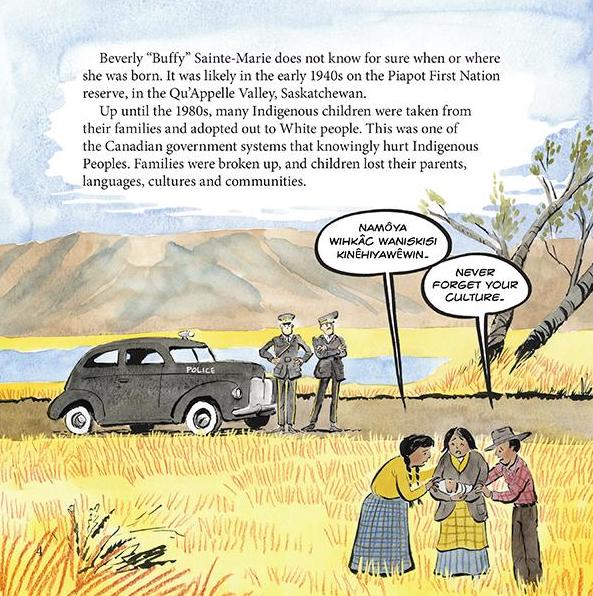
Buffy Sainte-Marie was probably born in the 1940s on the Piapot First National reserve in Saskatchewan but was taken and adopted by the Sainte-Maries of the northeastern U.S.A. Her childhood, often spent alone, was filled with music, with Buffy starting to play the piano at age 3, and learning music by ear. At 16, she taught herself to play guitar, and, while at university, she started playing at small clubs and then larger ones. After graduation, she became a full-time musician.
From Meet Buffy Sainte-Marie by Elizabeth MacLeod, illus. by Mike Deas
As her songs were garnering much attention, from her "Universal Soldier" as a protest song, and "Until It's Time for You to Go" as recorded by countless famous artists, she was noticing how Indigenous roles were depicted on the screen. When she was asked to take a lead rode in an episode of "The Virginian," she maintained the need to hire Indigenous actors for Indigenous roles, leading the action for diversity.
From Meet Buffy Sainte-Marie by Elizabeth MacLeod, illus. by Mike Deas
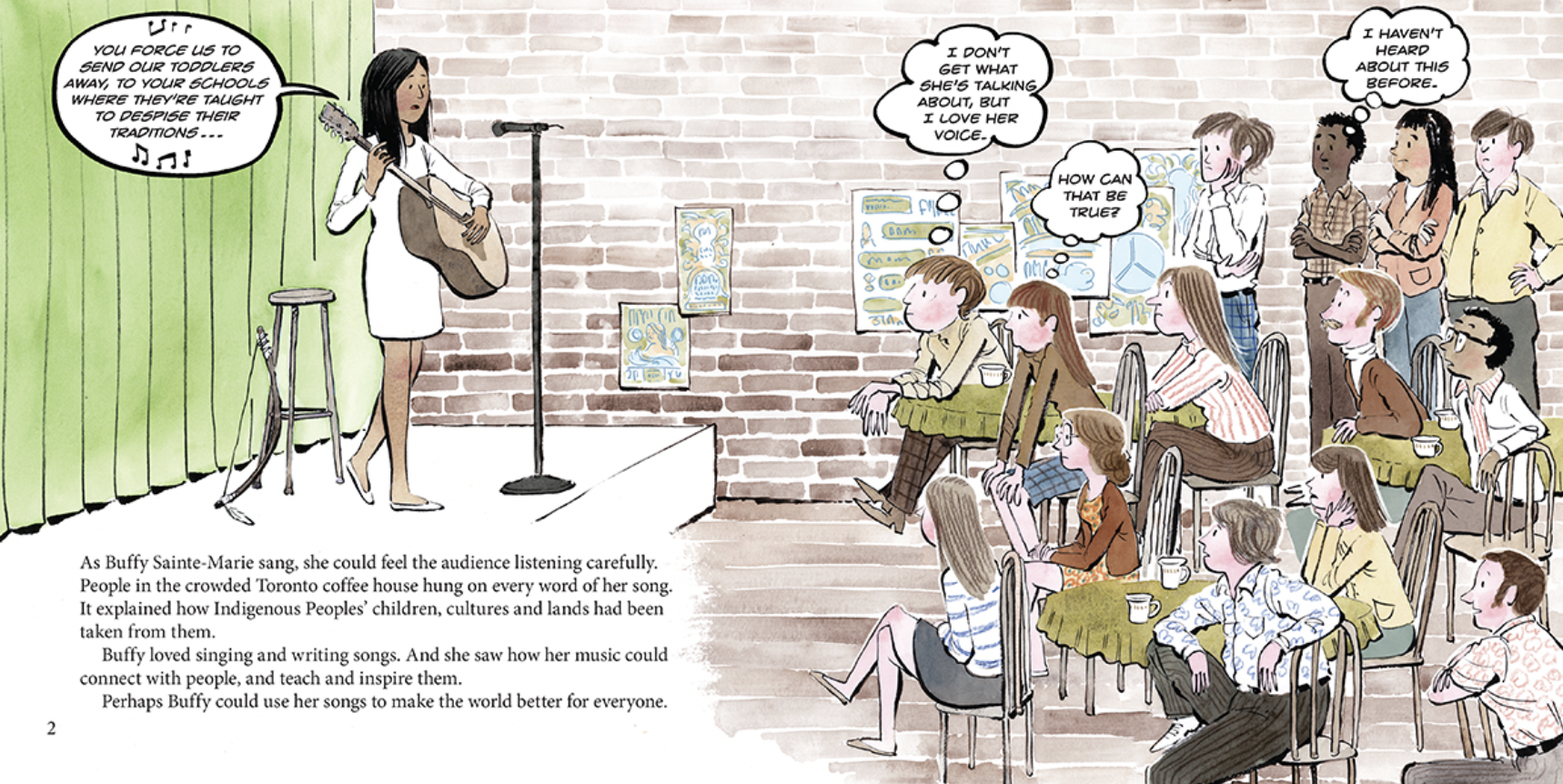
Her other initiatives included starting the Nihewan Foundation for Native American Education which supported Indigenous teens going to university. She has spoken globally about Indigenous Peoples to further understanding. And even though her music was snubbed in the late 1960s and 1970s by radio stations and more for her political messages, she persevered, continuing to extend her activism to championing the rights of Indigenous Peoples. Along the way she won an Oscar, made several important appearances on "Sesame Street," and used new technology for creating visual art and music. She lent her support to the Idle No More movement and was awarded everything from the Polaris Music Prize to Junos and the Spirit of Americana/Free Speech in Music Award.

With her art fuelling her activism, whether it involved Indigenous Peoples, anti-war protests, missing and murdered Indigenous women, or shelter animals, Buffy Sainte-Marie's story in Meet Buffy Sainte-Marie will provide inspiration to young readers. She defies labelling as she is everything from a singer and a songwriter to a humanitarian, a protester, a teacher, a speaker, an advocate, and more. But by letting her heart and passions lead her, she has accomplished so much and done so much good work
Using the power of positivity, Buffy shares her messages with her songs and through art, education and the organizations she supports. Buffy teaches that we can all work together to help make the world a better place. (p. 29)
Elizabeth MacLeod makes sure that readers will learn about Buffy Sainte-Marie's achievements–a timeline of key events appends the illustrated story–but also about her spirit, and her spirit is great, both broad and deep. Buffy uses it, with her voice in music and art, to educate, to mobilize to action, to inspire, and to give voice. Mike Deas's artwork, which involves gouache and watercolour paints and ink, along with digital tools, supports the story with detailed illustrations from Buffy's personal and professional life, from childhood to the 2020s. He takes her story from being taken from her Cree parents as a baby to performing on stage with a red dress–a symbol of missing and murdered Indigenous women. With that, Mike Deas carries readers through nine decades of Buffy Sainte-Marie living and performing and inspiriting. 

There are many stirring reads of important Indigenous activists and leaders but, as an illustrated biography, Meet Buffy Sainte-Marie gives us a comprehensive and unequivocal depiction of an amazing woman, a woman of talents, of courage, of conviction and of spirit. The story, as the woman, touches, and impresses.
 
• • • • • • 

Scholastic Canada Biography series by Elizabeth MacLeod and Mike Deas:
 
Meet Thérèse Casgrain (2021)
Meet David Suzuki (2021)
Meet Buffy Sainte-Marie (2023)

November 08, 2022

Berani: Guest review

 This book was reviewed by Grade 9 student Bronte.

Written by Michelle Kadarusman
Pajama Press
978-1-77278-260-8
224 pp.
Ages 8-13
August 2022

Malia is a courageous girl who stands up for what she believes in, but activism can be a risky business. When she gets into some trouble with her school for circulating a petition against palm-oil, a product that many families in her town rely on for their income, she has to make a difficult decision that could result in lots of trouble for many people. Meanwhile she is trying to convince her Canadian-born mother not to move the family from Indonesia where Malia has lived all her life, and where her late father is buried.

Ari spends his days attending school, playing chess, and doing chores around his uncle’s restaurant in exchange for a chance to live with him, and get an education at the local public school. But the guilt of leaving behind his dear cousin, Suni, and the rest of his family has been gnawing on him. Furthermore, Ginger Juice, his uncle’s pet orangutan, has been suffering from her poor living conditions, and he’s worried her days are numbered. 
 
Berani alternates between the points of view of Ari and Malia as they help others and try to solve problems around their communities, as well as that of Ginger Juice, who longs for home. It is an inspiring story ideal for grades 4-6, written by Michelle Kadarusman, award-winning author of books such as Music for Tigers and The Theory of Hummingbirds. As someone who cares for the environment, I think Berani is a fantastic way to introduce some of our world’s problems to kids. This book touches on so many important issues: animal rights, climate change, preserving the environment, the loss of family members, and the struggles of moving. The main characters Ari, Malia, and of course Ginger Juice are brave, kind, and thoughtful. The book’s colourful descriptions and Indonesian words sprinkled throughout (a glossary is provided) really set the scene, and the way the chapters flip between the kids' and orangutan's perspectives is a nice touch as well. It’s a great way to start conversations about our world, and our responsibilities as inhabitants of it. (Michelle Kadarusman includes a section with information on orangutans and how we can help them.) Berani, which I would rate 9 out of 10 stars, is definitely worth a read!

~ Written by Bronte, Gr. 9

August 07, 2020

The Girl with the Cat

Written by Beverley Brenna
Illustrated by Brooke Kerrigan
Red Deer Press
978-0-88995-531-8
32 pp.
Ages 5-10
April 2020

Based on a true story, The Girl with the Cat recounts a fortuitous visit to an art gallery that leads to an act of activism and the permanent installation of a bronze sculpture in Saskatoon.
From The Girl with the Cat by Beverley Brenna, illus. by Brooke Kerrigan
When a young girl and her older brother go exploring one Saturday shortly after the family's move from Toronto to Saskatoon, they discover an art gallery of epic proportions. Within the walls, the girl discovers a plethora of art which cannot be touched; that is, until she finds a bronze sculpture of a girl in a rocking chair with a cat on her lap. Without a sign about touching, lonely Caroline touches the chair and sees it rock. She pats the cat, and takes in the details of the artwork, from the girl's bare feet and shorts to the ripples of the cat's fur. Everything reminds Caroline of the home and cat she left behind and of playing with her friends. She makes a connection and returns to talk to the girl and her cat, identified as Nina and Sammy, time and time again.
From The Girl with the Cat by Beverley Brenna, illus. by Brooke Kerrigan
I sit beside them and the Gallery breathes softly around us. In the stillness I start to really see the paintings. This room is full of summer. There are trees for treehouses and beaches for swimming. I bet Nina likes this place. Maybe that's one of her secrets. I tell her my secrets in return.
But when Caroline learns that the sculpture is being returned to Ottawa where the artist lives, Caroline is devastated.
It feels as if there's a hole in the roof and all the light is leaking out.
Nine-year-old Caroline gathers up the little bit of money she and her brother have and delivers it with a letter to the director. Though he suggests there's nothing he can do, the next morning her letter graces the front page of the newspaper, and a month later Caroline is pleased to hear that the "Girl With Cat" would not be moved.

From The Girl with the Cat by Beverley Brenna, illus. by Brooke Kerrigan
According to the notes at the conclusion of The Girl with the Cat, Caroline Markham was the little girl who wrote the letter that saved this sculpture at the Mendel Art Gallery in 1966. That sculpture, by the artist Arthur Price of his own daughter and her cat, remains in Saskatoon though it has been relocated with the gallery's collection to the city's new art museum. But this child's small act of activism, championing a piece of art with which she made a connection and helped her become accustomed to her new home, reminds us that small deeds can enact important changes. Beverley Brenna, who has penned everything from picture books and early readers (I reviewed Sapphire the Great and the Meaning of Life last year) to middle grade, YA and short stories, is very astute about getting into the heads of children and giving voice to that which matters to them. This story may be about taking action but at its most heartfelt it's about the anguish a child feels about her family's move and her need for reassurance and a friend. She finds both in a bronze sculpture that also leads her to real friends. Not surprising she returns the favour.
From The Girl with the Cat by Beverley Brenna, illus. by Brooke Kerrigan
With Brooke Kerrigan's illustrations created with the softest of media like pencil crayon and watercolours, The Girl with the Cat is both muted and dramatic. Brooke Kerrigan makes the gallery itself impressively monolithic and the art it houses striking, which is how a child would perceive them to be. Her distinctive art styling has both a grace and a magic that consistently draw me in to the story. (Read my reviews of The Christmas Wind, The Little Boy Who Lived Down the Drain, and Fishermen Through & Through for a sampling of some of my favourites by Brooke Kerrigan.)

I'm glad Arthur Price created his sculpture and that it was there to comfort Caroline in 1966 and that she was able to help safeguard its presence in Saskatoon, but I am most thankful that Beverley Brenna and Brooke Kerrigan were able to share this story about how a small act can lead to transformation.

September 05, 2019

Our Future: How Kids are Taking Action

Written and illustrated by Janet Wilson
Second Story Press
978-1-77260-103-9
32 pp.
Ages 7-12
September 2019
Together, we want to show that everyone can do something for our future and that together, as a world family, we can solve these problems.
With that hopeful message, Janet Wilson begins her latest non-fiction book about young activists who are working to make a difference.

In each double-spread, Janet Wilson dedicates original art and story to one warrior for world justice and then also mentions two other influencers who have taken on a similar cause. In the breathtaking mixed media technique of hot wax painting–applying layers of hot beeswax mixed with resin and oil colour–Janet Wilson depicts young activists in rich landscapes of place and triumphs. Her art is deep in texture and colour, luxuriant in its content and in its composition. 
From Our Future: How Kids are Taking Action by Janet Wilson
Canada's Autumn Peltier from Wiikwemkoong Unceded Territory on Manitoulin Island is profiled for her advocacy for clean drinking water for her community which supported the work of her aunt, Water Walker Josephine-ba Mandamin.  Stella Bowes and Marcus Deans are also showcased for their work to ensure water quality in Canada and elsewhere.

American Jaelun Parkerson encouraged his youth football team to emulate Colin Kaepernick's taking of the knee to protest racism and police brutality while Hebh Jamal organized protests against Islamophobia and Claudette Colvin's actions in 1955 helped end bus segregation in Alabama.

In Indonesia, sisters Melati and Isabel Wijsen organized themselves to get plastic bags banned where they live, and Edgar Edmund Tarimo and Hannah Testa have both taken action to combat plastic pollution at home and globally.
We youth may only be 25 percent of the world's population but we are 100 percent of the future. 
(Melati and Isabel Wijsen, pg. 11)
From Our Future: How Kids are Taking Action by Janet Wilson
Jesse Thompson fought against discrimination leveled against him as a transgender hockey player and Ke'Shon Newman has spoken out against the prevalence of gun violence in America.
"Our voices are LOUD. Our voices are CLEAR. And, our voices are about to change HISTORY."
(Ke'Shon Newman, pg. 25)
From Our Future: How Kids are Taking Action by Janet Wilson
These are young leaders who are fighting against pollution, climate change, against cruelty to animals, in support of those struggling in war-torn countries and seeking refuge. They are fighting gun violence, bullying and supporting mental health. They live in Canada and the U.S. as well as in Kenya, Hong Kong, New Zealand, Indonesia, Colombia and elsewhere. Their stories are as diverse as their issues of concern and their homelands. It becomes evident that there is much in our world that needs fixing and that there are many young people around the globe who are willing to step up and take action.

With Our Future: How Kids are Taking Action, Janet Wilson has added new stories to her impressive series (see other titles in this series below) regarding laudable young people who recognize their obligation to do something to make the world a better place than the one they have inherited. Kudos to them for putting themselves out there and encouraging others to do the same, and to Janet Wilson for shining a light on their extraordinary efforts.

Our Earth: How Kids are Saving the Planet (2010)
Our Rights: How Kids are Changing the World (2013)
Our Heroes: How Kids are Making a Difference (2014)
Our Future: How Kids are Taking Action (2019)

April 22, 2019

Mya's Strategy to Save the World

Written by Tanya Lloyd Kyi
Puffin Canada
978-0-73526-525-7
200 pp.
Ages 9-12
April 2019
Reviewed from Advance Reader's Copy

She may be dealing with her mother's prolonged absence tending to her ill grandmother, a comic but persistent misunderstanding about her sister's shin pads, a communication project with an annoying boy, and a mission to convince her parents to get her a cell phone, but Mya is still out to save the world because it seems to need it.

Twelve-year-old Mya, eight-year-old sister Nanda and their father seem to be a little lost when Mom heads to Myanmar to tend to her ailing mother. Mya, who aspires to work for the United Nations, uses all her skills in conflict resolution, patience, forgiveness and more to handle the ever-imploding household that can't balance meal preparation, laundry, cleaning and child care. But Mya is also a globally conscious and compassionate girl who, having organized their Kids for Social Justice group with best friend Cleo, worries about many issues, including the Rohingya crisis in Myanmar. However, while she would love to have the support of Cleo, her friend has just been gifted her first cell phone and is way too involved with texting and her crush Drew.

Meanwhile, Mya has been partnered with Ian to work on a communications project for English. As they pursue their project, sometimes in sync and sometimes not, Mya begins to learn a little bit more about effectively interacting with others to get her points across although not without a few misunderstandings and occasional strife. Oh, and did I mention the issues surrounding the mining of cobalt–war, child labour, safety, etc.–which is a key component in electronics like cell phones? Can Mya use all her diplomacy to find a friendly resolution to all the issues–environmental, social justice, family and relationship–with which she is concerned?

Wow, this girl has a lot on her plate: family, friends, school, boys, the world. (Did I mention she gets her period while her mother is away?) Yet, she never curls up and hides her head under the blankets. She's other there doing her bit and trying her best. Even when it seems like no one appreciates her efforts or takes them seriously, she manages. Taking advice from her father,
...if people take small steps in the right direction, the world will slowly shift. (pg. 158)
Mya continues to crusade for herself, others and our world. But Tanya Lloyd Kyi never makes Mya a saint or a tedious rah-rah cheerleader.  Rather, Mya is a stalwart advocate for doing one's best. Moreover, there is a freshness to Mya's social activism and her coming of age story. Tanya Lloyd Kyi could have weighed down the story with social issues that are heart-breaking and alarming or she could have steeped Mya's navigation into puberty with angst and confusion. Instead, she chose to offer hope that those small steps would lead somewhere positive, making those baby steps the first steps to social change and, on  a personal basis, to being a teenager.

••••••••••••
 
Tanya Lloyd Kyi launches Mya's Strategy to Save the World this week in Vancouver. See details here.