Showing posts with label Deborah Kerbel. Show all posts

December 15, 2025

Community Snowman

Written by Deborah Kerbel
Illustrated by Tine Modeweg-Hansen
Groundwood Books
978-1-77306-951-7
32 pp.
Ages 3-7
October 2025 
 
There's snow out there and loads more coming. Whether it's in a yard, in a park, or in a schoolyard, there will be snow persons being built. (Actually, there will be snowmen, snow women, snow friends, snow dinosaurs, snow bears, and more.) And what's better than building a snow person? It's building it with others.
From Community Snowman, written by Deborah Kerbel, illustrated by Tine Modeweg-Hansen
After an ordinary night of sleep, a child awakens groggily to their routines. But when they look out the winter, everything changes from ordinary to amazing because the world outside is coated with deep, fluffy snow. Soon it's a race to get dressed and bundled up and head outside with their caregiver, perhaps a grandfather, following with similar enthusiasm, albeit a little more slowly and carrying a satchel with his knitting. So, as the child make snowballs and snow angels and starts making a snowman, their grandfather clears a bit of bench and gets to his sock knitting.
From Community Snowman, written by Deborah Kerbel, illustrated by Tine Modeweg-Hansen
All around people are bustling. Some trudge through the snow, heads down, oblivious to the snow joy in this child and in other children. Maybe they're going to work or to school, or walking their dogs, or going for groceries. But our child is busy too. Now they are starting to build a snowman. The bottom ball is always easy because you just roll it in to place. But the next ball, still large and needing to be lifted, is far more challenging, especially when another kid throws our child off balance with a snowball. No worries. He comes to help them. Two children then become three children at work and then a couple of teens join in to create the three-ball shape. 
From Community Snowman, written by Deborah Kerbel, illustrated by Tine Modeweg-Hansen
Now everyone gets in on the creation, with food stuffs like a pickle, chocolates, and bagels being added, and then with bits and bobs of clothing: a hat, work gloves, a shawl, and earmuffs. Everyone contributes something. But what does a man without a coat, socks, or gloves have to give? A poppy.
 
Without words, Deborah Kerbel tells a story of a community coming together to build a snowman and building kindness and compassion. It's a powerful story of how a small thing can become a meaningful moment. What's starts as play leads to friendship, to acceptance, and to benevolence. That's tough to get all that into a story that is wordless. But, with Deborah Kerbel as the storyteller, I'm not surprised by the strength of her story to draw her readers in, touch them, and make them feel the fellowship of the moment. But Tine Modeweg-Hansen, a Copenhagen-born illustrator who lives in Montreal, gives Deborah Kerbel's story the life of colour and community. In watercolour and ink, Tine Modeweg-Hansen's art, very reminiscent of the award-winning Quentin Blake, fills in those words with activity and detail. The cold and the wetness of the snow, the movement of the characters, human and animal, and the diversity of people makes the story spirited. Everyone and everything becomes part of a story that could only be described as feel-good.
 
At this time of year, with snow on the ground and holiday cheer ringing out, let's remember that community can come together spontaneously and with the greatest of heart without the giving of expensive gifts or conspicuous charity. It can happen naturally from a child's delight with snow and not overlooking those who might need help, whether it's lifting a ball of snow or providing a pair of socks.
From Community Snowman, written by Deborah Kerbel, illustrated by Tine Modeweg-Hansen

March 27, 2025

No Huddles for Heloise

Written by Deborah Kerbel
Illustrated by Udayana Lugo
Orca Book Publishers
978-1-4598-3910-6
32 pp.
Ages 4-7
March 2025 

I like Heloise. Heloise knows what she likes and doesn't like. She likes sledding and fish popsicles, sharing rocks with friends, and her own space. 
From No Huddles for Heloise, written by Deborah Kerbel, illustrated by Udayana Lugo
What she doesn't like, other than the leopard seals that no penguins like, are crowds and hullabaloo and those huddles that penguins do for warmth and protection. Those huddles that are just too close.
Huddles give Heloise the heebie-jeebies.
The jim-jams.
The willies.
And the collywobbles.
From No Huddles for Heloise, written by Deborah Kerbel, illustrated by Udayana Lugo
But how can she say no to the other penguins and not hurt their feelings? Typically, she has a number of excuses from taking her fish for a walk or polishing her rock collection. Heloise is perfectly happy on her own, enjoying her things, her space, and her own thoughts. 
From No Huddles for Heloise, written by Deborah Kerbel, illustrated by Udayana Lugo
But then the other penguins stop asking her to join them in huddles and Heloise begins to question her own wants and needs, and seeks companions elsewhere. Unfortunately, her travels are disappointing and even dangerous on her own and she returns home to find that her friends have found a way to accommodate her need for personal space while offering her the protection that huddles provide.

It's lovely to read a story about an introverted character who doesn't feel compelled to fit in with the extroverts or have the extroverts demand that their way of socializing and gregarious behaviour is preferable and, worse, the norm. I'm so glad Deborah Kerbel, an accomplished writer of picture books, middle grade and YA, demonstrates an acceptance of the introverted Heloise rather than sympathy for her nature. (The sympathy should be towards the attitude she experiences from those who are not introverted.) Instead, Deborah Kerbel validates the fullness of Heloise's life without the partying and closeness demanded or even just requested by her penguin peers. Heloise is a happy penguin, accepting of her nature and choices. She's never rude but she is true to her herself. Too bad that she feels like she doesn't belong because belonging does not mean being the same as others.
From No Huddles for Heloise, written by Deborah Kerbel, illustrated by Udayana Lugo
I love the positive messages that Deborah Kerbel gives us in No Huddles for Heloise, and BC's Udayana Lugo gives us the whimsy of that message in Heloise and her friends. From their accessories, like pom-pom hats, scarves, and bandanas, to props like a rock polisher or a whale stuffed animal, Udayana Lugo demonstrates the differences among the penguins are the norm and Heloise's introversion is just another manifestation of wonderful diversity. She created her art primarily using gouache and coloured pencils, which gives a bright and rich portrayal of the penguins and the landscape in which they live and play.
 
I'm with Heloise–except for the fish popsicles–that quiet and solitary activities offer comfort in ways that many extroverts will never understand. While we all must engage with others for safety, for work, or for other needs, it's lovely to see Heloise be accepted and even accommodated for her needs, not chastised for being different.

April 10, 2024

Group Book Launch: May 26, 2024 (Toronto, ON)

If you read my January 1st post about upcoming books, you'll know that there are hundreds of books of kidCanLit released in a 6 month period. While it's hard to get to all the launches that are set, it is far easier when multiple authors get together to launch their new books. In the spirit of cooperation, and under the umbrella of Authors' Booking Service, eight authors of picture books, and middle-grade fiction and non-fiction will be launching their new books in a special Group Book Launch.  
 
Creators who will be present are Dana L. Church, Caroline Fernandez, Deborah Kerbel, Amanda West Lewis, Monique Polak, Sade Smith, Michael F. Stewart, and Farida Zaman. These are their books:
 

Remember This: The Fascinating World of Memory (Orca Think)
Written by Monique Polak
Illustrated by Valéry Goulet
Orca Book Publishers
96 pp.
Ages 8-13
March 2024


Iggy Included
Written by Deborah Kerbel 
Scholastic Canada
240 pp.
Ages 8-12
May 2024
 

Seeking Draven
Written by Michael F. Stewart
Red Deer Press
200 pp.
Ages 9-12
April 2024


A Planet is a Poem
Written by Amanda West Lewis
Illustrated by Oliver Averill
Kids Can Press
40 pp.
Ages 8-12
May 2024
 

Asha and Baz Meet Katia Krafft
Written by Caroline Fernandez
Illustrated by Dharmali Patel
Common Deer Press
114 pp.
Ages 6-9
February 2024


Plague Thieves
Written by Caroline Fernandez
DCB Young Readers
208 pp.
Ages 9-12
May 2024


The Monarch Effect: Surviving Poison, Predators, and People
Written by Dana L. Church 
Scholastic Focus
320 pp.
Ages 8-12
April 2024


Meena Can't Wait 
Written and illustrated by Farida Zaman
Orca Book Publishers
32 pp.
Ages 6-8
March 2024


And the launch?  Here are its details:

Sunday, May 26th, 2024

2-3 PM (EST)

at

Toronto Public Library
Northern District Branch
Gwen Liu Meeting Room
40 Orchard View Blvd.
Toronto, ON

Get this free, family-friendly event into your calendar now. It's a great opportunity to chat with creators of kidCanLit and get autographed books for all your young readers.

February 26, 2024

Ary's Trees

Written by Deborah Kerbel
Illustrated by Sophia Choi
Fitzhenry & Whiteside
978-1-55455-509-6
32 pp.
Ages 5-8
October 2023
 
On March 21, the world will recognize the United Nations-designated International Day of Forests. Sadly, no matter how long forests have been around, in their different forms around the world, there are still those who might take a lesson from Ary and her friends about the importance of forests and see beyond what they can do for us and what we should do to ensure their constancy.
 
From Ary's Trees, written by Deborah Kerbel, illustrate by Sophia Choi
When their island home is longer viable, Ary's father goes searching for a new home, and finds it in a flourishing island.
As they begin to prepare the island for their new community, Ary, who delights in the trees, begs him, "Please don't cut too many this time."
She closed her eyes and took a deep breath. The air smelled green. Leaves swished overhead as the tree covered her with a blanket of cool shade. How she'd missed that sound!
Not surprising, with every "chop-chop of busy axes," Ary's heart aches. And though she is assured by her father that, "There are lots to spare," she sees that more and more are being cut, for building, and then for crops, and to construct boats, and then because everyone wants more, more, more.
From Ary's Trees, written by Deborah Kerbel, illustrated by Sophia Choi
Ary is bereft for and with the trees. As the palm trees are cut, brown tears rain down. And when the people can't be bothered cutting, they burn down the trees.

Ary is furious, and some of her friends join her in protest. Still, no one listens. They are but children and know not of what they speak, apparently. Ah, but an island without trees suffers. The land crumbles, the structures crack and splinter, and there is no relief from the sun. Ary's father and the other adults choose to find a new island. Ary and a handful of friends find a different solution, one borne of loyalty and regeneration.

Deborah Kerbel's story of environmental responsibility is still one that needs to be heard and empowered in all. Ary's Trees reminds us that it may be the children who will be the ones to change the attitude of their own generation and the subsequent ones, especially when their elders are not getting it. Ary sees the truth, that thinking that "a little bit more (cutting) won't make a difference" is flawed, that "The trees are here for our use" is selfish and short-sighted, and that the trees are their friends and worthy of consideration and charity.

Though I've reviewed many of Deborah Kerbel's books, from picture books like Snow Days and Before You Were Born (still my go-to book for expectant parents) to middle-grade novels like My Deal with the Universe to her YA (e.g., Under the Moon), this is my first opportunity to review a book illustrated by Toronto's Sophia Choi. Also a surface pattern designer, Sophia Choi creates art that speaks of bold colours and shapes, whether it be palm trees or flowers in the understories, or tree stumps and birds. There's a folk-art vibe to her art that speaks of a natural world that will mesmerize and delight, but that also will be missed when gone.
From Ary's Trees, written by Deborah Kerbel, illustrated by Sophia Choi
Whether you read Ary's Trees with your children or students for International Day of Forests, or save it for World Tree Day on June 28th, or for Earth Day on April 22, or to teach a science curriculum, Deborah Kerbel and Sophia Choi's picture book will demonstrate that trees are more than just a producer of materials for human consumption. Trees are living entities that can provide shade and soil stability, habitat, and food, and provide oxygen while absorbing carbon dioxide. As they live, so do we. Fortunately, the youngest inhabitants of the island, Ary and her friends, were able to realize that we humans have an interrelationship with trees, and all living things, and if we sustain them, then they will help sustain us. (Still a lesson too many developers and even politicians haven't learned.)
 

November 24, 2023

Next Door

Written by Deborah Kerbel
Illustrated by Isaac Liang
Kids Can Press
978-1-5253-0658-7
32 pp.
Ages 3-7
October 2023
 
Wordless picture books have a general hush about them. In wordless books, i.e., ones in which the stories are told through illustrations alone, no one is speaking and there is no text to distract. It's all rather subdued. In fact, it's a perfect reflection of what the main character, a young boy with hearing aids, must experience much of the time. But don't be fooled into thinking that there is no story to be told or personal connection to be made.
From Next Door, written by Deborah Kerbel, illustrated by Isaac Liang
A boy and his mother head out from their home just as a moving van arrives and begins unloading boxes. It's evident these are not their goods as the boy is familiar with the places and people he encounters on their walk. Though he may have limited hearing, as evidenced by his hearing aids, he notices everything, from the musician busking, the construction workers at work, and even baby birds in a high nest. It's unfortunate when a cyclist races past the boy, startling him into dropping his teddy bear. But, after confirming he is okay, communicating via American Sign Language, his mother settles the boy.
From Next Door, written by Deborah Kerbel, illustrated by Isaac Liang
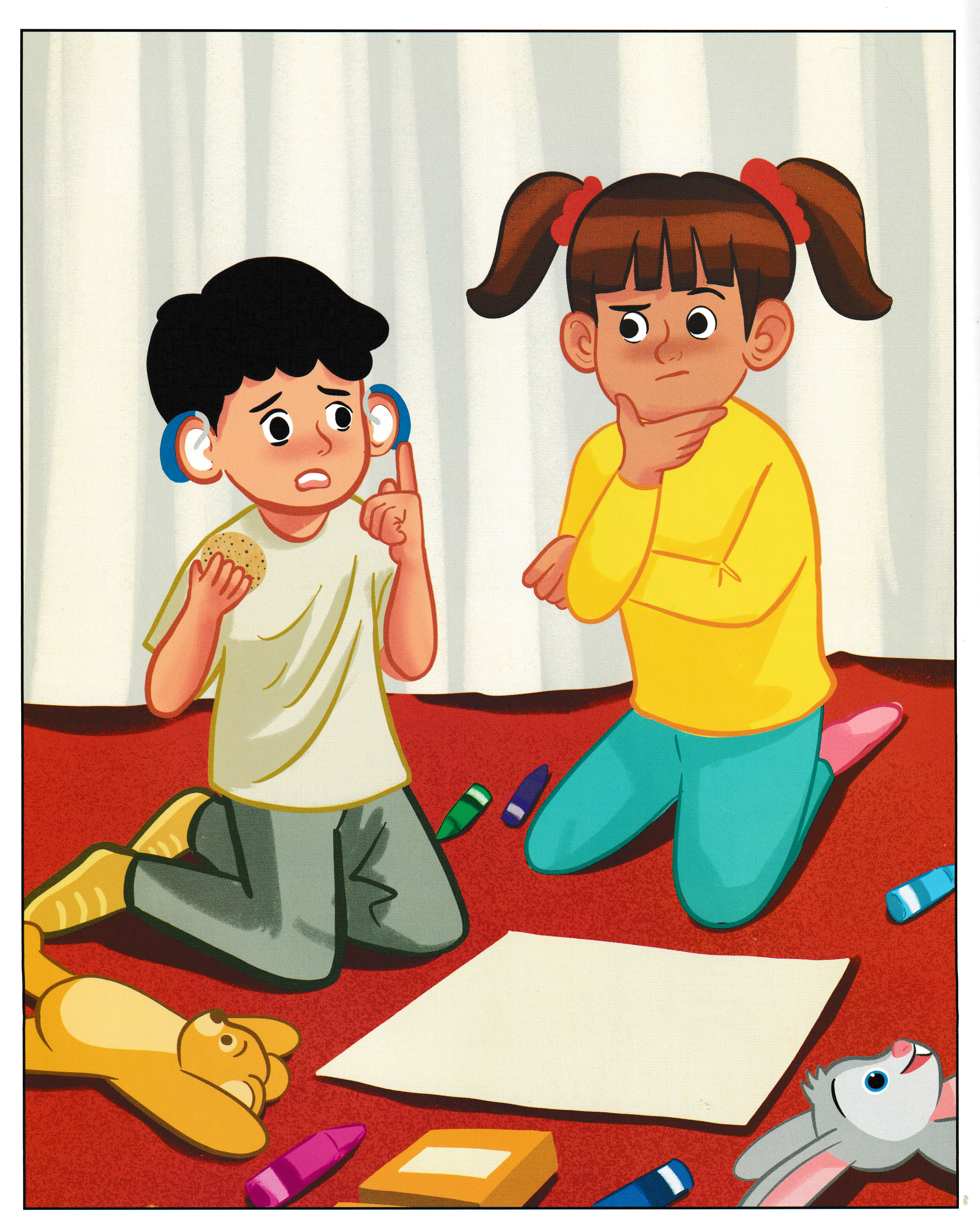
Returning to their building, they visit their new neighbours in the apartment next door. Using her own way of communicating, with hand movements and an Arabic/English dictionary, the woman welcomes them. But the boy spies a little girl hiding from them. When he approaches her, it is evident that neither can understand the other. But through the sharing of food and art, the two children find their own way to communicate.
 
This story is deeply personal for Toronto author Deborah Kerbel whose own sister had been born profoundly deaf. Deborah Kerbel's Author's Note speaks of her sister's abilities to connect, and Next Door's story reflects that ability for children who find different ways to communicate because of hearing and language differences. Undoubtedly a child who has a hearing impairment and one whose language is different than those around them may both feel at a disadvantage when trying to communicate. But, as the boy demonstrates, his disability is not a hindrance to living a good life, one in which he communicates with others, just in his own way. He successfully uses American Sign Language and his hearing aids to enable connection with others. But, when he meets the new little girl next door, he's on an equal playing field as she struggles to get him to understand her. But, with some effort and the common ground of art, along with a tasty cookie, a connection is made.
From Next Door, written by Deborah Kerbel, illustrated by Isaac Liang
Deborah Kerbel opens up about her sister's story to help convey the possibility that communication does not cease with hearing or a different language. We find new ways to communicate when the customary route is not available. By juxtaposing the boy's circumstances with that of his new young neighbour, Deborah Kerbel has found a way for any child for whom communication is challenging, because of, for example, cultural differences, emotional barriers, or physical barriers, to accept that different can still be effective. 
 
Isaac Liang is a deaf illustrator from Singapore who imbues the art of Next Door with knowledge and sensitivity. Because of his personal experiences with hearing impairment, Isaac Liang has found a way to bring the quiet and the connection for the children through his digital art. Because comprehension through the sense of hearing is compromised, his emboldens the story with colour and shape. Perhaps words are unnecessary but meaning still comes through with every building, person, and detail. 

Next Door is a great picture book for helping children develop their visual literacy skills and their empathy and acceptance for those who communicate differently. Hopefully it will help them to recognize that we do not all hear or see or understand the same way–the cyclist who almost collides with the child assumed the boy could hear him coming–and to find new ways of communicating that might work better for others. And, when it all comes down to it, kindness always works.

September 13, 2022

When Spider Met Shrew

Written by Deborah Kerbel
Illustrated by Geneviève Côté
Groundwood Books
978-1-77306-563-2
32 pp.
Ages 3-6
September 2022
 
When a group of animals realize that there's something missing in their lives, they come together in a unique way to help each other out.
From When Spider Met Shrew by Deborah Kerbel, illus. by Geneviève Côté
The story begins with a hungry spider who creates a web to catch its food. But when the wind grabs the spider and its web, Spider makes the acquaintance of a shrew whose field is about to be plowed. Spider offers to help Shrew find a new home.
 
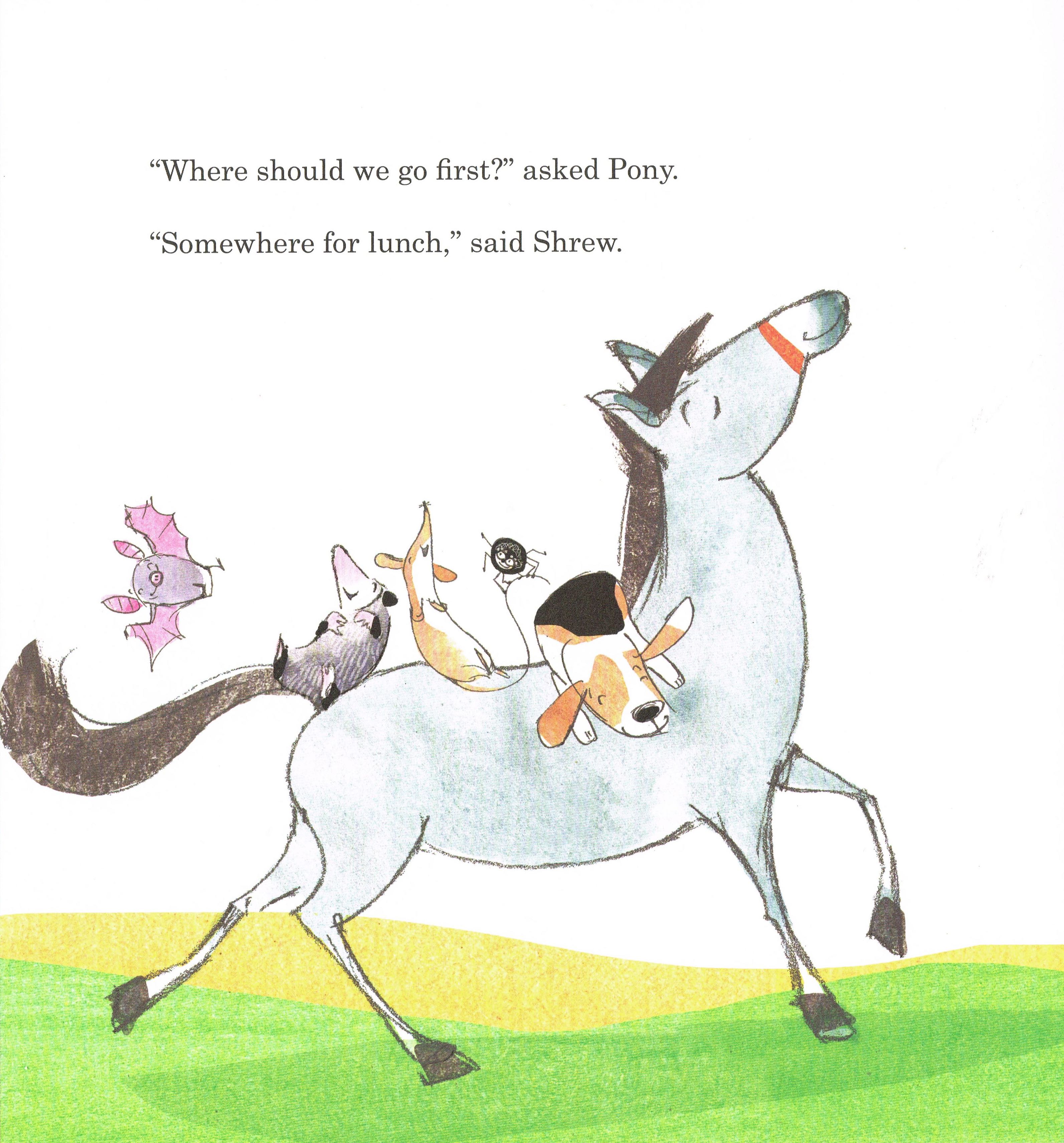
When a storm strikes, they take shelter in the tree of a bat, who is wet, and an opossum, who has lost its mother. The foursome go off in search of Possum's mother until they meet a depressed beagle saddened by the loss of her puppies. Dog is invited to be Possum's new mom, at least temporarily, and they all get on Dog's back. Bat can now move around, even though its wetness prevents flight; Shrew can share in Dog's doghouse; Possum has a surrogate mom on whose back they can travel; and Dog is needed again. Finally they meet Pony who misses the fun they used to have with a human riding them. Guess what they all do?  After that, there is only one need to fulfill and that's the one that started this whole story.
From When Spider Met Shrew by Deborah Kerbel, illus. by Geneviève Côté
Cumulative tales, those that build with repeated words or actions to progress the story, are fabulous for engaging young readers and helping them recognize words. Though a modified cumulative tale in that the words are repeated but not rigorously throughout the story, When Spider Met Shrew has that echoing of a spider who is hungry, a shrew who is homeless, a bat who is wet, an opossum who is scared and a dog who is sad. (Since the pony is at the end of the story, their boredom doesn't get repeated.) Deborah Kerbel gives us that repetition but goes beyond and that's what makes When Spider Met Shrew a little different. Whether children will read the story themselves or as part of a story time read-aloud, they'll get into the rhythm of the story, but they will also feel for the plights of the animals and appreciate their compassionate companionship that results in a happy ending that comes from helping out a friend or two, in their own way. Cumulative tales can be on the simple side, relying on the reiteration to carry the story, but, by embedding that repetition in a story of different animals feeling vulnerable because of human interference, the cycle of life, weather and time, Deborah Kerbel makes us feel not just laugh.
From When Spider Met Shrew by Deborah Kerbel, illus. by Geneviève Côté

Likewise, Geneviève Côté's watercolour illustrations may look simple with a background and a couple of animals, but the artwork is far more complex in its emotional substance. The burdens of the animals are evident both in words and graphics and their willingness to express those vulnerabilities enables them to get the support they require.

Alone a spider, a shrew, a bat, an opossum, a dog and a pony have hunger, homeless, sadness and more, but together they have better.

November 02, 2021

Windy Days

Written by Deborah Kerbel
Illustrated by Miki Sato
Pajama Press
978-1-77278-217-2
24 pp.
Ages 2-5
October 2021
 
When a picture book, a two-dimensional source, can evoke weather such that the reader feels the bite of the wind or the slash of the briskness of leaves against skin, it's doing something terrific. I may be able to feel the wind by just stepping outside right now but I'd much rather experience it through the text and paper collage of Deborah Kerbel and Miki Sato's latest collaboration.
From Windy Days by Deborah Kerbel, illus. by Miki Sato
In Pajama Press's Toddler Tough format of padded cover, rounded corners and thick pages, Windy Days explores children's experiences with the wind in the autumn, from fun fall fairs to Halloween outings. There are their encounters in the natural world with gentle breezes scattering milkweed seeds and tossing leaves, to creating energy with wind turbines and flying kites. Some of those winds are soft air movements while others are blasts of cold that practically toss little ones off their feet. Whatever their form, they're there, especially at this time of year, and reminding us of weather as our constant, bringing sound and movement and consequences.
Gusting wind: whoosh and whirl
Flags a-flutter, pinwheels twirl
From Windy Days by Deborah Kerbel, illus. by Miki Sato
Weather is always with us–regardless of those unique days when the weather people  announce that we'll be having some weather today!–and it impacts our choices in clothing, activity, emotions and experiences. It makes us cautious and impetuous, eager and subdued. Weather makes us who we are when we're outside. The winds of fall are no different, impacting our play and our learning. They affect our emotions: fear from branches tapping on a window during a storm; annoyance for biting our cheeks and noses; and delighting us with the dances of airborne leaves and seeds. And then delivering the first snowflakes of the next season.
From Windy Days by Deborah Kerbel, illus. by Miki Sato
I can't think of a better day to review Deborah Kerbel and Miki Sato's latest picture book collaboration than today, an incredible blustery day shortly after Halloween. Though little ones will be familiar with every scene depicted in the book, they will be especially aware of that Halloween scene as they sit inside their homes sorting their treats and listening to the winds outside. It's that familiarity of experiences that will endear Windy Days to our youngest readers. They know what it feels like to be inside listening to the wind against a window or outside bracing themselves as they trudge to daycare or school. They know what too little wind feels like but also too much. These are their experiences with wind. And Deborah Kerbel gives them the evocative words to go with those experiences. Roaring, whistling, howling give us the sounds but sweeping, biting, and tapping give us the movement. The wind is a living thing in Deborah Kerbel's words and an acquaintance that joins us for many of our fall days.
From Windy Days by Deborah Kerbel, illus. by Miki Sato
Because of the texture of her cut-paper collages and her judicious use of lines to portray movement, Miki Sato takes readers outside to enjoy and endure the winds of fall. By adding a third dimension in her illustrations and using bold vibrant colours, Miki Sato gives these familiar childhood scenes character, inviting us to reminisce about our own experiences with the wind. By making the wind as real as the costumed child losing her witch's hat or the girl with the umbrella almost sailing off her feet, Miki Sato makes the wind the star of Windy Days.

It's never too early to introduce children to STEM concepts like the weather–there is an activity page appended to the story–and now in the fall when warm breezes are transforming into brisk winds and biting blasts of air will soon to be the norm, Windy Days will help young children see themselves in the weather of their own lives and reflect on the nuances of the wind in its impact on them.

🌬🌬🌬🌬🌬

Take in the weather with all the books in this series, including upcoming Rainy Days in the spring of 2022.

Snow Days (2020)
Sunny Days (2021)
Windy Days (2021)
Rainy Days (coming in 2022)


July 30, 2021

Sunny Days

Written by Deborah Kerbel
Illustrated by Miki Sato
Pajama Press
978-1-77278-197-7
24 pp.
Ages 2-5
June 2021
 
On the heels of Snow Days (2020) and just before Windy Days (due out in October), Deborah Kerbel and Miki Sato take little ones out into the sunshine to enjoy the weather and to rhyme their way through with solar brilliance.
From Sunny Days by Deborah Kerbel, illus. by Miki Sato
From rubbing sleep from one's eyes to reading outdoors and planting seeds in the spring, children are escorted by the sun. Then with summer comes outdoor play in flower meadows, in the water and on a beach, and while taking sanctuary under an umbrella.
Prickly sun, burning heat
Cool shade and an icy treat
From Sunny Days by Deborah Kerbel, illus. by Miki Sato
As the sun gets lower in the sky, the crickets come out and the shadows grow long, and finally sleep comes for both child and our brightest star.
Evening sun, cricket song
Shadows stretching tall and long
From Sunny Days by Deborah Kerbel, illus. by Miki Sato

The rhymes may seem simple but there is a richness in Deborah Kerbel's take on what children experience in the sun. What's most important is what they feel, what they see, what they notice, and how it affects them. After all, Sunny Days is a book for our youngest children, connecting with them and their realities. There are the sensations of the blazing sun freckling the skin and the drying of mud. There is sunshine everywhere and anywhere, including an urban setting, a backyard, a beach or a park and Sunny Days shines on the lives of children's routines, joys and play. 
From Sunny Days by Deborah Kerbel, illus. by Miki Sato
I've always loved textured illustration and Miki Sato's paper collages are becoming a favourite, doing more than just following Deborah Kerbel's words. The artwork gives us crumbly soil in which seeds are dropped, cooling water lapping onto sandy shores, and angry clouds having left puddles for mud pies. The quality of Miki Sato's artwork infuses Sunny Days with more than just warmth and light; it also gives a sense of place and pursuit.

My recommendation for enjoying Sunny Days? Get yourself and your young charge on a blanket on the grass or the sand, or on a bench in a park or in yard. Let the child hold the book which is in Pajama Press's Toddler Tough hardcover format (padded cover, rounded corners and thick paper) and read it aloud, asking questions and even doing the fun and easy science experiments on the final page of the book. Then read it again on a rainy day to remember what sunny days are like.  I suspect your child will start learning the rhymes and reading along with you soon enough and you might even encourage a new curiosity with weather or the solar system. Who knows what Sunny Days may bring?

April 08, 2021

Double Book Launch: The Life and Deaths of Frankie D. & Like a Duck (Online)

Here's an event to celebrate!
 
It's a
 
 DOUBLE BOOK LAUNCH
 
for 
 
The Life and Deaths of Frankie D.
Written by Colleen Nelson
Dundurn
978-1-459747586 
256 pp.
Ages 12+
April 2021


and
 
 
Like a Duck
 Written by Deborah Kerbel
Scholastic Canada
978-1-443175760
240 pp.
Ages 8-12
March 2021

on
 
 Thursday, April 15, 2021

at

7 PM (CT) / 8 PM (EDT)

on
 
 Zoom
(use the QR code to register or the link here)

 
Join authors Colleen Nelson and Deborah Kerbel 
as they discuss and read from their new books.
And, there are promised surPRIZES.


March 29, 2021

This House is Home


Written by Deborah Kerbel
Illustrated by Yong Ling Kang
Owlkids Books
978-1-77147-380-4
32 pp.
Ages 4-8
March 2021

The concept of home has always been an important focus in literature: finding it, establishing it, cultivating it, holding onto it, and sadly even losing it. For some, it's ephemeral, fleeting in its nature, and for others it is the bedrock of life. For the families in This House is Home, it is both.
From This House is Home by Deborah Kerbel, illus. by Yong Ling Kang
Lily and her rabbit family live in a home that her grandmother says is "old and steady as mountains." But when a pair of suited foxes with clipboards approach Grandma about buying the house, she politely declines.
This house is home, and we'll live here for the rest of forever.
From This House is Home by Deborah Kerbel, illus. by Yong Ling Kang
Problem is that everyone else around them sells to the developers, and there is much upheaval as friends pack up and goodbyes are shared. And then the diggers arrive, flattening houses and trees, and constructing a road that like a "long gray tongue snaked toward our house, closer and closer, until it had pushed right up to our door. It didn't bother knocking."
From This House is Home by Deborah Kerbel, illus. by Yong Ling Kang
The construction workers might have placed pylons around their house but their house is now situated in the middle of a wide road of noisy, smelly vehicles racing past their windows. The impact on their garden was evident but also clear was the impact within their home: dirt, noise, irritability, and distress.
From This House is Home by Deborah Kerbel, illus. by Yong Ling Kang
But a solution to their problem comes to Lily, the artist, in a dream in which, "The road had melted into a sea. The cars had shrunken to fish. My house had grown sails." Their house would remain their home, just in a different location.

Having a development threaten your house, your home is a nerve-racking prospect. Undoubtedly it's a frustration of many whose abodes stand in the way of planning projects that look at the big picture and not the individual lives affected. The menace of the foxes' repeated efforts to get Grandma to sell are tangible, though she is always polite and gracious, but Deborah Kerbel's words focus on the calm and love inside the home and leaves the destruction and disquiet outside. Sadly, there comes a time when the outside encroaches on the inner sanctum of home. Still Grandma's strength of conviction that their house would remain steadfastly their home and Lily's problem-solving ensure that home will endure as such.

Illustrator Yong Ling Kang, who illustrated Tanna's Owl (2020), continues to charm with her watercolour art that adds the whimsy of a bunny family living in their home, having picnics, playing, knitting, and growing. She brightens those pages with all colours, saving the greys and browns for the mayhem of the construction, and gives fluidity to the story, indicative of the transitional nature of the house, with her brushstrokes and lines. As such, Yong Ling Kang's art echoes the joys and frustrations of Deborah Kerbel's characters from comfort through distress and back to buoyant.

This House is Home reminds us that home is more than a structure. It has roots that are grown of family, and, though it can change, as necessary, it carries the promise of steadfastness, even if in transition.