Showing posts with label making connections. Show all posts

November 11, 2024

Pick Me!

Written by Annika Dunklee
Illustrated by Lori Joy Smith
Bread & Butter Books
978-1-0689189-0-2
32 pp.
Ages 3-8
October 2024
 
Annie, Lillemor and Lilianne are good friends who do everything together. But what happens when they can't?
From Pick Me!, written by Annika Dunklee, illustrated by Lori Joy Smith
The three friends who first shared a story in Annika Dunklee and Lori Joy Smith's Me, Too! and then in its sequel Me, Me, Me, continue to bond over their shared interests and spend all their time together. Especially cute is their teaching each other their own language as Lilianne speaks French, Lillemor speaks Swedish, and Annie speaks her imaginative language of Oinky Boinky. But on a field trip to the museum, their teacher insists that Lillemor pick only one girl with whom to partner. This becomes an onerous task as she attempts three different ways to choose. Finally the teacher chooses, and Annie is left to partner with Meilin. 
From Pick Me!, written by Annika Dunklee, illustrated by Lori Joy Smith
Annie is less than gracious about being with her new partner, leaving her behind and repeatedly returning to her two friends. But she soon learns that Meilin too had another partner in mind and was equally upset with being paired with Annie. Now it's up to Annie to try to make a connection with Meilin and through a couple of ice breakers, the two become fast friends too.
From Pick Me!, written by Annika Dunklee, illustrated by Lori Joy Smith
Annika Dunklee certainly gets into the heads of little girls for whom friends can be the most important thing in their lives. In each book in this series, the girls are challenged with making friends, staying friends, and dealing with friends. Having a friend offers stability but when you can't be with your friends of choice–and this will always happen at school in group work and partnering up for games and activities–it can be monumental. It's not surprising that Annie would disregard her teacher's instructions and do what she chooses just to feel the security of her established friends. Her annoyance is palpable. But her friendships have given her the skills to be friendly to others, when she chooses to, and to make new friends. Pick Me! are words that reverberate in many schools every day but, with strategies to make decisions and choices as well as approaches to connecting with new people, Annika Dunklee's story also becomes a resource for navigating friendships, particularly at school.
From Pick Me!, written by Annika Dunklee, illustrated by Lori Joy Smith
PEI's Lori Joy Smith brings the joy of friendship to life in her bright illustrations. There is a simplicity to her art, focusing on the kids and their expressions of satisfaction and their connection, but also in their distress and frustration, all the emotions that come with becoming, being and holding onto friends. Annika Dunklee has made her characters diverse in their languages, but Lori Joy Smith has made them real in the diversity of their backgrounds, physical features, personalities and more. She's made their story one that is universal for all friends.

For a great kindergarten lesson, or for kids in Grades 1-2 who still need help in making and keeping friends, Annika Dunklee and Lori Joy Smith's trio of books featuring Annie, Lillemor and Lilianne will be invaluable. Moreover, Pick Me!, like the earlier two books, will offer young children a different perspective on friendships that they might find difficult to understand. When they're very young, it's difficult to see that others are may be struggling too. For Annie to realize that Meilin was also disappointed in not being with her friends was a big step to making a new friend and seeing beyond herself and ultimately getting something that made her happy: a new friend.
 
• • • • • • •

 Me, Too! (2015)
Me, Me, Me (2017)
Pick Me! (2024)

November 24, 2023

Next Door

Written by Deborah Kerbel
Illustrated by Isaac Liang
Kids Can Press
978-1-5253-0658-7
32 pp.
Ages 3-7
October 2023
 
Wordless picture books have a general hush about them. In wordless books, i.e., ones in which the stories are told through illustrations alone, no one is speaking and there is no text to distract. It's all rather subdued. In fact, it's a perfect reflection of what the main character, a young boy with hearing aids, must experience much of the time. But don't be fooled into thinking that there is no story to be told or personal connection to be made.
From Next Door, written by Deborah Kerbel, illustrated by Isaac Liang
A boy and his mother head out from their home just as a moving van arrives and begins unloading boxes. It's evident these are not their goods as the boy is familiar with the places and people he encounters on their walk. Though he may have limited hearing, as evidenced by his hearing aids, he notices everything, from the musician busking, the construction workers at work, and even baby birds in a high nest. It's unfortunate when a cyclist races past the boy, startling him into dropping his teddy bear. But, after confirming he is okay, communicating via American Sign Language, his mother settles the boy.
From Next Door, written by Deborah Kerbel, illustrated by Isaac Liang
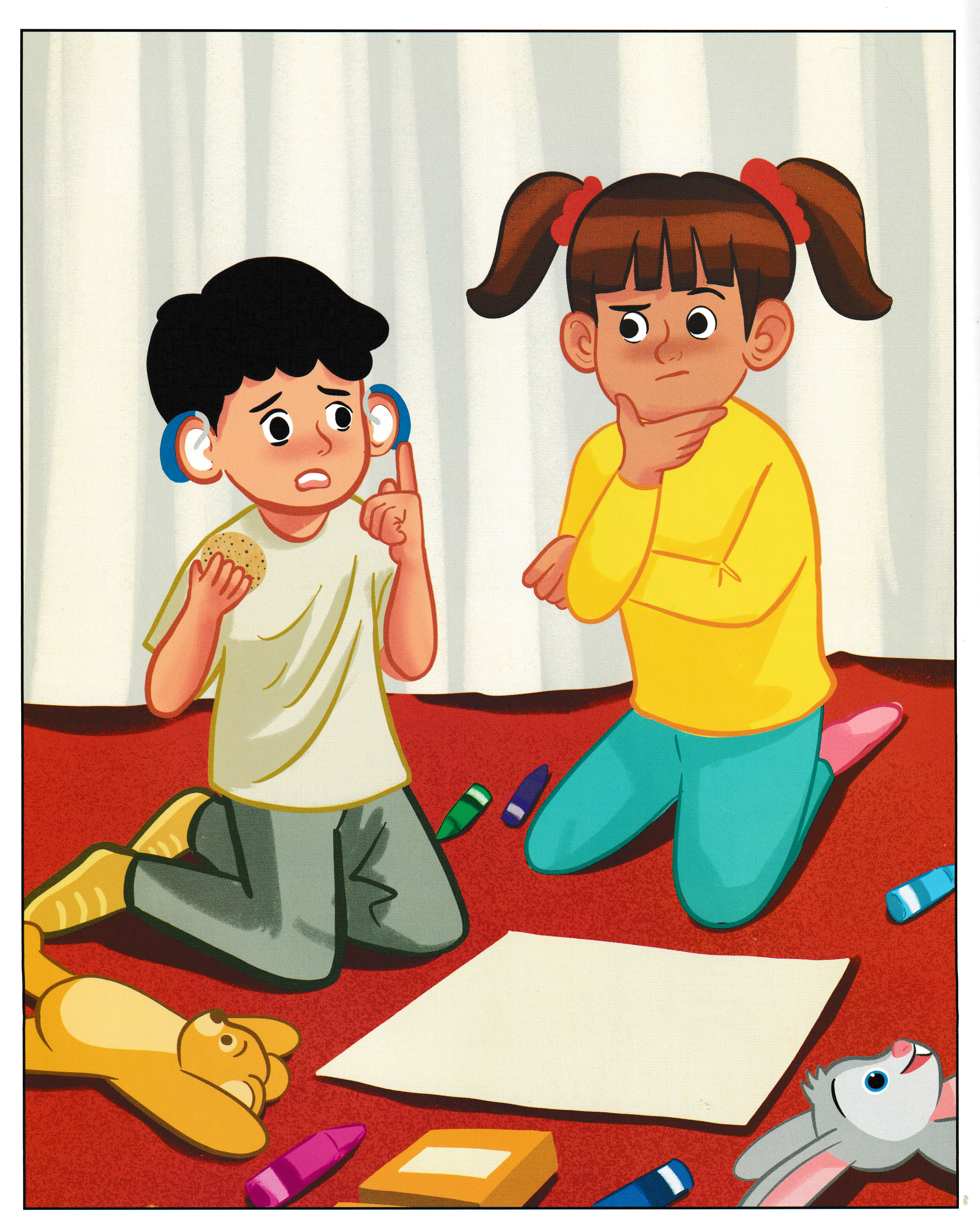
Returning to their building, they visit their new neighbours in the apartment next door. Using her own way of communicating, with hand movements and an Arabic/English dictionary, the woman welcomes them. But the boy spies a little girl hiding from them. When he approaches her, it is evident that neither can understand the other. But through the sharing of food and art, the two children find their own way to communicate.
 
This story is deeply personal for Toronto author Deborah Kerbel whose own sister had been born profoundly deaf. Deborah Kerbel's Author's Note speaks of her sister's abilities to connect, and Next Door's story reflects that ability for children who find different ways to communicate because of hearing and language differences. Undoubtedly a child who has a hearing impairment and one whose language is different than those around them may both feel at a disadvantage when trying to communicate. But, as the boy demonstrates, his disability is not a hindrance to living a good life, one in which he communicates with others, just in his own way. He successfully uses American Sign Language and his hearing aids to enable connection with others. But, when he meets the new little girl next door, he's on an equal playing field as she struggles to get him to understand her. But, with some effort and the common ground of art, along with a tasty cookie, a connection is made.
From Next Door, written by Deborah Kerbel, illustrated by Isaac Liang
Deborah Kerbel opens up about her sister's story to help convey the possibility that communication does not cease with hearing or a different language. We find new ways to communicate when the customary route is not available. By juxtaposing the boy's circumstances with that of his new young neighbour, Deborah Kerbel has found a way for any child for whom communication is challenging, because of, for example, cultural differences, emotional barriers, or physical barriers, to accept that different can still be effective. 
 
Isaac Liang is a deaf illustrator from Singapore who imbues the art of Next Door with knowledge and sensitivity. Because of his personal experiences with hearing impairment, Isaac Liang has found a way to bring the quiet and the connection for the children through his digital art. Because comprehension through the sense of hearing is compromised, his emboldens the story with colour and shape. Perhaps words are unnecessary but meaning still comes through with every building, person, and detail. 

Next Door is a great picture book for helping children develop their visual literacy skills and their empathy and acceptance for those who communicate differently. Hopefully it will help them to recognize that we do not all hear or see or understand the same way–the cyclist who almost collides with the child assumed the boy could hear him coming–and to find new ways of communicating that might work better for others. And, when it all comes down to it, kindness always works.

September 05, 2018

Anna at the Art Museum

Written by Hazel Hutchins and Gail Herbert
Illustrated by Lil Crump
Annick Press
978-1-77321-043-8
36 pp.
Ages 4-7
September 2018

Little Anna's mother has taken the girl to an art museum where everything seems "old and boring." But when Anna goes exploring and tries to have a little fun, roaring at the Babylonian ceramic panel of a lion, the guard chastizes her to be quiet. When she plays peekaboo with a baby, she almost topples a decorative urn. Even a colourful modern sculpture that looks like an interactive toy is not to be touched. Again her mother has to have the talk with her about "No shouting. No running. No climbing. No touching."
From Anna at the Art Museum by Hazel Hutchins & Gail Herbert, illus. by Lil Crump
While art is emulated unknowingly by the patrons (this will be the fun part for young readers to find), Anna thinks about "If only the museum could be turned inside out. Or the world outside in." But after the attendant allows her to peek in a workroom where conservators work at restoring art, including one in which she sees a little girl just like her (Mary Cassatt's Little Girl in a Blue Armchair, 1878), Anna's perspective on art changes.
From Anna at the Art Museum by Hazel Hutchins and Gail Herbert, illus. by Lil Crump
Anna at the Art Museum is so charming and so real.  Any teacher or parent who has ever taken a young child to a museum or art gallery for the first time knows that, in order to grab a child's attention, a connection must be made. Without a connection, art is just stuff on the wall and on pedestals. It's the same for text and people and ... everything.  Problem is that, while Anna is trying to find her connection with the art, all the adults around her are telling her she's making the wrong connections because she's trying to do it through touch and play. Finally, when she is able to make a visual connection, the art in the museum and her world come together and become real.
From Anna at the Art Museum by Hazel Hutchins and Gail Herbert, illus. by Lil Crump
Authors Hazel Hutchins and Gail Herbert have taken a big story of a little girl in an overwhelming art museum and brought it to the perspective of a child. We see and hear what Anna does, how she is experiencing the museum.  For that reason, Anna at the Art Museum will be a worthwhile addition to home, classroom and school libraries for reading prior to and after visits to places like museums and art galleries where, on the surface, children might be challenged to make connections easily.  But connections can be made and, if the plethora of artwork depicted by Nova Scotia artist Lil Crump is any indication, there's always something with which a person can connect. 
From Anna at the Art Museum by Hazel Hutchins and Gail Herbert, illus. by Lil Crump
Still Lil Crump's illustrations go beyond the famous artwork she reproduces in cameos throughout the book. (The appendix About the Art describes each piece and its creator, as well as details about the medium and gallery where it is displayed.) Lil Crump gives Anna life and lots of it. She is bored and playful and inquisitive and surprised. She is a child and, thank heavens, she still has the spark to see beyond the surface.

In Anna at the Art Museum, Hazel Hutchins, Gail Herbert and Lil Crump have shown us that there is much life in art and art in life and that seeing it might just take a fortuitous connection.