Showing posts with label neighbourhood. Show all posts

December 15, 2025

Community Snowman

Written by Deborah Kerbel
Illustrated by Tine Modeweg-Hansen
Groundwood Books
978-1-77306-951-7
32 pp.
Ages 3-7
October 2025 
 
There's snow out there and loads more coming. Whether it's in a yard, in a park, or in a schoolyard, there will be snow persons being built. (Actually, there will be snowmen, snow women, snow friends, snow dinosaurs, snow bears, and more.) And what's better than building a snow person? It's building it with others.
From Community Snowman, written by Deborah Kerbel, illustrated by Tine Modeweg-Hansen
After an ordinary night of sleep, a child awakens groggily to their routines. But when they look out the winter, everything changes from ordinary to amazing because the world outside is coated with deep, fluffy snow. Soon it's a race to get dressed and bundled up and head outside with their caregiver, perhaps a grandfather, following with similar enthusiasm, albeit a little more slowly and carrying a satchel with his knitting. So, as the child make snowballs and snow angels and starts making a snowman, their grandfather clears a bit of bench and gets to his sock knitting.
From Community Snowman, written by Deborah Kerbel, illustrated by Tine Modeweg-Hansen
All around people are bustling. Some trudge through the snow, heads down, oblivious to the snow joy in this child and in other children. Maybe they're going to work or to school, or walking their dogs, or going for groceries. But our child is busy too. Now they are starting to build a snowman. The bottom ball is always easy because you just roll it in to place. But the next ball, still large and needing to be lifted, is far more challenging, especially when another kid throws our child off balance with a snowball. No worries. He comes to help them. Two children then become three children at work and then a couple of teens join in to create the three-ball shape. 
From Community Snowman, written by Deborah Kerbel, illustrated by Tine Modeweg-Hansen
Now everyone gets in on the creation, with food stuffs like a pickle, chocolates, and bagels being added, and then with bits and bobs of clothing: a hat, work gloves, a shawl, and earmuffs. Everyone contributes something. But what does a man without a coat, socks, or gloves have to give? A poppy.
 
Without words, Deborah Kerbel tells a story of a community coming together to build a snowman and building kindness and compassion. It's a powerful story of how a small thing can become a meaningful moment. What's starts as play leads to friendship, to acceptance, and to benevolence. That's tough to get all that into a story that is wordless. But, with Deborah Kerbel as the storyteller, I'm not surprised by the strength of her story to draw her readers in, touch them, and make them feel the fellowship of the moment. But Tine Modeweg-Hansen, a Copenhagen-born illustrator who lives in Montreal, gives Deborah Kerbel's story the life of colour and community. In watercolour and ink, Tine Modeweg-Hansen's art, very reminiscent of the award-winning Quentin Blake, fills in those words with activity and detail. The cold and the wetness of the snow, the movement of the characters, human and animal, and the diversity of people makes the story spirited. Everyone and everything becomes part of a story that could only be described as feel-good.
 
At this time of year, with snow on the ground and holiday cheer ringing out, let's remember that community can come together spontaneously and with the greatest of heart without the giving of expensive gifts or conspicuous charity. It can happen naturally from a child's delight with snow and not overlooking those who might need help, whether it's lifting a ball of snow or providing a pair of socks.
From Community Snowman, written by Deborah Kerbel, illustrated by Tine Modeweg-Hansen

September 17, 2025

Our Corner Grocery Store

Written by Joanne Schwartz
Illustrated by Laura Beingessner
Tundra Books
978-1-77488-791-2
32 pp. 
Ages 3–7 
September 2025 
 
When Our Corner Grocery Store by Joanne Schwartz and Laura Beingessner was first published in 2009, it was heralded as a tribute to  neighbourhood shops and the communities they supported. It was a finalist for the Marilyn Baillie Picture Book award. Now with a new cover, Our Corner Grocery Store will introduce new readers to Anna Maria and her nonna and nonno as they work and bring their community together.
From Our Corner Grocery Store, written by Joanne Schwartz, illustrated by Laura Beingessner
On Saturdays, Anna Maria visits her Nonno Domenico and Nonna Rosa's corner grocery store. This is her favourite day of the week. After her nonna feeds her a hearty breakfast in their home which is behind and above the store, Anna Maria gets to work in the small shop. She sorts freshly-delivered bread and sweeps. She plays outside with her friend Charlie and watches her nonno and nonna serve customers. They make fresh sandwiches and watch as the neighbourhood kids pick out their sweet treats. And with only a few breaks to help make dinner and play with Charlie, Anna Maria enjoys a full day at her grandparents' corner store.
From Our Corner Grocery Store, written by Joanne Schwartz, illustrated by Laura Beingessner
For those who've enjoyed a local grocery store, where you were served by familiar faces and chatted with friendly staff, Our Corner Grocery Store is a reminder of the community that is rarely enjoyed in our world of big box stores and chain supermarkets. While there are still wonderful examples of these corner stores, they are fewer and far between now. So, for many, Our Corner Grocery Store is a reminder of a different time. It was a time when children could go alone to the corner store and pick up a freezie and sit on a stoop and enjoy it with their friends. It was a time when candies were selected and placed in small paper bags, rather than in pre-packaged bundles. Many children will not know these times, but their parents may, and their grandparents definitely would and Our Corner Grocery Store will open discussions about how things have changed and how they're still the same. (Most children will still recognize the freezies—even if called ice pops or something else—and the joy of picking one out on a hot summer day.)
From Our Corner Grocery Store, written by Joanne Schwartz, illustrated by Laura Beingessner
Joanne Schwartz, who wrote the award-winning Town Is by the Sea (illustrated by Sydney Smith, 2017), captures a sense of community and family in Our Corner Grocery Store. That community is both one of neighbours and family with Anna Maria helping all of them. It's refreshing to see a child helping her grandparents without whining that she'd rather be on her tablet or demanding to do something else. Joanne Schwartz has reminded us that there is still an innocence in children that makes them want to be with their family and do modest things like sort fruit and help make meals. I know those kids are out there but too often we get the books of precocious children who do silly and outrageous things for laughs and just because they can. It was lovely to visit Nonno Domenico and Nonna Rosa's grocery store, especially as Laura Beingessner captures the very essence of a neighbourhood store and a child's place in it.
 
There's a freshness and simplicity to Laura Beingessner's illustrations. Using ink and paint, she gives details but doesn't lose the sensibility of the store and its neighbourhood. Most of us will recognize a store with its wooden-slat bins holding a collection of fruits and veg with hand-printed price signs, and a store with candies alongside brooms, moka pots, and toilet paper. But Our Corner Grocery Store is more than just about a store. It is about a place of people (and cats and dogs). And Laura Beingessner includes them all. 
From Our Corner Grocery Store, written by Joanne Schwartz, illustrated by Laura Beingessner
I have a strong desire to go find a local grocer and get some fresh produce, say hello to those who welcome us into their domain, and hope that, like this grocery store, it will continue to serve, to flourish, and to provide goods and community for many years to come.
 
• • • • • • •  
 
The 2009 edition of Our Corner Grocery Store:

December 08, 2023

Once, a Bird

Written by Rina Singh
Illustrated by Nathalie Dion
Orca Book Publishers
978-1-4598-3143-8
32 pp.
Ages 3-6
September 2023 
 
I know many people are trying to forget a time of lockdowns and restricted movements during the early years of the pandemic. But Rina Singh and Nathalie Dion's story reminds us of the gifts of nature and community that were revealed during those tenuous times. And though their story takes us out of those times, it never lets us forget what discoveries were made when tensions were high, isolation was the norm, and health was insecure.
From Once, a Bird, written by Rina Singh, illustrated by Nathalie Dion
Without words, Rina Singh tells a story of the arrival of a robin to a land of complexity and quiet. There may be snow on the ground but as the bird travels over parks, highways, and agricultural fields, there is no one to be seen. It is people-less and still. It could be a dystopian landscape, but Nathalie Dion gives us hope and light in the greenness of the fields, the blues of the skies and the unscathed infrastructure.
From Once, a Bird, written by Rina Singh, illustrated by Nathalie Dion
The bird finds its way to a budding tree outside a walk-up apartment building where an elderly woman spots it. She alone is looking out her windows as her neighbours keep their blinds and curtains closed. But then others take in the sight of the robin, each in their own way. Whether it be a grandson and grandfather watching it with binoculars, or a young person taking photos with her phone, or two children chatting between windows. Even a new puppy dog is held up to witness the bird.
 
As life goes on for the bird, building its nest, laying its eggs, and feeding its young, the neighbourhood begins to open up: a door, a window, a walk with the dog. And, with time, the neighbourhood returns to normal as the bird and its young fly off, having taken the people through the tough times.
From Once, a Bird, written by Rina Singh, illustrated by Nathalie Dion
Although the audience for Once, a Bird is listed as 3-5 years of age, the depth of the storytelling is far greater, and could be for all ages. Rina Singh has given a nuanced story of isolation and connection with nature that may have been born of a pandemic, and all who have been living with solitude and/or withdrawal, whether because of distance, mental health, or even personality, will also understand. She offers hope that separation does not mean desolation, and that opening oneself to the natural world can help sustain us.

I've reviewed a number of picture books illustrated by Montreal's Nathalie Dion (e.g., The Big Bad Wolf in My House, I Found Hope in a Cherry Tree, The Dog's Gardener) and her watercolour and gouache art lends itself well to contemplative stories such as Once, a Bird. There is an intangible, almost divine, sense of beauty that comes from both introspection and deep relationships depicted in her illustrations. Her art is sensitive to the ephemeral nature of challenges, keeping her colours subdued but calm, and introducing brighter colours, initially only on the robin, as the people emerge, and the neighbourhood returns to life.
 
For hope through difficult times, take note of how once a bird brought a community together, and how Rina Singh and Nathalie Dion were able to do the same to tell its and our story.
 
• • • • • • • 

A French-language edition is also available as Il était une fois un oiseau.


November 24, 2023

Next Door

Written by Deborah Kerbel
Illustrated by Isaac Liang
Kids Can Press
978-1-5253-0658-7
32 pp.
Ages 3-7
October 2023
 
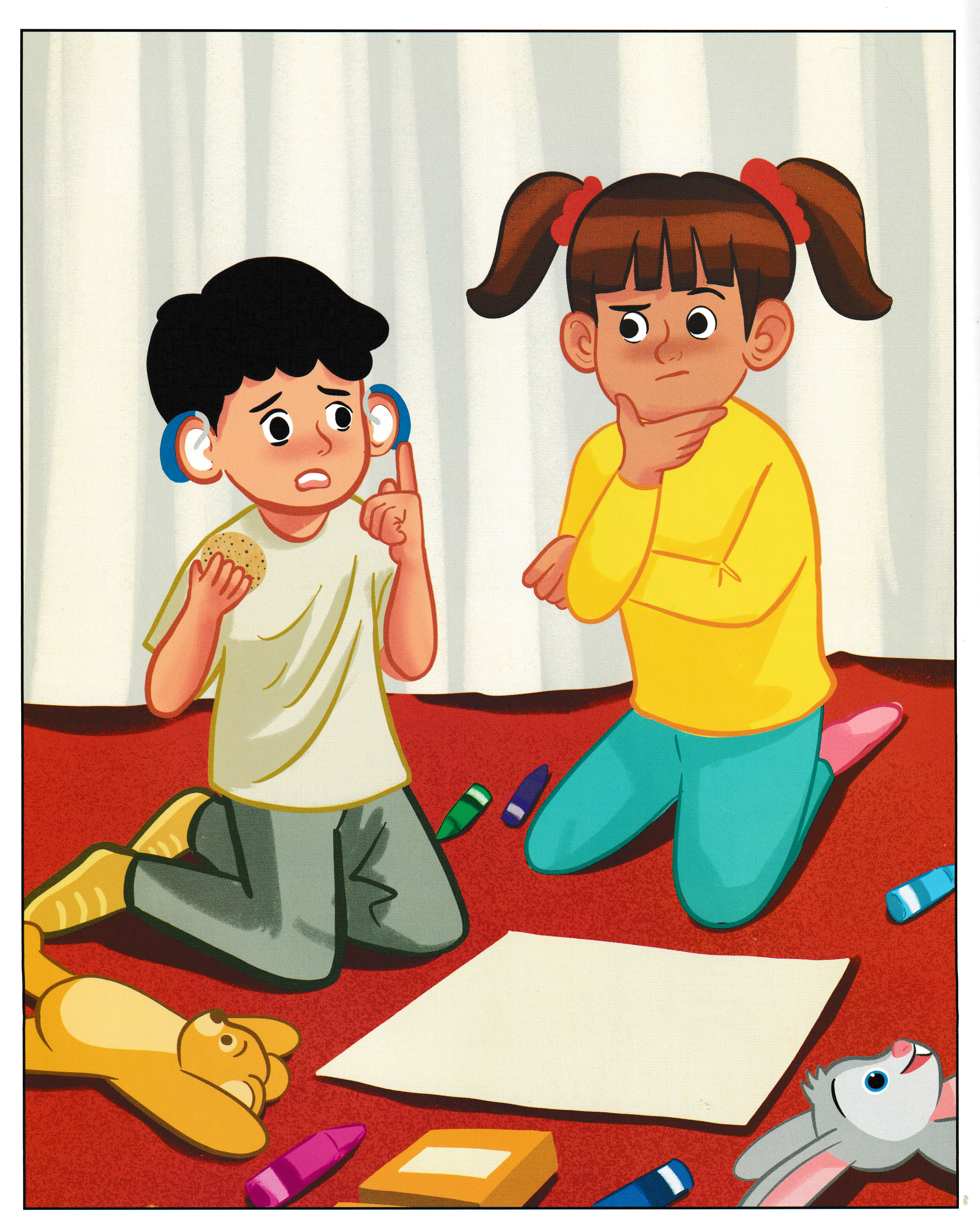
Wordless picture books have a general hush about them. In wordless books, i.e., ones in which the stories are told through illustrations alone, no one is speaking and there is no text to distract. It's all rather subdued. In fact, it's a perfect reflection of what the main character, a young boy with hearing aids, must experience much of the time. But don't be fooled into thinking that there is no story to be told or personal connection to be made.
From Next Door, written by Deborah Kerbel, illustrated by Isaac Liang
A boy and his mother head out from their home just as a moving van arrives and begins unloading boxes. It's evident these are not their goods as the boy is familiar with the places and people he encounters on their walk. Though he may have limited hearing, as evidenced by his hearing aids, he notices everything, from the musician busking, the construction workers at work, and even baby birds in a high nest. It's unfortunate when a cyclist races past the boy, startling him into dropping his teddy bear. But, after confirming he is okay, communicating via American Sign Language, his mother settles the boy.
From Next Door, written by Deborah Kerbel, illustrated by Isaac Liang
Returning to their building, they visit their new neighbours in the apartment next door. Using her own way of communicating, with hand movements and an Arabic/English dictionary, the woman welcomes them. But the boy spies a little girl hiding from them. When he approaches her, it is evident that neither can understand the other. But through the sharing of food and art, the two children find their own way to communicate.
 
This story is deeply personal for Toronto author Deborah Kerbel whose own sister had been born profoundly deaf. Deborah Kerbel's Author's Note speaks of her sister's abilities to connect, and Next Door's story reflects that ability for children who find different ways to communicate because of hearing and language differences. Undoubtedly a child who has a hearing impairment and one whose language is different than those around them may both feel at a disadvantage when trying to communicate. But, as the boy demonstrates, his disability is not a hindrance to living a good life, one in which he communicates with others, just in his own way. He successfully uses American Sign Language and his hearing aids to enable connection with others. But, when he meets the new little girl next door, he's on an equal playing field as she struggles to get him to understand her. But, with some effort and the common ground of art, along with a tasty cookie, a connection is made.
From Next Door, written by Deborah Kerbel, illustrated by Isaac Liang
Deborah Kerbel opens up about her sister's story to help convey the possibility that communication does not cease with hearing or a different language. We find new ways to communicate when the customary route is not available. By juxtaposing the boy's circumstances with that of his new young neighbour, Deborah Kerbel has found a way for any child for whom communication is challenging, because of, for example, cultural differences, emotional barriers, or physical barriers, to accept that different can still be effective. 
 
Isaac Liang is a deaf illustrator from Singapore who imbues the art of Next Door with knowledge and sensitivity. Because of his personal experiences with hearing impairment, Isaac Liang has found a way to bring the quiet and the connection for the children through his digital art. Because comprehension through the sense of hearing is compromised, his emboldens the story with colour and shape. Perhaps words are unnecessary but meaning still comes through with every building, person, and detail. 

Next Door is a great picture book for helping children develop their visual literacy skills and their empathy and acceptance for those who communicate differently. Hopefully it will help them to recognize that we do not all hear or see or understand the same way–the cyclist who almost collides with the child assumed the boy could hear him coming–and to find new ways of communicating that might work better for others. And, when it all comes down to it, kindness always works.

December 14, 2021

I Love You More

Written by Emil Sher
Illustrated by Barbara Reid
North Winds Press (Scholastic Canada)
978-1-4431-7580-7 
32 pp.
Ages 0-8
December 2021/January 2022

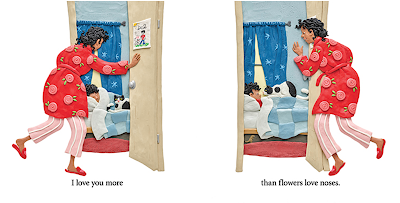
We know that telling someone you love them is special but how to express the measure of that love? In Emil Sher's newest picture book, which could only have been given the depth of emotion that Barbara Reid's textured art could convey, it's a game of whimsical comparisons and heartfelt declarations that demonstrate that there are so many ways to love.
From I Love You More by Emil Sher, illus. by Barbara Reid
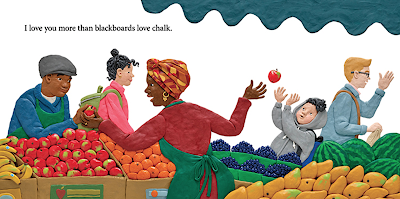
From an early morning greeting–"I love you more than flowers love noses" through breakfast and a walk to school, a mother and child express their love and witness those expressions by others. From the schoolyard to the classroom, and a mom's lunch on a park bench, there are so many vignettes that show connections and affection. Parents and caregivers are there for the children before school–"I love you more than laces love shoes"–and picking them up after school to return home, with everything showing closeness and linkages. ("I love you more than stars love wishes" and "I love you more than pianos love hands" were two of my favourites.) And as the day ends, with mum falling asleep on the couch, a child uses words and actions to express his love.
From I Love You More by Emil Sher, illus. by Barbara Reid
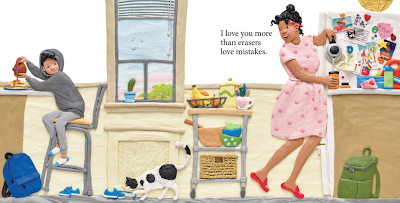
Emil Sher explains the word game that he and his family played comparing affection with a connected pairing like erasers and mistakes, runways and planes and answers and question marks. Not only does I Love You More communicate loads of messages of things that go together, it offers light-hearted word play off of which Barbara Reid's artwork bounces in delight. Using her trademark plasticine in bright colours and detailed settings inside homes, multi-storey buildings, schools and on streets, Barbara Reid gives life to Emil Sher's text. There a calico cat that cuddles, cleans and plays, neighbours that enjoy their balconies and children unique in their own ways. Not only do we see the city in all its glory, we see the life that gives and feels love.
From I Love You More by Emil Sher, illus. by Barbara Reid
The first reading of I Love You More will give young readers some laughs for the playful pairings and affection conveyed as well as the basis for playing their own word game. But subsequent readings–and there will be more readings–will give them opportunities to delve into the illustrations' details and give them food for thought about what it means to be connected.

September 29, 2020

Night Walk

Written by Sara O'Leary
Illustrated by Ellie Arscott 
Groundwood Books
978-1-55498-796-2
32 pp.
Ages 3-7
September 2020


I think a lot of us have sleepless nights, nights during which we are "owl-eyed" and our heads churn. When this little girl can't sleep, her dad offers her a solution in a Night Walk.
 
From Night Walk by Sara O'Leary, illus. by Ellie Arscott
So pulling on boots, hat and coat over her pajamas, the child joins her father in a walk "just to be out." As might be expected, everything looks different at night, as they walk "from one island of light to the next like explorers," peeking into the lit windows of people's late-night lives. There's the variety store's sad-looking woman joyously welcoming a baby in her apartment above. There are people at restaurants or eating at home. Others are walking dogs or cycling or traveling by bus. One man plays his violin to his pets on his deck decorated with fairy lights.  Everywhere there is life and colour, sound and quiet.
 
From Night Walk by Sara O'Leary, illus. by Ellie Arscott

A final stop on their Night Walk takes the child and her father to the playground where she recognizes that this community of people and places, which she usually only experiences in the daylight hours, is her home and where she wants to be.

From Night Walk by Sara O'Leary, illus. by Ellie Arscott 

Sara O'Leary loves to give us a child's perspective on the ordinary which becomes extraordinary through their eyes and she has done the same with Night Walk. By seeing her community, one she passes through regularly during the day, at a different time and lit from outside by the moon and streetlights and from within by lamps, the child sees differently and is amazed. It's this wonder that Sara O'Leary, whose previous works include A Family is a Family is a Family and When I Was Small, captures in the depth and simplicity of the child's words and thoughts. They are told from her perspective and with her voice, and the fascination with this new world is unmistakable.
From Night Walk by Sara O'Leary, illus. by Ellie Arscott

This is Toronto artist Ellie Arscott's first picture book but she matches the marvel of the child's experience with illustrations that reflect the sweeping landscape of the neighbourhood. In her watercolour and ink artwork, Ellie Arscott takes the homes and businesses and people in the community from the backdrop into the all-around i.e., foreground, middle ground and background. The reader will still always be able to pick out the child in her bright red vest but Ellie Arscott makes us feel like we are seeing the world from the young girl's point of view and it is this world that is the star of Night Walk.

I hope that there will always be someone to guide a young child on a Night Walk of discovery, safe in their community and open to all the lights that shine.

October 04, 2019

Small in the City

Written and illustrated by Sydney Smith
Groundwood Books
978-1-77306-198-6
40 pp.
Ages 4-7
September 2019

On October 2, the Canada Council for the Arts announced its finalists for the 2019 Governor General's Literary Awards, and Small in the City was one of the nominated titles for the English-language children's book illustration. This is Sydney Smith's fourth nomination–he and JonArno Lawson won in 2015 for Sidewalk Flowers (Groundwood, 2015)–and this one is all the more distinct as Small in the City is his first picture book as author and illustrator.
From Small in the City by Sydney Smith
Though the cover makes a young child who looks out of a streetcar window larger than life, minimizing the buildings reflected in the glass, Sydney Smith's illustrations show a child peripheral to the city. They look out over the streets of people doing and buildings standing. When they leave the streetcar, they are dwarfed by everything in the busy city. People march past looking at their feet or their phones. Sounds of taxis and car horns and construction and sirens are loud and scary. It's almost too much.
From Small in the City by Sydney Smith
But as the child ventures through the cold streets and snowflakes begin to fall, they know how to be a part of that city. They know which alleys to avoid and wonderful places to hide or climb or enjoy the steam from a dryer vent. As they walk from the busyness into a neighbourhood of trees and yards, local stores and houses, and a park, this child gives advice about where safety can be found. Soon enough the reader will observe that the child has posted salmon-pink notices to posts and fences and doors. The child may be small in the city but a lost cat is even smaller. Still, with the flurries becoming snow squalls with near whiteout conditions, the child reaches home, convinced that "You will be all right."
From Small in the City by Sydney Smith
Sydney Smith's artwork, created with ink, watercolour and gouache, journeys with the child from a dark-toned city centre through neighbourhoods infused with colour to a home blanketed in the lightness of peace and contentment. It's a Toronto of commerce and community, movement and stability, and this child lives in it and of it. They may be small but they are not insignificant and as they walk closer and closer to home, their presence becomes more meaningful.

Being small in the city is a perspective most adults have forgotten. It's seeing the heart of the city as it is, free of interpretation and expectation but infused with perception. As such, Small in the City is a story of a child for children and most certainly for those who have ever lost a pet. This could have been a sad story of loss and fear but Sydney Smith makes it one of resilience and hope, expectation and common sense. It's seeing shelter and warmth, food and comfort where adults might only see trees and shrubs, a dryer vent, the fishmonger and a church ledge. It's perspective as perception that makes Small in the City effusive in community and family and takes the reader from the obscurity to the light of home with its happy ending.

April 21, 2017

Stop Feedin' da Boids!

Written by James Sage
Illustrated by Pierre Pratt
Kids Can Press
978-1-77138-613-5
32 pp.
Ages 3-7
April 2017

I wish I could review more books illustrated by Pierre Pratt. Unfortunately for me, his illustrations often accompany French-language texts and I am reluctant to reveal my lack of skill reviewing French books.  So, although author James Sage is British, I am delighted to be able to review an English-language text that is fortunate to be illustrated by Montreal's Pierre Pratt, a man whose bio includes copious nominations and awards, including the Governor General Literary Award for Children's Book Illustration, Le Prix TD, Bratislava's Golden Apple Award, and the UNICEF-Bologna Book Fair Illustrator of the Year Award.
From Stop Feedin' da Boids!
by James Sage
illus. by Pierre Pratt
In Stop Feedin' da Boids!, Swanda and her dog Waldo and her family move from the country to Brooklyn.  Though she misses the wildlife, she soon finds herself enamoured with the birds that flock outside their apartment onto the iron fire-escape.
From Stop Feedin' da Boids!
by James Sage
illus. by Pierre Pratt
Providing the birds with a bird feeder, more and more pigeons come to visit, much to the dismay of her neighbours who are displeased with the mess.  Swanda seeks help from so-called experts–a pest control officer, a zookeeper and an exotic bird fancier– but it's not until Lexi from the deli tells Angelo who tells another neighbour who shares with another neighbour and so on and so on the titular advice that Swanda rids the building and neighbourhood of her countless feathered friends. But Swanda's story doesn't end there. A chance sighting and a lot of heart finds Swanda discovering some new wildlife to welcome into her home.
From Stop Feedin' da Boids!
by James Sage
illus. by Pierre Pratt
James Sage weaves a light-hearted story about a little girl who likes animals perhaps a little too much but whose intentions are always charitable.  But it's Pierre Pratt's artwork that provides the context for Swanda's love of animals and the neighbourhood that envelops her.  She is part of her community, whether it be the countryside or a diverse neighbourhood of people, animals and urban life. They are both detailed landscapes of colours and textures, solitude and activity.  Look for the dogs or cats looking out windows, or Mr. Kaminski's two-toned shoes, or the mega-armed bodybuilder.  There's a 1920s feel to the Brooklyn of Stop Feedin' da Boids!, and Pierre Pratt uses strong strokes and bold colours to create a cityscape of tall angled buildings and community of diverse people, all different in size, colour, shape, expression and dress.  It's wild and it's homey.  It's the same style that charmed readers in Gustave (by Rémy Simard, Groundwood, 2014) and No-Matter-What Friend (by Kari-Lynn Winters, Tradewind Books, 2014) by bringing an intensity to the storytelling and readers into the story's setting.

Go ahead and read this one aloud–get that Brooklyn accent right!–but be sure to share the illustrations to get the whole story behind why Swanda should "Stop Feedin' da Boids!"

January 23, 2017

The Best Mistake Mystery (The Great Mistake Mysteries, Book 1)

by Sylvia McNicoll
Dundurn
978-1-4597-3625-2
120 pp.
Ages 9-13
January 2017

"I know that if you relax enough to stretch, reach, and risk, the twists along your path will lead to something amazing." - Sylvia McNicoll

Student Stephen Nobel sees mistakes in every turn of his path, past and present, anticipating more in his future.  His days as a Grade 7 student are logged as a compendium of mistakes, though Sylvia McNicoll only shares three consecutive days, of ten mistakes each, in The Best Mistake Mystery, demonstrating that a whole lot can happen in three days, both gaffes and opportunities, depending on how you look at them.

His dad’s new business, Noble Dog Walking, has given Stephen the opportunity to regularly walk the Bennetts’ two dogs: Ping, a small Jack Russell, and Pong, a tall greyhound.
And we’re off–like a wagon pulled by a mismatched team, a horse and a pony.” (pg. 18)
Just like for the dogs, for whom every step is a new adventure of sounds and smells and textures, Stephen becomes witness to a myriad of happenings which will all become part of a bigger mystery or two.  He finds a bag of poop lodged in a tree.  He meets up with an annoying and relentlessly questioning classmate, Renée, with whom he learns that an earlier school drill was actually a response to a bomb threat.  Ping tackles a skateboarder.  Pong urinates on some bricks being worked by a contractor, Mr. Mason.  Then the teen sees the principal, Mrs. Watier, in the orange VW Beetle he’d seen their former custodian Mr. Sawyer driving earlier.  Later Stephen observes that same VW driving around the school’s parking lot late at night.

The mysteries begin to mount when school is cancelled the next day because that orange car had crashed into the school overnight and, because of a brick on the accelerator, filled the school with fumes.  Worse, the car belongs to Renée’s older brother, Attila, who is questioned, though he denies any role, since his car was at the high school auto shop.  The twists and turns of who did what, who was where and why something happened become a full-blown pot boiler with threatening texts, an impending wedding, a dognapping and ransom demand, and a whole lot of snooping, with and without dogs in tow. 

I love a good mystery and The Best Mistake Mystery is a great one.  Sylvia McNicoll throws in so many red herrings and suspects that readers will be changing their hunches as to who did it and why repeatedly.  Just like the winding neighbourhood through which Stephen walks Ping and Pong, a lovable but unlikely duo of canine champions, The Best Mistake Mystery is bursting with characters, storylines, life lessons and dogs. And readers will love all of that.  

But personally, I adore Sylvia McNicoll’s message, and the premise for this new series, The Great Mistake Mysteries, that mistakes are opportunities that enrich our lives.  They may certainly feel like challenges, even curses, but ultimately most mistakes should be considered serendipitous, providing chances to learn and grow and tweak our lives for the better.  And, if you solve a mystery or two in the process, all the better.


Check back tomorrow for my interview with author Sylvia McNicoll about The Best Mistake Mystery and her new series, The Great Mistake Mysteries (cute logo posted below).

Also, get in on one of the book launches for The Best Mistake Mystery this week for a chance to get a signed copy of the book, and maybe share a doggie treat with your own canine best friend. Details here.