Showing posts with label Orca Book Publishers. Show all posts

April 22, 2026

Gone Forever?: Places to See (and Save) Before They Disappear (Orca Think)

Written by Erin Silver
Illustrated by Xulin Wang
Orca Book Publishers
978-1-4598-4098-0
96 pp.
Ages 9–12
February 2026 
 
Reviewing Erin Silver's latest non-fiction book, Gone Forever?: Places to See (and Save) Before They Disappear on Earth Day seems fitting. On a day on which we celebrate our Earth and how to protect it, we have much to learn from a book about global locations threatened by climate change.
From Gone Forever?: Places to See (and Save) Before They Disappear, written by Erin Silver, illustrated by Xulin Wang
Erin Silver, who has written countless books of non-fiction including Good Food, Bad Waste (2023), Mighty Scared: The Amazing Ways Animals Defend Themselves (2024), and Plant Attack (2025), takes on the challenging topic of climate change. However, by taking the perspective of showcasing key locations, from the Arctic to the Pacific Islands and the Amazon rainforest, Erin Silver speaks less of generalities and more to familiar sites and places people live. 
From Gone Forever?: Places to See (and Save) Before They Disappear, written by Erin Silver, illustrated by Xulin Wang
The book is organized into four major chapters:
  1. Major Meltdown
  2. Cue the Waterworks
  3. Under Fire
  4. Life on Earth
The first looks at the impacts of global warming on the ice caps in Antarctica and in the Arctic. The impacts examined go beyond the ice sheets and glaciers, and into the water, the krill, polar bears, and more. Insights from those who visit those locations are shared, as are suggestions about helping to combat climate change.
From Gone Forever?: Places to See (and Save) Before They Disappear, written by Erin Silver, illustrated by Xulin Wang
The next chapter looks at changing weather patterns, which cause more rain and severe storms in some areas, resulting in places being flooded, and sinking and shrinking. Mitigation with mangroves and engineering are just two approaches. Other areas will get drier, which could lead to food insecurity. A Q & A with a climate architect reveals much about solutions to this aspect of global warming. 
From Gone Forever?: Places to See (and Save) Before They Disappear, written by Erin Silver, illustrated by Xulin Wang
The next chapter examines the fires in California and in British Columbia, while the final chapter looks at the threat to biodiversity, focusing on the Amazon rainforest and the Galá
pagos Islands. As in the earlier chapters, there are interviews, including with a climate adventurer and a biologist, info boxes called "The Info Express" with interesting tidbits,  and always assurances that activism can help. Completing this book are a comprehensive glossary and lists of resources for young people to access.
 
Erin Silver delivers a thorough examination of how climate change is affecting our world. And, though she makes it a global discussion, her research brings it closer to home, even if it's not our home specifically. It's a personal look at how global warming is impacting everyone and everywhere. That means it's up to everyone to do something, anything. With numerous photographs and Toronto's Xulin Wang's bold and colourful digital art, Gone Forever?: Places to See (and Save) Before They Disappear takes the reader around the world to see evidence of climate change. But with text and art combined, the message is not one of hopelessness but rather one of expectancy and action. And on this Earth Day, Gone Forever?—note the question mark—has a productive message to share.

March 14, 2026

My Language Is a Garden

Written by E.G. Alaraj
Illustrated by Rachel Wada
Orca Book Publishers
978-1-4598-4065-2
32 pp.
Ages 6–8
February 2026 
 
How a child begins to learn a language is a complex process of exposure and comprehension. It involves being introduced to it from those who speak it and who cherish it. And when it's taught with love and reverence, it almost sacred. For this father sharing his language with his child, it's everything.
From My Language Is a Garden, written by E.G. Alaraj, illustrated by Rachel Wada
In evocative rhyming verse, E.G. Alaraj gives a father voice to embody his language with memories and meaning as he shares it with his daughter. It's obvious how much his language means to him, reminiscent of people and places, and tastes, smells, and sounds. E.G. Alaraj gives weight to this parent's words, both tender and passionate.  
My language roams the desert
And fills its pails with sand.
Builds castles, forts, and shelters
That stretch across the land. (pg. 12) 
From My Language Is a Garden, written by E.G. Alaraj, illustrated by Rachel Wada
This father is determined, but not vehement, drawing on images of cities and mountains, shores and markets, to convey what language can bring and conjure. There is magic in language, and he is earnest about sharing this with his child.
Our language, it will bloom—
Add sweetness to the air,
And tie my heart to yours,
 
So I'm with you everywhere. (pg. 27–29)
E.G. Alaraj's poem is emotional, as is the premise upon which it is based. Her author's note explains her husband's efforts to help their children learn and then retain their Arabic language. But My Language Is a Garden could speak to any parent or educator teaching a heritage language, hopeful of children holding that connection with culture and ancestry, as they balance contemporary influences outside of that language. But instead of drilling that language and forcing communication by using it, this father invites and illustrates with much affection and safety, coaxing his child to see and feel the language, just as the reader does with E.G. Alaraj's expressive words. The rhyming verses soothe and transport, as well as entice inwards and open worlds beyond. 
From My Language Is a Garden, written by E.G. Alaraj, illustrated by Rachel Wada
As dramatic as E.G. Alaraj's words are, Rachel Wada's illustrations give them artistic substance. Her art was created digitally and feels like watercolours, suspending people and places in different times and spaces. Rachel Wada, whose art has honoured books like I Am Wind: An Autobiography (Rachel Poliquin, 2024) and Shizue's Path (Mark Sakamoto, 2023), expresses strength and sensitivity with her use of line and shape. Whether in her gloriously lush gardens of poppies, in the rolling dunes of sand, or in the branches and stems of trees, Rachel Wada makes big locales seem personal and intimate, and the people within them connected.
 
As teachers and parents in Canada, we often use English language acquisition and learning as milestones for children, but learning a heritage language should be similarly appreciated. Beyond its purpose in communication, those languages help connect children with their families, their cultures, and their ancestors. It gives their lives colour and history, heart and identity. This father's language, depicted as a living entity that grows and feels, nurtures and responds, already enriches his life, connecting him with so much, and E.G. Alaraj makes us hopeful that he is able to cultivate that same abundance for his child.

January 19, 2026

Sophie Shares the Stars

Written by Heather Smith
Illustrated by Catherine Petit
Orca Book Publishers
978-1-4598-4015-7
32 pp.
Ages 3–5
September 2025 
 
Sophie has lived with her Michael since she was three years old. (She is eight now.) It's obvious that she adores her adopted father and he her. In fact, he's given her the universe both as a ceiling display and as a deeply felt sentiment.
My Michael says, "You are the whole universe."
I think that means he can't live without me. (pg. 3) 
From Sophie Shares the Stars, written by Heather Smith, illustrated by Catherine Petit
The life they have together is filled with love. They spend time talking, playing, and going to beach, and, when she messes up, he helps do better. But when her father, affectionately called My Michael, becomes ill, things change. It doesn't change between them but around them. Sophie tries to help him as he helped her when she had been ill. But Michael's illness is not a flu or a cold or a broken leg or anything with a visible nature. He has one of the myriads of invisible illnesses that most people do not see. Not surprising that their neighbour, Mr. Donaldson, declares that he saw Michael the day before and he didn't look sick. The child never knows what to say—and she shouldn't have to explain for her father—and always changes the subject.
From Sophie Shares the Stars, written by Heather Smith, illustrated by Catherine Petit
But the one thing Sophie can do is share her universe with him. By removing some of the glow-in-the-dark stars from her ceiling and creating the Big Dipper on the wall behind her Michael's bed, she shares the stars with him. Her Michael has good days and bad, but she's always there to hope he'll feel better, to make sure he knows he's loved, and to see him as the Michael is.
From Sophie Shares the Stars, written by Heather Smith, illustrated by Catherine Petit
Sophie Shares the Stars is a touching story about a familial relationship, but it tackles more by including adoption and an invisible illness. In her "Author's Note," Heather Smith speaks to her personal connection with the story, but, even without that knowledge, I know that she would have treated the topics with sensitivity and understanding, never with judgement. Anyone with an invisible illness, particularly those which are chronic or a mental illness, can attest to the frustration and isolation that comes with dealing with the illness and with others. If those others cannot see a cast, an open wound, or bandages, many will not understand the complex symptoms with which the ill person is suffering. I appreciate that Heather Smith never reveals Sophie's Michael's illness, but it really is irrelevant to the story. It is invisible and that's all that needs to be said. Because the story is about Sophie and her relationship with her Michael, and how they became a family, and grow stronger each day as a family, regardless of the challenge of his illness.
 
Montreal illustrator Catherine Petit uses pencil and digital tools to create the upbeat artwork that is all about the relationship between father and daughter. This child is well loved, bursts with energy and wonder, and shares her goodness with her father, knowing that he would choose her again. His open arms, and his dedication to bringing her joy and safety, are visible in every illustration, even when he's not feeling his best. And her devotion to him is palpable. She may be his universe, but Catherine Petit lets us see her smile, her eyes, and her concerned hugs and soothing caresses that he is hers.
 
I know this picture book is aimed at young children, and those who have been fostered or adopted will appreciate how a new family can be created when a birth family is not available to care for a child. But Sophie Shares the Stars will also be a reminder to all readers that there are those who live with invisible illnesses who many appear unimpaired—"appear" is the operative word—but whose lives and those who love them are significantly impacted, even when symptoms wax and wane. Thankfully for both Sophie and her Michael, they are there for the other to make life not just bearable but bright.

December 08, 2025

The First Christmas Tree: An Innu Tale

Written by Ovila Fontaine
Illustrated by Charlotte Parent
Translated by Ann Marie Boulanger 
Orca Book Publishers 
978-1-4598-4180-2 
56 pp.
Ages 6–8
October 2025 
 
Many of us are getting into the holiday spirit and putting up Christmas trees or thinking about getting one. Perhaps that's why I've put off reviewing this lovely new picture book until there's snow on the ground and a nip in the air. 
From The First Christmas Tree: An Innu Tale, story by Ovila Fontaine, illus. by Charlotte Parent
Ovila Fontaine, an Innu Elder from the First Nation of Uashat mak Mani-Utenam on the northern shore of the St. Lawrence River, won the 2024 Governor General award for his French-language edition, Le premier arbre de NoĂ«l. That lovely book has now been translated into English and more young people will have the opportunity to read a story of the Great Manitou choosing the fir tree to bring brightness during the cold, harsh winter.

The Great Manitou begins his search for the perfect tree. For each of the trees he approaches, he recognizes positive attributes, knowing how each tree is used by the Innu. There's the birch tree with its flexibility and strength, useful for snowshoes, bowls, harpoons, canoes, and drums. There's the larch (tamarack) tree with its hard wood and usefulness for bows and sleds, and more medicine made from its bark. The Great Manitou also visits the black spruce whose mossy branches provide firewood for the Innu and food for caribou. The only tree he disregards is the fir tree.
From The First Christmas Tree: An Innu Tale, story by Ovila Fontaine, illus. by Charlotte Parent
When the Great Manitou approaches the birch tree, the larch tree, and the black spruce, he asks them if they'd like to be the first Christmas tree and bring joy to Innu children. Each tree declines, only concerned for how it might affect them. Finally, with the fir being the only tree left to ask, the first Christmas tree is found, and the other trees are chastened by the Great Manitou and given attributes that characterize them to this day.
From The First Christmas Tree: An Innu Tale, story by Ovila Fontaine, illus. by Charlotte Parent
Though many of us will recognize the fir as the most popular Christmas tree, Ovila Fontaine's tale shows us that that recognition was hard-won. Like many things in life in which your potential is not seen or disregarded, timing can be everything. For the fir tree, it was being in the right place at the right time, and being open to an opportunity, something the other trees were too egotistical to embrace. More importantly, each tree that declined the honour of being the first Christmas had consequences thrust upon them by the Great Manitou, censured for their lack of generosity and humility. And though most of the trees showed pride and minimal grace, Montreal illustrator Charlotte Parent makes all the forest and its animals glorious. Using gouache, she creates these expansive scenes of woodland life, flora and fauna. The dark and cold of winter is expertly achieved with lavender blue and variations thereof and with brushstrokes for mounds of snow. The infrequent but bold pink of the animals—described in an illustrated glossary of English and Innu-aimum words—and persons indicates the rich presence of the spirit of the Great Manitou in the natural world and its omnipresence.
From The First Christmas Tree: An Innu Tale, story by Ovila Fontaine, illus. by Charlotte Parent
An enchanting book for the holiday season, The First Christmas Tree is a different kind of origin story. Not only do we learn the Innu tale of how the fir became known as a Christmas tree, but we also learn why the birch loses its leaves in the fall, why the larch sheds its needles, and why the black spruce never grows tall or wide and has prickly needles. With its quietly dazzling artwork, it's a picture book to be appreciated beyond the Christmas season.
 
• • • • • • • 
 
Le premier arbre de Noël
Ecrit par Ovila Fontaine
Illustré par Charlotte Parent
La Pastèque  
978-2-897771492 
2023 


November 12, 2025

Star Sailor, the Story of Words

Written by Sara Cassidy
Illustrated by Julie McLaughlin
Orca Book Publishers
978-1-4598-3663-1 
40 pp.
Ages 6–8
August 2025 
 
Where would we be without words? With a few letters, or sometimes a lot of them, words either alone or with others can inspire, inform, entertain, emote, and connect. They help us communicate that which we need to share, and to learn, and so much more. Their story is one of endowment, giving readers and listeners the bounty of their wealth, and empowerment.
From Star Sailor, the Story of Words, written by Sara Cassidy, illustrated by Julie McLaughlin
Sara Cassidy begins with an introduction to what words are and how words arise, including the titular "star sailor" which is an astronaut. She discusses how words can be very old while others can arise daily. (Did you know that every day at least ten English words are spoken for the first time? [p. 4]) Sara Cassidy also talks of words coming from sounds that they imitate (e.g., hum), from the combination of words (e.g., bedroom), including to form portmanteaus like "hangry," and from sharing common characteristics (e.g., the ribs of an umbrella and our body's ribs).  
From Star Sailor, the Story of Words, written by Sara Cassidy, illustrated by Julie McLaughlin
There are multiple pages of the geographical and cultural origin of words, whether it's cheddar named after a village in England, and Dalmatians originating in Dalmatia, Croatia, or those arising from languages of First Peoples, like canoe, skunk and the cayenne pepper, and from foreign languages (e.g., patio, glitch, and sauna). Words can be built from roots, prefixes and suffixes, and they can be modified as needed. With all this information shared in a snappy presentation, Sara Cassidy still acknowledges that sometimes words have arisen by mistake, that they've arisen without our understanding of their origins, and that sometimes words need to be retired when they become inappropriate or obsolete. There's a lot to know about words, but Sara Cassidy breaks it down into manageable chunks, which will help inspire new lexophiles.
From Star Sailor, the Story of Words, written by Sara Cassidy, illustrated by Julie McLaughlin
Sara Cassidy, who has written everything from picture books (e.g., Helen's Birds, 2019) and early readers (e.g., The Great Googlini, 2018) to middle-grade fiction (e.g., A Boy Named Queen, 2016) and hi-lo YA (e.g., Skylark, 2014), gives us an illustrated non-fiction book about lexicology, the study of the form, meaning, and use of words. Just like words, it is informative, creative, inspiring, and definitely entertaining. And with Julie McLaughlin's illustrations, Star Sailor, the Story of Words is also colourful and playful.
 
Julie McLaughlin, who illustrated the award-winning Why We Live Where We Live (Kira Vermond, 2015), complements Sara Cassidy's light-hearted approach to an involved topic with her digital artwork that is vibrant and whimsical, inclusive and detailed. Beyond the text, there are many information elements to parse out of Julie McLaughlin's illustrations. Whether it's her depictions of onomatopoeia or her use of LEGO as building blocks for words, Julie McLaughlin keeps everything informative in a playfully enlightening way. 

I love a book that celebrates words and how they work. Because language is always evolving, Star Sailor, the Story of Words gives readers the basics of how words come to be and come to change, helping young people to understand the role words play in culture and how all of us have and will continue to be a part of that. 

November 05, 2025

Bark Twice for Murder (Orca Currents)

Written by John Lekich
Orca Book Publishers
978-1-4598-4148-2
120 pp.
Ages 9-12
RL 3.0
August 2025 
 
There may be a murder and some nefarious actions in John Lekich's latest hi-lo novel but, rest assured, regardless of the title, no dogs are injured, abused, or killed in Bark Twice for Murder. And though it may not be important to many readers, for this reader, it's critical. Instead, Bark Twice for Murder has food, humour, a mystery to solve, and a talking dog. See? Lots to love and nothing to fear.
 
Fourteen-year-old Harry lives with his grandmother Elinor since his parents were killed in a plane crash a few years earlier. His dad was a chef with a food truck named "Pasta Express," and his mom loved to bake. No surprise that Harry finds comfort—maybe a bit too much comfort, says his therapist—in cooking for others. Fortunately, he has lots of people to talk to after Elinor, who took over the food truck business and expanded it, has set up one truck outside of Vancouver's New Day Shelter to provide breakfasts and lunches for the unhoused. A lonely Harry likes getting to know the people there and becomes friendly with Stanley and his dog Waffles. The duo are noteworthy in several respects. First, Stanley was once a chef and begins to teach Harry how to cook and improve service. Second, he has conversations with Waffles who is a dog that hates being a dog. And when Rudy "the Worm" Carelli, a regular at their small takeout restaurant, tells Harry that Stanley has stolen a portrait from Rudy's father, and that Stanley is in danger, Harry gets involved.
 
But when Stanley is murdered, and Harry hears a voice in his head saying, "Somebody murdered my best friend" (p. 29), Harry is compelled to partner with Waffles to find Stanley's murderer and solve the mystery of the missing portrait of Rudy's grandmother.

John Lekich who first provided this reader with great laughs and characters in The Prisoner of Snowflake Falls (Orca, 2012) does so again in Bark Twice for Murder. His young protagonists always seem to get mixed up in some criminal activity but it's generally due to circumstances beyond their control and with them really trying to do good. And with some supernatural elements involving Waffles, both in his origin story and his ability to communicate with Stanley and then Harry, John Lekich surprises readers as well as makes them laugh. Add in characters named Jimmy the Fork, Carmine "the Cobra" Carelli, Shaky Sam, Rudy "the Worm" and, of course, Waffles the dog, and you've got a cast of quirky or unnerving personalities that take Harry out of his comfort zone and make him feel like he belongs.  
 
Don't be surprised if you can't figure out the mystery of the missing portrait or who murdered Stanley. John Lekich doesn't make it an easy solve, but he does let Harry solve it. Bark Twice for Murder may be a hi-lo story written at a third grade reading level, but John Lekich ensures that the story is intricate enough for older middle-grade readers to become invested in Harry's story and in solving the mystery. They might even get wrapped up in learning to cook risotto, lasagna, or minestrone. That's because John Lekich has seasoned this book with so much richness of story that they'll be barking—with laughter—for another. 
August 04, 2025

Miss Match (Orca Currents)

Written by Susan Hughes
Orca Book Publishers
978-1-459842069
144 pp.
Ages 9–12
RL 2.8 
April 2025 

With Grade 8 almost finished and summer just weeks away, thirteen-year-old Polly, along with her friends Dev, Zoey, Roger and Matt, starts thinking about how to make a little money for summertime fun like going to the movies and baseball games, enjoying fast food, and shopping. Polly, ever the entrepreneur, comes up with the idea of a matchmaking service for all the Grade 7 and 8 students attending the end-of-year dance.

When they advertise their service and get students to submit applications with a $20 fee–money-back guarantee–they are overwhelmed with responses. They pull in over $2000 and Polly is tasked with setting up a dedicated bank account for the money. When she is unable to do so, Polly lies. It becomes the first of several lies she makes to her friends and her mother to cover up her embarrassment and fears of how they will judge her. Readers will wonder what her classmates would think about the accuracy of the nickname they've given her, i.e., Miss Match, if they knew the discrepancy between what she promises and what she actually does.

Susan Hughes has dazzled this reader with the breadth of her writing. I have reviewed her picture books (e.g., What Happens Next), her middle-grade novels (e.g., Four Seasons of Patrick), her YA (e.g., Virginia), and her non-fiction (e.g., Off to Class: Incredible and Unusual Schools Around the World). Each time, Susan Hughes writes with sensitivity and understanding. In Miss Match, she reminds us that everyone comes up with ideas some time, and some of them will be fantastic and some will be ludicrous. How we deal with our successes or our failures will speak more to our natures and strengths than the accolades or the judgements. Susan Hughes knows this and ensures that Polly comes across as a real person, who actually has a great idea but can't always deliver on it because she is shy, she is nervous about being judged, and she is young. Fortunately, she hangs around with a great bunch of people whose understanding of what it's like to be 13 is evident. They don't just forgive, they empathize.
 
While Miss Match is part of the Orca Currents series of high-interest novels for middle-grade students reading below grade level (reading level here is 2.8), Susan Hughes does not take short-cuts by giving readers a simple plot with little substance. She packs in issues of dishonesty, first crushes, inclusion–her friends are diverse in their abilities and disabilities, in their nationalities, and even in their gender-loving nature—and more. She tells the story with sensitivity and understanding but gives readers an ending that is satisfying without being contrived. Perhaps after celebrating a few more birthdays and with a little more experience, Miss Match could see herself in business again, providing a valuable service and growing her entrepreneur skills, one match at a time.

April 21, 2025

Keep Our World Green: Why Humans Need Gardens, Parks and Public Green Spaces

Written by Frieda Wishinsky
Illustrated by Sara Theuerkauf
Orca Book Publishers
978-1-459838383
96 pp.
Ages 9-12
For release May 13, 2025
 
Tomorrow is Earth Day 2025 and, though Keep Our World Green will not be released for a few more weeks, it's appropriate to speak to the book's messaging about conservation and protection of green spaces and their importance for our physical health, mental health and community.
As long as you have a garden, you have a future, and as long as you have a future, you are alive. ~ Frances Hodgson Burnett
Frieda Wishinsky starts her book with a look at the history of green spaces, whether they be when our ancestors moved from hunting and gathering to growing their own food, or the establishment of gardens. She highlights particular historic ones like the ancient gardens of Egypt and Japan to the classic gardens of Padua and Versailles and gardens from the 20th century, and their value in protecting diversity and endangered species, and in the development of medicines and in celebrating religious beliefs.
From Keep Our World Green: Why Humans Need Gardens, Parks and Public Green Spaces, written by Frieda Wishinsky, illustrated by Sara Theuerkauf
Next, Frieda Wishinsky delves into green spaces of parks that are known for their beauty, from Central Park in New York City to Vietnam's Cat Ba National Park in Vietnam.
From Keep Our World Green: Why Humans Need Gardens, Parks and Public Green Spaces, written by Frieda Wishinsky, illustrated by Sara Theuerkauf
We may get solace and nourishment from these spaces but they also inspire creativity from visual artists, musicians, and writers. There is the famous art of Claude Monet, Frida Kahlo, and Georgia O'Keefe, and the words of poets and storytellers from Henry David Thoreau to E. B. White. Composers like Vivaldi found inspiration in nature as did contemporary musicians like Joni Mitchell and Michael Jackson.
From Keep Our World Green: Why Humans Need Gardens, Parks and Public Green Spaces, written by Frieda Wishinsky, illustrated by Sara Theuerkauf
But our green spaces, both natural and created, are in danger. From our use of chemicals to land development and climate change, our green spaces and their elements, like the bees and birds, are challenged. Frieda Wishinsky has some suggestions for young people as to how they might help based on how others have heeded the call for conservation and environmental protection. Whether you start small with cuttings or planting your own or a community garden, there is always something that a young person, and the adults around them, can do to help keep our world green.
From Keep Our World Green: Why Humans Need Gardens, Parks and Public Green Spaces, written by Frieda Wishinsky, illustrated by Sara Theuerkauf
Frieda Wishinsky presents a varied but comprehensive look at green spaces, whether created by landscape architects, humble home gardeners or the natural world. She celebrates their beauty and their virtues, recognizes their role in keeping us happy, enlightened and healthy, and inspires us to ensure their longevity and security. It's a big order to include all those aspects in a book on green spaces but Frieda Wishinsky, a lover of gardens and parks and natural spaces (see for example, A Flower is a Friend), gives readers enough to whet their interest and how to find more information. (A list of resources is provided.)
 
While many photographs of people and places are used to support the text, Vancouver's Sara Theuerkauf provides illustrations of people and places. She ensures that these green spaces are bustling with life, whether it be of the wild variety, of the humans enjoying the space, or of the green life that exudes its own spirit. 

Depending on where you live, spring may be budding out or imminent, and hopefully we'll all be thinking about what we can do to celebrate the green spaces at home and abroad, and to ensure they are with us for a long, long time. Frieda Wishinsky encourages readers to see the green spaces, to acknowledge their power and importance, and to take actions, even in humble and little steps, to make sure those much-needed gardens, parks and public green spaces continue to flourish and be lauded for what they offer.
 

March 27, 2025

No Huddles for Heloise

Written by Deborah Kerbel
Illustrated by Udayana Lugo
Orca Book Publishers
978-1-4598-3910-6
32 pp.
Ages 4-7
March 2025 

I like Heloise. Heloise knows what she likes and doesn't like. She likes sledding and fish popsicles, sharing rocks with friends, and her own space. 
From No Huddles for Heloise, written by Deborah Kerbel, illustrated by Udayana Lugo
What she doesn't like, other than the leopard seals that no penguins like, are crowds and hullabaloo and those huddles that penguins do for warmth and protection. Those huddles that are just too close.
Huddles give Heloise the heebie-jeebies.
The jim-jams.
The willies.
And the collywobbles.
From No Huddles for Heloise, written by Deborah Kerbel, illustrated by Udayana Lugo
But how can she say no to the other penguins and not hurt their feelings? Typically, she has a number of excuses from taking her fish for a walk or polishing her rock collection. Heloise is perfectly happy on her own, enjoying her things, her space, and her own thoughts. 
From No Huddles for Heloise, written by Deborah Kerbel, illustrated by Udayana Lugo
But then the other penguins stop asking her to join them in huddles and Heloise begins to question her own wants and needs, and seeks companions elsewhere. Unfortunately, her travels are disappointing and even dangerous on her own and she returns home to find that her friends have found a way to accommodate her need for personal space while offering her the protection that huddles provide.

It's lovely to read a story about an introverted character who doesn't feel compelled to fit in with the extroverts or have the extroverts demand that their way of socializing and gregarious behaviour is preferable and, worse, the norm. I'm so glad Deborah Kerbel, an accomplished writer of picture books, middle grade and YA, demonstrates an acceptance of the introverted Heloise rather than sympathy for her nature. (The sympathy should be towards the attitude she experiences from those who are not introverted.) Instead, Deborah Kerbel validates the fullness of Heloise's life without the partying and closeness demanded or even just requested by her penguin peers. Heloise is a happy penguin, accepting of her nature and choices. She's never rude but she is true to her herself. Too bad that she feels like she doesn't belong because belonging does not mean being the same as others.
From No Huddles for Heloise, written by Deborah Kerbel, illustrated by Udayana Lugo
I love the positive messages that Deborah Kerbel gives us in No Huddles for Heloise, and BC's Udayana Lugo gives us the whimsy of that message in Heloise and her friends. From their accessories, like pom-pom hats, scarves, and bandanas, to props like a rock polisher or a whale stuffed animal, Udayana Lugo demonstrates the differences among the penguins are the norm and Heloise's introversion is just another manifestation of wonderful diversity. She created her art primarily using gouache and coloured pencils, which gives a bright and rich portrayal of the penguins and the landscape in which they live and play.
 
I'm with Heloise–except for the fish popsicles–that quiet and solitary activities offer comfort in ways that many extroverts will never understand. While we all must engage with others for safety, for work, or for other needs, it's lovely to see Heloise be accepted and even accommodated for her needs, not chastised for being different.

March 19, 2025

Ins and Outs

Imagined by Elizabeth Withey
Illustrated by Salini Perera 
Orca Book Publishers
978-1-4598-3835-2
32 pp.
Ages 3-5
March 2025 
 
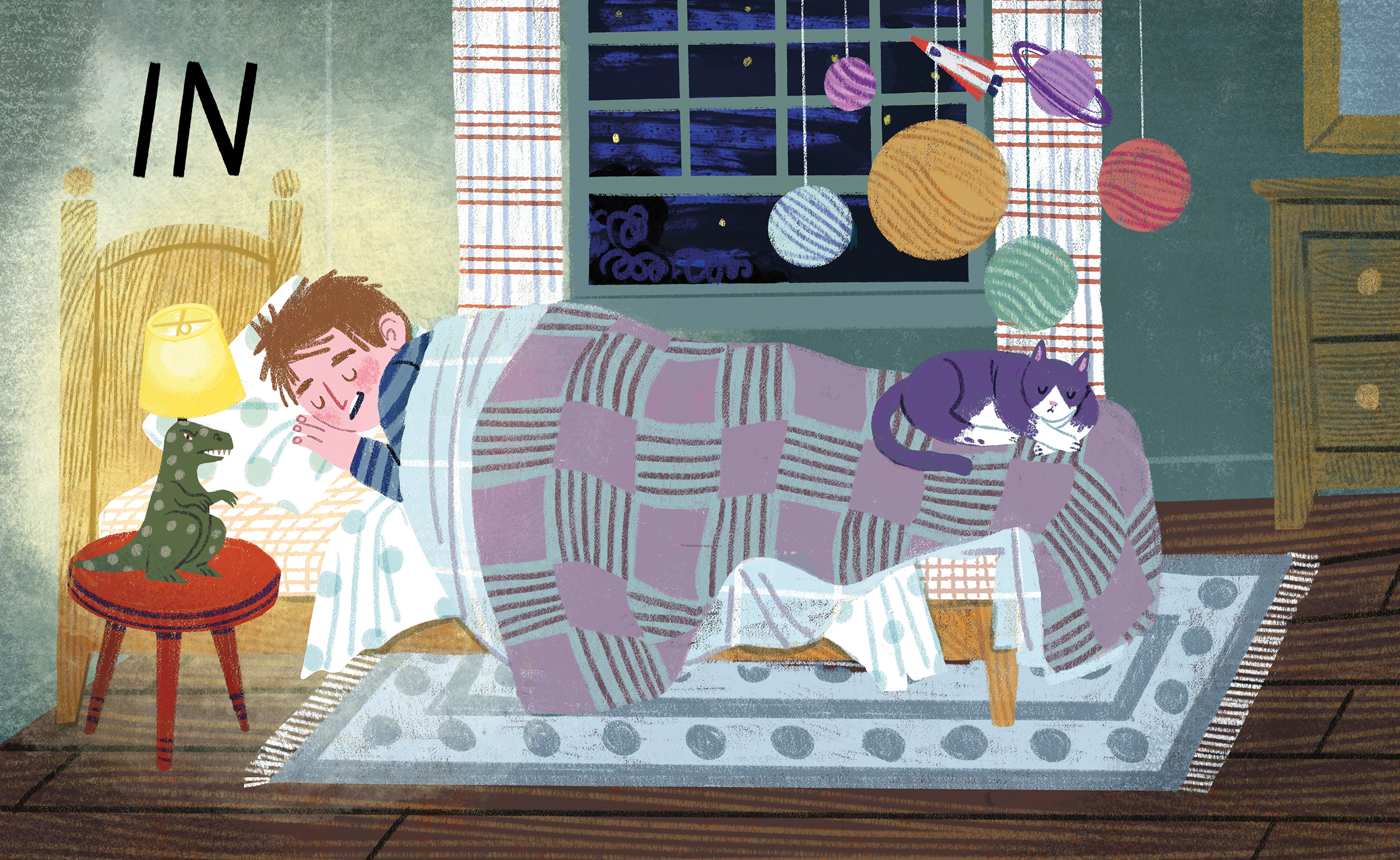
You'll notice that, instead of indicating Elizabeth Withey as the author above with the words "Written by," I've repeated the words "Imagined by" as they appear on the front cover of Ins and Outs. This is because Ins and Outs is primarily a concept book that reinforces the idea of positioning i.e., being in and out. The text is limited to two words: "in" and "out." But Elizabeth Withey, a Calgary author, journalist and visual artist, doesn't need more words. She has envisioned fabulous pairings of circumstances that many children will recognize to easily pick up on the concepts of in and out.
From Ins and Outs, imagined by Elizabeth Withey, illustrated by Salini Perera
The first combination of in and out involves a child snug in bed, in the house, while outside the bedroom window a cat prowls in the dark and a luna moth takes flight. From a school yard to cycling on the street, playing in a garden or with a playground parachute, a diverse group of children show things that happen outside and inside, and in and out of a wide variety of places and things.
From Ins and Outs, imagined by Elizabeth Withey, illustrated by Salini Perera
Elizabeth Withey gives young children many opportunities to grasp the concept of "in" and "out" from both obvious and not-so-obvious scenarios. The "inside" and "outside" are the obvious like the children who are standing outside the school or the cat that exits the bedroom to head outside. But Elizabeth Withey has also imagined cold breath going in and condensed exhalation going out, and a nail in the road that will soon be "in" a bike tire and allow air out. The use of a hearing aid to allow sound in and the use of sign language to allow words out is a one of the most thought-provoking of circumstances. As such, the learning of the concept of in and out becomes an interactive read with every double-page spread offering chances to find more and more examples than the most obvious.
From Ins and Outs, imagined by Elizabeth Withey, illustrated by Salini Perera
Because the text is so sparse, the illustrations must provide much of the basis for the learning of the concept, and artist Salini Perera's digital illustrations provide that basis handsomely. She ensures that the big idea of "in" or "out" is evident but then provides little details that enhance the messaging about the concept. With art lively both in content and form, Salini Perera, whose illustrations were reviewed in Beautiful You, Beautiful Me, helps children see the ins and outs of our world.
From Ins and Outs, imagined by Elizabeth Withey, illustrated by Salini Perera
It's different to read a concept book that isn't a board book, especially one that focuses on such a basic concept. But I guess all concepts are basic until you understand them.  Still, Elizabeth Withey and Salini Perera have imagined a refreshing way to teach the idea of position and get children to think even more deeply about how it can be demonstrated in the most unusual of activities.

March 07, 2025

Nevin Knows

Written by Mireille Messier
Illustrated by Elena Comte
Orca Book Publishers
978-1-4598-3684-6
32 pp.
Ages 3-5
February 2025 
 
What does Nevin know? He knows what he wants. 
From Nevin Knows, written by Mireille Messier, illustrated by Elena Comte
Nevin may not have a lot of words in his vocabulary yet–he is but a toddler–but he's pretty clear how to say "No" and "Yes" and he knows when to use them. When he and his Grandpa Frank are getting ready to visit the park, Grandpa Frank asks Nevin what he wants to wear. He gives his grandson choices, some of which are quite silly, and Nevin makes it clear which is the best choice for him. He may not realize it, but Grandpa Frank is giving the child the opportunity to be part of the process rather than just making him do what his caregivers are going to do anyways. (The sneakers were always the best choice, as was the ball cap.)
From Nevin Knows, written by Mireille Messier, illustrated by Elena Comte
Even as they start heading out, Grandpa Frank asks Nevin which way to go. (I'm sure Grandpa Frank knows but by giving Nevin the opportunity to voice his choices, the child is amused and given power.)
From Nevin Knows, written by Mireille Messier, illustrated by Elena Comte
Nevin knows his favourite places to play and how much he likes greeting the birds and a dog, and even which flowers to pick for Nana. (Thankfully he doesn't want the planted flowers but rather the dandelions.)
From Nevin Knows, written by Mireille Messier, illustrated by Elena Comte
The whole point of Nevin Knows is how a grandfather allows his grandson to make choices that empower him, even if Grandpa Frank has known all along what they would be doing and where they would be going. It's a kind and compassionate grandparent who can ask rather than always be telling a child what's going to happen. I suspect that even if Nevin chose something inappropriate, Grandpa Frank would turn it around to ensure that it was a good choice but one that Nevin made himself. Mireille Messier, who has written numerous picture books in both English and French (e.g., The Magic Cap, Nutcracker Night, and Fatima and the Clementine Thieves just to name a few), easily gets into the head of a young child and what they want and to thrive, and into the shoes of those fun and kind grandparents who care for their grandchildren without being authoritarian. Mireille Messier demonstrates that young children, even those with limited vocabularies, can share their feelings and needs if there are only those who would ask and listen.
 
Elena Comte, a Montreal illustrator and nurse, created the artwork for Nevin Knows digitally, emphasizing the shapes and colours that would appeal to very young children. But more than that, she creates scenes that emphasize the elements would be most important to children: dandelions, birds, swings, a playground spring rider, grass, and those they love. 

Both Mireille Messier and Elena Comte make sure that this book truly is about Nevin. There may be caregivers who supervise and protect him, but Nevin is given the capacity to make choices. With that gift of empowerment, even in allowing him to make the simplest of choices, his grandfather bolsters his little grandson and provides him with opportunities for building his confidence and his voice, and for strengthening their relationship. How lovely is that?