Showing posts with label supernatural. Show all posts

November 05, 2025

Bark Twice for Murder (Orca Currents)

Written by John Lekich
Orca Book Publishers
978-1-4598-4148-2
120 pp.
Ages 9-12
RL 3.0
August 2025 
 
There may be a murder and some nefarious actions in John Lekich's latest hi-lo novel but, rest assured, regardless of the title, no dogs are injured, abused, or killed in Bark Twice for Murder. And though it may not be important to many readers, for this reader, it's critical. Instead, Bark Twice for Murder has food, humour, a mystery to solve, and a talking dog. See? Lots to love and nothing to fear.
 
Fourteen-year-old Harry lives with his grandmother Elinor since his parents were killed in a plane crash a few years earlier. His dad was a chef with a food truck named "Pasta Express," and his mom loved to bake. No surprise that Harry finds comfort—maybe a bit too much comfort, says his therapist—in cooking for others. Fortunately, he has lots of people to talk to after Elinor, who took over the food truck business and expanded it, has set up one truck outside of Vancouver's New Day Shelter to provide breakfasts and lunches for the unhoused. A lonely Harry likes getting to know the people there and becomes friendly with Stanley and his dog Waffles. The duo are noteworthy in several respects. First, Stanley was once a chef and begins to teach Harry how to cook and improve service. Second, he has conversations with Waffles who is a dog that hates being a dog. And when Rudy "the Worm" Carelli, a regular at their small takeout restaurant, tells Harry that Stanley has stolen a portrait from Rudy's father, and that Stanley is in danger, Harry gets involved.
 
But when Stanley is murdered, and Harry hears a voice in his head saying, "Somebody murdered my best friend" (p. 29), Harry is compelled to partner with Waffles to find Stanley's murderer and solve the mystery of the missing portrait of Rudy's grandmother.

John Lekich who first provided this reader with great laughs and characters in The Prisoner of Snowflake Falls (Orca, 2012) does so again in Bark Twice for Murder. His young protagonists always seem to get mixed up in some criminal activity but it's generally due to circumstances beyond their control and with them really trying to do good. And with some supernatural elements involving Waffles, both in his origin story and his ability to communicate with Stanley and then Harry, John Lekich surprises readers as well as makes them laugh. Add in characters named Jimmy the Fork, Carmine "the Cobra" Carelli, Shaky Sam, Rudy "the Worm" and, of course, Waffles the dog, and you've got a cast of quirky or unnerving personalities that take Harry out of his comfort zone and make him feel like he belongs.  
 
Don't be surprised if you can't figure out the mystery of the missing portrait or who murdered Stanley. John Lekich doesn't make it an easy solve, but he does let Harry solve it. Bark Twice for Murder may be a hi-lo story written at a third grade reading level, but John Lekich ensures that the story is intricate enough for older middle-grade readers to become invested in Harry's story and in solving the mystery. They might even get wrapped up in learning to cook risotto, lasagna, or minestrone. That's because John Lekich has seasoned this book with so much richness of story that they'll be barking—with laughter—for another. 

October 27, 2025

Songs for Ghosts

Written by Clara Kumagai
Penguin Teen Canada
978-1-774882825
399 pp.
Ages 14+
August 2025 
 
Reviewed from audiobook
Penguin Random House Canada Audio 
Narrated by Kenichiro Thomson and Susan Momoko-Hingley  
 
Each story from the past is one for the future. (p. 368)

There are two stories in Song for Ghosts. From different times and different places, these two stories run parallel until they converge. How they converge and why comes from the blending of music with family and the supernatural and Japanese culture. And in the end, a Japanese-American teen learns more about himself from a young Japanese woman from a century earlier. 
 
The story of seventeen-year-old Adam is a contemporary one. He hangs with friends—though he did just have a bad breakup with his boyfriend Evan—plays the cello, goes to Japanese school on Saturdays, and spends time with his family: stepmom Kate, baby half-brother Benny, and Dad when he's not away on military business which is often lately. The second story comes into play when Adam discovers an old book of letters in a wooden box with Japanese writing on it. Thinking it might be connected to his Japanese mom who passed when he was a baby, Adam begins to read the dated letters from a young woman who writes to her recently deceased Obasama (grandmother). And when a ghost begins to appear in his house, Adam is both terrified and intrigued. He wants answers, so he looks to the diary.
 
In this diary of letters, the young woman, who lives in Nagasaki, plays the biwa, a Japanese lute important in storytelling, and begins to take lessons from a blind biwa hōshi. Soon the diary writer is playing for ghosts in order to appease them. Meanwhile, her uncle decides it is time for her to marry, and, though not a man he has selected, she is courted by an American lieutenant. The connection she makes with him, and with his associate Mr. S–, changes the trajectory of her life. And when Adam is approved for a homestay in Nagasaki, he expands his search for information on the diary writer and her story. 
 
Songs for Ghosts, recently nominated for the White Pine award of the Forest of Reading, is a far more involved story than I can possibly recount here. First, Clara Kumagai immerses the reader, through both the diary writer's letters and Adam's visit to Japan, in the richness of Japanese stories and music, and of Japanese history, and of its culture from food to festivals. There is also romance, both for the diary writer and for Adam, though their relationships are complicated. Third, there is much to learn about Adam and his family, both in the U.S. and in Japan, and the bonds he has with them. Needing to learn more about his mother's family takes him to learn more about himself. Finally, I haven't even mentioned the correspondence of Adam's story and that of the diary writer to Puccini's Madama Butterfly. Even with all these distinct storylines and plot elements, Clara Kumagai is subtle and elegant in wrapping them together across time and place, and bringing Adam and the diary writer as well as other characters to merge in a satisfying and redemptive way. As such, readers as well as the ghosts who want to be remembered are appeased.

August 18, 2025

Ghost Circus

Written by Adrienne Kress
Illustrated by Jade Zhang
Union Square Kids
978-1-4549-4829-2
256 pp.
Ages 9–13
August 2025 
 
When Casey, a living boy, finds himself in the stands of a ghost circus, he is confused, as is Creepy Girl, a ghost with hollow eyes, who finds him. He'd already had a weird day where the school bus driver didn't see him and his classmate Emily presented their project without him. Now he's at the circus, which is filled with ghost performers, and Creepy Girl, with a little friend called Polterghost, is trying to help him, though not understanding herself why a boy who is not dead can interact with the ghost world.
From Ghost Circus, written by Adrienne Kress, illustrated by Jade Zhang
Being the only ghosts who can leave the circus, Creepy Girl and Polterghost follow Casey as he heads home. There he finds his distraught parents and a clue that leads him to the hospital where Casey lays in a coma. But he cannot re-enter his body, though he tries. When Casey realizes the Headless Horseman is following him, he and his new friends return to the Ghost Circus  where the Horseman cannot enter. 
 
At the Ghost Circus, Creepy Girl introduces Casey to several performers, hoping they might help them. First, there is Madame Avenire, the fortune teller, who had always told Creepy Girl that she had a mission to help a lost child. 
In my living days I told people their future. Now I tell them their pasts. 
The living and the dead are the same in that way...never existing in the present. (p. 79)
From Ghost Circus, written by Adrienne Kress, illustrated by Jade Zhang
It's only when they speak with the Elephant, who reveals how he joined the circus and how it has evolved over time, that Casey and Creepy Girl realize what has been happening, who the Headless Horseman seeks, and what they must do.

While Ghost Circus is in essence a ghost story, it has greater depth to it. Both Creepy Girl and Casey are on the hunt for answers. Creepy Girl doesn't know who she was and why she cannot cross over while Casey wants to know if he is going to die because he can't re-enter his body. Both are immersed in fear for what has happened and what will happen. That fear pervades their attitudes in different ways. At the onset, Casey is rude, annoyed that Creepy Girl doesn't understand what he's feeling and that she doesn't have all the answers he needs. Creepy Girl, on the other hand, seems to be nonchalant about his situation, not understanding what's happening and why she's involved when she's not a part of his story. But with time, Creepy Girl begins to understand her mission and Casey sees that others have their own stories and fears. By seeing beyond themselves and helping others, the two with Polterghost, who always has a benevolence to others, gain in understanding and start to make things right. 
From Ghost Circus, written by Adrienne Kress, illustrated by Jade Zhang
It's been too long since I've reviewed an Adrienne Kress story, and I'm so pleased to review Ghost Circus, her debut graphic novel. (Her bibliography to date includes young adult novels like The Friday Society and Outcast, and middle grade series like The Explorer Society, Ticket to Ride and Bendy.) She does have a wonderful penchant for the fantastical and I'm seeing a little more creepiness in her stories, but it's not creepy. It's the kind that titillates and entertains and will engage young readers completely. While not a horror story, Ghost Circus has the supernatural elements that might evoke unease, especially when dealing with the ghosts—Creepy Girl has hollow eyes, there's a guy with a giant hole in his torso as if from a cannon ball, and the Headless Horseman is definitely one to fear—but never scares. Rather, Adrienne Kress and Ghost Circus make us think. They make us think about the Between, that space between living and crossing over; about those who take all our energy for themselves; and how by helping others we can do much to help ourselves.  
From Ghost Circus, written by Adrienne Kress, illustrated by Jade Zhang
Jade Zhang, a Toronto visual artist, keeps the chill of Adrienne Kress's story but she makes it playful and fresh with her choice of colours and softness of line and shape. Creepy Girl has creepy elements to her, as do most of the ghosts, especially when depicted in their blueness, but Creepy Girl generally looks like a naive girl with big eyes. And Polterghost is adorable. He's small and friendly and helpful. (See him try to give an apple to the Headless Horseman's horse in the illustration above.) Jade Zhang keeps the yucky for those characters that are truly vile. 
 
Though Adrienne Kress resolves Casey's story, and relatively happily, it looks like there will be a sequel to Ghost Circus. Casey tells Creepy Girl that "We'll figure out what's going on" (p. 247) and I foresee another "lively" story (pun intended) starring our new favourite trio of characters, perhaps to discover Creepy Girl's origin story. (I'll just be happy to call her something other than Creepy Girl.)

August 27, 2024

Misadventures in Ghosthunting

Written by Melissa Yue
HarperCollins
978-1-4434-7091-9
367 pp.
Ages 8-12
Releases August 27, 2024
 
Life had done nothing to prepare me for what to do if a ghost was trying to burn your house down. Even worse, I'd got no advice on what to do if your entire family didn't believe you could see ghosts but Grandma snuck you protective talismans like it was a black market dealing. (p. 19)
Emma Wong thought her greatest worry was the D she got on her Grade 9 math exam. But when a ghost of a young man shows up, calling her Lin Wai–her Chinese name is actually Yan Ling–and threatening to expose her exam if she didn't go with him, things get a little dicey. When she doesn't, Ghost Boy uses a calligraphy brush to write something in the air and starts a fire on the family's ancestral altar. She tells her family about the ghost-like boy but, for a family who doesn't believe in ghosts, she gets no support. Fortunately, best friend Michelle Zhang knows that Emma can see ghosts and wants to help. 
 
It's also fortunate–or is it?–that Emma meets Leon, a boy in a long peacoat with a messenger bag who claims to be a guardian whose job it is to help maintain stability in the world by monitoring ghosts in the Mortal Realm and he's there to help her. He confirms that she has the Sight i.e., the ability to sense ghosts, seeing them and getting physical sensations like headaches and nausea when they are near. He warns her about geoi hau gwai or hungry ghosts who were ungenerous mortals who search the Mortal Realm for offerings to sustain themselves. When Ghost Boy returns–his name is Henry–Emma unwittingly sends him back to the Underworld by striking him with a paper talisman her Mah Mah had always given her. Surprisingly Leon confirms that Emma is using a ghosthunting tool. 

Emma is so confused. Her family does not believe in ghosts and yet her grandmother always gave her protective talismans to ward off evil at entrances to buildings. Now she has Leon who is trying to protect her from Henry, a ghost hunter of the Underworld who works for one the Ten Lords there and whose job it is to rein in unruly ghosts who cause trouble. But why pick on Emma?

With Leon's protection and direction, Emma learns more about her family history and her own abilities, all with the objective of helping her much-loved grandmother and ultimately making things right for spirits in the Underworld.
 
I wish I could tell you everything that happens in Melissa Yue's debut novel but Misadventures in Ghosthunting is a big story. It's a story of family, familial expectations, and a grandmother-granddaughter relationship. It's one of Chinese culture and superstitions and the Ghost Festival and magic and glorious food. It's one of history, including a love story. And it's about making things right, even when you aren't responsible for making them wrong. Oh, and there's a splattering of robotics too. As I said, it's a big story, with layers in the present and in the past, in the Mortal Realm and in the Underworld, in the mundane teen world of school and parental expectations and in one of needle-mouth ghosts and immortals. And Melissa Yue tells it with humour, cultural respect, and familial devotion. 
A family is built from shared memories. (p. 342)
Through all her characters, mortal and not, Melissa Yue embeds us in their stories, finding goodness in some that might appear evil and flaws in some that are generally good. All her characters are fully developed. They make mistakes, take chances, have weakness and lack in confidence. They also do their jobs, even unusual ones, make connections with others, have pasts, and always look for something more. They are human, even if they're immortal.
 
It's hard to parse out everything in Misadventures in Ghosthunting because there is so much but Melissa Yue gives middle-grade readers a story that is full and intricate with characters and subplots and history and that little bit of magic. Whether you believe in ghosts or not, you'll cheer for Emma and her allies in their attempts at righteousness and for the defeat of evil. I don't know if anyone was celebrating the Ghost Festival just over a week ago but honouring the dead with offerings sounds like a wise rite to observe, especially when the consequences of not doing so could be overwhelming. Emma knows.

• • • • • • •
 
Look for my interview with author Melissa Yue tomorrow here on CanLit for LittleCanadians. She reveals much about her writing and the story, as well as some important background about the cultural traditions and framework used as a basis for Misadventures in Ghosthunting.

June 10, 2024

Waking the Dead and Other Fun Activities

Written by Casey Lyall
Greenwillow Books (HarperCollins)
978-0-06-323987-6
288 pp.
Ages 8–13
May 2024
Bringing people back to life is an unusual service for a funeral home, but it is one my family did with great pride. (p. 1)
Twelve-year-old Kimmy Jones knows it's a privilege to have the Jones's gift of Waking those newly departed who have some unfinished business and to grant them one last wish. Her father, Nathan, now passed, had it and so does Kimmy's Grandma Bev on her father's side. In fact, Grandma Bev is training Kimmy now that the child has turned 12. Kimmy's mom Julia and her stepdad Alex know what Grandma Bev and Kimmy can do and allow them to perform Wakings at their Jones Family Funeral Home though they are cautious as Kimmy is still a trainee and everyone insists she honour the boundaries that have been placed on their gift. And though Kimmy is able to Wake, everything changes when Grandma Bev dies. 
 
When Kimmy tries to Wake Grandma Bev, knowing she had secrets still to share with Kimmy, including the recipe for her awesome cookies, all she gets is a nosebleed.
How could she let her spark move on and pretend she had no unfinished business?
She had me. (p. 57)
Worse yet, months afterwards, Kimmy is still having no success in Waking, though the power she used to feel in her chest when she was trying to Wake someone has become a "tug, tug, tug" that never leads to anything. 

When a boy around her age is found dead in the park, Kimmy is convinced that here is a soul who definitely has unfinished business i.e., revealing who murdered him. She breaks into the hospital morgue and, pushing harder than she ever has, Wakes Devon who doesn't know what happened to him. Surprisingly, Devon does not return to dead when Kimmy breaks the connection. Now Kimmy has a bigger problem: she's got a kid who is supposed to be dead but isn't and who can't go home, and she needs to figure out why he's still Awake and how did he die. 

With much humour and sharp investigative skills, Kimmy and Devon and a motley group of family and newly dead work to determine what is going on with the dead in their town of Basbridge, including Grandma Bev, and put things to right.
 
Casey Lyall, whose most recent book Gnome is Where Your Heart Is was nominated for a Silver Birch Fiction award, knows how to blend all the right elements for a comedic supernatural mystery, while making sure that readers understand how overwhelming death and grief can be. Still there is a message about life being for the living, except sometimes if you've been dead (!). Young readers on the Silver Birch Forest Kid Committee put this new book on their summer reading list of recommended Canadian titles for middle grade readers and they know great books when they read them. Waking the Dead and Other Fun Activities is a fabulous read. It has laughter and magic, mystery and life lessons about death and grief and living. 
Devon stared at the sign. "You live in a funeral home?'
"Yup."
His eyebrows crawled up his forehead. "And you bring dead people back to life?"
"I told you!" I flung a hand in the air. "It's not usually permanent!"
"Terrible business model," he muttered. (p. 108)
For many young readers, Waking the Dead and Other Fun Activities will be a can't-put-it-down read, especially once they get invested in the characters, most notably Kimmy and Devon. They'll want to know if Devon becomes a zombie, gets to go home or dies again. They'll want to know why Kimmy can't find Grandma Bev's spark to Wake her for her last few minutes or whether the gift of Waking has died for the Jones family. There is a mystery to solve–remember Devon was murdered–and some family secrets and legacy to sort out. Did I mention there was magic at hand too?

The story in Waking the Dead and Other Fun Activities is rich, like Grandma Bev's complex cookie recipe that Kimmy just can't replicate. She tries but it's just so sophisticated that you can't always figure out why and how it works so well. That's what Casey Lyall's writing is like. I don't know how she does it, but Casey Lyall has always done mysteries well (see her Howard Wallace, P. I. series) but what brings everything to life–pun intended–is the way she weaves humour and compassion into her stories. Her books, like Waking the Dead and Other Fun Activities, are complete packages that have everything to entertain, to inspire the imagination, and to subtly support middle graders who might be dealing with their own family issues, including grief. Casey Lyall may not purport to provide answers but it's more than enough that she can delight us with her clever plotting, her vibrant characters, and her ability to astonish with the supernatural that is still wholly believable.

January 14, 2021

You Were Never Here

Written by Kathleen Peacock
HarperTeen
978-0-06-300251-7
392 pp.
Ages 13+ 
October 2020
 
I used to think that once things broke, you couldn't put them back together, that the cracks would always be present and there was no point in trying. (pg. 388)
Seventeen year old Mary Catherine Montgomery a.k.a. Cat undoubtedly thinks of herself as broken, or at least not normal, and it has nothing to do with her physique, though she often deprecates herself for her wild red hair and chubbiness. What Cat can do, since puberty, is feel others' desires and fears when she has skin-to-skin contact. Consequently, she wears long sleeves as much as possible and avoids crowds and any chance of close contact with anyone. She's learned from experience how damaging it can be to reveal what she knows. The first time was with Riley Fraser, the boy next door to her Aunt Jet's in Montgomery Falls, New Brunswick. Now after another incident because of her gift, Cat is leaving her home in NYC and going to stay with her aunt. But things are much different now. Oh, she still has her gift, though she generally knows how to avoid its consequences. It's Riley. He's disappeared.

At her aunt's home, now a rooming house, Cat meets eighteen-year-old Aidan Porter, as well as his friends Chase, Joey and Skylar, and reconnects with Riley's older brother Noah who returned from university when his brother disappeared three months earlier. As Cat tries to fit in with her horror film-loving new acquaintances and piece together the bullying that Skylar is experiencing related to Riley, as well as help Noah learn what happened to his brother, Cat gets caught up in another incident when they discover the near-dead body of another student, Rachel Larsen.

In a thrilling YA novel of a suspicious disappearance, a supernatural gift and the natural need for acceptance and human contact, Kathleen Peacock sends us into the community of Montgomery Falls and into the heads of Cat and several others to recognize that,
Sometimes... people fear the things they want or want the things they fear. (pg. 154)
Discovering what happened to Riley is paramount in You Were Never Here but learning about Cat's ability and how that has impacted her relationships with Riley, her NYC friend Lacey, her father, and others is also relevant. Because of that power, Cat avoids getting close to people, including her own family, and can't trust herself to feel for anyone, worried that they might run out on her or accuse her of being a monster. How do you trust others when you can't trust yourself? Blending Cat's gift with regular teenage angst, a craving for friendship and a bit of romance, and a mystery or two to be solved, Kathleen Peacock has created a story teeming with emotions and tension, and reminds us what it takes to be human, and Cat most certainly is. She's bright, realistic, compassionate, and cautiously trusting, though not always of herself. She is not the monster but there is one around. And, as with any good mystery, the reveal is both unexpected and convincing.

October 24, 2018

Monsters: The Reckoner, Book Two

Written by David A. Robertson
HighWater Press
978-1-55379-748-7
246 pp.
Ages 14+
October 2018

Trust comes from truth. (pg. 199)

In Strangers, the first book in David A. Robertson's The Reckoner series, Cole Harper returned to the Cree community of Wounded Sky, a reserve constantly in recovery from tragedy. At that time, he'd been lured back by Coyote a.k.a. Choch with whom Cole had made a deal when the supernatural being helped save Cole's two friends, Eva and Brady, from a school fire ten years earlier that killed so many others. Though treated as a pariah, Cole helped stop a murder spree and provided a cure, with his unique blood, for a flu affecting the community. Now, in Monsters, that trickster Choch expects Cole to stick around and try to expose the truths about the mysterious experimentation that had taken place at the research facility and help heal a community.

Cole's first step is to recover the files he'd discovered in Strangers that revealed how he and others had been test subjects at the former Mihko Laboratories research facility. However, with Mihko returning to the community and quarantining all those who had been cured but now were looking worse, and Victor, a local resident, and Jayney, a spirit girl, talking about a monster or bogeyman or perhaps even Upayokwitigo, Cole's task becomes more complicated. Who is this creature? Why are the "flu" patients looking sick again? Why are guards posted at the clinic and the research facility? With the residents of Wounded Sky vacillating between acclaiming Cole as a hero and a criminal, Cole is finding it hard to learn anything. And did I mention how flummoxed he is about his feelings, particularly for best friend Eva, who has a boyfriend, and for another girl, Pam? Cole's probably feeling like it sucks to be him. No wonder his anxiety is out of control and he's struggling between choosing to take meds and trying to cope without. But can he quash that debilitating anxiety sufficiently to save himself and Wounded Sky from monsters of so many manifestations?
"...if there's somethin' that evil, there's gotta be somethin' that good." (pg. 236)
There is a lot of evil hanging around Wounded Sky and, at this time of year, many will think those monsters will all be vicious creatures that inspire fear. But, though there are a lot of monsters in Monsters, not all are physical beings. Some are inner demons, like Cole's overwhelming anxiety founded in his past but pervading his present and undoubtedly ready to affect his future. But they are also the community's fears that it will be unable to recover from its tragedies and that it's in danger of losing its identity. Those are monsters like no other. Fortunately, there is still much goodness and strength in Cole and the community, and readers will be hopeful that there are some happy endings for both.

David A. Robertson continues the thriller he began in Strangers by setting up new mysteries built on those established in Book One. However, although Monsters may answer a few questions, David A. Robertson leaves the reader still wondering about that research facility and what they did to Wounded Sky's inhabitants, past and present, and hoping that Cole will not lose himself in his struggle to find the answers.

Still, without spoiling the ending, readers need to be prepared for David A. Robertson's plot twist. A monster may be revealed, seemingly tying up a plot line, but Monsters closes out with a shock and a gasp that will have readers waiting for Book Three in the series, Ghosts, to learn how Cole, the Reckoner, is able to make peace for himself and Wounded Sky.  Spring 2019 can't come soon enough.
••••••••••••

Just a quick note that

MONSTERS

launches

Tuesday, October 30, 2018

7 p.m.

at

McNally Robinson
Grant Park in the Atrium
Winnipeg, MB

and

will be hosted by
Katherena Vermette

A portion of book sales from that night will be donated to
Anxiety Disorders Association of Manitoba

December 30, 2017

Strangers: The Reckoner, Book One

Written by David A. Robertson
HighWater Press
978-1-55379-676-3
216 pp.
Ages 14+
October 2017

David A. Robertson, author of the Governor-General's literary awarded illustrated children's book When We Were Young (illustrated by Julie Flett, HighWater Press, 2016), returns his writing to young adults with Strangers, the first book in a new supernatural thriller series called The Reckoner. Still honouring his Cree roots with a story installed in the fictionalized Cree community of Wounded Sky, David A. Robertson shows us life on a remote Manitoba reserve where a past tragedy and current illness and murder have its inhabitants reeling in suspicion and anger.  And it doesn't help that that trickster Coyote is playing a leading role.

Seventeen-year-old Cole Harper has been living in Winnipeg since his Aunt Joan and grandmother moved him there to forget "everything he'd lost in the tragedy and his role in it" (pg. 13) ten years earlier.  Now his friend Ashley Ross is summoning Cole back to Wounded Sky with cryptic messages about needing to come home.   But Cole's return is far from welcome and he learns from Ashley that his phone had been missing and he'd never sent any messages to Cole.  And he tells Cole this minutes before he is shot dead.  While he awaits RCMP Constable Wayne Kirkness, Cole is visited by Choch, the anthropomorphized spirit being Coyote, who reminds Cole of a deal they'd made ten years earlier when Cole had saved two friends, Eva and Brady, from a burning school in which everyone else perished, including Cole's mother. Now Choch expects payback though he doesn't tell Cole exactly what he needs of him.  After Ashley's murder and an illness hits the community, Cole is sure it is to make things right here at Wounded Sky.  But then two more murders and deaths from the illness have the community turning on Cole, whose arrival coincided with the newest tragedies.  How can he do right by Wounded Sky when it's obvious the community, except for a few, resent his return from the city and his earlier role in the fire in which he only saved two lives?

There are mysteries aplenty in Strangers and not all are able to be solved in this first book in the series.  Who murdered Ashley?  How is the research facility, now closed, involved in the tragedies at Wounded Sky? How did the fire at the school start? With the advice of his grandmother to find his peace and "If you accept yourself for who you are, you belong anywhere" (pg. 109), Cole faces the challenges of an angry community, the antics of an arrogant and reckless Choch, and his own anxiety to be the hero needed to heal himself and others.
All legends, Cole, come from some place of truth. Whether they're about Coyote or a sky that was cut and bled the heavens like tears, or a boy that saved others. Look at your own scars. (pg. 124)
Beyond David A. Robertson's intricate plotting, he creates a character of Wounded Sky itself.  He makes sure that readers, Indigenous or not, get an authentic glimpse of life on a reserve: remote, ignored, self-reliant, challenged, vulnerable and cohesive.  From Elder Mariah making hot muskeg tea and Cole's tobacco tie, to the northern lights of spirits playing and Coyote's pranks, Strangers is both singular and inclusive, educating readers and encircling many in its story. I look forward to Book 2 in The Reckoner series so that I can witness how David A. Robertson resolves mysteries first revealed in Strangers and undoubtedly creates a few more for Cole to confront.

November 28, 2017

Those Who Run in the Sky

Written by Aviaq Johnston
Illustrated by Toma Feizo Gas
Inhabit Media
978-1-77227-121-8
200 pp.
Ages 10+
April 2017
The young hunter knew that the sky above danced in joy with northern lights.  Since it was rare at this time of year, it meant that this day was going to go well, and that the spirits were on the side of the living, allowing them to carry on with their lives. (pg. 1)

Piturniq, or Pitu as he is often called, is the young hunter, a boy of sixteen who is becoming known as the Great Hunter.  This is his coming-of-age story.

From Those Who Run in the Sky 
by Aviaq Johnston 
illus. by Toma Feizo Gas
As a young man, Piturniq is already acknowledged as a good hunter, helping to provide for his mother, brothers and sister as well as sharing with the family of Saima to whom he wishes to become betrothed. But he senses a disquiet in himself and others towards him, particularly from his mother.  He grapples with his pride, jealousy, annoyance and anger, and the meaning of his nightly dreams of a fox and an old man on an island.  Though he wishes he might be as great as his father, Piturniq is surprised when Tagaaq, the camp leader and son of a shaman mother, suggests Pitu might be the village's next leader.  In fact, Tagaaq tells Pitu that the spirits have whispered to him and told him that Pitu is to become a shaman, though there is much darkness in his future.

Tagaaq takes Pitu under his wing, teaching him through his stories, including those of his shaman mother and a great shaman who disappeared from the world after the deaths of his beautiful wife and children.  Though both Pitu and Saima are eager to wed, the boy is instructed to wait until he completes his lessons.  But all must wait after a winter hunting trip leaves Pitu alone in the harsh environment and entering the spirit world.  Here Pitu struggles to survive, seeking shelter and food, and then combating supernatural demons, wolves, qallupilluq and more.  But it is also here where Pitu meets the fox, Tiri, who is Pitu's tuurngaq (a shaman's spirit guide), and the old man, an angry and brittle shaman named Taktuq, who will help the boy grow into the shaman he is destined to become.
From Those Who Run in the Sky 
by Aviaq Johnston 
illus. by Toma Feizo Gas

Though Those Who Run in the Sky is Piturniq's journey of becoming a man with the courage and faith to serve his family and his community, as well as attend to the spirit world, it is also a story of an Inuit lifestyle of long ago.  The details provided by Aviaq Johnston, a young Nunavut writer, deal with hunting practices, family and adoption, summer and winter camps, relationships with other communities, and the creatures of the supernatural world, and they become the rich fabric of Piturniq's story.  The traditions of this Inuit culture wrap Pitu' story in a reality that needs to be shared with all youth, Indigenous and otherwise.  It's a glimpse into a time that might once have been shared through the storytelling tradition.  Thankfully Those Who Run in the Sky, which refers to the spirits chasing after a walrus head and thus producing the northern lights, can now share the stories in a text for all to read.

The black and white illustrations by Ottawa animator and digital artist Toma Feizo Gas that dot the text of Those Who Run in the Sky deepen the surreal nature of Pitu's journey, adding to the story without taking over.  With text as lavish in historical and emotive detail as is provided by Aviaq Johnston, Those Who Run in the Sky did not need more.

With the publication of Those Who Run in the Sky, which was recently nominated for the 2017 Governor General's Award for Young People's Literature (Text), the northern lights must be dancing with joy.

November 07, 2017

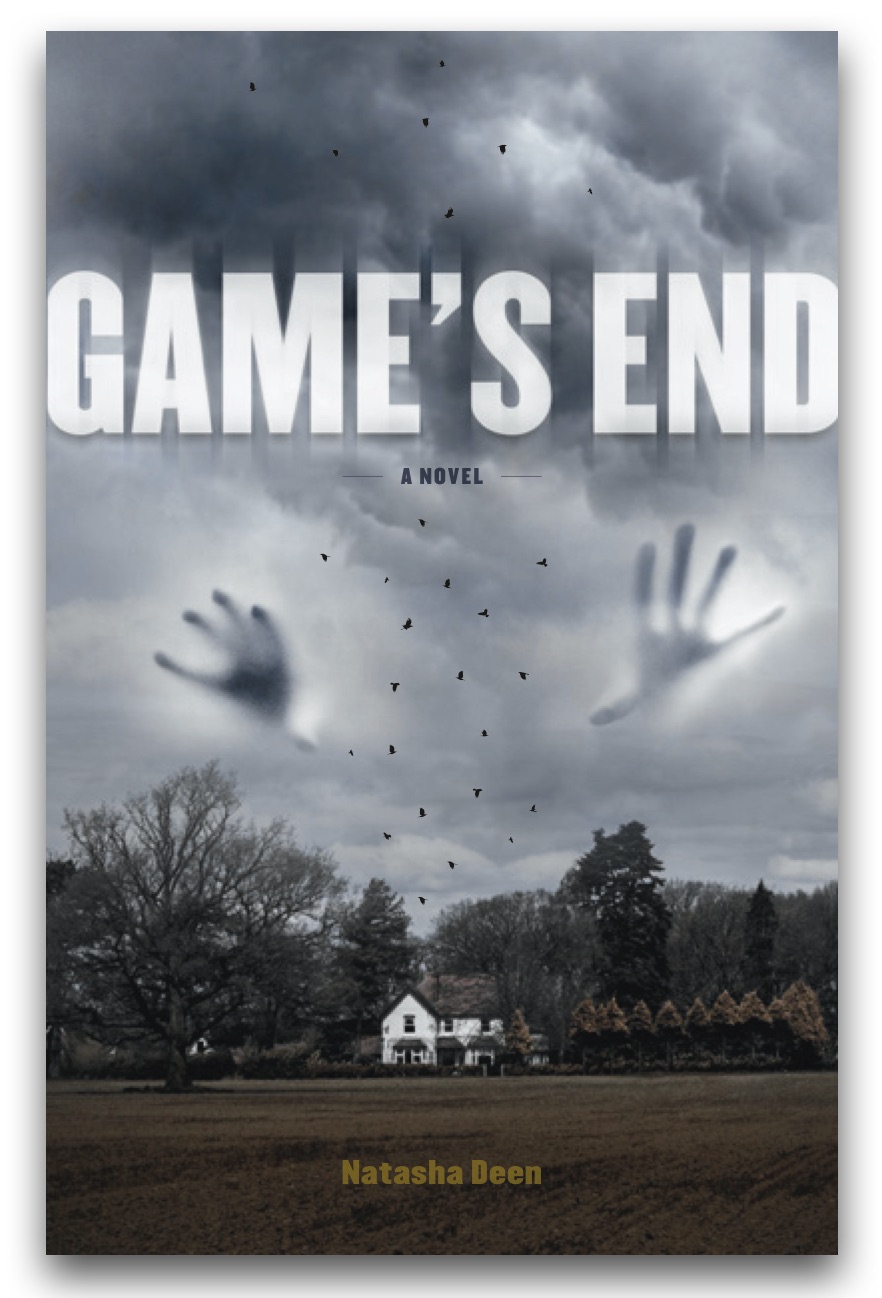
Game's End: Q & A with author Natasha Deen


Game's End
Written by Natasha Deen
Yellow Dog (formerly Great Plains Teen Fiction)
978-1-927855 -85-0
240 pp.
Ages 13+
November 2017


Yesterday I reviewed Game's End, the third book in Natasha Deen's series that began with Guardian and Gatekeeper. Today I have the thrill of interviewing author Natasha Deen about her newest young adult paranormal mystery.


•••••••••••••••••


HK: In my review of Gatekeeper, I called you the “princess of YA paranormal murder mysteries” and I stand behind that moniker, though I know you can write other genres as well.  But, though there are wild supernatural elements to Game’s End, at its heart the story is a whodunit, a murder mystery to be solved.  Are you a fan of mystery books and if so, who are a few of your favourite authors?

ND:  First of all, thank you for those kinds words! That thrills me. ☺

I am a huge fan of mysteries. There’s just something—thrilling, fascinating, intriguing—about hunting and gathering puzzle pieces, and delving beneath the personalities to find the truth. (I think it’s a bit like real life, where you listen and talk to people, and search for the subtext of their actions and words, and puzzle out who they are versus who they (1) want you to think they are (2) who they are trying to be).

I come by my love of mystery via family genetics.  Some of my favourite memories are the weekend afternoons when everyone was taking a nap, except my mother and I, who drank tea, ate cookies, and watched PBS Masterpiece Theatre,  as well my family coming together during the weeknights to watch TV and guess the murderer in Murder She Wrote, Columbo, and Matlock.

When it comes to my favourite authors, there are too many to name, but my first mystery-author love has to be Agatha Christie. Murder on the Orient Express, And Then There Were None, and any of the Miss Marple mysteries are tops in my books (no pun intended).


HK: Your subplots do double-duty, adding depth to the mystery as well as being the source of red herrings to trick the reader into guessing the identity of the murderer and more.  How hard is it to craft subplots that have to lure readers into thinking the story is going one way and then take them completely off course?  

ND:  It definitely takes some doing, but it’s so much fun to play with readers, and I really enjoy it. It’s like hiding Easter eggs and I love trying to find the balance of hiding clues deep enough to trick readers, but still making it apparent, so when they go back, they can see the clues.

As a reader, I love that feeling of racing to guess the bad guy before the main character/detective reveals them. It’s so exciting when you have that “Aha! I knew I was right!” moment, but I also love the “Ahh! They got me, I didn’t see it coming!” But when I go back, I can see how they were setting up the clues.

Stories that drive me crazy are when the author has some off the page clue that only the detective is privy to, or some sudden plot twist that’s not actually a twist, it’s just a sharp turn/plot device—that’s cheating. Put the clues on the page and let’s see how it turns out.


HK: From Guardian to Gatekeeper and now Game’s End, you have kept Maggie honest, humble and very real, though she has supernatural powers.  How did you ensure that she stay this real when she obvious isn’t?

ND:  I think from Maggie’s perspective, she’s not special.  Everyone has powers and talents, hers just happens to be seeing the dead. It doesn’t make her any better than anyone else, and with a dad like Hank, I just couldn’t see her being raised any way but the way she shows up on the page.

Also, I come from a culture (Guyanese) that embraces the idea of the supernatural, so why would you freak out or act weird? That would be like acting strange when you see the sun, but the sun is always there.

It’s not that Maggie doesn’t understand her power is unusual, but since it’s part of her, it just is…one of my favourite shows is West Wing, and one of the things that struck me was that the characters are never over the top or shrill. Then I realized that what was unusual for me (i.e., another country threatening to launch weapons or impose sanctions) is an everyday event for them. If they were over-reactive to it, they’d exhaust themselves by the end of the day. So, I think it’s the same with Maggie. It’s her everyday. She’s always seeing ghosts, transitioning them, learning about the terrible, beautiful aspects of their life. I’d like to think that it gives her depth and an appreciation for all the ways life is special and unique.


HK: While you’d made Maggie a sympathetic character, there are many others who are totally reprehensible and yet very real in the abuse they inflict on others.  Did you find it emotionally draining to write about domestic abuse and self-righteousness and violence against those who are vulnerable?

ND:  The short answer is yes. There’s a lot of personal experiences that inform those narratives, both mine and people I care about, and it’s a hard place to go, a hard place to live in, BUT, as storytellers, it’s important for authors to take the pain of those moments to make sure the story we tell is true to life, and the characters are as real as they can be.

One of the things that I feel is my saving grace and helps me not to get mired in the pain/darkness is my characters rise above those circumstances, so the bad things in life aren’t there to weigh them down, but to lift them up. I hope it’s something my readers can trust about my work—that there’ll be intense moments and difficult scenes, but in the end there is some kind of positive resolution.

There are a lot of studies on the effects of reading on the brain, on the physiological changes that happen when we imagine, so it’s important for me that even if there isn’t always a Hollywood happy ending in a book, it ends on some kind of hopeful note.

If I can expand out the answer, then it’s worth noting in my personal philosophy, I believe we’re all storytellers, and that’s why sharing stories (with friends, in writing, with groups) is an important thing. The world is made better and stronger when we connect through our shared stories and experiences.


HK: While there is much fear associated with death and dying, the concept of an afterlife offers some prospect for good to come out of that fear.  Do you believe in a particular version of an afterlife?  If so, does this belief come from a spiritual background, personal experiences with a psychic medium, or something else entirely?

ND:  Asking a Guyanese person if they believe in ghosts is akin to asking them if they believe in the sky. ☺ The sky exists, it’s there whether you believe it or not. According to Guyanese philosophy, ghosts and the supernatural is just another level of existence. Your ancestors will visit you in your dreams, they can change the reality around you, so you must always be aware of unusual occurrences in the everyday (a butterfly showing up in a location butterflies aren’t known to appear, for example). It’s why you should always behave—no one wants a lecture from long-dead Auntie who shows up in your dreams.

As a kid of two nations, Canada and Guyana, it’s one of the things I had to reconcile. North American culture doesn’t embrace the supernatural in the same way as Guyanese. But I’m so proud of my heritage and the subtext of this belief, that love can be so strong, your family members so connected to you that even death can’t break that bond, and I love the lesson to pay attention to the world around you, to pay attention to the unusual things because something beautiful might be coming your way.


HK: Although I’ve never heard of them, the supernatural creatures called serengti seem familiar to me yet I can find no reference to them in the literature.  Are these creatures from any particular mythology or are they your own fantastical creation? 

ND:  I sketched out the series back in 2010, and I remember coming across a reference to an ancient creature that was female and…that’s all I remember. When I tried to find my notes, they were missing. I *feel* like I came up with the serengti term, but that it’s based off of mermaids, sirens, and my wondering about what the after-life of Hans Christian Anderson’s Little Mermaid may have been like.


HK: I so enjoy your humour.  Even in a book that deals with death and the supernatural, I found myself laughing aloud at the banter between Maggie and Serge and Nell’s pluck.  How can you remain light and jovial in your writing when immersed in a story about murder and violence and dangerous situations?

ND:  I have to thank my family and my family history for that. When you grow up as a POC, your life is just different from the non-POC kids (I still remember being 9 years-old and telling a Caucasian girl in my class that I was creeped out by white pillows, and her not having a clue about why, and when I said, “Well, because of the KKK and the Aryan Nations,” she still looked confused. That was one of the many moments I realized my growing up and how I navigated the world wasn’t going to be like my classmates, and what the world offered me versus what it offered them was never going to be the same).

My family history is one of struggle and overcoming, of standing strong while terrible things happened, and letting the bad things pass. Part of the standing strong involved love, forgiveness, a lot of humour. There’s an unspoken code of conduct in my family. In a bad situation, find a way to laugh. If you can do that, you can find a way to overcome, you can find the light, and a way out of whatever darkness is encroaching on you.

From a story/character perspective, I wanted to give Maggie, Serge, Nell, and Craig a similar philosophy. Certainly from Maggie and Craig’s perspectives, they’ll have seen things they can’t unsee. Serge is now heading down that path, and for Nell, she doesn’t have the same abilities (or any supernatural powers) as her friends, so how does she navigate the stories she hears from them, and how does she step in to support? Humour seems like the perfect weapon.


HK: The ending of Game’s End leaves it open for the possibility of more books in the series.  Are you planning on continuing Maggie’s story?  Readers will definitely want to learn about the return of a key character. (I won’t spoil the ending for readers, though they should be prepared that, as you say, “Maybe there are no happy endings.  Maybe there are just endings, and it is up to us to make them happy.”; pg. 240)

ND:  I’m giggling because for writers, our stories are forever continued, and we’re always living with our characters. The Guardian trilogy wrapped some of the big issues facing Maggie—bullying, domestic violence, abuse, forgiveness, resilience—in a series of horror/mystery/suspense novels, and I feel as though I’ve told that portion of her story. Having said that, I’m definitely open to more of Maggie’s adventures.


•••••••••••••••••

Many thanks to Natasha Deen for answering my somewhat lengthy questions 
and 
Marketing Director Mel Marginet at Great Plains for facilitating this interview.

• • • • • • • • • • • • • • • • •

If you haven't read the whole series, time to get your own copies of Guardian, Gatekeeper and Game's End!


November 06, 2017

Game's End

Written by Natasha Deen
Yellow Dog, an imprint of Great Plains Publications
978-1-927855-85-0
240 pp.
Ages 13+
November 2017


     “He’s not my real brother, we’re soul-bonded.”
     “If he’s not your brother, why do you call him that?” asked Zeke.
     “Because.” Serge wriggled into the spot between us. “It sounds better than ‘hi, meet Serge. We used to go to school together and he bullied me until I wanted to die. Luckily, he was the one who stopped breathing.  I helped him figure out that his so-called suicide was a murder, and then we discovered in this life we were both scripted to become guardians.  We watch over the dead and living, transition souls from this plane to the next, and make sure the bad spirits from hell stay there.’”
     “Yeah,” Zeke nodded. “I can see how that’s a mouthful.”
(pg. 25)

That's essentially the creation story of Maggie Johnson and Serge Popov though there is so much more to their story.  There's Maggie's supernatural boyfriend Craig who is a ferrier of the dead, and her extremely plucky (her word, not mine) and loyal best friend Nell, and her dad Hank and his girlfriend Nancy who is the sheriff.  They all "live"–some more than others–in Dead Falls, Alberta where Maggie has been involved, with some supernatural help, in exposing those responsible for the deaths of several people, sadly raising the ire of some local citizens who consider the teen "a death magnet" (pg. 159) who has ruined the reputations of the town and some people like Serge's father, Reverend Popov.  The vibe in the town is definitely off but there's something worse coming as foretold by The Voice–the disembodied voice that comes through radios and whom Maggie suspects is her mother–and it's coming for Maggie.  Craig believes it's as a power-seeking soul-eater, which appears and swallows up lost and wandering dead just as Maggie is trying to help the newly dead Zeke cross over with his little brother Homer.  If the soul-eater is the only threat is yet to be seen.

As Craig and Serge attempt to get more info from the other side about her mother, Maggie is being pulled into her own investigations.  She tries to learn more about her mother from Hank who reveals that she too had powers that were tearing her apart.  On top of that, Maggie is experiencing unusual out-of-body experiences that take her to different times and places to witness the rescue of children's souls by a serengti, a supernatural called Serena, who compassionately tries to spare them the trauma of their deaths.

Then a murder shatters Maggie's world, and she's on the trail, both of our world and a supernatural one, to find the killer and keep those she loves safe.

Game's End is the conclusion of Natasha Deen's Guardian trilogy that began with Guardian (Great Plains Teen Fiction, 2014) and led to Gatekeeper (Great Plains Teen Fiction, 2016), all stories that embed the reader in the worlds of the dead.  For the dead in Game's End those worlds includes both the good and the bad, those who attempt to ease the dead to the other side and those, both living and supernatural, who seek to harm for the sake of power.  The evil that kills and aims to destroy is palpable in Game's End and, except for those who attempt to harm the children Serena wishes to rescue, not always easily identifiable.  Like evil everywhere, it is masked with lies and smiles and facades of rational behaviour.  The only reassurance is that, whether they are the self-righteous or domestic abusers or murderers, justice, in this world and the next, will be levelled against them.  That's the reassuring message of Natasha Deen's paranormal mystery: revenge is not necessary because there's karma.

Even so, Natasha Deen makes Game's End a story about a typical teen who is trying to find her niche in the world.  What she has on her plate is a little different than most teens, balancing being a friend and daughter with battling evil on both sides of the death divide.  But it all reads so naturally because of Natasha Deen's characters and a healthy infusion of comic relief.  While Maggie may be playing "demonic whack-a-mole" (pg. 29) with some unfriendly entities, she's rolling her eyes at Serge's wisecracks and Nell's off-hand comments that always alleviate the tension.

“Oh, he’s cute,” said Nell.
“Calm down,” I said. “He’s dead.”
“I could make him feel alive again.”
(pg. 21)

I know it's bizarre to match Natasha Deen's intense plotting with her tongue-in-cheek humour but the two work so artfully together, one escalating the drama and the other cushioning it, that Game's End would be a very different entity without this curious pairing.

Game's End may be Book 3 in this series but it's far from game over for Natasha Deen.  And if you're a new reader to the Guardian series, you've got three books of robust plotting, clever characters and bright banter ahead of you. Enjoy!


•••••••••••••••••

Look for my in-depth interview with author Natasha Deen tomorrow.  She graciously answered some tough questions about her writing, her beliefs and plotting for Game's End and her whole Guardian series. 

•••••••••••••••••

October 06, 2017

The Disappearance

Written by Gillian Chan
Annick Press
978-1-55451-983-5
197 pp.
Ages 12+
September 2017

The who of the disappearance is Jacob but the why and where and how are answers that the police are  trying to extract from his group home roommate Mike McCallum, a teen who obviously has something to hide and is pleased to do so.  

It's pretty hard for Mike to stay under everyone's radar.  He's a big guy and his face is massively disfigured after his mother's boyfriend Danny brought a cleaver down on it.  Still Mike's internal scarring, from the death of his little brother Jon by Danny's drunken hand, is far worse.  Taken from his mother, a woman who regrets Danny being in prison, Mike has been in foster care for three years before he ends up at Medlar House.  There amongst the foster kids he meets the enigmatic Jacob, a boy who'd been found beaten up and unconscious in Dundas Valley Conservation Area and rarely speaks and shuts down in body and spirit when overwhelmed.  But when Jacob finally speaks to Mike it is to tell him that Jon has been there and has told Jacob about his death and more.

As Mike learns the routines of Medlar House and the personalities of the other kids, especially keeping an eye on the vicious Paddy and his lackey Matt, the fearful Adam and the victimized Jacob, he finds his role changing from thug to protector.  In his own way, Mike is trying to right his own wrong i.e., not saving Jon. But before he can really help, Jacob is exposed to far greater danger and horrific bullying that compels Mike to try to find a happy ending for this boy.  What he learns, with the help of Adam, is as mysterious as Jacob himself.

Without spoiling Gillian Chan's extraordinary plot twist, I can say that The Disappearance includes a supernatural element that has never been handled as eloquently as it has here. It is unexpected and unique and wholly convincing. (I want to share.  Really I do.  But I can't.) Still, even beyond her fantastic plot, Gillian Chan creates rich characters–Mike, Jacob, Adam, Chaz, Paddy, and others–that carry this story of hurts.  What has happened to Mike and Jacob is tragic.  Their lives have been destroyed by vicious and uncaring people whose choices superseded benevolence.  Even the charity granted the boys is tempered by the personalities of those involved: some do-gooders, some lazy, others greedy and some, like Chaz, compassionate and effective.  All they can do is endure and hopefully survive.  Without giving the reader a fairy tale ending of rainbows and sunshine, Gillian Chan resolves the story with realism and justness and the anticipation that sometimes you can save another.

```````````````````````````

The launch for The Disappearance is tomorrow in Hamilton.  Do go if you're in the area.  Details are provided here.

May 29, 2017

The People of the Sea

Told by Donald Uluadluak
Illustrated by Mike Motz
Inhabit Media
978-1-77227-138-6
28 pp.
Ages 5-8
April 2017

The supernatural can be frightening but all the more when based in a true story.  This is a true story.  It is the story that was told by Nunavut Elder Donald Uluadluak of a childhood encounter that revealed a bridge between the world of his Inuit life and the myths of his people.
From The People of the Sea 
told by Donald Uluadluak 
illus. by Mike Motz
Donald Uluadluak recalled playing with two friends on the beach and in the water near Arviat, Nunavut in 1940.  When a woman with long dark hair like seaweed and pale skin appeared in the water, watching the trio but never speaking, the boys ran away, back to their camp.  It wasn’t until much later that they shared with their families what they’d seen and were told they’d seen an arnajuinnaq, one of the sea-dwellers of Inuit myths.
From The People of the Sea 
told by Donald Uluadluak 
illus. by Mike Motz
Imagine seeing a supernatural creature. Donald Uluadluak and his friends must have been stunned to learn what they had seen.  Startlingly, he reveals that “Our parents told us that, in the past, people of the sea were easy to spot.  But by the time I was a boy, they had become rare and were not often seen.” (pg. 26) I don’t know why these creatures revealed themselves to the Inuit and specifically to Donald Uluadluak and his friends but The People of the Sea gives us a first-hand account like no other.  Whether the reader believes Donald Uluadluak's account or not, there is an honesty to his story, perhaps because of the playful innocence of the children and the earnestness with which they share the story with their families.  Still Mike Motz's illustrations convey a cool creepiness to the story and makes the reader think about the possibility that a supernatural creature visited three boys that day.

Inhabit Media co-founder Neil Christopher provides notes about his interactions and work with storyteller Donald Uluadluak, having helped put the Elder's stories, including Kamik: An Inuit Puppy Story (Inhabit Media, 2012), to paper so that all might share in their knowledge and cultural importance.  Though Donald Uluadluak passed in 2014, his daughter Elizabeth Issakiark ensured his tales would not be lost.  Like Neil Christopher does in his introduction, I would like to thank Elizabeth Issakiark for her dedication to helping share her father’s stories and to Donald Uluadluak for revealing so much personal history and heritage for those of us ignorant of much but interested in learning.  I hope that The People of the Sea is but the first of more Donald Uluadluak’s stories that will be shared with the world.
Donald Uluadluak and daughter Elizabeth Issakiark 
from preface to The People of the Sea