Showing posts with label Inhabit Media. Show all posts

November 08, 2024

Lemming's First Christmas

Written by Jamesie Fournier
Illustrated by Tim Mack
Inhabit Media
978-1-77227-543-8
28 pp.
Ages 0-5
October 2024
 
Avinngaq (lemming in Inuktitut) lives under a house and hears children singing, "Santa Claus is coming to town." When she asks Qimmiq (a sled dog), he tells her that Santa Claus puts presents under the tree. That just leads to more questions because Avinngaq doesn't know what a tree is. And so begins Avinngaq's quest to ensure Santa Claus visits her.
From Lemming's First Christmas, written by Jamesie Fournier, illustrated by Tim Mack
Qimmiq has a simple explanation about a tree–"It grows out of the ground, and you decorate it"–and he goes with Avinngaq to find one. The other Arctic animals bring forth what they suggest might be a tree. From Natsiq (a ringed seal) who brings some seaweed, and Tuktu (a caribou) who brings a purple saxifrage, Qimmiq can only tell what is not a tree. Other animals include Tiriganiaq (an Arctic fox) and Ukaliq (an Arctic hare) but it's not until Avinngaq rests on a piece of driftwood that Qimmiq confirms she's found a tree.
From Lemming's First Christmas, written by Jamesie Fournier, illustrated by Tim Mack
So, the friends decorate the driftwood with the seaweed, the purple saxifrage, arctic willow, and berries, sing, "Santa Claus is coming to town" and are delighted to find presents under the tree the next morning.
From Lemming's First Christmas, written by Jamesie Fournier, illustrated by Tim Mack
For our very youngest children, Lemming's First Christmas would be a bright beginning to the holiday season. Of course, they'll start singing the song too and it could get tiresome for the next seven weeks but maybe you could break that up with a reading or two of Lemming's First Christmas and some discussions about Arctic animals and plants, about cultural traditions, and even the magic of the holiday season. Jamesie Fournier, a writer in Iqaluit, keeps the story positive and simple, which is perfect for an early picture book–it has thicker pages and a reinforced cover–while introducing them to the Arctic and its plant and animal species, and teaching them a few words of Inuktitut. (A double-spread at the back posts the Inuktitut names and their pronunciations along with illustrations of the animals depicted.) It's very sweet and all the more so for Tim Mack's illustrations. I've reviewed several books which Tim Mack has illustrated (It's Time For Bed and What's My Superpower?) and his cartoon style of digital art will resonate with very young readers. His characters are cute and recognizable, and even if unfamiliar with an Arctic environment, children will recognize the play of shadows at night, the magic of snow and stars, and the quest for answers from those we know.
From Lemming's First Christmas, written by Jamesie Fournier, illustrated by Tim Mack
Get into the holiday season in a gentle way with Lemming's First Christmas. It's an easy introduction for those who may become overwhelmed with the customs of the holiday and let them see it from the perspective of a group of animals who interpret a tradition in their own way and make it a very sweet first Arctic Christmas.


September 28, 2024

Dad, I Miss You

Written by Nadia Sammurtok
Illustrated by Simji Park
Inhabit Media
978-1-77227-482-0
40 pp.
Ages 9-12
August 2024
 
Dad, I Miss You is a conversation that only takes place in the minds of a father and son as the boy is returned, again, to a residential school, leaving his father, mother, and two-year-old sister behind. It is a heartbreaking exchange that never takes place in person but tells us so much about the family and what they went through.
From Dad, I Miss You, written by Nadia Sammurtok, illustrated by Simji Park
As a young boy recalls catching a fish, having learned from his father, his father watches his son out the window, also thinking about how proud he is for feeding the family and sure the boy will be a good provider for his own family when he is a man.
From Dad, I Miss You, written by Nadia Sammurtok, illustrated by Simji Park
When the child hears the plane that will transport him far from his home, in his mind he tells his dad that he doesn't want to go back there. Hearing the same plane, his father is hopeful that it will be over soon if the boy just does what they say. After all, "They said it will be better this way." (p. 9)
 
And as the boy packs his things, he wishes that his dad would stop them from taking him and not to let them take his baby sister too. His dad has the same worries about his daughter.
From Dad, I Miss You, written by Nadia Sammurtok, illustrated by Simji Park
As the boy is taken away and endures the horrors of residential school, from the cold and lack of food to punishment and loss of language, his father keeps hope that his child is learning and will be home soon. But things are different when he returns home. Thankfully there is still love and acceptance and the wisdom to understand what he may be going through.
I know you've forgotten some parts of yourself, but after some time, you'll find yourself again. (p. 37)
Every story that speaks to the residential school experiences of Indigenous families is heartbreaking. But Nadia Sammurtok approach of getting into the unspoken thoughts of both son and father remind us of the emotional toll on both parents and children. While the son knows what he must live with at the school, from hunger and abuse, loss of culture and homesickness, his father does not know. The boy's family has been told a sanitized and misleading version of what his child will learn and do, but without first-hand accounts they cannot know what happens there. Still, as both father and son show stoicism, revealing their feelings and thoughts only to themselves, Nadia Sammurtok shows us the depth of their connection. They think about similar things but from different perspectives and readers can only hope that this connection will sustain their relationship through the hardships of a child taken away to residential school. (As the story is based on Nadia Sammurtok's own family history of residential school separation, we hope that they found strength in that connection.)
From Dad, I Miss You, written by Nadia Sammurtok, illustrated by Simji Park
Simji Park, an artist based in England and the Netherlands, uses pencil and watercolours to create scenes of great heart and feeling. Just as the dialogue between father and son is repressed, Simji Park's illustrations are subdued, using soft tones and quiet lines to depict simple scenes of home and school. She still conveys the muted comfort of home and the angst of the residential experience, but she does so with hushed ambience, reflecting the unspoken dialogue between father and son.

Every book that speaks about the tragedy of families separated when Indigenous children were forced into residential schools is unique and revealing. By focusing on the unspoken thoughts of a parent and a child, Nadia Sammurtok makes us see something a little different. The bond between a parent and a child is stretched and almost severed and yet there is hope that there is enough resilience to reunite and strengthen. Dad, I Miss You is a story of tragedy but also one of the capacity of family to reconnect and prevail.
 
• • • • • • •
Teaching about the residential school experiences is a challenging one for teachers and parents. A QR code appended to the book links to downloads of educational support materials. 
• • • • • • •

July 26, 2024

Sea Snooze

Written by Sarabeth Holden
Illustrated by Emma Pedersen
Inhabit Media
978-1-77227-442-4
28 pp.
Ages 3-5
July 2024
 
While a mother reads a bedtime story to her children perched in their bed, their imaginations are invited to soar.
From Sea Snooze, written by Sarabeth Holden, illustrated by Emma Pedersen
All aboard our little boat!
We'll sail all night. Let's see where we float!
In their dream boat, they travel far and wide, over mountains and icy seas, where the stars shine bright and guide their way. They see gulls and guillemots, minke whales and belugas, and seals.  As the animals play and feed, the children sail across the waves.
Minkes in the sound exhale from their spouts,
spraying drops of sparkling water all about.
From Sea Snooze, written by Sarabeth Holden, illustrated by Emma Pedersen
These are but their dreams, spurred on by their mother's reading and their own lives in an Arctic environment. In fact, their bedroom provides all the setting elements, from the animals in a mobile near the bed, to a wallpaper border of water and starry sky, and stuffed bears and narwhal. (If readers look closely, they'll see the patches on the balloon tethered to their boat match those of the well-loved stuffed narwhal toy on the bed.) Their dreams come from their lives: the bed is their boat, its blankets their sails, and their experiences, from snacking on seaweed and fish to watching the wildlife of their Arctic home, give texture to their dreams.
Soon the morning will come,
the sunshine glittering gold,
with all the wonders that
the new day holds.
What a lovely rhyming text to send your own young ones into their nightly respite! They may not know of an Arctic home with an ocean rich with wildlife both in the water and above it, but they'll appreciate taking a boat to a wondrous place with familiar elements from their own lives. Author Sarabeth Holden, who also wrote Please Don't Change My Diaper! and Benny the Bananasaurus Rex, both of which were also illustrated by Emma Pedersen, may currently live in Toronto but her experiences living in Nunavut and being a mother feed her stories. Sea Snooze speaks to parents putting little ones to bed and to those same little ones visiting dreamland via their own experiences. A co-founder of the Toronto Inuit Association, Sarabeth Holden embeds this story in modern Inuit life whose homes could be anywhere in Canada. But, by emphasizing the landscape that only those of the far north would understand and the inclusion of an occasional Inuktitut word, Sarabeth Holden helps us see that the dreams of these children are unique to their home, and all the richer for their familiarity with it. Yet, with her energetic rhyming that has us travelling with the children on their dream boat, Sarabeth Holden is singing a lullaby for children to rest, imagine, and enjoy their lives in a different way.
From Sea Snooze, written by Sarabeth Holden, illustrated by Emma Pedersen
Emma Pedersen keeps the playful in the soothing tranquility of children heading to sleep and into their dreams. From their colourful pajamas and bedding to their assortment of toys and art, these kids have wonderful energy to feed those dreams. And though their dreamworld is mostly one of dark turquoises and blues, not unlike the Arctic Ocean and a night sky, Emma Pedersen infuses those scapes with warmth in the playfulness of the animals and the whimsy in their faces and in the clouds. 
 
You might want to read Sea Snooze to your own little ones, perhaps before bedtime, so that they might be encouraged to use their imaginations to discover their own sleep journeys. Their beds may be different, their toys unlike those in Sea Snooze, and the animals they have seen a far cry from the narwhal and the minke whale, but hopefully they'll have their own foundation for dreams to bring joy and contentment and, of course, sleep.

April 17, 2024

I Am a Rock

Written by Ashley Qilavaq-Savard
Illustrated by Pelin Turgut
Inhabit Media
978-1-77227-475-2 
28 pages 
Ages 3-5
April 2024

Never has a rock been less of an insentient thing than in Ashley Qilavaq-Savard's I Am a Rock. For this child and his mother, this pet rock feels, sees, hears, and experiences all the seasons and life of an Arctic landscape, with or without its child by its side.
 
As a boy prepares for bed, a time open to great inquisition, Pauloosie asks his mother, "Anaana, what would it be like if rocks were alive?" as his adorable pet rock, Miki Rock, rests alongside him. With a playful voice and great wisdom, his mother answers him.
From I Am a Rock, written by Ashley Qilavaq-Savard, illustrated by Pelin Turgut
First, his mother tells of the rock watching as animals feed and make homes with the changing seasons. There are foxes and ptarmigan, belugas, and char. But there is more than just watching. There is also listening.
From chirps to howls to
beating hooves and squeaks,
I can hear them all.
From I Am a Rock, written by Ashley Qilavaq-Savard, illustrated by Pelin Turgut
And feeling? Miki Rock feels everything from the snow that blankets it to "the joy of the sun's warm kiss."
From I Am a Rock, written by Ashley Qilavaq-Savard, illustrated by Pelin Turgut
Finally, Miki Rock acknowledges that, though it can see, hear, and feel, it could not fly, run or walk until Pauloosie picked it up.
 
As I write this review, I hear Simon & Garfunkel's 1965 song with the same title but know their message is completely opposite to that of Ashley Qilavaq-Savard's book. While they sang of closing oneself off for protection, Ashley Qilavaq-Savard gives us a story of companionship and feeling that speaks to consciousness and awareness. Miki Rock is as sentient as we are. It may not be able to grow or to move (or can it?) but its appreciation for what goes on around it is evident. It senses warmth and cold and feels excitement and joy. It may be Pauloosie's Anaana who is giving that life to Miki Rock but, as a reader of I Am a Rock, I am convinced, as I'm sure Pauloosie is, that life exists within that rock.
 
If Ashley Qilavaq-Savard's words don't convince you, pair them with Turkish illustrator Pelin Turgut's artwork. Between Miki Rock's expressive face, which is limited to two specks for eyes and a crack for a smile, as well as orange lichen cheeks and a tuft of "hair" and landscapes of snowy mountains, frozen lakes, northern lights, and bright Arctic flora, Pelin Turgut gives us a rock that embraces its "life."
 
From I Am a Rock, written by Ashley Qilavaq-Savard, illustrated by Pelin Turgut
We may know logically that rocks don't feel anything but isn't fiction supposed to help us imagine different worlds and reach beyond the rational into something else? With the special companionship Pauloosie gets from Miki Rock, he already knows that a rock can be more than a fixed object. (A reading of I Am a Rock would be a fabulous lesson to teach the characteristics of living things.) Courtesy of his Anaana, Pauloosie now knows even more about his pet.

August 25, 2023

We Love You As Much As the Fox Loves Its Tail

 Written by Masiana Kelly
Illustrated by Tamara Campeau
Inhabit Media
978-1-772274769
28 pp.
Ages 3-5
July 2023
 
This is a picture book about love. It's about how much love there is for a child, before its birth and after and even in the future, and it's the love that is seen in a northern environment of foxes, narwhals and muskoxen.  As such, We Love You As Much As the Fox Loves Its Tail is a lullaby to a newborn.

From We Love You As Much As the Fox Loves Its Tail, written by Masiana Kelly, illus. by Tamara Campeau
Speaking to their new baby, a family recalls how much they longed for the baby and how they celebrated its arrival. How do you express anticipation and adoration? They look to the familiar in their lives for demonstrations of love. There's the polar bear who loves to sleep and the caribou who love to run. In a northern environment, both green and flowered in the summer and crystal blue in the winter, and often vividly dynamic with the aurora borealis, there is much available to which the family can compare their love, both as it is and as it will be given.
From We Love You As Much As the Fox Loves Its Tail, written by Masiana Kelly, illus. by Tamara Campeau
Masiana Kelly's text suggests a familiarity with those northern environs and, as an Inuk and Dene writer from Nunavut and the Northwest Territories and as a mother, she obviously draws on her background. Her words speak of love and appreciation for her home of people and place. And that joy comes through with brilliance in Tamara Campeau's artwork. Oh, the colours and the life of those waters and skies, animals and land! These digital illustrations are filled with life, but then Tamara Campeau has always excelled at bringing the spirit of the north into her artwork and to the stories of others, like Grandfather Bowhead, Tell Me a Story and In the Sky at Nighttime.

From We Love You As Much As the Fox Loves Its Tail, written by Masiana Kelly, illus. by Tamara Campeau
If you know anyone having a baby or just having had a baby, We Love You As Much As the Fox Loves Its Tail would be a lovely gift to the family. It evokes the abundance of love and the closeness of family, and, no matter if the family lives in an urban landscape, in a prairie rural community, or a far northern region, We Love You As Much As the Fox Loves Its Tail will evince the joy of a new babe from its pages.

April 28, 2023

The Woman and Her Bear Cub

Adapted and retold by Jaypeetee Arnakak
Illustrated by Dayna B. Griffiths
Inhabit Media
978-1-772274660
36 pp.
Ages 3-6
April 2023
 
Many children take it upon themselves to adopt animals they believe have been abandoned. They do it with the best of intentions, though sometimes without regard for the bigger picture. The Woman and Her Bear Cub is a traditional Inuit story of such a fostering but with the wisdom that comes with living in conjunction with the natural environment and not overriding it.
From The Woman and Her Bear Cub by Jaypeetee Arnakak, illus. by Dayna B. Griffiths
A child and her mother are out on the ice hunting when they discover a polar bear cub stranded behind some broken ice. The mother wisely looks for tracks and evidence that the mother bear is nearby but can find none, so they help the cub from its location and take it home.
From The Woman and Her Bear Cub by Jaypeetee Arnakak, illus. by Dayna B. Griffiths
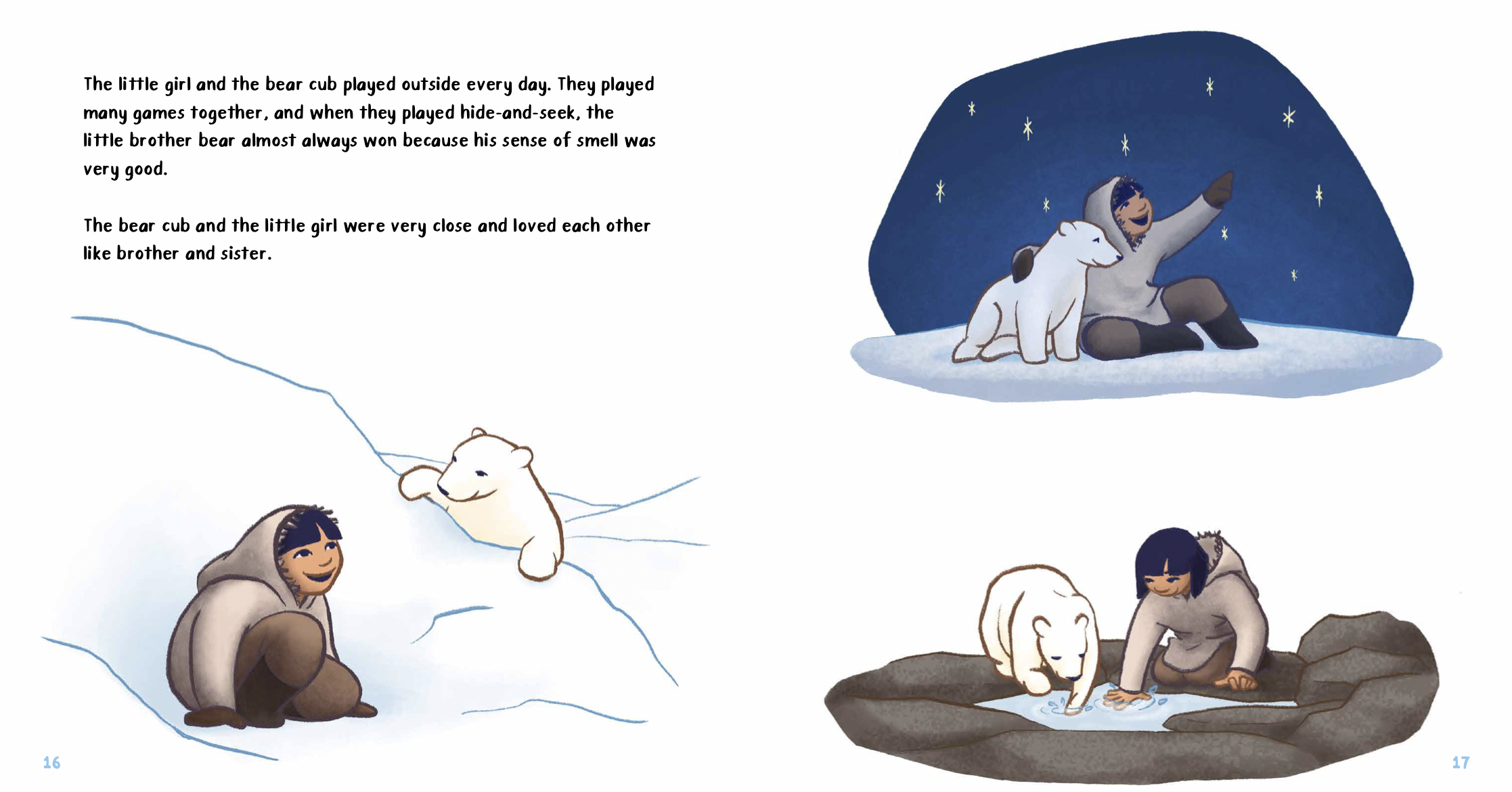
The child calls the cub her baby brother and their bond is as strong as siblings. They spend time together, playing and such, with the bear becoming an integral part of their family, even bringing back seals and fish that he has caught for them.
From The Woman and Her Bear Cub by Jaypeetee Arnakak, illus. by Dayna B. Griffiths
But when the cub is no longer a baby bear, and he becomes so big that the others in the village are concerned, the mother prepares her child for the time he would have to leave them. Still, it isn't until her brother bear returns from hunting one day with his own mother that the mother and child are able to say goodbye.
From The Woman and Her Bear Cub by Jaypeetee Arnakak, illus. by Dayna B. Griffiths
Jaypeetee Arnakak is a multi-talented Inuit linguist, translator, educator, and writer who grew up in Clyde River on Baffin Island. He has edited a collection of traditional stories from oral recordings of Inuit Elders and adapted several into picture books. The Woman and Her Bear Cub is one such traditional story and one that tells of compassion for living things and letting go when the time is right. There is no willful removal of a wild animal to provide companionship or entertainment. Neither is there a selfishness to take and keep what does not belong to them. The mother and her child give sanctuary to a lost bear cub only until he is reunited with his mother. It's not about their needs but about his needs. 

That quietness of purpose and landscape is portrayed in the illustrations of The Woman and Her Bear Cub by artist and designer Dayna B. Griffiths of Toronto. By creating art that appears stark, with a restrained palette of blue, white, and grey-brown, Dayna B. Griffiths makes the Arctic landscape of blue sky and white snow dotted with an occasional qarmaq (dwelling) very powerful. As such, the interjection of a white bear and grey-brown-clad people, with the occasional dog of both grey and white, in that landscape makes them both an important and insignificant focus.

As with most traditional stories, even those that may take on fantastical proportions, there is a germ of truth, and I suspect this one is based in reality. Adopting a lost animal and caring for it until care is no longer necessary is a story for all times. Here, a polar bear and an Arctic landscape may make this story unique, but its premise is grounded in the authenticity of compassion for those in need and dictated only by the one most affected. It is a lesson in selflessness and benevolence and a true reflection of the graciousness of Inuit values.

August 02, 2022

The Ugly Place

Written by Laura Deal
Illustrated by Emma Pedersen
Inhabit Media
978-1-77227-432-5
28 pp.
Ages 4-7
July 2022

When our negative moods take over, everything becomes ugly: places, people, ourselves.  
There is only one way to get to the ugly place, and you have to feel absolutely miserable.
From The Ugly Place by Laura Deal, illus. by Emma Pedersen
With the wet and gloomy weather, this child recognizes that everything is pointing them to a visit to the ugly place. They see ugliness in the exposed shore at low tide, in the fish, in their own mucky footprints on the wet tundra, and the smells of the salt water and the stale seaweed. And this child wallows in that which they see as ugly and matches their ugly mood.
From The Ugly Place by Laura Deal, illus. by Emma Pedersen

But seeing, really seeing, brings clarity. By focusing on that which is in front of them, perception is changed.

...my heart settles when I see the seagull circle around again in effortless flight, joined by another. Their crisp white feathers are exceptionally bright against the sunless sky. They play while gliding and swooping through the air.
They close their eyes and open their senses to the sounds, the smells and the feel of the emerging sun.

Then, and only then, is when IT HAPPENS.
Small things emerge to announce their joyful presence: a stir of the water, the flip and flop of sculpins, and life in the sea, on the land, and in the air. And in the child's heart, through the art of breath.

From The Ugly Place by Laura Deal, illus. by Emma Pedersen
Everything becomes part of an orchestral piece of music with the child conducting. It's up to them to see the virtues of every piece of their place and harmonize them for the big finish. And that grand performance is what finally takes the child from the ugly place to one where smiling is possible and the despair of the person and place disappears.
 
Getting to the ugly place is not hard when negative emotions overwhelm. Whether it is anger or fear, anxiety or disappointment, misery makes for an efficient vector to joylessness and the blindness to that which would normally inspire gratitude and bring comfort. While Iqaluit's Laura Deal may envision a literal ugly place to which this child visits, with scowling rocks and clouds, the ugliness is actually within and carried by the child, creating the foulness they experience within their landscape. But children, not unlike many adults, don't realize that they carry that ugliness with them to place and people. Fortunately, they also carry the possibility of finding joy both within and without, as this child discovers with some mindfulness in an natural environment. Laura Deal, whose earlier picture books In the Sky at Nighttime and How Nivi Got Her Names share a northern perspective of culture and place, again takes us to a community of the tundra, of rocky terrains, gulls and Arctic sealife. It's a place where a child can walk for great distances from town, ponder their moods and take the time for mindful appreciation beyond themselves. It's a place for insight and reflection, thoughtfulness and solitude, all of which reverberate in Laura Deal's text.

Likewise, Toronto illustrator Emma Pedersen mirrors the moods of the child as they experience the ugly place and shift to acknowledgement of the beauty evident. The furrowed brows and hunched shoulders of a child among the harshness of a landscape teeming with grimacing components reflects the bitterness of their feelings and the gloom of the weather. But all is transformed with light and softness as joy returns. 
 
Misery and despair will happen in our lives. But, it can and will give way to calm and joy given the opportunity for mindfulness of self and nature, a lesson for all who feel.
From The Ugly Place by Laura Deal, illus. by Emma Pedersen

June 06, 2022

Una Huna?: Ukpik Learns to Sew

Written by Susan Aglukark
Illustrated by Amiel Sandland and Rebecca Brook
Inhabit Media
978-1-77227-433-2
36 pp.
Ages 5-7
June 2022
 
After Ukpik's father (ataata), uncle and cousin return from a hunting trip with five caribou, the child's mother enlists her help in preparing the furs for a special project. Though she doesn't know what the special project will be, Ukpik is delighted to be part of something that will include some beads (sunguajait) that her anaana had been saving.
From Una Huna?: Ukpik Learns to Sew by Susan Aglukark, illus. by Amiel Sandland and Rebecca Brook
First, Ukpik is told get the ulu her grandfather (ataatatsiaq) had made for her as she would help with the cleaning of the skins. She is instructed on how to remove incidental fat and how to be careful with the sharp tool. Later the skins are stretched out and pinned to the ground to dry.
From Una Huna?: Ukpik Learns to Sew by Susan Aglukark, illus. by Amiel Sandland and Rebecca Brook 
As they wait for the skins to dry, Anaana allows Ukpik to work with the beads forming a pattern. After the skins are dry, Anaana teaches Ukpik how to soften the skins by tromping on them and also using a sakuut

For practise, Anaana cuts pieces according to a pattern for Ukpik and her friend Qopak to learn to sew mittens. When it becomes evident that the girls are becoming fatigued, Ukpik's anaana reminds her that:
You must begin your lessons now so you know how to do the right stitches for each pattern. The size and shape of the stitches matter, Ukpik, and to get these right, you must practise. (pg. 25)
From Una Huna?: Ukpik Learns to Sew by Susan Aglukark, illus. by Amiel Sandland and Rebecca Brook
It takes days of patience and meticulous work to prepare the skins so that they might be fashioned into clothing, and it's a skill that connects Ukpik and Anaana and others with their ancestors. Anaana and Ataata recognize that the world for Ukpik and her peers is changing (the earlier book Una Huna?: What is This? relates the introduction of new tools to the community from the south) but that skills like sewing and skin preparation are lines of kinship that will link them with their heritage forever.  
 
Author Susan Aglukark is perhaps best known as an award-winning Inuk singer-songwriter but her Una Huna? picture books take us to a northern Indigenous community in a different way, perhaps to see what growing up there might have been like for her. Una Huna?: Ukpik Learns to Sew reminds us that learning is happening constantly for children and especially for this Inuk child who wants to know and to discover all that she can. Una Huna? translates to "What is this?" and reflects Ukpik's inquisitive nature and desire to understand the nature of her people's ways of living while still being a kid who likes to play with her friends and puppy on the tundra. And, for most readers, Una Huna?: Ukpik Learns to Sew will be an introduction to traditional skills of the Inuit in addition to their language (a glossary with Inuktitut pronunciation guide is provided), making this picture book another culturally relevant book from Inhabit Media.
 
The illustrations by Amiel Sandland and Rebecca Brook are both playful and informative, striking the right balance for young readers who will learn but be entertained by the artwork. Amiel Sandland has always been astute at keeping the art simple enough for children to get the essentials of the details without overloading them with insignificant fluff. As such, the illustrations give us the starkness of the tundra and the straightforwardness of living as Inuit on the land while emphasizing an ancestry of significance.
 
Una Huna?: Ukpik Learns to Sew is an endearing recollection of the learning of traditional skills from a parent who is both patient, wise and loving.  It's about being at the crossroads of past and future, connecting to one's heritage but seeing what that might mean for later. It's a big story told skilfully with the essence of the Inuit at its core.

February 28, 2022

I Can See You

Written by Rosemarie Avrana Meyok
Illustrated by Michelle Simpson
Inhabit Media
978-1-77227-420-2
28 pp.
Ages 0-4
February 2022
 
Concepts books, i.e., those that teach concepts such as the alphabet, colours and numbers, are always valuable resources for parents and teachers. These books introduce young children to early learning but, if handled well, will entertain while that learning is happening. With bright illustrations, a simple rhythm of repetition and a unique cultural foundation for that learning, I Can See You will teach, delight and enlighten.

From I Can See You by Rosemarie Avrana Meyok, illus. by Michelle Simpson
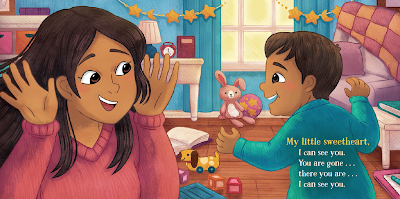
In I Can See You, mothers and grandmothers endearingly play with babies, based on the senses of seeing, hearing, smelling, feeling and even tasting. Embraced with obvious adoration, a baby, always called "my little sweetheart" is experienced fully by the parent or caregiver.
 
From I Can See You by Rosemarie Avrana Meyok, illus. by Michelle Simpson
From playing peek-a-boo to giggles, hugs and kisses and cuddles, each baby is well-loved and the basis for readers, and undoubtedly young listeners, to understand how the five senses can be the vectors for that love.

From I Can See You by Rosemarie Avrana Meyok, illus. by Michelle Simpson  
Born in NWT and residing in Nunavut, author Rosemarie Avrana Meyok speaks from experience both of people and place. As a great-grandmother, she has undoubtedly done her fair share of baby cuddling and nurturing. Her words are simple, as appropriate for a concept book, but never shallow. Rosemarie Avrana Meyok gives depth of feeling to those words but also experience with their message. From the baby in an amautik (parka with a hood for a baby) receiving kunik (nose kisses) from her mother to an Arctic landscape of cottongrass and saxifrage or northern lights–depending on the season– I Can See You takes young readers to the far north. In her joyful artwork, Niagara Falls illustrator Michelle Simpson brings that landscape to life, in its people and its place. The vegetation is distinctly that of the tundra, the stilted houses are raised above the permafrost, the stuffies include walrus, narwhal and snowy owls, and there are earrings that are beaded or resemble the ulu. Everything speaks to an Arctic community and an Inuit culture at its heart. And more at its heart is the love of mother or grandmother, perhaps aunt or sister, for babies who are seen, heard, touched, tasted and smelled with tenderness, knowing all the love that every child deserves.

November 08, 2021

Animals Illustrated: Wolverine: Guest review

Occasionally I invite young readers to share a review of a Canadian book they've read and enjoyed. Here I'm pleased to share a review of Animals Illustrated: Wolverine by Grade 3 student Hudson G.

Written by Allen Niptanatiak
Illustrated by Patricia Ann Lewis-MacDougall
Inhabit Media
978-1-77227-298-7
28 pp.
Ages 6-8
September  2021 

When I picked out this book, I didn’t know much about wolverines, but I was a little scared of them.  I was hoping to learn more about them so I wouldn’t be scared at all.  This book had good information about wolverines on each page.  The number of words was just the right amount for young readers.  The "Table of Contents" has a good amount of topics covered including: diet, survival adaptations, babies, and tough animals.  The overall information in the book was really good to help the reader understand about wolverines.  These animals are really important to Indigenous people and there is a section on traditional uses.  This section is a great idea to explain to children all of the uses for their fur.  For example, their fur makes parka trim and mittens.  The "Fun Facts" section was also good, but I would have liked more than just three main facts.  Instead of sentences, dot jots would be better to fit in more fun facts on the double-page spread.

This book is illustrated by Patricia Ann Lewis MacDougall and I really like the drawings and how realistic they are.  I felt like it was real life and I was right there with the wolverine.  The muted colours she used seem to represent the wildlife in the Arctic and helps the reader feel the location better.  The art also has labels on the pictures to help the reader understand the text better.  A combination of the information I learned and the beautiful illustrations have helped me to feel better about wolverines and they are no longer scary to me.

~Review by student Hudson G., Gr. 3
 
From Animals Illustrated: Wolverine by Allen Niptanatiak, illus. by Patricia Ann Lewis-MacDougall

• • • • • • •

Inhabit Media's popular Animals Illustrated series currently comprises of nine titles.

Narwhal (2016)
Muskox (2016)
Walrus (2017)
Bowhead Whale (2018)
Arctic Wolf (2018)
Caribou (2019)
Wolverine (2021)
Ringed Seal (2021)

October 12, 2021

Little Moar and the Moon

Written by Roselynn Akulukjuk
Illustrated by Jazmine Gubbe
Inhabit Media
978-1-77227-299-4
28 pp.
Ages 4-7
October 2021
 
Unless you've lived in a far northern community, you can't imagine the impact of day length on daily activities, especially around the summer and winter equinoxes.  But for little Moar, the fall is particularly concerning with the earlier onset of the night after a summer of full days.

Like most kids after school, little Moar and his friends like to play. But little Moar is always wary of being out too late, cognizant of the ever-darkening sky. You see, while many children are afraid of the dark, little Moar is afraid of the moon.
Whenever he looked at the moon, he saw a face. The face looked like it was giving him a half-smile, and that scared him.
From Little Moar and the Moon by Roselynn Akulukjuk, illus. by Jazmine Gubbe
So with the sky getting a little darker, he says goodbye to his friends and heads home. But another group of friends invite him to play a game of tag and he decides he can sneak in a game before it's too late. However, having so much fun, he loses track of time and, seeing the sky even darker, decides he must head home right then.
From Little Moar and the Moon by Roselynn Akulukjuk, illus. by Jazmine Gubbe
But on the way home, he encounters his cousin feeding his uncle's ten sled dogs. When he asks for little Moar's help, the boy relents, wanting to be helpful. Still the darkness comes as it does and little Moar runs into his uncle's house for shelter. How will the little boy make it home safely if the moon is always watching him?
From Little Moar and the Moon by Roselynn Akulukjuk, illus. by Jazmine Gubbe
Roselynn Akulukjuk, who gave young readers The Owl and the Lemming (2016), again takes us into Nunavut, not for a legend but instead for a quintessential experience for children: dealing with the impact of day length. Many kids love to play outside after school and most don't stay outside so long that they have to worry about the impending darkness. But when the darkness comes early as it does in the far north, making it home before the sun has set is crucial, especially for young who might be fearful of the darkness. Still little Moar isn't afraid of the darkness as much as he's apprehensive about the moon and the face his imagination perceives in its contours. Many cultures have lore associated with the pareidolic image of a face in the moon so little Moar's fear of this entity is not atypical. Many see a pair of eyes and a mouth in that natural satellite. Thankfully Moar's mother can reassure him that what he's seeing are contours and shadows but will he believe her?

Darkness can be frightening but Jazmine Gubbe, an illustrator, concept artist and animator, gives a warmth to that twilight and dusk, using the softness of pinks, greens and purples to transition to rich darker blues of the night. Her colours evoke place and time, bringing us to a Nunavut community in the fall, cool in temperature and vibrant in its activity of play and people. 

Fears are fears, whether in the short days of Nunavut or an urban setting in southern Canada. But for little Moar, his fear is based in his natural environment, not created from frightening graphics on visual media or elsewhere. His fear may not dissipate immediately with the wise words of his mother–fears are unfailingly stubborn–but knowing that he could outplay the moon with some careful maneuvers will surely go a long way to putting that moon in its place, far, far away from Moar.

September 06, 2021

Grandfather Bowhead, Tell Me a Story

Written by Aviaq Johnston
Illustrated by Tamara Campeau
 Inhabit Media
978-1-77227-297-0
28 pp.
Ages 0-3
September 2021

Grandfather Bowhead, Tell Me a Story is both love song and lullaby, wrapped up in an endearing dialogue between grandfather and young offspring. 

From Grandfather Bowhead, Tell Me a Story from Aviaq Johnston, illus. by Tamara Campeau

As a young bowhead whale asks their grandfather to tell them about the wonderful things he has experienced in his 200 years of life, Grandfather Bowhead recalls the marvels of the northern lights, of the animals he's met and friends he's made, of giant icebergs, of geese who travel halfway across the world, of the excitement of swimming mighty currents, and of the hard work he faced. With each request for more tales from Grandfather Bowhead's life, the calf, whom the grandfather calls Little Arvaaq, gets a glimpse of excitement, survival, appreciation and experience. But with each account, Grandfather Bowhead always admits that the wonders of Little Arvaaq are superior and preferable.

From Grandfather Bowhead, Tell Me a Story from Aviaq Johnston, illus. by Tamara Campeau

Grandfather Bowhead, tell me a story
of something amazing you have seen.

Little Arvaaq, I’ve seen walruses dive into the
very depths of the ocean to find clams to eat,
but that does not compare to the depth of my
love for you.

From Grandfather Bowhead, Tell Me a Story from Aviaq Johnston, illus. by Tamara Campeau

While focusing on an intergenerational relationship, Nunavut's Aviaq Johnston is still able to highlight the extraordinary life of the bowhead whale which is thought to be the longest-lived mammal on the planet. Still, with all the wonders the elder bowhead has witnessed, the wonder that is his Little Avaaq is greater. With reverence and adoration, Grandfather Bowhead tells his stories in richly emotive words but always with the caveat about this bowhead calf. 

Grandfather Bowhead, tell me a story
of the sweetest thing you have seen.

Well, Little Arvaaq, in all my two hundred years
I’ve seen everything you can imagine,
but nothing compares to the sweetness of
your sleeping breaths.

The depth of adoration, amazement and affection from Grandfather for Little Avaaq is epitomized in Tamara Campeau's profound artwork. Digitally rendered, the illustrations of Grandfather Bowhead, Tell Me a Story are both realistic and dramatic, depicting the greatness of the bowheads and the other sea creatures in an Arctic landscape of deep waters, massive bergs and vibrant northern lights. Tamara Campeau makes her art truthful, grounded in accuracy, but also ethereal, giving a spiritual essence through her use of colour and line that matches Aviaq Johnston's words.

If I was a grandparent, I would love to share this story with a grandchild to verbalize the depth of devotion and tribute extended between grandfather and young in Grandfather Bowhead, Tell Me a Story. After all, such affection should be the standard for all young.