Showing posts with label senses. Show all posts

June 15, 2026

Savor the Day

Book cover of "Savor the Day" by Shari Green and illustrated by Gabby Grant shows a girl and a grandfather walking a grassy area on the beach
Written by Shari Green
Illustrated by Gabby Grant
Sleeping Bear Press
978-1-53411-353-4
32 pp.
Ages 5–8
April 2026 
 
Time can go very slowly or very quickly. It only seems to have two speeds. Either way, it will pass, and, when it has passed, it cannot be recovered. Savouring the day is the only way to hold onto it through the fullness of experiencing it and the memories created. Shari Green, eloquent writer of middle-grade novels like Root Beer Candy and Other Miracles (2016), Macy McMillan and the Rainbow Goddess (2017), and Missing Mike (2018) as well as her award-winning YA novel Song of Freedom, Song of Dreams (2024), has given readers a debut picture book that reminds us to find and appreciate all the moments of a day.
A girl awakens as her grandfather opens the curtains to a sunny day
From Savor the Day, written by Shari Green, illustrated by Gabby Grant
The day enjoyed by this child may look to an outside observer as quiet and uninteresting. She is woken up by her grandfather and taken to the beach. From all appearances, it is a simple day of playing, resting, walking, swimming, and eating. But there is more to her day, to their day, because they are mindful of each moment.
A child and her grandfather water hand-in-hand towards a beach
From Savor the Day, written by Shari Green, illustrated by Gabby Grant
In rhyming text that is as subtle as their day is understated, Shari Green takes us by the hand to walk alongside this grandparent and grandchild, from morning wake-up and breakfast, to evening car ride home and bed.
Savor the sun sinking down to the sea—
savor the finger-paint sky.
The peeking-out stars and getting in cars—
the pause as you're waving goodbye.
(pg. 27-29) 
A girl enjoys the sand of a beach
From Savor the Day, written by Shari Green, illustrated by Gabby Grant
This child and her grandfather make it clear that everything can be enjoyed, whether it's a twinkle in the eye, the feel of the sand between your toes, the colours of sea stars, or the sound of a blackberry dropped into a pail. It's the sounds and feels, and sights and tastes of life that need to be appreciated, no matter how small or fleeting.
A child watches another flying a kite on a beach
From Savor the Day, written by Shari Green, illustrated by Gabby Grant
Shari Green's words have always soothed through the uncertainty of life and the challenges that may be daily or rare. Without preaching about being mindful, Shari Green helps us see what mindfulness can bring. It's being in the moment for the sake of that moment. For this child and her grandfather, a simple, perhaps typical, day becomes a sensory experience that is exceptional and full.
 
The UK's Gabby Grant keeps that lightness of simplicity with her pencil crayon drawings enhanced with watercolours. Her scenes reflect the idea that you don't need lots of stuff or lots of people or busyness to make something grand. There is sand and water and sky. There are the two, grandfather and granddaughter, and occasional others, both human and animal. Otherwise, the focus is on what this child is enjoying in the way of sounds, tastes, sights, and feels. And by keeping her palette to one of softness, Gabby Grant makes us feel the calm of that day. She helps readers savor their own day of reading a book about a day at the beach.
 
Whether you're fortunate to have a beach near you to enjoy or to have the opportunity to spend time with a grandparent or someone who loves you, keep the moments of that day close. Feel every moment of quiet or turbulence, or warmth and sun or coolness and rain, of nothing special and something extraordinary. Every moment and every feeling is to be savoured as an important part of the whole. After all, the moments make the day, which add up to a life lived well.

November 26, 2024

It's My Brain!

Written and illustrated by Elise Gravel
North Winds Press (Scholastic Canada)
978-1-0397-1009-2
40 pp.
Ages 6-9
October 2024
 
From the brilliant brain that first brought us lessons about our bodies and how they work comes a fabulous follow-up about the control centre of those bodies. Elise Gravel, known for the quirkiness of her amorphous creatures in books such as It's My Body!, Everybody!, and Killer Underwear Invasion, has brought them back to teach young readers about the brain and its functions. Perfect for our youngest readers who are just learning the basics of the human body, It's My Brain! takes an in-depth but comical look at the brain and what it does for us.
From It's My Brain!, written and illustrated by Elise Gravel
From an introduction in which the brain is described as "big, jellyfish, squishy wods of chewing gum," It's My Brain! covers the basics of the brain's form and function. The text describes how information is collected through our senses, processed and responded upon. It talks of the learning that has to happen for babies. Most importantly, it talks about how, though our brains are essentially the same in what they do, they can work differently.
From It's My Brain!, written and illustrated by Elise Gravel
The spreads that discuss how we learn differently and at different rates are important ones. Readers will undoubtedly appreciate that some people learn through independent work while others prefer socializing to help them learn. Some learn better through play and activity, whereas others learn best through quiet observation. This acknowledgement of the diversity of brains and the positive message to respect these differences are a hallmark of so many of Elise Gravel's illustrated non-fiction books and one that elevates the lessons within from just content to a model of STEM teaching for young children.
From It's My Brain!, written and illustrated by Elise Gravel
But beyond lessons about the human body and how it works, Elise Gravel reminds us that sometimes the brain is challenged and struggles, and that talking to a trusted person, whether it be a parent or teacher, friend or doctor, "can help our brains feel better."
From It's My Brain!, written and illustrated by Elise Gravel
Young kids need to learn about body parts and what they do but It's My Brain! takes anatomy lessons from form and function to ones of sensitivity and appreciation. As always, everyone is included in It's My Brain! whether they be blobs of turquoise, red or gold. It doesn't matter whether they have ears or not, or pickle-shaped bodies or use a wheelchair; they all have brains that work for them and so deserve care.
 
Elise Gravel's colour palette and unique creatures are her trademark and will always get readers excited for a new lesson or story that reminds us that we are human and how to be our best selves. By making connections for kids between what their brains do to help them be and do, Elise Gravel boosts learning about a squishy mass to an appreciation of wonder for the human body and the diversity of its form.
 
• • • • • • •
 
Scholastic Canada provides activities like connect the dots and more for It's My Brain! as well as other Elise Gravel books at https://www.scholastic.ca/books/app/webroot/elise-gravel/.
 
• • • • • • • 

April 17, 2024

I Am a Rock

Written by Ashley Qilavaq-Savard
Illustrated by Pelin Turgut
Inhabit Media
978-1-77227-475-2 
28 pages 
Ages 3-5
April 2024

Never has a rock been less of an insentient thing than in Ashley Qilavaq-Savard's I Am a Rock. For this child and his mother, this pet rock feels, sees, hears, and experiences all the seasons and life of an Arctic landscape, with or without its child by its side.
 
As a boy prepares for bed, a time open to great inquisition, Pauloosie asks his mother, "Anaana, what would it be like if rocks were alive?" as his adorable pet rock, Miki Rock, rests alongside him. With a playful voice and great wisdom, his mother answers him.
From I Am a Rock, written by Ashley Qilavaq-Savard, illustrated by Pelin Turgut
First, his mother tells of the rock watching as animals feed and make homes with the changing seasons. There are foxes and ptarmigan, belugas, and char. But there is more than just watching. There is also listening.
From chirps to howls to
beating hooves and squeaks,
I can hear them all.
From I Am a Rock, written by Ashley Qilavaq-Savard, illustrated by Pelin Turgut
And feeling? Miki Rock feels everything from the snow that blankets it to "the joy of the sun's warm kiss."
From I Am a Rock, written by Ashley Qilavaq-Savard, illustrated by Pelin Turgut
Finally, Miki Rock acknowledges that, though it can see, hear, and feel, it could not fly, run or walk until Pauloosie picked it up.
 
As I write this review, I hear Simon & Garfunkel's 1965 song with the same title but know their message is completely opposite to that of Ashley Qilavaq-Savard's book. While they sang of closing oneself off for protection, Ashley Qilavaq-Savard gives us a story of companionship and feeling that speaks to consciousness and awareness. Miki Rock is as sentient as we are. It may not be able to grow or to move (or can it?) but its appreciation for what goes on around it is evident. It senses warmth and cold and feels excitement and joy. It may be Pauloosie's Anaana who is giving that life to Miki Rock but, as a reader of I Am a Rock, I am convinced, as I'm sure Pauloosie is, that life exists within that rock.
 
If Ashley Qilavaq-Savard's words don't convince you, pair them with Turkish illustrator Pelin Turgut's artwork. Between Miki Rock's expressive face, which is limited to two specks for eyes and a crack for a smile, as well as orange lichen cheeks and a tuft of "hair" and landscapes of snowy mountains, frozen lakes, northern lights, and bright Arctic flora, Pelin Turgut gives us a rock that embraces its "life."
 
From I Am a Rock, written by Ashley Qilavaq-Savard, illustrated by Pelin Turgut
We may know logically that rocks don't feel anything but isn't fiction supposed to help us imagine different worlds and reach beyond the rational into something else? With the special companionship Pauloosie gets from Miki Rock, he already knows that a rock can be more than a fixed object. (A reading of I Am a Rock would be a fabulous lesson to teach the characteristics of living things.) Courtesy of his Anaana, Pauloosie now knows even more about his pet.

August 02, 2022

The Ugly Place

Written by Laura Deal
Illustrated by Emma Pedersen
Inhabit Media
978-1-77227-432-5
28 pp.
Ages 4-7
July 2022

When our negative moods take over, everything becomes ugly: places, people, ourselves.  
There is only one way to get to the ugly place, and you have to feel absolutely miserable.
From The Ugly Place by Laura Deal, illus. by Emma Pedersen
With the wet and gloomy weather, this child recognizes that everything is pointing them to a visit to the ugly place. They see ugliness in the exposed shore at low tide, in the fish, in their own mucky footprints on the wet tundra, and the smells of the salt water and the stale seaweed. And this child wallows in that which they see as ugly and matches their ugly mood.
From The Ugly Place by Laura Deal, illus. by Emma Pedersen

But seeing, really seeing, brings clarity. By focusing on that which is in front of them, perception is changed.

...my heart settles when I see the seagull circle around again in effortless flight, joined by another. Their crisp white feathers are exceptionally bright against the sunless sky. They play while gliding and swooping through the air.
They close their eyes and open their senses to the sounds, the smells and the feel of the emerging sun.

Then, and only then, is when IT HAPPENS.
Small things emerge to announce their joyful presence: a stir of the water, the flip and flop of sculpins, and life in the sea, on the land, and in the air. And in the child's heart, through the art of breath.

From The Ugly Place by Laura Deal, illus. by Emma Pedersen
Everything becomes part of an orchestral piece of music with the child conducting. It's up to them to see the virtues of every piece of their place and harmonize them for the big finish. And that grand performance is what finally takes the child from the ugly place to one where smiling is possible and the despair of the person and place disappears.
 
Getting to the ugly place is not hard when negative emotions overwhelm. Whether it is anger or fear, anxiety or disappointment, misery makes for an efficient vector to joylessness and the blindness to that which would normally inspire gratitude and bring comfort. While Iqaluit's Laura Deal may envision a literal ugly place to which this child visits, with scowling rocks and clouds, the ugliness is actually within and carried by the child, creating the foulness they experience within their landscape. But children, not unlike many adults, don't realize that they carry that ugliness with them to place and people. Fortunately, they also carry the possibility of finding joy both within and without, as this child discovers with some mindfulness in an natural environment. Laura Deal, whose earlier picture books In the Sky at Nighttime and How Nivi Got Her Names share a northern perspective of culture and place, again takes us to a community of the tundra, of rocky terrains, gulls and Arctic sealife. It's a place where a child can walk for great distances from town, ponder their moods and take the time for mindful appreciation beyond themselves. It's a place for insight and reflection, thoughtfulness and solitude, all of which reverberate in Laura Deal's text.

Likewise, Toronto illustrator Emma Pedersen mirrors the moods of the child as they experience the ugly place and shift to acknowledgement of the beauty evident. The furrowed brows and hunched shoulders of a child among the harshness of a landscape teeming with grimacing components reflects the bitterness of their feelings and the gloom of the weather. But all is transformed with light and softness as joy returns. 
 
Misery and despair will happen in our lives. But, it can and will give way to calm and joy given the opportunity for mindfulness of self and nature, a lesson for all who feel.
From The Ugly Place by Laura Deal, illus. by Emma Pedersen

February 28, 2022

I Can See You

Written by Rosemarie Avrana Meyok
Illustrated by Michelle Simpson
Inhabit Media
978-1-77227-420-2
28 pp.
Ages 0-4
February 2022
 
Concepts books, i.e., those that teach concepts such as the alphabet, colours and numbers, are always valuable resources for parents and teachers. These books introduce young children to early learning but, if handled well, will entertain while that learning is happening. With bright illustrations, a simple rhythm of repetition and a unique cultural foundation for that learning, I Can See You will teach, delight and enlighten.

From I Can See You by Rosemarie Avrana Meyok, illus. by Michelle Simpson
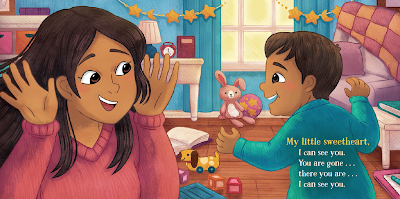
In I Can See You, mothers and grandmothers endearingly play with babies, based on the senses of seeing, hearing, smelling, feeling and even tasting. Embraced with obvious adoration, a baby, always called "my little sweetheart" is experienced fully by the parent or caregiver.
 
From I Can See You by Rosemarie Avrana Meyok, illus. by Michelle Simpson
From playing peek-a-boo to giggles, hugs and kisses and cuddles, each baby is well-loved and the basis for readers, and undoubtedly young listeners, to understand how the five senses can be the vectors for that love.

From I Can See You by Rosemarie Avrana Meyok, illus. by Michelle Simpson  
Born in NWT and residing in Nunavut, author Rosemarie Avrana Meyok speaks from experience both of people and place. As a great-grandmother, she has undoubtedly done her fair share of baby cuddling and nurturing. Her words are simple, as appropriate for a concept book, but never shallow. Rosemarie Avrana Meyok gives depth of feeling to those words but also experience with their message. From the baby in an amautik (parka with a hood for a baby) receiving kunik (nose kisses) from her mother to an Arctic landscape of cottongrass and saxifrage or northern lights–depending on the season– I Can See You takes young readers to the far north. In her joyful artwork, Niagara Falls illustrator Michelle Simpson brings that landscape to life, in its people and its place. The vegetation is distinctly that of the tundra, the stilted houses are raised above the permafrost, the stuffies include walrus, narwhal and snowy owls, and there are earrings that are beaded or resemble the ulu. Everything speaks to an Arctic community and an Inuit culture at its heart. And more at its heart is the love of mother or grandmother, perhaps aunt or sister, for babies who are seen, heard, touched, tasted and smelled with tenderness, knowing all the love that every child deserves.

November 26, 2021

Chaiwala!

Written by Priti Birla Maheshwari
Illustrated by Ashley Barron
Owlkids Books
978-1-77147-368-2
24 pp.
Ages 3-7
October 2021

For kids in North America, it may be a treat to pick up a hot chocolate or a smoothie at their local fast food spot, but for this young girl it's all about the chai, and getting it from the skilled and artistic chaiwala at the train station.
From Chaiwala! by Priti Birla Maheshwari, illus. by Ashley Barron
When she and her mother disembark their train, the child runs to the line for the chaiwala, a person who makes the aromatic and tasty beverage, chai. 
From Chaiwala! by Priti Birla Maheshwari, illus. by Ashley Barron
But waiting for a cup of chai to be made is a whole experience. There is no impatience for the time and effort the chaiwala takes to make that heavenly chai. In fact, judging by the expression on the child's face, every sound and every scent enhances that experience to something ethereal. From the "clink" of the cups to the grinding of the ingredients and the  scooping of tea leaves, the child observes and enjoys. This is not a child irritable with waiting. For her, the making of the chai is as gratifying as drinking it. And her appreciation is as palpable as the tea itself.
From Chaiwala! by Priti Birla Maheshwari, illus. by Ashley Barron
This is teacher Priti Birla Maheshwari's first picture book and, by basing it on a childhood memory of enjoying chai with her family, she is able to evoke an anecdote about the chaiwala and turn it into a sensory celebration. From the smells of the spices, the sounds of the chaiwala at his task, and the colours of the train station and its people, Chaiwala! celebrates an attribute of Indian culture that may be familiar for those living or visiting India but new to others. By sharing, Priti Birla Maheshwari is teaching and inviting readers to see something amazing and perhaps different.

Those same sensory experiences burst from Ashley Barron's paper collage work. Like the busyness of a train station and the symphony involved in the making of the chai, Ashley Barron bombards us with feeling through colour and form. She lets us breathe in the sweet and the spicy, feel the warmth of location and drink, and enjoy the taste of a cup of chai. By focusing on the child and her experiences, Ashley Barron's cut-paper art brings an intimacy to the process of watching the chai being made and then savouring it with family.

Although I've enjoyed a cup or two of chai, I've never visited India, that is, until I read Chaiwala! With this picture book, I experienced a brief moment of being in that train station in Jaipur, watching a child watch the chaiwala and appreciating the specialness of that moment with her mother. I believe my next cup of chai may seem somewhat bland compared to that made by the chaiwala but it'll certainly evoke memories of reading Chaiwala!

September 29, 2021

My City Speaks

Written by Darren Lebeuf
Illustrated by Ashley Barron
Kids Can Press
978-1-5253-0414-9
32 pp.
Ages 3-7
September 2021

When a young girl and her father head to her outdoor violin recital, the city becomes their companion, sensory-rich and amazingly diverse in its scope. This visually-impaired child, as evidenced by her white cane, listens as her city speaks and she hears, as well as smells and tastes and feels. Her city is alive.
From My City Speaks by Darren Lebeuf, illus. by Ashley Barron

As she and her father walk to the park, she "sees" everything but her seeing is with all her senses except her eyes. The reader will see the neighbour pruning his shrubs and the lady walking her terrier and her father locking the door but the child will know them in her own way. We see them reach the tactile paving at the busy intersection while she hears the city moving.
It rushes and stops and waits and goes.
From dropping a letter off in the post box to watering plants in the raised garden beds near a construction site, the child hears the city growing in different ways. But the city is really a spectacle of contrasts: busy and relaxed, playful and working. And she hears it all.
From My City Speaks by Darren Lebeuf, illus. by Ashley Barron

After stops at a playground, ice-cream shop and grocer's, filled with their own sensory experiences, the weather changes.
It pitters and patters and drips and drains.
From My City Speaks by Darren Lebeuf, illus. by Ashley Barron
Finally after a subway ride, alive with "whispers and giggles and sometimes meows," the girl and her father reach the outdoor venue where she and other children are to perform. Then, her city not only speaks, it listens.

Vancouver's Darren Lebeuf may take us to his neighbourhood–though maybe not–to experience it through the senses of a child whose eyesight is impaired but this could be any city. There are roads and parks, stores and playgrounds. There are quiet areas and busy ones, and the girl notices everything around her. By choosing to make his character less dependent on her eyesight, the sense that most of us rely on as we navigate our neighbourhoods, Darren Lebeuf helps us hear and occasionally smell and taste, reminding us of everything we undoubtedly miss when we use only our eyes. Moreover by giving a rhythm to his words, like the "hasty honks, impatient beeps, distant chimes, reliable rumbles, speedy sirens and urgent clangs," Darren Lebeuf has found the city's heartbeats, those that come from its people, its infrastructure, and more.

But while Darren Lebeuf's character cannot rely on her eyesight, readers will get the full visual experience from Ashley Barron's cut-paper collages of the most vibrant colours and the most intricate details. There's a hot pink Vespa, a raccoon peeking out from a trash container, and the family's cats playing with a toy mouse. On the subway, the child may not see the hijab-wearing woman sharing earbuds with a wheelchair-bound young man or the pink-haired person beside another with pencil-skewered hair, but we do. And so the child's amazing sense of what is going on around her is all the more impressive. 
 
Darren Lebeuf and Ashley Barron's My City Speaks certainly speaks to an awareness for one's environment but it also celebrates the richness of an urban landscape in stimulating all our senses and the importance of being ever present in its distinct quality.