Showing posts with label emotions. Show all posts

January 12, 2026

Sometimes I Feel That Way Too

Written by Hannah Beach
Illustrated by Rebecca Bender
Plumleaf Press 
978-1-069093561
36 pp.
Ages 4–8
January 2026 
 
Giving voice to your feelings is not always easy and it is especially challenging for children who don't always have the words to do so. Hannah Beach, an emotional health and play-based learning consultant, gives both an appropriate and playful means by which children might express those feelings, especially with Rebecca Bender's lively artwork to give them context.
From Sometimes I Feel That Way Too, written by Hannah Beach, illustrated by Rebecca Bender
A child awakens and sees their teddy bear snuggled up against the dog, and declares that, "Sometimes I feel that way too." In a series of double-page spreads, this child goes through their day, sensing how a balloon might be excited, or how a lone tree leaf in autumn might feel sad, or how all the boots lined up at school feel like they belong. In each case, he expresses the circumstances in which he might feel the same way. At school, at home, or on a walk in the rain, at play, at learning, or eating, this little boy feels a lot and can always find something that mirrors his feelings. Sometimes they're joyous and exuberant emotions like the popping of popcorn, but sometimes they're less so like when they feel lonely, angry or disappointed. In each case, the child sees something in their everyday life that reflects that feeling.
From Sometimes I Feel That Way Too, written by Hannah Beach, illustrated by Rebecca Bender
The words Hannah Beach uses, via her little character, are words that young children will understand, as are the feelings. Whether it's a snail tucked up in their shell, or a lonesome orange that doesn't get picked for a snack, or a stacking block game that topples, it's all seen from this child's point of view. Illustrator Rebecca Bender does the same, emphasizing what the child sees and feels. Her artwork, created with a soft blend of gouache, watercolour, pencil, collage, and digital media, emphasizes the child who appears throughout the day, inside a school or home and outside, displaying a full range of emotions. We see that range in his face, in his eyes, in his body language, and in his smile. Rebecca Bender makes us see all the feelings he's feeling. Just as she has consistently done in all her books—including her award-winning Giraffe and Bird series (see Giraffe and Bird Together Again [2018]) and How Do You Feel? (2016)—Rebecca Bender gives us a lightness to a big message. 
From Sometimes I Feel That Way Too, written by Hannah Beach, illustrated by Rebecca Bender
If you're a teacher or a parent who wants to help a child express their emotions in their own terms, Sometimes I Feel That Way Too would provide a perfect starting point. Children could find their own examples of what looks sad or lonely, angry or disappointing from within their own activities and experiences. Feelings are very personal, so it only makes sense to connect them to a child's own daily life. And, when they communicate those feelings in their own way—this child likes to draw the items that mirror his emotions—those who care for them will be better equipped to help.
From Sometimes I Feel That Way Too, written by Hannah Beach, illustrated by Rebecca Bender

November 25, 2025

Call Me Gray

Written by Andrew Larsen and Bells Larsen
Illustrated by Tallulah Fontaine
Kids Can Press
978-1-5253-1135-2
32 pp.
Ages 4-8
October 2025 
 
For a four-letter word, "gray" packs a lot of meaning. It can mean the colour that is between black and white, the two sides that allow no middle ground. It can mean the dullness of a cloudy day with the absence of sun pulling a pall over everything. It can also reflect a feeling of detachment or depression, far more profound than the blues of sadness. But, for the child in Andrew Larsen and Bells Larsen's story, it's a name that holds colour and brightness, sunshine and joy.
From Call Me Gray, written by Andrew Larsen and Bells Larsen, illustrated by Tallulah Fontaine
It's the beginning of winter, and an unnamed child is looking forward to some wonderful traditions that they and their father partake in, starting with the building of their ice rink. But this year, this child knows something has changed.
But this year feels different.
 
It's not the snow
and it's not the cold.
 
It's me. 
 (pg. 6)
 
From Call Me Gray, written by Andrew Larsen and Bells Larsen, illustrated by Tallulah Fontaine
As they build their ice rink, the child hesitantly tries to gain some clarity to their feelings. A  recent incident, in which their best friend doesn't invite them to her sleepover because it's only for girls, has them saddened and perplexed. Talking to their dad, the child asks some very big questions including, "Do you ever feel mixed up about who you are?" (pg.12) Their dad tries to answer this and other questions but it's obvious that he's not grasping exactly what his child is asking. Still, as their work progresses, there is one statement that makes their dad stop and think and appreciate what his child is saying. 
"I look like a boy but
sometimes I feel more
like a girl."  
   (pg. 15)
And with that meaningful communication,  a subtle but monumental change begins to take place in the midst of enduring winter traditions.
From Call Me Gray, written by Andrew Larsen and Bells Larsen, illustrated by Tallulah Fontaine
I have reviewed so many Andrew Larsen books, both picture books and middle-grade fiction, including Goodnight, Hockey Fans (2017),  Dingus (2017), and 
Me, Toma and the Concrete Jungle (2019), and each one seems deeply personal. Call Me Gray has that same overtone, perhaps because Andrew Larsen has written it with his son, and the two have spoken of Bells Larsen's own experiences as a transgender person. I don't know if Andrew Larsen and Bells Larsen built ice rinks together and enjoyed hot chocolate afterwards, but the relationship between father and child in Call Me Gray is a touching one without being saccharine. In fact, it's quite real. They speak, they interact, and they question as they try to understand themselves and the other. And it's obviously a safe space in which to question and to make choices. 
From Call Me Gray, written by Andrew Larsen and Bells Larsen, illustrated by Tallulah Fontaine
This is the first children's picture book that Edmonton's Tallulah Fontaine has illustrated,  though her work has been featured on advertising displays and in numerous publications including the New Yorker, the New York Times, and The Economist. Rendered in gouache and finished digitally, her illustrations focus on that which is important: the relationship between the child and their father, as well as others. Tallulah Fontaine shows them pounding stakes, shovelling snow, and chatting while they work. She shows them putting on their skates and skating and always interacting, either in silence or in important conversations. Their work, together to build rink or to build understanding, is the goal. And Tallulah Fontaine always conveys much in the faces of her characters, whether it be disappointment, confusion, contentment, or hope.

Call Me Gray may become a wonderful story starter for challenging conversations about gender identities or about encouraging self-expression or about building an ice rink. It might help children share their feelings, or help their parents establish safe spaces to discuss big issues. But Call Me Gray may also take "gray" out of the unfavourable realm and move it into one of inclusivity and association and positive change.

May 19, 2025

Sam

Written by Eric Walters
DCB
978-1-770867949
228 pp.
Ages 9-14
May 2025 
 
She was strong. She didn't give up. She didn't take crap from anybody. I liked that. And all she really wanted was a place to call home. I understood that better than I even would have wanted. (p. 133)
 
The "she" of whom fourteen-year-old Sam Reid speaks is Anne of Green Gables, and, along with support from a select group of new acquaintances, the boy with red hair and a matching temper has a lot to learn and especially from L. M. Montgomery's 1908 fictional character.
 
Sam may be a smart kid, but it doesn't stop him from letting his temper get the better of him. When confronted with a shopkeeper trying to rip $10 off of him and having to stand up against the high school's quarterback, who ends up with a broken nose, Sam knows he should have kept his cool. But things get worse when Sam is accosted in a school bathroom and fights back, leaving Cody, the quarterback, with a concussion.
...there's no question that I have a temper, but that's only because people are always doing things to provoke me. (p. 9) 
With no family–his parents were killed in a car crash by a drunk driver four years earlier–and foster parents who don't want him back, he is sent to the Johnson Juvenile Center, a detention facility for those younger than 18 who were awaiting trial or those already convicted and serving sentences less than 18 months. Sam would be at the Johnson Juvenile Center, a.k.a. the Gables, for at least 5 weeks while he is assessed before heading to court. While his social worker Jenna Williams is keen to help, his court-appointed lawyer Mr. Turner is challenged, especially when additional charges of fraud and theft are brought by the shopkeeper, and everyone seems disappointed that the local football hero would be out of commission. 

At the Gables, Sam must deal with a nasty guard Mr. Roberts who insists on calling Sam "Red" and is just waiting for the chance to write him up for poor behaviour, bad attitude, and more. There's also a convicted "long-timer" Bruce who seems to have it out for Sam after an innocent mistake of sitting at the wrong dining table ends with Sam shooting off his mouth again.
Why did people keep coming at me and why wasn't I smart enough to shut up and move on when they did? (p. 64)
Thankfully Sam has some good people on his side trying to help him be the best version of himself. There's his roomie Nigel, a smaller guy who is in for throwing a chair at someone; Mrs. Martinez, their English teacher; Kate, a kind-hearted guard; and his psychologist, Dr. McEnny. Now if Sam could only stop seeing everything and everyone as a threat or a challenge and use his smarts–and he is very intelligent–to help himself. 
Sometimes smart can't overcome circumstances, situations, and tragedy. (p. 128)
Things start to change for Sam when Mrs. Martinez assigns Nigel and Sam each a book on which they will prepare a report, and Sam gets Lucy Maud Montgomery's Anne of Green Gables, hoping he'll find some interesting parallels with his own life. If he can just get past his outrage and humiliation, especially when he sees that Anne is a redhead like he is, Sam may be able to use his potential and discover his strength to find hope.
 
For lovers of L. M. Montgomery's Anne of Green Gables, the parallels between Anne's life and that of Sam will be evident, even though their differences in time and circumstances are significant. (In fact, an assignment Sam completes for Mrs. Martinez focuses on these very parallels.) Eric Walters is very subtle in his homage to Montgomery and her red-haired character, though his "Author's Note" suggests an extraordinary depth of admiration for the author and her book. This is abundantly evident in his appreciation for her words–quotes from Anne of Green Gables are cited often and always fitting–and the themes of persevering life's challenges and finding hope against tragedy and adversity. Eric Walters makes us believe in Sam. The young teen may not be completely likeable at the beginning of Sam but he's a kid who has had a lot of hard knocks. His temper, which may or may not be as a result of his circumstances, and I don't mean the colour of his hair, is an entity with which he has a relationship, good or bad. It's in his learning about that anger and his recognition that he has been able to keep it in check that almost releases him from it and allows Sam to grow. While he initially thinks Anne is almost delusionally optimistic, he too starts to acknowledge the positives of things that once appeared to only be difficult. 

Sam has had a tough life, bouncing from foster homes and receiving homes, never being offered a true home since the death of his parents. But, as horrific as going to a juvenile center must be, the Gables becomes a place of salvation for Sam, as Green Gables was for Anne, helping him acquire a support system as tough as any loving family and teaching him the strength he has always had to overcome that which seems formidable. With kind souls and kindred spirits, Sam's life goes beyond "a perfect graveyard of buried hopes" as Anne declares at the beginning of Anne of Green Gables, to one of possibilities.

May 01, 2025

I Am Not a Sloth

Written by Marie-Pier Meunier
Illustrated by Valérie Desrochers
CrackBoom! Books
978-2-898026041
32 pp.
Ages 6-9
May 2025 

Harry may be a sloth i.e., the mammal but he is not lazy or complacent. He is more than just sloth, and he wants everyone to see all the things that he is because he has a big personality and he's proud of it. In fact, he introduces the reader to all the Harrys he is.
From I Am Not a Sloth, written by Marie-Pier Meunier, illustrated by Valérie Desrochers
He is joyful and generous, but he can also be furious and cranky. He can be studious and adventurous but also proud and anxious. He is typical in that he is a blend of positives and less positives, lovely traits and others when challenged with life. He may be a sloth–which he finally accepts–but he's so much more.
I am HARRY
and that suits me just fine.
I like myself as I am, one of a kind. 
From I Am Not a Sloth, written by Marie-Pier Meunier, illustrated by Valérie Desrochers
Quebec's Marie-Pier Meunier's message is that all of us are not just one thing. We are a blend of so many traits, both good and less desirable, that make us who we are. We might not always like being envious or stubborn and we certainly don't want to be labelled based on a single trait or a single bad act because we are more than our worst moments. Too often children are told by their peers or a parent or a teacher than they are one thing, whether precocious or difficult, lazy or entitled, and that's all they will remember or fear that's how everyone will see them. Harry is more than a sloth in his behaviours but then aren't we all? We all have days of inefficiency or fatigue or even unkindness, but we should not let those moments define us. It's unfortunate that we often see ourselves and others in terms of our worst not who we truly are. It's hard for Harry to accept that he is a sloth because of the connotations associated with that label but Marie-Pier Meunier lets him see how much more he is–just as young readers might do so–and how full his personality is. (Her author's note speaks about how personalities are formed, that we are not defined by our emotions, and that labels are hurtful.)
From I Am Not a Sloth, written by Marie-Pier Meunier, illustrated by Valérie Desrochers
Valérie Desrochers, an illustrator also from Quebec, makes I Am Not a Sloth a joyful acceptance of self beyond the obvious. She makes Harry both shy and brave in acknowledging his true self. He has twinkling eyes, a smile that is both affectionate and self-deprecating, and a face that expresses all the good and the not-so-good traits that are Harry. And in a landscape of lush fronds and leaves, as well as in a playful house setting, readers get to see the big picture that is Harry.
 
I Am Not a Sloth would a fabulous starter for so many lessons, from writing characters that are full-developed to self-image and acceptance. Most of all, it is a sweet story about acknowledging everything about ourselves, good and bad, and not dwelling on the worst, and that includes avoiding labelling, a harmful practice that overlooks the individual as a whole.
From I Am Not a Sloth, written by Marie-Pier Meunier, illustrated by Valérie Desrochers

April 11, 2025

If a Bumblebee Lands on Your Toe

 
Written by Cynthia Mackey
Illustrated by Vikki Zhang 
Yeehoo Press
978-1-953458742
40 pp.
Ages 3-8
April 2025 
 
If a bumblebee landed on your toe, most people would react poorly, swatting away the bee–even if it hadn't harmed you–and screaming with panic. In most cases, the reactions would end up causing more stress and perhaps harm. But, given the opportunity to see the situation from a different perspective and truly appreciate the moment, If a Bumblebee Lands on Your Toe illustrates the beauty of an occasion that brings nature to our feet, in more ways than one.
From If a Bumblebee Lands on Your Toe, written by Cynthia Mackey, illustrated by Vikki Zhang
Victoria's Cynthia Mackey does not recommend throwing caution to the wind, but she does suggest that in those moments of stillness there are ways to keep you safe by taking lessons from our natural world. It may start with pretending you're playing a game of freeze dancing or imagining yourself as a boat frozen into a lake.  
From If a Bumblebee Lands on Your Toe, written by Cynthia Mackey, illustrated by Vikki Zhang
It's being slow and meticulous, "like a garden snail inching under a daisy on a rainy day" or like a hibernating bear awaiting spring. Of course, when you must act, you should do so with caution, like blowing at the bee as the wind might, or crying out for help gently like a "chickadee who alights softly upon a willow branch."
From If a Bumblebee Lands on Your Toe, written by Cynthia Mackey, illustrated by Vikki Zhang
Finally, you may need to shoo that bumblebee away like a lion flicks its tail "shaking off water after a bath" but still you appreciate the bravery, cleverness and calm you showed.
 
Many will use the word whimsical to describe Cynthia Mackey's story of quiet strength when faced with a bumblebee landing upon your body. She recognizes that it is still a potentially dangerous situation, but Cynthia Mackey takes the reader outside the body to find fanciful examples of how to behave. Whether it is drawing wisdom from a mouse or an owl, a lion or a snail, there is insight about being cautious and safe when faced with a bee that could sting. And through the process of calming oneself to not startle the bee or harm it and consequently ourselves, Cynthia Mackey asks us to be mindful of the moment, and to not focus on what could happen but instead to look at what we can do now to make things right. All her examples of how to behave help us see the beauty in the natural world as its animals move, react and live with each other. 
From If a Bumblebee Lands on Your Toe, written by Cynthia Mackey, illustrated by Vikki Zhang
The whimsy of Cynthia Mackey's words are fully realized in the artwork of Chinese artist Vikki Zhang. Her artwork which is blend of different media are complex spreads of movement and ornamentation, rich in line and shape. The flowers and the patterns in the backgrounds and in the clothing are extraordinary and would be a delight to colour if left as black-and-white outline drawings. But, perhaps most charming is the bee which is depicted as a fairy with delicate wings, ballet flats and a striped dress. She is dainty and almost innocuous in most illustrations, which seems fitting since it is the character with the bee on her toe that is the focus. Vikki Zhang's art emulates Cynthia Mackey's message that the solution for dealing with a bumblebee landing on your toe is not with the bee but the keeper of that toe who must choose wisely and calmly to avoid serious harm.
 
So, if a bumblebee lands on your toe, there are many recourses but being calm and quiet and seeing beyond the fear and anxiety seem to be useful starting points. After all, there's a lot of beauty in the natural world and it is filled with the wisdom to handle just such a dilemma.

July 10, 2024

See You Later, Alligator!

Written by Lana Button
Illustrated by Noémie Gionet Landry
Scholastic Canada
978-1-4431-9885-1
32 pp.
Ages 3-8
July 2024
 
A lot of kids have anxiety about school. It's being away from home, it's being without the comfort of family, it's a day of unknowns, and it's a day of other's expectations that need to be met. Flora is not necessarily fearful of school but it sure is nice to be with her family and dog, and leaving that to enter a school of strangers isn't very easy.
From See You Later, Alligator!, written by Lana Button, illustrated by Noémie Gionet Landry      
When Flora's moms drop her off at school, getting Flora to get past the gate and into the school yard becomes a monumental feat. It would seem that, though Flora thinks going to school is easy-peasy, she continues to be drawn back to them and her dog for one last hug, or one more kiss, or another goodbye wave. With each rhyming phrase for goodbye–who knew there were so many?–Flora continues to be distracted from joining her classmates in the school yard.
From See You Later, Alligator!, written by Lana Button, illustrated by Noémie Gionet Landry
Some may think that Flora is anxious about school but I suspect it has more to do with wanting to be close to her family than not being at school. She's not crying or complaining about an upset stomach or misbehaving; she just obviously loves her family. It may be a "See you later, Alligator!" and a "Take care, Polar Bear!" and even a "See you soon, Raccoon!" plus extra hugs and kisses and elbow bumps and more before she enters the school, but she does, and is happy to be among her classmates.
 
If you have a little one starting school for the first time, or a young child returning to school after summer holidays, there may be some hesitancy but a reading of Lana Button's See You Later, Alligator! will reassure them that many children feel some unease at leaving the comfort of home for the classroom. In addition to writing a wonderful collection of picture books (e.g., What If Bunny's Not a Bully?, My Teacher's Not Here! and Raj's Rule (For the Bathroom at School)), Lana Button is an early child educator and knows young children and their fears, worries, expectations, and more. As such, she has always aimed her books for their needs, and See You Later, Alligator! is just another stellar example of understanding and addressing how children perceive and react with regards to school and how to best address their needs.
From See You Later, Alligator!, written by Lana Button, illustrated by Noémie Gionet Landry
Noémie Gionet Landry, an illustrator (and doctor!) from New Brunswick, is a new name for me but she is no newcomer to children's book illustration. Her digital artwork has an ease and brightness to it, seeing young children with their animal backpacks, colourful clothing, and diversity in everything about them. Noémie Gionet Landry makes sure that every child will recognize themselves somewhere in See You Later, Alligator! and will find the familiar in its setting and story. She brings the visual to Lana Button's story, ensuring children will appreciate it at a personal level.

Summer vacations may have just started for many children but September (or August or whenever) is around the corner and See You later, Alligator! will be just as important as pencil crayons and a new backpack to starting the year off right. Help your young children see that going to school can be easy-peasy once they get in the door.

March 21, 2023

When Things Aren't Going Right, Go Left

Art by Peter H. Reynolds
Words by Marc Colagiovanni
Orchard Books
978-1-338-83118-4
32 pp.
Ages 4-8
March 2023
 
Of course, things don't always go right. That's life. But how we handle it when things don't go right makes for a good story when we get back on track.
From When Things Aren't Going Right, Go Left by Marc Colagiovanni, illus. by Peter H. Reynolds
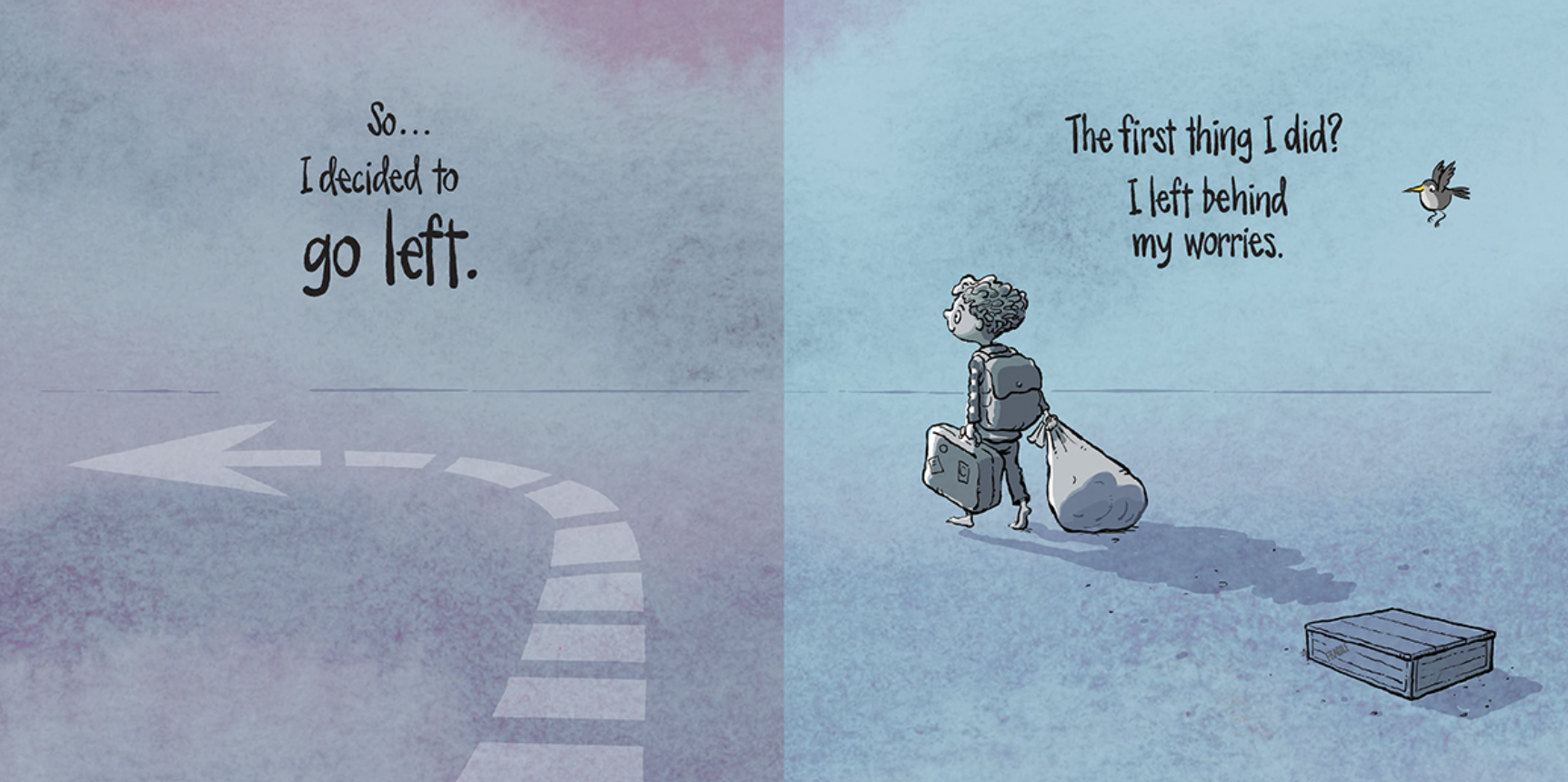
In Rhode Island's Marc Colagiovanni's debut picture book, a child is burdened by a box of worries, a sack of doubts, a suitcase of fears and a knapsack of frustrations. He wants to try something that has frustrated him, worried him, scared him, and made him doubt himself. It's a pool with a diving board.
From When Things Aren't Going Right, Go Left by Marc Colagiovanni, illus. by Peter H. Reynolds
He'd attempted a dive once and had been unsuccessful, and now considers another attempt. Ah, but there are those doubts and those fears and more. Worse yet, as he attempts to leave them behind, one encumbrance at a time, the annoying creatures shout back at him. Can he make them manageable or leave them behind to take control?
From When Things Aren't Going Right, Go Left by Marc Colagiovanni, illus. by Peter H. Reynolds
The message that it's okay to put down your burdens is an important one for all of us who sometimes feel we need to power through everything and anything. Marc Colagiovanni obviously knows this and, by using an example of a child attempting something that both scares and frustrates him, he reminds us that not everything is going to go right or be easy. It could be trying a formidable dive or making a new friend or overlooking those pesky demons that cause us stress and worry. We all have them, and we all need to find coping strategies to get beyond them. The message is meaningful, but the medium is everything.
From When Things Aren't Going Right, Go Left by Marc Colagiovanni, illus. by Peter H. Reynolds
The artwork from Peter H. Reynolds takes When Things Aren't Going Right, Go Left from social emotional advice to a visualization for coping. Though some may see a child attempting a dive as trivial, to that child those burdens of worry and fear are great. They are heavy loads of disquiet and cannot be diminished because others might seem them as negligible. Peter H. Reynolds makes us feel the weight of those burdens in the child's face and body language and, most clearly, in the palette of the art. From the grey blues and purples of the child's troubled steps, through the times of lighter oranges and pinks, until his world is bright and sunny yellow, this child feels everything, and so do we. 

Peter H. Reynolds's books are always a treat of messaging and graphics, and his collaboration with Marc Colagiovanni reminds us again that we have the capacity to make things better for ourselves while inspiring all of us to do our best.

 ⇨⇦ ⇨⇦ ⇨⇦

When Things Aren’t Going Right, Go Left by Marc Colagiovanni and Peter H. Reynolds | BOOK TRAILER

Uploaded by Scholastic to YouTube on February 222, 2023.

December 23, 2022

Finding Your Stars

Written by Carolyn Morris
Illustrated by Lena Lee
978-1-7778356-0-6
38 pp.
Ages 3-8
November 2022

 May you be gentle with your clouds and generous with your stars.
 
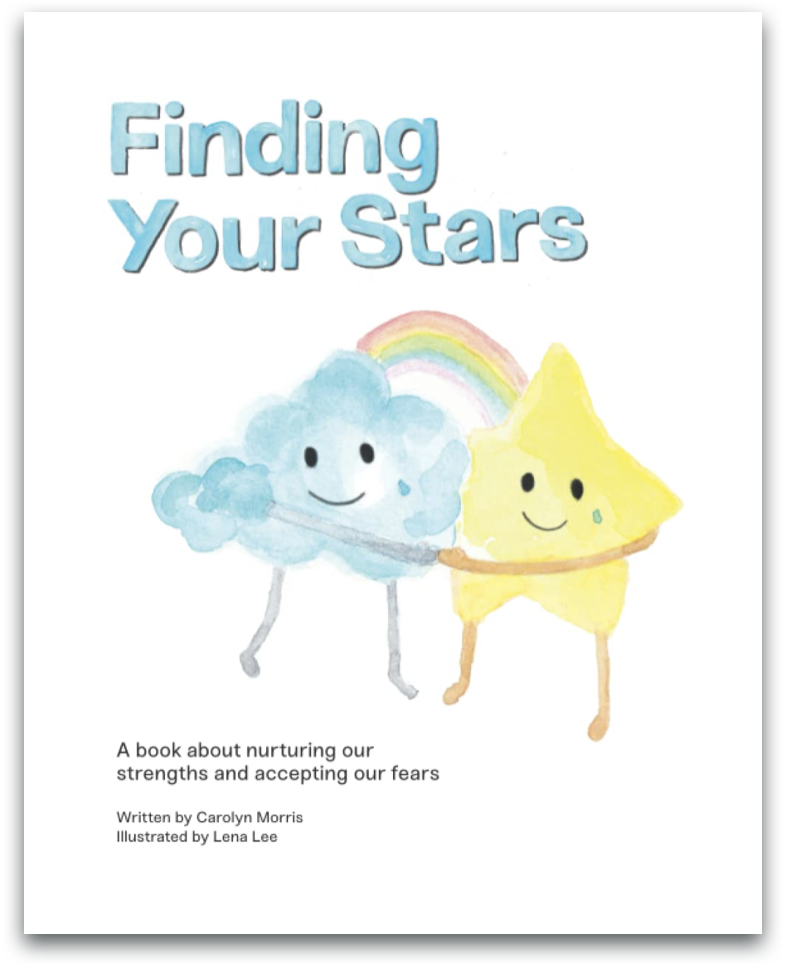
With those wise words in her dedication, author Carolyn Morris begins her rhyming story to help children see that the strengths and positives in their lives will sometimes be accompanied or even overshadowed by challenges and weaknesses. Both are part of who we are.
We each have stars
inside that glow.
They're special skills
and games we know.
From Finding Your Stars by Carolyn Morris, illus. by Lena Lee
But, sometimes we fall, or we fail, and clouds move in. 
Your clouds are worries,
flaws and fears.
They cover your stars
in gloom and tears.
From Finding Your Stars by Carolyn Morris, illus. by Lena Lee
Young children will understand about clouds covering up their stars. They know what it's like to feel less than shiny. Whether it's because of a friendship gone wrong, a test failed, or family disappointments, the stars and the clouds get into a tug of war. Carolyn Morris suggests that whatever the child focuses on will become stronger. (There's a sweet tug-of-war game between a blue cloud and a golden star in which the cloud cheers its win.) By focusing on the clouds, even if only to dispel them, you give them power to spread "their fears, their faults, their pain." Acknowledging them is fine–"But, if you greet the storm, then spin, back to your stars"–but you should turn back to the stars who will help lift you up. And as you're lifted, you see more stars.
So don't forget how
bright you are,
Embrace your clouds,
then shine those stars.
Most of us get mired in our worries and fears. It's human nature to focus on the negatives because they're consuming. If things are going well, you don't attend those aspects because they aren't of concern. But Toronto author Carolyn Morris isn't necessarily telling us to ignore those "clouds"; instead she's suggesting that it's okay to acknowledge them but then focus on the positives as these are the things that will help you come out from the shadow of the clouds. The message is a simple one but, by creating an analogy with stars and clouds, Carolyn Morris helps kids see that trying to get rid of the clouds is impossible and that the stars will not always be shining. However, you can enjoy the shine of the stars and give the clouds a rest to float on by, which they will almost always do.
From Finding Your Stars by Carolyn Morris, illus. by Lena Lee
Lena Lee who illustrated Finding Your Stars gives the story an ephemeral quality with watercolours and pale colours, reminding young readers graphically that clouds are unenduring. They may reappear intermittently and perhaps infrequently but they are transitory. The bolder stars, on the other hand, stick around a lot longer. I like that neither the clouds nor the stars are aggressively negative or positive; they just are. That is very much like the clouds and stars in our lives. Seldom are the clouds so onerous that they cannot be put aside temporarily or so threatening to our stars that they cannot be managed. And children need to see that they often have the capacity to find their stars.

Here's to everyone finding their stars and weathering the clouds as they come and go.
 
⭐⛅⭐⛅⭐⛅⭐⛅⭐⛅ ⭐
 
Additional resources, including printable colouring pages, are available at findingyourstars.com and would be handy for parents and teachers who want to help young children.

August 02, 2022

The Ugly Place

Written by Laura Deal
Illustrated by Emma Pedersen
Inhabit Media
978-1-77227-432-5
28 pp.
Ages 4-7
July 2022

When our negative moods take over, everything becomes ugly: places, people, ourselves.  
There is only one way to get to the ugly place, and you have to feel absolutely miserable.
From The Ugly Place by Laura Deal, illus. by Emma Pedersen
With the wet and gloomy weather, this child recognizes that everything is pointing them to a visit to the ugly place. They see ugliness in the exposed shore at low tide, in the fish, in their own mucky footprints on the wet tundra, and the smells of the salt water and the stale seaweed. And this child wallows in that which they see as ugly and matches their ugly mood.
From The Ugly Place by Laura Deal, illus. by Emma Pedersen

But seeing, really seeing, brings clarity. By focusing on that which is in front of them, perception is changed.

...my heart settles when I see the seagull circle around again in effortless flight, joined by another. Their crisp white feathers are exceptionally bright against the sunless sky. They play while gliding and swooping through the air.
They close their eyes and open their senses to the sounds, the smells and the feel of the emerging sun.

Then, and only then, is when IT HAPPENS.
Small things emerge to announce their joyful presence: a stir of the water, the flip and flop of sculpins, and life in the sea, on the land, and in the air. And in the child's heart, through the art of breath.

From The Ugly Place by Laura Deal, illus. by Emma Pedersen
Everything becomes part of an orchestral piece of music with the child conducting. It's up to them to see the virtues of every piece of their place and harmonize them for the big finish. And that grand performance is what finally takes the child from the ugly place to one where smiling is possible and the despair of the person and place disappears.
 
Getting to the ugly place is not hard when negative emotions overwhelm. Whether it is anger or fear, anxiety or disappointment, misery makes for an efficient vector to joylessness and the blindness to that which would normally inspire gratitude and bring comfort. While Iqaluit's Laura Deal may envision a literal ugly place to which this child visits, with scowling rocks and clouds, the ugliness is actually within and carried by the child, creating the foulness they experience within their landscape. But children, not unlike many adults, don't realize that they carry that ugliness with them to place and people. Fortunately, they also carry the possibility of finding joy both within and without, as this child discovers with some mindfulness in an natural environment. Laura Deal, whose earlier picture books In the Sky at Nighttime and How Nivi Got Her Names share a northern perspective of culture and place, again takes us to a community of the tundra, of rocky terrains, gulls and Arctic sealife. It's a place where a child can walk for great distances from town, ponder their moods and take the time for mindful appreciation beyond themselves. It's a place for insight and reflection, thoughtfulness and solitude, all of which reverberate in Laura Deal's text.

Likewise, Toronto illustrator Emma Pedersen mirrors the moods of the child as they experience the ugly place and shift to acknowledgement of the beauty evident. The furrowed brows and hunched shoulders of a child among the harshness of a landscape teeming with grimacing components reflects the bitterness of their feelings and the gloom of the weather. But all is transformed with light and softness as joy returns. 
 
Misery and despair will happen in our lives. But, it can and will give way to calm and joy given the opportunity for mindfulness of self and nature, a lesson for all who feel.
From The Ugly Place by Laura Deal, illus. by Emma Pedersen

June 23, 2022

Annie's Cat is Sad


Written by Heather Smith
Illustrated by Karen Obuhanych
Feiwel and Friends
978-1-250-80684-0
32 pp.
Ages 4-8
June 2022
 
When Annie comes home from school and her cat Delilah does not rush to see her or even want to hang out with her, Annie is convinced that Delilah is sad. But what to do when your cat is sad?
From Annie's Cat is Sad by Heather Smith, illus. by Karen Obuhanych
Though Annie is delighted to see Delilah, having missed her while at school, she needs to seek out her cat. But Delilah seems to want to be alone, hiding beneath the sofa. Annie understands and tries to do whatever she can to draw Delilah out and make her happy.
From Annie's Cat is Sad by Heather Smith, illus. by Karen Obuhanych
She warms some milk, tops it with whipping cream, makes a joke–it's a cattuccino–and offers a hug. Then Annie turns on the TV and invites Delilah to join her in some yoga, making up her own colourful poses.
From Annie's Cat is Sad by Heather Smith, illus. by Karen Obuhanych
But as she tries to engage Delilah, it's obvious that it's Annie who has had a bad day, and it may be Delilah who will help the orange-haired child deal with her sadness when the other strategies don't work.

No one likes to see someone they care for in distress, whether from fear or sadness or trauma. While a young reader will undoubtedly understand a beloved pet who is not acting like itself and be concerned, they will also empathize with coming home from a bad day at school and looking to their furry friend for solace. As a parent and a kind person, Heather Smith understands this and makes sure that children will accept that bad days happen and there are different ways to cope. Sometimes those strategies work and sometimes they don't. But the best thing to do is try to find what works for you. It may just be a cuddle with a cat who understands better than you that sadness has taken hold. 

It's a very light touch that Heather Smith has taken with Annie's Cat is Sad. She can do angsty and heavy (The Agony of Bun O'Keefe and Chicken Girl are but two young adult examples) but Heather Smith excels at the subtle, allowing young people to take from the text the meaning that they need to read. (Her award-winning The Phone Booth in Mr. Hirota's Garden is another prime example.) That's especially poignant when her readers need to read between the lines and with cues from Hawaii's Karen Obuhanych's illustrations. Take the understated line, "I just want you to know. It's okay to cry." with an illustration of a tear dropping from Annie's eye as a large-eyed Delilah watches. We as readers may be watching Delilah for most of the story, wondering what it would take to make her less sad, and charmed by Karen Obuhanych's grey tabby with the pink nose and green eyes. But, Annie with her voluminous ginger hair is really the star and young readers will want to go back over the story is find the clues that it was really Annie who was dealing with the bad day.

Whether feline or human, child or adult, we have bad days. And, as Annie ostensibly strives to help Delilah through hers, she provides examples for all to distract themselves from their temporary troubles, and assure them that support can be found, especially when you share your burdens.

May 09, 2022

The Tunnel

Written by Sarah Howden
Illustrated by Erika Rodriguez Medina
Owlkids Books
978-1-77147-427-6
32 pp.
Ages 4-8
March 2022

Something bad has happened. There is much concern for the child, with his mother offering hugs and his aunt asking him if he's okay. But the boy doesn't want to talk about. What he does want to do is dig a tunnel and crawl inside. So he does.
From The Tunnel by Sarah Howden, illus. by Erika Rodriguez Medina

Taking a small plastic shovel, the child starts digging into the floor of his bedroom. Deep, deep he digs, excavating a meandering tunnel that encounters worms and beetles and moles and more.  

From The Tunnel by Sarah Howden, illus. by Erika Rodriguez Medina
It's dark down there but I don't mind.

In fact, the boy realizes, after he comes up to the surface outside his home, that no one knows that he's out there.

I could just disappear.

From The Tunnel by Sarah Howden, illus. by Erika Rodriguez Medina
That empowering thought is enough for the boy. He doesn't have to disappear right now. 

I'll go home for now, I tell myself.
But I can always come back.

By returning home after his jaunt, the child can now take comfort in his room and his mother's presence.

I think she knows I need a secret place.
She might have secret places of her own.
 
I think she knows we sometimes travel far away. 
Alone, where we don't have to talk.
I'm glad Sarah Howden never reveals to young readers what nature of bad this boy experienced. By leaving it open, it could be anything and thus relevant to any child who has felt a trauma. His response, then, could be theirs. They might recognize the need for a parent or concerned adult to try to help but not knowing how. Fortunately, Sarah Howden gives this child the freedom to choose what he needs: to be silent or to escape, whether figuratively or literally. 
 
There is starkness in his situation and in Sarah Howden's words, so the bleakness of Vancouver's Erika Rodriguez Medina's artwork mirrors that atmosphere. There's not much colour in this child's life right now, nor are there in Erika Rodriguez Medina's illustrations. It's pretty much black and white, with some grey and only minimal red. I'm sure that's how this child feels. Whatever has happened to him, it has turned his world into monotones, gradations of badness. There is some colour, not unlike the goodness that is shadowed in his life, but it is so close to him that he might not be able to see it until he can look at it from a distance, perhaps outside his house or himself.
From The Tunnel by Sarah Howden, illus. by Erika Rodriguez Medina
Sarah Howden could've given her picture book a happy ending in which the boy's distress is erased with his tunnel and the love of family but, let's face, that's not very realistic. Trauma does not disappear because of good intentions or diversions. But, both Sarah Howden and Erika Rodriguez Medina show us that there is some light and colour in his life and they make sure he sees it too.