Showing posts with label companionship. Show all posts

September 13, 2022

When Spider Met Shrew

Written by Deborah Kerbel
Illustrated by Geneviève Côté
Groundwood Books
978-1-77306-563-2
32 pp.
Ages 3-6
September 2022
 
When a group of animals realize that there's something missing in their lives, they come together in a unique way to help each other out.
From When Spider Met Shrew by Deborah Kerbel, illus. by Geneviève Côté
The story begins with a hungry spider who creates a web to catch its food. But when the wind grabs the spider and its web, Spider makes the acquaintance of a shrew whose field is about to be plowed. Spider offers to help Shrew find a new home.
 
When a storm strikes, they take shelter in the tree of a bat, who is wet, and an opossum, who has lost its mother. The foursome go off in search of Possum's mother until they meet a depressed beagle saddened by the loss of her puppies. Dog is invited to be Possum's new mom, at least temporarily, and they all get on Dog's back. Bat can now move around, even though its wetness prevents flight; Shrew can share in Dog's doghouse; Possum has a surrogate mom on whose back they can travel; and Dog is needed again. Finally they meet Pony who misses the fun they used to have with a human riding them. Guess what they all do?  After that, there is only one need to fulfill and that's the one that started this whole story.
From When Spider Met Shrew by Deborah Kerbel, illus. by Geneviève Côté
Cumulative tales, those that build with repeated words or actions to progress the story, are fabulous for engaging young readers and helping them recognize words. Though a modified cumulative tale in that the words are repeated but not rigorously throughout the story, When Spider Met Shrew has that echoing of a spider who is hungry, a shrew who is homeless, a bat who is wet, an opossum who is scared and a dog who is sad. (Since the pony is at the end of the story, their boredom doesn't get repeated.) Deborah Kerbel gives us that repetition but goes beyond and that's what makes When Spider Met Shrew a little different. Whether children will read the story themselves or as part of a story time read-aloud, they'll get into the rhythm of the story, but they will also feel for the plights of the animals and appreciate their compassionate companionship that results in a happy ending that comes from helping out a friend or two, in their own way. Cumulative tales can be on the simple side, relying on the reiteration to carry the story, but, by embedding that repetition in a story of different animals feeling vulnerable because of human interference, the cycle of life, weather and time, Deborah Kerbel makes us feel not just laugh.
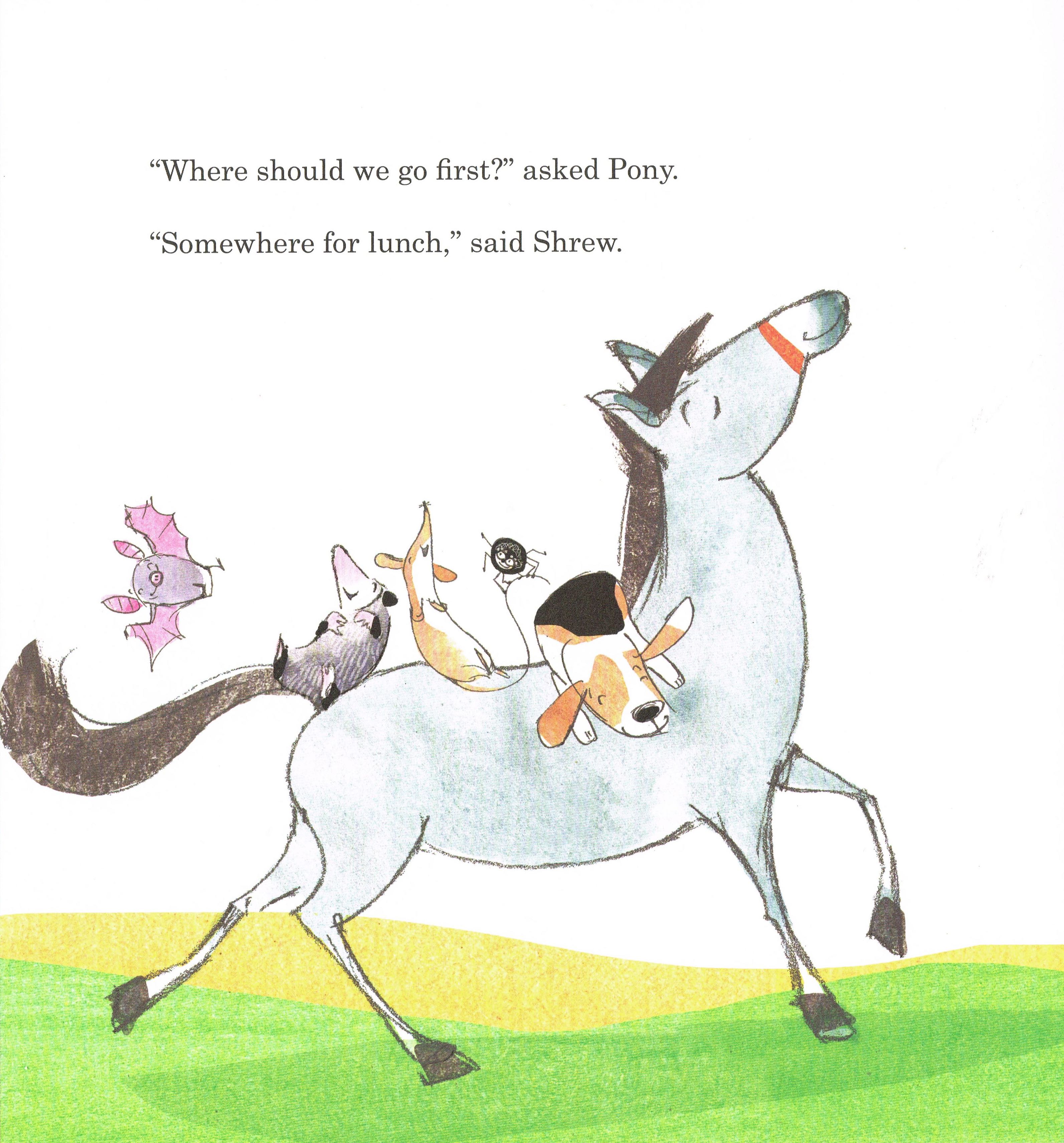
From When Spider Met Shrew by Deborah Kerbel, illus. by Geneviève Côté

Likewise, Geneviève Côté's watercolour illustrations may look simple with a background and a couple of animals, but the artwork is far more complex in its emotional substance. The burdens of the animals are evident both in words and graphics and their willingness to express those vulnerabilities enables them to get the support they require.

Alone a spider, a shrew, a bat, an opossum, a dog and a pony have hunger, homeless, sadness and more, but together they have better.

June 23, 2022

Annie's Cat is Sad


Written by Heather Smith
Illustrated by Karen Obuhanych
Feiwel and Friends
978-1-250-80684-0
32 pp.
Ages 4-8
June 2022
 
When Annie comes home from school and her cat Delilah does not rush to see her or even want to hang out with her, Annie is convinced that Delilah is sad. But what to do when your cat is sad?
From Annie's Cat is Sad by Heather Smith, illus. by Karen Obuhanych
Though Annie is delighted to see Delilah, having missed her while at school, she needs to seek out her cat. But Delilah seems to want to be alone, hiding beneath the sofa. Annie understands and tries to do whatever she can to draw Delilah out and make her happy.
From Annie's Cat is Sad by Heather Smith, illus. by Karen Obuhanych
She warms some milk, tops it with whipping cream, makes a joke–it's a cattuccino–and offers a hug. Then Annie turns on the TV and invites Delilah to join her in some yoga, making up her own colourful poses.
From Annie's Cat is Sad by Heather Smith, illus. by Karen Obuhanych
But as she tries to engage Delilah, it's obvious that it's Annie who has had a bad day, and it may be Delilah who will help the orange-haired child deal with her sadness when the other strategies don't work.

No one likes to see someone they care for in distress, whether from fear or sadness or trauma. While a young reader will undoubtedly understand a beloved pet who is not acting like itself and be concerned, they will also empathize with coming home from a bad day at school and looking to their furry friend for solace. As a parent and a kind person, Heather Smith understands this and makes sure that children will accept that bad days happen and there are different ways to cope. Sometimes those strategies work and sometimes they don't. But the best thing to do is try to find what works for you. It may just be a cuddle with a cat who understands better than you that sadness has taken hold. 

It's a very light touch that Heather Smith has taken with Annie's Cat is Sad. She can do angsty and heavy (The Agony of Bun O'Keefe and Chicken Girl are but two young adult examples) but Heather Smith excels at the subtle, allowing young people to take from the text the meaning that they need to read. (Her award-winning The Phone Booth in Mr. Hirota's Garden is another prime example.) That's especially poignant when her readers need to read between the lines and with cues from Hawaii's Karen Obuhanych's illustrations. Take the understated line, "I just want you to know. It's okay to cry." with an illustration of a tear dropping from Annie's eye as a large-eyed Delilah watches. We as readers may be watching Delilah for most of the story, wondering what it would take to make her less sad, and charmed by Karen Obuhanych's grey tabby with the pink nose and green eyes. But, Annie with her voluminous ginger hair is really the star and young readers will want to go back over the story is find the clues that it was really Annie who was dealing with the bad day.

Whether feline or human, child or adult, we have bad days. And, as Annie ostensibly strives to help Delilah through hers, she provides examples for all to distract themselves from their temporary troubles, and assure them that support can be found, especially when you share your burdens.

February 02, 2022

Hat Cat

Written by Troy Wilson
Illustrated by Eve Coy
Candlewick Press
978-1-5362-1366-9
32 pp.
Ages 4-8
February 2022
 
In a charming little house with a garden rich in trees and plants lived an old man. He loved the squirrels that visited him. In fact, he liked to feed them by placing peanuts in his tweed bucket hat and welcoming the squirrels to sit upon it to feast.
From Hat Cat by Troy Wilson, illus. by Eve Coy
 One day, he'd laid his checked hat down on the bench beside him and a kitten found its way beneath. Appropriately he named the cat Hat. The old man loved Hat. He fed it, played with it and stroked it, welcoming it into his home completely. But the one thing he would not do was allow Hat to go outside. Between not wanting to lose the little cat and not wanting his beloved squirrels to be chased away or hurt, the old man would not allow himself to let Hat outside. And so, Hat stayed inside, longingly looking outside.
From Hat Cat by Troy Wilson, illus. by Eve Coy
Day after day, the old man and Hat and the squirrels had their routine. And then one day, the elderly man did not feed Hat or play with it. Days went by before other people came to feed Hat and talk to him. And on one of those days, Hat slips out. 
From Hat Cat by Troy Wilson, illus. by Eve Coy
What happens when Hat gets outside and when the old man happily returns is the true tale of Hat Cat and one that speaks of companionship and trust.

I've been captivated by multiple books by Troy Wilson (e.g., Goldibooks and the Wee Bear; Little Red Reading Hood and the Misread Wolf; Liam Takes a Stand) and Hat Cat has done the same. As a cat lover and a feeder of backyard red squirrels, I can empathize with the older man's desire to keep both safe and welcomed at his home. They enrich his life with the company they provide and he is given purpose with the care-giving he accords them. Those mutual relationships are so endearing but also tenuous, as seen when the elderly man is ostensibly taken ill and unavailable to both Hat and the squirrels. As a reader, I became anxious for the little cat when days went by without the older man tending to it and was relieved when first alternate caregivers attended the home and Hat and then the man returned. And with that, both Hat and the man have learned that taking a chance on something different is sometimes worth it.
 
Hat Cat is illustrated by England's Eve Coy who provides the charming landscapes of home and garden for the older man, Hat and the squirrels. The settings delight with colour and warmth, the house filled with homey plants, books, furniture and artwork, and the garden lush with planters, flowers and more. It's a place we'd all love to visit and where a man, a cat and some squirrels have made a home.
 
Young readers may recognize a grandparent or elderly neighbour in Hat Cat and the tender relationships between a man and the animals, both domestic and wild, for which he cares. I hope they also see the goodness of caring for others, furred or not, as worthwhile and enriching for all, and something to which we should all aspire. The rewards are certainly priceless.

May 18, 2021

The Dog's Gardener


Written by Patricia Storms
Illustrated by Nathalie Dion
Groundwood Books
978-1-77306-256-3
36 pp.
Ages 4-7
April 2021

Depending on where you are located in Canada, Patricia Storms's story of The Dog's Gardener may already be in full swing or just starting, or perhaps a few weeks away if there are still occasional frosts. But, as the gardening season slowly ramps up, you know there are dogs like Dutch who are ready for the outdoors.
 
From The Dog's Gardener by Patricia Storms, illus. by Nathalie Dion
Told from a dog's perspective, The Dog's Gardener recounts a day of togetherness. From the early morning when Dutch hears her footsteps but waits for her to wake him up, pretending "to be asleep, just so I can hear her gentle voice."  And...
Then I wait for those beautiful words.
"Okay, Dutch. Let's go outside."
With that, the two companions make their way outdoors to an expansive garden of trees, flowers, and vegetables.

From The Dog's Gardener by Patricia Storms, illus. by Nathalie Dion
He knows her routines, from her heading to the dark and dusty shed that frightens him, to her midday rest at the great stump. And he has his own routines, waiting outside as she gets her tools from the little house, to rolling in the grass and napping at her feet when she rests, and anticipating the delight that comes with the turning on of the water hose.
From The Dog's Gardener by Patricia Storms, illus. by Nathalie Dion
Their day of gardening is a lesson in mindfulness, focusing on the task at hand, whether it be digging, watering, rolling or resting. And it's about being together with someone who is different and appreciates the same things but differently.

The Dog's Gardener is a lazy, summertime read of such depth of feeling between a dog and a human that the outdoors almost feels like another character in their story. Patricia Storms, whose picture books include Moon Wishes and Never Let You Go, conveys that contentment of task and company, together but separate, each pursuing outdoor joy, ending her story, as the pair head inside at the end of the day, with a single significant word: together.

Nathalie Dion, whose illustrations graced both The Big Bad Wolf in My House and I Found Hope in a Cherry Tree, does well in creating artwork for stories with emotional connections between characters, even if those characters are non-human. Because the relationship in The Dog's Gardener is one of serenity and affection, Nathalie Dion's illustrations, which are created with hand-painted gouache textures combined with painting using a digital pastel brush, are reflective of its uplifting nature. The colours are warm and bright, the activity of dog and human are distinct and harmonious, and the story moves gently from morning to end of day.

For dog-lovers and gardeners, The Dog's Gardener is a complete package of fellowship and appreciation for the now, of undertakings and of company, of surroundings and of inclinations. For those who are neither, The Dog's Gardener is what we should be: mindful of what we're doing and with whom and appreciating every positive moment.

October 26, 2020

The Old Woman

Written by Joanne Schwartz
Illustrated by Nahid Kazemi
Groundwood Books
978-1-77306-211-2
36 pp.
Ages 5-9
September 2020
 
As fall will soon blend into winter, The Old Woman seems a perfect read. Just as a calendar year trudges onto its end, an elderly woman and her equally-aged dog plod on in their lives, albeit in good company, never hurrying, getting where they will when they do.

From The Old Woman by Joanne Schwartz, illus. by Nahid Kazemi

When the old woman and the dog head out into the hills for a walk because she "wanted to hear the crunch of dry leaves under her feet and the wind whispering through the trees," she remembers the trees, boulder and rocks and "when she used to play outside for hours, never wanting to go in." They walk, they play–well, she tosses sticks and the dog chases them– and they rest and they appreciate what is.
From The Old Woman by Joanne Schwartz, illus. by Nahid Kazemi

It's hard to identify the mood of Joanne Schwartz and Nahid Kazemi's picture book The Old Woman.  Both the text and the art whisper of a melancholic story of an elderly woman and her vigilant canine companion. But it's not. This is a story of serenity and memory and togetherness. It has the heart that comes from many years of living, alone and together, of caring for others and contemplating the vastness of the world while appreciating the small domain created through companionship.
 
The Old Woman is not a story of loneliness, though some may see it that way, especially through the lens of a COVID19-inflicted society.  But it is not. The woman may be appear to be lonesome but the story is more about living each day as possible with an occasional look back to what was. It's this wistfulness that touched me. Between Joanne Schwartz's words evoking such emotional tranquility and Nahid Kazemi's ethereal illustrations of filmy chalk pastels and coloured pencils that give The Old Woman such solemnity, I cried each time I read The Old Woman.
 
I hope that when we all pass from fall to winter that we all have the companionship of a loyal friend and the will to appreciate what we had and have, even if more slowly.

From The Old Woman by Joanne Schwartz, illus. by Nahid Kazemi
 

September 01, 2019

Harvey Comes Home

Written by Colleen Nelson
Illustrations by Tara Anderson
Pajama Press
978-1-77278-097-0
224 pp.
Ages 8-12
September 2019

A scent, a touch, a colour, a voice. They can draw memories. And memories can take you places. They can take you away from the present and towards something else. They can take you to a past that needs to be remembered or give direction to follow forward. And they can take you home in more ways than one.
 
Harvey is a West Highland Terrier who is left in the care of a dog-sitter while Maggie and her family go on holidays. While they are away, Harvey gets out of his yard and "His curiosity takes him farther and farther away from his home." (pg. 18) After several days away, scrambling for food, attacked by another dog, distracted from a rescue, Harvey is found by eleven-year-old Austin who helps his Grandpa out after school at the Brayside Retirement Villa. Though his mother and grandfather insist that Harvey's owners must be looking for him and that Austin needs to take him to the shelter to help locate them, Austin lies about his efforts, hopeful that he'll be able to keep the dog.

During the day, Harvey stays with Grandpa Phillip at Brayside where everyone, staff and residents alike, fawn over the Westie who acts as an unofficial therapy dog. But when Austin arrives, Harvey accompanies him on his chores. When the reticent Mr. Pickering takes a liking to Harvey, Austin finds the ninety-six-year-old man finally willing to talk and share about his past. He talks of his own dog, General, and of growing up during the 1930s. Though Mr. Pickering is sometimes confused about who Austin is, whether his own wife is still alive, and what Brayside is, he goes to a place of memory with Harvey by his side. As for Harvey, when he "sits beside Mr. Pickering, he drifts off into a place of contentment." (pg. 69)

While Mr. Pickering reminisces about living during the Depression and his complicated friendship with an abandoned girl named Bertie, Harvey's memories of Maggie are fading to elusive scents and sounds, Austin continues in his uncomfortable lies, and Maggie searches desperately for the Westie. Colleen Nelson's title may give away a happy ending for Harvey but it's wrapped in a complex tug-of-war of emotions as Mr. Pickering tells his heartrending stories about hardships and tragedies and lessons about forgiveness are learned.

Told in alternating chapters from the perspectives of Harvey, Maggie and Austin, Harvey Comes Home is not just a story about a dog lost and found. It's a story about the bonds between human and dog. These are the bonds that tie us in love and gratitude, responsibility and empathy. They are the ones that give us our humanity via our benevolence for others. But Harvey Comes Home is also about the power of memory to bring us home. I will admit that Colleen Nelson's story brought me to tears time and time again, as an aging Mr. Pickering grabs at his memories, as Bertie survives against all odds, and as Harvey and General are loved and love.  Colleen Nelson always tells a good story (see her YA titles Sadia, Blood Brothers, Finding Hope, and The Fall for a great sampling) but, in her first middle-grade novel, she is able to grab the reader's heartstrings while blending a dog story with an intergenerational relationship and embedding profound reflections on the Depression and the Dust Bowl. It's a complete package as Harvey's, Maggie's and Austin's stories converge, integrated with heart and important messages about connecting with others and forgiveness for mistakes made when scared, hurt or alone.

Harvey Comes Home will make dog-lovers hug their animals and children ask their grandparents to share their stories from their own childhoods, bringing all a little closer and giving life to new memories for all.
From Harvey Comes Home by Colleen Nelson, illus. by Tara Anderson

January 21, 2016

The White Cat and the Monk: A Retelling of the Poem “Pangur Bán”

by JoEllen Bogart
Illustrated by Sydney Smith
Groundwood Books
978-1-55498-780-1
32 pp.
Ages 4-8
March, 2016


At its foundation, The White Cat and the Monk has all the elements of a contemplative read: quiet, books, companionship, and a cat.  But, bigger picture, The White Cat and the Monk is an essay in study and reflection in one’s work and the importance of mindfulness.  JoEllen Bogart has taken the essence of Pangur Bán, a ninth century Old Irish poem, to its humble message and, with Sydney Smith’s austere but inspired illustrations, produced a masterpiece.

The story of Pangur Bán is a simple one.  A white cat treds a familiar path at night to the room of a monk who studies his manuscript, replendent in colour, while Pangur, the cat, waits and watches for a mouse.  Their tasks are intense and focused yet strangely companionably intimate and respectful.  Each appreciates the other’s need for quiet and concentration while providing an anchor for that isolation.

JoEllen Bogart has provided a lovely interpretation of the importance of work and the efficacy of mindfulness, and Sydney Smith has demonstrated again why he has won mutiple awards for his illustrations in Sidewalk Flowers.  In The White Cat and the Monk, Sydney Smith has emphasized the simplicity in the lives of the cat and the monk with the coarse lines and neutral palette of greys, taupes, beiges, golds and blacks, with colour only appearing in the nose of Pangur, the cheeks of the monk, the pages of the manuscript he reads and the few plants and flowers.  Yet the tones of the illustrations, like the text, are not sombre, just modest, as are the tasks upon which the two characters are concentrating.  The White Cat and the Monk is a brilliant reinforcement in words and art of the magnitude of focusing on just that moment and just that one task for life to be complete.  
From The White Cat and the Monk
 by JoEllen Bogart and Sydney Smith

August 18, 2012

Nobody's Dog

by Ria Voros
Scholastic Canada
978-1-4431-1913-9
150 pp.
Ages 8-12
Available September 2012

Reviewed from uncorrected proof

Jakob Nebedy, almost 14, must feel like a star (the celestial kind) just hanging in the sky, without any connections.  Well, at least not anymore and very few.  Six months earlier his parents were killed in a car crash that has left him without any memory of the event.  Although he still lives in the family home, his mother's sister, Aunt Laura, an ER nurse, is his guardian, and she's barely managing herself.  Luckily before his parents died, Jakob had made a great friend, Grant, who had given him the guts to be J-man or J, rather than Nobody, a nickname given to him at school.  But Grant has moved to England, and it's the beginning of summer.  If Jakob had had a dog, like he'd begged for year after year, he wouldn't feel so alone.  But his dad had always said Jakob wasn't responsible enough to care for a dog.

Not surprising Jakob gets recruited to hang out with Libby, the eleven-year-old living with her mom Soleil in the basement apartment, when her mom's at work.   While eager to earn a few bucks to save towards getting a dog, Jakob is very conscious of Libby's relentless drawing and her knowing watchfulness.  Late one night, when Jakob sees a husky wandering outside his house, he follows the dog for hours, even feeding it, but being sure to tell Libby it was only a raccoon.  The husky, who Jakob learns later is Chilko, the pet of Soleil's new boyfriend, returns night after night.  Jakob, who feels like Chilko "gets him", discovers that roaming with the dog provides him with opportunities to connect with others, recall times watching the stars with his dad, experience his bolder J-man persona again, and even trigger his memories about the accident.

In Nobody's Dog, her first children's novel, Ria Voros has managed to create a perfect middle grade read attractive to junior readers: eleven- and thirteen-year-old protagonists, an engaging dog, secret outings, learning about oneself, and an uncomplicated and satisfying resolution.  Nobody's Dog lacks the saccharine nature of so many animal stories:  the heroic feats, the gushy love between child and animal, the evil pet-hater from whom the animal must escape, and the requisite happy reunion at the end.  Nobody's Dog is nobody's 101 Dalmatians. Nobody's Dog is a sophisticated story of survival and friendship layered with memories, youthful judgements and everyday living, with a noteworthy canine presence.

April 18, 2012

Larf

Written and illustrated by Ashley Spires
Kids Can Press
978-1-55453-701-3
32 pp.
Ages 3-7
2012

There's no way anyone could think that the term "abominable snowman" is a synonym for a sasquatch when that sasquatch is Larf.  How could anyone possibly consider a seven-foot vegetarian who jogs, gardens and cares lovingly for his pet bunny, Eric, as anything but adorable. (Hmm.  Adorable? Abominable? They must have the two words confused.)  So what if he's big and elusive?  In these times of social justice, we should embrace his uniqueness and individuality and respect his privacy.
From Larf, written and illustrated by Ashley Spires
And, if Larf reads about another sasquatch and decides he'd like to meet another of his kind, so be it.  Solitude, after all, isn't always the only option.  So, Larf camouflages himself in a pair of jeans and a black beret, and, with Eric strapped into his front baby carrier, Larf takes the bus to the busy town of Hunderfitz.  But, meeting the sasquatch is not as Larf predicts, and disappointment ensues.  However, this sasquatch still helps fate bring companionship to Larf's life through an unexpected encounter.
From Larf, written and illustrated by Ashley Spires
Just as Ashley Spires' Binky the Space Cat (Kids Can Press, 2009) and Small Saul (Kids Can Press, 2011) have charmed their way into readers' hearts, so will Larf, the gentle giant of sasquatches.  Although Larf believes he is the only one of his kind, children will have heard about the terrifying Yeti, the Abominable Snowman, and Bigfoot whose size overrides any other descriptors other than vicious.  But Larf's size does not define him because his character is far too lovable to be impeded by his bulk.  Charmingly, Ashley Spires uses bright and unpretentious ink and watercolour (just like Larf himself) to illustrate his story.  But it's the details that will have readers searching for hints and hidden humour throughout, whether it be the declaration on Larf's mug or the very Canadian blanket he drapes across his lap.  Ashley Spires' Larf uses a light touch to illustrate how we should be ourselves but be open to new adventures that may enrich our lives in unpredictable ways.