Showing posts with label cats. Show all posts

July 09, 2026

Cat Shapes

Book cover of "Cat Shapes" by Aidan Cassie shows a cat peeking out of the top of a box
Written and illustrated by Aidan Cassie
Kids Can Press
978-1-5253-1327-1
24 pp.
Ages 1–3
June 2026 
 
Aidan Cassie recognizes that cats can be very different, but she means more than just their sizes, colours, and personalities. Because cats are so curious and playful, they can also produce wonderfully eclectic shapes.
Six different cats swirl
From Cat Shapes, written and illustrated by Aidan Cassie
Aidan Cassie, known for her charming picture books Sterling, Best Fork Dog Ever (2018) and Little Juniper Makes It Big (2019), seems to know cats well. She knows the curious ones who can jump in boxes and take on the shape of a square. She knows that a hungry one may want to jump into a goldfish bowl and become the shape of a circle. There's a fancy cat, a thirsty cat, a sneaky one, and a sleepy one too. And each one becomes the shape of what it enters. But Aidan Cassie knows the best shape that cats become, as do all cat lovers.
An orange cat peers into an empty cardboard box
From Cat Shapes, written and illustrated by Aidan Cassie

An orange cat squeezes into a square box
From Cat Shapes, written and illustrated by Aidan Cassie
Many concept books—those that teach a simple concept like letters, numbers, or colours—can become formulaic. Sometimes the author has a theme and wants the concept to fit into that theme. But Aidan Cassie does not do this. Cat Shapes is more than a book about shapes. Children will learn the basic shapes of square, circle, triangle, oval, rectangle, diamond, and more, but, because it's all based on the silly behaviours of cats, Cat Shapes does more than teach a concept. It delights with its authenticity and humour, speaking to cat lovers young and old. 
A hungry cat eyes a goldfish swimming in its fishbowl
From Cat Shapes, written and illustrated by Aidan Cassie
Aidan Cassie's previous books have shown us the breadth of her illustrative style, but she's matched her digital artwork perfect to a concept book for very young children. There are just enough details to set the scene, whether it's a hungry cat eyeing a goldfish or one hiding in a drawer, so that little ones know what's going on. Even if they don't have cats, young readers will be able to look for the shapes in familiar settings and start to understand why cats do what they do. Cat Shapes may be about identifying common shapes but it's also a quick lesson in cat behaviour.
 
I wonder if the six distinct cats in Aidan Cassie's book are the same six that she names in her dedication because they are so unique. If so, I suspect she's seen a lot of adorable cat action over the years. With Cat Shapes, those cats can now add educators and shape-masters to their accomplishments. Of course, I always knew cats were clever. Cat Shapes just proves it.

May 05, 2025

The Crayon Stub

Written and illustrated by Marcus Cutler
G. P. Putnam's Sons (An imprint of Penguin Random House)
979-8-217-00333-4
40 pp.
Ages 3-7
May 2025 
 
Judging by the plethora of artwork on the refrigerator and adoring the walls, Big Cat loves to draw. He draws dinosaurs and robots and unicorns and pizzas and more. But when he's ready to attempt his next masterpiece, he is dismayed to find only a small nub of red crayon left in his box.
From The Crayon Stub, written and illustrated by Marcus Cutler
As he comes unglued, Big Cat looks at his previous works and deliberates about what he'll use his limited resource on. Little Cat, who may or may not be responsible for the lack of crayons, accompanies Big Cat as he ponders and worries and stresses.
From The Crayon Stub, written and illustrated by Marcus Cutler
But then Big Cat tosses his red crayon stub and drawing paper away in frustration and Little Cat grabs them. After a chase ensues, a masterpiece may be created but through extraordinary means.
From The Crayon Stub, written and illustrated by Marcus Cutler
While I have reviewed a number of books which Marcus Cutler has illustrated (e.g., Do Not Turn the Page!, and The Walrus and the Caribou), this is the first picture book of his that I've reviewed that he has both written and illustrated. (Note: he does have an earlier story, I Do Not Eat Children, that I have not read.) And, what I've realized is that there's a difference when he is the author-illustrator. Marcus Cutler's digital artwork has always had a degree of silliness that brings a playful mood to the stories but, when he also writes the text, the funniness is enhanced. Most young readers would recognize the distress of missing all their crayons, but Marcus Cutler gives us an over-the-top reaction in Big Cat's response. And then we've got a younger sibling who gets into an older sibling's things and uses them indiscriminately–wait until readers see what Little Cat does with the crayon stub–and the laughs continue. The art is both straightforward and clever in its simplicity but also filled with little details that captivate. Together Marcus Cutler gives us the funny in the story and the art.
From The Crayon Stub, written and illustrated by Marcus Cutler
There may only be a stub of a red crayon left in Big Cat's box but it's enough to create a tale rich in humour, colour, and character, courtesy of Marcus Cutler.

March 13, 2025

Mystery at the Biltmore #2: The Classified Catnapping

Written by Colleen Nelson
Illustrated by Peggy Collins
Pajama Press
978-1-77278-336-0
136 pp.
Ages 7-10
April 2025 
 
Things are certainly exciting at the Biltmore, the residence that Elodie LaRue lives at on the Upper West Side in New York City. Who knew that after her first case, The Vanderhoff Heist, that there would be another mystery to solve at the Biltmore during the same summer? And her next would begin with a murder! (Just kidding. It's just a movie.)
 
The courtyard of the Biltmore has become a movie set for a film that features the most famous feline resident of the building. Bijou, the very wealthy heir to the fortune of fashion designer Lucien Saint Martin, lives in a swanky apartment with her nanny, Paula Benson, who has had to leave her family, notably her 10-year-old daughter Tiya, in Queens. While visiting her mom, Tiya is tasked with getting a driver and car to pick up Bijou at her pet grooming salon while Paula is busy prepping for Bijou's big eighth-birthday bash. But Tiya arrives late at Spaw and learns that Bijou has already been picked up. So, the child asks Elodie and her sidekick Oscar, an aspiring stuntman and magician, to find Bijou before the party that night.
From Mystery at the Biltmore: The Classified Catnapping, written by Colleen Nelson, illustrated by Peggy Collins
The Biltmore has no shortage of suspects, from the regular residents like Mrs. Fineman and her noisy Pomeranian Lawrence, and Bianca Winthrop Parker Saint March, the niece of Bijou's cat daddy, to Freddy the doorman, and those associated with the movie, like the animal trainer, Bijou's agent, Bijou's biographer, and even stuntman Lance Beauregard. But Elodie and Oscar have to follow the clues, ask the right questions, and figure out the motive before they can catch the wrongdoer, hopefully before Paula finds out.
 
Colleen Nelson keeps young readers guessing with each chapter focused on another character. She puts out a number of red herrings–including of the fishy variety–but always helps the reader see the logic in Elodie and Oscar's thinking, never surprising them with unfair plot elements. Colleen Nelson actually makes the mystery solvable as the story progresses, but you have to pay attention. Elodie does, and she is always able to figure out who did the crime.
From Mystery at the Biltmore: The Classified Catnapping, written by Colleen Nelson, illustrated by Peggy Collins
The mystery is paramount and novel, and perfect for an early middle-grade reader. Mysteries can become convoluted and difficult to dissect but Colleen Nelson actually keeps the plot fairly linear, with no curve balls or weird surprises, thereby allowing the reader to follow with Elodie and Oscar, and Carnegie, her West Highland Terrier, as they unearth what everyone is and was up to. Then add some charming spot art from Peggy Collins, some word play like puns–who doesn't like Spaw as the name of a pet grooming salon?–an assortment of crazy stunts and magic tricks courtesy of Oscar, and The Classified Catnapping becomes an entertaining middle-grade cozy that will have young readers eager for another visit to the Biltmore.
 
🏢 🏢 🏢 🏢 🏢
 
Mystery at the Biltmore #1: The Vanderhoff Heist (2024)
Mystery at the Biltmore #2: The Classified Catnapping (April, 2025)

December 18, 2023

How to Decorate a Christmas Tree

Written by Vikki VanSickle
Illustrated by Miki Sato
Tundra Books
978-0-735268586
40 pp.
Ages 4-8
October 2023
 
We always decorate our tree about a week before Christmas so I'm right on target for my family for the reading of this book. But Vikki VanSickle and Miki Sato's picture book How to Decorate a Christmas Tree will resonate with anyone who has ever decorated a tree at Christmas, whether early or late, because of the familiarity of the task and the heart which is embedded in it.
From How to Decorate a Christmas Tree, written by Vikki VanSickle, illustrated by Miki Sato
We may all have our own way of preparing a Christmas tree for the holidays, but certain steps are always needed.  First, the tree must be gotten, whether from a forest, a store, or a storage area. This family waits until it's cold to pick up their tree but, depending on where you live, this might or might not be feasible. Inside, the tree is released from its bindings, placed in the cleared area, and the first sensory experience begins. Ah, that fresh scent!
From How to Decorate a Christmas Tree, written by Vikki VanSickle, illustrated by Miki Sato
With each new step, from unravelling the strings of lights, to retrieving the ornaments and placing them one at a time on the tree, the family must be cautious of the tabby cat that likes to get into things and under things. And as the family places each ornament on the tree, some handmade, some store-bought, there is a memory and an emotion that comes with it. It could be a memory of a time, or a place, or a person, or a feeling, but each ornament touches them as they place them gingerly and strategically upon the tree. And each story is told to a little one in a playpen too young for this year's endeavour but included just the same.
From How to Decorate a Christmas Tree, written by Vikki VanSickle, illustrated by Miki Sato
You could Google "how to decorate a Christmas tree" online and you would probably find hundreds if not thousands of sites to help. But, Vikki VanSickle, who has written everything from picture books to middle grade and young adult, whether humourous, realistic fiction, romance, or speculative fiction, doesn't make this a one-size-fits-all story. She's not telling you how you must decorate. Instead, she lets us glimpse in the window of one family as a little girl tells her baby brother everything that they do and why and what it means. She's sharing and making a Christmas for all to remember.
From How to Decorate a Christmas Tree, written by Vikki VanSickle, illustrated by Miki Sato
Illustrator Miki Sato's watercolour and cut-paper art gives the texture that makes How to Decorate a Christmas Tree something more special. Whether she makes the ornaments that appear tactile though in only two dimensions or gives us a popcorn strand so real that we can smell its popping in the air, Miki Sato brings us into that living room to open boxes, delicately handle fragile memories, and to enjoy the comfort of family.

Whether you decorate your Christmas tree with a cat in attendance or a dog, with popcorn or tinsel, with homemade ornaments or store-bought bling, your tree will be perfect because it's yours, created with love and memories of Christmases past and future, and always family, whether present or not. Merry Christmas!
 
From How to Decorate a Christmas Tree, written by Vikki VanSickle, illustrated by Miki Sato

August 12, 2023

A Tale of Two Kitties

Written and illustrated by Judith Graves
Acorn Press
978-1-773661179
32 pp.
Ages 2-4
August 2023

It may have been National Cat Day on August 8th but for some of us every day is National Cat Day.
From A Tale of Two Kitties by Judith Graves
Mittens and Boots are two cats who look amazingly similar except for the distinct white markings that define them. Though they are treated the same in terms of their food and their sleeping preferences–their own chairs on opposite sides of a fireplace–they differ in their interests–singing vs. painting–and like to be kept separated. Then the chairs are gone, and a loveseat takes their stead. 
 
Mittens and Boots are not happy, convinced this is payback for all the things cats do, like hacking up in unusual places, enthusiastic use of their litter boxes, and late-night yowling. But, when sleep times comes, the two are forced to share the loveseat, albeit with some annoyance. Still, it seems the loveseat has a mind of its own and determined to bring the two felines together, maybe even with a new friend.
From A Tale of Two Kitties by Judith Graves
Anyone who has ever had multiple cats in a home knows that they can be best buddies or warily tolerant. Sometimes their humans are successful in bringing them together and sometimes less so. Obviously author-illustrator Judith Graves–whose YA novel Exposed is the only book I've reviewed here–knows about cats and living with them. Their personalities are so distinct and yet they share commonalities that make us wonder why they aren't better friends or at least companionable. But, cats will be cats and forcing them together, even as a loveseat did, doesn't always work. But, when options are limited, they can be compelled to accept and even endure the other, overriding their innate territorial instincts.
From A Tale of Two Kitties by Judith Graves
A Tale of Two Kitties
is Judith Graves's debut picture book as the author and the illustrator, and as an artist (see her website at https://judithgraves.com/ or her etsy shop at https://www.etsy.com/ca/shop/SassyLassieDesignsCA) with designs in acrylic as well as watercolour, I hoping we'll be seeing more of her work in children's book illustration. The story of Boots and Mittens is sweet and familiar, and we might be able to anticipate the next story with the arrival of Snowball (!). But it's Judith Graves's art of expressive cats, colourful wallpapers, and homey furnishings that brings life to her story. I love the colours, primarily teal and orange, and the warmth of that palette because, let's face it, with cats in the home, there's always a softness of spirit. 

Embedded in Judith Graves's art and story is an endearing cheekiness. "Purrhaps" it's her use of feline-inspired puns or the playfulness of her art, but regardless A Tale of Two Kitties is a whole package of sweet fun, lively art and feline reality.

July 10, 2023

When Rubin Plays

Written and illustrated by Gracey Zhang
Orchard Books (Scholastic)
978-1-338-64826-3
56 pp.
Ages 4-8
July 2023
 
In a small town by a rain forest, there is an orchestra. Rubin's sister Isabel plays in this orchestra, and Rubin would listen through the open windows of their rehearsal space. The music is inspirational and uplifts Rubin. When he asks the maestro if he can play too, Rubin is handed a violin. But the sounds that come out of it when Rubin plays are screechy and howly, and the other young musicians snicker.
From When Rubin Plays by Gracey Zhang
Rubin is instructed by the maestro to practise so that he might be able to play with the rest of the orchestra. First the boy practises quietly at the back of the room. Then, when everyone leaves, he takes himself deep into the forest to practise. Still his violin is "shrill and uneven." But soon he is surrounded by cats who follow his playing, replying to his music with their own howling. 

Back and forth they went, their sounds a leaping crescendo deep into the night.

From When Rubin Plays by Gracey Zhang
When he returns next to the practice room, the young musicians offer Rubin some tips and he continues to play at the back of the room.  But at night, he plays with passion for his feline audience who perform their own music.

When the orchestra gives a concert, Rubin joins them, though he plays "too quietly, too small." But when Isabel encourages him to play, he does so, and an unexpected feline display of sound and dance brings the human audience to their feet. In a musical merger of orchestra, audience, cats and Rubin, harmony and connection are achieved.

From When Rubin Plays by Gracey Zhang
Author-illustrator Gracey Zhang based her story on an image that she had of a boy playing a violin to cats. Learning of a centuries-old history of baroque classical music in small Bolivian towns, Gracey Zhang blended the two into When Rubin Plays. Her story melds the richness that music brings to a child and to a community of both humans and felines while focussing on the passion of a young boy for learning an instrument. Rubin's music might need some refinement but his determination to play, even when only cats are his audience, is paramount. Ultimately, his persistence elevates his playing to connect the boy with the rest of the orchestra and with his audiences, as well as enabling his audiences to connect with each other.

The interactions of child with the music as well as for his listeners is dynamic, and Gracey Zhang's illustrations, primarily ink and paint, lend movement to that dynamism. There's the sounds of the violin playing and the cats' responses to the music that are full of life, but then Gracey Zhang also gives everything the colour of vitality. There is an energy to the musicians, to the people, to the animals that supersedes any skill or lack thereof, and it comes through in the brightness of colours in the clothing and the diversity of felines. When Rubin Plays is a book of life and connection to music and others.

Whether Rubin plays for the cats, with the orchestra, for an audience of people, or for the joy it brings him, there is passion. It's the enthusiasm that comes with finding something that touches you. Rubin's music, whether screechy or melodic, is always full of passion and reminds us all to follow our hearts, even when others may see, or hear, it differently.

June 23, 2022

Annie's Cat is Sad


Written by Heather Smith
Illustrated by Karen Obuhanych
Feiwel and Friends
978-1-250-80684-0
32 pp.
Ages 4-8
June 2022
 
When Annie comes home from school and her cat Delilah does not rush to see her or even want to hang out with her, Annie is convinced that Delilah is sad. But what to do when your cat is sad?
From Annie's Cat is Sad by Heather Smith, illus. by Karen Obuhanych
Though Annie is delighted to see Delilah, having missed her while at school, she needs to seek out her cat. But Delilah seems to want to be alone, hiding beneath the sofa. Annie understands and tries to do whatever she can to draw Delilah out and make her happy.
From Annie's Cat is Sad by Heather Smith, illus. by Karen Obuhanych
She warms some milk, tops it with whipping cream, makes a joke–it's a cattuccino–and offers a hug. Then Annie turns on the TV and invites Delilah to join her in some yoga, making up her own colourful poses.
From Annie's Cat is Sad by Heather Smith, illus. by Karen Obuhanych
But as she tries to engage Delilah, it's obvious that it's Annie who has had a bad day, and it may be Delilah who will help the orange-haired child deal with her sadness when the other strategies don't work.

No one likes to see someone they care for in distress, whether from fear or sadness or trauma. While a young reader will undoubtedly understand a beloved pet who is not acting like itself and be concerned, they will also empathize with coming home from a bad day at school and looking to their furry friend for solace. As a parent and a kind person, Heather Smith understands this and makes sure that children will accept that bad days happen and there are different ways to cope. Sometimes those strategies work and sometimes they don't. But the best thing to do is try to find what works for you. It may just be a cuddle with a cat who understands better than you that sadness has taken hold. 

It's a very light touch that Heather Smith has taken with Annie's Cat is Sad. She can do angsty and heavy (The Agony of Bun O'Keefe and Chicken Girl are but two young adult examples) but Heather Smith excels at the subtle, allowing young people to take from the text the meaning that they need to read. (Her award-winning The Phone Booth in Mr. Hirota's Garden is another prime example.) That's especially poignant when her readers need to read between the lines and with cues from Hawaii's Karen Obuhanych's illustrations. Take the understated line, "I just want you to know. It's okay to cry." with an illustration of a tear dropping from Annie's eye as a large-eyed Delilah watches. We as readers may be watching Delilah for most of the story, wondering what it would take to make her less sad, and charmed by Karen Obuhanych's grey tabby with the pink nose and green eyes. But, Annie with her voluminous ginger hair is really the star and young readers will want to go back over the story is find the clues that it was really Annie who was dealing with the bad day.

Whether feline or human, child or adult, we have bad days. And, as Annie ostensibly strives to help Delilah through hers, she provides examples for all to distract themselves from their temporary troubles, and assure them that support can be found, especially when you share your burdens.

February 02, 2022

Hat Cat

Written by Troy Wilson
Illustrated by Eve Coy
Candlewick Press
978-1-5362-1366-9
32 pp.
Ages 4-8
February 2022
 
In a charming little house with a garden rich in trees and plants lived an old man. He loved the squirrels that visited him. In fact, he liked to feed them by placing peanuts in his tweed bucket hat and welcoming the squirrels to sit upon it to feast.
From Hat Cat by Troy Wilson, illus. by Eve Coy
 One day, he'd laid his checked hat down on the bench beside him and a kitten found its way beneath. Appropriately he named the cat Hat. The old man loved Hat. He fed it, played with it and stroked it, welcoming it into his home completely. But the one thing he would not do was allow Hat to go outside. Between not wanting to lose the little cat and not wanting his beloved squirrels to be chased away or hurt, the old man would not allow himself to let Hat outside. And so, Hat stayed inside, longingly looking outside.
From Hat Cat by Troy Wilson, illus. by Eve Coy
Day after day, the old man and Hat and the squirrels had their routine. And then one day, the elderly man did not feed Hat or play with it. Days went by before other people came to feed Hat and talk to him. And on one of those days, Hat slips out. 
From Hat Cat by Troy Wilson, illus. by Eve Coy
What happens when Hat gets outside and when the old man happily returns is the true tale of Hat Cat and one that speaks of companionship and trust.

I've been captivated by multiple books by Troy Wilson (e.g., Goldibooks and the Wee Bear; Little Red Reading Hood and the Misread Wolf; Liam Takes a Stand) and Hat Cat has done the same. As a cat lover and a feeder of backyard red squirrels, I can empathize with the older man's desire to keep both safe and welcomed at his home. They enrich his life with the company they provide and he is given purpose with the care-giving he accords them. Those mutual relationships are so endearing but also tenuous, as seen when the elderly man is ostensibly taken ill and unavailable to both Hat and the squirrels. As a reader, I became anxious for the little cat when days went by without the older man tending to it and was relieved when first alternate caregivers attended the home and Hat and then the man returned. And with that, both Hat and the man have learned that taking a chance on something different is sometimes worth it.
 
Hat Cat is illustrated by England's Eve Coy who provides the charming landscapes of home and garden for the older man, Hat and the squirrels. The settings delight with colour and warmth, the house filled with homey plants, books, furniture and artwork, and the garden lush with planters, flowers and more. It's a place we'd all love to visit and where a man, a cat and some squirrels have made a home.
 
Young readers may recognize a grandparent or elderly neighbour in Hat Cat and the tender relationships between a man and the animals, both domestic and wild, for which he cares. I hope they also see the goodness of caring for others, furred or not, as worthwhile and enriching for all, and something to which we should all aspire. The rewards are certainly priceless.

December 30, 2021

Catalina

Written and illustrated by Lori Doody
Running the Goat, Books & Broadsides
978-1-927917411
40 pp.
Ages 3-7
August 2021
 
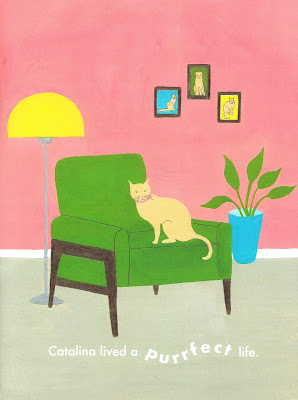
If I have to close out the year with one book with a positive message, let it be Lori Doody's Catalina, a picture book about acceptance and adaptation. Isn't that one that needs to be told as we enter a second year of a pandemic? And it all comes from a tale of a cat and three puppies.
From Catalina by Lori Doody
Catalina is a contented cat. She's happy in that she loves her life as it is. Her life is her own. She eats, plays and sleeps when and where she wants. Of course, there are times when she's a little lonely when her people aren't at home and she's alone but still "Catalina lived a purrfect life." And then everything changes.
From Catalina by Lori Doody
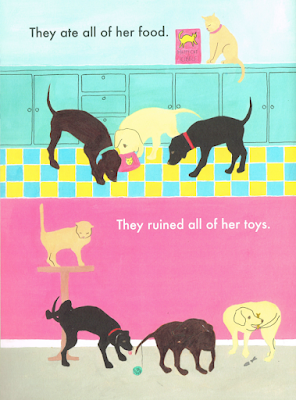
Her people bring home three Labrador Retriever puppies. Catalina is not amused. They are everywhere in her house: where she eats, what she plays with and where she sleeps. They're bigger than her, louder than her and rambunctious. She just can't get away from them and she doesn't like the way she feels: crooked (Newfoundland-speak for in a bad mood, according to the glossary).
From Catalina by Lori Doody
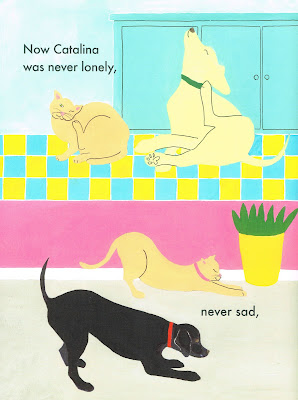
And then she notices a few things. The pups are willing to share with her and keep her company and she was no longer lonely.

Lori Doody gives us a quaint story of introducing new pets into a household already established for another. Many pet owners know the potential difficulties of doing so, whether with the same or different species. Catalina was content with the status quo even if there were things missing for her, like friends. It wasn't until she met the new dogs that she realized what it was that was missing in her life: companionship. But Lori Doody has given us more than a story about a cat and three dogs. In her folk art style, Lori Doody has given us a metaphor for accepting change and adapting to it, even if the benefits cannot be perceived initially. Catalina thought her life was "purrfect." It wasn't though. That became obvious once she embraced the Labs as there to stay, and she gained friends, playmates, cuddle buddies and more. If she'd closed herself off from the unfamiliar, she would have never realized the gifts the puppies brought into her life.

It's a simple story: cat meets dogs, cat is annoyed with dogs, cat learns to love dogs, and everybody is happy. But Lori Doody tells it as a lesson in colour and affection. She does it with softness of line, a landscape of patterns, and the warmth of a hospitable palette. As Catalina learned to love something new, so should we try when presented with something new. Different is not always bad, as we may anticipate. It's just different, and, as Catalina learns, it may even be wonderful.

June 07, 2021

Snazzy Cat Capers series: Guest review

 This review was written by teacher Elizabeth Cook.
 
Written by Deanna Kent
Illustrated by Neil Hooson
Imprint (Macmillan)

This series has been sitting in my TBR pile for quite some time and I am regretting how long it has taken me to get to this treasure by Deanna Kent and Neil Hooson. This middle grade series, which blends the text of novels with black-and-white graphic novel artwork, focuses on cat burglar Ophelia Von Hairball V, a fun and fabulous character who is a fusion of master criminal (though she always returns the stolen goods), secret agent and glamorous diva. Because I was instantly hooked by the globetrotting cat adventures, entertaining characters, and witty word play, I devoured the first three books in the series (see details below) in just two days and am already hoping that at least one more book will follow. 

Snazzy Cat Capers 
(Book 1)
Written by Deanna Kent
Illustrated by Neil Hooson
Imprint (Macmillan)
978-1-250211149
240 pp.
Ages 7-10
2018
 
In the first book of the series, we are introduced to Ophelia Von Hairball V.  She is a classy cat burglar who steals only the most precious items from around the world to enjoy at her house. But, after she's played with the trinkets, she always returns them to their owners, since keeping them would make her a criminal! While she loves the glitz and glimmer of her sparkly treasures, it is the thrill of the chase that she enjoys most and she is quite good at it too!  Ophelia Von Hairball V is the #1 rated cat burglar in the FFBI (Furry Feline Burglary Institute). This title is hard earned as the dogs of CCIA (Central Canine Intelligence Agency) are always on her tail, as is her evil uni-browed cousin, Pierre, who regularly ranks at #2 because of his sloppy execution. Though the FFBI provides their agents with access to inventors, Ophelia prefers to work alone, though she finds inventor Oscar Fishgerald Gold, a hard-working goldfish, useful and so she keeps him around...but at a paw’s length. In this book, the FFBI have challenged their cats to steal a rare Himalayan diamond and deliver it to headquarters for the opportunity to earn the top spot. Using her cunning, Oscar's incredible gadgets, a good plan and the ability to think on her paws, Ophelia is determined to hold onto her top ranking, even if she has to evade the CCIA and her evil cousin Pierre to do so.
 

The Fast and the Furriest 
(Snazzy Cat Capers, Book 2)
Written by Deanna Kent
Illustrated by Neil Hooson
Imprint (Macmillan)
978-1-250143471
224 pp.
Ages 7-10
2019
 
The second book in the series starts with the theft of the valuable Secret Claw from FFBI’s vault. This device emits a red laser beam so strong that it can control all of the cats around the world. Naturally, the dogs of CCIA want control of this device to prevent thefts by the cats. Ophelia, as the FFBI's top cat burglar, is tasked with travelling the world to locate the three pieces of the device and return them safely to the Institute's vault. Ophelia plans to use her panache and global connections to help steal the components back, though she knows that the CCIA and her cousin Pierre will be out to thwart her efforts. Luckily, she has her fin-ventor, Oscar, and their loyal invention P.U.G. (Personal Ultra Gadget) to help her.
 

Meow or Never 
(Snazzy Cat Capers, Book 3)
Written by Deanna Kent
Illustrated by Neil Hooson
Imprint (Macmillan)
978-1-250143495
224 pp.
Ages 7-10
2020

In Ophelia Von Hairball V's third book, the feline burglar is presented with perhaps her greatest challenge yet.  Every cat burglar has been instructed to steal the most valuable item they can and bring it to FFBI headquarters for judging within seventy-two hours.  For a cat burglar of her calibre, stealing is the easy part. For Ophelia, though, the real challenge is working cooperatively in a team, as each burglar must work with an inventor to demonstrate that "teamwork makes the dream work." Having fired 16 previous inventors before Oscar Fishgerald Gold, and relentlessly trying to give Oscar the slip on every mission, Ophelia needs to learn how to cooperate with her team if she is to be successful on this mission. Fortunately, Oscar creates many fabulous disguises and inventions to keep Ophelia interested and readers entertained, including the O.M.G. (Ophelia Mew-bile Go) car which boasts endless modes, including pirate, cuppa-tea and leprechaun, and which comes in very handy as they travel across the globe to steal a jewelled purple sceptre. Now if Ophelia can out-manoeuvre her evil cousin Pierre and the CCIA, she is sure to win this competition paws down!


I highly recommend this series for its fun themes of cat and mouse, or should I say cat and dog! Young readers will enjoy delving into Snazzy Cat Capers themselves but older readers will also appreciate the humour and be encouraged to read them aloud to younger children.  I especially enjoyed the oodles of puns including “paw-rtner”, “fin-tastic”, and “hiss-tory.” In fact, almost every chapter title is a clever play on words that will make adults and astute young readers chuckle. Moreover, every chapter is preceded by a quote from Ophelia Von Hairball V that is a misappropriation of a famous line from history. A few of my favourites include: "To be fabulous or not to be fabulous? That is the question. Except it is a ridiculous question because we all know the answer" and "I came. I clawed. I conquered."  The clever wit embedded throughout the series will definitely entertain readers of all ages.
 
 
~ Reviewer Elizabeth Cook is a teacher in the Halton District School Board. She is an avid reader and fan of Canadian literature.  
 

March 22, 2021

Easter Morning, Easter Sun

Written by Rosanna Battigelli
Illustrated by Tara Anderson
Pajama Press
978-1-77278-177-9
24 pp.
Ages 3-6
March 2021 

For those who celebrate Easter, Rosanna Battigelli and Tara Anderson will give life to your celebrations of hot cross buns, Easter egg hunts and family feasts. For those who don't, Easter Morning, Easter Sun shares springtime festivities that herald a new season of colours, freshness and connection of family and friends. So, we're all invited to enjoy Easter Morning, Easter Sun.
From Easter Morning, Easter Sun by Rosanna Battigelli, illus. by Tara Anderson
This Easter begins, as it does for many, with an Easter breakfast and hot cross buns which the mother cat has just pulled out of the oven. Then the family heads outside with their baskets, as do other families, for an egg hunt and to enjoy the spring: apple blossoms, a robin singing at its nest, a white duck and her ducklings on the water, and daffodils and grape hyacinths colouring the grass.
From Easter Morning, Easter Sun by Rosanna Battigelli, illus. by Tara Anderson
In rhyming verse, Rosanna Battigelli lets us join the diverse family of cats–mom is a white cat, dad is a jauntily-bereted cat of black, while little ones are grey, grey-striped, orange-tabby, and brown tabby–as they listen and watch and enjoy.
Easter springtime,
Easter buzz,
Easter chirping,
Easter fuzz.
They tumble and play, alongside a family of charming mice, until, to the evident delight of all, their guest, a dapperly-dressed rabbit with half-moon pince nez eyeglasses, joins them until it's time for goodbyes.
Easter sunset,
Easter light,
Easter bedtime,
Easter night.
From Easter Morning, Easter Sun by Rosanna Battigelli, illus. by Tara Anderson
Rosanna Battigelli delighted us with her debut picture book Pumpkin Orange, Pumpkin Round (2019), which was also illustrated by Tara Anderson, giving us a holiday-themed rhyme perfect for young children. They'll appreciate the rhythmic verse and repetitive nature of the text, sure to know the words after just a few readings. It's simple in its vocabulary but meaningful and comprehensive in its story. This is all the more so due to Tara Anderson's artwork created with oil-based coloured pencils and mineral spirits. There's a texture to her illustrations, from her medium to her technique, that emulates the grain of a blanket or the grass, the water or the cats' fur. What's more, her cats never fail to bring joy and smiles from their expressions and antics, and now we have mice from Tara Anderson that do likewise.

It doesn't matter if you celebrate Easter or not because Easter Morning, Easter Sun will take you into one cat family's festivities to partake in their traditions–you can even decorate your own eggs with the recipe provided–and rhyme along as they enjoy their day.
From Easter Morning, Easter Sun by Rosanna Battigelli, illus. by Tara Anderson

September 03, 2020

I Do Not Like Stories

Written by Andrew Larsen
Illustrated by Carey Sookocheff
Owlkids Books
978-1-77147-378-1
32 pp.
Ages 3-7
September 2020

Like many children, this child has very definite preferences, especially about the types of stories he likes. Actually he is more adamant about the types of stories he doesn't like than those he likes. But does he really know what he doesn't like?

From I Do Not Like Stories by Andrew Larsen, illus. by Carey Sookocheff
From waking up to his cat pawing his face to getting dressed, feeding his fish, heading to school and participating in his school day, the child is reminded about all the stories he doesn't like i.e., stories about fish and buildings, numbers and fruit, and buses and bikes. As the day goes on, everything remind him of the stories he doesn't like.

From I Do Not Like Stories by Andrew Larsen, illus. by Carey Sookocheff
But as the boy relates all the stories he does not like, his cat, a lovely tuxedo, lives those stories. The boy doesn't like stories about numbers or letters but his cat races by a parking meter and surprises the postal carrier with his bag of mail. The boy languishes over his lunch fruit and thinks about how much he does not like stories about apples or pears or peaches or plums while his feline friend visits a fruit stand, toppling produce after a dog chases it away. For each experience for which the child recounts his dislike of stories, his cat is creating its own stories about that same set of circumstances. From trees to going home and doing things, the boy dislikes the stories and the cat lives them.

From I Do Not Like Stories by Andrew Larsen, illus. by Carey Sookocheff


In the end, the boy relents that he might like a story about a cat.

Without establishing the fact that the child has been wrong all along and that he, in fact, does like stories, Andrew Larsen delivers that message with a tongue-in-cheek approach. It's like a parent who smiles, knowing that the child who insists that they don't like something will like it once they try it. It's accepting a child's assertions as true but allowing for leeway in the actuality of those pronouncements. By allowing the child to come to that realization himself, Andrew Larsen takes the adult out of the equation and makes it all about the growth of the child in learning what he might like for himself.

As in her earlier books (see What Happens Next, Wet and Buddy and Earl for other samples), Carey Sookocheff's illustrations play on the author's important message and elevates it with subtlety of colour and line for greater impact. Her artwork plays on that juxtaposition of child and cat, what one affirms and the other experiences. Same circumstances but different perspectives and appreciation for those circumstances. Carey Sookocheff's minimalist palette, primarily pale blue-greys with splashes of yellow and orange, keeps the reader focused on the darkest elements of her illustrations: the cat and the child's head. So, while it is the child's head only that has decided what he doesn't like, it's the whole cat that lives life, pursuing adventures and involving itself in its day fully.

For any child who cannot see beyond a pervasive opinion that may or may not be valid, I Do Not Like Stories will make them think twice and perhaps even consider a different perspective to the story.

From I Do Not Like Stories by Andrew Larsen, illus. by Carey Sookocheff