Showing posts with label Lori Doody. Show all posts

June 03, 2025

Mr. Beagle and the Quidi Vidi Caper

Written and illustrated by Lori Doody
Running the Goat, Books & Broadsides, Inc.
978-1-998802234
44 pp.
Ages 4-8
June 2025 
 
If it's a picture book by Lori Doody, you know it's time for another visit to Newfoundland and Labrador. In fact, Lori Doody invites us to revisit her character Mr. Beagle, whose nose for mystery helped him solve the local cases in Mr. Beagle Goes to Rabbittown, Mr. Beagle and the Georgestown Mystery, and Mr. Beagle Climbs Signal Hill.  This time, Mr. Beagle heads to the charming neighbourhood of Quidi Vidi in St. John's, Newfoundland and discovers a new mystery to solve.
From Mr. Beagle and the Quidi Vidi Caper, written and illustrated by Lori Doody
While making a delivery from his store, Mr. Beagle's Convenience, he notices that folks in the neighbourhood are looking a little sad and seem to be having a hard day. He learns that their stuffed teddy bears have gone missing. "It was unbearable!"
From Mr. Beagle and the Quidi Vidi Caper, written and illustrated by Lori Doody
He walks through the neighbourhood, talking to people and visiting the fish and chips stand and the one selling pupsicles before heading to the wharf. As the locals and tourists, all donning colourful sweaters and hats, scarves and bottoms, meander the wharf, shopping, taking boat rides, fishing, watching artists and more, Mr. Beagle has his beagle eyes open and his sniffer on the scent. With observation and insight, he catches the culprit whose plight compelled him to theft.
From Mr. Beagle and the Quidi Vidi Caper, written and illustrated by Lori Doody
But identifying the thief is just part of Mr. Beagle's talent. As in his earlier stories, Mr. Beagle finds a way to help the offender and in turn enrich the community in a novel way. And for Quidi Vidi, there's going to be a new attraction.
 
With a plethora of pun and subtle charm, Lori Doody has Mr. Beagle solving a mystery and helping the neighbourhood of Quidi Vidi. The mystery he tasks himself to solve may not be a heist of incalculable wealth, but it is a grab at the most precious and comforting of possessions for many: a beloved teddy bear. So, he takes his task seriously and just apprehending the culprit is not enough. Mr. Beagle needs to know why the theft took place and what could be done to resolve this for both thief and victims. In doing so, he institutes a form of restorative justice whereby both victim and perpetrator can find healing.
 
That's a big message for a little story about a dog who solves the mystery of the disappearing teddy bears, but St. John's printmaker Lori Doody keeps the lightness and brightness of the story in her art. From the bold colours of the sea, sky and land to the myriad of characters that populate the community, Lori Doody takes us to a neighbourhood that is unique and rich in spirit. And with another mystery solved, Mr. Beagle has strengthened another Newfoundland community and revitalized its residents through humanity.
 
Mr. Beagle Climbs Signal Hill (2022)
Mr. Beagle and the Quidi Vidi Caper (2025)
 

October 03, 2022

Lana Llama

Written and illustrated by Lori Doody
Running the Goat, Books & Broadsides
978-1-927917-81-7
32 pp.
Ages 3-7
July 2022
 
Lana Llama looks similar to her flock. She is wooly like the sheep and she has four legs and two ears and a fuzzy tail. But she still notices that her legs and neck are longer and she can't bleat.
From Lana Llama by Lori Doody
As with any creature who wants to fit in, Lana tries to emulate the sheep of her flock. But it's awkward and she is unsuccessful.
From Lana Llama by Lori Doody
Still, when a barnyard bully, also with the same attributes of wooliness, four legs, two ears and a fuzzy tail, comes along, Lana Llama uses her differences to stand up to it and be accepted by her flock exactly as she is.

Now she's happy to stand up for others,
just by standing out.
 
From Lana Llama by Lori Doody
Every Lori Doody picture book that comes out is a treat for the heart and the eyes. Her folk art consists of simple lines and bold colours but it is more. It's both subtle and striking, and still cozy and true. She doesn't overwhelm with details in her characters or landscapes but the farm and its animals are definitive and real. Based in that reality is always a story that will resonate with young readers (and old ones too). Here it's about trying to fit in but finding the best fit comes from being oneself. Of course, Lana Llama wants to be like the sheep of her flock. They are her people, her community, and she believes that they give her her identity too. But Lori Doody reminds us that what makes us different makes us unique and valuable, with Lana Llama being the only one who can stand up to a barking bully by virtue of those very differences.

Whether you're a bleater, a hummer, a clucker or a barker, Lori Doody will find you the right community as she did for Lana Llama. After all, we all belong.

December 30, 2021

Catalina

Written and illustrated by Lori Doody
Running the Goat, Books & Broadsides
978-1-927917411
40 pp.
Ages 3-7
August 2021
 
If I have to close out the year with one book with a positive message, let it be Lori Doody's Catalina, a picture book about acceptance and adaptation. Isn't that one that needs to be told as we enter a second year of a pandemic? And it all comes from a tale of a cat and three puppies.
From Catalina by Lori Doody
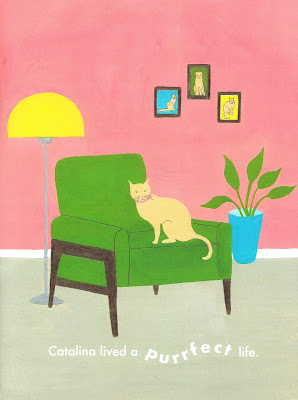
Catalina is a contented cat. She's happy in that she loves her life as it is. Her life is her own. She eats, plays and sleeps when and where she wants. Of course, there are times when she's a little lonely when her people aren't at home and she's alone but still "Catalina lived a purrfect life." And then everything changes.
From Catalina by Lori Doody
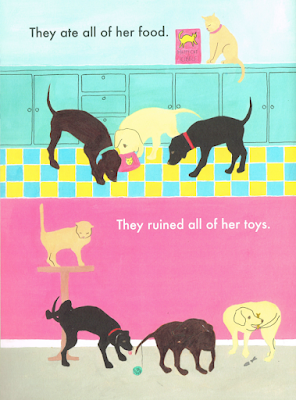
Her people bring home three Labrador Retriever puppies. Catalina is not amused. They are everywhere in her house: where she eats, what she plays with and where she sleeps. They're bigger than her, louder than her and rambunctious. She just can't get away from them and she doesn't like the way she feels: crooked (Newfoundland-speak for in a bad mood, according to the glossary).
From Catalina by Lori Doody
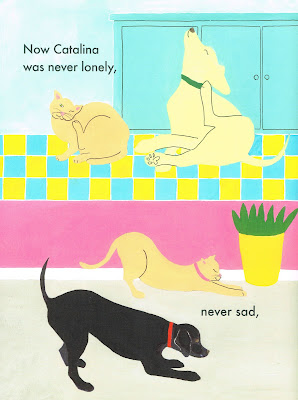
And then she notices a few things. The pups are willing to share with her and keep her company and she was no longer lonely.

Lori Doody gives us a quaint story of introducing new pets into a household already established for another. Many pet owners know the potential difficulties of doing so, whether with the same or different species. Catalina was content with the status quo even if there were things missing for her, like friends. It wasn't until she met the new dogs that she realized what it was that was missing in her life: companionship. But Lori Doody has given us more than a story about a cat and three dogs. In her folk art style, Lori Doody has given us a metaphor for accepting change and adapting to it, even if the benefits cannot be perceived initially. Catalina thought her life was "purrfect." It wasn't though. That became obvious once she embraced the Labs as there to stay, and she gained friends, playmates, cuddle buddies and more. If she'd closed herself off from the unfamiliar, she would have never realized the gifts the puppies brought into her life.

It's a simple story: cat meets dogs, cat is annoyed with dogs, cat learns to love dogs, and everybody is happy. But Lori Doody tells it as a lesson in colour and affection. She does it with softness of line, a landscape of patterns, and the warmth of a hospitable palette. As Catalina learned to love something new, so should we try when presented with something new. Different is not always bad, as we may anticipate. It's just different, and, as Catalina learns, it may even be wonderful.

September 15, 2021

Mr. Beagle and the Georgestown Mystery

Written and illustrated by Lori Doody
Running the Goat, Books & Broadsides
978-1-927917428
44 pp.
Ages 3-7
August 2021

Mr. Beagle first sniffed out a mystery in Mr. Beagle Goes to Rabbittown (2020) and brought his community of Rabbittown together in one of acceptance for diversity. Now Mr. Beagle is visiting his cousin Georgie in the neighbourhood of Georgestown and there's another mystery to solve. 
From Mr. Beagle and the Georgestown Mystery by Lori Doody
Enjoying a walk in the neighbourhood, Georgie tells Mr. Beagle of a spate of break-ins around Georgestown. But the cat burglar wasn't stealing valuables like money (piggy banks, actually) or art; they were taking storybooks. The residents of Georgestown were waking up to emptied bookshelves, saddened to realize there would be no more relaxing reads or bedtime stories for little ones.
From Mr. Beagle and the Georgestown Mystery by Lori Doody
Mr. Beagle puts his head to work to finding the cat burglar, looking throughout the community for possible suspects, from renovators and painters to line workers adept with tall ladders. But it's not until the cat burglar makes their way to Georgie's one night that Mr. Beagle realizes how wrong he was about the who and the why of the burglaries and helps makes things right for the neighbourhood.
From Mr. Beagle and the Georgestown Mystery by Lori Doody
Lori Doody consistently presents readers with important messages in quaint stories with playful settings and characters. She gives us the colour of a Newfoundland community with a diversity of characters–dogs, cats, rabbits, foxes, etc.–and reminds us not to judge too quickly. The end-papers (I used them as background for the book cover above) celebrate the diversity of individuals in Lori Doody's story, always reminding us that differences bring richness to a community. And that community is what is key to Lori Doody's stories. Here, not only does Mr. Beagle solve the mystery of the thefts, he finds a way to turn things around for the thief, get the books returned to their rightful owners and create a neighbourhood meeting place where books might be shared and celebrated by all. With the whimsy of its bold lines and shapes and the vibrancy of its colours and characters, Mr. Beagle and the Georgestown Mystery gives readers a lesson in ignoring appearances and stereotypes and celebrates the benefits of embracing all for the betterment of all. I'd say that's another victory and mystery solved for Mr. Beagle.
 
📗📘📙📕📗📘📙

Author-illustrator Lori Doody talks about her new book in a short video posted at https://youtu.be/eoNVwoxLcNI by publisher Running the Goat, Books & Broadsides.

 
Uploaded by RunningTheGoat on June 28, 2021 to YouTube.

August 21, 2020

Mr. Beagle Goes to Rabbittown

Written and illustrated by Lori Doody
Running the Goat, Books & Broadsides
978-1-927917-31-2
44 pp.
Ages 3-6
July 2020

This new picture book from Newfoundland's Lori Doody is a true allegory about a multicultural society, emphasizing the precarious balance of acceptance of self and community, of staying true to oneself while trying to fit in.

From Mr. Beagle Goes to Rabbittown by Lori Doody
In Rabbittown, a town alive with colour, all the bunnies know each other.  Then Mr. Beagle comes to town and opens up his convenience store. Because the bunnies–this is Rabbittown–"didn't know what to think of him," Mr. Beagle's business is slow. At the same time, mittens begin to go missing. Having a "good nose for sniffing out trouble," Mr. Beagle goes on the hunt for the lost mittens.
From Mr. Beagle Goes to Rabbittown by Lori Doody
He prowls the streets and businesses and eventually detects an odd scent in Rabbittown, finding one "fishy" bunny.  When this rabbit is revealed to be a cat who'd just wanted to fit in to the neighbourhood and was borrowing mittens for his kittens who kept losing their own, the community comes together to embrace the new arrivals and any others who decide to make Rabbittown their home. 

From Mr. Beagle Goes to Rabbittown by Lori Doody
Rabbittown, with its Hare Salon, Hop's barbershop and Hoppington Post, reflects a community that, on its surface, appears to be segregated but is not. They may be different species in a town settled by rabbits but it becomes evident that all belong and are welcomed.
And now Rabbittown was a neighbourhood where 
any bunny, dog, cat, mouse, squirrel or fox
could find new friends 
and warm mittens.
As she did in her earlier books Capelin Weather (2017), The Puffin Problem (2017), Mallard, Mallard, Moose (2018), and Paint the Town Pink (2019), author and illustrator Lori Doody paints an important message in a charming story. Older readers will understand the complexity of a story about diversity and inclusivity, though our youngest readers may only see a tale about rabbits and a dog and some cats, and be captivated by the colours of Lori Doody's artwork. But, with re-readings of the story, and looking back, as I did, to see whether they can spot the wannabe rabbit from the onset, they will be excited to realize the clues were there all along and will endeavour to fill in more of the story for themselves. As welcoming as her illustrations of bold colours and folksy shapes, Lori Doody's story invites the reader into a community where everyone and anyone can reside and be accepted.

August 03, 2019

Paint the Town Pink

Written and illustrated by Lori Doody
Running the Goat, Books & Broadsides
978-1-927917213
44 pp.
Ages 3-8
July 2019

Lori Doody is very good about bringing stories from Newfoundland to the bright illustrations of her picture books. In The Puffin Problem (2017), Capelin Weather (2017) and Mallard, Mallard, Moose (2018), she takes odd kernels of truth and germinates them into radiant stories of importance. She does the same in Paint the Town Pink by taking the true story of an accidental flamingo and creates a book about finding one's tribe and acceptance.
Once, on a particularly windy day,
a stranger arrived in town.
From Paint the Town Pink by Lori Doody
So begins the tale of Rose, the flamingo, who arrives in town and tickles the locals into thinking and living pink.
From Paint the Town Pink by Lori Doody
As she searches for a flock of her own, among pink-dressed bridesmaids at the Colonial Building, flamenco dancers, pink poodles, yoga enthusiasts and "a funny bunch of small flamingos who liked to visit a new lawn every day," the town begins to transform. The vehicles become pink, there is a rise in pink foods like ice cream, lemonade, macarons and cotton candy, and everyone starts wearing pink clothing. They even start painting their buildings because "Everyone did their best to make her feel like she belonged." Rose had found her new home.
From Paint the Town Pink by Lori Doody
There really have been pink flamingos that have flown off-course and ended up in Newfoundland, though their tales are not as inspired as Rose's in Paint the Town Pink.  But Lori Doody's story is not really about them. It is instead a story about being a stranger in a strange place and finding a way to make it home but only with the assistance of those who have come before. I know Rose is a flamingo but her story is a universal one of being out of place, feeling isolated, looking for commonalities, and finding acceptance from those who make an effort to embrace diversity as important.

It's lovely that Lori Doody's story is based on the flamingo and the colour pink. To be "in the pink" or "tickled pink" or having things "coming up roses" are all positive sentiments and the tints and shades with which she paints the town are similarly cheerful. Against a blue-grey sky, the streetscapes are bright and lively. Though Lori Doody's illustrations are generally uncomplicated in their design, they hold details that will delight. From the many cats in the windows and playing with yarn, to the names of businesses and music albums that highlight the colour pink, there is so much to observe and consider. Moreover, with her folk art approach to her illustrations, Lori Doody firmly plants Rose and her readers into a Newfoundland of colour and vivacity. It's no wonder that, with a town invigorated with pink from inside and out, Rose would find it a welcoming place.
From Paint the Town Pink by Lori Doody

June 15, 2018

Mallard, Mallard, Moose

Written and illustrated by Lori Doody
Running the Goat Books & Broadsides
978-1-927917-16-9
44 pp.
Ages 3-7
April 2018

The title sounds like the game Duck-Duck-Goose but, although there are ducks and a goose, the hero of the story is a moose and this is no game. It's about finding a home.
From Mallard, Mallard, Moose by Lori Doody
A moose is wandering the streets of St. John's, Newfoundland. It happens. But, he's accompanied by two mallards who follow him everywhere. He's perplexed by their attentions and "It was beginning to put him in a foul mood." His wanderings are not aimless: he's looking for a new home for his ducks. But, like Goldilocks, somethings just don't fit. A park has swans that make the mallards nervous. The downtown has pigeons. The harbourside has seagulls and even a menacing chicken. Location after location don't seem to work for the ducks. Even the restaurant Mallard Cottage looks to have potential until they check out the menu which apparently highlights wild game. (Oh dear!) It's not until a goose, which Lori Doody identifies as a Graylag Goose, a Eurasian species that is only rarely found in North America, agrees "to take the mallards under his wing" that the moose know his quest is complete.
From Mallard, Mallard, Moose by Lori Doody
Like her previous picture books Capelin Weather and The Puffin Problem (Running the Goat Books & Broadsides,  2017), Lori Doody embeds the reader in a Newfoundland setting of hilly streets, buildings of colourful clapboard siding, shorelines, animals and whimsically-named businesses. Her art is the centrepiece of Mallard, Mallard, Moose though the story itself is charming and feasible. That's the thing with Mallard, Mallard, Moose.  You know the story could be true. Moose in Newfoundland? Yep. Mallards too? Yes. One species imprinting on another? It's happened. And the Graylag Goose, which extraordinarily was a resident of St. John's for ten years, probably encountered more than a few mallards. This could be their story, and Lori Doody makes it all the more authentic with her folksy fine art. The mixed media on paper allows her to emphasize the depth of colour and the simple lines of a St. John's landscape and transport readers to a storefront window or park bench to observe the goings-on. It's bold and humble and concrete and pragmatic, and it works so well.  I love the drama and the earthiness of the story and art in Mallard, Mallard, Moose and I expect and hope that we'll continue to see Newfoundland in Lori Doody's picture books in the future.

August 11, 2017

The Puffin Problem

Written and illustrated by Lori Doody
Running the Goat Books & Broadsides
978-1-927917-14-5
44 pp.
Ages 3-8
July 2017

Puffins! They're everywhere!  They're on the roofs and on the street.  They're on doorsteps and at store fronts. They're at the museum and art gallery and at the playgrounds.  They may be cute, but they have become The Puffin Problem.

Though there has never been a puffin problem to date, Lori Doody creates a scenario in St. John's whereby the city is overrun with puffins.  It is a quaint problem, though with puffins sidling up to people wherever and whenever, not everyone thinks they're all that cute.  Apparently all the puffins are affecting the people of St. John's as well as their pets and other birds.
From The Puffin Problem by Lori Doody
Birders, of course, love the opportunity to take in the plethora of puffins (actually a collection of puffins is called an improbability, a parliament or a circus) but most people feel otherwise.  The idea of shipping them off to Iceland doesn't fare very well.  However, a child's proposal of luring the puffins with food–with all manner of fish coming from Mudder's Fish Cakes, Ise The By, Me Ole Trout Fish Shop, Fish Out of Water Street, Anyfin Goes and Taiyō Sushi–finally gets the birds out to sea, at least for this year.
From The Puffin Problem by Lori Doody
Only in Newfoundland could this story be had.  And Lori Doody ensures that the reader recognizes the streets and landscapes of St. John's, from their colourful buildings, rocky cliffs and St. John's Harbour to The Rooms and the whimsical store names (like The Picture Plant and The Chocolate Lab).  As in her recently released Capelin Weather, also from Running the Goat Books & Broadsides, the art is fundamental to the story, providing a folksy flavour.  The colours are bold and the lines and shapes are rugged, reflective of the culture of Newfoundland.  The flattened perspective is typical of folk art and Lori Doody produces that feature with strength and distinct design.  The puffin problem may be identified as that by the residents of Lori Doody's story but for readers it's a charming tale of what can happen when cuteness overtakes everyday life.
From The Puffin Problem by Lori Doody

August 04, 2017

Capelin Weather

Written and illustrated by Lori Doody
Running the Goat Books & Broadsides
978-1-927917-09-1
32 pp.
Ages 3-7
July 2017

When the small fish known as capelin are rolling, it's a sight to behold and one with which many Newfoundlanders and some others on the Gaspé and in Nova Scotia are familiar.  Normally the capelin arrive to spawn on the beaches sometime between June and July, at the onset of summer, and grey, cold, wet weather is referred to as capelin weather.  But for Kate, the end to Capelin Weather can't come soon enough!
From Capelin Weather by Lori Doody
Like many children, summer holidays means the freedom to be outside playing in the sun and warmth.  For Kate, it means picnics and swimming and soccer and bonfires on the beach.  But not this year.  This year it is cold and overcast and rainy.  All the things she wants to do can't be done.  Her bingo-playing grandmother explains that when this "capelin weather" passes i.e., when the capelin arrive and people have collected their fill, a hot and sunny summer will be left behind.  Kate tries to make the connection between the small fish and the weather, imagining them falling from the sky like rain.  That is until the capelin do roll in.  Then the people come out to catch some, as does Kate, heralding the true beginning to summer.
From Capelin Weather by Lori Doody
Lori Doody's story is quintessential Newfoundland with its rocky beaches, summer past times, icebergs, lupines, lighthouses and more.  From the paintings on the wall of Kate's room and where her grandmother plays bingo–pictures of the Queen and a Newfoundlander dog– to the landscapes of shores and sea, Capelin Weather is a folk artist's rendering of the province affectionately known as the Rock.  The story is not an unusual one–a child wishing for warmer weather to have some outdoor summer fun–but it is unique in the context of that summer weather being signalled by the arrival of some fish and a fishing expedition like no other.  Of course children who've participated in this summer ritual and live in Newfoundland will love this story. But I'm sure other young ones will enjoy it as well, fascinated by the practice, the scenery and the weather lore within.  From her story to her boldly-coloured art, Lori Doody gets the flavour just right (though I do wonder what capelin taste like!)