Showing posts with label pets. Show all posts

July 16, 2026

Eon: My Pet Tardigrade

A tiny pink organism with eight legs floats among colourful plants
Written by Cybèle Young
Illustrated by Cybèle Young and Nell Jocelyn
Tundra Books
978-1-77488-041-8
56 pp.
Ages 3–7
Releases August 11, 2026 
 
Don't be surprised if you've never seen or heard of a tardigrade. They're very tiny. Very, very tiny. At about 0.5 mm in length, they are barely visible to the naked eye. Ah, but a microscope reveals this tiny creature to a young scientist with a new tool and captures her heart.
A girl looks through a microscope
From Eon: My Pet Tardigrade, illustrated by Cybèle Young & Nell Jocelyn, written by Cybèle Young
Once she spots the micro-animal with his two little eyes and his ambling, plodding gait, she wants to take care of him. Actually, she wants to hug him but that's impossible so she plans to make that which he might appreciate. A bed? A chair? A slide? 
Different views through a microscope show forms of different colours and shapes
From Eon: My Pet Tardigrade, illustrated by Cybèle Young & Nell Jocelyn, written by Cybèle Young
But this young scientist knows it's best to ask questions, so she researches the little guy she names Eon, and learns he's a tardigrade a.k.a. a water bear or a moss piglet. She learns of the extremes at which it can live, and the diversity of habitats it can occupy. So, she prepares a wide variety of dioramas in which to live. And when she loses sight of him—he is very small—she learns more about what a tardigrade needs and gives him an opportunity for a new life where he might have a new home that is "the most magical most-est yet." (pg. 42)
A tiny pink tardigrade plods through the water among a variety of colourful microscopic organisms
From Eon: My Pet Tardigrade, illustrated by Cybèle Young & Nell Jocelyn, written by Cybèle Young
As small as Eon, the tardigrade, is, Eon: My Pet Tardigrade tells a big story. It's a story of scientific discovery, creativity, and benevolence. It's seeing what is almost not seen and educating oneself to help guide one's actions. Cybèle Young has garnered much attention and many awards with the intensity of her simple texts and the complexity of her mixed media illustrations. With Eon, she and collaborator Nell Jocelyn will charm readers into discovery, into looking deeper and smaller, and finding ways to express creativity. They've blended pencil drawings (Cybèle Young) with paper sculptures made with Japanese papers (Cybèle Young) and a variety of western papers (Nell Jocelyn). This blending of media gives substance and texture to a story of something almost imperceptible. Because Eon is so small, young readers may have to hunt for him on the many pages, especially when he's dressed in scuba equipment, hiding among stalagmites, or basking on a cactus. The creativity of the child—or rather Cybèle Young and Nell Jocelyn—to create miniature scenes of wondrous detail and movement brings Eon, the tardigrade, from insignificant to something substantial, a star of her displays and a superstar on the planet. (Read about tardigrades in Cybèle Young's "The story behind Eon" or do your own research. It will fascinate.)

A girl works with paper to craft minitiature scenes and objects for the tardigrade. Scenes include it bathing in a green tub, playing badminton, and having a picnic.
From Eon: My Pet Tardigrade, illustrated by Cybèle Young & Nell Jocelyn, written by Cybèle Young
The story of Eon: My Pet Tardigrade is as much about the child and her response to Eon as it is about learning about tardigrades. I'd never heard of tardigrades and am now excited to learn more. Teachers might love to create lessons on adaptation, habitats, life cycles, and more based on these little invertebrates, but they shouldn't limit themselves to STEM lessons. Eon: My Pet Tardigrade gives opportunities for teaching about compassion, understanding, and letting go as well. For a little guy, Eon has a lot to give.

January 06, 2026

To Be With You

Words by Dave Gunning
Illustrated by Meaghan Smith
Nimbus Publishing
978-1-77471-405-8
32 pp.
Ages 3–7
September 2025 
 
Based on Canadian singer-songwriter Dave Gunning's song of the same title, To Be With You is a love song. It's the love of a dog for their child, and the unbreakable bond that connects them every moment of every day and every night.
From To Be With You, words by Dave Gunning, art by Meaghan Smith
In very simple rhyming text that young children will adore and repeat easily, the song (listen to it here) speaks to different dogs spending time with their children: playing, sleeping, eating together, going for walks, and touching. Its refrain, "All I want is to be with you," repeats over and over again, though the children and dogs vary. There's a girl in a wheelchair hugging a dog as big as herself, and a dachshund excited for a walk with their child who wears yellow rain gear. There's a girl with a leg brace running through a wildflower meadow with a large floppy dog, and a husky-like dog chasing bubbles that a small boy is blowing. All children are here as are all the dogs that bring them companionship, love, and safety. And Dave Gunning's words make it clear that,
All I want is to be with you
All day long and all night too
All I want is to be with you
All I want is to be with you 
From To Be With You, words by Dave Gunning, art by Meaghan Smith
Much of the sweetness in To Be With You comes from Meaghan Smith's illustrations. She may also be an East Coast singer-songwriter, but her art is what defines this book. (The first book I've reviewed that included her art was It Snowed (2025) which she wrote and illustrated.) She brings great softness and affection to her art. Most notably, though, we notice that we rarely see the child's full face. The emphasis is on each dog, speaking to the child about what they are feeling, demonstrating exuberance, love, and togetherness with every flick of a tail, tongue hanging out, and eyes wide open anticipating their next moment together. Meaghan Smith makes the story, and Dave Gunning's words, about the dog, and it's a joyous perspective.
From To Be With You, words by Dave Gunning, art by Meaghan Smith
For the child who loves their dog, and who loves them right back, To Be With You will become a lovely accompaniment to a bedtime routine, a walk in the park, or a wind-down song before a nap. Moreover, the words could just as easily be a love song between a parent and child—do listen to the song (link here again) because its melody is very catchy—and could become a new lullaby to share  in your home.

March 13, 2025

Mystery at the Biltmore #2: The Classified Catnapping

Written by Colleen Nelson
Illustrated by Peggy Collins
Pajama Press
978-1-77278-336-0
136 pp.
Ages 7-10
April 2025 
 
Things are certainly exciting at the Biltmore, the residence that Elodie LaRue lives at on the Upper West Side in New York City. Who knew that after her first case, The Vanderhoff Heist, that there would be another mystery to solve at the Biltmore during the same summer? And her next would begin with a murder! (Just kidding. It's just a movie.)
 
The courtyard of the Biltmore has become a movie set for a film that features the most famous feline resident of the building. Bijou, the very wealthy heir to the fortune of fashion designer Lucien Saint Martin, lives in a swanky apartment with her nanny, Paula Benson, who has had to leave her family, notably her 10-year-old daughter Tiya, in Queens. While visiting her mom, Tiya is tasked with getting a driver and car to pick up Bijou at her pet grooming salon while Paula is busy prepping for Bijou's big eighth-birthday bash. But Tiya arrives late at Spaw and learns that Bijou has already been picked up. So, the child asks Elodie and her sidekick Oscar, an aspiring stuntman and magician, to find Bijou before the party that night.
From Mystery at the Biltmore: The Classified Catnapping, written by Colleen Nelson, illustrated by Peggy Collins
The Biltmore has no shortage of suspects, from the regular residents like Mrs. Fineman and her noisy Pomeranian Lawrence, and Bianca Winthrop Parker Saint March, the niece of Bijou's cat daddy, to Freddy the doorman, and those associated with the movie, like the animal trainer, Bijou's agent, Bijou's biographer, and even stuntman Lance Beauregard. But Elodie and Oscar have to follow the clues, ask the right questions, and figure out the motive before they can catch the wrongdoer, hopefully before Paula finds out.
 
Colleen Nelson keeps young readers guessing with each chapter focused on another character. She puts out a number of red herrings–including of the fishy variety–but always helps the reader see the logic in Elodie and Oscar's thinking, never surprising them with unfair plot elements. Colleen Nelson actually makes the mystery solvable as the story progresses, but you have to pay attention. Elodie does, and she is always able to figure out who did the crime.
From Mystery at the Biltmore: The Classified Catnapping, written by Colleen Nelson, illustrated by Peggy Collins
The mystery is paramount and novel, and perfect for an early middle-grade reader. Mysteries can become convoluted and difficult to dissect but Colleen Nelson actually keeps the plot fairly linear, with no curve balls or weird surprises, thereby allowing the reader to follow with Elodie and Oscar, and Carnegie, her West Highland Terrier, as they unearth what everyone is and was up to. Then add some charming spot art from Peggy Collins, some word play like puns–who doesn't like Spaw as the name of a pet grooming salon?–an assortment of crazy stunts and magic tricks courtesy of Oscar, and The Classified Catnapping becomes an entertaining middle-grade cozy that will have young readers eager for another visit to the Biltmore.
 
🏢 🏢 🏢 🏢 🏢
 
Mystery at the Biltmore #1: The Vanderhoff Heist (2024)
Mystery at the Biltmore #2: The Classified Catnapping (April, 2025)

December 15, 2022

Luna's Green Pet

Written by Kirsten Pendreigh
Illustrated by Carmen Mok
Sleeping Bear Press
978-1-534111615
40 pp.
Ages 5-8
August 2022
 
What is Luna's green pet? Is it a turtle? A parrot? A fish? A frog? It's none of those because Luna's apartment does not allow pets.  Though her friends suggest a rock or a pet-a-guchi, Luna can't seem to connect with them. But, one day, she rescues the perfect pet for her.
From Luna's Green Pet by Kirsten Pendreigh, illus. by Carmen Mok
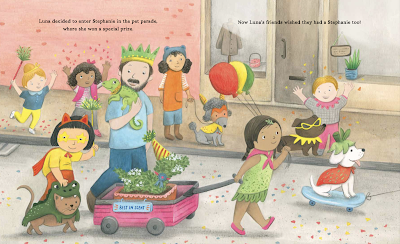
In a trash bin outside her apartment, she discovers a small plant. It even had its name on a marker: Stephanotis floribunda. Because it's quite a mouthful, Luna calls her Stephanie. And Luna is the best pet caregiver. She transfers Stephanie to a new and bigger pot, gives her new soil, and waters her. She reads stories to Stephanie and even takes her for walks in the park.
From Luna's Green Pet by Kirsten Pendreigh, illus. by Carmen Mok
Luna's friends may not be impressed with Stephanie's personality, but Luna loves her new pet and Stephanie is thriving. In fact, Stephanie grows so much that Luna must shape her long stems into an animal form. But then one day, Stephanie exhibits strange growths and Luna is concerned, ready to take her pet to a botanist for examination, until she learns it's just the natural cycle of life blossoming in Stephanie.

Not every child is fortunate to live in a household where they can have a pet, whether because of building restrictions or familiar limitations with respect to health or finances. But having a pet is a
privilege and one that Luna takes seriously. Her pet may be a plant, but Stephanie gives Luna companionship, offers the child opportunities for responsibility and learning, and nurtures Luna's empathy and self-confidence. By having Luna think outside the box about what a pet can be, BC's Kirsten Pendreigh offers kids an exemplar in problem solving. Luna has a problem i.e., no pets in her building and needs to find a solution i.e., a pet that will be allowed. She finds both a solution and a pet in Stephanie. Even better, hers is a rescue that needed a home and some loving care to become the star Stephanie would become. (I suspect that Stephanie would've been much loved regardless of becoming a winner at the pet parade.) And, if all that goodness wasn't enough, through the miracle of a life cycle, Stephanie's seeds are to be spread further afield to bring joy to others.
From Luna's Green Pet by Kirsten Pendreigh, illus. by Carmen Mok
As a picture book, Luna's Green Pet uses illustrations to help convey the story and bring it to life. Carmen Mok, who has illustrated a number of fabulous books including When I Listen to Silence, Viola Shrink and Tough Like Mum uses a variety of media including gouache, India ink, dry pastel and colour pencil to create her refreshing artwork. Green is a star in Luna's Green Pet, highlighting the importance of flora in the natural world, but Carmen Mok makes sure to use a full palette and soft lines and shapes to draw young readers into Luna's world. Kids may identify themselves in Kirsten Pendreigh's story, but they'll see their lives in the artwork Carmen Mok has created for Luna's world of home, school, and outdoors.

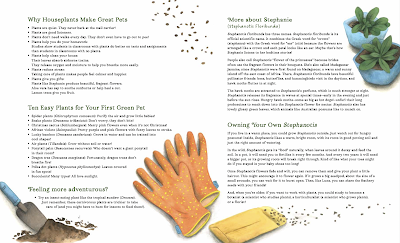
It may be raining or snowing outside right now here in Canada–in fact, where I live it's doing both!–but what better a time to talk to children about growing plants, whether it be as a school project to learn about a plant's life cycle, or in preparation for a spring planting, or as a pet to be loved. With a story to bolster any of that learning and some guidance from Kirsten Pendreigh–she appends her story with some background into Stephanie and growing plants–as well as the brightness of Carmen Mok's illustrations, Luna's Green Pet will get kids clamouring to develop their green thumbs and perhaps look at plants as the engaging living things they are.
From Luna's Green Pet by Kirsten Pendreigh, illus. by Carmen Mok

August 06, 2021

Peggy's Impossible Tale

Written by Slavia Miki and Roy Miki
Illustrated by Mariko Ando
Tradewind Books
978-1-926890-21-0
58 pp.
Ages 4-8
June 2021
 
In eighteen short chapters, some as brief as two pages of which one is an illustration, Slavia Miki and Roy Miki tell the story of guinea pig Peggy as she becomes friends with Lisa and becomes part of a family. It's sweet and loving and it's the kind of animal story I can get into.

Told from the guinea pig's perspective, young readers join Peggy as she is adopted from the pet store and taken home. Her squeaks affirm she understands Lisa and, in fact, she teaches the child to understand those squeaks through repetition. Peggy learns to tell time e.g., when Lisa comes home from school, and even how to climb stairs and walk on a leash. From learning about the dangers of electrical outlets to the crow and cat, Peggy proves she's one smart guinea pig and more than worthy of a Special Pets Contest award.
From Peggy's Impossible Tale by Slavia Miki and Roy Miki, illus. by Mariko Ando
For children who've just learned to read, Peggy's Impossible Tale will give them a great story while building their confidence to read chapter books. That same confidence in trying new things and developing an understanding of new concepts is what made Peggy so extraordinary. So Slavia Miki and Roy Miki, who also wrote Dolphin SOS (Tradewind, 2014) together, have charmed little ones with an animal story and given them a message about compassion and friendship that's a little different.
From Peggy's Impossible Tale by Slavia Miki and Roy Miki, illus. by Mariko Ando
Though most early chapter book have some artwork, the illustrations by Vancouver's Mariko Ando, a printmaker, are plentiful. Her artwork graces every double-spread, giving us a sense of Peggy and Lisa's relationship as well as Peggy's spirit. From scenes of Peggy facing a daunting staircase or hiding from the air-sucking machine and cuddling with Lisa, Mariko Ando takes us into Peggy's heart. 

Simple but engaging, Peggy's Impossible Tale shows young readers that the impossible isn't always so, whether for guinea pig or child, and that challenging any improbability can be an accomplishment in itself. And there's a cute guinea pig.

July 18, 2019

Princess Puffybottom...and Darryl

Written by Susin Nielsen
Illustrated by Olivia Chin Mueller
Tundra Books
978-1-101-91925-5
32 pp.
Ages 4-7
February 2019 

Oh, she is truly royalty! Princess Puffybottom rules over her household, getting her subjects to cater to her needs and whims. In return, she might allow them to pet her and play with her. Then Darryl arrives and everything changes.
From Princess Puffybottom...and Darryl by Susin Nielsen, illus. by Olivia Chin Mueller
When her humans bring home the eager puppy, Princess Puffybottom sees only a horrible, disgusting animal but she is convinced that she just needs to wait for him to be banished. When her subjects leave with Darryl and are gone a long time, she is certain that they have taken him to a faraway kingdom and she is ready to celebrate.
From Princess Puffybottom...and Darryl by Susin Nielsen, illus. by Olivia Chin Mueller
But then the two return with Darryl sporting an Elizabethan collar. Princess Puffybottom has no choice but to work towards getting Darryl ejected. But her efforts are futile and, at a party, Princess Puffybottom realizes that she is no longer adored as she once was. Only Darryl recognizes her sadness and gives her the attention she desires. Finally the cat appreciates his regard and efforts as valuable. It's a good thing because there's a new addition coming and it's sure to be another surprise for Princess Puffybottom.

From Princess Puffybottom...and Darryl by Susin Nielsen, illus. by Olivia Chin Mueller
Most readers will recognize Susin Nielsen's name from her authorship of middle-grade and young adult novels like Word Nerd (Tundra, 2008), We Are All Made of Molecules (Tundra, 2015) and Optimists Die First (Tundra, 2017). She tells important stories about real kids but writes them with humour to lighten the angst. With Princess Puffybottom...and Darryl, Susan Nielsen brings that same humour but in a story with an animal perspective though the circumstances could be human. No one likes to be neglected or usurped by another, whether it be a sibling, a friend, a competitor or another pet. But, for a cat, this is especially heinous since many of them look down on everyone. (Winston Churchill is quoted as saying, in justification for his fondness for pigs, that dogs look up at humans, cats look down on us, and pigs would look you straight in the eye.) Having to share her humans with a lowly canine may not be acceptable to Princess Puffybottom but at least she is able to recognize that she doesn't have to compete with Darryl; instead, she can let him worship her.  Darryl gets a friend, Princess Puffybottom gets a devotee, and the household is copacetic once again.

Compliments of  Olivia Chin Mueller's digital illustrations, Princess Puffybottom and Darryl are adorable rivals for their peoples' affections. They are soft and cuddly though Princess Puffybottom's air of superiority gives her an aloof appearance whereas frisky Darryl is completely unfettered in his liveliness. Together they become the furry symbol of acceptance and companionship, even if Princess Puffybottom still believes she rules all.
From Princess Puffybottom...and Darryl by Susin Nielsen, illus. by Olivia Chin Mueller

June 11, 2019

My Puppy Patch

Written by Theo Heras
Illustrated by Alice Carter
Pajama Press
978-1-77278-080-2
24 pp.
Ages 3-6
June 2019

Getting a new pet is a great responsibility and I am delighted that this bright child takes that responsibility seriously now that Patch has joined their household.  Patch, obviously so named for her intriguing dark spot around her left eye, is a clever puppy who has already learned the commands to sit, stay down, come, roll over and stay. But she is young and occasionally distracted.  Still the little girl knows it's a big day because today Patch will be taken outside the fence for a walk.
From My Puppy Patch, illustrations by Alice Carter, text by Theo Heras
The two friends go for a walk and, though Patch explores and plays with Benny's puppy Smallfry, she always comes when called. It becomes evident that the puppy has learned a lot, just as her girl has, knowing to be cautious of other dogs, giving the puppy love, water, a bed, treats and all the things that are right for a young dog.
From My Puppy Patch, illustrations by Alice Carter, text by Theo Heras
For families getting a new dog, Theo Heras gives some excellent advice about canine care, and this little girl is doing it all right, understanding that Patch has basic needs for health and well-being but also for learning and emotional care. Their relationship is certainly one of friendship but the learning goes both ways as the child shows flexibility in her expectations and as Patch's skills in following commands are reinforced.
From My Puppy Patch, illustrations by Alice Carter, text by Theo Heras
Ottawa artist Alice Carter preserves the lightness of Theo Heras's message about the interrelationship between child and puppy by keeping her illustrations bright and colourful and her characters effusive in their expressions. There's play in the artwork and it reflects the affection and enjoyment the two have for each other and in their outing. 
From My Puppy Patch, illustrations by Alice Carter, text by Theo Heras
For children taking on the responsibility of a puppy, My Puppy Patch emphasizes the joys and only occasional but natural missteps as part of the process of learning to cultivate a solid relationship between child and dog. It may be work, like any education, but it's worth it.

March 12, 2019

Sapphire the Great and the Meaning of Life

Written by Beverley Brenna
Illustrated by Tara Anderson
Pajama Press
978-1-77278-069-7
128 pp.
Ages 7-10
February 2019

Finding one’s own purpose in life is not an easy task and one which many of us never find. Imagine being a hamster in a cage in a pet store and wondering about what life holds for you. Is it just anticipating fresh bedding? Is it waiting for extra peanuts? Is it to find a forever home? Is it to be free?  But with the hamster’s adoption by nine-year-old Jeannie, the hamster, first known as Harvey Owens and then Sapphire, looks for that meaning and finds it with the help of a rich collection of characters and a few nibbles on fingers.

Told in the alternating voices of Sapphire and Jeannie, Beverley Brenna begins Sapphire the Great and the Meaning of Life with a long-awaited trip to the pet store for Jeannie’s promised Christmas gift of a hamster.  Though the visit almost doesn’t happen as Jeannie’s mother deems her daughter’s behaviour at the mall as inappropriate, Jeannie picks out the white hamster with the navy blue eyes and purchases all the materials to make his home perfect. But the hamster, whom she originally names Harvey Owens after her father who has moved out of the house, is frightened by the new sounds, smells and temperatures and lashes out by biting, even more so after they are involved in a car accident. Jeannie, who is dealing with her own stresses that include not being heard, a father who seems to be off with a new life and a mother struggling with two young children and trying to deal with her own grief and anger about her marriage, recognizes that the little guy bites when scared or surprised, and helps educate all who come near him to be considerate. And since he is such a great comfort to all of them–Jeannie, her brother Alistair, her mom and others–once they learn how to be kind to him, he has much to offer them back. And it makes no difference when he is identified as a her.

Sapphire the Great and the Meaning of Life is far greater than a story about a girl getting a pet hamster. It’s about struggling to find your place. Jeannie is a pretty good caregiver for Sapphire but she’s trying to figure out why her father isn’t keeping in touch, whether her parents are “getting put back together” (pg. 40), why her little brother seems stressed, how to be a friend, why her Mom’s new friend Anna Conda seems reserved though really cool, and the questions that kids want answered but no one will respect them enough to tell them the truth. Meanwhile Sapphire is recognizing how nice her new home is, singing when pleased, and beginning to understand freedom, especially after a dangerous escape outdoors in frigid January.
It seems to me that Free is just a little bit too big to think about for very long. (pg. 67)
It’s perfect that Jeannie’s story and Sapphire’s come together to become something bigger and better. Just as the two are better for having each other in their lives, Beverley Brenna’s text is enhanced with the adorable illustrations by Tara Anderson which head each of the forty-two chapters. Her pencil sketches of Sapphire make up the majority of these illustrations and show the little hamster eating, playing, sleeping, hiding and just being all-around cute. I had some trepidation about an animal story, especially one which begins in a pet store, but Tara Anderson’s charming artwork reassured me that Sapphire’s story would turn out well.

A perfect early reader for kids who love animals, Sapphire the Great and the Meaning of Life is actually more about giving significance to managing our own stories. It may require a nip or a bite or some yelling to be heard, or perhaps a snuggle or a quiet voice might be in order, but it's about finding the meaning of your own life, even if only for the time being.
From Sapphire the Great and the Meaning of Life by Beverley Brenna,               illustrated by Tara Anderson

August 10, 2017

Wet

Written and illustrated by Carey Sookocheff
Henry Holt and Company
978-1-62779-775-7
32 pp.
Ages 4-8
June 2017

Wet is about being wet, about getting wet, about the manner of getting wet and about the gratification or annoyance of being wet.  Wet may be all about wetness but it certainly isn't all wet as topics go.

From Wet by Carey Sookocheff
Through a series of single- and double-spread illustrations, author and illustrator Carey Sookocheff has a boy recollecting how he becomes wet at a pool and elsewhere: quickly or slowly, with friends or by himself, deliberately and accidentally. He also talks of cats, fish, and dogs, floors, painted park benches and more.  He makes note of washing hands and splashed shirts, puddles and spills, and tears, baths and laundry.  But he ends his day in the dryness of a safe, warm bed with only kisses to moisten his face.
From Wet by Carey Sookocheff
Carey Sookocheff, who has illustrated her own Solutions for Cold Feet and Other Little Problems (Tundra, 2016) as well as Maureen Fergus' Buddy and Earl series of picture books, creates a child-like ambiance to her illustrations that serves the text wonderfully. There's a simplicity in spirit, recounting how wetness happens and what it looks like.

Wet is a fun little book that doesn't have to be taken as lesson-building material but it could be used so effectively for preschool and kindergarteners learning about emotions and even states of matter or the water cycle.  Because Wet is so familiar in its circumstances relating to swimming, baths, rain, pets and bedtime, children will have no problem relating to this boy's activities as they change and affect his state of dryness.  Whether soaking wet or lightly dampened, it's not so bad being wet.  And Wet, the book, is neither a wet blanket nor a damp squib, and summer is definitely a time to relish being wet.
From Wet by Carey Sookocheff

August 15, 2016

Buddy and Earl and the Great Big Baby

Written by Maureen Fergus
Illustrated by Carey Sookocheff
Groundwood Books
978-1-55498-716-0
32 pp.
Ages 4-7
August 2016

Our dynamic duo of Buddy, the dog, and Earl, the hedgehog, introduced in Buddy and Earl (Groundwood, 2015) and revisited in Buddy and Earl Go Exploring (Groundwood, 2016) have a new adventure afoot when it is announced that Mrs. Cunningham and her baby are coming for a visit. Meredith, the young girl in the family, seems excited, and the two pets follow suit. But what’s a baby? Earl questions, and makes all manner of speculation from a mode of transportation to an electrical appliance or something to eat, while Buddy adds his modest knowledge to the discussion.

The arrival of the child leaves them both chagrined as the baby pays no attention to anyone and leaves of swath of destruction as it ambles through the house, tasting, eating, breaking. A consequent delivery to its cage i.e., playpen has the baby making friends with Earl who then appoints himself guardian when the great big baby escapes to new and wild adventures in bedrooms of snakes and lava and dinosaurs and, the deadliest of all, water.
From Buddy and Earl and the Great Big Baby 
by Maureen Fergus, illus. by Carey Sookocheff
Buddy’s faithfulness is only surpassed by Earl’s joie de vivre making the two a duo of contrasts and congeniality. In facing a new encounter, Buddy and Earl work together to understand, mitigate and even appreciate the complication that is the great big baby. By giving voice to Buddy and Earl and even Meredith as they handle the baby, Maureen Fergus covers a variety of sentiments, recognizing that babies, like pets, aren’t always small and adorable but still “make the world a happier place” (pg. 31).

Again Carey Sookocheff illustrates Buddy and Earl’s adventure with the right feel of simplicity and wonder. There is sparseness to the artwork that is brilliantly appropriate for a story told from the perspective of a dog and a hedgehog, undoubtedly less concerned with the material excessiveness of our world. Imaginative play and exploration are emphasized, not things, and Carey Sookocheff makes sure that, with her minimal colour palette and attention to shape and line, Buddy and Earl remain the stars of this story, nothwithstanding a great big baby, that is.

Buddy and Earl 
From Buddy and Earl and the Great Big Baby 
by Maureen Fergus, illus. by Carey Sookocheff

August 10, 2016

Ooko

by Esmé Shapiro
Tundra Books
978-1-101-918449
40 pp.
Ages 3-7
July 2016

Looks like foxes are the newest thing in children’s picture book characters and, though Esmé Shapiro has made Ooko a darling of a fox, he/she could be any creature, human or otherwise, who just wants a friend (though Ooko is incredibly lovable!)

In simple statements, Ooko takes stock of all he has: a stick, a leaf, a rock.  But he doesn’t have a friend with whom he can play.  So, Ooko goes looking: in a hole, in a tree, under a moose.  When he witnesses another four-legged creature playing with a furless, two-legged one called a Debbie, he comes to the revelation that he needs a Debbie too!  

But all the Debbies around seem to be enamoured with their own “foxes” and pay him no heed, even when he tries to emulate all the attributes he is convinced make them so lovable.  That is, until a Debbie who is missing her eyeglasses mistakenly grabs Ooko and “plays” with him as she would her true pet.  
From Ooko by Esmé Shapiro

Only when he meets a raccoon who wants to be his friend does Ooko accept himself as he is, not how he believes others want him to be.

Esmé Shapiro’s story is sweet and quirky with a positive message of self-acceptance and friendship but it’s her illustrations that make Ooko a truly special achievement.  From uniquely-shaped Ooko, with his rotund orange body highlighted by massive and bright eyes to the assorted dogs, bizarrely-coiffured humans and bold and leafy landscapes, Ooko is a fun and imaginative story that celebrates the individuality of friendships.

^^^^^^^^^^^^^^^^^^^^^^^^^^^^^^^^^^

Check out these Ooko extras:

•  Esmé Shapiro's Ooko book trailer at https://vimeo.com/161983649 

• The Globe and Mail's video of Esmé Shapiro drawing her cute characters at http://fw.to/2bq9S5c

June 07, 2016

Spare Dog Parts

by Alison Hughes
Illustrated by Ashley Spires
Orca Book Publishers
978-1-4598-0704-4
32 pp.
Ages 4-7
January 2016

Spare Dog Parts is for every dog lover who knows that the perfect mutt may be a motley amalgam of odd and sods that others may pooh-pooh but she is the best of everything.

In this fun story, a lab coat-clad young girl seems to create her perfect pooch out of a miscellany of body, legs, paws, tail and facial features.  What could be a frightening prospect of manufacturing a living creature is instead a light-hearted look at how a little girl visualizes the conception of her loving and much-loved pet.
There were no more matching sets of legs left, so my dog got a spare brown leg, a black one, a white one with black spots, and one that couldn't make up its mind if it was white or not. (pg. 11)
From Spare Dog Parts by Alison Hughes, illus. by Ashley Spires
This dog may look a bit like a Frankenstein of a mutt, but she has a sweet disposition and “knows all the important things.  Like where the sunbeam falls. And the sound of food. And when someone needs her.” (pg. 21-25)

The message behind Alison Hughes’ whimsical story is one of acceptance and appreciation and one that true pet-lovers already know.
When my dog was made, they used leftover parts,
But somehow, when they fit them together
          like a big
             dog puzzle...
                ...they made a perfect dog.
(pg. 28-31)
Teaming Alison Hughes’ story up with the artwork of Ashley Spires, creator of award-winning characters such as Binky and Larf and Small Saul, is inspired.  Ashley Spires knows about creating love from bits and pieces and about that which makes a pet so lovable.  I’m sure that this little girl is not unlike Ashley Spires herself, trying things out, analyzing the best combination and finally coming up with perfection.

Spare Dog Parts emulates its message that it’s not the parts that are important but the whole, and the whole is full and finished and flawless.

February 15, 2016

If I Had a Gryphon: Book launch (Toronto)

Join

Vikki VanSickle

author of 


for the launch of her

first picture book

If I Had a Gryphon
by Vikki VanSickle
Illustrated by Cale Atkinson
Tundra Books
978-1770498099
32 pp.
Ages 3-7
February 2016

on

Saturday, February 20, 2016

2:00 p.m. - 3:30 p.m.

at

Lillian H. Smith Library
Toronto Public Library
239 College Street
Toronto, ON


There will be:
• activities
• prizes
• fun for all ages!
Sam from If I Had a Gryphon

Books will be sold by Mabel's Fables

No registration required

December 07, 2015

Mouse Pet

by Philip Roy
Illustrated by Andrea Torrey Balsara
Ronsdale Press
978-1-5530-443-7
32 pp.
Ages 4-8
September 2015

Happy the Pocket Mouse, introduced in Mouse Tales (2014) and revisited in Jellybean Mouse (2014), is back in his third adventure and this time he wants to share his happiness with a pet that he and his human John could take for walks and pat.

John listens to the little mouse’s wish and all the fun Happy is sure will be theirs but helps him to understand the significant responsibilities required of pet care.  In fact, Happy decides they should get a goat–even naming it Lola–and has an answer to every objection John makes. Fortunately, and with much affection, John suggests an alternative and one that makes everyone happy!

Happy the Pocket Mouse has a heart full of love and he shares it so completely with John that it only makes sense that he extend that love to another and maybe even another.  The dialogue that Philip Roy has created between Happy and John is so endearing and honest that the reader will feel privileged to eavesdrop on their affection and tender conversation.  With so much caring and compassion, you know that the resolution to their pet discussion will be a sweet one.


The text is so appealing and yet concise and emotive, and the illustrations by Andrea Torrey Balsara are just as charming.  It’s like drinking hot cocoa and eating sweet treats.  The anticipation is just as wonderful as the consumption and you’re left with a warm feeling of goodness and sweetness and look forward to another helping soon enough.