Showing posts with label responsibility. Show all posts

April 16, 2025

Mrs. Nobody

Written by Y. S. Lee
Illustrated by Marie Lafrance
Groundwood Books
978-1-77306-836-7
32 pp.
Ages 3-6
April 2025 
 
Who is Mrs. Nobody? Is she the nobody who draws with markers on the wall? Or the one lies about washing her hands or cutting Alice's hair? Is she the one who took something out of someone's wallet and used the paper for confetti? That's Mrs. Nobody and she's always with Alice, until she isn't. 
From Mrs. Nobody, written by Y. S. Lee, illustrated by Marie Lafrance
Mrs. Nobody is Alice's friend, and she has the best ideas, like climbing to the highest branches and playing puppy. And she sings Alice back to sleep when the child awakens in the night. Alice loves her.
 
But one day, Alice doesn't want to be the puppy anymore; she'd like to be the owner holding the leash. Mrs. Nobody isn't happy, growing larger and more menacing, her hair twirling like a twister and her lovely blue dress becoming a stormy grey before she slams out the house. 
From Mrs. Nobody, written by Y. S. Lee, illustrated by Marie Lafrance
That night, when Alice cannot sleep, she longs to hear Mrs. Nobody's voice sing to her. Instead Alice finds her own small voice and sings herself back to sleep.
 
Mrs. Nobody does return the next day, as pretty as a flower in pink, but she wants to play puppy again with, no surprise, Alice as the puppy. But that brave little voice that helped Alice get to sleep is still there and Alice tells Mrs. Nobody that she is tired of being Puppy. When Mrs. Nobody becomes enraged, howling threats at Alice that the child would never see her again, Alice stays strong and still tells Mrs. Nobody, "No." But, with grace, Alice finds a way to stand up for herself and allow Mrs. Nobody the dignity to give way to Alice's ideas.
From Mrs. Nobody, written by Y. S. Lee, illustrated by Marie Lafrance
Most children have an imaginary friend. Many offer comfort, as does Mrs. Nobody when Alice cannot sleep, and some help children partake in mischief, as does Mrs. Nobody with the antics the two get up. But young Alice is coming into her own and realizing that she is not a plaything to be dominated by Mrs. Nobody. Y. S. Lee brings Alice to this realization subtly and by purpose. Most children learn to stand up for themselves when presented with a bully and, though the outcomes will not necessarily be the same as with an imaginary friend, the act of claiming one's self worth is significant. 
 
Mrs. Nobody may not be the dark and complicated suspense of Y. S. Lee's YA historical mystery series The Agency (I reviewed The Traitor in the Tunnel and Rivals in the City) but there is a depth of discomfort that comes with being bullied and then abandoned before finding one's voice and self-confidence. In both published works, a character does not know the quality of her voice until she needs to express it, and when she does, it is to her benefit to realize her worth. Young Alice is lively and imaginative, but she is not a doormat. Soon enough she realizes she has the stuff in her to sing herself back to sleep and to come up with great ideas for play. Finding that voice is key to her happiness and an ongoing relationship with Mrs. Nobody.
From Mrs. Nobody, written by Y. S. Lee, illustrated by Marie Lafrance
Marie Lafrance gives Mrs. Nobody, the character, the energy and zest for play that Alice has imagined for her. She is colourful and wacky in her attire, which contrasts with Alice who wears plain clothes; that is, until Alice stands up for herself and begins to shine in her own vibrant attire. Like Alice's imaginative relationship with Mrs. Nobody, Marie Lafrance's art, drawn in graphite pencil and coloured in Photoshop, is vivid and elaborate, a mosaic of colours and shapes and lines. From the toys with which they play to the countless animals–perhaps stuffies?–like a fox, an octopus, birds and fish, and winding vines and branches, Marie Lafrance creates spreads that are exuberant and rich.
 
Mrs. Nobody is a lesson is finding one's voice and knowing that expressing it might not always be accepted immediately and not without some strife. Still by accepting and sharing our self-worth with others, we give others the opportunity to shine alongside us. Bravo, Alice. With your voice, you will never be a nobody.
 

July 20, 2021

Sully, Messed Up: Q & A with author Stephanie Simpson McLellan

Yesterday I reviewed Stephanie Simpson McLellan's new middle grade/young adult novel Sully, Messed Up from Red Deer Press. This story about bullying was so compelling that I asked author Stephanie Simpson McLellan if I could do a Q & A with her to learn a little bit more about Sully and his story. She graciously agreed.

Sully, Messed Up
Written by Stephanie Simpson McLellan
Red Deer Press
978-0-88995-637-7
312 pp.
Ages 11-15
April 2021

Today I present that interview with author Stephanie Simpson McLellan about Sully, Messed Up.

Author Stephanie Simpson McLellan


HK:  When Sully wakes up on the first day of Grade 9, his face is messed up, with his nose, ears, mouth, nose and eyes relocating themselves around his head. Throughout the story, his facial landscape changes, but no one, except the Purse Lady, can see it. What was the purpose of giving Sully this transforming face?
 
SSM:  When I wrote the first draft of this story many years ago, my own three children were journeying through the often confusing and anxious space called adolescence. I remember well navigating this time myself. Every emotion feels so big and significant, and certainly anxiety – Sully’s prevailing emotion - can feel very physical. Most of us can relate to feeling sometimes that whatever emotion we’re feeling must be obvious – as plain as the nose on our face. So, at the most basic level, Sully’s messed up face is a metaphor for what he’s feeling inside.

Over the last year as I worked with Peter Carver on the book, I started to think also that it was an especially apt metaphor given that, with the popularity of social media, little is private. Both the good and bad things that happen to you— and everything in between—are very public. It’s like one giant bulletin board where everything about you is posted for everyone to see. No hiding! We even post emojis to tell people how we’re feeling, which is like giving people permission to look into your heart. In this vein, the metaphor of Sully’s messed-up face plays with how public everything is these days by taking it out of the digital space and putting it back into the physical world. Sully’s misery feels very public to him—so real and uncomfortable that surely everyone must be able to see his fears and insecurities.


HK:  I loved Mr. C’s fence of figurines whose scenes predict or illustrate Sully’s life and those of others in it. The characters you chose to represent each of the story’s characters, like Charlie Brown for Sully, Sleeping Beauty for Blossom and Madonna for the Purse Lady, were brilliant.  Please tell us about the inspiration for this fence, and how you chose the figurines to symbolize the characters.
 
SSM:  True Street, where the fence is located, is loosely based on a real street in my town that comes off Newmarket’s Fairy Lake Park. While I’ve taken some creative liberties with the actual geography and look of the house that sits on this short street, the real house actually did have a snake-rail fence about a decade ago, to which plastic figurines were affixed and often rearranged. While I never knew (or even saw) the owner, those figurines on the fence intrigued me, and I wondered what motivated someone to do this.

The character of each plastic figurine took some time to sort out. The final cast of characters is probably version six, changing each time I rewrote another draft. I wanted it to be at least somewhat plausible that each figurine could exist, and that readers would know who they were, but also wanted each figurine to reflect and reveal the character it represented. It’s a pretty eclectic mix, but then life (and high school as a subset of life) is a little like that – throwing people together from all sorts of backgrounds.


HK:  As an educator, I was saddened by the ineffectiveness and ignorance of Sully’s teachers and even his principal with regards to his bullying and the hazing carried out in the school. Why do you think they were all so oblivious of these goings-on? Or were they?
 
SSM:  My own kids had some great and not so great teachers. That’s probably true for all of us. I think, truthfully, that the bully/victim dynamic is tough on everyone, and as much as a school can say they don’t tolerate bullies, there are many things that make this difficult to regulate. For one, much of what happens to Sully occurs off school grounds. Secondly, Sully himself hides what’s happening from the teachers and other adults, fearing reprisal from the bullies. My goal wasn’t to paint the school administration as ineffectual but perhaps instead to reflect that there are some kids who fall through the cracks for one reason or another. In my son’s case, I knew there were teachers and administrators who cared, but it didn’t change the outcome. Mr. Green and Ms. Winters are parodies of real teachers I’ve known. The wonderful Ms. Wippet embodies many of the incredible educators I’ve encountered, but even Ms. Wippet can help only so far as Sully permits her to. 


HK:  Outside of bullies Tank, Ox and Dodger, so many characters could have altered the course of Sully’s story in Sully, Messed Up if they had spoken, listened or acted. Sully needed to speak up sooner, teachers and administrators needed to listen and open their eyes, and Sully’s classmates could’ve stepped up rather than act as silent bystanders or reinforcers who perpetuated the bullying with name-calling and laughter.  Which character or characters, outside of the trio of bullies, do you think was most important in that they could have changed everything for Sully by acting differently?
 
SSM:  Sully himself, as he came to realize, was the key to changing everything. Blossom and Morsixx tried very hard to help Sully but I believe that no matter how much we are loved and cared for by others, we are each ultimately responsible for ourselves. We make our own choices. It is up to us to advocate for ourselves. When I reflect back on some of my other books (such as Hoogie in the Middle and The Christmas Wind) I realize the thread of this is in much of what I write.

Eleanor Roosevelt said, “No one can make you feel inferior without your consent.” I’m not saying bullies can’t gain power over others (history gives us enough of those examples), but I believe that on a personal level, you can shrink a bully’s power by refusing to consent to the opinion they have of you. Decide that their opinion is not valid and then live that. Making a decision like this changes the way you think, feel and act. It changes the choices you make.

At one point in the book, I quote Barack Obama’s eloquent line: “Change will not come if we wait for some other person or some other time. We are the ones we’ve been waiting for. We are the change that we seek.” I think all the people in the world could have come to Sully’s aid, but it was only when he was ready that he became able to change is outcome.


HK:  Tennyson’s poem “The Lady of Shalott” figures prominently in Sully, Messed Up, both as part of an English assignment but also as reflective of Blossom’s story. Why use this classic ballad to mirror one character’s story?
 
SSM:  My undergrad major was English Lit (with a minor in Economics) and I loved nineteenth century literature. “The Lady of Shalott” poem and the beautiful rendering of it by John William Waterhouse, always stayed with me. When I first conceived the character of Blossom (at a Motocross park in Chatsworth, Ontario where my son was riding), it was with the image of “The Lady of Shalott” in my head: someone ethereal and mysterious; strong and individual, but also someone under the control of something bigger than her and, thus, ultimately fragile.


HK:   Though readers cannot help but feel bad for Sully as a victim of bullying, he is not always a likeable character. He’s so wrapped up in his own issues, monumental as they are, that he can’t see how rude he can be to others like Winston and Blossom and Morsixx. Why make Sully worthy of both our sympathy and occasionally our scorn?
 
SSM:  Not all of us are born leaders and heroes, and certainly Sully isn’t either of those for much of the book. But I think most of us have, or have had, a little bit of this in us. A preoccupation with our own story, unable to see outside our own heads. I wanted to make Sully real, someone deeply flawed who would really have to work at creating the best version of himself. Throughout much of the book, he giftwraps himself as the victim Tank is seeking. He does understand this on some level but hasn’t grown enough to alter it. I do love books where the protagonist is a hero waiting to happen, someone who already has the right ingredients for greatness, but I wanted to pay homage to someone who might never have completely realized his own potential without first being dragged kicking and screaming to this point. I think there are real Sully’s in every school. Kids who are under the radar, who don’t believe in themselves, who are fearful and anxious. I wanted to volley the idea that even these “through the cracks” kids have the potential to pull themselves in a different, and perhaps better, direction.


HK:  If there was one message you would like readers to take from Sully, Messed Up, what would it be?
 
SSM:  I would like readers to reflect on the idea that we are each captain of our own ship. That change starts with us and if we’re not happy with our current reality, it’s up to us to make different choices – including asking for, or accepting, help from others.

• • • • • • •

Sincere thanks to Stephanie Simpson McLellan for agreeing to be interviewed and providing such thoughtful and honest answers to my questions. 
 
Learning even more about Sully, I encourage all educators and school administrators and parents to read Sully, Messed Up to help the young people in their lives.
 
• • • • • • •

Though Sully, Messed Up is Stephanie Simpson McLellan's first novel for young people, she has an impressive collection of children's picture books. Do check out these titles too.

Leon's Song (2004)
The Chicken Cat (2000)

April 26, 2021

Treaty Words: For As Long As the Rivers Flow

Written by Aimée Craft
Illustrated by Luke Swinson
Annick Press
978-1-77321-496-2
60 pp.
Ages 10+
March 2021

At a size of 17 cm x 12 cm (6.75" x 4.75"), Treaty Words: For As Long As the Rivers Flow is a small book. But its small size belies the depth of lesson and sharing about relationships with the land and water that Indigenous Peoples have and what a treaty really means.
From Treaty Words: For As Long As the Rivers Flow by Aimée Craft, illus. by Luke Swinson
A girl and her Mishomis (grandfather) sit by the kitchi sipi (great river), where he'd lived all his life, on the land, in the bush and on the river. Though she'd grown up in the city, she has always considered the land home. This is where he'd taught her to listen to the land and remind her of her responsibilities to it and the water and to their stories.
From Treaty Words: For As Long As the Rivers Flow by Aimée Craft, illus. by Luke Swinson
He tells her of the original treaty, with their grandfather sun and grandmother moon working with mother, the earth, to create life. The agreement to work together, known as aagooiidiwim for the Anishinaabe, is the basis for collaborations with all nations, whether deer, human or other, to ensure respect and find solutions to always honour the treaty.
From Treaty Words: For As Long As the Rivers Flow by Aimée Craft, illus. by Luke Swinson
We were given the ability to learn from our relatives on this earth about their treaty relationships and through what we call natural law, or earth's law. (pg. 50)
As I read Aimée Craft's words, I wanted to make sure that I fully respected their profound meaning, evocative of culture and history, and ever enduring. An Anishinaabe-Métis lawyer and professor from Treaty 1 in Manitoba, Aimée Craft crafts her words from a place of understanding, both of people and place and time, taking the lessons from her elders and seeing their place in making treaties then and now. The magnitude of treaty words is never in question.
This is why the Treaty is for as long as the sun shines, the grass grows, and the river flows. (pg. 23)
The reverence of Treaty Words: For As Long As Rivers Flow comes through in Aimée Craft's words, resonant and weighty, steadfast and dynamic. Luke Swinson, an Anishinaabe illustrator who is a member of the Mississaugas of Scugog Island First Nation, could have attempted to match that weightiness with complex and detailed artwork but he chose better. His lines create the necessary movement, from and to place and time, to carry the same messages. Digitally created to reflect and honour the natural environment of water, land and sky, Luke Swinson takes us to the place in which treaties were and are made and demand awe and deference. 

Don't let the small size of Treaty Words: For As Long As the Rivers Flow mislead you into believing this book is anything but very, very big and important. Its lessons that relationships are the basis for making treaties are everything and should help us all understand how to ensure those relationships are sound, fair and lasting.

March 12, 2021

Torch (The Flight and Flame Trilogy, Book 3)

Written by R. J. Anderson
Enclave Publishing
978-1-62184-160-9
239 pp.
Ages 11+
February 2021
 
 
When we first met the piskey Ivy in Swift, the first book in R. J. Anderson's The Flight and Flame Trilogy, she'd been determined to look out for her family and friends of the Delve, worried about poisonous air and long-held conflicts with spriggans, faeries and even humans. But, because of her unique wingless nature, Ivy has always had to prove herself. In the second book, Nomad, while looking to help the piskeys of the Delve escape the tyranny of her Aunt Betony, the Joan i.e., the queen of the Delve, Ivy becomes romantically involved with the spriggan-faery Martin whose own story needed telling. Then, after a violent confrontation with the Joan, a handful of piskeys, including Ivy's little sister Cicely, brother Mica and his fellow hunter Maddock, follow Ivy above-ground.

Now, Ivy is challenged to providing a safe home for the piskeys who've followed her, but worries that she could never become the Joan they need, as she lacks the skill of making fire at will. Things become worse when a deception is perpetrated to make her appear to make fire, and she is compelled into a betrothal with Maddock who offers to act as her Jack, the consort to the Joan. But Ivy and the piskeys know that Betony will not stand to lose her people to Ivy and an attack is sure to come. Fortunately for Ivy, she can rely on the help of faeries Thorn and Broch, and especially Martin who comes to her aid time and time again. Unfortunately, Martin is a spriggan and hated by the piskeys for being so, and Ivy must hide her love for Martin from her people.

But Martin, who had always believed himself to be the last of the spriggans who'd been killed off in conflicts with the piskeys, discovers a barrow of chambers with spriggan treasure, arms and stores. Most surprising are the egg-like shells harbouring young spriggans. While Martin nurtures the awakened young spriggans, about thirty boys and girls, becoming a true leader to his people, Ivy is torn between being with Martin, doing what's right for her own people, and contending with their distrust of all spriggans and faeries. Though Ivy knows that Martin has had his own issues with her people, she has come to trust him and he repeatedly shows himself to be worthy of that trust. But can Ivy find a way to save the piskeys, from the poison in the Delve and the tyranny of Betony and her Jack Gossan, bring peace between those who distrust and discriminate, and still be with Martin?
 
R. J. Anderson may be writing about fantastical creatures like piskeys, spriggans and faeries but the hostility between these groups and Ivy's need to balance her own wishes with the obligations she feels to her people are as human as anything we might experience. Mica's infuriating knows-better attitude and Cicely's petulance when she doesn't get what she wants are all too human, as is Ivy's unhappiness with being pressured to do what everyone else decides is the right thing to do. When she leads with her heart, driven by her love for Martin and her people, she leads well as a true Joan would.

But Torch is also a book of fantasy, of incredible people who inhabit Cornwall and beyond. Some are tasked with digging while others protect treasure. They can shape-shift and cast glamours and spells and wards of protection.  The worlds of Torch, as in Swift and Nomad, are both imaginative and real, and R. J. Anderson has excelled at making the reader feel everything from the gentleness of love to the anger of frustration with her characters. Thankfully through all that emotion and otherworldliness, R. J. Anderson has resolved her tale of the Cornish piskeys and their neighbours with much heart, happiness and hope, demonstrating that it's possible to find the way through conflict and prejudice to understanding and love.

February 24, 2021

Nothing But Life

Written by Brent van Staalduinen
Dundurn 
978-1-45974-618-3
304 pp.
Ages 12+
February 2021

Fifteen-year-old Wendell (Dills) Sims's story in Nothing But Life begins with his juvenile sentencing after attacking a classmate, Patrick (Pat) Schultz, with box cutters. But this isn't the real start of his story because it's his backstory, about what happened before he and his mother moved back to Hamilton from Windsor, that overwhelms his present.

Now tracked with an ankle monitor by his probation officer Sean, Dills begins his community service picking up garbage at Churchill Park and environs. Under the casual direction of the park manager Gal, a scarred man who smells of pot, Dills toils away in the heat, trying to keep his head down and avoid trouble, even when his bully Pat comes around to provoke him. But Dills constantly hears his stepdad Jesse's voice in his head, remembering the advice he often shared, especially from his time in the military, to help Dills understand and make good choices.
"Own your own shit, kid," Jesse says. "One, no one can shoulder it for you. Two, it feels good to be responsible." (pg. 167)
Now, though, Jesse is also beckoning him to visit him. "I'm here. Come see me." Over and over again, Dills hears Jesse begging him to visit him in the hospital where he lies in a vegetative state, neither dead nor living. But Dills is torn between his love for the only father he has ever known and the horrors of a shooting at his school for which Jesse was responsible. Troubled by his confusion of feelings and tethered by his probation, with neither the money nor the physical means to get to Windsor, Dills is stymied. When he becomes acquainted through Gal with Mia Al-Ansour, a classmate and competitive wrestler, things take a different turn, and Dills make a decision to make the impossible possible, albeit with much deception, some hacking, and a lot of support from Mia, Gal and his Aunt Viv.

Though Nothing But Life is based on how Dills has coped in the aftermath of a school shooting by his stepdad, it's not about a school shooting. In fact, Hamilton author Brent van Staalduinen provides very few details of what actually happened at Wendell's school. What's more, though Dills finds a way to visit Jesse in Windsor, it's less about reconnecting and more about finding closure so that there is nothing but life ahead for Dills. Still, by writing with much seriousness, Brent van Staalduinen makes the reader realize that a story about a young man reclaiming his life rather than living it as the legacy of his stepdad's military PTSD or his own trauma associated with the shooting is sombre and requires thoughtfulness and compassion. The dying happened and that would never change. But Dills finds a way to ultimately end things with Jesse so that he might go beyond the kid whose stepfather perpetrated a school shooting and become the kid who is taking responsibility for his actions, and, even better, being open to friendships and more. It's nothing but life and, as Jesse would say, "Clear as mud."

February 12, 2020

Tanna's Owl

Written by Rachel and Sean Qitsualik-Tinsley
Illustrated by Yong Ling Kang
Inhabit Media
978-1-77227-250-5
32 pp.
Ages 5-8
January 2020

In "A Greeting from Rachel" as the preface to the book, Rachel Qitsualik-Tinsley recounts how all animals were important and considered family. When her father brings home an orphaned baby snowy owl, she learns an important lesson about caring and ownership.
I don't think you can really own an animal. Or a piece of Land. Or anything, actually. You can only bring things together. Learn to help. To care.
The little grey and brown owl with the big eyes that Tanna thought to be ugly at first needs lots of care. They house the little bird whom they called Ukpik (Inuktut for owl) in her father's workshop. It needs to eat several times a day and that means Tanna and her siblings must go out to catch lemmings. When Ukpik does not get her food right away, she stomps and sways and chomps in her demanding way.
From Tanna's Owl by Rachel and Sean Qitsualik-Tinsley, illus. by Yong Ling Kang
As Ukpik grows, becoming both bigger, less cute and more dangerous with her sharp beak, Tanna continues to feed her, now giving her any kind of meat or fish. When Tanna takes her outside, Ukpik looks interested in flying, flapping her wings, but she is too young to fly yet. After Tanna goes away to school and returns the following summer, she learns that Ukpik is gone.
"It was grown," Father told her. "The owl didn't belong to us. It had to fly free."
From Tanna's Owl by Rachel and Sean Qitsualik-Tinsley, illus. by Yong Ling Kang
Though the child had felt burdened taking care of the little owl, she missed Ukpik. So when she spots a fully grown snowy owl, Tanna hopes that maybe it was the owl she'd cared for.

From Tanna's Owl by Rachel and Sean Qitsualik-Tinsley, illus. by Yong Ling Kang
Though many a child will bring home an animal for which to care, Tanna's Owl is a unique tale of the far north and embedded in a culture and heritage that respects its animals as part of the Land or Water or Sky. Tanna's father is very matter-of-fact about her need to care for the orphaned bird but also for its need to leave when ready. Staying as a family pet was not respectable nor natural. Tanna knows this in her heart but she obviously comes to care for the animal who may not have seen the little girl as more than a food source. Fortunately, her father's wisdom is subtly shared with the child about what she needs to do, positive or sad.

Nunavut's Rachel and Sean Qitsualik-Tinsley's stories always bring readers to an Inuit world of place, people and experience. I've reviewed a variety of their tales from origin stories in How Things Came To Be: Inuit Stories of Creation (Inhabit Media, 2016) to history in Tuniit: Mysterious Folk of the Arctic (Inhabit Media, 2015) or picture books like Lesson for the Wolf (Inhabit Media, 2015). They provide a real glimpse into life in the Arctic for the Inuit people and a reminder that they reside in a natural world that is vast and complex. With their stories, we learn more each time. Accompanied by the simple and informative illustrations by Toronto's Yong Ling Kang, children will see what a baby owl and a full-grown snowy look like as well as how an Inuit family may live. The art depicts a modesty of life with a practicality of wisdom and pleasures while still representing familial and natural connections.

Inviting us in to learn the story of Tanna's Owl, Rachel and Sean Qitsualik-Tinsley with Yong Ling Kang have taught us more bout compassion, responsibility and respect, as well as cultural experience, than any school lesson might.
From Tanna's Owl by Rachel and Sean Qitsualik-Tinsley, illus. by Yong Ling Kang

June 11, 2019

My Puppy Patch

Written by Theo Heras
Illustrated by Alice Carter
Pajama Press
978-1-77278-080-2
24 pp.
Ages 3-6
June 2019

Getting a new pet is a great responsibility and I am delighted that this bright child takes that responsibility seriously now that Patch has joined their household.  Patch, obviously so named for her intriguing dark spot around her left eye, is a clever puppy who has already learned the commands to sit, stay down, come, roll over and stay. But she is young and occasionally distracted.  Still the little girl knows it's a big day because today Patch will be taken outside the fence for a walk.
From My Puppy Patch, illustrations by Alice Carter, text by Theo Heras
The two friends go for a walk and, though Patch explores and plays with Benny's puppy Smallfry, she always comes when called. It becomes evident that the puppy has learned a lot, just as her girl has, knowing to be cautious of other dogs, giving the puppy love, water, a bed, treats and all the things that are right for a young dog.
From My Puppy Patch, illustrations by Alice Carter, text by Theo Heras
For families getting a new dog, Theo Heras gives some excellent advice about canine care, and this little girl is doing it all right, understanding that Patch has basic needs for health and well-being but also for learning and emotional care. Their relationship is certainly one of friendship but the learning goes both ways as the child shows flexibility in her expectations and as Patch's skills in following commands are reinforced.
From My Puppy Patch, illustrations by Alice Carter, text by Theo Heras
Ottawa artist Alice Carter preserves the lightness of Theo Heras's message about the interrelationship between child and puppy by keeping her illustrations bright and colourful and her characters effusive in their expressions. There's play in the artwork and it reflects the affection and enjoyment the two have for each other and in their outing. 
From My Puppy Patch, illustrations by Alice Carter, text by Theo Heras
For children taking on the responsibility of a puppy, My Puppy Patch emphasizes the joys and only occasional but natural missteps as part of the process of learning to cultivate a solid relationship between child and dog. It may be work, like any education, but it's worth it.

January 23, 2019

The Unteachables

Written by Gordon Korman
Scholastic Canada
978-1-4431-7016-1
279 pp.
Ages 9-13
January 2019

I can always rely on Gordon Korman's books to make me laugh. But, with The Unteachables, for the first time, Gordon Korman has made me cry too. Maybe it's because I'm a teacher. Maybe it's because an injustice is righted. Maybe it's because a motley group of kids steps up in a big and meaningful way. Whatever the reason, The Unteachables delivers more than expected, just like the students in Mr. Kermit's SCS-8 class.

In a comedy of errors or even negligence, Kiana Roubini who has moved in with her father and stepmom and baby brother while mom is off shooting a movie ends up inappropriately and unregistered in class SCS-8, a self-contained special grade eight class at Greenwich Middle School. The only other students in the class are the angry Aldo Braff; Elaine ("Rhymes with pain") Ostrover; Barnstorm Anderson, an injured jock who had been passed year after year but did no work; quirky comic-movie-TV fan Mateo Hendrickson; Rahim Barclay who sleeps all day; and Parker Elias, farm boy for whom reading is just an endless barrage of confusing anagrams. Their teacher is Mr. Zachary Kermit who, though once a dedicated and inspiring teacher, was ruined by a cheating scandal twenty-two years earlier in which he had no part but for which the superintendent, Dr. Thaddeus, is determined to make the man pay dearly, forever it would seem. Mr. Kermit, or Ribbit as his class calls him, was the teacher of a student, Jake Terranova, who'd stolen and sold copies of the aptitude test, marring the reputation of the school at which Dr. Thaddeus was then principal. Now after years of reassignment after reassignment, Mr. Kermit is coasting until his early retirement at the end of the school year. Unfortunately, Dr. Thaddeus is not going to let that happen.

To the whole school, SCS-8 is the class of Unteachables and Mr. Kermit is happy to accept that. He gives them worksheets that he never grades and works on his crossword puzzle. As long as they don't burn the school down, he's okay with whatever they do or don't. But, enthusiastic young Miss Fountain next door is determined to foist her primary class management ideas on him and his students. Worse yet, she engages car dealership mogul Jake Terranova, the cheating scandal lynchpin, to interact with the kids, hopeful that a reconciliation may return Mr. Kermit to great teaching.

As in life, Gordon Korman's novels are filled with a plethora of characters, all with their own foibles and strengths. By alternating the voice of the chapters between Kiana, Parker and Mr. Kermit, along with Mateo, Aldo, Barnstorm, principal Mrs, Vargas, Dr. Thaddeus and Jake Terranova, Gordon Korman embeds perspective and perception, not always accurate but always telling.
The guidance counsellors say I have anger management problems. They don't know what they're talking about. I manage to get angry better than anybody else in the whole school. No problem. (pg. 39)
Though there is redemption for those who never should have needed to redeem themselves, The Unteachables makes sure to impart positive messages about learning and teaching, and that no one is unteachable.
How can the school know they're unteachable if nobody ever tries to teach them? (pg. 60)
With a dedication "For all teachers who soldier on" Gordon Korman has written a story for the students and their teachers that inspires everyone to do their best because the impact of that choice may never be identified but it will undoubtedly be realized.

July 05, 2017

I See London, I See France

Written by Sarah Mlynowski
HarperCollins
978-1-44344-317-3
377 pp.
Ages 13+
July 2017

I See London, I See France could be 19-year-old Sydney Rothstein's travel journal but it's more a story of her coming into herself, evolving from doormat and people-pleaser to the protagonist of her own adventure, all within the grand setting of Europe. It's a bumpy road with a lot of switchbacks, drama and tourist attractions and it's worth the ticket price.

This was the summer trip to Europe that wasn't supposed to happen, although Sydney and her BFF Leela Veer had been planning on it since they were children.  With Sydney's mom's agoraphobia putting the kibosh on her going to college anywhere but home in Maryland, it looked like Leela was going to end up in Europe with her boyfriend Matt whom she'd met at McGill.  But then Matt kisses some random girl and the two break up and he's supposed to cancel his ticket and Sydney's younger sister Addison agrees, reluctantly, to take on the job of caring for their mother for a month and Sydney finds enough money to go.  So, with Travel Europe guidebook in hand and a cell phone which she only uses with free WiFi, Sydney sets out on her excellent European adventure with her supportive but oft-coddled best friend.

They barely get off the ground when the two American girls learn Matt did not cancel his trip but is instead going to be travelling with his best friend Jackson.  Leela can't help stressing over what Matt is doing and if they're going to bump into the guys (and sometimes making sure they do!) and what she still feels for him.  Being the sensitive friend she is, Sydney goes along with Leela, trying to make sure she has a great time, sacrificing her own needs even while stressing over her sister's casual care-giving of their mother.  And, amidst all that emotional balancing act and visits to London, Amsterdam, Paris and several more planned and unplanned destinations, Sydney starts experiencing her own panic attacks and crushing on Jackson, whom Leela calls a "man whore."

How do you have a mind-blowing European adventures with a friend who vacillates between hating and stalking her ex/boyfriend while worrying about your agoraphobic mother who is being looked after by your sixteen-year-old sister? You put on that bon vivant attitude and keep trying new foods and drinks, seeking out the must-see tourist attractions, kissing some random guys and making sure that your BFF has the spectacular adventure you planned. Fortunately, Sydney finds she can talk to Jackson, even when she isn't supposed to be seeing him, and to her college friend Kat whom the girls visit in Paris and unfortunately whom Leela obviously feels threatens her friendship with Sydney.  It's a whirlwind trip of old and new friends, old and new loves, and food and drink–I think I fixated on the waffles and gelato–and selfies.  What they bring home, beyond the snow globes for Addison, is far more than can fit in their luggage.

There are a lot of teens starting their own European adventures right now, perhaps just for the summer or as part of a gap year.  I See London, I See France will certainly resonate with them as they leave family, friends and romances behind and seek to make new connections and memories, some fleeting, some life-long, along the way.  Sarah Mlynowski, who consistently delights with her entertaining and warm-hearted children's, teen and adult books,  takes on this rite of passage for many young people and creates a story that, even with the stressors of family and friends and decision-making, anyone would be pleased to have as their own.  Of course there's angst, both the kind as a result of others' actions and the self-imposed variety, but there's love and sex and novelty and experiences that go beyond the norm.  It's what a summer should be, at least once in your life. Bon voyage!

December 08, 2016

Akilak's Adventure

by Deborah Kigjugalik Webster
Illustrated by Charlene Chua
Inhabit Media
978-1-77227-123-2
32 pp.
Ages 5-7
November 2016

“…your destination is not running away; it will be reached eventually.” (pg. 6)

This is now Akilak’s grandmother reassures the young girl when she sends her off on her own when the older woman injures herself.  Akilak must travel on foot to her uncle’s camp, hopefully reaching it before nightfall, so that she might get food which they had planned on replenishing during a hunting trip, now cancelled.

The journey across the tundra is long but making the acquaintance of Caribou who decides to accompany the young girl on her journey makes the distance more manageable.  As the two companions trek across the northern landscape, Akilak’s imagination has her wondering how much more quickly she could travel as a fish across the water, or a fleet-footed wolf across the land, or as a snow goose across the sky.  But when Caribou asks whether she would really choose to be an animal rather than a human, Akilak understands the value of being exactly who she is.
From Akilak's Adventure 
by Deborah Kigjugalik Webster 
illus. by Charlene Chua
From their shelter to their clothing and footwear, and their habits and the nuance of language, Deborah Kigjugalik Webster has accomplished what she set out to do: told a wonderful story contextualized in Inuit culture.  She may have intended this originally for her daughters but by wrapping in her own Inuit heritage the story of an imaginative young girl with a seemingly daunting task, Deborah Kigjugalik Webster has created a tale that will entertain, teach and inspire all.  Artist Charlene Chua, who has also illustrated Fishing with Grandma (Susan Avingaq and Maren Vsetula, 2016) and Leah’s Mustache Party (Nadia Mike, 2016) for Inhabit Media, adds an effortlessness to the realism of her illustrations.  Though depicting animals with representative flair, Charlene Chua keeps the energy of the story gentle, never miring her art in the enormity of Akilak’s mission but instead illustrating it as the adventure Deborah Kigjugalik Webster, Akilak and Caribou all recognize it to be. I wish I could adequately scan the double-spread illustrations to share the sweetness of Charlene Chua’s cartoon-like creations because they convey more completely the breadth of Akilak’s Adventure than my mere words can.

I’m sorry that I missed announcing the book launch for Akilak's Adventure which was held on November 13, 2016 at Kaleidoscope Kids’ Books in Ottawa but it's better to get the book late rather than never.  Akilak’s Adventure has timeless teachings about responsibility and the importance of imagination to make it a worthwhile read now and always.
From Akilak's Adventure 
by Deborah Kigjugalik Webster 
illus. by Charlene Chua

September 23, 2016

Hungry Bird

Written and illustrated by Jeremy Tankard
Scholastic 
978-0-545-86417-6
32 pp.
Ages 3-5
September 2016

Jeremy Tankard’s award-winning Bird is back in his third volume, after the successful Grumpy Bird (Scholastic, 2007) and Boo Hoo Bird (Scholastic, 2009), and this time the little blue guy with the attitude is hungry.  He and his friends–Fox, Beaver, Sheep, Raccoon and Rabbit–have gone off for a hike when Bird, who continues to look grumpy, suffers a grumbling stomach.

While his friends are well prepared for their hike, sporting backpacks some of which contain their favourite snacks, Bird is supply-less, though he is the first one to feel peckish.  Unfortunately,  instead of asking his friends politely if they might share a treat with him, he wants to know if they packed anything for him.  Worse yet, when each answers him, politely offering to share, Bird declines.  At first, he refuses with relative politeness, but, just as in Grumpy Bird and in Boo Hoo Bird, Bird’s responses become more impassioned, ranging from “Are you crazy?” and “YUCK! That sounds DISGUSTING!” to demanding food and shouting, “HOW ON EARTH CAN I EAT A CARROT?!”  At last, Bird’s pleas escalate till he is convinced he will starve to death –of course, he won’t–and crawls with weakness to his friends, finally agreeing to try their snacks.

From Hungry Bird by Jeremy Tankard
As egocentric as Bird is, he’s not unlike the very young children (and self-centered adults!) who see everyone as there to meet their demands and needs immediately.  Only when he’s desperate does Bird relent and recognize that his friends have always been there to help him and are more than willing to share.  The only impediment to having his needs met is the petulant Bird himself.

Jeremy Tankard’s animals are distinct, walking on two legs, and colourful in bold colours of blue, orange, gold, tangerine, red and white.  With distinctive features like large buck teeth and characteristic tails and ears, the six creatures are easily identifiable while still unlike any other animals ever created in illustrations.  These coarsely-outlined creatures, displayed in landscapes of generally single colours, always stand out, never lost in backgrounds of irrelevant details.  Hungry Bird, like its predecessors, is all about the characters, both in illustration and story, with subtle messages about responsibility, courtesy, sharing, and trying new things. Lots of life lessons for an ornery but lovable, little blue bird.
From Hungry Bird by Jeremy Tankard

December 07, 2015

Mouse Pet

by Philip Roy
Illustrated by Andrea Torrey Balsara
Ronsdale Press
978-1-5530-443-7
32 pp.
Ages 4-8
September 2015

Happy the Pocket Mouse, introduced in Mouse Tales (2014) and revisited in Jellybean Mouse (2014), is back in his third adventure and this time he wants to share his happiness with a pet that he and his human John could take for walks and pat.

John listens to the little mouse’s wish and all the fun Happy is sure will be theirs but helps him to understand the significant responsibilities required of pet care.  In fact, Happy decides they should get a goat–even naming it Lola–and has an answer to every objection John makes. Fortunately, and with much affection, John suggests an alternative and one that makes everyone happy!

Happy the Pocket Mouse has a heart full of love and he shares it so completely with John that it only makes sense that he extend that love to another and maybe even another.  The dialogue that Philip Roy has created between Happy and John is so endearing and honest that the reader will feel privileged to eavesdrop on their affection and tender conversation.  With so much caring and compassion, you know that the resolution to their pet discussion will be a sweet one.


The text is so appealing and yet concise and emotive, and the illustrations by Andrea Torrey Balsara are just as charming.  It’s like drinking hot cocoa and eating sweet treats.  The anticipation is just as wonderful as the consumption and you’re left with a warm feeling of goodness and sweetness and look forward to another helping soon enough.

February 23, 2015

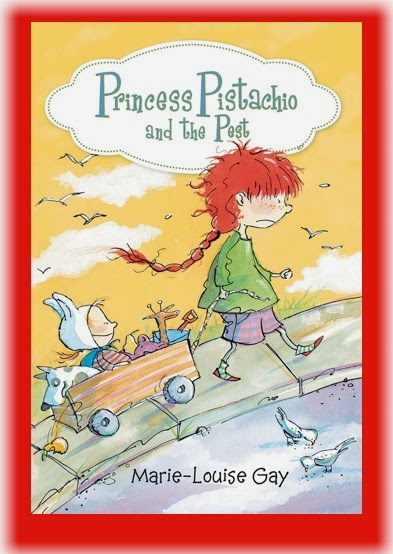
Princess Pistachio and the Pest

by Marie-Louise Gay
Translated by Jacob Homel
Pajama Press
978-1-927485-73-6
48 pp.
Ages 5-8
For release March, 2015

Pistachio Shoelace may have been disappointed when she learned the true nature of her royal status, or lack thereof, in Princess Pistachio (Pajama Press, 2014) but the little red-haired wonder of Marie-Louise Gay's newest series has unforeseen challenges to address in her second adventure, Princess Pistachio and the Pest.  And we're so delighted to share in it with her.

Waking up from a horrible school dream in which she is humiliated when she can't answer a simple addition problem, Pistachio is thrilled to realize it's the first day of summer vacation.  She's ready for adventures with her friends Madeline and Chichi exploring a local cavern. But "Pistachio's heart falls to her belly button" (pg. 12) when her mother instructs her to take her baby sister Penny to the park.

Dragging a wagon loaded with Penny, a tower of toys and the hidden dog, Pistachio continues to daydream about exploring the cavern and what she might find.  Meanwhile, Penny dressed in her rabbit-ear hat and Superman cape, proclaims herself to be Super-Rabbit and repeatedly demonstrates that her super-powers are of the unorthodox kind: pilfering fruit from Mr. Pomodoro's grocery stand; climbing up on a wall and falling into Mrs. Oldtooth's garden; and scavenging treasure from the park's fountain.  Unfortunately, Pistachio is taken as responsible for Penny's misdeeds.

Courtesy of her baby sister, Pistachio is never bored and, upon returning home, realizes that there are worse ways to spend a day than babysitting Penny.  But, it's Pistachio herself, with her imaginative daydreams to compensate for missed adventures and with her reactive diatribes to unexpected turns of events, who makes the day eventful.  Her fiery temper may share each disappointment but it's her exuberance for life that mitigates any annoyances the readers may have about her exasperation.  After all, it was the first day of summer holidays and Pistachio's mother knew to use her "maple syrup tone" (pg. 12) to attempt to sway her daughter.  I suspect the girls' mother, with her own fiery red
hair and foxy twinkle, knows well enough what Pistachio feels.  And luckily, Pistachio may feel many things–embarrassment, disappointment, irritation, fear, inspiration–but never boredom.  

Again, Marie-Louise Gay takes our Pippi-Longstocking-esque young character and places her in classic childhood scenarios to which Pistachio must adapt.  Babysitting younger brothers and sisters during summer vacation is not uncommon for children.  But by taking Pistachio into a neighbourhood of colourful people, diverse friends, and lively interactions, young readers may find the means to endure, even enjoy, surprises that arise during the crazy, lazy days of summer when anything can happen, as it does in Princess Pistachio and the Pest.

August 30, 2014

The Cat at the Wall

Written by Deborah Ellis
Groundwood Books
978-1-55498-491-6
154 pp.
Ages 8-12
For release September, 2014

Many people believe that we are each put on this earth for a specific purpose: to love, to suffer, to teach, to battle, to learn humility, to help others find their voices.  But, if one is placed here to learn a lesson that doesn't get learned, the consequence might be reincarnation to try again. I suspect that's why thirteen year old Clare from Bethlehem, Pennsylvania has returned as a scrawny cat in Bethlehem on the West Bank. And judging by her attitude, she still has a lot to learn.

Clare the cat becomes immersed in a situation in the West Bank that has her reflecting on the circumstances that led to her death and her return as a feline struggling for food and shelter and avoiding skirmishes with other cats, including the king tom and his bunch.  Her past human life and current feline existence are told in parallel lines, allowing comparisons between her role in her own demise and in helping to resolve a conflict in which she is essentially an observer.

After being chased from the wall at a checkpoint from the West Bank to Israel, the cat sneaks into a small house when two Israeli soldiers break in, planning on setting up a surveillance on another residence.  Happy for the safety, shelter and opportunities for food and the occasional scratch, the cat makes herself quite at home, even creating some of the same mischief she enjoyed in her previous life.

When she exposes a young boy hidden under a toy city constructed of boxes and cans and other garbage, the two soldiers first restrain him as a potential threat before coming to his aid with an inhaler for his asthma and food. Sadly, the two Israelis do not understand the child as he chants and rocks himself back and forth.  However, Clare the cat has the distinct ability to understand all languages spoken by humans and animals and recognizes the boy's repetitious murmurings as the famous poem Desiderata by Max Ehrmann (1927), words that she despises because of their negative association with a teacher, Ms. Sealand, whom Clare blames for her death.  Aaron, the more seasoned soldier, a commander from Tel Aviv, is more intuitive about the boy than Simcha, the gun-happy young American private who came looking for a chance to fight and who is suspicious of everything including the scared little boy.  Even while they wonder about the young boy's family, Aaron is able to empathize with the youngster, seeming him as vulnerable and as scared as any of them.

Meanwhile, the cat watches and judges all those around her: Aaron, Simcha, the boy, and others who later become players in the situation, all the while recalling events involving her younger sister Polly, her parents, Ms. Sealand (rudely called Ms. Zero)–everyone.  Her own refrain seems to be "Not my fault.  Not my problem." (pg. 24), acknowledging that "Being kind doesn't lead to anything good." (pg. 63) 

But even the cat (who understands all linguistically) could never have imagined that the life lessons shared with her before she'd died as a thirteen-year-old girl would be others' salvation.  Not that Deborah Ellis ever writes anything that contrived or convenient.  Clare the cat doesn't just, bang, recognize how she can help resolve conflicts; Clare the girl never did.  The cat is still essentially the brash female who absolves herself of any responsibility for the consequences her actions bring about.  It's almost impossible for her to look beyond herself, to see the big picture, the context in which she experiences life.  That is, until she realizes she must do something quite extraordinary.

The concept of karma is well-illustrated in The Cat at the Wall, as is the idea of a purposeful life. But Deborah Ellis does not belabour these themes to teach responsibility or gratitude.  She simply tells an extraordinary story of conflicts that can spiral out of control and be resolved by adherence to some simple truths. The Cat at the Wall is a touching allegory that should remind us all to live a life of goodness and honesty.  It will be well worth it in the end.

<><>><><><><><><><><><<><><><>
Here, for context, is Max Erhmann's famous poem:
Go placidly amid the noise and haste, and 
remember what peace there may be in 
silence. As far as possible without surrender 
be on good terms with all persons. 
Speak your truth quietly and clearly; and listen
to others, even the dull and the ignorant; they too 
have their story. 
Avoid loud and aggressive persons, they are 
vexations to the spirit. If you compare yourself
with others, you may become vain and bitter;
for always there will be greater and lesser 
persons than yourself. 
Enjoy your achievements as well as your 
plans. Keep interested in your own career, 
however humble; it is a real possession in the
changing fortunes of time. 
Exercise caution in your business affairs; for 
the world is full of trickery. But let this not blind
you to what virtue there is; many persons
strive for high ideals; and everywhere life is
full of heroism. 
Be yourself. Especially, do not feign affection. 
Neither be cynical about love; for in the face of
all aridity and disenchantment it is as perennial as
the grass. 
Take kindly the counsel of the years,
gracefully surrendering the things of youth. 
Nurture strength of spirit to shield you in
sudden misfortune. But do not distress
yourself with dark imaginings. Many fears are
born of fatigue and loneliness. 
Beyond a wholesome discipline, be gentle with
yourself. You are a child of the universe, no
less than the trees and the stars; you have a
right to be here. And whether or not it is clear
to you, no doubt the universe is unfolding as it
should. 
Therefore be at peace with God, whatever
you conceive Him to be, and whatever your
labors and aspirations, in the noisy confusion
of life keep peace with your soul. With all its
sham, drudgery, and broken dreams, it is still
a beautiful world. Be cheerful. Strive to be happy.
 © Max Ehrmann 1927