Showing posts with label resilience. Show all posts

February 04, 2026

Shirley: An Indian Residential School Story

Written and illustrated by Joanne Robertson with Shirley (Fletcher) Horn
Second Story Press
978-1772604542
70 pp.
Ages 9–12
Releases February 10, 2026 
 
Shirley, who originally came from Moose Factory, before moving with her family to the southern area of Treaty 9, on the Missinaibi River, remembers being happy. They hunted, fished, trapped, gathered food, and grew food in their garden. But when she was five, the Indian agent came, declaring that since her parents had separated, she and her siblings, which included three-year-old Billy and older sister Frances, would be going with him.  
From Shirley: An Indian Residential School Story, written by Joanne Robertson with Shirley (Fletcher) Horn, illustrated by Joanne Robertson
They were taken by canoe to St. John's Indian Residential School in Chapleau. The first order of business was separating the children into different areas, and Shirley declares that "separating us was their first act of cruelty." (pg. 11) As Shirley and her little brother were too young for school, she became the companion for the minister's young daughter, and Billy was kept outside with the chickens.
From Shirley: An Indian Residential School Story, written by Joanne Robertson with Shirley (Fletcher) Horn, illustrated by Joanne Robertson
When she was finally able to go to school, Shirley loved learning and felt that "being in the classroom took away some of the loneliness." (pg. 17) She saw her siblings at church and at mealtimes, but never being allowed to speak to them was difficult. 
From Shirley: An Indian Residential School Story, written by Joanne Robertson with Shirley (Fletcher) Horn, illustrated by Joanne Robertson
When St. John's Residential School was condemned, the children were moved to Shingwauk Indian Residential School in Sault Ste. Marie. They were able to see their father again, who presented them with generous bags of apples and oranges—which the supervisors took to oversee—and their aunt and uncle who "filled up more than our bellies in our brief visit. They filled up our spirits with good feelings." (pg. 18)
 
At their new school, their routines were quite strict. (The inside front and back covers display "Pupils' 'Timetable,' Shingwauk Home" with times, bells and activities, from workers to work  to the marching to dormitories and the saying of grace, laid out.) And, though Shirley and her friends find ways to endure the rigorous nature of their lives—having competitions, daring each other, and grabbing moments of joy when possible—Shirley missed her family very much. Not surprising that Shirley with others attempted several escapes, though hers were not successful being children so far from home. 
From Shirley: An Indian Residential School Story, written by Joanne Robertson with Shirley (Fletcher) Horn, illustrated by Joanne Robertson
The stories of residential schools are plentiful and always horrific. For children to be taken from those who loved them and to be forced to dissociate from family and their culture and heritage is heartbreaking. Shirley (Fletcher) Horn's story, as shared with Joanne Robertson (who wrote and illustrated The Water Walker, 2017), is an honest portrayal of her experiences, but still told in an age-appropriate tone. Enough stories of survivors of residential schools and of those who were victimized in those schools are plentiful and tragic. But, because Joanne Robertson and Shirley (Fletcher) Horn take Shirley's reminiscences, good and bad, and focus on her perspective on them and how she dealt with everything, what comes across most importantly is her resilience. As a child, she made herself think of other things, to delve into her learning, and to "shut off my loneliness." (pg. 30) She fought off bullies, fear, and, most of all, that loneliness. She is strong and gutsy, and she endured.
 
The images in Shirley: An Indian Residential School Story are a unique blend of photographs, many from Algoma University archives of Shingwauk Residential School Centre and from Joanne Robertson, and drawings by Joanne Robertson. By mixing two media, she helps us focus on Shirley and the other children, and less on their grim circumstances. By limiting colour to the children and any positive circumstances they appreciated like a confirmation dress, or the river banked by trees, Joanne Robertson reminds us of where the goodness is. 
 
Shirley: An Indian Residential School Story is an important addition to all compilations of middle grade stories about Indigenous children in residential schools. By telling her story, just as she did to the Truth and Reconciliation Commission, Shirley (Fletcher) Horn's has found a way to share for those who endured the same and for those who cannot imagine it and need to be informed. 

May 19, 2025

Sam

Written by Eric Walters
DCB
978-1-770867949
228 pp.
Ages 9-14
May 2025 
 
She was strong. She didn't give up. She didn't take crap from anybody. I liked that. And all she really wanted was a place to call home. I understood that better than I even would have wanted. (p. 133)
 
The "she" of whom fourteen-year-old Sam Reid speaks is Anne of Green Gables, and, along with support from a select group of new acquaintances, the boy with red hair and a matching temper has a lot to learn and especially from L. M. Montgomery's 1908 fictional character.
 
Sam may be a smart kid, but it doesn't stop him from letting his temper get the better of him. When confronted with a shopkeeper trying to rip $10 off of him and having to stand up against the high school's quarterback, who ends up with a broken nose, Sam knows he should have kept his cool. But things get worse when Sam is accosted in a school bathroom and fights back, leaving Cody, the quarterback, with a concussion.
...there's no question that I have a temper, but that's only because people are always doing things to provoke me. (p. 9) 
With no family–his parents were killed in a car crash by a drunk driver four years earlier–and foster parents who don't want him back, he is sent to the Johnson Juvenile Center, a detention facility for those younger than 18 who were awaiting trial or those already convicted and serving sentences less than 18 months. Sam would be at the Johnson Juvenile Center, a.k.a. the Gables, for at least 5 weeks while he is assessed before heading to court. While his social worker Jenna Williams is keen to help, his court-appointed lawyer Mr. Turner is challenged, especially when additional charges of fraud and theft are brought by the shopkeeper, and everyone seems disappointed that the local football hero would be out of commission. 

At the Gables, Sam must deal with a nasty guard Mr. Roberts who insists on calling Sam "Red" and is just waiting for the chance to write him up for poor behaviour, bad attitude, and more. There's also a convicted "long-timer" Bruce who seems to have it out for Sam after an innocent mistake of sitting at the wrong dining table ends with Sam shooting off his mouth again.
Why did people keep coming at me and why wasn't I smart enough to shut up and move on when they did? (p. 64)
Thankfully Sam has some good people on his side trying to help him be the best version of himself. There's his roomie Nigel, a smaller guy who is in for throwing a chair at someone; Mrs. Martinez, their English teacher; Kate, a kind-hearted guard; and his psychologist, Dr. McEnny. Now if Sam could only stop seeing everything and everyone as a threat or a challenge and use his smarts–and he is very intelligent–to help himself. 
Sometimes smart can't overcome circumstances, situations, and tragedy. (p. 128)
Things start to change for Sam when Mrs. Martinez assigns Nigel and Sam each a book on which they will prepare a report, and Sam gets Lucy Maud Montgomery's Anne of Green Gables, hoping he'll find some interesting parallels with his own life. If he can just get past his outrage and humiliation, especially when he sees that Anne is a redhead like he is, Sam may be able to use his potential and discover his strength to find hope.
 
For lovers of L. M. Montgomery's Anne of Green Gables, the parallels between Anne's life and that of Sam will be evident, even though their differences in time and circumstances are significant. (In fact, an assignment Sam completes for Mrs. Martinez focuses on these very parallels.) Eric Walters is very subtle in his homage to Montgomery and her red-haired character, though his "Author's Note" suggests an extraordinary depth of admiration for the author and her book. This is abundantly evident in his appreciation for her words–quotes from Anne of Green Gables are cited often and always fitting–and the themes of persevering life's challenges and finding hope against tragedy and adversity. Eric Walters makes us believe in Sam. The young teen may not be completely likeable at the beginning of Sam but he's a kid who has had a lot of hard knocks. His temper, which may or may not be as a result of his circumstances, and I don't mean the colour of his hair, is an entity with which he has a relationship, good or bad. It's in his learning about that anger and his recognition that he has been able to keep it in check that almost releases him from it and allows Sam to grow. While he initially thinks Anne is almost delusionally optimistic, he too starts to acknowledge the positives of things that once appeared to only be difficult. 

Sam has had a tough life, bouncing from foster homes and receiving homes, never being offered a true home since the death of his parents. But, as horrific as going to a juvenile center must be, the Gables becomes a place of salvation for Sam, as Green Gables was for Anne, helping him acquire a support system as tough as any loving family and teaching him the strength he has always had to overcome that which seems formidable. With kind souls and kindred spirits, Sam's life goes beyond "a perfect graveyard of buried hopes" as Anne declares at the beginning of Anne of Green Gables, to one of possibilities.

February 10, 2025

Black Boy, Black Boy

Written by Angela Bowden
Illustrated by Ibe Ananaba
Nimbus Publishing
978-1-77471-401-0
36 pp.
Ages 4-9
January 2025

Black Boy, Black Boy may be presented as a picture book, powerfully illustrated with the art of Ibeabuchi (Ibe) Ananaba, but it reads like spoken-word poem. I could hear the voice of "Aunty Angela"–this is how Angela Bowden signs off her appended note "To the Black Boys reading this"–ringing loud and clear and emphatic as she speaks and urges all black boys to see themselves and to see the legacy from which they came and the one to which they will create for themselves. It's inspiring, encouraging and enlightening.
From Black Boy, Black Boy, written by Angela Bowden, illustrated by Ibe Ananaba
Angela Bowden begins Black Boy, Black Boy with a series of questions. At first the questions are about the boys' heritage and identity.
Do you know where you come from? 
Do you know what you're made of? 

Do you know who your people be?
She provides context for where they came from, whether it be Africans, or Loyalists, Maroons, refugees or others but always speaks to the "pride and wisdom, courage and bravery" embedded in their heritage. She speaks of the past and the now, and what can still be. Angela Bowden conveys messages about spirit and freedom, rhythm and harmony, and purpose. Whether they be men like Frederick Douglass and Robert Shephard, or contemporaries like Barack Obama, Angela Bowden urges the boys to keep reaching because,
Black Boy, you are a gift
Of the past and the present
I wish I could share the power and rhythm of Angela Bowden's words. They jump from the page into the reader's ears and heart reminding us of the potential to elevate and move young people with words. Her poetry, sometimes rhyming and sometimes free verse, will raise spirits to see beyond a moment of self and look back and forward to understand how that moment is but a flash. I can't speak to how a black boy may respond or interpret this poetry but I can share with you how moved I was as Angela Bowden speaks to them and reminds them of who they truly are and will be.
From Black Boy, Black Boy, written by Angela Bowden, illustrated by Ibe Ananaba
Her words are more than sufficient to inspire but with Ibe Ananaba's artwork, Black Boy, Black Boy becomes an anthem to self-realization. With the shapes, the lines, and the colours, Ibe Ananaba thrusts forward the message of legacy and self-fulfillment. Whether they are boys playing or being loved, feeling fear or shining bright, Ibe Ananaba sees these boys and strengthens them with his art.
From Black Boy, Black Boy, written by Angela Bowden, illustrated by Ibe Ananaba
I know a lot of educators will use Black Boy, Black Boy as a teaching tool during Black History Month with its recognition of Canadian and international icons from music to medicine, activism to politics. (The last page recounts the famous individuals depicted in Ibe Ananaba's artwork, including Nelson Mandela, Rev. Dr. Martin Luther King Jr., and Francis Dorrington.) But it behoves all readers, teachers, and parents to see Black Boy, Black Boy as more than this. It is a poem of recognition and resilience, of reassurance and faith, that black boys should stand tall and go forward knowing the past and their futures are secured through their ancestry and the black boys that came before them and those who will follow.

July 26, 2022

kā-āciwīkicik / The Move

Written by Doris George and Don K. Philpot
Illustrated by Alyssa Koski
Heritage House
978-1-77203-409-7
48 pp.
Ages 4-8
May 2022

The story of kā-āciwīkicik or The Move, a dual-language picture book, begins with an elderly Cree couple looking out from their new house in a rocky barren land, having moved from their old place beside a river close to a lake, land covered with trees, and brush and meadows. As upset as the old woman is in having to leave so much behind, her husband tells her that "There's nothing we can do to change things".  But he's wrong.
 
From kā-āciwīkicik / The Move by Doris George and Don K. Philpot, illus. by Alyssa Koski

Recalling the belief of her grandmother, a diviner, that the spirits would extend help when asked, the old woman first wishes for some trees so that she might have wood to smoke her fish and moose hides. With that, a group of black ash appear and root themselves in the yard. Consequently, the old man gathers some old wood and, in addition to making a smudge, starts a fire for his wife's drying racks.
From kā-āciwīkicik / The Move by Doris George and Don K. Philpot, illus. by Alyssa Koski
When the couple's daughter and two grandchildren come to visit, they reminisce about the old songs, and their activities like making maple sugar candy and weaving baskets from birch bark. With a wish, maple and birch trees then appear, along with spruce, and the elderly couple get to work tapping the trees and boiling sap, as well as cutting strips of bark and gathering roots for baskets. Moreover they can now share with their grandchildren the skills of those springtime activities.

When summer comes and the old woman remembers picking saskatoon berries for bannock and winter storage, she laments how far away they are from the berries now. With a clap of thunder and a heave of the ground, a trail appears and saskatoon berries materialize everywhere. It is finally then that the old woman looks out over their new home and land, and recognizes that, "It's good here."
From kā-āciwīkicik / The Move by Doris George and Don K. Philpot, illus. by Alyssa Koski

Though there are supernatural elements to Doris George and Don K. Philpot's story, it is a story rooted in reality and history. Their "Authors' Note" recalls the building of a dam in northern Manitoba in the early 1960s and the relocation of the Chemawawin Cree Nation from ancestral lands. It's the contrast of the old with the new but also the establishment of a new familiarity that is significant. What the Cree couple leave behind is tradition, family, culture and home. But, they are able to re-establish all, with a little spiritual assistance, to continue providing for themselves and others and build a new life. While the disruption caused by forced relocations is very real, authors Doris George and Don K. Philpot emphasize that the quality of life travels with the couple. With their resilience, they make it work.  

Alyssa Koski of Kainai Nation transitions the couple from the greyness of their stark new land to its promise. She gives us contemplation in the old woman's face, purpose in their activities, and hope in the lushness of the new greenness. By juxtaposing the real with the unreal, Alyssa Koski takes us into Doris George and Don K. Philpot's First Nation experience story of ancestry, upheaval and survival and, with colour and shape, shows us the continuity that inspires and reassures.

July 08, 2022

When the Wind Came

Written by Jan Andrews
Illustrated by Dorothy Leung
Kids Can Press
978-1-5253-0339-5
32 pp.
Ages 4-7
June 2022
 
When the Wind Came is a story of reminiscences. Its narrator, a pig-tailed child who loves to read, recalls how life was on their family farm. It may be a different time, with a mother pulling out weeds by hand and with an earthen root cellar for storing food, but its story is one for all time. 
From When the Wind Came by Jan Andrews, illus. by Dorothy Leung
Living on a farm, a child remembers her father tending the cattle, her mother weeding with a baby playing on a blanket nearby. She also remembers that baby brother whimpering endlessly while she reads beneath a tree. And then the wind comes and everything changes.
I remember my mother
grabbing up my baby brother.

I remember her running 
with him in her arms.
 
I remember my father opening
the door to the root cellar.
She remembers the darkness and the silence, and then coming out to witness the destruction of that wind. 
Our home was gone
when we came out.
From When the Wind Came by Jan Andrews, illus. by Dorothy Leung
As they attempt to retrieve anything that might have survived, her mother cobbles together some food, and it is the child's job to clean the dishes.
I don't know why I did it.
I wasn't even thinking.
Maybe I was crying.
Maybe tears were running down my cheeks.
What she did was make bubbles.

We may hear of devastating storms more nowadays because of media reporting and people sharing on social media but those catastrophes have always been there and those who've endured them do just that. They endure. They pick themselves up and get on with things. Even with unfathomable destruction and losses, they try to go on. They find food and do dishes and maybe even have a laugh before they leave it all behind. And Jan Andrews takes us into their family and their pain and their tenacity. She makes us feel the child's frustration with a wailing baby, the force of the storm, and the ruination of their home. She also gives us a family living off the land, accepting nature's unpredictability, and always showing resilience.

The youngCanLit world lost a literary legend when Jan Andrews passed unexpectedly in 2017. She could write it all: picture books, middle grade, short stories, and young adult novels. She was always a storyteller (first president of the Storytellers of Canada) who'd won the Silver Birch Express Award in 2012 for When Apples Grew Noses and White Horses Flew: Tales of Ti-Jean, was awarded the Order of Canada, and was nominated for multiple Governor General's Literary Awards. Even five years from her passing, we have another extraordinary tale of resilience housed in a story of tragedy. The storm that brings the wind and destroys the family farm is pivotal but it's the response to that catastrophe that is the true story. It's a story of seeing beyond the dark, finding a lightness in that gloom. The wind may have brought destruction and despair but it also revealed that which was there all along: resilience. It was creating sparkles of joy from soap, bubbles that entertained and distracted and changed nothing and changed everything. From something little during something monumental, faith for a future was found.

Dorothy Leung is a new pencil (and paint) creator in children's book illustration and she impresses with her take on this important story. The vastness of the farm setting, the force of that storm, and the normality of a family's response are all evident through her use of colour and shape. The contrast of the dryness of those fields and the power of that destructive wind is almost tactile, and definitely convincing. She has fortified Jan Andrews's story with her art.

We will continue to hear about devastating weather and its impact on communities but Jan Andrews and Dorothy Leung's picture book shows us that, when the winds come, there will always be stories to tell of resilience and possibility.

March 26, 2022

A Soft Place to Fall

Written by Tanya Christenson
Red Deer Press
978-0-889956384
409 pp.
Ages 12+
January 2022
 

Out of suffering have emerged the strongest souls;
the most massive characters are seared with scars.
 
~ Kahlil Gibran 


Kahlil Gibran's words may end Tanya Christenson's debut novel, A Soft Place to Fall, but they work well as a preface to a story of struggles, challenges and loss from which triumphs emerge from the ordinary.

The story is told from the perspective of Creighton Fischer, a boy whose singing mom, Gracie Rae, left when he was just five, and whose father's work with the carnival has kept them moving for many years. When, after Creighton's Grade 7 year, Dad decides it's time for them to settle down, they move to Breton, Mom's old home town. Because of gaps in his learning and attendance, it is recommended that Creighton join an alternate school. There, under the compassionate and diverse teaching methods of Ms. Hayworth, Creighton becomes part of a unique cohort. The dozen or so students soon reveal themselves to be impacted by various traumas and disabilities but Ms. Hayworth's approach is to meet their needs and not slot them into the rigid curriculum. And by showing flexibility and empathy, she brings out the best in most of them. That is, except for Carlos a.k.a. Carcass. And for Creighton, he finds his first real friends in Carin, Ratchet and Schooner and the support system he and all of them need to brave the loss of loved ones, economic hardships, bullying, past traumas, criminal charges, and even love.

The twelve kids in Ms. Hayworth's class may attend L.O.S.E.R. (Lane Oslo School of Educational Reform) but they aren't losers. They may be flawed through trauma, mental health, disability or circumstances beyond their control but they are not losers. They are human. Their resilience may at times be shaky but it is undeniable and it thankfully allows them to persist.
 
BC's Tanya Christenson, a teacher and school counsellor, knows kids and she's written these kids as human as you and I. And she doesn't wrap up their struggles with happy endings, ribbons or balloons. Tanya Christenson makes their outcomes as real as the kids. They've suffered abandonment, abuse and upheaval, and they have endured. Sometimes they've triumphed over those struggles and  sometimes not, and like all of us, they have needed support and a soft place to fall. Because, after all, we will all fall some time, some way. I just hope that there will always be a soft place to fall, perhaps even land, for anyone challenged by life. And that's everyone.

January 08, 2022

A Sky-Blue Bench

Written by Bahram Rahman
Illustrated by Peggy Collins
Pajama Press
978-1-77278-222-6
32 pp.
Ages 5-8
 November 2021
 
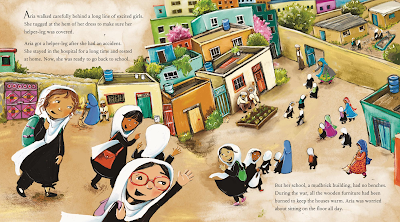
Bahram Rahman, author of The Library Bus (Pajama Press, 2020), returns the reader to Afghanistan and offers another hopeful tale of resilience and courage, creativity and endeavour.
From A Sky-Blue Bench by Bahram Rahman, illus. by Peggy Collins

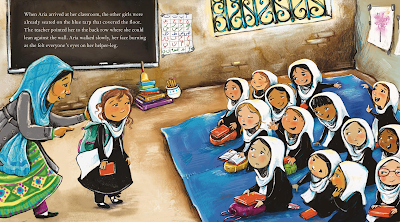
Aria is an Afghan girl with lovely new red shoes and a helper-leg that she got after an accident. (Bahram Rahman's appended notes talk of land mines and unexploded ordinance.) While she is eager to be returning to school after her lengthy hospitalization, Aria is apprehensive, especially as all the wooden school furniture has been destroyed for firewood and the children now sit with bent knees on a floor tarp, something she will be unable to do.

From A Sky-Blue Bench by Bahram Rahman, illus. by Peggy Collins
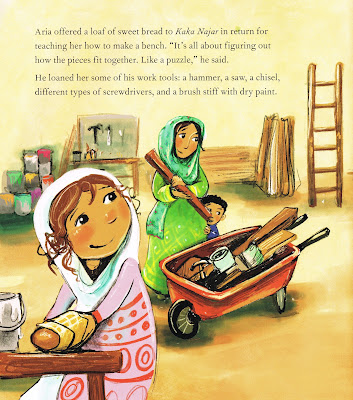
Aria contemplates not returning to school but rejects that idea and instead comes up with the "brave idea" to build herself a bench. Most of the girls laugh at her plan but Aria is determined and she and her lone friend scavenge the city for discarded wooden boards, broken pieces of furniture, and random nails and screws. Then, Aria and her mother visit a carpenter in the old city who, for the gift of a loaf of bread, loans her an assortment of tools and a can of sky-blue paint.
"Sky-blue is the color of courage, peace and," he tapped at his temple, "wisdom."
From A Sky-Blue Bench by Bahram Rahman, illus. by Peggy Collins
And so a bench is created, and with it an opportunity for Aria and the other girls to take control of their own schooling needs.

Though Bahram Rahman makes it clear from his notes about circumstances he and others experienced in his homeland of Afghanistan, he does not dwell on the horrors of land mines or the challenges of living with a civil war. Instead Bahram Rahman speaks to a girl's determination to get an education, be proactive and resourceful, and to challenge herself to meet her own needs. It's a brave commentary on focusing on what you can change, not on what you can't, and Aria demonstrates that the possibilities can be inspiring. 

While there is a brightness and a child-like quality to her art, Peggy Collins (Harley the Hero, 2021) stays firmly in realism, but without immersing her art in the adversity of the situation. Aria's prosthetic leg is barely visible under her black dress and the challenges of the civil war are obscured by the vibrancy of the community in its activity and colour. Peggy Collins takes us into the Afghanistan of Aria's life, not of news reports: her school, her helper-leg, her mother and little brother, and her community. Her sky-blue bench is as assured as she is.

A Sky-Blue Bench may be a story from Afghanistan but its lessons about self-reliance and resourcefulness will speak to all children, especially those facing their own challenges, and encourage them to find solutions. With a desire, some hard work and a little wisdom, Aria was able to build something worthwhile, with wood and with vision.

December 08, 2021

My Words Flew Away Like Birds

Written by Debora Pearson
Illustrated by Shrija Jain
Kids Can Press
978-1-5253-0318-0
40 pp.
Ages 4-8
October 2021

There are all kinds of fitting in. But when you're new to a country with a new language, it is especially hard. Not only are you missing your old home with its familiar people and places, you're in a new place where communication is near impossible. For the child in My Words Flew Away Like Birds, she is completely unprepared for the vacuum of language with which she and her parents must endure.
That was my world 
back then.
This little girl remembers the trees, the noisy market, her grandfather's bakery, and her friends. In preparation for their move, her mother teaches her some rudimentary phrases that should help break the ice, like "Hello, how are you?," and "It was nice to meet you.
From My Words Flew Away Like Birds by Debora Pearson, illus. by Shrija Jain
The words felt strange 
and lumpy 
in my mouth.
But, though she is amazed by the things she sees, like snow and a dog in a coat and booties, everyone speaks so fast in her new country and she cannot grasp the words or their meaning. She tries desperately to watch and listen but she feels so lost. 
From My Words Flew Away Like Birds by Debora Pearson, illus. by Shrija Jain
It's not until the next spring when she helps a little girl who falls off a playground swing that she can use one of her learned phrases, experiment with echoing the other child's words, and finally make the connection that makes her feel she belongs.

Many of us know what it's like to travel to new places where different languages are spoken. If we're considerate, we try our best to communicate in their language but appreciate it when the locals help us out by speaking in ours. But for immigrants, immersion in a new culture with a new language is undoubtedly daunting. Not only do they have to navigate bureaucratic and new cultural norms, they often must do so in a new language. For children who are desperate to make connections at school or in their neighbourhoods, how do they do this without words? Fortunately, what the child in My Words Flew Away Like Birds realizes eventually is that kindness and play have no language barriers and learning only happens when mistakes are made. These are both simple and complex messages and Debora Pearson shares them with a convincing text rich in auditory embellishments and striking dialogue, emphasizing what is most important to the young child. She'll remember the sounds she hears and the muffled vocalizations, hand-lettered for emphasis, until they can become words to her, words that don't fly away but instead are ones she can grab hold of.
From My Words Flew Away Like Birds by Debora Pearson, illus. by Shrija Jain
Artist Shrija Jain's pen and ink illustrations, which were coloured digitally, underscore the importance of the words and the connectivity between child and place. Using only pastel shades of blue, rose, purple and orange to offset the vivid black details of hand-lettered words, the immigrant family and those with whom they interact, and sparse landscape elements, Shrija Jain demonstrates what is truly important: connection through communication in all its forms and efforts.

This child may feel like the words of her first language flew away but she does find some new words and is delighted to move forward and recognize that "these words are here to stay." As with much learning, it happens with time and practice, and that includes mistakes, and the making of connections to make that learning worthwhile.

July 20, 2021

Sully, Messed Up: Q & A with author Stephanie Simpson McLellan

Yesterday I reviewed Stephanie Simpson McLellan's new middle grade/young adult novel Sully, Messed Up from Red Deer Press. This story about bullying was so compelling that I asked author Stephanie Simpson McLellan if I could do a Q & A with her to learn a little bit more about Sully and his story. She graciously agreed.

Sully, Messed Up
Written by Stephanie Simpson McLellan
Red Deer Press
978-0-88995-637-7
312 pp.
Ages 11-15
April 2021

Today I present that interview with author Stephanie Simpson McLellan about Sully, Messed Up.

Author Stephanie Simpson McLellan


HK:  When Sully wakes up on the first day of Grade 9, his face is messed up, with his nose, ears, mouth, nose and eyes relocating themselves around his head. Throughout the story, his facial landscape changes, but no one, except the Purse Lady, can see it. What was the purpose of giving Sully this transforming face?
 
SSM:  When I wrote the first draft of this story many years ago, my own three children were journeying through the often confusing and anxious space called adolescence. I remember well navigating this time myself. Every emotion feels so big and significant, and certainly anxiety – Sully’s prevailing emotion - can feel very physical. Most of us can relate to feeling sometimes that whatever emotion we’re feeling must be obvious – as plain as the nose on our face. So, at the most basic level, Sully’s messed up face is a metaphor for what he’s feeling inside.

Over the last year as I worked with Peter Carver on the book, I started to think also that it was an especially apt metaphor given that, with the popularity of social media, little is private. Both the good and bad things that happen to you— and everything in between—are very public. It’s like one giant bulletin board where everything about you is posted for everyone to see. No hiding! We even post emojis to tell people how we’re feeling, which is like giving people permission to look into your heart. In this vein, the metaphor of Sully’s messed-up face plays with how public everything is these days by taking it out of the digital space and putting it back into the physical world. Sully’s misery feels very public to him—so real and uncomfortable that surely everyone must be able to see his fears and insecurities.


HK:  I loved Mr. C’s fence of figurines whose scenes predict or illustrate Sully’s life and those of others in it. The characters you chose to represent each of the story’s characters, like Charlie Brown for Sully, Sleeping Beauty for Blossom and Madonna for the Purse Lady, were brilliant.  Please tell us about the inspiration for this fence, and how you chose the figurines to symbolize the characters.
 
SSM:  True Street, where the fence is located, is loosely based on a real street in my town that comes off Newmarket’s Fairy Lake Park. While I’ve taken some creative liberties with the actual geography and look of the house that sits on this short street, the real house actually did have a snake-rail fence about a decade ago, to which plastic figurines were affixed and often rearranged. While I never knew (or even saw) the owner, those figurines on the fence intrigued me, and I wondered what motivated someone to do this.

The character of each plastic figurine took some time to sort out. The final cast of characters is probably version six, changing each time I rewrote another draft. I wanted it to be at least somewhat plausible that each figurine could exist, and that readers would know who they were, but also wanted each figurine to reflect and reveal the character it represented. It’s a pretty eclectic mix, but then life (and high school as a subset of life) is a little like that – throwing people together from all sorts of backgrounds.


HK:  As an educator, I was saddened by the ineffectiveness and ignorance of Sully’s teachers and even his principal with regards to his bullying and the hazing carried out in the school. Why do you think they were all so oblivious of these goings-on? Or were they?
 
SSM:  My own kids had some great and not so great teachers. That’s probably true for all of us. I think, truthfully, that the bully/victim dynamic is tough on everyone, and as much as a school can say they don’t tolerate bullies, there are many things that make this difficult to regulate. For one, much of what happens to Sully occurs off school grounds. Secondly, Sully himself hides what’s happening from the teachers and other adults, fearing reprisal from the bullies. My goal wasn’t to paint the school administration as ineffectual but perhaps instead to reflect that there are some kids who fall through the cracks for one reason or another. In my son’s case, I knew there were teachers and administrators who cared, but it didn’t change the outcome. Mr. Green and Ms. Winters are parodies of real teachers I’ve known. The wonderful Ms. Wippet embodies many of the incredible educators I’ve encountered, but even Ms. Wippet can help only so far as Sully permits her to. 


HK:  Outside of bullies Tank, Ox and Dodger, so many characters could have altered the course of Sully’s story in Sully, Messed Up if they had spoken, listened or acted. Sully needed to speak up sooner, teachers and administrators needed to listen and open their eyes, and Sully’s classmates could’ve stepped up rather than act as silent bystanders or reinforcers who perpetuated the bullying with name-calling and laughter.  Which character or characters, outside of the trio of bullies, do you think was most important in that they could have changed everything for Sully by acting differently?
 
SSM:  Sully himself, as he came to realize, was the key to changing everything. Blossom and Morsixx tried very hard to help Sully but I believe that no matter how much we are loved and cared for by others, we are each ultimately responsible for ourselves. We make our own choices. It is up to us to advocate for ourselves. When I reflect back on some of my other books (such as Hoogie in the Middle and The Christmas Wind) I realize the thread of this is in much of what I write.

Eleanor Roosevelt said, “No one can make you feel inferior without your consent.” I’m not saying bullies can’t gain power over others (history gives us enough of those examples), but I believe that on a personal level, you can shrink a bully’s power by refusing to consent to the opinion they have of you. Decide that their opinion is not valid and then live that. Making a decision like this changes the way you think, feel and act. It changes the choices you make.

At one point in the book, I quote Barack Obama’s eloquent line: “Change will not come if we wait for some other person or some other time. We are the ones we’ve been waiting for. We are the change that we seek.” I think all the people in the world could have come to Sully’s aid, but it was only when he was ready that he became able to change is outcome.


HK:  Tennyson’s poem “The Lady of Shalott” figures prominently in Sully, Messed Up, both as part of an English assignment but also as reflective of Blossom’s story. Why use this classic ballad to mirror one character’s story?
 
SSM:  My undergrad major was English Lit (with a minor in Economics) and I loved nineteenth century literature. “The Lady of Shalott” poem and the beautiful rendering of it by John William Waterhouse, always stayed with me. When I first conceived the character of Blossom (at a Motocross park in Chatsworth, Ontario where my son was riding), it was with the image of “The Lady of Shalott” in my head: someone ethereal and mysterious; strong and individual, but also someone under the control of something bigger than her and, thus, ultimately fragile.


HK:   Though readers cannot help but feel bad for Sully as a victim of bullying, he is not always a likeable character. He’s so wrapped up in his own issues, monumental as they are, that he can’t see how rude he can be to others like Winston and Blossom and Morsixx. Why make Sully worthy of both our sympathy and occasionally our scorn?
 
SSM:  Not all of us are born leaders and heroes, and certainly Sully isn’t either of those for much of the book. But I think most of us have, or have had, a little bit of this in us. A preoccupation with our own story, unable to see outside our own heads. I wanted to make Sully real, someone deeply flawed who would really have to work at creating the best version of himself. Throughout much of the book, he giftwraps himself as the victim Tank is seeking. He does understand this on some level but hasn’t grown enough to alter it. I do love books where the protagonist is a hero waiting to happen, someone who already has the right ingredients for greatness, but I wanted to pay homage to someone who might never have completely realized his own potential without first being dragged kicking and screaming to this point. I think there are real Sully’s in every school. Kids who are under the radar, who don’t believe in themselves, who are fearful and anxious. I wanted to volley the idea that even these “through the cracks” kids have the potential to pull themselves in a different, and perhaps better, direction.


HK:  If there was one message you would like readers to take from Sully, Messed Up, what would it be?
 
SSM:  I would like readers to reflect on the idea that we are each captain of our own ship. That change starts with us and if we’re not happy with our current reality, it’s up to us to make different choices – including asking for, or accepting, help from others.

• • • • • • •

Sincere thanks to Stephanie Simpson McLellan for agreeing to be interviewed and providing such thoughtful and honest answers to my questions. 
 
Learning even more about Sully, I encourage all educators and school administrators and parents to read Sully, Messed Up to help the young people in their lives.
 
• • • • • • •

Though Sully, Messed Up is Stephanie Simpson McLellan's first novel for young people, she has an impressive collection of children's picture books. Do check out these titles too.

Leon's Song (2004)
The Chicken Cat (2000)

July 19, 2021

Sully, Messed Up

Written by Stephanie Simpson McLellan
Red Deer Press
978-0-88995-637-7
312 pp.
Ages 11-15
April 2021

Who is Sullivan Brewster? He's Sullivan to his mom, Rooster to his little sister Eva, and Van to his stepdad Bill. He's Sully to his friend Morty, who has changed his own moniker to Morsixx since reinventing himself over the summer before their first year in high school. And to those who don't know him or want to target him, he becomes Bella, Sally and a host of horrible nicknames. Is it any wonder that thirteen-year-old Sully doesn't know who he is or what he should be doing or who his friends are? He truly is messed up, and that doesn't even count the messing up he's getting from a trio of bullies named Tank, Ox and Dodger.
 
Sully's story seems to start on that first day of Grade 9 when he wakes up with his facial elements relocated around his head.
His nose, pink and dripping, hunkered sideways on his left temple. One of his ears–it was hard to tell which one from the unfamiliar angle–bulged where his nose should have been. The other protruded, antenna-like, right above his lips, which quivered, post-scream, in the middle of his forehead. (pg. 9)
But no one seems to notice. Still, Sully uses his long hair to hide his potential disfigurement. This instead grabs the attention of Tank, the overlord at Wild Forest Secondary, and his sidekicks Dodger and Ox. Worried that he will now become the victim of the Gr. 9 hazing called the Naked Niner, whereby a selected student is unclothed and photographed and publicly humiliated, Sully tries to stay out of Tank's field of view. Unfortunately, everything he does seems to garner him more unwanted attention. 
 
First, he believes his friend and locker partner Morty/Morsixx is drawing too much attention with his new emo boy look and attitude so Sully starts avoiding him by carrying his backpack everywhere, hiding out in the parking lot at lunch and abstaining from taking the bus. Even though Morsixx and Blossom, a new girl who adorns her face and arms with ink of vines and flowers, try to support him, Sully continues to reject their efforts. Then he's given the topic of menstruation for his Sex Education class and Dodger pranks him with countless tampons, earning him the displeasure of the principal and a host of new nicknames.
 
When he begins to walk to and from school, past a purple house on True Street, with its fence adored with an unusual assortment of figurines in ever-changing scenes, Sully becomes acquainted with the Purse Lady who gets his attention when she asks him, "What happened to your face?" (pg. 80) But who is she and why does Mr. C, the strange man in the purple house, seem to know her and Sully and maybe even what is happening in his life, all represented in the figurines of Charlie Brown, the Knight, Sleeping Beauty, Darth Vader and more?
 
School can be a place of refuge for some but for others, especially those who become marked as victims, it can be brutal. And for Grade 9 students, it can be especially challenging. With an implicit hierarchy of power and confusion about the supports which they may or may not have, those preyed upon by bullies may become even more isolated. This is Sully who confuses his friends with contributing to his victimization and who doesn't want to worry his family. He is awkward in discussions with his teachers and his principal and then makes further choices that complicate things for himself. But, while Sully has been victimized, Stephanie Simpson McLellan tries not to play up the young teen as a victim. He is instead confused or rather messed up. He's got all the basics–friends, family, the will– to make things right but, like his face, things just haven't fallen into place correctly. Fortunately, when he can see beyond his personal disasters and into those of others, Sully learns to stand up for himself and help himself adapt. This is an important message for young people and, amidst all Sully's struggles, it's one that Stephanie Simpson McLellan emphasizes. With some insight and a little help from others, Sully is finally able to put to rights his situation and find himself.

• • • • • • • • •

Tomorrow I interview author Stephanie Simpson McLellan about Sully, Messed Up. For middle-graders and early young adults and their parents and their teachers, this Q & A will speak to all of you.

June 22, 2021

Tough Like Mum: Q & A with author Lana Button

Yesterday I reviewed Tough Like Mum, written by Lana Button and illustrated by Carmen Mok.
Written by Lana Button
Illustrated by Carmen Mok
Tundra Books
978-0-7352-6598-1
32 pp.
Ages 3-7
April 2021
 
 
Today I have the pleasure of presenting 
this question and answer interview 
with author Lana Button.
 
Author Lana Button

 
HK:  When I started reading Tough Like Mum, I wasn't sure if the issue tackled by the book was poverty or depression. Then I realized that what was most important was resilience which can be the antidote to both. As the author, what came first for you in writing the story: the issue or the response?
 
LB:  I am sensitive to these issues on a personal level, on a professional level as an early childhood educator, and on a creative level as an author for young audiences. I wanted to write a picture book story that would bring these issues to light; knowing and experiencing that there are children among the picture book audience who live with the challenges Kim and her mum face. It is important and powerful for children to read, in stories, that they are not alone in their experience. 

I also felt that a picture book tackling the issues of poverty and mental health could be used as a tool for building understanding and developing empathy, for those who have not had these life experiences. I was interested in telling a story that would provide a safe and age-appropriate place to start important conversations.

Finding the response–figuring out how to tell a hard-hitting story, while respecting the age and sensitivity of my young audience–was where I was tripped up, and where this story idea was stalled for a long time. I waited for the story to come to me. Then I heard two comments. One by a teacher. “Some of my students can’t complete their homework because their power gets shut off and it’s too dark.” Another was a response to the cost of an upcoming field trip. “It’s only $6.00. I mean, what’s $6.00?” All I could think from that was, “We can’t assume to know what $6.00 might mean to a family, what life is like in their home.” And BOOM! this very resilient little girl, waking up with her thumb in her mouth, popped into my head and her story became very clear to me.
 

HK:  Poverty is a tough topic to cover in a picture book, especially one for young children, though this is sadly the experience for many. How did you manage to stay realistic about the issue, for children to be able to see themselves, and still be compassionate without revealing vulnerabilities and sensitivities that some would prefer hidden? 
 
LB:  It is a tough topic, for sure. And I wanted to give a voice to Kim’s reality, while ensuring my young audience wasn’t overwhelmed. And so, I entrusted Kim as my storyteller. This resilient little girl is not easily shaken, and she conveys her experience in a matter-of-fact way, as children often do. She tells it simply, which allows a young audience to interpret the story at its baseline. I then relied heavily on the illustration to fill in the details of Kim and her mum’s reality. The nuances of the illustration allow an audience, when they are ready to take it in, to dig deeper into the story.


HK:  Tough Like Mum ensures that, first and foremost, we see the strengths of those dealing with poverty and hard times, not any weaknesses. Your title says it all. Is there a mum or a child for whom you wrote this book?
 
LB:  I wrote Tough Like Mum with the hope that there will be an audience who feels connected to this story on a personal level. I wrote it for anyone who is struggling or has struggled with financial burdens, and for those experiencing the weight of depression in their home.  In particular–the child who needs to feel seen, who needs to feel championed to try one more time, to reach out and ask for help–this book is for them.

 
HK:  I think that whatever hardships we all go through–physical, emotional, financial–asking for help is one of the hardest things to do and Tough Like Mum demonstrates that it happens for both adults and children. Why do you think it’s so hard to do so?
 
LB:  When we ask for help, we expose our vulnerability. That’s a scary place to be. Yes, it might be a path to help. But it might also be a path to rejection, to judgment and gossip, and to more pain. And if we’ve tried reaching out and then experienced hurt or rejection, it can be so much harder to take that chance again. 

And sometimes it might seem that the only thing we have control over is our reputation.
 
But it is my hope that a young reader might be inspired by Kim’s strength. That in times where they might need help, they will reach out to ‘the helpers’ in their community; the friends, the neighbours, the teachers.

In Tough Like Mum, Jen has done a great job teaching her daughter to be resilient. But ultimately it is Kim who leads her mum to realize that she is tough enough to accept help

 
HK:  The austerity of Carmen Mok's artwork reflects Kim and her mother's circumstances well. How much input did you have in ensuring the tone of the illustrations worked with your story?
 
LB:  I wrote the story with quite a few art notes. And I had a great conversation with Tara Walker at Tundra Books, who had the same visual interpretation of the story that I had. Samantha Swenson and I worked closely on the edits and she patiently indulged me as I gave her pages of back story for what seemed like every scene. I felt ‘heard’ and I felt like we were all on the same page when it came to the tone of the story. And so, when it was placed in the very talented hands of the incredible Carmen Mok it was time for me to step away and let Carmen and Sam do their magic. This distance is an essential part of the process, so that the illustrator can bring to life their interpretation, of what then becomes our story. And the result was a wonderful collaboration of words and art that told the story I was hoping to tell.

 
HK:  If there is one thing that you’d like young readers to see or learn from this story, what would it be?
 
LB:  I would love for a young reader to see hope at the end of a difficult day. I would love for each reader to see themselves as strong and resilient, and tough enough to ask for help (and keep asking for help) when they need it.


 • • • • • • •
 

Thanks to author Lana Button for talking to me about Tough Like Mum. This interview has given me loads to think about with respect to writing, and books that children need to read, of which Tough Like Mum is surely one.

Thanks also to Samantha Devotta, Associate Publicist at Penguin Random House Canada Young Readers, for reaching out and helping arrange this interview, and providing images to accompany both the review and this Q & A.

June 21, 2021

Tough Like Mum

Written by Lana Button
Illustrated by Carmen Mok
Tundra Books
978-0-7352-6598-1
32 pp.
Ages 3-7
April 2021

Though her mum might not always feel very tough or that she is able to manage, Kim tries to emulate her, never admitting she needs help or acknowledging anything she might perceive as weakness. But can anyone really be tough all the time?
From Tough Like Mum by Lana Button, illus. by Carmen Mok

From Carmen Mok's gouache and coloured pencil illustrations, it is evident that Kim and her mother are financially strapped. They share a bed, their socks are unmatched, their clothes and furniture are patched, and the food in the house is minimal. It's no wonder that Kim awakens soothing herself with her thumb in her mouth. But Kim is a tough cookie, tough like her mum, and she gets herself ready for school, making her own breakfast and lunch, and even planning for dinner–"Tomato, you are my favorite soup. Sit right here and wait for me"–because her mom hasn't gotten out of bed this morning. But Kim has a form for school that is due that day, a form for a field trip that costs $6.00. How is she going to get Mum to sign it when she's still sleeping, attempting to shut out the world–"Don't start on me, Kim!"–and get the money she knows they don't have?

On that cold winter day, Kim gets herself off to school, though some parents question her about being without a hat. Kim just tells them she doesn't need it, and the parents call her tough like her mom Jen. Kim won't let anyone see that she's cold. Because she's learned not to ask for help. And at lunchtime when David makes fun of her sandwich, she stays tough, never letting them see how sad and mad she is on the inside. But there's still the problem of the school trip. 

She has tried to find a solution, submitting a few coins she'd found in her mom's pocket, hoping the teacher wouldn't notice. But Mrs. Jones does notice and suggests her mother check a certain box on the form. It may read "I can't pay" but Kim knows it really means "I need help" and that's a box her mum has never checked.

From Tough Like Mum by Lana Button, illus. by Carmen Mok
Accepting help is never easy, and it seems to be especially so for Jen and Kim.  But when Kim gets home from school, she finds a way to take care of her mother, sadly still in the clothes she slept in, with compassion, humour and courage. Asking and accepting help might not be easy but it can be worth it.
From Tough Like Mum by Lana Button, illus. by Carmen Mok

Though Lana Button's picture books, including Raj's Rule (For the Bathroom at School), What If Bunny's NOT a Bully, and Willow Finds a Way, are aimed at young children, they focus on some tough issues. There are worries that young children have that cloud their lives and can cause anxiety. Whether it's bullying or self-confidence, using the bathroom or an absent teacher, Lana Button understands that these are very big issues for children. But in Tough Like Mum, Lana Button demonstrates that the shame of poverty transcends age and manifests differently for young children and for their parents who try to provide their best. Kim wants to be tough about what money they don't have, or the food she eats, or the clothes she wears. She strives to be tough like her mum. But sometimes being tough means accepting that help is needed. Together Kim and her mum realize this.

Lana Button's honest story of a single mum and child living in poverty and struggling with the perceived disgrace of their circumstances is stark. There are moments of lightness, like when Kim is praised for her reading and then brings that joy to her mum with it, or when they snuggle together in bed. But it's a hard life for both and the illustrations by Carmen Mok reflect that sparseness of their lives. From a sparsely-furnished home, to the mismatched clothing and furniture, patched or damaged, theirs is an unadorned life, and the art depicts that. 
From Tough Like Mum by Lana Button, illus. by Carmen Mok

But Lana Button's message of having the courage to accept help is paramount. Asking for help is not weak, though many, including Kim, may feel that it is so, exposing their vulnerabilities. Perhaps Kim's mum has never checked that box before, managing to somehow scrape together needed funds or accepting that Kim would have to do without. But by acknowledging that they might need some help, they've taken a big step forward. That just proves how tough Kim and her mum truly are.
 
• • • • • • •

Check back tomorrow for my interview with author Lana Button about Tough Like Mum and her approach to writing this story.