Showing posts with label self-reliance. Show all posts

January 08, 2022

A Sky-Blue Bench

Written by Bahram Rahman
Illustrated by Peggy Collins
Pajama Press
978-1-77278-222-6
32 pp.
Ages 5-8
 November 2021
 
Bahram Rahman, author of The Library Bus (Pajama Press, 2020), returns the reader to Afghanistan and offers another hopeful tale of resilience and courage, creativity and endeavour.
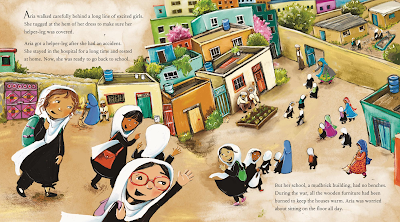
From A Sky-Blue Bench by Bahram Rahman, illus. by Peggy Collins

Aria is an Afghan girl with lovely new red shoes and a helper-leg that she got after an accident. (Bahram Rahman's appended notes talk of land mines and unexploded ordinance.) While she is eager to be returning to school after her lengthy hospitalization, Aria is apprehensive, especially as all the wooden school furniture has been destroyed for firewood and the children now sit with bent knees on a floor tarp, something she will be unable to do.
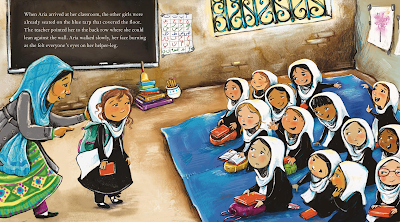
From A Sky-Blue Bench by Bahram Rahman, illus. by Peggy Collins
Aria contemplates not returning to school but rejects that idea and instead comes up with the "brave idea" to build herself a bench. Most of the girls laugh at her plan but Aria is determined and she and her lone friend scavenge the city for discarded wooden boards, broken pieces of furniture, and random nails and screws. Then, Aria and her mother visit a carpenter in the old city who, for the gift of a loaf of bread, loans her an assortment of tools and a can of sky-blue paint.
"Sky-blue is the color of courage, peace and," he tapped at his temple, "wisdom."
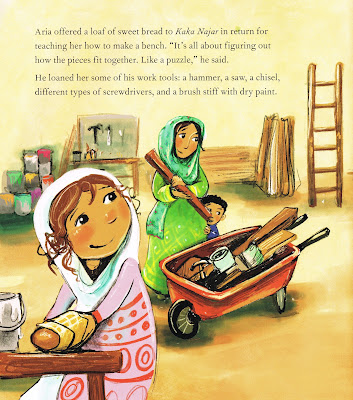
From A Sky-Blue Bench by Bahram Rahman, illus. by Peggy Collins
And so a bench is created, and with it an opportunity for Aria and the other girls to take control of their own schooling needs.

Though Bahram Rahman makes it clear from his notes about circumstances he and others experienced in his homeland of Afghanistan, he does not dwell on the horrors of land mines or the challenges of living with a civil war. Instead Bahram Rahman speaks to a girl's determination to get an education, be proactive and resourceful, and to challenge herself to meet her own needs. It's a brave commentary on focusing on what you can change, not on what you can't, and Aria demonstrates that the possibilities can be inspiring. 

While there is a brightness and a child-like quality to her art, Peggy Collins (Harley the Hero, 2021) stays firmly in realism, but without immersing her art in the adversity of the situation. Aria's prosthetic leg is barely visible under her black dress and the challenges of the civil war are obscured by the vibrancy of the community in its activity and colour. Peggy Collins takes us into the Afghanistan of Aria's life, not of news reports: her school, her helper-leg, her mother and little brother, and her community. Her sky-blue bench is as assured as she is.

A Sky-Blue Bench may be a story from Afghanistan but its lessons about self-reliance and resourcefulness will speak to all children, especially those facing their own challenges, and encourage them to find solutions. With a desire, some hard work and a little wisdom, Aria was able to build something worthwhile, with wood and with vision.

May 11, 2021

Hare B & B

Written by Bill Richardson
Illustrated by Bill Pechet
Running the Goat, Books & Broadsides Inc.
978-1-927917381
72 pp.
Ages 4-8
April 2021

If the wolf in Little Red Riding Hood was a coyote and the rabbits in Watership Down were hares, then Hare B & B would be a cross between these two stories. Sort of. Hare B & B is actually its very own story of a clever hare family that runs a bed-and-breakfast and works to thwart a wily coyote. A little dark, a whole lot of clever and completely charming.
From Hare B & B by Bill Richardson, illus. by Bill Pechet
Harriet, called Harry by all, is delighted to help out when her mother has identical septuplets who are named Barry, Perry, Mary, Larry, Jerry, Carrie and Terry. One day after taking the young ones out for a long walk in their pram, Harry returns home to find it encircled with police tape and the sad news from Officer Goose (They/Them) that their parents had opened their door to a coyote disguised as an encyclopedia salesman.
From Hare B & B by Bill Richardson, illus. by Bill Pechet
Determined to keep their family together, Harry devises a plan to rent out their parents' room. Assigning tasks to each of her siblings, Harry gets them dusting and vacuuming, washing and preparing for their guests, including sending out ads via twitter i.e., their bird friends.

From Hare B & B by Bill Richardson, illus. by Bill Pechet
The reviews about the breakfast, bed and entertainment (Terry plays the harp) are glowing. But then an odd guest, claiming to be a hare, arrives, ostensibly before the wedding of her sister. Harry is a clever hare and she knows this is not one, maybe not even a rabbit. After a little spying, Harry discovers the animal's true nature and she puts a new plan in action with her siblings.

From Hare B & B by Bill Richardson, illus. by Bill Pechet 

With some cleaver manoeuvres involving tickles, molasses and harp strings, the coyote is begging to be taken to jail.
 
From fun wordplay and silliness all around, Bill Richardson will give young readers more than a few chuckles and their parents and teachers smiles. Not unlike the original fairy tale of a wolf disguising itself to deceive a red-caped little girl, Hare B & B has a lesson about trust and caution but Bill Richardson does it with such charm that it's just fun to learn. Still he makes sure not to scare children, unlike so many fairy tales. The parents' death is never explicit, and Harry makes sure to remind her seven siblings that...
...there is nothing a smart hare with a good plan cannot accomplish. We must move forward. We must love each other as much as we can. We cannot be fearful every time someone comes to the door. 
That lightness of touch is carried through by designer Bill Pechet's ink and watercolour illustrations. The art is delicate in colour and line, with splashes of blue, green, turquoise and pink. Everything is soft, except for the sharpness of the deceptive coyote, and the reader is charmed by Harry and her septuplet siblings, rooting for them to succeed in their bed-and-breakfast endeavour and find justice for their parents. They do.
 
At 72 pages, Hare B & B is an extended picture book that gives the reader lots of opportunities to learn about the difference between hares and rabbits, appreciate the puns and look for hidden details in the illustrations, as well as discover that it's okay to be both open and cautious. With love, anything is possible.

August 28, 2018

The Defiant

Written by Lesley Livingston
HarperCollins
978-1-44344-631-0
371 pp.
Ages 13+
January 2018

Gladiatrix Fallon went from king's daughter to human chattel and fighter and finally Victrix in Lesley Livingston's The Valiant (HarperCollins, 2017) but, instead of resting on her laurels and rewards as bestowed by Julius Caesar himself, she's still fighting, now to restore sister's legacy and keep her fellow gladiatrices alive to battle another day.

The Defiant begins with a mock sea battle between Fallon's sister Sorcha's academy, the Ludus Achillea, and that of their rivals, the Ludus Amazona, which belongs to the nasty Pontius Aquila whom Fallon discovered in The Valiant to be part of a dark cult called the Sons of Dis who feast on the hearts of fallen fighters.  But that rivalry explodes when Pontius Aquila arrives claiming that the gladiatrices at the Ludus Achillea have revolted against the Lanistra (Sorcha) who is absent and must be dead. He has bought the ludus from her second in command, Thalestris, who is now also gone. Aquila who had been thwarted when he first wanted to purchase Fallon is determined to have her fight for him. With a little help from her Roman paramour Caius and his fellow legionnaire Quintus, as well as a few unlikely allies, including a kitchen slave, the murderer of her first love and a supposedly-dead Gaulish chieftain, Fallon with many of her oath sister gladiatrices escape and embark on a new struggle: to save Sorcha from the vengeful Thalestris and reclaim the ludus.

I wish I could tell you so much more about the plot of The Defiant, including the legionnaire's instruction of the formidable gladiatrices in coordinated team fighting; the battle with the Amazons, a reclusive group of women on Corsica; Fallon and Cai's romance amidst new trust issues; the reappearance of the vile Nyx, Fallon's rival in Caesar's arena; and a myriad of characters whose trustworthiness is always in question. But a single post is not sufficient to share the richness of Lesley Livingston's newest book.

However, I can tell you that, like every book I have ever read of Lesley Livingston's, there is so much complexity to her plotting, a blend of fantasy infused with well-researched reality, here the history of ancient Roman times, that readers will experience the full effect as a sensory experience. There is brutality and inequality, discrimination and power struggles, and moments of tenderness, sorority and much passion.   

Most importantly, The Defiant has positive messages about the strength of women to battle for themselves and determine their own destinies as they can.  Fallon and Sorcha, and even nasties like Nyx and Thalestris, defy the odds to rise in a paternalistic world, to choose for themselves beyond the rule of men, an intriguing concept for their time. They are sisters in arms and philosophy.
Help me see that we are not the equal of man, we are better. (pg. 248)
But Lesley Livingston goes beyond that decisive message and masterful plotting and characterizations.  She writes with command of language.  Every word embeds the reader in the time and place of The Defiant, often with colourful imagery that reveals and amuses.
The next morning I awoke with a head full of sheep's wool and bootnails. (pg. 37)
Fortunately, The Defiant is not the end of Fallon's story. In February of 2019, The Triumphant, the conclusion to the Valiant series, will be published, and there is news of a series in development at The CW based on the first book in the series.  There may be much in her world that wants to put her down but readers of Lesley Livingston's fantasy would never let her fade away.  She is valiant, she is defiant and she will be triumphant.

⚔⚔⚔⚔⚔⚔⚔⚔⚔

We're delighted that Lesley Livingston will be joining YA authors Natasha Deen and Kari Maaren on a speculative fiction panel at the Eden Mills Writers' Festival on Sunday, September 9, 2018.  We're sure to have a great discussion and you'll get a chance to hear the authors read from their works, to ask a few questions, and to even get a book or two autographed.  Do come and join us!

July 19, 2018

The Whirlpool

Written by Laurel Croza
Illustrated by Kelsey Garrity-Riley
Groundwood Books
978-1-77306-032-3
96 pp.
Ages 10-14
May 2018

Don't be deceived by the simple cover illustration and the less-than-100 page count. The Whirlpool, a collection of seven short stories from award-winning picture book author Laurel Croza, is not an early reader.  Its stories are sophisticated and aimed at upper middle grades, covering a wide variety of issues from emotional abuse and grief to destiny and bullying.

In It's a Step, the narrator Charity lives with her mother and abusive father.  As her dad rails against her mom taking a job at Tim's, both mother and daughter find the means to take a small step to a better life.  In Book of Dreams, Mike finds the support he doesn't get at home from his mom and her latest boyfriend at a restaurant where he gets respect, appreciation and a turkey dinner. While a very different story in terms of characters, OH! is also about finding home. The Oh! So Perfect Hair Dolly goes from factory to store shelf and dreams of being named by a child. The desolation of being passed over during Christmas shopping and then being relegated to the reduced price bin is reflective of any child who has felt unloved.  

The Whirlpool is the story of fifteen-year-old Jasmine who is the brunt of swirling rumours at the whirlpool that is school about her having a baby. As she deals with the gossip and nastiness, Jasmine resolves to "look the whirlpool in the eye" (pg. 30) and reveal her story. A Beautiful Smile also looks at nastiness at school, this time with a young teen from the north standing up to a mean girl at her new Toronto school. Most satisfying is the public and clever way in which Nicola finds support and salvation.

Although all the stories have something important to impart, my two favourite stories are The Sunflower and Destiny. Though told from the perspective of a squirrel, The Sunflower is neither trite nor silly. It is an emotional story about loss and grief and making connections, and I defy anyone not to sob at its telling.  Destiny is a revealing story about following one's dreams, regardless of others' desires and opinions.  Johnny helped inspire his younger sister Dani to play hockey even when her father thought figure skating would be more appropriate. Dani persevered and changed her father's mind about her playing hockey. Now, with Johnny drafted to the OHL, she wants to help her brother accept his true destiny too.

Each story in Laurel Croza's collection is packed with emotional growth, from taking first steps to fulfilling one's destiny, or saving yourself, or accepting strengths and weaknesses as part of the whole package. The stories may be brief (each less than 20 pages) but they wallop you with the power of their storytelling, dialogue and message. My favourite, The Sunflower, does that all in five pages.

I shouldn't be surprised that Laurel Croza can weave such powerful tales. Her highly-acclaimed picture books, I Know Here and From There to Here, which were beautifully illustrated by Matt James, conveyed amazing stories in few words. But these stories are not picture book tales transformed into text. They are not for our youngest readers, though, because of the length of the books, parents and teachers might expect them to be so.  The stories in The Whirlpool collection deal with issues of abuse, gossip, abandonment, and death. While these are issues with which younger readers may be familiar, the older protagonists in Laurel Croza's stories suggest that older middle grade readers might understand the messages better.

I've always loved short story collections for the breadth of stories that can be told and the piecemeal manner in which the text can be read. They are potent teaching tools and convenient for reading in shorter time periods. With The Whirlpool, Laurel Croza has provided a worthwhile addition to the youngCanLit collection of short story anthologies as it enlightens, reassures and inspires.

September 28, 2013

Stained


by Cheryl Rainfield
Harcourt Children's Books/Houghton Mifflin Harcourt
978-0-547-94208-7
304 pp.
Ages 14+
Release date October 1, 2013
Reviewed from advance reading copy


Sixteen-year-old Sarah Meadows has always focused on the port-wine stain that covers the right-side of her face, determined to get the surgical treatments so that she might become "normal".  The debilitating impact she has experienced because of it has compelled her to live vicariously through her comic character, Diamond, to hide behind a curtain of hair, and to only hang out with other social outcasts. But the very day she is to start treatment, her father learns that someone has embezzled so much money from his graphic design company that there isn't enough to pay a bank loan and her surgery.

At school, Sarah has to share this unexpected news with her group of friends: Charlene who is overweight and the brunt of her father's verbal abuse; Gemma, a lesbian; and Nick, who is considered a geeky "doughboy" by others, though Sarah considers that,
"They don't care that he's kind, smart, and good natured, and sort of cute in a soft, chubby way, with messy, sandy hair that's always falling into his eyes and a quick smile. All they see is his weight and his social awkwardness." (pg. 15)
When Nick narrates a chapter, he emulates the same sentiments about Sarah, calling her beautiful and wishing she could see how amazing she is.

On the way home, a bullying incident has Brian Gormley, her dad's cute assistant, coming to her rescue, offering to help and drive her home.  Though she declines, feeling that "Something isn't right" (pg. 35), Brian grabs her, drugs her and locks her away, with a padlocked leather blindfold on.  He claims that he will help her and her parents by giving them "freedom from the pain in their lives" (pg. 84) as he has done for others.  Thus begins a tortuous imprisonment of months in which Sarah endures physical, sexual and psychological abuse at Brian's hands.  Worse is Sarah's ignorance of the efforts being made to find her, especially by Nick and her parents, with the duplicitous Brian even offering assistance.  Nick becomes relentless in pursuing every lead possible, outdoing the seemingly ineffective efforts of the police.

Throughout Sarah's imprisonment, she attempts to understand Brian's motivations, determined that she would not "let Brian's lies become my reality." (pg. 154) As she attempts to appease him, Sarah is actually becoming emotionally stronger, learning how to handle him and manipulate situations as she can. It's ironic that the very manipulation Brian accuses Sarah of instigating to derive guilt from her parents is a skill she develops courtesy of his abuse. Though he may see her as becoming weaker and submissive, Sarah continues to look for any means to save herself, recognizing that she "has to get herself out, not wait for someone to save her." (pg. 179)

Cheryl Rainfield has courageously admitted that she has drawn on her personal experiences to write Stained (see original Stained release announcement ), emphasizing the positive attributes of courage, perseverance, and self-reliance rather than on the trauma.  This becomes self-evident from the tag line for the book,
Sometimes YOU have to be your own hero.
But just as important is self-acceptance, as Sarah, Nick and her friends learn.  They might all see the "better side" of life for those who are beautiful or slender or popular, but a crash course in introspection makes them realize the superficiality of those attributes and the absence of any relationship with goodness.  The beautiful Brian Gormley is a prime example of a revolting inside to an oft admired exterior.  Sadly for Sarah, this lesson must come at the cost of her freedom.

Not an easy read, Stained will have young adult readers both cringing for the physical, sexual and emotional abuse Sarah must endure and cheering for her efforts and determination to survive, recognizing that her Stained face has only been masking, temporarily, the hero within.

___________________________________________

Look for posts shortly regarding Cheryl Rainfield's book launch for Stained and her take on improving body image.  In the meanwhile, check out Cheryl Rainfield's video explaining why she wrote Stained  here on YouTube.

August 03, 2013

Smokescreen

Written by Nancy Hartry
Tundra Books
978-1-77049-405-3
202 pp.
Ages 12+
August 2013

I know that most coming-of-age stories involve protagonists in their early to mid-teens, but Kerry Williams is seventeen and definitely in need of growing into herself by Smokescreen's book end.  You see, at the story's onset, Kerry is thrown into a totally unfamiliar situation: a summer job for the Department of Forestry and Parks in the northern Ontario bush as a cottage development technician i.e., looking for potential sites to develop for cottages.  Kerry is convinced that her mother happily finagled this job for her after she'd disappointed her by losing a major Irish Dance competition due to a fall and subsequent injury ("My body betrayed me.  Correction, my mother overtrained me." pg. 8). Regardless how naive the Toronto teen might feel in her new circumstances, especially after she meets Yvette Bernier, her nineteen-year-old partner for the summer, she is determined to not fail.  Luckily, even though Yvette comes off the bus looking like a trendy urbanite, she knows everything about working in the bush, dealing with campfuls of men, negotiating with bosses who try to push summer students into unsafe conditions, and how to handle herself to ensure a profitable and worry-free summer, and she willingly shares this knowledge with Kerry.

But a raging forest fire has them moving base camps several times and conscripted to work in food prep and camp work for the fire crews.  In addition to their misogynistic boss, Buzz Harcourt, there's Didier, the handsome and friendly crew boss of a fire unit; Matt the pilot who must take them north regardless of Yvette's refusal to go; Rolf, the older, no-nonsense professional camp cook who is eventually brought in; Slash, the scary and scarred man brought in to help with heavy kitchen work; Aubrey, the intense Métis fire crew boss on whom Kerry crushes and Yvette does not trust; and Mr. Sirois, the violent and sexist boss man from New Brunswick.  

Over time, Yvette has learned to trust very few people, particularly ones that seem to have hidden agendas, and she warns Kerry repeatedly about watching her back.  But, with the discovery of Yvette's pink lighter at the source of the forest fire, the young women realize that there is someone who is setting Yvette up, and they must tread carefully to keep their jobs and protect themselves.  Problem is that Kerry and Yvette have very different perceptions about whom to trust, and the emotional baggage they each bring to their friendship has them repeatedly at odds.  It's only when the two get mixed up in a potentially deadly situation that Kerry can see Yvette's vulnerability and accept her own strengths as the basis for their survival.

Nancy Hartry, author of the 2010 Canadian Library Association's Book of the Year for Children Award–Watching Jimmy (Tundra, 2009)–knows how to take a straightforward storyline, e.g., teens taking summer jobs in the bush, and enriching it with psychological intricacies and complex social situations that can take straightforward to dangerous.  And that's probably why her stories hit home for her readers.  There are no paranormal experiences or supernatural elements that take the story into the fantasy and improbable, if not impossible, realm.  The characters in her books could be our children, our neighbours, friends, family.  So, as we read and recognize that these circumstances could happen to anyone and that different elements could be derived directly from the news, we read a little more cautiously, hopeful that no one we know should ever have these experiences, and thoroughly, perhaps learning the means by which survival may be achieved.  Nancy Hartry shares a dramatic story that could be passed down from one summer student to another, or from parent to child, or from anyone to anyone who wants to tell a good story and teach a little something in the process.  Nancy Hartry does both in Smokescreen