Showing posts with label Bahram Rahman. Show all posts

November 17, 2023

If You See a Bluebird

Written by Bahram Rahman
Illustrated by Gabrielle Grimard
Pajama Press
978-1-77278-284-4
32 pp.
Ages 5-8
October 2023
 
When families are displaced, whether from war, natural disasters, persecution, or something else, making a new home is not always easy, especially for children. And the good memories of that original home may make one long for what once was. But home is not just a place. It is the family too, as an Afghan boy learns from his grandmother and a visiting bluebird.
From If You See a Bluebird, written by Bahram Rahman, illustrated by Gabrielle Grimard
Ali and his parents and Nana had to flee Kabul, Afghanistan after war broke out. They travelled by foot, bus, and eventually escaped via plane, taking very little from their home. Now, in Canada, they live near an ocean, and Ali and Nana ride bikes to collect blackberries. But Ali misses Kabul, noting that the blackberries are not as deliciously sweet as the mulberries back home. Nana points out to him that though they are different they are not bad.
From If You See a Bluebird, written by Bahram Rahman, illustrated by Gabrielle Grimard
When they take a break from their berry-picking, they see a bluebird, and Nana reminds him that if you see a bluebird and make a wish before it flies away, your wish will come true. Her wish, for their family to be together and safe, had already come true. But his wish is for the fighting to stop in Kabul so that they might return home. It is then that Nana reminds him that home "is the love we have for each other."
 
It would be tough for a child to give up the familiar and the sweetness of his life in Kabul, with his mother playing her ghichak, his toys on a swing, gathering mulberries, and sitting on the tree's branch to look out over his neighbourhood. But,when he is reminded by his Nana of what home really is, he sees his new situation in a different light. There are now blackberries, his mother has a new instrument, spruce trees line the driveway, and they are safe. He finally appreciates this, shouting out to his parents when they arrive back that, "I am home!"

Bahram Rahman, himself a refugee from Afghanistan, gives us a different perspective of war and escape from war and adjustment to a new living situation in If You See a Bluebird. He has already shared stories in The Library Bus (2020) and A Sky-Blue Bench (2021) but in his latest picture book story, Bahram Rahman demonstrates that escape from a dangerous conflict does not always translate into a rejection of that insecurity. Because there has been loss, of place, people, objects and connection, the substitution of a new home in safety is not necessarily embraced immediately or wholeheartedly. So, Bahram Rahman shows us that a little boy can miss the wonderful things he remembers of his Afghan home but learn to lean towards something different and new that is nonetheless home.
From If You See a Bluebird, written by Bahram Rahman, illustrated by Gabrielle Grimard
Gabrielle Grimard, who also illustrated The Library Bus, has such a sensitive touch for making us feel Ali's hesitation at embracing the new place as home, holding such strong positive memories of Kabul. She gives us the bleakness of the danger when the soldiers come and the family flees but Gabrielle Grimard brings in the birghtness and colour when Ali and his family are safe and happy, whether in a Kabul without war or in Canada.

If You See a Bluebird offers the hope one needs when going through change and especially when challenged with hardships. It's a reminder that with love and family, all can be endured. And making a wish when a bluebird lingers might just help as well.

January 08, 2022

A Sky-Blue Bench

Written by Bahram Rahman
Illustrated by Peggy Collins
Pajama Press
978-1-77278-222-6
32 pp.
Ages 5-8
 November 2021
 
Bahram Rahman, author of The Library Bus (Pajama Press, 2020), returns the reader to Afghanistan and offers another hopeful tale of resilience and courage, creativity and endeavour.
From A Sky-Blue Bench by Bahram Rahman, illus. by Peggy Collins

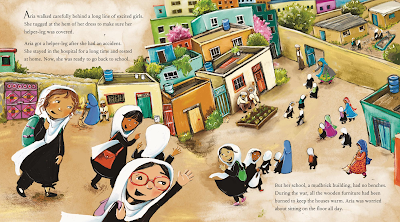
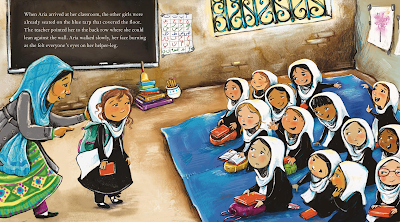
Aria is an Afghan girl with lovely new red shoes and a helper-leg that she got after an accident. (Bahram Rahman's appended notes talk of land mines and unexploded ordinance.) While she is eager to be returning to school after her lengthy hospitalization, Aria is apprehensive, especially as all the wooden school furniture has been destroyed for firewood and the children now sit with bent knees on a floor tarp, something she will be unable to do.

From A Sky-Blue Bench by Bahram Rahman, illus. by Peggy Collins
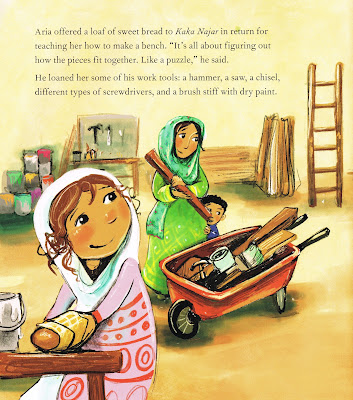
Aria contemplates not returning to school but rejects that idea and instead comes up with the "brave idea" to build herself a bench. Most of the girls laugh at her plan but Aria is determined and she and her lone friend scavenge the city for discarded wooden boards, broken pieces of furniture, and random nails and screws. Then, Aria and her mother visit a carpenter in the old city who, for the gift of a loaf of bread, loans her an assortment of tools and a can of sky-blue paint.
"Sky-blue is the color of courage, peace and," he tapped at his temple, "wisdom."
From A Sky-Blue Bench by Bahram Rahman, illus. by Peggy Collins
And so a bench is created, and with it an opportunity for Aria and the other girls to take control of their own schooling needs.

Though Bahram Rahman makes it clear from his notes about circumstances he and others experienced in his homeland of Afghanistan, he does not dwell on the horrors of land mines or the challenges of living with a civil war. Instead Bahram Rahman speaks to a girl's determination to get an education, be proactive and resourceful, and to challenge herself to meet her own needs. It's a brave commentary on focusing on what you can change, not on what you can't, and Aria demonstrates that the possibilities can be inspiring. 

While there is a brightness and a child-like quality to her art, Peggy Collins (Harley the Hero, 2021) stays firmly in realism, but without immersing her art in the adversity of the situation. Aria's prosthetic leg is barely visible under her black dress and the challenges of the civil war are obscured by the vibrancy of the community in its activity and colour. Peggy Collins takes us into the Afghanistan of Aria's life, not of news reports: her school, her helper-leg, her mother and little brother, and her community. Her sky-blue bench is as assured as she is.

A Sky-Blue Bench may be a story from Afghanistan but its lessons about self-reliance and resourcefulness will speak to all children, especially those facing their own challenges, and encourage them to find solutions. With a desire, some hard work and a little wisdom, Aria was able to build something worthwhile, with wood and with vision.

December 29, 2020

The Library Bus

Written by Bahram Rahman
Illustrated by Gabrielle Grimard
Pajama Press
978-1-77278-101-4
32 pp.
Ages 5-8
November, 2020

While education should be a right for all everywhere, sometimes someone has to step up to make sure those without access because of gender inequality or location or some other restriction get the schooling they should be receiving. That someone in The Library Bus is Pari's mother.

From The Library Bus by Bahram Rahman, illus. by Gabrielle Grimard
Little Pari, who will not be starting school until the following year, is going to help her mother on the library bus she takes around to villages and refugee camps without access to schools. Pari knows this is a privilege and takes her role seriously, repeating to herself that she should, "Arrange the books...clean up...be nice to the other girls." For the girls who wait patiently for the bus's arrival and cherish their time with the books and their teacher, the library bus is their school.
From The Library Bus by Bahram Rahman, illus. by Gabrielle Grimard

They exchange their library books for new ones and sit down with Pari's mother who teaches them the alphabet and their numbers in English. For the children of the refugee camps, they provide school supplies like notebooks and pencils. Pari is impressed by how much the girls know and want to learn. As she helps, she listens and learns too, ably reading the important acronyms of WFP and UNHCR by the time they leave the camp.

From The Library Bus by Bahram Rahman, illus. by Gabrielle Grimard
When Pari asks her mother where she learned the alphabet, she is told how Grandpa taught her mother in the basement as girls were prohibited from attending school. For that reason, she insists that Pari study well when she gets to school so that she might experience the freedom that learning gives.

The encouragement of learning is always powerful but by embodying it in Afghanistan, a country impacted by war and restrictive policies, Bahram Rahman's first children's book tells it gently but with influence. Many Canadian children will not appreciate the privilege that attending school and receiving an education entails. It is the norm for them. But for Bahram Rahman's characters, education is everything, and the generosity and impact of the library bus and its in-house teacher are significant.
From The Library Bus by Bahram Rahman, illus. by Gabrielle Grimard
Illustrated by award-winning artist Gabrielle Grimard with watercolour and digital media, Bahram Rahman's gentle strength of message is emulated. The softness of the watercolour and the openness of Gabrielle Grimard's character's faces invite the readers in to the story and the bus, allowing them to travel with Pari and her Mama and join the girls to be part of something bigger and meaningful.

While Bahram Rahman claims to have taken liberties to rearrange the details in the telling of the story of The Library Bus, based on his own experiences and meeting others in Afghanistan, I see only the truth about the hope gifted to the girls with the books and teaching that came with the bus's weekly visits. Now, by Bahram Rahman and Gabrielle Grimard's hands, the travels of The Library Bus will lead to even greater learning.