Showing posts with label creativity. Show all posts

July 16, 2026

Eon: My Pet Tardigrade

A tiny pink organism with eight legs floats among colourful plants
Written by Cybèle Young
Illustrated by Cybèle Young and Nell Jocelyn
Tundra Books
978-1-77488-041-8
56 pp.
Ages 3–7
Releases August 11, 2026 
 
Don't be surprised if you've never seen or heard of a tardigrade. They're very tiny. Very, very tiny. At about 0.5 mm in length, they are barely visible to the naked eye. Ah, but a microscope reveals this tiny creature to a young scientist with a new tool and captures her heart.
A girl looks through a microscope
From Eon: My Pet Tardigrade, illustrated by Cybèle Young & Nell Jocelyn, written by Cybèle Young
Once she spots the micro-animal with his two little eyes and his ambling, plodding gait, she wants to take care of him. Actually, she wants to hug him but that's impossible so she plans to make that which he might appreciate. A bed? A chair? A slide? 
Different views through a microscope show forms of different colours and shapes
From Eon: My Pet Tardigrade, illustrated by Cybèle Young & Nell Jocelyn, written by Cybèle Young
But this young scientist knows it's best to ask questions, so she researches the little guy she names Eon, and learns he's a tardigrade a.k.a. a water bear or a moss piglet. She learns of the extremes at which it can live, and the diversity of habitats it can occupy. So, she prepares a wide variety of dioramas in which to live. And when she loses sight of him—he is very small—she learns more about what a tardigrade needs and gives him an opportunity for a new life where he might have a new home that is "the most magical most-est yet." (pg. 42)
A tiny pink tardigrade plods through the water among a variety of colourful microscopic organisms
From Eon: My Pet Tardigrade, illustrated by Cybèle Young & Nell Jocelyn, written by Cybèle Young
As small as Eon, the tardigrade, is, Eon: My Pet Tardigrade tells a big story. It's a story of scientific discovery, creativity, and benevolence. It's seeing what is almost not seen and educating oneself to help guide one's actions. Cybèle Young has garnered much attention and many awards with the intensity of her simple texts and the complexity of her mixed media illustrations. With Eon, she and collaborator Nell Jocelyn will charm readers into discovery, into looking deeper and smaller, and finding ways to express creativity. They've blended pencil drawings (Cybèle Young) with paper sculptures made with Japanese papers (Cybèle Young) and a variety of western papers (Nell Jocelyn). This blending of media gives substance and texture to a story of something almost imperceptible. Because Eon is so small, young readers may have to hunt for him on the many pages, especially when he's dressed in scuba equipment, hiding among stalagmites, or basking on a cactus. The creativity of the child—or rather Cybèle Young and Nell Jocelyn—to create miniature scenes of wondrous detail and movement brings Eon, the tardigrade, from insignificant to something substantial, a star of her displays and a superstar on the planet. (Read about tardigrades in Cybèle Young's "The story behind Eon" or do your own research. It will fascinate.)

A girl works with paper to craft minitiature scenes and objects for the tardigrade. Scenes include it bathing in a green tub, playing badminton, and having a picnic.
From Eon: My Pet Tardigrade, illustrated by Cybèle Young & Nell Jocelyn, written by Cybèle Young
The story of Eon: My Pet Tardigrade is as much about the child and her response to Eon as it is about learning about tardigrades. I'd never heard of tardigrades and am now excited to learn more. Teachers might love to create lessons on adaptation, habitats, life cycles, and more based on these little invertebrates, but they shouldn't limit themselves to STEM lessons. Eon: My Pet Tardigrade gives opportunities for teaching about compassion, understanding, and letting go as well. For a little guy, Eon has a lot to give.

June 24, 2026

If I Could Draw...

Book cover of "If I Could Draw" by Patricia Storms shows a child with paper and pencil surrounded by colourful toys, candy, and animals
Written and illustrated by Patricia Storms
 ‎ DC Canada Education Publishing
978-1-834140667
36 pp.
Ages 4–8
April 2026 
 
A boy is bored. He is dismayed that he can't draw and that's what's holding him back from eliminating that boredom. If only he could draw, all would be well.
A child unhappily draws sketches of robots and more.
From If I Could Draw..., written and illustrated by Patricia Storms
 He then imagines all the wonderful things he would draw if he could draw. There would be dancing skyscrapers, unicorns playing ukuleles, and robots that served desserts. (Yum!) But as he imagines all the things he would draw, his little brother interrupts him, wanting to play. 
Robots present various sweet desserts.
From If I Could Draw..., written and illustrated by Patricia Storms
In fact, he's so delighted to hear his big brother's ideas that he draws them, giving his brother the tangible art he so longs to create. What comes from that is a mutual admiration of their skills to imagine and to draw making a collaboration to chase away any boredom.
A young child imagines a kind world.
From If I Could Draw..., written and illustrated by Patricia Storms
Patricia Storms's story is one of creativity and self-awareness. It's reminds young children to identify the skills they have and not focus on the ones they don't have. (There will always be things we can't do.) Even better, she lets a younger brother help his older sib recognize what he himself cannot see. This lovely sibling relationship is one of support, not competition. And even though the older brother is initially reluctant to engage with his younger sib, he is moved by his words and takes the time to listen. By doing so, he learns to see his little brother's drawing skills and accept appreciation for own imagination. 
A boy throwing out a ideas while his little brother draws them
From If I Could Draw..., written and illustrated by Patricia Storms
Patricia Storms has both written and illustrated her own picture books (e.g., Never Let You Go, 2013), written picture books illustrated by others (e.g., The Dog's Gardener, 2021), and illustrated those authored by others (e.g., Moon Wishes, 2023). She obviously has no problems with the drawing component or the writing part. Still she reminds us that sometimes we forget what we can do when we can't do something else. And Patricia Storms helps us see the misery of not being able to do something—those illustrations lack colour and life—but also the brightness and fun when one is free to visualize and create.
 
I'm glad that Patricia Storms continues to delve into her creativity by exploring her art, both written text and visual art, to give colour and shape to the joy of a child's imagination. By showing us the different skills of two siblings, Patricia Storms reminds us to try, to play, and to collaborate if we are to find inventiveness.

November 10, 2025

All of Us

Written and illustrated by Manon Gauthier
Translated by Michel Savard
Running the Goat, Books & Broadsides
978-1-98802296
32 pp.
Ages 3–8
October 2025 
  
The message of All of Us is a simple one, but sadly one that we need to reinforce continually. It's one of inclusivity and diversity and it's basic science. We're all the same and yet we're all different. 
From All of Us, written and illustrated by Manon Gauthier
Manon Gauthier, who has wowed this reviewer with the books she's illustrated such as Middle Bear (Susan Isern, 2017), Good Morning, Grumple (Victoria Allenby, 2017), and Elliot (Julie Pearson, 2016), has combined her talents by authoring as well as illustrating All of Us. With simplicity of text and complexity of art, Manon Gauthier develops the idea of how all animals, including humans, are different in their abilities or lack thereof, in their morphologies, in their physiologies, and more. There's "the fish who blows bubbles as it breathes,"(p. 12) and "the quiet and solitary moose," (p. 22) as well as "the tall bharal who has no fear of heights." (p. 7) There's the dancing sifaka, the cold-blooded reptiles and amphibians, and the savannah animals that can tolerate the heat. All differ in what they like, what they look like, what they can do, and more. But, essentially, we all are made up of cells, and Manon Gauthier conveys this in her words and her illustrations, using the same irregularly-shaped oval as the basis for all animals.
From All of Us, written and illustrated by Manon Gauthier
It's not until her last illustration, a double-page spread of a cell, that the reader will recognize Manon Gauthier's cleverness at using the cell's shape as the face or body or abdomen of all the 
mammals, birds, reptiles, amphibians, invertebrates and fish within All of Us. All of us really do have something in common, even with all the differences. And by using her defining cut-paper collage, in earthy tones of browns, greys, and creams with occasional touches of red, blue, green, and orange, Manon Gauthier gives a textured dimensionality and hearty organic feel to her story.
From All of Us, written and illustrated by Manon Gauthier
Whether you're a teacher who'd love to introduce a lesson on the diversity of living things with a captivating picture book, or open a lesson on animal cells, or even launch discussions about inclusivity and connection, All of Us will work beautifully. (Manon Gauthier even includes an activity in which readers can create their own animal with the same template she used throughout the book.) Whether you read it for the messaging which is presented gracefully or for the intriguing artwork, All of Us is a book for all of us about all of us.

August 06, 2025

The Little Ghost Quilt's Winter Surprise

Written by Riel Nason
Illustrated by Byron Eggenschwiler
Tundra Books
978-1-774885376
48 pp.
Ages 3–7
Releases August 26, 2025 
 
It might seem odd reviewing in August a book that involves winter but, when it's nearing 30°C outside, it's nice to think about the loveliness of snow and cold temperatures and the celebrations that bring us joy. For the little ghost quilt, introduced in Riel Nason and Byron Eggenschwiler's first collaboration The Little Ghost Who Was a Quilt (2020), winter brings new experiences and joys too.
From The Little Ghost Quilt's Winter Surprise, written by Riel Nason, illus. by Byron Eggenschwiler
While his ghost sheet friends are shivering with the cold, the little ghost quilt is able to comfortably withstand the temperatures and the snow. He enjoys the same indoor activities as they do—making crafts, playing games and reading "boooooks"—but he wishes they could share in outdoor adventures as well. One December evening while visiting a human neighbourhood, the little ghost quilt is drawn to bright lights and joyous celebrations. He sees decorated trees, inside and outside; people skating and singing and baking cookies; and everything looking shiny and bright. He is saddened to think his friends are missing out on all this. So, the little ghost quilt with his big heart plans to do something for his ghost sheet friends. 
From The Little Ghost Quilt's Winter Surprise, written by Riel Nason, illus. by Byron Eggenschwiler
But on his way back home, the little ghost quilt is caught in a terrible winter storm and is snagged on the branch of a birch tree. He does get free, but the storm and that tree give him an idea about how to implement his plan with what they have available.
From The Little Ghost Quilt's Winter Surprise, written by Riel Nason, illus. by Byron Eggenschwiler
I'm delighted to review a picture book by Riel Nason whose only books that I have reviewed to date have been YA (i.e., All the Things We Leave Behind and The Town That Drowned). But, just as she demonstrated in those young adult novels, Riel Nason gives her characters depth of feeling for others. For the little ghost quilt, he's quite cognizant of the fact that his quilt gives him warmth and protection while his friends, in their skimpy sheets, have neither and must stay indoors. Yet, with his freedom to engage in outdoor activities, the little ghost quilt still wants to share his experiences with his friends. He doesn't gloat about his opportunities. Instead, he appreciates what he is able to witness and thinks about how he can share with others. Riel Nason has given a patchwork-quilt ghost the benevolence to which we should all aspire.
From The Little Ghost Quilt's Winter Surprise, written by Riel Nason, illus. by Byron Eggenschwiler
It's impossible not to feel the weather and the joy that the little ghost quilt experiences on his winter outing. Byron Eggenschwiler's pencil and digitally-rendered artwork takes us into the dullness of winter and makes the colours of the holiday season shine. By emphasizing the dreariness of the winter with a muffled environment of snow and dirt in colours of grays and browns, Byron Eggenschwiler keeps the focus on the goodness and the cheerful, in other words on the quilt colours of the little ghost and on the Christmas celebrations and those enjoying them. 

While you may not be thinking of winter or Christmas yet—times when The Little Ghost's Quilt's Winter Surprise will be a must-read—this picture book is more than a seasonal tome to share with young children. It's a story of kindness and compassion; it's a book about understanding what others are experiencing and how to help expand the scope of their lives. (Can I use the word "lives" for ghosts?) Because of the little ghost quilt's good will, he's able to bring the light to the actuality of his ghost friends both in spirit and in illumination and thus bring the essence of Christmas to all.

May 05, 2025

The Crayon Stub

Written and illustrated by Marcus Cutler
G. P. Putnam's Sons (An imprint of Penguin Random House)
979-8-217-00333-4
40 pp.
Ages 3-7
May 2025 
 
Judging by the plethora of artwork on the refrigerator and adoring the walls, Big Cat loves to draw. He draws dinosaurs and robots and unicorns and pizzas and more. But when he's ready to attempt his next masterpiece, he is dismayed to find only a small nub of red crayon left in his box.
From The Crayon Stub, written and illustrated by Marcus Cutler
As he comes unglued, Big Cat looks at his previous works and deliberates about what he'll use his limited resource on. Little Cat, who may or may not be responsible for the lack of crayons, accompanies Big Cat as he ponders and worries and stresses.
From The Crayon Stub, written and illustrated by Marcus Cutler
But then Big Cat tosses his red crayon stub and drawing paper away in frustration and Little Cat grabs them. After a chase ensues, a masterpiece may be created but through extraordinary means.
From The Crayon Stub, written and illustrated by Marcus Cutler
While I have reviewed a number of books which Marcus Cutler has illustrated (e.g., Do Not Turn the Page!, and The Walrus and the Caribou), this is the first picture book of his that I've reviewed that he has both written and illustrated. (Note: he does have an earlier story, I Do Not Eat Children, that I have not read.) And, what I've realized is that there's a difference when he is the author-illustrator. Marcus Cutler's digital artwork has always had a degree of silliness that brings a playful mood to the stories but, when he also writes the text, the funniness is enhanced. Most young readers would recognize the distress of missing all their crayons, but Marcus Cutler gives us an over-the-top reaction in Big Cat's response. And then we've got a younger sibling who gets into an older sibling's things and uses them indiscriminately–wait until readers see what Little Cat does with the crayon stub–and the laughs continue. The art is both straightforward and clever in its simplicity but also filled with little details that captivate. Together Marcus Cutler gives us the funny in the story and the art.
From The Crayon Stub, written and illustrated by Marcus Cutler
There may only be a stub of a red crayon left in Big Cat's box but it's enough to create a tale rich in humour, colour, and character, courtesy of Marcus Cutler.

October 21, 2024

What Inspires

Written by Alison Hughes
Illustrated by Ellen Rooney
Orca Book Publishers
978-1-459837683
32 pp.
Ages 6-8
September 2024
 
Though there is a neurological explanation for the stimulation of creativity, the derivation of the word "inspiration" suggests a divine influence upon the mind or soul. But whether the interplay of neural networks or instigation of external forces, the children in Alison Hughes's latest picture book are being inspired to imagine, to play, and to interact in different ways with their world.
From What Inspires, written by Alison Hughes, illustrated by Ellen Rooney
Three children and a dog head to a park where not much is happening or so it would seem. But, as with children the world over, they find stuff to inspire them in their play. From watching the leaves rustling in the wind or the seeds spiralling into the air, there is much to enjoy, and the children begin to dance "a joyful seed dance, wild and free." Other park visitors join in, whether in the dance or in clapping and singing. That leads to chalk painting which leads to the construction of a castle from trees and boughs and to a ship based on the playground set. Soon there are magical creatures flying, battles to be fought, a chase and a parade. And the three children are joined by dozens of others, a diverse group of children and adults.
 
After a day of imaginative play, the weary children take to their beds and are inspired to dream more adventures.
In the twirling dance
                 of their dreams,
they wove colors, shapes and
                                   adventures
into something beautiful
                            and strange
                                         and new.
Alison Hughes's books have always had the capacity to uplift, whether they be picture books like The Creepy-Crawly Thought, Oliver Bounces Back! and The Cold Little Voice, or novels like Fly and Over the Top. Though many of her books depict children dealing with issues from anxiety and worry to cerebral palsy and bullying, What Inspires focuses on the positives that can come from being open to inspiration for creativity that can come from a falling seed, a tree, or a playground set. There is no formula for inspiration. It only requires a receptivity to the possibility in the everyday. A park with people doing ordinary things, whether biking or sitting, enjoying the quiet or watching the clouds, becomes a canvas for a myriad of experiences and connections. Moreover, Alison Hughes allows her characters to play how they wish and to imagine what they are and can do. They can dance in a wheelchair or upon a swing, tap their feet or soar on skateboards. Their experiences are their own, just as their dreams are at the end of the day. 
From What Inspires, written by Alison Hughes, illustrated by Ellen Rooney
Ellen Rooney, who won BC's Christie Harris Illustrated Children's Literature Prize in 2021, uses a variety of materials, most notably coloured pencils, cut paper and digital drawing tools. These give her art textures and layers that blend the real with the imagination, grounding the characters in a park but elevating them into worlds of their own creation. From the quiet at the start of the kids' visit to the park to the busyness and exuberance of inspired play, as entwined with a sweeping ribbon of orange and green inspiration, Ellen Rooney demonstrates the fullness of life that comes with creativity.
From What Inspires, written by Alison Hughes, illustrated by Ellen Rooney
What inspires you will be your own and can happen at any time and at any place and with anyone, or no one. It could be something small and tangible, to overwhelming and ethereal. Whatever force it is that inspires you, I hope that you embrace it, even if for only a moment, to encourage the originality of thought and action that it can spark.

August 21, 2024

Bea's Paper Imaginarium


Written and illustrated by Rachael Speirs
Plumleaf Press
978-1-738165223
40 pp.
Ages 6-10
August 2024
 

With paper, Bea could do and be anything. She could take her baby sister Millie and the cat Waffles into space to explore. She could become a scientist studying amazing animals like the great sushi-cat i.e., Waffles wrapped in paper nori and fish. And she could be a storyteller who creates comic books.
From Bea's Paper Imaginarium, written and illustrated by Rachael Speirs
But then she runs out of clean paper. And when she goes to school, hopeful of finding some there, her teacher Ms. Abdul reminds her that, since it is the end of the school year, they would be using up what they had in the reusable paper scraps bin. This dismays Bea. She needs clean paper to make her art.
From Bea's Paper Imaginarium, written and illustrated by Rachael Speirs
When she finally does find a piece of paper, in the street no less, Bea's excitement transforms into anger when baby Millie makes it unclean with her scribblings. Realizing her overreaction and really observing the "damaged" paper, Bea sees new possibilities for the first time and delves into art made with found objects and less-than-pristine paper.
From Bea's Paper Imaginarium, written and illustrated by Rachael Speirs
Ontario's Rachael Speirs is best known for her art and specifically her collage-like art that blends paper with fabric, watercolours, gouache, acrylics and more to create stories. Her bio tells of the emergence of her own artistic creations from play at an early age, and this has inspired Bea's own journey of artistic development. I suspect that many artists find themselves stuck in one genre or medium without being compelled to try different ones like Bea was. She was convinced she needed clean paper to make her art. Fortunately a misstep by baby Millie takes her off of that limited path and gives her the opportunity to expand her imagination and create something different. 
From Bea's Paper Imaginarium, written and illustrated by Rachael Speirs
I wish you could see the textures of Rachael Speirs's artwork in Bea's Paper Imaginarium. There are bits of cut fabric and cardboard, and painted paper cut into the shapes of balls and hair and fish. You can even see where Bea has taped paper together. Rachael Speirs's art reflects authentically the art that a child might create: it's colourful, it's layered, and it's imaginative. It's the kind of art that comes from joy in the process.
From Bea's Paper Imaginarium, written and illustrated by Rachael Speirs
For teachers who want to encourage children to think outside the box in maker spaces or for parents who want to inspire originality and artistry, Rachael Speirs's picture book will help do both and without preaching about what children should or shouldn't do. Bea's Paper Imaginarium demonstrates the satisfaction that comes from designing and building and following your own path of creativity and seeing opportunities where only dead ends and misfortunes once resided.

March 15, 2024

One Giant Leap


Written and illustrated by Thao Lam
Owlkids Books
978-1-77147-599-0
48 pp.
Ages 3-7
March 2024
 
Getting a child dressed, especially in winter, is akin to the prep required to outfit an astronaut. Each step must follow another to ensure coverage, safety, and fit. But when you're venturing out into that wide world of possibilities, it's best to be prepared.
From One Giant Leap, written and illustrated by Thao Lam
Zippers pulled up on a suit, boots tugged onto feet, gloves wrenched on, and a hat stretched down low on a forehead are just the first steps of venturing outside. But as the child is transported in an elevator to the 1st floor, an imaginative transformation occurs. What was a child in a snowsuit is now an astronaut in a spacesuit. So, when they finally venture outside, it isn't into the snow, it's onto the moon.
From One Giant Leap, written and illustrated by Thao Lam
Everything now is an exploration of a new land of shapes and structures. There's climbing and falling, searching and anticipating, and following footsteps. Are those aliens or something else? Is there peril? Can they communicate? Should they? What should they say?
From One Giant Leap, written and illustrated by Thao Lam
Can the astronaut reach their destination and fulfill their mission? Only by following their trek across barren landscapes of inhospitable structures and unusually-garbed creatures can readers even know whether they make it to...the coatroom at school.

As a wordless picture book, One Giant Leap has a story that is driven by the cut-paper collage of Thao Lam's artwork. The story which is immense comes from the reader seeing and interpreting the visuals. Is that a rocket launch pad or an apartment elevator? Are those aliens or children in colourful snowsuits? Are those buildings or mountains, man-made structures or lunar landforms? Vietnamese-Canadian author-illustrator Thao Lam, known for her complex and meaningful books including The Paper Boat: A Refugee Story and The Line in the Sand, still knows how to do playful. Dressing in a snowsuit and venturing out into the greater universe, this child embarks on an other-worldly adventure, fueled only by imagination. What they experience is all up to them, and Thao Lam lets us see what they see. It's a textured landscape of dull grays and blacks, with only a dash of colour from an orange spacesuit or when other bizarre creatures appear. But in that lunar landscape, it is all about starkness, with the energy provided only through the child's imagination.
From One Giant Leap, written and illustrated by Thao Lam
Whether stepping onto an unknown space body or onto a frozen city street, it's a giant leap of daring that must come from within. It's knowing what to expect and never knowing what could be found. For this little one, it's One Giant Leap into inventiveness and creative thought, and it looks like they had a great flight.

January 29, 2024

Kaiah's Garden

Written by Melanie Florence
Illustrated by Karlene Harvey
North Winds Press (Scholastic Canada)
978-1-4431-9025-1
32 pp
Ages 5-8
January 2024
 
When a child moves with her family to a new home, she misses her old home at her Grandma's. The house isn't just far away in a new town, it lacks the colour that was part of her grandmother's home. That life came from many things, inside and outside, and, compared to that home, everything feels gray here.
From Kaiah's Garden, written by Melanie Florence, illus. by Karlene Harvey
From the quiet stairs to the backyard of dried-up weeds and flowers, Kaiah can't see anything beyond her feelings of missing her grandmother and her home. But when she hears a voice she senses as her grandmother saying, "Did you forget what's in your treasure box?" Kaiah is reminded of all she'd once enjoyed. In a special box worn smooth by generations of her people, she recalls the beading projects she'd completed with her Grandma. There's her very first, an apple, which brings back memories of an apple tree in the yard and of Grandma's warm hands touching hers to teach her how to bead. There's the sunshine yellow sun she'd beaded, as well as a flower, turtle, butterfly, and more. Her grandmother and her garden may not be there at their new house but Kaiah, with a little help from her mother and brother, knows how to bring her grandmother and more to this new home.
From Kaiah's Garden, written by Melanie Florence, illus. by Karlene Harvey
Melanie Florence, author of the award-winning Missing Nimâmâ and Stolen Words, again shares her heritage with us, teaching us about the importance of beadwork to Indigenous Peoples. (There is "A Note on Beadwork" at the conclusion of the book.) For Kaiah, the beadwork takes her back to her earlier life with her grandmother, learning the skill and embedding memories to help her reconnect with those who came before her. Now, she will use the beadwork for healing her spirit as well as for connecting her with her new home. Those tiny little beads can do so much when used to create and honour.
From Kaiah's Garden, written by Melanie Florence, illus. by Karlene Harvey
Karlene Harvey, a Tsilhqot-in and Syilx illustrator from BC, reminds us that the beadwork of Melanie Florence's story is what is most important. From the colourful and meaningful beadwork that adorns the endpapers of Kaiah's Garden to each of the pieces Kaiah draws from her treasure box, there is life and luminosity that is derived as much from the beads as from the association they endow.
 
Kaiah may believe that all there is a grayness at her new home–well, until she remembers her treasured beadwork–but Kaiah's Garden is nothing but colour. It's bold and beautiful and memorable, just like the treasures Kaiah pulls from her box.

November 01, 2023

The Little Books of the Little Brontës

Written by Sara O'Leary
Illustrated by Briony May Smith
Tundra Books
978-0-7352-6369-7
40 pp.
Ages 5-9
October 2023
 
This is the story of four siblings who lived about 200 years ago. Their names were Charlotte, Bramwell, Emily, and the youngest was Anne. After their mother had died, as well as their two older sisters, they lived with their father, their Aunt Bramwell, a housekeeper named Tabby, and many pets. And they loved to read and tell stories.
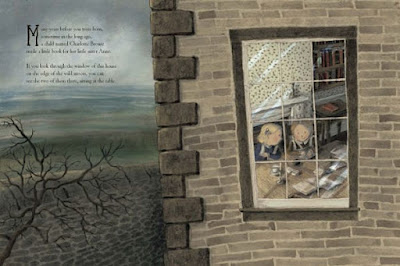
From The Little Books of the Little Brontës, written by Sara O'Leary, illustrated by Briony May Smith
They read everything they could, from novels and poetry, to geography, the dictionary, and the Bible. And when they weren't reading, they were making up stories, creating characters, and acting out plays. And they wrote their own little books to share with each other. What a special gift to have a sister who would paint pictures and hand-stitch pages and give their lives a happily-ever-after. When Bramwell received a set of toy soldiers, which he shared with his sisters, they created even smaller books that would fit into the hands of the toy soldiers. These books were tiny but the worlds within were colossal.
They contain continents and oceans, love stories and battles. There are heroes and antiheroes. And sometimes those who die in one story are brought back to life in another.
Their little books and their stories sustained them and inspired them all to write, taking them to new worlds.
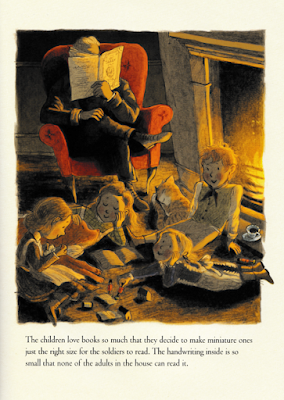
From The Little Books of the Little Brontës, written by Sara O'Leary, illustrated by Briony May Smith
The Little Books of the Little Brontës is not necessarily an illustrated biography of the four Brontë siblings though it does contain key biographical information about their home, the people in their lives, and their occupation with writing and books. But Sara O'Leary has not written this picture book to tell their biographies. She has written it to speak to the power of storytelling and the imagination to sustain us through challenges. There is much still left to tell of the Brontës' stories but those details can just as easily be discovered through research. Like the power of the Brontës' stories, Sara O'Leary takes the reader to see a different world, one in which travel to unknown places is possible, in which struggles are won, and in which lives may be happier, easier, and more exciting. That's the true story of the stories that the Brontës told. Their stories comforted them and fostered their creativity.

Briony May Smith, a British illustrator, uses mixed media to take us into the long-ago world of the Brontë children. She gives their world both historical accuracy but a sweetness of siblings reliant on each other for support and love. The softness of her pencil and digital media take away the austerity of the Brontës' lives and makes them rich in family and togetherness and, of course, literary creativity.
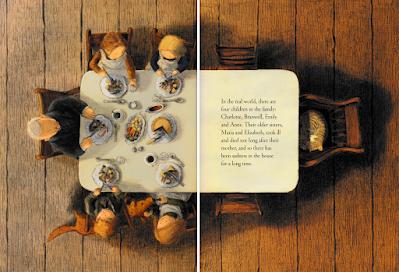
From The Little Books of the Little Brontës, written by Sara O'Leary, illustrated by Briony May Smith
I have reviewed a number of Sara O'Leary's earlier books (including When I Was Small, 2011; A Family is a Family, 2016; Night Walk, 2020; and  Percy's Museum, 2021) and, regardless of the story, there is a gentleness in her storytelling. It's in the choice of her words and the structure of her phrasing and in the choices she makes to tell or not tell. The timeline that appends The Little Books of the Little Brontës cannot help but speak to the losses the Brontës experienced in their short lives–the four who are featured in this book all passed in their 20s or 30s–but, though Sara O'Leary mentions the loss of the children's mother and their older sisters, she makes this story about the wonders of books and storytelling.

The Little Books of the Little Brontës will surely inspire young readers to delve a little deeper into the history of the Brontës but also to create their own little books–instructions provided–and find the wonder in making worlds for themselves and others.
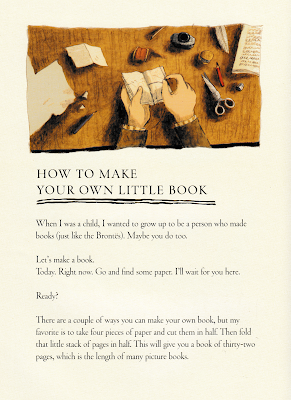
From The Little Books of the Little Brontës, written by Sara O'Leary, illustrated by Briony May Smith

June 20, 2023

Granny Left Me a Rocket Ship

Written by Heather Smith
Illustrated by Ashley Barron
Kids Can Press
978-1-5253-0552-8
32 pp.
Ages 4-7
June 2023
 
This is a story of what is left after a grandparent passes. Many think of the tangible bequests. This child's inheritance is so much more.
From Granny Left Me a Rocket Ship, written by Heather Smith, illus. by Ashley Barron
When Granny dies, there was a hole in our family.
Remembering her helped us fill it.
After a boy's grandmother dies, his family deals with their grief in different ways. There's the sharing of stories and photos, and there's reminiscing about the items she bequeathed them. But what did she leave him? It wasn't one thing. She's left him an abundance of memories of adventures that they'd created together. 
From Granny Left Me a Rocket Ship, written by Heather Smith, illus. by Ashley Barron
Whether it's the memory of creating a tent with blankets or a flying broomstick, a knight's sword on which marshmallows were roasted, or a rocket ship, often using Granny's blue cane, this child has a lifetime of memories of fantastic exploits.

Grief and loss are handled differently for everyone and will definitely vary between adults and children. The adults in this household must get on with the task of sorting out Granny's home and cherishing unique gifts bestowed on them, as do the two older children. But what the narrator gets is far greater and this child knows it. Heather Smith, author of everything from picture books like Annie's Cat is Sad to middle-grade novels in verse (e.g., Ebb & Flow) and YA like The Agony of Bun O'Keefe, always gets into the heart of feelings. She finds a way to see something positive and uplifting even in the challenging times. Here, a child is dealing with the loss of a beloved grandparents, and he finds a way to be grateful for the experiences he had with his grandmother. We've all heard of or experienced how a family loss can become a struggle of disputes with who got what, but this child sees beyond the material things his parents and siblings got and knows that he got so much more. He didn't get the tuba or the record collection or the microscope but he got everything he wanted in adventures and time and imaginative play with an elder he loved. In few words, Heather Smith lets us feel the adoration and gratitude.
From Granny Left Me a Rocket Ship, written by Heather Smith, illus. by Ashley Barron
From Ashley Barron's cut-paper collage with watercolour, and acrylic and pencil crayon, readers will never experience the grief that is the reason that the child was left something at all. There is no somberness to Ashley Barron's illustrations and that's because, while this boy and his family have experienced a loss, they are grateful for the gifts and time and  relationships they've had with their mother and grandmother. For the narrator, the gift of time and connection takes him from Granny's very real living room into his imagination with palm trees and teal waters to dragons and owls.
When Granny died,
she left me a world of adventure...
that I can take with me wherever I go.
What a gift.