Showing posts with label depression. Show all posts

April 29, 2025

I Lost a Day

Written and illustrated by Briana Corr Scott
Nimbus Publishing
978-1-77471-363-1
32 pp.
Ages 4-8
April 2025 
 
For many of us, losing a day is a negative event. It means that we lost 24 hours in which we could have accomplished something or been more present for others or ourselves or enjoyed life. It could be losing it to strong feelings or procrastination, to futility, defeat or discombobulation. But Briana Corr Scott shows children that the loss of a day can bring positives of calm, greater clarity, effectiveness, and more.
From I Lost a Day, written and illustrated by Briana Corr Scott
In rhyming verse, Briana Corr Scott gets into the heads and hearts of children as they are overcome with anger or rage or sadness.
When my head holds a storm
That blocks out the light
 
When my hands are hard fists
That are ready to fight...
When those times come, each finds a way to cope, whether it be hiding under their sheets, listening to the rain, reading, sketching, playing music, running, or just being outdoors. Everyone is different but they choose strategies that work for them to help be distracted from the anger or the sadness or to help it dissipate. 
I smell the cool earth
As the wind moves the leaves
 
A piece of my sadness
Floats away on the breeze. 
From I Lost a Day, written and illustrated by Briana Corr Scott
The strategy that touched me the most was the untangling of a ball of yarn as it is a metaphor for the undoing of a lost day. After all, a lost day is but one day among many.
Yarn that is tangled
Can always be wound...
 
In the days that I lost
It was me that I found.
The title of I Lost a Day caught me off-guard with the discouraging tone I thought it set for the book. It is but a title. That title and the first illustrations of the book are just a preamble to explain what children can do to deal with big feelings of anger and depression, irritability and anxiety. It sets up the story to be one of enlightenment, in other words one of learning to see differently and to feel the lightness that comes of self-care. Briana Corr Scott, whose book While You Were Sleeping I reviewed in 2023, has a delicacy to her storytelling and her artwork. Her author's note details a personal connection to the story of I Lost a Day–in addition to suggestions for other activities to help cope with those lost days–and I believe that this connection is what has helped her be sensitive and comprehensive in the strategies she recommends to children to try.
From I Lost a Day, written and illustrated by Briana Corr Scott
That awareness of the enormity of those feelings and that potential ways in which they may be addressed and successfully waived come through in Briana Corr Scott's illustrations. She uses gouache and watercolour to create artwork that portrays those overwhelming feelings that can cause a loss of days, days of raging storms and devastating anguish. These images are powerful in their darkness and their influence to dominate. But then Briana Corr Scott shows children finding the stillness in rain and reading and the quiet in running and drawing, and recovering themselves. 
The sadness can't catch me
I'll pass it right by
 
My body feels lighter
When I sit and sigh.
This is not a how-to book to defeat depression or anger. It is however a story that appreciates how time may be lost to feelings that overwhelm and offers possibilities for coping with no judgment and no obligation to conform or control. Briana Corr Scott, instead, shows kindness and understanding with the hope that we might find ways to care for our mental health that work for us.

August 16, 2022

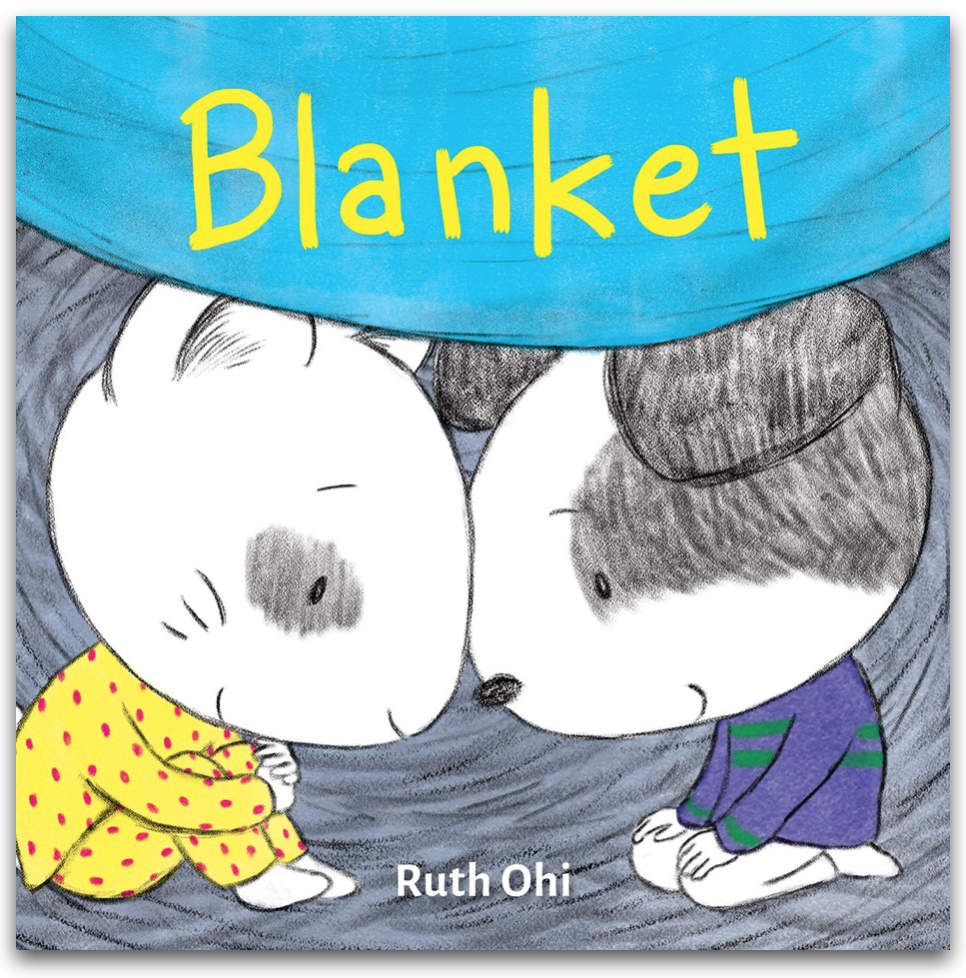
Blanket

Written and illustrated by Ruth Ohi
Groundwood Books
978-1-77306-614-1
32 pp.
Ages 3-6
August 2022 
 
Readers and writers know the power of words. Words can evoke and reassure, anger and subdue, and enlighten and confuse. They can do it all, or it would seem. But sometimes words aren't needed for an impact to be made. Author and illustrator Ruth Ohi makes this subtle and powerful point with her first wordless picture book, Blanket.
From Blanket by Ruth Ohi
Sometimes it doesn't matter if it's sunny outside and the birds are chirping and the flowers are blooming. Inside, really deep inside, is where it can still be grey and that sunshine cannot reach. Yet.
From Blanket by Ruth Ohi
When Cat awakens to the grey inside, they take their turquoise blanket and burrow under it. When Dog shows up, they see the lump that is Cat beneath the blanket, but Dog does not demand anything of Cat. Dog sits down nearby and quietly reads. With time and still beneath the blanket, Cat snuggles over to Dog. Eventually, Cat lifts the blanket and allows Dog to enter and share their protected space.

It's obvious that, while the darkness beneath the blanket offers Cat security, it is also a place where fears can grow and take over. But Dog has a flashlight and the two play with the light before Dog suggests using the blanket to create a shelter over two chairs. It gives Cat the security they need but offers more light and something else. It's a first step to feeling safe enough to venture outside and transform the blanket from shield to shared comforter.
From Blanket by Ruth Ohi

While Ruth Ohi's charming animals are easily recognizable for their sweetness and emotional depth, Blanket is so different from her earlier picture books because of its wordless nature. I've always been delighted with Ruth Ohi's books (e.g., No Help Wanted; Fox and Squirrel, The Best Christmas Ever; Kenta and the Big Wave); still, Blanket is so impressive in its story and messaging that it will sit with me for a very long time. (Though I love sharing books with others, I'll be holding on to Blanket for myself.) Blanket reminds us that, if someone is dealing with sadness or depression, it is not up to others to decide how to help them. When an individual is dealing with an internal greyness, everyone wants to help but seldom–only in dire circumstances–should another decide what is needed. Dog knows this. With time and patience, a flashlight and some playfulness, Dog is able to offer Cat opportunities to come out from the shadows of the blanket. It's still up to Cat when they are ready to move from beneath the blanket into the light. And with few colours and strategic lines of smiles and eyes that are dim and then bright, Ruth Ohi tells us all this in her moving illustrations. Even in the darkness of Cat's sadness, Ruth Ohi has given us light through her art.

A blanket can be so much more than a coverlet for a bed. It can be shelter and armour, defense and offense, and love and fear. It can hide and reveal. This is Cat's blanket. It offers them the opportunity to hide from the world but also reveals Cat as they are to Dog. There is power in that blanket for good and I'm so glad that Cat used it as they needed and that Dog was there to take their cues from Cat.

June 21, 2021

Tough Like Mum

Written by Lana Button
Illustrated by Carmen Mok
Tundra Books
978-0-7352-6598-1
32 pp.
Ages 3-7
April 2021

Though her mum might not always feel very tough or that she is able to manage, Kim tries to emulate her, never admitting she needs help or acknowledging anything she might perceive as weakness. But can anyone really be tough all the time?
From Tough Like Mum by Lana Button, illus. by Carmen Mok

From Carmen Mok's gouache and coloured pencil illustrations, it is evident that Kim and her mother are financially strapped. They share a bed, their socks are unmatched, their clothes and furniture are patched, and the food in the house is minimal. It's no wonder that Kim awakens soothing herself with her thumb in her mouth. But Kim is a tough cookie, tough like her mum, and she gets herself ready for school, making her own breakfast and lunch, and even planning for dinner–"Tomato, you are my favorite soup. Sit right here and wait for me"–because her mom hasn't gotten out of bed this morning. But Kim has a form for school that is due that day, a form for a field trip that costs $6.00. How is she going to get Mum to sign it when she's still sleeping, attempting to shut out the world–"Don't start on me, Kim!"–and get the money she knows they don't have?

On that cold winter day, Kim gets herself off to school, though some parents question her about being without a hat. Kim just tells them she doesn't need it, and the parents call her tough like her mom Jen. Kim won't let anyone see that she's cold. Because she's learned not to ask for help. And at lunchtime when David makes fun of her sandwich, she stays tough, never letting them see how sad and mad she is on the inside. But there's still the problem of the school trip. 

She has tried to find a solution, submitting a few coins she'd found in her mom's pocket, hoping the teacher wouldn't notice. But Mrs. Jones does notice and suggests her mother check a certain box on the form. It may read "I can't pay" but Kim knows it really means "I need help" and that's a box her mum has never checked.

From Tough Like Mum by Lana Button, illus. by Carmen Mok
Accepting help is never easy, and it seems to be especially so for Jen and Kim.  But when Kim gets home from school, she finds a way to take care of her mother, sadly still in the clothes she slept in, with compassion, humour and courage. Asking and accepting help might not be easy but it can be worth it.
From Tough Like Mum by Lana Button, illus. by Carmen Mok

Though Lana Button's picture books, including Raj's Rule (For the Bathroom at School), What If Bunny's NOT a Bully, and Willow Finds a Way, are aimed at young children, they focus on some tough issues. There are worries that young children have that cloud their lives and can cause anxiety. Whether it's bullying or self-confidence, using the bathroom or an absent teacher, Lana Button understands that these are very big issues for children. But in Tough Like Mum, Lana Button demonstrates that the shame of poverty transcends age and manifests differently for young children and for their parents who try to provide their best. Kim wants to be tough about what money they don't have, or the food she eats, or the clothes she wears. She strives to be tough like her mum. But sometimes being tough means accepting that help is needed. Together Kim and her mum realize this.

Lana Button's honest story of a single mum and child living in poverty and struggling with the perceived disgrace of their circumstances is stark. There are moments of lightness, like when Kim is praised for her reading and then brings that joy to her mum with it, or when they snuggle together in bed. But it's a hard life for both and the illustrations by Carmen Mok reflect that sparseness of their lives. From a sparsely-furnished home, to the mismatched clothing and furniture, patched or damaged, theirs is an unadorned life, and the art depicts that. 
From Tough Like Mum by Lana Button, illus. by Carmen Mok

But Lana Button's message of having the courage to accept help is paramount. Asking for help is not weak, though many, including Kim, may feel that it is so, exposing their vulnerabilities. Perhaps Kim's mum has never checked that box before, managing to somehow scrape together needed funds or accepting that Kim would have to do without. But by acknowledging that they might need some help, they've taken a big step forward. That just proves how tough Kim and her mum truly are.
 
• • • • • • •

Check back tomorrow for my interview with author Lana Button about Tough Like Mum and her approach to writing this story.

January 29, 2020

What's Up, Maloo?

Written and illustrated by Geneviève Godbout
Tundra Books
978-0-7352-6664-3
40 pp.
Ages 3-7
January 2020

Tackling issues of mental health in picture books requires a special touch. You can be neither silly about it nor aggressive while still getting the message out that there is help. Geneviève Godbout's text and art, always thoughtful and serene in soft pastels and coloured pencils, meets the challenge with style and compassion.
From What's Up, Maloo? by Geneviève Godhout
When kangaroo Maloo is happy and hopping, she is on top of the world. Life is a bed of roses, pink ones in fact. But when she's not, the hop goes out of her and a grey cloud envelopes her thinking. She walks to her friends who all ask, "What's up, Maloo?" and all she knows is that she's not hopping. There's the baking wombat, the swimming crocodile, and the koala, all who want to help. They attempt to lull her into play with balls in the water, and levitate her with the air from fans but the black cloud around Maloo does not dissipate and she isn't hopping.
From What's Up, Maloo? by Geneviève Godhout
The friends continue on their walking journey until they find a sail-like sheeting which they spread out and upon which Maloo bounces, hoping for her hop to come back. A bit of fun, a lot of friendship and a little time and Maloo is hopping again, now with her friends in tow!
From What's Up, Maloo? by Geneviève Godhout
Geneviève Godbout's illustrations are so serene and thoughtful, emphasizing a tenderness to Maloo's plight and the compassion of her friends. But still Geneviève Godbout's story stays inspirited, playing with graphic idioms such as Maloo's lack of a spring, or hop, in her step, the black cloud around her as an analogy for depression, and the bed of roses that make up her landscape when she is happy. Geneviève Godbout's What's Up, Maloo? makes me hopeful that, with a little help from friends who are supportive without being controlling or taking charge of her feelings, Maloo can get her hop back whenever the dark cloud descends again.

🌸🌸🌸🌸🌸🌸

It seems highly appropriate that I review What's Up, Maloo? on January 29th which is Bell's Let's Talk Day.  This is the day when media corporation Bell Canada contributes 5¢ to mental health initiatives in Canada for every applicable text, call, tweet, or social media video view in support of Bell Let's Talk.  So let's talk about What's Up, Maloo? to get our own conversation going about using Canadian picture books to support mental health. You'll find me on social media doing just this and I hope you'll do the same.

December 21, 2018

Kate's Ring

Written by Donna Grassby
Red Deer Press
978-0-88995-567-7
276 pp.
Ages 11-15
October 2018

Thirteen-year-old Kate might wish for a ring just as her best friend has–Grace has an heirloom opal ring from her grandmother–but Kate's Ring is bigger than a child's dream to possess something special. That's because Kate's ring is not one of gold or silver but rather one of people and place.

It's the 1920s and Kate lives with her five younger siblings–Michael, David, Lily, Colin and Sarah–and her parents in Whitney Pier on Cape Breton. Though her story begins on a happy note with Poppa taking her out of school on her birthday to join him on his bread deliveries, Kate's story is not one filled with childhood joys. Mamma has consumption and is weak and often resting, while Poppa has started drinking and rarely at home. Sadly, the responsibilities for children and house fall to Kate, who begins to fall behind in school.  While there is family around, including Mamma's mother and siblings, there is much strife especially from Aunt Flora who constantly berates Poppa about his drinking and Mamma who always forgives him his ways and despises her sister's interference.  With Poppa unable to keep a job, he decides to get one logging on the mountain in Margaree, where his parents, Aigneis and Hector, live on a farm without electricity or indoor plumbing. Mamma is thrilled to go, though Aunt Flora convinces her to allow Kate to stay with her and Uncle Will to finish her school year, as on the mountain only Lily and David would be going to school.

For about three months, Kate experiences what it is like to have guardians who take care of her. They feed her, clothe her, love her and worry about her safety. Though her family is never far from her thoughts, she enjoys a real Christmas of family warmth. Then Aigneis insists that Kate join the rest of her family on the mountain as they need her help and her mother misses her.

While her mother promises her that Kate will return to school and not end up in service, Kate wonders how her mother can make such a promise, especially with Mamma feeling worse and praying to never leave the mountain. Though Kate appreciates some aspects of her new life, like learning skills like carding and spinning fleece as well as participating in a céilidh, she is more than ready to return to Whitney Pier when Mamma starts coughing up blood and collapses.

Though Aunt Flora continues to pass along money and food to the family via Kate, things are not much better with Mamma in the hospital. Unfortunately, things go from bad to worse and the family Kate has always known fractures with one tragedy after another. How the family will survive and in what configuration is only resolved through Donna Grassby's poignant storytelling, both heartbreaking and hopeful.

Kate's Ring is not a story of lightness and familial comfort. There are moments of joy, like when Kate's Aunt Flo and Uncle Will gift her with a pair of snowshoes or when she learns how to spin yarn, but Kate's life is more about responsibilities and chores and getting by. Sadly this probably has been the lot of many children whose families have had to deal with illness and financial woes, especially with parents who could not be there for their children because of their own troubles. Still Kate accepts her responsibilities for her siblings and her family without much fuss; instead she just does what is expected and necessary while holding onto a sliver of faith that things will right themselves. Even the  book's cover upholds the idea that sometimes, even when you feel like you're a long way out from the safety of shore, there's more rain to come.

Setting Kate's Ring in 1920s Cape Breton, Donna Grassby makes sure young readers see that childhood was not always about play and school. Sometimes it was whatever was needed to help the family out. And by contrasting life in towns and in rural areas, where you might or might not have electricity and plumbing, where travel happened by horse, car and train, and not all children were fortunate enough to go to school, Donna Grassby embeds that story of loss and hardship in families of different shapes. It's family created, sustained and reconfigured that makes Kate's Ring real for the time and for now.

June 12, 2018

I'm Sad

Written by Michael Ian Black
Illustrated by Debbie Ridpath Ohi
Simon & Schuster Books for Young Readers
978-1-4814-7627-0
40 pp.
Ages 4-8
June 2018

At any time, there will be media coverage about a celebrity's unexpected death from suicide. There will be yet another outcry for resources to support mental health initiatives.  And there will be those who still won't get it, thinking that having everything–fame, money, friends, home–is enough assurance that overwhelming, debilitating sadness cannot overtake and even engulf.  But if there's a great place to start to acquire an understanding of sadness, which can manifest as depression, it's the newest collaboration from the dynamic duo of Michael Ian Black and Debbie Ridpath Ohi who amused and enlightened us with I'm Bored (Simon & Schuster Books for Young Readers, 2012).
From I'm Sad by Michael Ian Black, illus. by Debbie Ridpath Ohi
The first double spread has a single image of the pink flamingo simply stating, "I'm sad." The message is a simple statement but Debbie Ridpath Ohi's illustration says so much more. From the drooping feathers to the bowed neck and downcast eyes, this bird is barely holding itself up or together.  The imaginative little girl and bored potato from I'm Bored listen and attempt to understand. They try to help by acknowledging that they don't think the flamingo will always feel sad and that everybody feels sad sometimes. Even as they try to help, as all friends would want to do, they grapple with understanding what the flamingo needs, initially only thinking of what would work for them. Michael Ian Black astutely recognizes that we all can only understand from our own frame of reference, with the little girl thinking ice cream, sports and activity while the potato knows that dirt would certainly cheer it up.  Even after the little girl recognizes that sometimes allowing oneself to be sad can be therapeutic and relieving flamingo that its sadness will not change their friendship, it's a good laugh courtesy of the potato's dry wit that relieves some of the tension.  It may not alleviate the sadness but it can help.
I'm Sad by Michael Ian Black, illus. by Debbie Ridpath Ohi
Many children's books that attempt to provide bibliotherapy fall short of the mark because they tend to get too preachy, convinced they have the answer. I'm Sad is not one of them. It surpasses in its message that sadness can be a significant emotion and reassurance can be the most effective strategy for helping a friend feeling debilitated by it.  By having the little girl and the potato attempt to understand, question, reassure, and suggest, Michael Ian Black has them standing with flamingo in its struggle with sadness. They don't try to vacuum it up or ignore it. They simply accept it as the flamingo explains it.  If flamingo begins to feels better, so be it.  If it doesn't, they are still there for it.

In the boldness of her colour and line, Debbie Ridpath Ohi makes sure that the depth of Michael Ian Black's message is evident. Amidst the potato's cynicism and the little girl's joie de vivre, the flamingo's sadness is unmistakable. Debbie Ridpath Ohi's ability to evoke so much story with the simplest of lines continues to astound and impress me. (See my reviews of Sam & Eva and I'm Bored.) Even her final image packs a punch of friendship and support with only a silhouette without benefit of colour.
From I'm Sad by Michael Ian Black, illus. by Debbie Ridpath Ohi
All school libraries and guidance counselling offices should have a copy of I'm Sad to help children understand the sadness they or their friends or family may be experiencing and to reassure, just as the little girl and potato do, that support is there, even if the sadness can't be wiped out.
From I'm Sad by Michael Ian Black, illus. by Debbie Ridpath Ohi
• • • • • • • • • •
n.b. There is a classroom guide by Marcie Colleen available for download here

February 22, 2018

Here So Far Away: Book launch (Toronto, ON)


Hadley Dyer

author of middle-grade and young adult novels and non-fiction
including the best-selling

Johnny Kellock Died Today


 is set to launch her newest YA

Here So Far Away
Written by Hadley Dyer
HarperTeen
9780062473172
368 pp.
Ages 14+
March 2018


on

  Wednesday, March 21, 2018

7:30 p.m.

at

TYPE Books
883 Queen St. W.
Toronto, ON

From HarperCollins Website:
Award-winning author Hadley Dyer’s YA debut is smart, snarky, and emotionally gripping, about a rebellious cop’s daughter who falls in love with an older man, loses her best friend, and battles depression, all while trying to survive her last year of high school. 

Feisty and fearless George Warren (given name: Frances, but no one calls her that) has never let life get too serious. Now that she’s about to be a senior, her plans include partying with her tight-knit group of friends and then getting the heck out of town after graduation.

But instead of owning her last year of high school, a fight with her best friend puts her on the outs of their social circle.  If that weren’t bad enough, George’s family has been facing hard times since her father, a police sergeant, got injured and might not be able to return to work, which puts George’s college plans in jeopardy.

So when George meets Francis, an older guy who shares her name and her affinity for sarcastic banter, she’s thrown. If she lets herself, she’ll fall recklessly, hopelessly in love. But because of Francis’s age, she tells no one—and ends up losing almost everything, including herself.

This is a gorgeous, atmospheric, and gut-wrenching novel that readers won’t soon forget.

Retrieved from https://www.harpercollins.com/9780062473172/here-so-far-away on February 22, 2018.


August 02, 2017

Road Signs That Say West

Written by Sylvia Gunnery
Pajama Press
978-1-77278-023-9
216 pp.
Ages 12+
May 2017

Three sisters. One road trip.  No regrets?

When their parents go off on their European holiday, 19-year-old Hanna convinces her sisters Megan, 17, and Claire, 15, to head west on a summer road trip from Nova Scotia to Vancouver.  But the Three Sisters' Road Trip, with multiple stops at roadside attractions, camping and hostelling and the meeting of new friends, becomes more of an unloading of secret baggage and a clash of personalities than a sisterly bonding experience.

From their photo at the statue of Glooscap, to Montreal where their clubbing leads to Megan's hospital visit and her wrist in a sling, Hanna directs, Claire worries and Megan remonstrates her sisters.  Meeting a group travelling from PEI, Hanna accepts an invitation to a wedding they're attending in North Bay.  Onto Marathon and the Terry Fox memorial, the girls pick up the hitchhiking teen named Bear with his beagle Jake and end up driving them all the way to Pinawa, Manitoba to the home of his aunt and uncle where he intends to help out since his cousin Lenny joined the armed forces.  Bear and Megan make a connection but around that swirls unrest with a man sexually harassing Hanna and the fears Bear's uncle has about his son's safety.

Manitoba leads to Saskatchewan and Alberta where they meet a flutist-busker named Charley who encourages Hanna in her song-writing as healing for Claire's grief before the three head to BC where their road trip takes a sudden turn from which the three sisters may or may not find their way back.

It's evident from the onset that Hanna and Claire have back stories that affect their current interactions with others and between the sisters, though there's a lot more story to how the three became who they are than is ever told.  Hanna had gone to university but had left mid-term to take on an au pair position in Italy from which her parents had to involve lawyers to extricate her safely.  Though involved in scandalous circumstances beyond her control, Hanna parcels out little bits about it to her sisters, and still manages to keep mum about that of which she is most ashamed or embarrassed.  Claire is dealing with the recent suicide of her boyfriend Matt's best friend and still coming to terms with what Caleb had done.  Worried about leaving Matt behind and trying to resolve Caleb's death in her own mind leads Claire to contemplate depression and her own grief.  Megan is given no back story, except for having given up a summer job and anticipating starting university and continuing with her swimming.  Sadly, she is continuously vilified by her bossy and self-centred older sister and complacent younger sister for her cautious, more rational approach.  And, even though Sylvia Gunnery has written Road Signs That Say West from third-person omniscient point of view, critical commentary about Megan, the "grouchy complainer" (pg. 128) skews the narration for me.

The road trip scenario is an irresistible plot line, forcing the three sisters to interact (haven't we all been trapped in cars with those we may or may not like?) while they experience life and meet new people of all backgrounds and take in the diversity of places that make up Canada.  Roads Signs That Say West could be a travel commentary of places east to west (I found myself looking up information about Glooscap, Weyburn, and more) but it's really a story of family, a real family, of siblings with secrets, weaknesses, strengths and ambitions that they may or may not share.  The baggage that the girls take with them is far greater than their back stories and drives them to behave in complex and justifiable ways.  Though I would have preferred if Megan had been developed more as a character and not delivered as a scapegoat, especially since middle children are more often cooperative team players than embittered sulkers, young adult readers will appreciate the three different personalities Sylvia Gunnery has created as well as her story which takes the three to new places in their relationships within a colourful national landscape.

March 24, 2017

Everything Beautiful Is Not Ruined

Written by Danielle Younge-Ullman
Razorbill
978-0-425-28759-0
368 pp.
Ages 13–17
February 2017
After, I stand for a few moments looking out over the water, the moon reflecting off its glass-like surface.  It's beautiful, yes.  But the beauty doesn't reach me the way it's supposed to because I feel like it's been shoved down my throat.  I register the stark gorgeousness of the dying day, and what it fills me with is unease, and an ominous sensation of cracking inside–of cracking open, of a corresponding excruciating pain I have kept at bay by incredible discipline beginning to seep toward the surface. (pg. 87)
Ingrid Burke must feel like she's been deposited in another world, and one not of her choosing.  In fact, not even one like in the brochure her mother, retired opera singer Margot-Sophia Lalonde, had shown her of Peak Wilderness, an outdoors camp in northern Ontario, to which Ingrid has agreed to go so her mother would permit her attendance at a prestigious music school in London England.  Worse yet, Ingrid, who perceives herself to be “a model citizen and paragon of stability” (pg. 53) compared to the miscellany of other troubled youth campers, must survive three weeks of hiking, canoeing, roughing it, and sharing under the supervision of leaders Pat and Bonnie who seem to enjoy the group’s failures at near impossible tasks.

What happened that led Ingrid to this challenging and repeatedly dangerous situation is told in alternating chapters, organized by Ingrid's age, that speak to her life before Peak Wilderness.  They tell of her life travelling the world with her famous mother and then, after damage to Margot-Sophia’s vocal chords leads them home to Toronto,  the reversal of roles when Margot-Sophia is overcome with depression.  Revealed slowly but with ease are Ingrid’s experiences at school and home, feeling vulnerable and frustrated, fearful and positive, and her attempts to achieve normalcy and some happiness. Eventually we also learn what led her to Peak Wilderness.

My words cannot do justice to the depth of Danielle Younge-Ullman's characterizations and story-telling.  There is so much to share with readers that my words seem sparse and ineffective. But I can tell you that Danielle Younge-Ullman weaves Ingrid’s present and past into a fabric of ordinary and extraordinary, creating a life of tenacity to which most of us could aspire.  Though Ingrid doesn’t want to acknowledge the vulnerabilities that brought her to the camp, Danielle Younge-Ullman provides hints throughout the story–Isaac, an axe and an injured leg–that there is more to the teen’s story than she reveals to others and even to herself.  Her go-to survival mechanisms include a strained positivity —“How exciting, and what a magnificent opportunity to get in touch with my inner savage” (pg. 29)— and silence with a dose of denial.  But beyond Ingrid’s inner turmoil are the relationships the teen has with her mother, her new father, a boy with whom she has a connection, and all the campers.  These relationships drive Everything Beautiful Is Not Ruined.  They ebb and flow, both serene and passionate, not unlike the music of a great opera that Margot-Sophia might have performed.  Though Ingrid might think she knows the music of her life really well, she’s just learning to perform it with passion so that she can make it successfully to the triumphant finish. And Danielle Younge-Ullman makes sure that we want to stay for the whole performance without ever nodding off.

****************

On May 6, 2017, Danielle Younge-Ullman will be speaking at the Stratford Writers Festival Young Adult forum along with numerous other YA authors.  I'll post about it here soon but you can get details at http://digiwriting.com/stratford-writers-festival-young-adult-2017/

I'll be there and you should be too!

September 26, 2016

All the Things We Leave Behind

Written by Riel Nason
Goose Lane Editions
978-0-864-920416
240 pp.
Ages 14+
September 2016

There are so many incidents that can stand out small and don’t seem like anything at the time but end up meaning so much.  There are so many tiny twists in a life that you can never know the ultimate significance of. (pg. 80)
As teen Violet Davis looks back through her copious memories of incidents with her older brother Bliss and their parents, she now seems to see the significance of them with respect to his disappearance from their lives after graduation from high school.  There were all the signs of a wanderlust for moving beyond their small town of Riverbend and Hawkshaw, New Brunswick, for travel, for adventure.  There was also the darkness in Bliss that may have been triggered when the two first discovered the Department of Transportation’s gruesome boneyard of deer and moose road kills, perhaps Bliss’s “first proof of unhappy endings” (pg. 116) but this melancholy could not be repressed.
It seemed that every bad memory, in fact only bad memories, bubbled up in his brain.  His entire perspective changed and every thought he had was permeated and tainted, shifted and reinterpreted in a negative way. (pg. 116)
Now it’s the summer of 1977 and Violet’s parents are ostensibly on vacation, but really in search of  any evidence of Bliss’s travels.  And Violet has been left in charge of the family business, officially known as Charles J. Davis & Son Antiques but known locally and by all travellers as The Purple Barn, a roadside attraction and store brimming with crafty twig furniture and quilts and antiques and collectibles.

For Violet, the summer is more than just working at The Purple Barn, and keeping the busybody employee Mrs. Quinn in check; it’s also a time of hanging with her boyfriend Dean and best friend Jill and her boyfriend Johnny.  While her brother’s disappearance is always foremost in her mind, as she rethinks what she should have and could have done to keep him from leaving them behind, Violet is forced to struggle with two unrelated issues.  First, she must negotiate the purchase of the contents of the renowned Vaughn cottage, a grand home deserted after the drowning of the owners' grandson. Secondly, Violet is haunted by a white buck that no one else seems to see.  Is it Speckles, a piebald deer Bliss befriended years earlier,  or an apparition that is part of the rumoured ghost herd of the boneyard?

Riel Nason’s first book, multi-award winning The Town That Drowned (Goose Lane Editions, 2011), was a deeply moving examination of a small town dealing with its impending demise by deliberate flooding.  That community, Haventon, is now a memory in All the Things We Leave Behind, both as place and experience, but only one of many things left behind when people move, or die, or disappear.  Those things can be like the goods that The Purple Barn sells from estates or deserted houses, or the mementoes set to be bequeathed to family upon a grandmother’s death.  Or they can be people, like Violet, left behind when a brother goes exploring, or when someone dies.  It can even be the bones of the dead or their ghosts remaining to haunt people’s thoughts and dreams and nightmares.  The concept of things, including people, being left behind is a monumental one but one that Riel Nason addresses with sensitivity and completeness, understanding the nature of memories and mementoes as powerful beyond reason.
Having a reminder, a souvenir, to help you remember is great, but I think the best memories are through a special door in your mind that you can open without a key. (pg. 105)
Riel Nason’s writing, both intricate and profound in addressing the nature of loss and memory, does not dwell on grief, though the boneyard and the tragic deaths of the animals and people in the book are disturbing.  But, All the Things We Leave Behind is bigger and better than just that, instead becoming a souvenir in itself, one of  weighty contemplation and yearning for a past remembered and a future unlocked.  Even with the tragedies that unfold in All the Things We Leave Behind, there is a lightness and brightness in the darkness, and acknowledgement by Riel Nason that all the things we leave behind, tangible and intangible, become powerful tributes in their own ways.

May 11, 2016

Small Displays of Chaos

by Breanna Fischer
Coteau Books
978-1-55050-661-7
102 pp.
Ages 13+
May 2016
It wasn’t supposed to be this way.  Everything in her life was supposed to be better when she was thinner. (pg. 50)
For Saskatoon teen Rayanne Timko, her eating disorder began with a Phys Ed class fitness goal of healthy eating and improved exercise regime to get a good grade to match those of her academic subjects.  But the recording of all foods and monitoring her physical appearance became a ritual she couldn’t let go, ever hopeful of finding “the person who she wanted to be…hiding somewhere underneath.” (pg.  9).

Now a high school senior, Ray’s life is a complex existence of school counselling sessions, community service at a dog shelter, crushing on Josh Reid who’d witnessed her purging at a party, and convoluted family dynamics with a twin sister, an angry father, a conflicted mother and an impending family wedding that requires her dreading her participation as a bridesmaid.  And I haven’t even mentioned the voice of her judgemental thinner self Edie for whom Rayanne never seems to be good enough.

But even with a referral to an eating disorder specialist, Ray doesn’t know what she needs and finds it hard to ask for help.  It’s not until the family wedding that the desperate teen realizes that she’s been in the “final stage of a grand Disappearing Act” (pg. 74) from which she wouldn’t be able to hurt anyone and could finally just give up.

With all the positive affirmations about body image and awareness campaigns about eating disorders and mental illness, Small Displays of Chaos is still a timely and relevant story that needs to be told and heeded.  Breanna Fischer has based Small Displays of Chaos on her own experience being diagnosed with anorexia with bulimic behaviours and convincingly shares her skewed thinking and dangerous pursuits with candor and insight.  Luckily both Rayanne and Breanna Fischer are able to survive their crises and find the words to astutely convey the depth of those crises to provide valuable lessons. 

August 03, 2015

Remember

by Eileen Cook
Simon Pulse
978-1-4814-1696-2
320 pp.
Ages 12+
February 2015
People need to ball up.  Life isn't all sunshine and unicorns.  Now they're selling it to people our age?  What, because not getting into the college of our choice is crushing?  No date for prom causing premature PTSD?  It's not trauma; it's real life.  Life is hard sometimes.  It doesn't mean you don't face it. (pg. 12)
That's best friend Win's assessment of the Memtex treatment that teen Harper Bryne's father's company NeuroTech is now offering, with FDA approval, for the "softening" of painful memories that get in the way of living.  But when Harper's beloved horse, Harry, dies unexpectedly of colic, she is devastated and weeks later still unable to sleep or eat.  Though her parents refuse to allow her to receive treatment, Harper easily convinces her boyfriend, Josh, an part-time intern at NeuroTech–and a protegé of her father's– to sneak her in.  In recovery, Harper is thrilled to know she can still visualize Harry but without the devastating sadness and guilt, feeling like herself again.

That is, until she blacks out over memories of a woman falling and the smell of burning meat, and begins dreams of this woman.  Josh is convinced they are just false memories (he is so pro-NeuroTech).  But, having witnessed her blackout, Neil O’Malley, a college student involved in protests objecting to Memtex’s use, approaches her about the possible side effects of the treatment that he is convinced had a role in his older brother’s suicide.

Now Harper is delving into her past, doing some sleuthing around anomalous information about her horse and her mother, and getting Neil to help her with this research, while her relationship with Josh is put on hold and her friendship with Win takes a tailspin.  And then there’s her dad whom she’d always trusted to do everything and anything for her and now whom she is convinced is harbouring secrets and acting only in the best interests of his company.

Remember is a romance with a cautionary spin on the hazards of expecting lives filled only with lightness and good memories, devoid of the painful ones that help sculpt us into the persons we are.  Win is always remarking about Harper’s Mary Poppins’ positive attitude and is disappointed, almost angry, when Harper begins to be less so.  This is surprising considering she acknowledges that life isn’t all “sunshine and unicorns” (pg. 12). But, Win is not atypical, recognizing that sometimes life sucks while still preferring effusive busyness and happy demeanours at all costs.  Not surprising a lot of work related to PTSD and depression is done quietly and discreetly on the side.

Eileen Cook writes captivating realistic fiction with a hint of romance so well, ensuring some sweetness is always enmeshed in the conflict of keeping secrets and telling of lies.  Unraveling Isobel (SimonPulse, 2012)  and The Almost Truth (SimonPulse, 2012) are two more examples of her gripping YA that I’ve been pleased to review here on CanLit for LittleCanadians.  I know my young readers are as enthusiastic by Eileen Cook’s writing as I am, gripped by complex plotlines beyond their own lives and by romantic, friend and family relationships that reassure them that they are normal.  And Remember is one more YACanLit to add to that collection, albeit with a nuance of science fiction that makes us remember that the speculative may not always been that fantastic after all.

August 01, 2015

When Kacey Left

by Dawn Green
Red Deer Press
978-0-88995-523-3
228 pp.
Ages 12+
April 2015

Books that deal with suicide at their core are never easy to read or review.  They are heartbreaking ends to life. Period.  But When Kacey Left focuses that heartbreak on the survivors and less on the individual who committed suicide and that makes all the difference in the story-telling.  And it’s story-telling that gets to the crux of the repurcussions of suicide: that those left behind are left to grieve, to understand and to go on.

When Kacey Left is written as a series of letters in a journal by 16-year-old Sara a.k.a. Sticks to her best friend Kacey a.k.a. Stones as prescribed by Sara’s counsellor to deal in the aftermath of Kacey’s suicide.  The letters span the gamut of emotional devastation from sadness, depression, anger, denial, and guilt with questions, lots and lots of questions.  As reluactant as she is to pour out her emotions, Sara is very articulate about sharing everything with her friend.

Sara talks about their other friend, Drea, and her rise to popularity after Kacey’s suicide; about the reactions of fellow students to Kacey’s death and to Sara herself; about the funeral itself; about how their parents and teachers and even the school via principal directives have dealt with it.  Sara has to endure that stalklings of  an autistic girl whom she calls Weird Girl who wants to understand the spiritual consequence of Kacey’s demise.  There’s Sara’s mom who seems reluctant to give Sara time to herself, instead filling her time with guitar lessons, helping out at a school dance, and attending counselling sessions.  Dad’s reaction, on the other hand, is to get Sara a chocolate lab puppy she calls Hershey.  Sadly, Sara fells like everyone now knows her only as “the girl whose best friend killed herself.” (pg. 110)

As she attempts to make sense of Kacey’s suicide, taking months before she’ll even acknowledge that Kacey killed herself,  Sara finds herself trying to learn more about teen suicide and grief–such as the stages of denial, anger, bargaining, depression, and acceptance–ultimately helping her to open up to a major meltdown and help others understand what Kacey did.  No one might ever fully understand why Kacey did what she did but they would learn to accept it and and the consequences for all of them of what she did.
I’d told them I’d think about it. Me!? Some teen-suicide-prevention spokesperson? I feel like this is something I need to talk to you about, like I need your thoughts.  I’d be talking about you and I’m not sure you’d be okay with that.  I know you wouldn’t be.  But then again…you’re not here.  When you killed yourself, you kind of lost the right to have an opinion.  I think I’ve already made up my mind.  I just thought you should know…and I do hope you understand. (pg. 200-201)
I know that some people, like Principal Kline, are inclined to consider suicide a taboo subject that should not be discussed.  Whether it is the fear that others might consider suicide an option or the spiritual presumption that suicide leads to damnation, the reasons to keep it hush-hush is just ludicrous.   Dawn Green has done a great service to bringing suicide out of the closet and to the forefront of discussions by addressing what can happen in its aftermath.  By allowing Sara to share her own questions about Kacey taking her own life and trying to find answers whether through research, journaling or social discourse, Dawn Green will allow any young person who reads this book to take a closer look at suicide as more than just death or a storyline or an ending to pain, and instead a sorrowful consequence for those left behind.

I encourage everyone to read the section titled, “Suicide Information and Resources” with which Dawn Green appends her story.  It provides useful links and information, including the assertion that “There is a way through it.”  Her reference to the song, “Hold On” by Good Charlotte 2002 Sony BMG Music Entertainment) is especially positive but anguished. Here is a link to the group's YouTube video of the song so you can check it out for yourself. 

May 05, 2015

Forever Julia

by Jodi Carmichael
Great Plains Teen Fiction
978-1-927855-20-1
262 pp.
Ages 14+
April, 2015

Julia Collins must feel like she's living her life from out-of-body. And with the life she has, I might want out too. Her much-adored dad has passed from cancer just 6 months ago, and her Mom is so grief-stricken that she can't even bear to speak of him.  They now live in a small two-bedroom flat above their bookstore and money is an issue, though Julia had never minds thrift-store shopping with her long-time best friend and creative fashionista, Annika, who understands about Julia's issues with depression and anxiety and watches out for her constantly.

But now Julia is going out with the obscenely wealthy Jeremy Thurston, a.k.a. the Third, jock and popularity icon, and he is pressuring her to have sex, though she has made it clear that she is not ready.  The gutsy Annika can’t stand Jeremy and makes it clear every time he pulls some stunt, like kicking Julia out of the ski chalet where they were supposed spend the night when she refuses his advances yet again.  Sadly, in her mind, Julia is convinced that she can have it all: the wonderful dating relationship with Jeremy who calls her “beautiful”; new friendships with the popular girls; a scholarship to USC for architecture; and the best friendship she has ever had.  Imagine thinking,
Maybe if I convince Annika to tone down her wardrobe, Jeremy would see how incredible she really is and then maybe everyone would get along. (pg. 105)
Sadly naïve, but probably not atypical for a teen who is trying to work everything out.

Then Grandma, who generally splits her time between Arizona and the cottage, arrives to stay–in Julia’s room–while being treated for breast cancer.  Now both Grandma and Mom are watching her and what’s going on around her, and they’re not always pleased by what they see.

It’s not surprising that Julia questions everything that she feels but what’s worse is that she never trusts her feelings to be legit or honest.  Whether that’s because of her anxiety or depression is irrelevant.  All that matters is that the life that was once warmed with Dad and Mom happily living in a modest home and with a reliable and loving BFF is now a life she doesn’t even recognize as her own.  Who is the girl who lets herself drink when she knows it’s verboten with the meds she’s on?  Who is the girl who kisses her boyfriend in public like there's no one else around?  Who is the girl who apologizes to a guy who thinks nothing of stranding her at a ski resort when she doesn’t want to have sex?  Jeremy may get a tattoo, even a temporary one, that reads “Forever Julia” but Julia can’t be forever when she doesn’t  know who she is, who she wants to be, or who she can be.

Jodi Carmichael gets inside of this Julia and gives her a true voice, albeit one mixed and confused with guilt, grief, envy, desire, and affection.  Julia definitely morphs over the course of Forever Julia though I suspect she hasn’t come into herself completely, yet. Forever is a long time to be someone, to love someone, to trust someone, to be friends. It may be possible but maybe not.  Not everything can be forever: not life, not love, not lust, not even family nor  friends.  And Jodi Carmichael makes sure that Julia accepts this, even if only temporarily, in Forever Julia.

April 29, 2013

Record Breaker

by Robin Stevenson
Orca Book Publishers
978-1-5546-9959-9
152 pp.
Ages 9-12
2013

Most of us would do anything to alleviate the sadness and despair of one we love.  Children are inclined to do the same, although the means by which they are convinced they can do this may be rather unconventional.  Take young Jack, for example, in Robin Stevenson's latest from Orca Book Publishers, Record Breaker.  He is sure that breaking a world record will propel his mother from her overwhelming sadness following the death of his baby sister Annie, and he's willing to try just about anything. 

Jack seems like a pretty good kid.  When his dad tells him to get to the dinner table or help his mom or go to his dad's cousin's place, the Miller's, he does.  Because he often gets sent to the Millers, Jack spends a lot of time with his second cousin, Allan, who likes to repeat his mom's and dad's comments, ("My mom said it'll be a miracle if she (Jack's mom) ever gets over that baby dying" pg. 23; "My dad always said Kennedy was soft" pg. 40).  Regardless, Allan is willing to help Jack out in his record attempts, even painful ones like face-slapping. 

While Jack's concern for his mother tends to overwhelm his daily activities, several key events have an impact on him and those around him.  First, President John F. Kennedy is assassinated.  Although they live in Ancaster, the possibility of bombings are a real concern, and Jack's dad returns to building a fallout shelter started before Annie's birth.  Second, a new girl, Kate Levine, moves to a nearby neighbourhood, using a local treehouse that Jack had been using as an escape.  Kate is an astute young girl, helping Jack see that there is something, other than a world record, that he can accomplish to help his mother.  In fact, her mom believes Jack's mom needs someone to whom she can talk and Mrs. Levine volunteers to help.  Together with Allan and Kate, Jack finds the means to add some light to his mother's life, and remind both his parents that they still have a son who has been burdened with dealing with his sister's death on his own.

In the context of 1963 southern Ontario, Robin Stevenson shares the grief and fears and innuendo of a time unknown to most young readers.  But, by making the focus in Record Breaker a local one, with the grief related to the loss of a family member, the fears about a family who may be unable to rebuild itself, and others' gossip about issues of which they know very little, young readers will be able to empathize.  Even so, whether global or local, these issues can be devastating, and recovery may seem impossible.  But, as Jack and Robin Stevenson demonstrate, with a little help and a different perspective perhaps from unlikely sources, there is hope.

January 26, 2013

The New Normal

by Ashley Little
Orca Book Publishers
978-1-459-80074-8
222 pp.
Ages 12+
Release date March 2013
Reviewed from Advance Reading Copy


This is my reality.  I was sixteen and being hunted by a drug dealer.  My hair was falling out and my sisters were dead and my parents were broken and there wasn't a goddam thing I could do about any of it. (pg. 28)
This is The New Normal for teen Tamar.  And the drug dealer bit is the very least of her worries. Really. She can handle that and she does.  But the other repercussions of her twin sisters' deaths (in a car accident while driving with drunk boys who played road chicken) - her hair and her damaged parents - are not as easy to handle.

It's only been a few months since the death of her younger sisters and Tamar and her family have been falling apart.  Neither of "the parents" have worked since the accident.  Mom throws herself into yoga and more yoga.  Dad spends a lot of time in his bathrobe on the couch. And Tamar has been losing her body hair, in clumps, while she sleeps, on towels.  Though she keeps up her routines, attending school and playing with the chess club, false eyelashes and hats or bandanas are now part of her style.  Keeping it a secret has been manageable; her dad hasn't even noticed and her mom knows but tosses it off.   But when her friend Roy Lee, a Grade 12 student in the chess club, pulls at her bandana and reveals her lack of hair (luckily this happens away from school), Tamar tells him of her mysterious hair loss.  Fortunately Roy who cares for Tamar is more concerned about her health than her appearance.

Tamar continues to find ways to manage: looking for a job to help pay for a wig;  auditioning for the school production of The Wizard of Oz and earning the role of Auntie Em; starting to go out on dates with Roy; and working at the Cruisy Chicken.  Of course, she can't predict that the play's Dorothy would bully her about her sisters and tell Tamar she's not good enough for Roy, then pull off her wig and get Tamar suspended from school.  Or that Dad would fall off the roof and injury himself and need extra care.  Or that Mom would decide to take off for six weeks to study yoga and meditation at a retreat on an island off the BC coast.  But Tamar has a good head on her shoulders (even if it is becoming hairless), recognizing that, after an especially terrifying situation,
"the whole experience had made me feel lucky to be alive, and I hadn't felt that way in a long, long time." (pg. 213)
Even though Tamar and Roy are in their mid-teens, The New Normal is a great middle-grade novel, having less of the urgency and edginess of young adult novels.  Ashley Little has found the means to knit the grief of loss with the innocence of first love, both times of confusion.  With that first love, Tamar doesn't even realize that she's starting to care for Roy, that he has asked her out, or that there are others who see them as a couple.  Similarly, Tamar isn't sure about expressing her grief.  She continues to have flashes of memories, tender or nasty, of her sisters, but in many respects she is suppressing that grief, unlike the parents who are inundated with it.  For Tamar, that grief can only come out as a physical symptom, but it allows her to see her sisters' deaths in a different context and as part of a bigger picture.  It goes beyond the sadness and anger and lets her continue to live.  She might not embrace The New Normal but she knows it is what it is and doesn't try to make it otherwise.  Her parents should have paid attention to her a little sooner.