Showing posts with label Ruth Ohi. Show all posts

October 04, 2023

We Belong Here: Interview with author Frieda Wishinky and illustrator Ruth Ohi

We Belong Here
Written by Frieda Wishinsky
Illustrated by Ruth Ohi
North Winds Press (Scholastic Canada)
978-1-4431-9403-7
32 pp.
Ages 6-8
October 3, 2023
 
 
Yesterday, I had the pleasure of reviewing an important picture book, We Belong Here, about intolerance and kindness. Today, I have the good fortune of sharing with readers a bit more about the book and the creative process through this Q & A with its author Frieda Wishinsky and illustrator Ruth Ohi.


Helen Kubiw:  Whether it be the 1950s, the setting for We Belong Here, or now, there are always those who distrust others who are different, whether in their appearance, their cultures, their faith, language, or something else. Why do you think this still hasn’t changed?

Frieda Wishinsky:  That’s an important question. I think some people are afraid or uncomfortable with anyone who is different because they haven’t had the experience of getting to know them. I grew up in New York City where there were always people around from different cultures and backgrounds. I felt comfortable and curious about that difference. I loved the diversity of food, customs and experiences but I think that some people who live in places which lack diversity, feel afraid of what and who they don’t know.
 
Ruth Ohi:  We have a long way to go, but I feel it has changed: I believe there’s been progress. I’d like to see the interest in making things better continue to grow the way I think it already has.


HK:  I suspect those children who demonstrate intolerance, including those in the book, are often doing so from observing their own families expressing that same bigotry. While We Belong Here demonstrates the value in getting to know those who are different, how do think it’s possible for those children to rise above their learning when they’re seeing the worst at home?
 
Frieda Wishinsky:  I hope this story and friendship of Eve and Mark will help kids and their families appreciate that although we are different, we are also alike. No one likes being called mean names. Everyone wants to feel appreciated. And being in touch with people from different cultures makes life richer and better. Being open to change and new people makes us less fearful and happier. 


HK:  The note at the end of the book suggests that the book came about through discussions that you had about your family histories. Once you decide that this was going to become a book, how did the collaborative process work?
 
Frieda Wishinsky:  Over two years ago Ruth and I had coffee and shared our family histories. We talked about how Jewish and Japanese people faced discrimination after the war. I said, "If I can figure out how to write that theme of connection and help as a picture book, would you illustrate it?”  Ruth said yes. Now all I had to do was write the story. Not so easy! The story couldn’t be about adults. It had to focus on kids.
     It took me over a year and a half to figure out how to create a story about two kids from different places and cultures who help each other in difficult times.
     When I finally felt pretty good about my text, I passed it on to Anne Shone at Scholastic. Anne had worked on many books with both Ruth and me. Anne liked what I’d written but made some suggestions. After more revision, the text was approved by everyone at Scholastic. Ruth could now begin to illustrate.
     I didn’t see the story with its art till it was almost a finished book. Ruth and I did have a few discussions about historical accuracy, tomato sauce vs. beets, and adding in a carved wooden sculpture but we worked separately.
     Seeing the finished book was a delightful surprise. I loved how Ruth added evocative and touching art to the story and theme. I think her art highlighted and elevated my words. 

Ruth Ohi:  Once Frieda’s manuscript was accepted by Scholastic Canada, she and I communicated through our editor, Anne Shone. I read the text many times so that the characters could move about in my imagination for a bit. I then created page breaks and tiny thumbnails to see how action and pacing could work. I researched the 1950s to immerse myself in the time and sent research elements and resulting rough layouts to Anne. Sketches were drawn and redrawn many times with feedback, until approvals were given to begin final art.
Rough sketch by Ruth Ohi from We Belong Here

 
HK:  I appreciate the fact that both of you were able to contribute familial background history to the story of We Belong Here. I like that, by bringing the two together through Eve and Mark, you were able to produce a story of discrimination defeated by kindness. But, in your own family stories, did kindness always conquer the unfairness of intolerance?
 
Frieda Wishinsky:  During the early days of World War Two, my mom met the wives of two Polish Generals when they were all jailed by the Russians as political prisoners. (My mom’s offense was a German sounding last name) These women, Yadviga and Zhosha, treated my mom as a sister, although they came from different religions and backgrounds. The three of them helped each other survive the harshness of a Russian prison for two years. Yadviga and Zhosha also promised my mom that if they were released, they would make sure she was released too. When the Russians changed their political alignment, the Polish women were released, and they got my mom out of jail the next day. Yadviga and Zhosha then opened a children's home in Russia for kids whose parents had been sent to Siberia. My mom worked there till the end of the war.  My mom was a natural storyteller and told me what happened to her in those terrible years. I never forgot the kindness and humanity of these two women.
 
Ruth Ohi:  My Dad was one of the first Japanese Canadians to be allowed to teach in Toronto. He was also a guidance counsellor. Leafing through photos, he’d tell me stories about his wonderful students and the staff that he worked with then and throughout his career.


HK:  How much of the story includes actual events that took place, like the shop, the rock, and the taunts, and how much is fictionalized but based on stories told within the family?
 
Frieda Wishinsky:  The core of the story, that a Jewish family helps a Japanese family, is true. The rest is fiction. We did incorporate elements from our lives in the book though. For example, I was an imaginative kid who loved climbing up on some rocks in a NYC park. My dad carved a beautiful crane out of wood. My dad was a baker and made rugelach.


HK:  For each of you, what was the hardest part of creating this story?
 
Frieda Wishinsky:  The hardest part for me was taking a true story and a general theme and creating a picture book that was universal and kid focused.
 
Ruth Ohi:  One of the hardest parts for me was also one of the most interesting as I had the chance to research the 1950s: fashion, cars, buildings, packaging, life in general. Anything I illustrated needed to actually exist. Everyone helped: Frieda sent family photos, my art director Andrea sent some men’s hairstyles, and Anne found a cake plate that inspired a spot illustration.


HK:  While many of your picture books, like Fox and Squirrel have important messages about compassion, empathy, emotional support, your books generally have a light-hearted innocence to them that veils those important lessons. How did you approach illustrating We Belong Here knowing that a story of children coping with discrimination could not be couched in sweet and colourful animal characters?
 
Ruth OhiI think Frieda’s story has a sweet innocence as well. My author/illustrated picture books have a lot in common with We Belong Here as they tend to focus on the role of empathy. When finding friends who look different from you, it doesn’t always matter from a young child’s perspective whether it’s an animal or not. I love that there are so many different ways of viewing the world for a child to choose from. My book Scribble is a celebration of what makes us different. Three very different looking shapes (Circle, Square & Triangle), with the help of a non-shape friend, discover how much you can accomplish using your differences. Fox and Squirrel is a celebration of what makes us alike. The series is based on two very physically different animals who discover that they have a lot in common i.e., they both need to eat and sleep and like to play.
     Looking back, I think my author/illustrated stories reflect my childhood – someone who looked very different from everyone else in their class (I also wore a metal back brace for over four years for my scoliosis) and was figuring out their place in the world. I never set out to teach a lesson when I write a story, but do enjoy hearing that they help kids and spark conversations about empathy.


HK:  I know that We Belong Here is not your first picture book of a fictional account of a historical event. Your own Kenta and the Big Wave (2013) deals with the 2011 earthquake and tsunami in Japan, and Joy Kogawa’s Naomi’s Tree (2008) deals with the internment of Japanese-Canadians during WW2. How do you approach illustrating a book of historical relevance and are there certain challenges you need to address?
 
Ruth Ohi:  Like Frieda’s story, research was required for both. The interiors and houses in Kenta and the Big Wave came from photos taken during my visits to Japan with my Dad and then later with my husband and my own kids. Kenta’s dog is the Ohi’s Shiba Inu that my daughters got to walk. It was an honour to illustrate for Joy and great to finally meet her at the launch, do a library session together and hear her say that she loved my illustrations. She is so gracious and kind. I feel very lucky in the authors I’ve been able to illustrate for.


HK:  I had thought it was unusual for an author and an illustrator to query a book together (unless the author is the illustrator). How did you get the publisher to accept a submission with both text and illustrations?
 
Frieda Wishinsky:  We were lucky that we’d both published a bunch of books with Scholastic and we’d both worked with Anne Shone. Scholastic knew our work and we were happy this story resonated for them. Plus it’s great that I’m Jewish and Ruth’s background is Japanese so we could bring each of our cultures into the story authentically.


HK:  Do you see a follow-up book or perhaps a companion book that takes the perspective of an older Eve and Mark as teens or as parents themselves, or perhaps a story of a different kind of discrimination experienced by others?
 
Frieda Wishinsky:  I hadn’t thought of a follow-up book, but I’d love to do another book with Ruth. Now all I have to do is think of a story that she might like illustrating!
 
Ruth Ohi:  I’d love to illustrate another Frieda story. Anyone who gets to illustrate one of her manuscripts is very lucky indeed.

• • • • • • •

Many thanks to 
author Frieda Wishinsky and illustrator Ruth Ohi 
for the privilege of asking them questions 
about their new book We Belong Here
As a story, it has great depth in its history and its lessons, 
and both Frieda and Ruth have brought insight and heart to it.
I hope this interview shares all that with you, my readers.

• • • • • • •

October 03, 2023

We Belong Here

Written by Frieda Wishinsky
Illustrated by Ruth Ohi
North Winds Press (Scholastic Canada)
978-1-4431-9403-7
32 pp.
Ages 6-8
October, 2023  
 
Eve Bloom hated being called a greenhorn especially since, although she'd been born in another country, she'd lived here since she'd been little. She often found solace, and the privacy to cry, at a special place on a high rock in the park.
From We Belong Here, written by Frieda Wishinsky, illustrated by Ruth Ohi
When a new boy, Mark Nakamura, comes to her school, he is ridiculed for being Japanese. Eve goes to his defense to stop the bullies and takes him to her special rock. In gratitude, he gives her a small turtle he'd carved. Together the two enjoy imaginative storytelling and talk about their families. They became fast friends, spending time at the back of Eve's parents' store, Bloom's Delicious Foods, and at Mark's apartment. 
From We Belong Here, written by Frieda Wishinsky, illustrated by Ruth Ohi
But then Mark's father, a craftsman with wood, loses his job at the factory because a customer didn't want a Japanese man to make his furniture. Moreover, Eve's parents are shaken when a faulty shelf almost injures a customer who threatens that no one will shop there with a new market opening nearby. By bringing their families together, both the Blooms and the Nakamuras get what they need: support, work, customers, and the welcome that says they are appreciated in their community.
From We Belong Here, written by Frieda Wishinsky, illustrated by Ruth Ohi
We Belong Here may seem like a simple story of children and families of two different cultures, Jewish and Japanese, helping each other to be accepted by their community. But, because of Frieda Wishinsky and Ruth Ohi's back stories, We Belong Here is a much bigger story and one of great historical and contemporary relevance. The need to belong and be accepted is universal. And to not be accepted because of arbitrary qualities like place of birth, religion, language, physical differences, and such is unacceptable. But, differences are what create us and bond us. They improve our lives by opening our minds and our hearts. And with that comes understanding, compassion, and harmony. When Frieda Wishinsky and Ruth Ohi brought Eve and Mark and their families together, they could confront the prejudice both head on and discreetly. Whether challenging those who mistreat a classmate or supporting someone by hiring them for a work project, these efforts remind everyone that strength and courage come with compassion, not force.

This is a story borne of deeply personal stories. As readers will learn tomorrow in my interview with Frieda Wishinsky and Ruth Ohi, their connections are very real and make the story even more personal. But the way they tell the story, readers will not be left with remembering the nastiness but instead smell the rugelach in Eve's family's store, feel the smoothness of Mark's carvings, and appreciate the coming together of people to shop, to work, to play. Through Frieda Wishinsky's sincere words, I hear friendship, and through Ruth Ohi's art, I see kindness in a different time. Together they are melded into one story, one lesson in compassion, and one to uplift and reassure that intolerance can be overcome.
 
• • • • • • •
 
For a little something extra about We Belong Here, check back tomorrow for my interview with author Frieda Wishinsky and illustrator Ruth Ohi.
• • • • • • •

August 16, 2022

Blanket

Written and illustrated by Ruth Ohi
Groundwood Books
978-1-77306-614-1
32 pp.
Ages 3-6
August 2022 
 
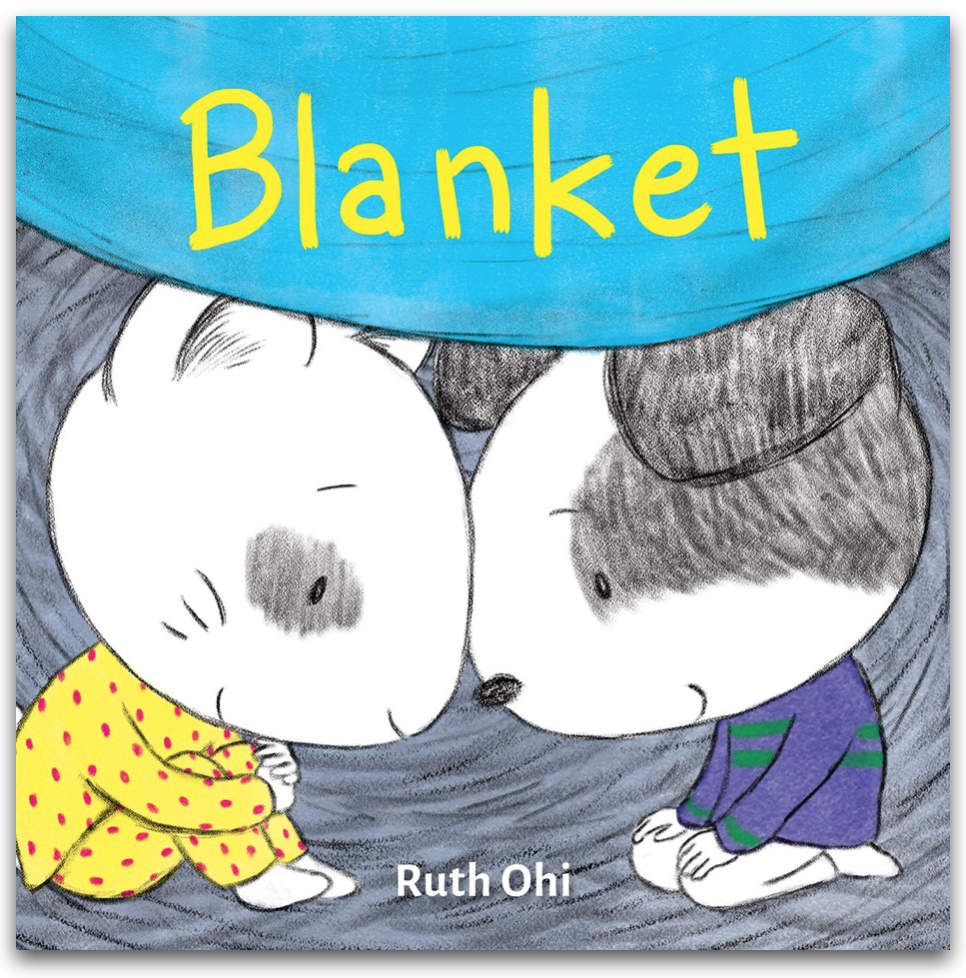
Readers and writers know the power of words. Words can evoke and reassure, anger and subdue, and enlighten and confuse. They can do it all, or it would seem. But sometimes words aren't needed for an impact to be made. Author and illustrator Ruth Ohi makes this subtle and powerful point with her first wordless picture book, Blanket.
From Blanket by Ruth Ohi
Sometimes it doesn't matter if it's sunny outside and the birds are chirping and the flowers are blooming. Inside, really deep inside, is where it can still be grey and that sunshine cannot reach. Yet.
From Blanket by Ruth Ohi
When Cat awakens to the grey inside, they take their turquoise blanket and burrow under it. When Dog shows up, they see the lump that is Cat beneath the blanket, but Dog does not demand anything of Cat. Dog sits down nearby and quietly reads. With time and still beneath the blanket, Cat snuggles over to Dog. Eventually, Cat lifts the blanket and allows Dog to enter and share their protected space.

It's obvious that, while the darkness beneath the blanket offers Cat security, it is also a place where fears can grow and take over. But Dog has a flashlight and the two play with the light before Dog suggests using the blanket to create a shelter over two chairs. It gives Cat the security they need but offers more light and something else. It's a first step to feeling safe enough to venture outside and transform the blanket from shield to shared comforter.
From Blanket by Ruth Ohi

While Ruth Ohi's charming animals are easily recognizable for their sweetness and emotional depth, Blanket is so different from her earlier picture books because of its wordless nature. I've always been delighted with Ruth Ohi's books (e.g., No Help Wanted; Fox and Squirrel, The Best Christmas Ever; Kenta and the Big Wave); still, Blanket is so impressive in its story and messaging that it will sit with me for a very long time. (Though I love sharing books with others, I'll be holding on to Blanket for myself.) Blanket reminds us that, if someone is dealing with sadness or depression, it is not up to others to decide how to help them. When an individual is dealing with an internal greyness, everyone wants to help but seldom–only in dire circumstances–should another decide what is needed. Dog knows this. With time and patience, a flashlight and some playfulness, Dog is able to offer Cat opportunities to come out from the shadows of the blanket. It's still up to Cat when they are ready to move from beneath the blanket into the light. And with few colours and strategic lines of smiles and eyes that are dim and then bright, Ruth Ohi tells us all this in her moving illustrations. Even in the darkness of Cat's sadness, Ruth Ohi has given us light through her art.

A blanket can be so much more than a coverlet for a bed. It can be shelter and armour, defense and offense, and love and fear. It can hide and reveal. This is Cat's blanket. It offers them the opportunity to hide from the world but also reveals Cat as they are to Dog. There is power in that blanket for good and I'm so glad that Cat used it as they needed and that Dog was there to take their cues from Cat.

July 08, 2019

No Help Wanted!

Written and illustrated by Ruth Ohi
North Winds Press (Scholastic Canada)
978-1-4431-6360-6
32 pp.
Ages 3-8
July 2019

Posy would be considered a keener, though in the adult world we might think of her as a bit of a control freak. She insists on taking control of any situation regardless of the efforts others make to share and support. So when Posy is tasked with the classroom job of taking care of their fish Bluey, Posy is all in. She feeds him, reads to him, sings to him and presents him with popsicle-puppet performances. (There are free downloadable pdfs of the jellyfish and fish shapes used, as well as a mask.) But when others offer to join in with their own puppets or play vet, Posy's signs of "Private" and "Keep Out!" make it clear that she is all Bluey needs.
From No Help Wanted! by Ruth Ohi
But, when Bluey starts to look unwell, regardless of Posy's extraordinary efforts, including a full-scale–love the pun!–fish-themed musical, Posy hides his fish bowl behind books, thinking that everyone would blame her.  It's not until she see Bluey resting at the bottom of the bowl that Posy recognizes the need to ask for help. With kindness, the kids ask "What can we do?" and "How can we help?" and come to Posy and Bluey's rescue.
From No Help Wanted! by Ruth Ohi
While Ruth Ohi's artwork was first introduced to youngCanLit readers via the text of others, I'm so glad that she has been writing her own picture books for many years now. From her Chicken, Pig, Cow series, or Fox and Squirrel books, or her many stand-alone picture books, Ruth Ohi always blends important messages about teamwork, compassion, and friendship with text and illustrations that are designed for young, young readers. These stories could be the basis of any character education program. Moreover by ensuring that there is no hyperbole or exhaustive language that reaches beyond the reading abilities and comprehension of her readers. Ruth Ohi sees and tells the story from the perspective children need in order to appreciate the message. As adults, we recognize Posy's enthusiasm for Bluey as somewhat high-handed but young children will just see it as bossy. What they will also see is that bossy kids need to learn how to work with others and that a little help is always welcome and not always a condemnation of efforts made.
From No Help Wanted! by Ruth Ohi (Image retrieved from http://www.ruthohi.com/books-recent#/no-help-wanted/)
Though her text is faultless, precise and communicative, it's still Ruth Ohi's illustrations that will draw children into the story. They will see themselves among the many children of different skin tones and hair types, of different abilities and personalities. One boy is in a wheelchair, a girl wears glasses, and some are shyer relative to Posy's exuberance. In fact, the class itself could be any class from kindergarten with its role-play props, or a Grade 1 or 2 class with numerous books and kids who can read and write. Moreover, by choosing a palette of pencil crayons and watercolours that are light and soft, Ruth Ohi makes sure that the message is swimming in subtlety and far more peaceful than one emboldened in colour and text.

There are many ways to send a message to children and No Help Wanted! finds an affable way in words and art to demonstrate that everyone at one time or another needs a little help and it's okay to ask.
From No Help Wanted! by Ruth Ohi

September 14, 2018

Fox and Squirrel Help Out

Written and illustrated by Ruth Ohi
North Winds Press (Scholastic Canada)
978-1-4431-6320-0
32 pp.
Ages 2-7
August 2018

Teaching young children about empathy is not always easy because our expectations of when they should express empathy does not always jive with their feelings that empathy is necessitated. Programs like Roots of Empathy–a program in which babies visit classrooms so that students might develop their own emotional literacy–work well because children have a natural empathy for babies and those smaller and more vulnerable than themselves. That's why Ruth Ohi's latest picture book, Fox and Squirrel Help Out, her fourth Fox and Squirrel book, provides a literary model for teaching empathy while charming little ones with the honest and endearing friendship of two special friends.

From Fox and Squirrel Help Out by Ruth Ohi
When something falls onto Fox's head, squeaking frantically and loudly, the two friends are flummoxed as to how to help the little creature. Though Fox sees beyond the noise and delights in the bat's warmth and softness, he recognizes the need to appease Squeak. Like a parent or babysitter trying to calm a restless baby, Fox and Squirrel try food and entertainment but it's only when Fox rocks back and forth on one leg that the little guy is calmed and comforted.
From Fox and Squirrel Help Out by Ruth Ohi
Squirrel may be a little disgruntled because Fox insists on focusing on Squeak's needs but it's upon Squirrel's head that Squeak finds the coziness necessary for sleep. But that's only before his real family comes looking for him and Fox and Squirrel must say goodbye.

I know that everyone thinks they can write a picture book but they can't. I get a lot of picture books for review by writers who have not learned what it takes to make one great. Ruth Ohi knows how to do it right, with each and every book she creates. (Check out Kenta and the Big Wave and Shh! My Brother's Napping as two important examples of her work.) Fox and Squirrel Help Out checks off all the boxes: it tells a charming story, with simple but impactful text, which is enhanced with unique illustrations that tell more about the characters and their motivations than the words alone. Ruth Ohi's artistic style which blends daintiness with cartoons invites readers in to her scenes. (Has anyone ever thought of how awesome stuffies of Fox and Squirrel would be?)
From Fox and Squirrel Help Out by Ruth Ohi
I could tell you that Fox and Squirrel Help Out has an important message about the empathy needed to "babysit" a young one who is away from its own family, but anyone who reads the story will get it. The book doesn't preach or need to in order to impress lessons upon the reader.  What is does do is share an anecdote of two friends spending time with another who needs their help. Sure there's acceptance of differences and appreciation of diversity of needs–Squirrel's attempts at entertaining, while adorable, just don't cut it with Squeak– but it's the two friends working together that continues to create the intimacy necessary to speak to children, here helping young ones see that they have the capacity to make things right in the world just on their own scale. It would appear that Fox and Squirrel Help Out more than just a young bat.

••••••••••••••••••••••••
If you head to author-illustrator Ruth Ohi's website at http://www.ruthohi.com/fox-and-squirrel-activities, you can get a variety of Fox and Squirrel activities, including bookmarks, cut-outs for stick puppets, etc. for Fox and Squirrel Help Out, as well as the other three books in the series.

May 16, 2017

I Am Canada: A Celebration

Written by Heather Patterson
Illustrated by Jeremy Tankard, Ruth Ohi, 
Barbara Reid, Jon Klassen, 
Marie-Louise Gay, Danielle Daniel, 
Ashley Spires, Geneviève Côté, 
Cale Atkinson, Doretta Groenendyk,
Qin Leng, Eva Campbell and
Irene Luxbacher
Scholastic Canada
978-1-4431-6304-0
Ages 3+
32 pp.
May 2017

With Canada celebrating 150 years since Confederation in 1867, there will be a plethora of books published solely for the purpose of memorializing that historic milestone for our relatively new country.  Though there has and will be sufficient backlash for praising the birth of a nation amidst the traditional habitation of this land by its Indigenous Peoples, I like to think that we can simply celebrate our land as it is, warts and all, as a glorious amalgamation of peoples and cultures.  This picture book, based on the poem by Heather Patterson and illustrated by thirteen outstanding illustrators, does just that.

The poem, written by Heather Patterson in 1996 and originally put to photographic interpretation (Scholastic Canada, 2006) reads as follows (I've separated lines as they appear in this edition; any errors are solely mine):
I am Canada.
I run, I swim,
I skate, I dance.
I skim over snow
on my toboggan.
I have space.
I read, I learn,
I draw, I dream.
I stay out late and see the
northern lights.
I have time.
I watch, I touch, I listen.
I make up my mind.
I decide to build a castle.
I am free.
I am Canada.
I am cool in summer
and cozy in winter.
I am springing in the spring
and floppy in the fall.
I eat pizza and pierogis
and peppers.
I eat meatballs and muffins
and mangos.
I am quiet,
I am curious,
I am friendly,
I am funny.
I explain, I explore, I enjoy,
I share, I sing, I celebrate.
I am Canada.

Each artist prepared a double-spread illustration to correspond with 1-4 lines of the poem and it's a delightful interpretation and showcase of Canada and its artistry by way of its creators, its landscape and its people.
Portion of illustration by Jeremy Tankard
in I Am Canada: A Celebration
by Heather Patterson
Jeremy Tankard, author-illustrator of Grumpy Bird and Hungry Bird, begins with a drawing of children hiking outdoors heading towards a blazing maple tree.  Ruth Ohi, author of recently reviewed Fox and Squirrel The Best Christmas Ever, brings a lightness of touch in style and content with everyone–families, pets, wildlife–enjoying the outdoors.  Plasticine artist Barbara Reid (Sing a Song of Bedtime) lends her craftsmanship to a winter scene of tobogganing, reminiscent of her award-winning Perfect Snow. Transplanted Canadian Jon Klassen (This is My Hat) focuses on his own outdoor scene of a lone house among bare winter trees amidst the wide open spaces of pristine snow, touched by a single child.  

Creator of Stella and Sam and Princess Pistachio, Marie-Louise Gay plays on the imaginative play that comes from books and learning with daydreaming children envisioning clouds of animals and skies of seas.  Danielle Daniel who burst onto the youngCanLit scene with her award-winning Sometimes I Feel Like a Fox honours our northern regions with a display of brilliant northern lights enjoyed by humans and wildlife alike.  Ashley Spires, author of Binky the Space Cat and The Thing Lou Couldn't Do, moves us to the warmth of a summer on B.C.'s shores for rest and recreation on the sand and in the water.

Simplest of all illustrations is award-winning artist Geneviève Côté's depiction of freedom, a child riding a blue loon embellished with a northern, a forested and an aquatic environments.  Her art, seen in her Mr. King and Piggy and Bunny series, has everything about Canada in the subtlest of depictions.
Illustration by Cale Atkinson 
in I Am Canada: A Celebration 
by Heather Patterson
But there's still more.  Cale Atkinson, illustrator of Vikki VanSickle's If I Had a Gryphon, lends his artwork to an exposé of Canada's four seasons and Doretta Groenendyk (A Harbour Seal in Halifax) provides a multicultural smorgasbord for a diversity of peoples and other animals.  (Have fun picking out all the foods displayed. I counted at least 17!) Perfect for the quiet stylings of prolific illustrator Qin Leng (A Family is a Family is a Family) is a spread about a walk in the woods of Mount Royal in the fall.  Eva Campbell, who illustrated Eric Walters' The Matatu, celebrates exploration and fireworks in her illustration.
Illustration by Qin Leng 
in I Am Canada: A Celebration 
by Heather Patterson
The culminating illustration is from Irene Luxbacher (Mr. Frank) and is perfection as the finale, with a blending of landscapes, indoor and out, and the anticipation of travel across this country.
Portion of illustration by Irene Luxbacher 
in I Am Canada: A Celebration 
by Heather Patterson
While Heather Patterson's words set the tone, it's the artwork of these Canadian illustrators that gives them substance and context.  I Am Canada is truly a celebration of all that is right in our country: the land and its people and the lifeblood they create.

************************************

A French-language version, Le Canada, C'est Moi, uses Geneviève Côté's illustration for its cover. 

November 28, 2016

Fox and Squirrel, The Best Christmas Ever

by Ruth Ohi
North Winds Press, an imprint of Scholastic Canada
978-1-4431-5703-2
32 pp.
Ages 2-7
September 2016

Now that the train of Santa Claus parades has begun and Christmas decorations are splattering front yards and homes throughout the country (yes, I know stores have been on the Christmas bandwagon for months!), it feels right to start reviewing some Christmas-themed books.   With Ruth Ohi’s Fox and Squirrel (Fox and Squirrel, 2013; Fox and Squirrel Make a Friend, 2014) making their own plans for the holidays, this might just get everyone else in the mood too.
From Fox and Squirrel, The Best Christmas Ever 
by Ruth Ohi
Once the snow comes, the two unlikely friends are definitely excited about Christmas. But while Fox is enjoying playing in the snow, Squirrel is enthusiastically planning colours, foods and starting a tower of evergreen twigs and red berries.  When Fox wants to help, Squirrel emphatically, almost rudely, fends him off, telling him, “Don’t touch! You’ll ruin it.” (pg. 11)

From Fox and Squirrel, The Best Christmas Ever 
by Ruth Ohi
Squirrel continues to go deeper into the forest, looking for more touches for his Christmas creation, until he realizes he cannot find his way back.  Fortunately, though chastized, Fox continued to try to contribute and was there with his friend to help make their way home.  With an apology and forgiveness, and the partnering of true friends, Fox and Squirrel do make the best Christmas ever.
From Fox and Squirrel, The Best Christmas Ever 
by Ruth Ohi
It’s hard not to love Ruth Ohi’s Fox and Squirrel (actually all her characters). Their eyes beam with joy, their mouths laugh with happiness, and their camaraderie is infectious.  In Fox and Squirrel, the Best Christmas Ever, the two are able to work through the ever-common stress of the holidays and find it’s the gift  of their friendship that makes the season.  This is sweetly conveyed in Ruth Ohi’s words, primarily simple dialogue between Fox and Squirrel, but more so in her cartoon-like illustrations of the two companions.  Their large oval heads with half-faces and bellies of white may be distinct, but it’s the body language and facial expressions that Ruth Ohi communicates with limited strokes that make Fox and Squirrel the lovable creatures they are.  In their watercolour landscapes of snow-covered fields, falling flakes, evergreens, and majestic trunks of bare deciduous trees, Fox and Squirrel exude affection for each other and life, and young readers will feel welcomed to enjoy the snow and the season with the two friends.
 
****************************************

Downloadable activities plus cards and bookmarks are available at Ruth Ohi’s website at http://www.ruthohi.com/fox-and-squirrel-winter-fun

The French-language version, Rikii et Rouquin, Le plus beau Noël (texte français de Josée Leduc) is also available.

March 23, 2014

Shh! My Brother's Napping

Written and illustrated by Ruth Ohi
North Winds Press/Scholastic Canada
978-1-4431-1993-1
32 pp.
Ages 3-7
For release April 2014

When Mommy and her boys return from grocery shopping, it is evident that baby brother needs to rest.  He's already sleeping in his stroller, and Mommy insists that everything be kept quiet because he's napping.  In rhyming verse, Ruth Ohi shares the older brother's reminders from Mommy and himself about his sleeping brother, though he is still a young child himself and interested in making music with pots and pans, and wanting to include his little brother in his fun. He does soon realize that there are lots of activities that he can do quietly, like reading and painting.  Of course, he may know that he's supposed to be quiet, but the illustrations indicate that his actions don't always focus on the quiet aspects.  After all, reading can be quiet, if you don't throw your book when it gets scary.  And painting can be very calming and silent, as long as you don't take your paintbrush to your little brother's face.  And building a town of blocks and books is very structured, unless it falls.  But it's the reciprocity of their relationship that brings this story to its surprisingly appropriate conclusion.

Everyone knows Ruth Ohi from her darling books about Chicken, Pig, Cow (Annick Press), siblings, and most recently Kenta and the Big Wave (Annick, 2013; reviewed here).  As in most of her books, including those she illustrates for others, Ruth Ohi speaks to relationships between friends or family members, both positive and those in need of reconciliation.  Here big brother knows what he should be doing, as Mommy reminds him, "Shh! Your brother's napping." He tries to follow Mommy's instructions and do quiet activities like reading, painting, and block-building, though it is hard when there's so many fun things to do, including with your little brother.  There is no evident meanness or sibling rivalry, just the desire for the boy mouse to include his baby brother in his play, though not always in the most thoughtful of manners.  In fact, when little brother does awaken and the two siblings start to interact, baby brother recognizes the need to reciprocate that kindness of quiet.  Well, maybe.  Shh! My Brother's Napping is a delightful tale of sibling love from several angles, including the one from which Mommy observes them.

September 17, 2013

Kenta and The Big Wave

Written and illustrated by Ruth Ohi
Annick Press
978-1-55451-576-9
32 pp.
Ages 4-7
July, 2013 

Most Canadian young readers will recognize Ruth Ohi's distinct style of illustration which blends softness with gravity and whimsy. (I know, how is that possible?) Check out Hazel Hutchins' Nicholas at the Library (Annick Press, 1990) and The Sidewalk Rescue (Annick Press, 2004) and Joy Kogawa's Naomi's Tree (Fitzhenry & Whiteside, 2010) and Naomi's Road (Fitzhenry & Whiteside, 2005) to see how Ruth Ohi has taken others' text and magnified it into astounding stories.  With her own books, including Chicken, Pig, Cow (Annick Press, 2008) series, Clara and the Bossy (Annick Press, 2006) and Me and My Sister (Annick Press, 2005), Ruth Ohi has found the means to share compassionate stories that teach about getting along with others. While focusing on a historical event, Ruth Ohi brings these same virtues to her newest Kenta and The Big Wave.

Based on the tsunami that hit the coast of Japan in 2011, Kenta and his family are part of the population that responds to the sirens and evacuates to higher ground and the shelter of the school gym.  With each step of Kenta's family's journey to safety and in dealing with the aftermath of the devastation, Kenta's beloved soccer ball travels across the turbulent ocean.

While Kenta and The Big Wave may seem a simple story with a happy ending with regards to a boy's lost soccer ball, it has far greater depth in its story-telling and illustrations.  Ruth Ohi ensures that the reader understands the breadth of the tsunami's destruction and the effects on Kenta's community first and foremost. The overwhelming waves on double-page spreads fully engulfing the soccer ball are reminder enough.  But, although she never trivializes the context of Kenta's soccer ball story, she tenderly demonstrates how important that ball is to him.

I know that Kenta and The Big Wave will touch many readers, though I suspect there will be many a teacher who will recognize the multitude of teachable moments in the book: perspective, compassion, loss, grief, generosity and tsunamis.  Here is a story that explains, with kindness, that which seems almost inexplicable.