Showing posts with label Jon Klassen. Show all posts

April 15, 2026

Jon Klassen Wins the 2026 Astrid Lindgren Memorial Award

Jon Klassen is an author-illustrator whose debut picture book, I Want My Hat Back, garnered him numerous awards and much acclaim. With each new title, including those he illustrated for others, the praise for his unique style of art and storytelling through illustration has grown. This week, Jon Klassen was awarded the 2026 Astrid Lindgren Memorial Award, the international children's literary award. 
Photo credit: Carson Ellis
 
This award administered by the Swedish Arts Council honours the late Swedish writer Astrid Lindgren (1907-2002) who wrote over 30 books for children, including the ever-popular Pippi Longstocking. "The statutes of the Astrid Lindgren Memorial Award stipulate that laureates shall be authors, illustrators, storytellers or reading promoters whose work or activity for children and young adults is 'of the highest artistic quality' and 'conveys the deeply humanistic spirit associated with Astrid Lindgren.'" (From https://alma.se/en/the-award/astrid-lindgren/in-the-spirit-of-astrid-lindgren) At five million Swedish kronor, the Astrid Lindgren Memorial Award is the largest book award of its kind.
 
I Want My Hat Back (Candlewick, 2011) (board book edition reviewed in 2019)
This Is Not My Hat (Candlewick, 2012)
We Found a Hat (Candlewick, 2016)
The Rock from the Sky (Candlewick, 2021)
The Skull (Candlewick, 2023)
 
The breadth of Jon Klassen's storytelling through words and illustrations is best described as powerfully minimalist. He tells little but suggests much. In each of the books he wrote and illustrated, Jon Klassen mesmerizes with the power of story. 
 
I was delighted to interview Jon Klassen in 2021 about his book The Rock from the Sky and I'd like to share that discussion here. His commentary on the story and his artwork is fascinating, and gives readers insight into his creativity and his singularity of finesse.
 
Do check out the full details about Jon Klassen as the 2026 laureate of the Astrid Lindgren Memorial Award, including a recording of the announcements at the Bologna Children's Book Fair, quotes from the jury, and even a recording of the phone call Jon Klassen received. The award will be presented by H.R.H. Crown Princess Victoria of Sweden this May in Stockholm.
 
Heartiest congratulations 
to the newest laureate of 
the Astrid Lindgren Memorial Award
 Jon Klassen 

April 06, 2026

Now I See . . . board book series

Written by Mac Barnett
Illustrated by Jon Klassen
Tundra Books
24 pp.
Ages 2–5
April 2026 
 
There are only 35 words in the four board books in Mac Barnett and Jon Klassen's new series, Now I See. That's because each book has the same 35 words, in the same order, and describing almost the same things. What changes is what is happening to the people and places over the four different seasons, and that is communicated with the dramatic and yet straightforward artwork of Jon Klassen.
 
The four books are as follows:

 
Now I See Spring
978-1-77488-673-1


Now I See Summer
978-1-77488-677-9


Now I See Fall
978-1-77488-665-6


Now I See Winter
978-1-77488-669-4


In each book, a double-page spread focuses on an illustration of one element and then its identification. They are the house; the tree; the garden; me (shadow of a child on the side of a house); some birds; a treat (that's nice and sweet); the farm; the sky; the wise old cat; something red; and the perfect hat. The final text is a declaration that, "it's my favorite time of the year." But, in each book, each element is a little different. The tree might be leafing out in Now I See Spring, fully green in summer, losing its red leaves in the fall, and bare in the winter. Each season brings something different in where we live, what we wear, what we like to eat, and what we see. And they are all true.
From Now I See Spring, written by Mac Barnett, illustrated by Jon Klassen
Mac Barnett and Jon Klassen collaborate to produce extraordinary books. There's their Caldecott Honor books Extra Yarn (2012) and Sam and Dave Dig a Hole (2014)—Jon Klassen won the Caldecott Medal for his own This Is Not My Hat (2012)—and their Shape trilogy of Triangle (2017), Square (2018) and Circle (2019). The Now I See books equal these earlier books in their verve, teaching an important concept without instruction. They teach by helping children make observations and connect to that which they experience in their own lives. And, by reading all four books together, children will see how the seasons change and their reading of simple words, repeated in each book, will be reinforced.
From Now I See Winter, written by Mac Barnett, illustrated by Jon Klassen
Mac Barnett gets the text right by keeping the words simple—mostly articles and nouns—and giving them rhythm, though not necessarily rhyme. The text has a quiet pep to it, carrying the reader from one scene to another. And Jon Klassen's watercolour and digital art is the ideal medium for giving a lot in an unambiguous way. His lines and shapes give us the seasons with their distinctions, emphasizing both colour and shape to the familiar and perhaps less familiar. 
From Now I See Summer, written by Mac Barnett, illustrated by Jon Klassen
Exceptional concept books are those that do more than teach. They delight with their words, they charm with their artwork, and they engage readers by inviting them to be part of the story. Mac Barnett and Jon Klassen's Now I See series is fresh in its exceptionality.

May 25, 2023

The Skull: A Tyrolean Folktale (Canadian Edition)

Written and illustrated by Jon Klassen
Candlewick Press
978-1-5362-2337-8
112 pp.
Ages 6-9
July 2023

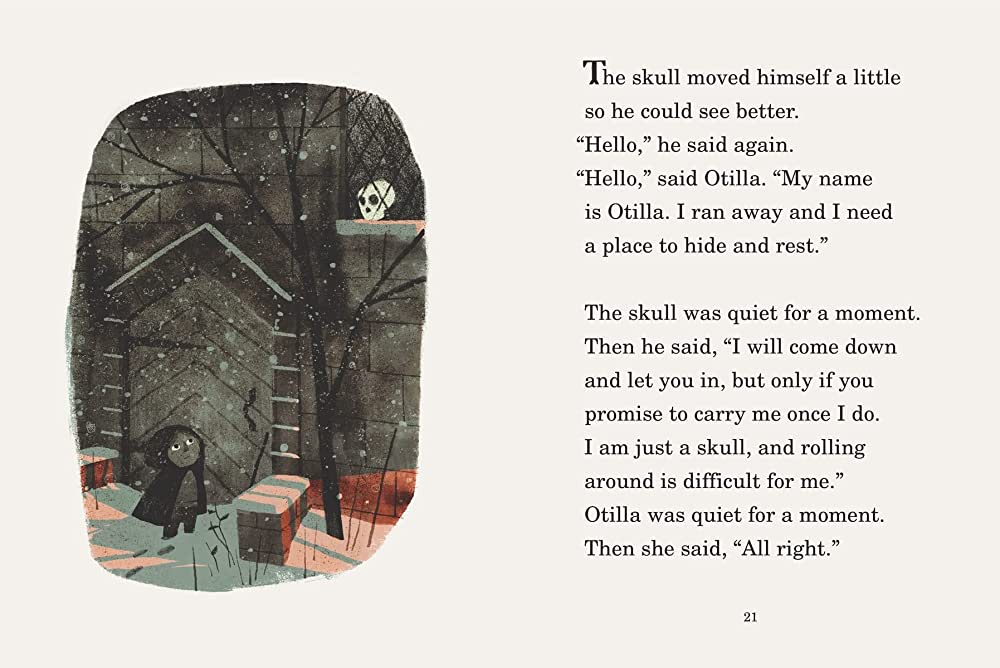
Once upon a time there was a little girl named Otilla who ran away in the dark and cold of a winter night. She heard her name being called but could not tell the source. As she struggled, even falling in the snow, scared and crying, she reaches the end of the woods and finds a large, old house with a skull in the window.
From The Skull by Jon Klassen
When she asks for shelter, the skull agrees but only if she will carry him because he is tired of rolling everywhere. (It did take him a long while to open the door for her.) Inside, he shows her around, including a garden room, a dungeon with a bottomless pit, a magnificent ballroom, and a great room in which he'd enjoyed tea by the fire under his portrait.
From The Skull by Jon Klassen

Before they head to bed, he warns her that a headless skeleton comes around looking for him, but he doesn't want to go with the skeleton. Otilla devises a plan. As the two sleep in a lovely bed, the skeleton appears, shouting, "GIVE ME THAT SKULL. I WANT THAT SKULL." (pg. 61) Otilla grabs the skull and carries it to the tower balcony, the skeleton chasing them all the way. Standing back, she lets the skeleton look over the edge before pushing it off.

But Otilla is a clever girl, and she knows that that may not be the end of the skeleton, so she finds a way to make sure it never comes back, and, in doing so, finds herself a new home.
From The Skull by Jon Klassen
If it weren't for the fact that there is no ghost, I would call this a ghost story. It's the kind of story that could be told around a campfire or at a sleepover or on Halloween. But, because The Skull is also from Jon Klassen, it has dry humour, remarkable artwork, and a touch of sweetness. The humour comes in dark playfulness, like Otilla feeding the skull pears and tea that go right through him but which he still enjoys. And the graphic and ink artwork in quintessentially Jon Klassen: dark and sombre with limited splashes of grey green and peach. From the chilling forest to the monolithic house of shadows and stone, Jon Klassen sets The Skull in places of gloom. Yet he pulls out some tenderness for both Otilla and the skull.  She, who has run away from an unknown situation, is able to connect with a skull who needs her help as much as she needs his. She carries him around like a stuffed animal, both respectful and comfortable, and she puts him to sleep so that she can take care of the skeleton's broken bones. There may be a skeleton and a skull and a creepy house and a scared little girl, but The Skull is more than a ghost story. It's one of reciprocity and compassion. With reciprocity comes connection and with connection comes benefit. And, with that, comes a happy ending.

April 16, 2021

Interview with Jon Klassen, author-illustrator of The Rock from the Sky

The Rock from the Sky
Written and illustrated by Jon Klassen
Candlewick Press
978-1-5362-1563-2
96 pp.
Ages 4-8
April 2021
 
After yesterday's review of Jon Klassen's picture book, The Rock from the Sky, I had the pleasure of interviewing the author-illustrator about his newest creation. Here is that Q & A.

Jon Klassen, author-illustrator of The Rock from the Sky

HK:  Between the little hats worn by Turtle and Armadillo, and the rock hanging in the air, I suspect that you’re a fan of the surrealist artist René Magritte.  Is this actually the case or is there another influence that inspires your art?

Jon Klassen:  I am a Magritte fan for sure – I don’t think I used to be, but I’ve come around – though the hats and the rock have other sources too. The bowler hats I think do a few jobs, referentially – Magritte, but also Laurel and Hardy, since I think of these stories as kind of like little comedy skits, and also Samuel Beckett’s Waiting for Godot. I’m not positive they wore bowler hats in that, but it feels like they did, and Beckett’s work generally has been a big deal for me. The rock itself is very Magritte, I agree, though there’s a weird reference for that one too – the first Edward Gorey drawing I remember seeing was on the cover of an edition of The 39 Steps by John Buchan and it’s just a drawing of a huge rock hanging in the sky over a flight of stairs going down a cliff, and it had a really big effect on me. I still love that drawing.

 
HK:  Was the germ of an idea from which The Rock from the Sky arose Magritte’s work The Castle of the Pyrenees or  something else altogether?
 
Jon Klassen:  I think it actually arose mostly from a talk I heard Alfred Hitchcock give on the nature of suspense, and how you could make an interesting scene out of a group of people sitting around a table talking about something very boring if you had told the audience ahead of time that there was a bomb under the table that would go off in 5 minutes. I enjoy drawing characters doing next to nothing, but I need some sort of setup that gives me permission to have pictures like that, so the rock from the sky was my “bomb under the table.” I really have been drawing rocks for like 15 years just hoping there will be a story for them some day. The back cover of the book, and the spreads where it’s just the rock in the sky, are kind of why I started the book in the first place.

 
HK:  Though there are only three characters–Turtle, Armadillo and Snake–and minimal dialogue and action, they are clearly distinct, especially Turtle and Armadillo. Why choose a turtle, an armadillo and a snake for your characters in The Rock from the Sky?
 
Jon Klassen:  They were kind of intuitive choices. I wanted this book to kind of connect with the other books I’d done, almost like the bit players from those books that finally got to put on their own show. The turtle was useful, practically speaking, since he moves slowly and it helps contrast with the rock falling. The armadillo-type guy just looks kind of humble, but also I think of him as kind of a man alone, out in the sticks a little more, so maybe he’s wise that way, kind of knowing. The snake just made me laugh. Snakes scare me badly in real life, so making him mute and kind of unknown to us was the best I could do. Also, he doesn’t get a bowler hat. I think he would have wanted one but there were only two so he had to settle for the beret.

 
HK:  Although we don’t actually know the source of the rock other than the sky, there is a suggestion that it is other-worldly. Why use a rock then, something so commonplace and familiar, rather than an unrecognizable structure, similar to the alien creature?
 
Jon Klassen:  I like the word “rock,” firstly, and as I say I really like drawing them. It’s such a blunt thing, and there’s no questions about it. If it was some kind of otherworldly structure, there would be all sorts of problems to solve that I wouldn’t know how to solve. It kind of reminds me of what I read about the making of 2001: A Space Odyssey where they had all these initial complicated ideas for what some kind of alien beacon would look like, but in the end they kind of had to admit there was no knowing, and the black monolith they finally used became almost a visual admission of that. We just don’t know. 

HK:  The book is divided into five parts which is different from your earlier picture books. While each chapter progresses the story, from the rock’s arrival and the animals’ interactions with it until the ending, each part still tells its own tale. It reminds me of I Want My Hat Back, This is Not My Hat, and We Found a Hat, which were written as three different books but are linked.  Did you write The Rock from the Sky as individual stories ever or were they always destined to be part of one? 
 
Jon Klassen:  I wrote the first story on its own, but kind of knowing that, even if I solved it, it was going to be too light to justify a whole book. But when it was done, I had these three characters who I knew something about, and I had a rock sitting there, and I wanted to see what the next little while felt like after it showed up, even if it didn’t do anything. The idea that their lives just kept going and their relationship problems just kept puttering along in the face of this thing, and all that it implied, was fun to think about. Cause you kind of have to keep going. What else are you going to do?


HK:  Though your humour is incredibly sophisticated in its layering and messaging, kids get it, even if differently from adults. Do you find yourself rethinking how you present a story to make sure it’s accessible for all or do you endeavour to always match the audience for which the book is slotted?
 
Jon Klassen:  I sort of ride the middle between myself and the kids, I think. If I’m interested, or laughing, or whatever I’m hoping will happen to an audience, that’s about the best I can hope for, and then the job isn’t so much to think about what they’re going to take out of it, but what they’ll understand, event-wise. Clarity in the words and the pictures, so that even little kids are given a good shot at least getting what’s physically going on, is a big goal and takes up a lot of my time. But past that I don’t find I’m very good at adjusting for different audiences or guessing who is going to get what.

 
HK:  The audience suggested for The Rock from the Sky is for readers of ages 4 to 8. I think that the book is sophisticated enough for older readers. In fact, I could even see it becoming one of those classics like Where the Wild Things Are or The Little Prince that were written for children but revered by adults who derive deeper meaning from the text and art. For whom did you write The Rock from the Sky?
 
Jon Klassen:  That is a very very nice thing to say. I do always hope that adults will like the books too, or at least understand what interested me about making them. You don’t want anyone to think you were bored. Who I have in my head when I’m making them I think is sort of a murky mixture, kind of ghosts fading in and out. It’s me now, it’s me as maybe a second or third grader, which is when I remember a lot of these books really connecting, but it’s also friends I had then, my brothers as they were then, my parents. I remember being kind of a ham at family reunion dinners and things like that, and that table was about 25 people, and I probably think of that size crowd at a maximum. That’s the room I know how to play to, even if everyone would rather just be eating.

 
HK:  Your art is described as created digitally with watercolours. Do you start with watercolour and then work with it digitally or are some images digitally rendered? Essentially what I’d like to know is where you start and how your progress to end up with such austere but powerful illustrations.
 
Jon Klassen:  Any austerity comes from the roughs, I think. My stories kind of live and die based on characters facing a certain way or walking from one spot to another one, and that has to be clear so I try not complicate it, visually. The roughs are all big shapes and big decisions, so I can have fun inside those shapes later but I know what their job is going to be also. I’m not looking for the final rendering of anything to carry the story, or the book, it’s just there to make it look better and hopefully add to the mood. Once the roughs are done and I know where everything is going to go, I do a lot of versions of the separate pieces - the skies, the ground, the rocks, the characters, and try and allow for happy accidents in there, knowing I can control things later. Then I just pick out my favourite ones and assemble them on the page. The digital part comes in when everything is on the page together and I want to make it all look cohesive. It’s a very relaxing way to work, usually, because there’s no phase that seems super high stakes, and I really enjoy enhancing or subduing all the weird things the paint does, but minding that it doesn’t take over or distract from the story, either.

 • • • • • • •
 
Interviewing Jon Klassen has been such a treat for me. 
I've admired his work since the publication of his first book 
I Want My Hat Back 
released in the month prior to this blog's inception.
I continue to be impressed by the depth of his work 
and this interview supports the validity of that assessment. 
 
So, many thanks to Jon Klassen for responding to my questions.


Thanks also to Sarah Dunn
Marketing and Publicity Director at ZG Stories,
for facilitating this interview.

April 15, 2021

The Rock from the Sky

Written and illustrated by Jon Klassen
Candlewick Press
978-1-5362-1563-2
96 pp.
Ages 4-8
April 2021
 
With his characteristic grim humour and understated but commanding illustrations, Jon Klassen returns with a new extended picture book (96 pages) to take on a story of fate, pride and connection. It is both of our world and not.
 
From The Rock from the Sky by Jon Klassen
In a series of five separate stories, each numbered and titled, Jon Klassen chronicles the interactions between a turtle, an armadillo, a snake and a rock. In the first, The Rock, the hat-wearing turtle–Jon Klassen does like his hats– has positioned himself at his favourite spot beside a rose-coloured flower. Though the reader can see, in the next double-spread, a massive rock suspended in the air, Turtle is oblivious. When Armadillo, in his own bowler, comes along and gets a bad feeling, he checks out a spot farther away beside a leafy stem where the beret-wearing Snake joins him. As Turtle shouts at them that his spot is better, approaching them to be heard, the massive rock drops onto Turtle's favourite spot.

From The Rock from the Sky by Jon Klassen
In The Fall, Turtle has climbed up upon the rock and fallen off onto his back. As can happen to any turtle, he is stuck, but he refuses to acknowledge to a concerned Armadillo that he had been climbing or that he had fallen. Moreover, he refuses the very help he requires.

I never need help.
OK.

What are you doing?
I came to take a nap.
It is nice under here.
You can take a nap
too, if you want.
There is just enough 
room for two.

No. I am not tired.
OK.

As such, the two acquaintances remain in place, with Turtle wide awake and stuck on his back, and still stubbornly refusing help, while Armadillo naps.
 
The third story, The Future, has contemplative Armadillo thinking about the future and what might grow and become of the area around the rock. But his imagination reveals a one-eyed, multi-legged creature as tall as the rock, sending out laser waves and blasting a flower into a charred mess before Turtle decries that...
I don't want to imagine into the 
future with you anymore.
Ever pensive, Armadillo ponders the beauty of the setting sun when Turtle approaches him and Snake in The Sunset. Shouting from far away, Turtle demands to know what they're doing. Of course, he cannot hear their responses so he just comes closer and closer until he misses the sunset completely, never stopping to notice it.
From The Rock from the Sky by Jon Klassen
Feeling disregarded by the sleeping Armadillo and Snake in No More Room, the final chapter in The Rock from the Sky, Turtle leaves, affronted by their apparent rejection. Turtle suggests that perhaps he will go away and never come back, shouting at them to ensure they hear him. Thinking they still cannot hear him, he approaches while repeating his message. However, Armadillo and Snake are quite awake now, seeing the strange creature behind the oblivious Turtle. Once again, Turtle has no idea what a close call he's going to have.
From The Rock from the Sky by Jon Klassen
Though there is much simplicity in the dialogue between Turtle and Armadillo–Snake does not speak–Jon Klassen uses subtle distinctions to embed more meaning in the story of the three acquaintances, perhaps even friends, who are as different in attitude and intention as a turtle, an armadillo and a snake might be. Through font colour and capitalization, Jon Klassen differentiates between his characters and the nature of their voices. He portrays Turtle as a proud and even tedious character who sees little beyond himself, never wanting to look anything but capable. Armadillo, on the other hand, is imaginative and attentive, both insightful and considerate while never arrogant. And Snake? He just is, taking things at face-value. Armadillo is the quiet leader, Snake the congenial follower, and Turtle the naive but self-important simpleton. Their fates and their connection with each other are what give The Rock from the Sky their stories.

Of course, Jon Klassen's distinction is in his artwork, having won the Governor General's Award for Children's Illustration, as well as the prestigious Caldecott and Kate Greenaway Medals. The Rock from the Sky is no less distinguished than his earlier award-winning books, especially those whose stories he penned like This is Not My Hat. The art, created digitally with watercolours, is authoritative. It is both organic, in line and shape and most definitely colour, but also otherworldly, importing the surreal or perhaps alien, to help us see better how things truly are.

I know many people think picture books are only for children but The Rock from the Sky is so sophisticated in its art and wry storytelling that I encourage it be read by all. It has a wicked tongue-in-cheek story about seeing what is in front of you, or above you, and ahead of you, and about listening to make sure you don't miss the obvious. I hope I was able to see and hear adequately to experience the true nature of Jon Klassen's extraordinary tale.

✪ ✪ ✪ ✪ ✪ ✪ ✪

I'm so excited to announce that tomorrow I'll be posting an interview I had with author and illustrator Jon Klassen about The Rock from the Sky. It was a thrill to get his perspective on his inspirations for The Rock from the Sky and to learn more about the process by which he created his new book. Do check back tomorrow for this special posting.

✪ ✪ ✪ ✪ ✪ ✪ ✪

March 06, 2019

Circle

Written by Mac Barnett
Illustrated by Jon Klassen
Candlewick Press
978-0-7636-9608-5
48 pp.
Ages 4-9
March 2019

Young readers met Circle and her friends Square and Triangle in Mac Barnett and Jon Klassen's earlier books in the Shape trilogy, Triangle (Candlewick, 2017) and Square (Candlewick, 2018), but now it's Circle's turn to reveal herself. In each of the books, the shape at its centre have dealt with personal issues of trust and self-confidence and, above all, friendship, and now Circle finds herself similarly challenged in this final book in the Shape trilogy.
From Circle by Mac Barnett and Jon Klassen


Circle and her friends Square and Triangle are playing a game of hide-and-seek near Circle's waterfall but she insists that they cannot hide behind the waterfall. But Triangle chooses to do just that and Circle slips in behind the falls to find him.
From Circle by Mac Barnett and Jon Klassen
It is very dark in the cavern behind the falls but, as Circle goes in farther, calling out to Triangle, it becomes pitch black. Only Circle's eyes are visible until a second pair appears. As Circle chastizes Triangle for his rule-breaking and disregard for his friends, the second pair of eyes remains silent. Finally Circle apologizes for her rant and tells Triangle that they love him, just as a third pair of eyes appear behind Circle with Triangle's voice thanking Circle for her declarations. Then things get a little harried as the two realize the third set of eyes does not belong to their friend, though in hindsight, Circle recognizes something highly relevant.
"You know," she said, "that shape in the dark might
not have been bad. It might have been a good shape.
We just could not see it."
From Circle by Mac Barnett and Jon Klassen
Let's talk about the subtlety of message which is perfectly understated for the very young for whom this board book was written. Kids will know about playing and rules and friends and getting frustrated and angry and then taking all back. They'll know about being afraid of the dark and confronting their fears. But, while Circle speaks to all that, in the hands of that dynamic duo of American Mac Barnett and Canadian Jon Klassen, it also speaks to larger issues of forgiveness and tolerance. Big concepts for a little book but presented in such a sophisticated way that it will permeate any barrier.
From Circle by Mac Barnett and Jon Klassen
There is a quietness to Jon Klassen's earthy illustrations, created with a combination of coloured pencils, gouache and crayons, evoking the natural setting for the stories of the three shape friends. Like the rocks and the cavern and the shapes themselves, the illustrations have substance but are not oppressive, while giving hints of harmony and freshness with the touches of mint green for Circle's waterfall. It's so easy to fall into Jon Klassen's art and swim around, even if in the pitch darkness of the deepest depths of that cavern.

I am sorry to see this trilogy end but I am ever hopeful that the partnership of Mac Barnett and Jon Klassen will continue, as it should, to add to the canon of picture books that tell powerful stories with distinction and without preaching.
Shape trilogy by Mac Barnett and Jon Klassen

February 13, 2019

I Want My Hat Back

Written and illustrated by Jon Klassen
Candlewick Press
978-1-5362-0757-6
40 pp.
Ages 3-8
New edition for release March 2019

With the release of this new board book edition of Jon Klassen's award-winning I Want My Hat Back, I am pleased that I can review this gem and introduce new readers to this delightful story. Originally published in 2011, a year before I started this blog, I missed out on reviewing Jon Klassen's first picture book, though I remember well sharing it with little ones.
From I Want My Hat Back by Jon Klassen
A bear has lost his hat and seeks it by asking a fox, a frog, a rabbit, a turtle, a snake, and an armadillo, "Have you seen my hat?" Their answers are varied, some confused, some preoccupied, and some defensive but all are negative. Ever polite, even helping a turtle to climb a rock, the bear often replies with a "Thank you anyway."
From I Want My Hat Back by Jon Klassen
It's not until a deer asks the bear what the hat looks like that he realizes he did see his hat. Mystery solved but what will bear do to get his hat back?
From I Want My Hat Back by Jon Klassen
Those who've read this book will all remember the twist that I Want My Hat Back takes and those who have not are in for a surprise but one that requires little ones to read the clues. From a series of repetitive enquiries to the revelation of the theft and finally the bear's response, both evident and not, I Want My Hat Back propels the reader from beginning to end, with subtle but dark humour that suggests consequences for actions.

In I Want My Hat Back, as well as in its sequels This is Not My Hat (Candlewick, 2012) and We Found a Hat (Candlewick, 2016), Jon Klassen beguiles with his simple but characteristic illustrations of animals and their landscapes. But the simplicity is hardly unsophisticated. It may be more reminiscent of folk art with its clarity of line and austere backgrounds but the art is punchy, just like the story. Bear may get his hat back but it's not a happy ending for the rabbit. Be prepared. Life is like that. And isn't grand that there are those like Jon Klassen who recognize that children's books don't need to be sugar and unicorns to be exceptional and appreciated?
Jon Klassen's hat trilogy

May 16, 2017

I Am Canada: A Celebration

Written by Heather Patterson
Illustrated by Jeremy Tankard, Ruth Ohi, 
Barbara Reid, Jon Klassen, 
Marie-Louise Gay, Danielle Daniel, 
Ashley Spires, Geneviève Côté, 
Cale Atkinson, Doretta Groenendyk,
Qin Leng, Eva Campbell and
Irene Luxbacher
Scholastic Canada
978-1-4431-6304-0
Ages 3+
32 pp.
May 2017

With Canada celebrating 150 years since Confederation in 1867, there will be a plethora of books published solely for the purpose of memorializing that historic milestone for our relatively new country.  Though there has and will be sufficient backlash for praising the birth of a nation amidst the traditional habitation of this land by its Indigenous Peoples, I like to think that we can simply celebrate our land as it is, warts and all, as a glorious amalgamation of peoples and cultures.  This picture book, based on the poem by Heather Patterson and illustrated by thirteen outstanding illustrators, does just that.

The poem, written by Heather Patterson in 1996 and originally put to photographic interpretation (Scholastic Canada, 2006) reads as follows (I've separated lines as they appear in this edition; any errors are solely mine):
I am Canada.
I run, I swim,
I skate, I dance.
I skim over snow
on my toboggan.
I have space.
I read, I learn,
I draw, I dream.
I stay out late and see the
northern lights.
I have time.
I watch, I touch, I listen.
I make up my mind.
I decide to build a castle.
I am free.
I am Canada.
I am cool in summer
and cozy in winter.
I am springing in the spring
and floppy in the fall.
I eat pizza and pierogis
and peppers.
I eat meatballs and muffins
and mangos.
I am quiet,
I am curious,
I am friendly,
I am funny.
I explain, I explore, I enjoy,
I share, I sing, I celebrate.
I am Canada.

Each artist prepared a double-spread illustration to correspond with 1-4 lines of the poem and it's a delightful interpretation and showcase of Canada and its artistry by way of its creators, its landscape and its people.
Portion of illustration by Jeremy Tankard
in I Am Canada: A Celebration
by Heather Patterson
Jeremy Tankard, author-illustrator of Grumpy Bird and Hungry Bird, begins with a drawing of children hiking outdoors heading towards a blazing maple tree.  Ruth Ohi, author of recently reviewed Fox and Squirrel The Best Christmas Ever, brings a lightness of touch in style and content with everyone–families, pets, wildlife–enjoying the outdoors.  Plasticine artist Barbara Reid (Sing a Song of Bedtime) lends her craftsmanship to a winter scene of tobogganing, reminiscent of her award-winning Perfect Snow. Transplanted Canadian Jon Klassen (This is My Hat) focuses on his own outdoor scene of a lone house among bare winter trees amidst the wide open spaces of pristine snow, touched by a single child.  

Creator of Stella and Sam and Princess Pistachio, Marie-Louise Gay plays on the imaginative play that comes from books and learning with daydreaming children envisioning clouds of animals and skies of seas.  Danielle Daniel who burst onto the youngCanLit scene with her award-winning Sometimes I Feel Like a Fox honours our northern regions with a display of brilliant northern lights enjoyed by humans and wildlife alike.  Ashley Spires, author of Binky the Space Cat and The Thing Lou Couldn't Do, moves us to the warmth of a summer on B.C.'s shores for rest and recreation on the sand and in the water.

Simplest of all illustrations is award-winning artist Geneviève Côté's depiction of freedom, a child riding a blue loon embellished with a northern, a forested and an aquatic environments.  Her art, seen in her Mr. King and Piggy and Bunny series, has everything about Canada in the subtlest of depictions.
Illustration by Cale Atkinson 
in I Am Canada: A Celebration 
by Heather Patterson
But there's still more.  Cale Atkinson, illustrator of Vikki VanSickle's If I Had a Gryphon, lends his artwork to an exposé of Canada's four seasons and Doretta Groenendyk (A Harbour Seal in Halifax) provides a multicultural smorgasbord for a diversity of peoples and other animals.  (Have fun picking out all the foods displayed. I counted at least 17!) Perfect for the quiet stylings of prolific illustrator Qin Leng (A Family is a Family is a Family) is a spread about a walk in the woods of Mount Royal in the fall.  Eva Campbell, who illustrated Eric Walters' The Matatu, celebrates exploration and fireworks in her illustration.
Illustration by Qin Leng 
in I Am Canada: A Celebration 
by Heather Patterson
The culminating illustration is from Irene Luxbacher (Mr. Frank) and is perfection as the finale, with a blending of landscapes, indoor and out, and the anticipation of travel across this country.
Portion of illustration by Irene Luxbacher 
in I Am Canada: A Celebration 
by Heather Patterson
While Heather Patterson's words set the tone, it's the artwork of these Canadian illustrators that gives them substance and context.  I Am Canada is truly a celebration of all that is right in our country: the land and its people and the lifeblood they create.

************************************

A French-language version, Le Canada, C'est Moi, uses Geneviève Côté's illustration for its cover. 

November 17, 2014

Jon Klassen: Author/Illustrator Event (Toronto)

Jon Klassen,
author and illustrator of


award-winning picture books

I Want My Hat Back 

This is Not My Hat

and 

illustrator of

Sam and Dave Dig a Hole

will give a short presentation about his work as well as sign his books

on

Tuesday, November 18th, 2014 

5pm – 7pm 

at

Little Island Comics 
742 Bathurst Street
Toronto, ON

January 25, 2012

2012 Notable Children's Books


The Association for Library Service to Children (ALSC), a division within the American Library Association announced its 2012 Notable Children's Books on January 22, 2012 at the ALA's Midwinter Meeting in Dallas.  For the committee, the term "notable" is used to refer to a book that is...
...worthy of note or notice, important, distinguished, outstanding.  As applied to children's books, notable should be thought to include books of especially commendable quality, books that exhibit venturesome creativity, and books of fiction, information, poetry and pictures for all age levels (birth through age 14) that reflect and encourage children's interests in exemplary ways.
Retrieved from http://www.ala.org/alsc/awardsgrants/notalists/ncb on January 25, 2012
 The final (but uncorrected) list, posted at the ALSC website, is lengthy and the reader can peruse it at his/her leisure.  However, I would like to note those Canadian books that made the list, bolding the Canadian author or illustrator or publisher. Congratulations to all of you for creating outstanding literature for our children.


Notables for Younger Children
I Want My Hat Back by Jon Klassen  Published by Candlewick Press

Notables for Middle Readers
Migrant by Maxine Trottier and illustrated by Isabelle Arsenault  Published by Groundwood Books

No Ordinary Day by Deborah Ellis  Published by Groundwood Books  

Notables for Older Readers
Queen of Hearts by Martha Brooks  Published by Farrar Straus Giroux (from Groundwood Books) 

Sita's Ramayana by Samhita Arni and illustrated by Moyna Chitrakar   Published by Groundwood Books

Stones for My Father by Trilby Kent  Published by Tundra Books

January 23, 2012

American Library Association 2012 Awards

Each year, the American Library Association (ALA)  honours books for young people with several long-established awards:  the Newberry Medal, the Caldecott Medal and the Coretta Scott King Awards.  But these distinctions are only three of the awards presented annually at the ALA's midwinter meeting.  Although the American Library Association is based in the U.S., it occasionally selects titles by Canadian authors and illustrators, hence its inclusion here.

to

Paul Yee for his book Money Boy (Groundwood Books, 2011) which was selected as one of four Honor Books for the Stonewall Book Award -Mike Morgan & Larry Romans Children’s & Young Adult Literature Award

and


Jon Klassen, the Canadian-born author/illustrator of I Want My Hat Back (Candlewick Press, 2011) whose book was selected as one of three Honor Books for the Theodor Seuss Geisel Award 


FYI:
The full roster of ALA awards include:
  • John Newbery Medal for the most outstanding contribution to children's literature
  • Randolph Caldecott Medal for the most distinguished American picture book for children
  • Michael L. Printz Award for excellence in literature written for young adults
  • Coretta Scott King (Author) Book Award recognizing an African American author of outstanding books for children and young adults
  • Coretta Scott King (Illustrator) Book Award recognizing an African American illustrator of outstanding books for children and young adults
  • Coretta Scott King – Virginia Hamilton Award for Lifetime Achievement
  • Schneider Family Book Award for books that embody an artistic expression of the disability experience
  • Alex Awards for the 10 best adult books that appeal to teen audiences
  • Andrew Carnegie Medal for excellence in children's video
  • Margaret A. Edwards Award for lifetime achievement in writing for young adults
  • May Hill Arbuthnot Honor Lecture Award recognizing an author, critic, librarian, historian or teacher of children's literature
  • Mildred L. Batchelder Award for an outstanding children's book translated from a foreign language and subsequently published in the United States
  • Odyssey Award for best audiobook produced for children and/or young adults, available in English in the United States
  • Pura Belpré (Illustrator) Award honoring a Latino illustrator whose children's books best portray, affirm and celebrate the Latino cultural experience
  • Pura Belpré (Author) Award honoring a Latino writer whose children's books best portray, affirm and celebrate the Latino cultural experience
  • Robert F. Sibert Informational Book Award for most distinguished informational book for children
  • Stonewall Book Award -Mike Morgan & Larry Romans Children’s & Young Adult Literature Award given annually to English-language children’s and young adult books of exceptional merit relating to the gay, lesbian, bisexual and transgender experience
  • Theodor Seuss Geisel Award for the most distinguished beginning reader book
  • William C. Morris Award for a debut book published by a first-time author writing for teens
  • YALSA Award for Excellence in Nonfiction for Young Adults honors the best nonfiction book published for young adults, ages 12 – 18
ALA Press Release January 23, 2012