Showing posts with label illustrated. Show all posts

May 27, 2026

Soccerology: Unbelievable Facts and Stories About the Beautiful Game

Book cover of Soccerology: Unbelievable Facts and Stories About the Beautiful Game by Kevin Sylvester shows players playing soccer
Written and illustrated by Kevin Sylvester
Annick Press
978-1-8402-066-2
92 pp.
Ages 9–12 
April 2026 
 
With FIFA World Cup 2026 coming soon to cities across North America, excitement will be growing. For those who are just catching World Cup fever and for those who have always loved the game, Kevin Sylvester presents a lively and informative look at soccer, long known as the beautiful game.
Illustration of different versions of historical soccer games
From Soccerology: Unbelievable Facts and Stories About the Beautiful Game, written and illustrated by Kevin Sylvester
Super sports fan Kevin Sylvester takes young readers through everything about soccer, including why North Americans call it that. There's a lot about the history of the game, including variants that led to its current version and a timeline of where it was played, the rules that it used, associations established around the world, including women playing the sport, or not, throughout time, and trailblazers in the sport.
A boy stands holding a soccer ball on a pitch
From Soccerology: Unbelievable Facts and Stories About the Beautiful Game, written and illustrated by Kevin Sylvester
Next Kevin Sylvester gives us a primer about how the game is played, from the ball to the pitch (soccer field), and shoes (cleats) and protective wear. There are also discussions about how the game is played, including spin techniques, heading, cheating, and rule enforcement. Most fascinating are the sections in which Kevin Sylvester shares anecdotes about the game: the spectacles, good and bad; the victories and, sadly, tragedies too; the traditions; and becoming inclusive and being adapted to be even more so. There is so much to learn, and Kevin Sylvester always shares his knowledge with enthusiasm and lively illustrations. 
 
Young readers will already know that Kevin Sylvester can write anything: picture books, non-fiction, middle grade novels, speculative fiction, humour, and more. (He's even written a mockumentary for adults.) It's all captivating. But what makes the difference are the illustrations. The artwork in Soccerology is a mix of pen and ink with digital media to give colour and movement to the text. With every illustration, Kevin Sylvester takes us to the pitch, to a crowded stadium, or to different places and times. 
A child soccer fan looks at the destruction left after a soccer game
From Soccerology: Unbelievable Facts and Stories About the Beautiful Game, written and illustrated by Kevin Sylvester
Even after sharing that in-depth look at soccer, Kevin Sylvester gives young readers more from which to learn, including stats and an extensive list of references and sources for further reading. Soccerology may be comprehensive, but for the soccer fan, beginner or pro, it's a book that opens up more possibilities for learning. The beautiful game is even more beautiful with understanding about its history and complexities, and there's no better way to kickoff this year's World Cup excitement than by sharing Soccerology with young fans. 

April 08, 2026

The Man In Motion: How Rick Hansen's World Tour Helped Break Down Barriers for People with Disabilities

Written by Lorna Schultz Nicholson with Rick Hansen
Illustrated by Emma Fitzgerald
Owlkids Books
978-1-77147-677-5
40 pp.
Ages 5–8
April 2026 
 
While people of my generation will remember Rick Hansen and his World Tour, many younger readers will know little of this extraordinary Canadian and his determination to help the world become more accessible for persons with disabilities. Now, Lorna Schultz Nicholson with Rick Hansen are bringing his story to inform young readers of his heroic accomplishments. 
From The Man In Motion: How Rick Hansen's World Tour Helped Break Down Barriers for People with Disabilities, written by Lorna Schultz Nicholson with Rick Hansen, illustrated by Emma Fitzgerald
Rick Hansen's story is told from his accident at age 15 when he'd broken his back and required use of a wheelchair. But in the 1970s, many buildings lacked accessibility features like ramps. Moreover, Rick noticed that people treated him differently, now seeing "his chair without seeing him." (pg. 5) Though he'd won wheelchair marathons and Paralympic events, he wanted to do more. With the help of some friends, he planned the Man In Motion World Tour with the aim of travelling by wheelchair over four continents to thirty-four countries. He set out on March 21, 1985 with his team.
From The Man In Motion: How Rick Hansen's World Tour Helped Break Down Barriers for People with Disabilities, written by Lorna Schultz Nicholson with Rick Hansen, illustrated by Emma Fitzgerald
From the onset, the road was long and challenging, and Rick faced potential setbacks like a smashed spare wheelchair, as well as inclement weather. Getting media attention and donations was arduous. But Rick and his team continued pushing through the United States, and then into Europe, Asia, and Oceania. He visited numerous countries, saw wondrous things, and often wondered if he'd done enough. 
From The Man In Motion: How Rick Hansen's World Tour Helped Break Down Barriers for People with Disabilities, written by Lorna Schultz Nicholson with Rick Hansen, illustrated by Emma Fitzgerald
Rick had been on his World Tour for over a year when he returned to North America. After being interviewed on The Today Show, more people became aware of Rick and the Tour. Finally, Rick had become famous enough to bring attention and get donations to support his tour and spinal cord research.
 
His final section of the Tour was across Canada, and he was given a hero's welcome everywhere. When his journey ended on May 22, 1987, he'd "raised $26 million and showed the world that people with disabilities have extraordinary potential." (pg. 35)
From The Man In Motion: How Rick Hansen's World Tour Helped Break Down Barriers for People with Disabilities, written by Lorna Schultz Nicholson with Rick Hansen, illustrated by Emma Fitzgerald
Lorna Schultz Nicholson gives us the hero of Rick Hansen without minimizing the struggles he faced on his tour. Her text, as well as a "Fun Facts" section, a summary of his story, and a note from Rick, remind us of the extraordinary efforts required to complete the Man In Motion World Tour. (For example, Rick travelled 40,075 km, wore out 160 tires, and burned through 94 pairs of gloves.) This is a story of the extraordinary by an extraordinary person, and Lorna Schultz Nicholson emphasizes this always. And she does it with a quiet fascination and casual storytelling that may make the reader forget that this is non-fiction. It's an amazing story and she tells it very well.
 
Emma Fitzgerald's pen and ink illustrations, later coloured digitally, give incredible detail to the story, whether it's the textures of a forest, the busyness of a street scene, or the toil of harsh weather. This Nova Scotia artist delivers the vastness of Rick Hansen's tour, from people and place to weather and hassles. And even though there is little detail in Rick and others, there is enough to see joy, apprehension, warmth, and even muscle-building. 

Forty years ago, Rick Hansen was in the middle of his Man In Motion World Tour. His aspiration to bring awareness to persons with disabilities, and the need for accessibility and spinal cord research was fulfilled but not finished. Even his "Note from Rick" invites young readers to think more deeply about persons with disabilities and about accessibility issues so that they too might help make a difference. By asking them to think about his story and those of other persons with disabilities, Lorna Schultz Nicholson and Rick Hansen have taken his story from one of then to one of now and into one of potential action. 

January 28, 2026

Planting Sunshine

Written by Andrée Poulin
Illustrated by Enzo (Enzo Lord Mariano)
Groundwood Books
978-1-77946-095-0
116 pp.
Ages 9–12
February 2026 
 
As is often the case, Theo's day is normal enough until it isn't. And what changes everything is watching the news coverage of war breaking out far, far away.
Theo's father
turns on the TV— 
     and war arrives
in their living room. (pg. 9)
Theo cannot believe what he is hearing and seeing. Horrified by the sights and sounds of bombs and guns, tanks and drones, and most of all the destruction of people and place, Theo is troubled. He wants to know why this happens, whether they are safe, and asks why humans are so cruel.
From Planting Sunshine, written by Andrée Poulin, illustrated by Enzo
Though the countries involved are never identified, readers might recognize some of the images described as those from the attack on Ukraine by Russia, such as the elderly woman who confronts a Russian soldier with sunflower seeds and suggests that if he puts them in his pocket. . .
At least when you die here
     on the soil of my country
     the sunflowers will grow 
                    around you. (pg. 20)
Theo asks his neighbour Mrs. Lena, an elderly woman who grew up in "the country now caught in this terrible war" (pg. 21), about the war and this incident, and she tells him of the sunflower—soniashnyk, in Ukrainian—being the "flower that feeds hope." (pg. 22) Seeing Theo's continued distress, day after day, she gives him sunflower seeds to plant.
From Planting Sunshine, written by Andrée Poulin, illustrated by Enzo
Each day there is more horrific news from the war, and the details stay with Theo. He thinks about the numbers, about the images, about the losses, and all he can do is wonder why no one is stopping it. 
Each day Theo asks, "Will the war end today?" (pg. 38) The war may be very far away but it's impacting Theo in the way he sees life. The word "bomb" no longer reminds him of diving board cannonballs. His friends playing war angers him. His dad refuses to let Theo watch the news anymore, so Theo hides his tablet and watches at night. And then the nightmares start, a mix of anger, fear, hatred and more.
 
When he meets a girl drawing doves on a wall as protest, Theo is finally able to share what he's feeling–never wanting to burden Mrs. Lena or his teacher or his father—and feels a little less alone. And he finds his own way to express his anger and his grief. 
From Planting Sunshine, written by Andrée Poulin, illustrated by Enzo
Still, he is unconvinced that the war will end or that things would change, until Mrs. Lena offers him the idea of hope. She tells him, "Hope lives in the after." (pg. 91) And, with a little help from those around him, Theo finds a way to settle his anger, remember what should never be forgotten, work to help a cause, and find "a small way to start building peace." (pg. 110)

I could quote page after page of eloquent text that clutches at the heart of Theo's bewilderment and trauma. AndrĂ©e Poulin has always had a knack for telling tough stories lightly—not lightheartedly—for a young audience. Whether it's sanitation (Burying the Moon, 2021), diversity and tolerance (Tickled Pink, 2020), or abandonment (The Biggest Poutine in the World, 2016), AndrĂ©e Poulin recognizes that her audience is young, and will be impacted differently about important issues. Theo is just such a child, significantly impacted by a war thousands of kilometres away, and not understanding fully what is happening. He's feeling a lot and needs help understanding those emotions and directing them into activities that help. AndrĂ©e Poulin takes Theo full circle, from unfamiliarity with war, to an introduction by media, to immersion in images and sensory overload, to impact and trauma, and finally purposeful attention. And she does so eloquently in words and in verse form. This book will become an exemplar of telling a story with sensitivity and compassion, and awareness of how world events can impact children in powerful ways. 
From Planting Sunshine, written by Andrée Poulin, illustrated by Enzo
Enzo (a.k.a. Enzo Lord Mariano), a Montreal-based illustrator, provides the artwork that frames AndrĂ©e Poulin's story. Using Procreate with watercolour textures, Enzo gives us some war images—the ones of a blue tractor in a field of sunflowers that is later devastated by bombs is especially heartrending—but generally it's all about Theo because this is his story. It is not a story of war. It is a story of a boy who struggles with the concept of war and his emotions with the senseless destruction it perpetuates. Enzo helps us see Theo's anguish and his anger, the trauma of his sleepless nights, and his despondency. But Enzo also shows us family, friendship, and community, and how those can soften the suffering.
 
I don't think I can say enough about Planting Sunshine. (A French-language version, Semer des soleils, was published in 2024 by La courte echelle.) Not only does it remind all that there is an ongoing conflict in Ukraine, but that there are children beyond the borders of that war that are struggling with it. Highly sensitive children like Theo can be impacted by what they see and hear in the news and cannot always articulate what they are feeling or recognize how to grapple with those emotions. In a world of strife and public media, children will continue to be exposed to all manner of frightening news. Awareness of their potential struggles and attention to their needs might help them find ways to plant sunshine and to unearth hope.

November 12, 2025

Star Sailor, the Story of Words

Written by Sara Cassidy
Illustrated by Julie McLaughlin
Orca Book Publishers
978-1-4598-3663-1 
40 pp.
Ages 6–8
August 2025 
 
Where would we be without words? With a few letters, or sometimes a lot of them, words either alone or with others can inspire, inform, entertain, emote, and connect. They help us communicate that which we need to share, and to learn, and so much more. Their story is one of endowment, giving readers and listeners the bounty of their wealth, and empowerment.
From Star Sailor, the Story of Words, written by Sara Cassidy, illustrated by Julie McLaughlin
Sara Cassidy begins with an introduction to what words are and how words arise, including the titular "star sailor" which is an astronaut. She discusses how words can be very old while others can arise daily. (Did you know that every day at least ten English words are spoken for the first time? [p. 4]) Sara Cassidy also talks of words coming from sounds that they imitate (e.g., hum), from the combination of words (e.g., bedroom), including to form portmanteaus like "hangry," and from sharing common characteristics (e.g., the ribs of an umbrella and our body's ribs).  
From Star Sailor, the Story of Words, written by Sara Cassidy, illustrated by Julie McLaughlin
There are multiple pages of the geographical and cultural origin of words, whether it's cheddar named after a village in England, and Dalmatians originating in Dalmatia, Croatia, or those arising from languages of First Peoples, like canoe, skunk and the cayenne pepper, and from foreign languages (e.g., patio, glitch, and sauna). Words can be built from roots, prefixes and suffixes, and they can be modified as needed. With all this information shared in a snappy presentation, Sara Cassidy still acknowledges that sometimes words have arisen by mistake, that they've arisen without our understanding of their origins, and that sometimes words need to be retired when they become inappropriate or obsolete. There's a lot to know about words, but Sara Cassidy breaks it down into manageable chunks, which will help inspire new lexophiles.
From Star Sailor, the Story of Words, written by Sara Cassidy, illustrated by Julie McLaughlin
Sara Cassidy, who has written everything from picture books (e.g., Helen's Birds, 2019) and early readers (e.g., The Great Googlini, 2018) to middle-grade fiction (e.g., A Boy Named Queen, 2016) and hi-lo YA (e.g., Skylark, 2014), gives us an illustrated non-fiction book about lexicology, the study of the form, meaning, and use of words. Just like words, it is informative, creative, inspiring, and definitely entertaining. And with Julie McLaughlin's illustrations, Star Sailor, the Story of Words is also colourful and playful.
 
Julie McLaughlin, who illustrated the award-winning Why We Live Where We Live (Kira Vermond, 2015), complements Sara Cassidy's light-hearted approach to an involved topic with her digital artwork that is vibrant and whimsical, inclusive and detailed. Beyond the text, there are many information elements to parse out of Julie McLaughlin's illustrations. Whether it's her depictions of onomatopoeia or her use of LEGO as building blocks for words, Julie McLaughlin keeps everything informative in a playfully enlightening way. 

I love a book that celebrates words and how they work. Because language is always evolving, Star Sailor, the Story of Words gives readers the basics of how words come to be and come to change, helping young people to understand the role words play in culture and how all of us have and will continue to be a part of that. 

October 25, 2025

Nightmare Jones: Poems

Written by Shannon Bramer
Illustrated by Cindy Derby
Groundwood Books
978-1-77306-946-3
56 pp.
Ages 9–12
October 2025
 
It's the time of year when the frightening and the strange are everywhere, whether in movies and stories, or in costumes and activities. Nightmare Jones will fit in beautifully with this collection of 28 poems which are steeped in darkness and will introduce unease and even reflection.
 
The titular poem, "Nightmare Jones," is about a scary swashbuckler who also dances. Other poems with chilling characters include "Chatterbox" about a collector of teeth, "Ghost in the Mirror," and "If She Was a Monster." And there are spiders and more spiders and insects and worms and more. 
Iridescent Flies and Beetles
of Dung and Doom
are Fools for Blood, come sing
inside me. Sing! Sing! Sing!
Di-dum-di 
(p. 47, from "The Strangest One")
From Nightmare Jones: Poems, written by Shannon Bramer, illustrated by Cindy Derby
Poet Shannon Bramer also writes of the scary things called feelings, whether it be about being lonely as in "Badlonely," that tenuous relationship with home ("The Scariest Word I Know"), or grief  as in "Sorrow." Shannon Bramer may present her poems to shake us up with the images she creates with her eloquent and powerful words, but she also makes us feel things that we might not want to feel. Still, her poems are elegant and sophisticated, and deep in their darkness and weightiness.
From Nightmare Jones: Poems, written by Shannon Bramer, illustrated by Cindy Derby
Several of Shannon Bramer's poems are prose poetry, and these are personal reflections about the moon ("Moon Song"), roses ("Loading Roses"), and a friend ("Button Rose"). Even in these she makes us feel for her insights and incidents.
From Nightmare Jones: Poems, written by Shannon Bramer, illustrated by Cindy Derby
San Francisco's Cindy Derby adds the right touch of ominousness, and she accomplishes this with a blend of powdered graphite, watercolour, gouache, colour burst powder, and pastels. With those mediums, the splattering and bleeding of colours just makes everything a little more unsettled.
 
Maybe you'll want to read these poems for Halloween, or maybe anytime you want a little chill, but Shannon Bramer deserves to have Nightmare Jones read throughout the year. Her words remind me of a deep pool that can be a little scary because of what might lurk beneath the surface, but there's a calm beauty that can be found within as well. I encourage you to take a dip.

October 08, 2025

Anne of Green Gables: The Chapter Book Collection

Adapted by Kallie George
Illustrated by Abigail Halpin
Tundra Books
978-1-774887905
Ages 6–9
October 2025
 
Last year, the world celebrated the 150th anniversary of the birth of Lucy Maud Montgomery, the author of Anne of Green Gables. That book, published in 1908, continues to enamour its fans and new readers. While the book and its sequels have captivated readers of all ages, its language, particularly vocabulary, is more challenging for younger readers since it is generally more suitable for those 12 years of age and older. But it would be a shame for those younger readers to miss out on the enchantment that is Anne. To that end, Kallie George, writer of the Heartwood Hotel and The Magical Animal Adoption Agency series, and illustrator Abigail Halpin have found the perfect means to introduce early readers to this red-haired star.
Now, Tundra Books is releasing a boxed set of the six previously-published books of stories adapted by Kallie George and illustrated by Abigail Halpin from the Anne of Green Gables story. These are the six books that are included in the set:

1.    Anne Arrives (2018)
2.    Anne's Kindred Spirits (2019)
3.    Anne's School Days (2021)
4.    Anne's Tragical Tea Party (2022)
5.    Anne Dares (2023) 
6.    Anne Dreams (2024)
 
By dividing up Anne's story into six short (64-72 pages long) books, Kallie George's adaptation is manageable as well as thorough. And with Abigail Halpin's illustrations, the books are enriched with colour and detail.  
From Anne Arrives, adapted by Kallie George, illustrated by Abigail Halpin
Anne's story begins with Anne Arrives. All the key elements of Anne's beginnings, from Matthew picking her up at the station and being surprised by her being a girl, to Marilla's wanting to return Anne to the orphanage, and the altercation with Mrs. Rachel Lynde are included. There is a sweeter tone to the story than perhaps the original, though Anne's angst at being returned to the orphanage and her anger at having her hair compared to carrots are evident. 
That night, she cried herself to sleep. Not even the beautiful cherry tree outside her window made her feel better. (Anne Arrives, p. 27)
From Anne's School Days, adapted by Kallie George, illustrated by Abigail Halpin
Anne's Kindred Spirits focuses on the girl's friendship with Diana, while Anne's School Days highlights her relationship with Gilbert Blythe. Anne's Tragical Tea Party centers on Anne and Diana's relationship, from an infamous tea party that becomes a disaster because of some misguided sharing of cordial to Anne's redemption by caring for Diana's little sister.

The final two books in this adaptation show us Anne as she grows as a person, first finding the courage to take on some daring exploits including public speaking (Anne Dares), and then daring to dream of being a raven-haired beauty and going to college (Anne Dreams)
From Anne Dreams, adapted by Kallie George, illustrated by Abigail Halpin
Without giving us every part of Anne's original story, Kallie George gives us the key anecdotes and a true sense of Anne the girl. Her spirit and the foibles come through loud and clear in the stories, the dialogue and her thoughts. Making Anne the full character she is while using a reduced vocabulary and simpler text is an achievement, and it is one that young readers will appreciate, especially once they get to read the original. 
 
Abigail Halpin complements the story of Anne with her illustrations which are rendered in graphite, watercolour and coloured pencils and then coloured digitally. The artwork is plentiful, at least once on every double-page spread, and contribute greater detail than can be provided in the limited text needed for early readers. From Marilla's distress at Anne's green hair in Anne Dreams to the period clothing of the girls—oh, those puffy sleeves Anne wanted so desperately (Anne Dares)—Abigail Halpin takes us into the lives of Anne and her friends and family and to visit Green Gables, the schoolhouse and the Lake of Shining Waters. 
 
These six books have given us Anne. Her story may look a little different because of the text and the artwork but Anne, in all her splendour and simplicity, is truly here. And now, younger readers can meet her and experience why the world adores her.
"I am not changed," Anne said to Marilla. "Not really. I've grown and branched out. But me, the real me, is just the same. Where I go or how much I change on the outside won't make a difference." (Anne Dreams, p. 58)

September 05, 2025

The Sustainable School: A Journey Through Time and Energy

Written by Erica Fyvie
Illustrated by Scot Ritchie
Kids Can Press
978-1-5253-0668-6
56 pp.
Ages 8–12
September 2025 
 
As the Grade 6 Eco Club presents their project to conduct an energy audit at the school, a buried time capsule outside the school mutters away, waiting to be discovered and realizing it hasn't had many opportunities to learn. As the kids discuss the upcoming improvements to make the school more energy efficient including a rainwater collection system, a green roof, and solar panels, construction workers outside discover the time capsule—which seems to have its own thoughts as seen by its distinct speech bubbles—left by Class 6 from 1900. In the time capsule is a note from the teacher, Miss  Edna Sorman, who speaks of the impressive engineering of Birch Elementary Public School. So, with that note and the artifacts within, the kids of Class 6 of 2025 begin to see how things have changed over more than a century. 
From The Sustainable School: A Journey Through Time and Energy, written by Erica Fyvie, illustrated by Scot Ritchie
With their teacher dividing the class into 4 teams to tackle the issues of electricity, plumbing, building, and transportation, the Energy League is born. Through discussions and perusal of the time capsule's contents, the students think about the past, what their lives are like now, and then aim to apply what they've learned to predicting what things could be like in 2125, sparking plans for a Future Fair.
From The Sustainable School: A Journey Through Time and Energy, written by Erica Fyvie, illustrated by Scot Ritchie
Within the context of the discovery and the class's activities, young readers will learn about energy, kinetic energy, wastewater measures, retrofitting, and more. We get glimpses into the past when a hand-cranked ice-cream freezer was a luxury at $1.26, when innovations like electric light bulbs  and indoor plumbing were often seen as dangerous, and when the horse and buggy were the norm.  In addition to revealing much about where things were at around the turn of the century (the 20th century), author Erica Fyvie provides snippets about other time capsules, some accidental, some not, like the global seed vault, the Terracotta Warriors, the wreck of the Titanic, Voyager Golden Records, and Scott's hut in Antarctica, as well as reports about recycled building materials, food waste as a source of energy, and zero-fuel transportation.
I
From The Sustainable School: A Journey Through Time and Energy, written by Erica Fyvie, illustrated by Scot Ritchie
The Sustainable School covers a lot of information, but it does so in an engaging format. The use of a graphic-novel style to embed history, inquiry-based learning and STEM concepts will interest middle-grade readers and their teachers and parents. It is a story that does not need to be read in one sitting—though it could be—and can be used as a fabulous launching off for a myriad of science lessons on environmentalism and energy but also studies of history, particularly how things have changed. With those query lessons (see above for part of one based on the question, "Can we build a new building with only recycled materials?"; p. 40), Erica Fyvie offers educators a different way of looking at inquiry. She encourages focusing on the past as a step in the evolution of our infrastructure systems and to project how things might just change in the future. And with the illustrations by Scot Ritchie, whose artwork has enhanced the text of many picture books and non-fiction books (e.g., All Our Love, Frederica, and If You Can Dream It, You Can Do It), The Sustainable School becomes a welcome information book for middle graders and their classrooms. I always remark on the lightness of Scot Ritchie's artwork, probably because of his rendering it in pencil and then ink before colouring in Photoshop but it lends itself well to keeping information text manageable and hardly imposing or dull. In fact, Scot Ritchie's characters, who show the wonderful diversity of many classes today, and the graphic-novel format create a milieu for engagement.
From The Sustainable School: A Journey Through Time and Energy, written by Erica Fyvie, illustrated by Scot Ritchie
I really hope that Erica Fyvie and Scot Ritchie can extend this style of non-fiction to other topics, perhaps One Health or education. It is very reminiscent of Linda Bailey and Bill Slavin's The Good Times Travel Agency in the blending of graphics with time perspective and information, and I believe Erica Fyvie and Scot Ritchie honour those who've first accomplished much in presenting non-fiction books in captivating and informative ways. After all, looking back isn't languishing there; it's informing the future.

July 30, 2025

T Is for Terry: An ABC of Courage

Written by Denise Dias
Illustrated by Noémie Gionet Landry
North Winds Press (Scholastic Canada)
978-1-0397-0679-8
32 pp.
Ages 3–8
July 2025 
 
Terry Fox's story of his cancer and of his Marathon of Hope is one that is firmly established in Canadian history. When he embarked on his cross-country run in 1980 in support of cancer research, he could not have imagined the impact his story and his undertaking would have on the world. For us, he was a champion and a warrior. And now his story is told in such a way that our youngest children, perhaps those who will still be having this book read to them, will understand who he was and what he accomplished. 
From T is for Terry, written by Denise Dias, illustrated by Noémie Gionet Landry
Denise Dias who is involved with the Terry Fox Foundation tells Terry's story using the alphabet as her guide. She begins pre-diagnosis with Terry enjoying play with his siblings and sports. With the letter C, readers learn that Terry became ill and had the courage to face losing part of one leg. (Thank you, Denise Dias, for not making Cc for cancer.) Then there is his treatment and his training, but the text is all about the positives: the dream, the effort, his friends, and his gratitude. 
From T is for Terry, written by Denise Dias, illustrated by Noémie Gionet Landry
With the letter H, Denise Dias begins Terry's Marathon of Hope, still always emphasizing the positives of the kindness people showed him, the pride they felt sharing in his marathon, and the example he was by inspiring people everywhere to carry on his dream. Sure, there were some details about his shoes and how tired he was, but the highlights of T is for Terry is the young man and his worthwhile efforts to help others who were sick through fundraising for cancer research.
From T is for Terry, written by Denise Dias, illustrated by Noémie Gionet Landry
T Is for Terry is a complete illustrated biography for young children, introducing them to this extraordinary young man and his mission in a way that is not scary and very inclusive.  Denise Dias may keep the text inspiring rather than disheartening but she gives everything to his story so it is thorough. What Denise Dias leaves out in the text New Brunswick's NoĂ©mie Gionet Landry includes but with care. Her digital artwork blends realism with cheerful illustrations that both inform and amuse. We see Terry and other cancer patients receiving chemo treatment, the solitude of his running through all kinds of weather, and his distinctive running gait. We also see the landscapes of Canada that Terry ran through, from the Atlantic Ocean through forests and neighbourhoods. NoĂ©mie Gionet Landry keeps the story but makes it more Terry.
 
I am often wary of themed alphabet books as they can seem contrived, trying to fit a story into the alphabet. T Is for Terry is not forced in its alphabetical storytelling. Terry's story is complete as an illustrated biography in T Is for Terry; it just happens that it is told with the use of the alphabet to organize information. With great honesty and philanthropy, Denise Dias tells how Terry Fox and his Marathon of Hope united a nation and committed us to working to fund cancer research. With all author royalties being donated to the Terry Fox Foundation—in fact, the text and illustrations copyrights are held by the Terry Fox Family—Denise Dias furthers that support now and in perpetuity. By encouraging discussions through T Is for Terry, I hope that teachers and parents will grab this book and further the support for the Terry Fox Foundation and the good work they do, and thus move us all closer to finding all the cures for cancer.

June 11, 2025

Meet Frederick Banting (Scholastic Canada Biography)

Written by Elizabeth MacLeod
Illustrated by Mike Deas
Scholastic Canada
978-1-0397-0785-6
32 pp.
Ages 6-10
June 2025 

I get excited with the release of each new addition to the Scholastic Canada Biography, and this is just so with Meet Frederick Banting, which came out last week. Elizabeth MacLeod and Mike Deas collaborate so well that I know that young readers will come away having learned and be inspired by another great Canadian.
 
While many will know the names Banting and Best for their discovery of insulin, the full story of Frederick Grant Banting, born on an Ontario farm in 1891, will be less well known to many. Banting's story, beyond a Heritage Minute of Historica Canada, is far less familiar, though, within his childhood, education, and work beyond the discovery of insulin, he is a man of great accomplishment, humanity, and charity.
From Meet Frederick Banting, written by Elizabeth MacLeod, illustrated by Mike Deas
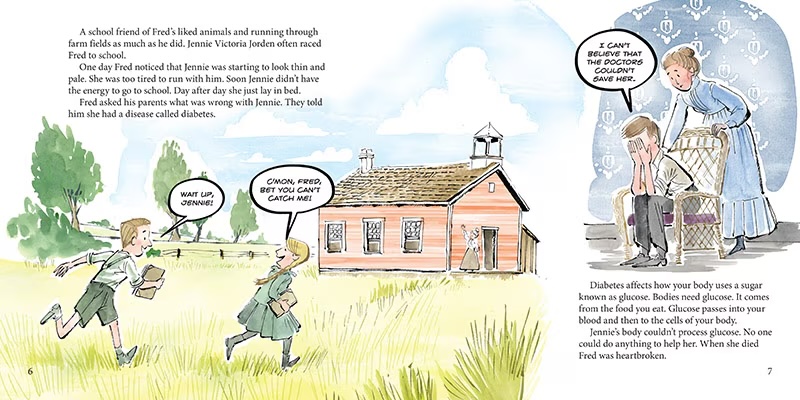
Living on a farm at the turn of the twentieth century would have been fairly typical though Fred was encouraged early on to really study the animals to help determine why they were sick and how to help them get better. However, it was his friendship with Jennie Victoria Jorden, a young diabetic, that probably was most critical to compelling him to consider why diabetics got sick and died and how he might help them.
From Meet Frederick Banting, written by Elizabeth MacLeod, illustrated by Mike Deas
At university, Fred studied medicine and, after working as a doctor in Britain and France during World War 1, he returned to Canada and started a family practice in London, Ontario. He also taught at the nearby university, and it was during his prep for an upcoming lecture on the pancreas, which was known to be involved with diabetes, Fred had an important realization. He took his idea to a professor at the University of Toronto who provided him with a lab and assistant, Charles Herbert Best. Their research into isletin which was renamed to insulin is well established, and the accolades he received, along with others, are firmly rooted in the history books.
From Meet Frederick Banting, written by Elizabeth MacLeod, illustrated by Mike Deas
But Elizabeth MacLeod tells us more about the man and his nature beyond his discovery. He didn't want to make money from his discovery and sold the rights to make the medicine for a single dollar. When he won the Nobel Prize in 1923, he split his prize money with Charley Best. And he continued to work for others, opening a diabetic clinic and helping the Canadian government by conducting research during World War 2. This extraordinary man lived a life of service and Elizabeth MacLeod makes sure to tell his story more completely. (She includes a timeline of his life at the conclusion of her story.)
 
The reason I love the Scholastic Canada Biography books is because I always learn something new. Elizabeth MacLeod goes beyond the obvious or the known and gives us a fuller picture of the individual. Here, Frederick Banting becomes a humanitarian and a researcher, more than just a Nobel Prize laureate or a celebrity to be lauded on a Walk of Fame, though he is both of those. And she tells his story with passion and directness, probably not unlike the man. This is his story and his life, and Elizabeth MacLeod tells it effectively for her audience.
 
That simplicity of message comes through in Mike Deas's illustrations that look like they were effortlessly created, but they are far more than just sketches. In a complex process of creating sketches digitally, with a Wacom tablet and Photoshop, Mike Deas traces them onto watercolour paper and then applies gouache and watercolour paints before using black ink to finish the illustration. But with that process, Mike Deas creates art that is both direct and detailed, has heart and authenticity, and is perfect for a story of a selfless man who worked to help others and not enrich his own life with money or accolades. 
 
Meet Frederick Banting may take longer than a single minute of recounting history, but Frederick Banting deserves more, and Elizabeth MacLeod and Mike Deas have given his legacy that which he is due. They have relayed to young readers that he was a great man and that all his work justifiably earned him the recognition as a great Canadian.
 
• • • • • • •

I know that readers always like to check out more of these books so here is a smattering of volumes from the Scholastic Canada Biography series:
 
Meet Viola Desmond (2018)
Meet Chris Hadfield (2018)
Meet Tom Longboat (2019)
Meet Elsie MacGill (2019)
Meet Willie O'Ree (2020)
Meet Terry Fox (2020)
Meet Thérèse Casgrain (2021)
Meet David Suzuki (2021)
Meet Mary Ann Shadd (2022)
Meet J. Armand Bombardier (2022)
Meet Buffy Sainte-Marie (2023)
Meet Jim Egan (2024) 
Meet Frederick Banting (2025)

September 03, 2024

Maud of Green Gables: How L. M. Montgomery's Anne Enchanted the World

Written and illustrated by Janet Wilson 
978-1-0688776-0-5
39 pp.
All ages
September 2024 
 
While the world knows the story of Anne of Green Gables, in whatever configuration they may have enjoyed–so many adaptations!–the story of her creator, Lucy Maud Montgomery, is less known to most of us. Was her story that of Anne's? Did she write from personal experiences? Was there really a Green Gables? And how did a freckled and red-haired girl enchant the world so completely?
From Maud of Green Gables: How L. M. Montgomery's Anne Enchanted the World, written and illustrated by Janet Wilson
The story within Maud of Green Gables is about the writer and her story. It's about being brought up by her grandparents, trying to get an education at a time when women were often relegated to housework, and finding her passion in writing. It is
about Maud's writing, from childhood and throughout her life, and the process of getting Anne's story rejected and accepted and then lauded globally. It's about how she felt about her book and the world. It's about how she saw herself and her place in the world, whether living on Prince Edward Island or in Ontario, whether as a freelance writer or a novelist.
 
“But oh, I love my work! I love spinning stories,
and I love to sit by the window of my room
and shape some ‘airy fairy’ fancy into verse.”
 
And, though Janet Wilson peppers her story with photographs and direct quotes from Montgomery's diaries and from her novel, reminding us that Maud of Green Gables is a biography of Lucy Maud Montgomery, it is the artwork that makes the story sing.
From Maud of Green Gables: How L. M. Montgomery's Anne Enchanted the World, written and illustrated by Janet Wilson
 Janet Wilson's oil paintings do more than just captivate. First, they let us see Anne of Green Gables again and in a different light. (And the light in Janet Wilson's art is brilliant!) We see Anne as she dreams, as she imagines, as she takes in the wonders of her world, and as she treasures moments with those she loves.
From Maud of Green Gables: How L. M. Montgomery's Anne Enchanted the World, written and illustrated by Janet Wilson
But Janet Wilson also lets us see Lucy Maud Montgomery beyond the images recorded in photographs. Those images of her as a child or as a woman, or of her homes and those in her life are static. They captured a person or a place in one moment. Janet Wilson's paintings give us heart and always radiant light. Whether Maud is reading with a cat on her lap, playing with a camera, or walking along a shore, there is a radiance that comes from within.
From Maud of Green Gables: How L. M. Montgomery's Anne Enchanted the World, written and illustrated by Janet Wilson
Maud of Green Gables could have been a dry biography about L. M. Montgomery's story, from early life and family to education and writing and then to her marriage and death. But anyone could tell that story. Telling it with the richness of this art could only be done by the likes of Janet Wilson, the artist whose realism brought In Flanders Fields: The Story of the Poem by John McCrae, written by Linda Granfield, to life. Here her art recreates Maud and Anne with light and life. Moreover, by quoting from Maud's diaries and from Anne's story, Janet Wilson connects the two women on a deeper level, reaching into the hearts of Anne and Maud simultaneously and making us feel for both writer and character and know them both a little better.
 
• • • • • • • 
 
Janet Wilson launches Maud of Green Gables: How L. M. Montgomery's Anne Enchanted the World this Saturday (September 7, 2024) in Eden Mills, Ontario. Check here for details, including how to purchase her new book.
 
 • • • • • • •