Showing posts with label Andrée Poulin. Show all posts

January 28, 2026

Planting Sunshine

Written by Andrée Poulin
Illustrated by Enzo (Enzo Lord Mariano)
Groundwood Books
978-1-77946-095-0
116 pp.
Ages 9–12
February 2026 
 
As is often the case, Theo's day is normal enough until it isn't. And what changes everything is watching the news coverage of war breaking out far, far away.
Theo's father
turns on the TV— 
     and war arrives
in their living room. (pg. 9)
Theo cannot believe what he is hearing and seeing. Horrified by the sights and sounds of bombs and guns, tanks and drones, and most of all the destruction of people and place, Theo is troubled. He wants to know why this happens, whether they are safe, and asks why humans are so cruel.
From Planting Sunshine, written by Andrée Poulin, illustrated by Enzo
Though the countries involved are never identified, readers might recognize some of the images described as those from the attack on Ukraine by Russia, such as the elderly woman who confronts a Russian soldier with sunflower seeds and suggests that if he puts them in his pocket. . .
At least when you die here
     on the soil of my country
     the sunflowers will grow 
                    around you. (pg. 20)
Theo asks his neighbour Mrs. Lena, an elderly woman who grew up in "the country now caught in this terrible war" (pg. 21), about the war and this incident, and she tells him of the sunflower—soniashnyk, in Ukrainian—being the "flower that feeds hope." (pg. 22) Seeing Theo's continued distress, day after day, she gives him sunflower seeds to plant.
From Planting Sunshine, written by Andrée Poulin, illustrated by Enzo
Each day there is more horrific news from the war, and the details stay with Theo. He thinks about the numbers, about the images, about the losses, and all he can do is wonder why no one is stopping it. 
Each day Theo asks, "Will the war end today?" (pg. 38) The war may be very far away but it's impacting Theo in the way he sees life. The word "bomb" no longer reminds him of diving board cannonballs. His friends playing war angers him. His dad refuses to let Theo watch the news anymore, so Theo hides his tablet and watches at night. And then the nightmares start, a mix of anger, fear, hatred and more.
 
When he meets a girl drawing doves on a wall as protest, Theo is finally able to share what he's feeling–never wanting to burden Mrs. Lena or his teacher or his father—and feels a little less alone. And he finds his own way to express his anger and his grief. 
From Planting Sunshine, written by Andrée Poulin, illustrated by Enzo
Still, he is unconvinced that the war will end or that things would change, until Mrs. Lena offers him the idea of hope. She tells him, "Hope lives in the after." (pg. 91) And, with a little help from those around him, Theo finds a way to settle his anger, remember what should never be forgotten, work to help a cause, and find "a small way to start building peace." (pg. 110)

I could quote page after page of eloquent text that clutches at the heart of Theo's bewilderment and trauma. Andrée Poulin has always had a knack for telling tough stories lightly—not lightheartedly—for a young audience. Whether it's sanitation (Burying the Moon, 2021), diversity and tolerance (Tickled Pink, 2020), or abandonment (The Biggest Poutine in the World, 2016), Andrée Poulin recognizes that her audience is young, and will be impacted differently about important issues. Theo is just such a child, significantly impacted by a war thousands of kilometres away, and not understanding fully what is happening. He's feeling a lot and needs help understanding those emotions and directing them into activities that help. Andrée Poulin takes Theo full circle, from unfamiliarity with war, to an introduction by media, to immersion in images and sensory overload, to impact and trauma, and finally purposeful attention. And she does so eloquently in words and in verse form. This book will become an exemplar of telling a story with sensitivity and compassion, and awareness of how world events can impact children in powerful ways. 
From Planting Sunshine, written by Andrée Poulin, illustrated by Enzo
Enzo (a.k.a. Enzo Lord Mariano), a Montreal-based illustrator, provides the artwork that frames Andrée Poulin's story. Using Procreate with watercolour textures, Enzo gives us some war images—the ones of a blue tractor in a field of sunflowers that is later devastated by bombs is especially heartrending—but generally it's all about Theo because this is his story. It is not a story of war. It is a story of a boy who struggles with the concept of war and his emotions with the senseless destruction it perpetuates. Enzo helps us see Theo's anguish and his anger, the trauma of his sleepless nights, and his despondency. But Enzo also shows us family, friendship, and community, and how those can soften the suffering.
 
I don't think I can say enough about Planting Sunshine. (A French-language version, Semer des soleils, was published in 2024 by La courte echelle.) Not only does it remind all that there is an ongoing conflict in Ukraine, but that there are children beyond the borders of that war that are struggling with it. Highly sensitive children like Theo can be impacted by what they see and hear in the news and cannot always articulate what they are feeling or recognize how to grapple with those emotions. In a world of strife and public media, children will continue to be exposed to all manner of frightening news. Awareness of their potential struggles and attention to their needs might help them find ways to plant sunshine and to unearth hope.

November 19, 2021

Burying the Moon

Written by Andrée Poulin
Illustrated by Sonali Zohra
Groundwood Books
978-1-77306-604-2
112 pp.
Ages 9-12
October 2021

Every night
in the field 
     of Shame
Latika has only
     one thought
     one wish:
     to bury the moon. (pg. 14)
That's because Latika and the girls and women of her Indian village always head to the field on the outskirts to crouch and do their business in the night as there are no toilet facilities available to them. They are silent, they are ashamed and they are fearful. And Latika resents that moon shining down on them and revealing them in the shame of their bodily functions.
From Burying the Moon by Andrée Poulin, illus. by Sonali Zohra
At home, Latika's grandmother is bedridden, her Aunt Nita sobs for the loss of her young son, and her older sister Ranjini, once the brightest student at school, rages at everything now that she has turned twelve and been forced, as a young woman, to stop attending school.

When a very-important-government-official, Mister Samir, comes to Padaram to see how the government could help the village, Latika is desperate to ask about "you know what" but she is dissuaded by her mother.
It's so hard
to stay silent
when you have
important things
          to say.
Important things
  that everyone
      stays silent
          about. (pg. 41)
When Mister Samir brings an engineer to the village to install a well, Latika tries to speak with Mister Samir, whose smiling eyes encourage her. But when the sarpanch–village leader–and Mister Samir have a disagreement, Latika is terrified to approach him. Still Latika finds a way to engineer something that will work before she is able to share their need for sanitation with Mister Samir and change minds, including her own about burying that moon.
From Burying the Moon by Andrée Poulin, illus. by Sonali Zohra
Today, November 19, is World Toilet Day and Burying the Moon makes a significant contribution in recognizing the great number of people globally who do not have access to toilets and sanitation. Worse yet is the gender inequality and discrimination that accompanies this deficiency. With girls prohibited from going to school once they turn twelve in anticipation of them getting their menstrual periods, the stigma of expelling their bodies' waste is compounded. But Andrée Poulin does more than just indicate how inconvenient the lack of toilets are for women. She recognizes that the Shame, always capitalized in Burying the Moon, is a greater burden for them. It robs them of their pride, their voices and their education. 
 
Telling Latika's story in free verse is inspiring. The text is heavy with meaning and emotion but short on filler. The depth of Latika's loathing for the moon, her jealousy at what boys are allowed to do, and her anger at the harm their village's unsanitary conditions have done is so palpable that readers will feel all that. Even though most who read this book will know nothing of these conditions, whether sanitation or gender discrimination, they will sympathize and hopefully learn more. (Andrée Poulin who previously worked in international development assistance offers further reading to help inform readers.)
 
With India's Sonali Zohra's digitally-rendered illustrations, rich in purples, roses and blues with lines of vitality, providing the context for Andrée Poulin's story, Burying the Moon is both a story to inform about a global issue and one of empowerment as Latika steps up to find a solution while discovering her own voice.

February 07, 2020

Tickled Pink: How Friendship Washes the World with Color

Written by Andrée Poulin
Illustrated by Lucile Danis Drouot
Pajama Press
978-1-77278-104-5
32 pp.
Ages 4-7
February 2020 


I'm tickled pink by any book that supports diversity and acceptance of differences as the norm so I'm especially thrilled about a picture book that supports this message in as subtle and eloquent a way, as well as playful, as Tickled Pink: How Friendship Washes the World with Color.

When Zac the zebra and Poncho the panda are playing and Filippo the flamingo asks if he can join them, he is told that he is too pink, a colour which gives Poncho a headache. But when Filippa asks his parents, they tell him pink is the colour of kindness and happiness. So Filippo tries again.

From Tickled Pink: How Friendship Washes the World with Color by Andrée Poulin, illus. by Lucile Danis Drouot

From Tickled Pink: How Friendship Washes the World with Color by Andrée Poulin, illus. by Lucile Danis Drouot
Zac and Poncho are now rude to Filippo, telling him they don't want him to play and that "Pink doesn't mix with black and white." His grandmother shows him with her paints how wrong that idea is. So Filippo adds some black and white paint to his body and asks politely again. But, of course, Zac and Poncho continue to make excuses, about pink being the colour for babies who cry and princesses who are fussy.

From Tickled Pink: How Friendship Washes the World with Color by Andrée Poulin, illus. by Lucile Danis Drouot

Though Filippo gets support from his family, it's input from his shy peer, Ludo the lemur, that makes things right for Filippo.  Ludo recounts to Filippo all the wonderful things that come in pink: shrimp, salmon, bubble gum, cherry blossoms, begonias, peonies, petunias, and roses. And Ludo, who is black and white, says he would be pleased to play with Filippo. That play includes adding a little pink paint to the sleeping zebra and panda, who are not pleased, but also to other animals who are "tickled pink to go pink."

From Tickled Pink: How Friendship Washes the World with Color by Andrée Poulin, illus. by Lucile Danis Drouot
The story in Tickled Pink is far from black and white. It goes beyond a story of excluding those who are different. It demonstrates how much we all want to be included.  Filippo could have thrown up his wings and said, "Fine, I don't want to play with you, Zak and Poncho" but he didn't. He questioned his parents and his grandmother and his sister, all to help him grasp what being pink meant. But bullying and intolerance are incomprehensible, especially when "reasons" are given to explain the intolerance. I'm glad Andrée Poulin gave Filippo a quiet and insightful friend in Ludo who proves that it's not the black-and-white animals that lack understanding, but just one zebra and one panda. (Okay, there may be others out there, there always are, but it's clear that it's not all black-and-white animals.) For intolerance to be eliminated, everyone needed to see beyond the colours.

Artist Lucile Danis Drouot keeps her palette, until the very end, black, white, gray and pinks to emphasize the separation that Zak and Poncho highlight but she adds a playfulness in her animals' activities–vine-climbing, soccer, volleyball, and badminton–that embeds the message in gentleness and whimsy. A final spread resplendent in pinks brightens the world in happiness and friendship.

Like any racism or discrimination, the zebra and the panda could have arbitrarily chosen an attribute other than colour, such as non-feathered vs. feathered, or four-legged vs. two-legged.  But, like so many who discriminate, they chose colour. Fortunately, there are so many who don't see the colour, only the substance, and infuse our world with goodness and acceptance.

March 11, 2016

Going for a Sea Bath

by Andrée Poulin
Illustrated by Anne-Claire Delisle
Pajama Press
978-1-927485-92-7
32 pp.
Ages 5-8
March, 2016

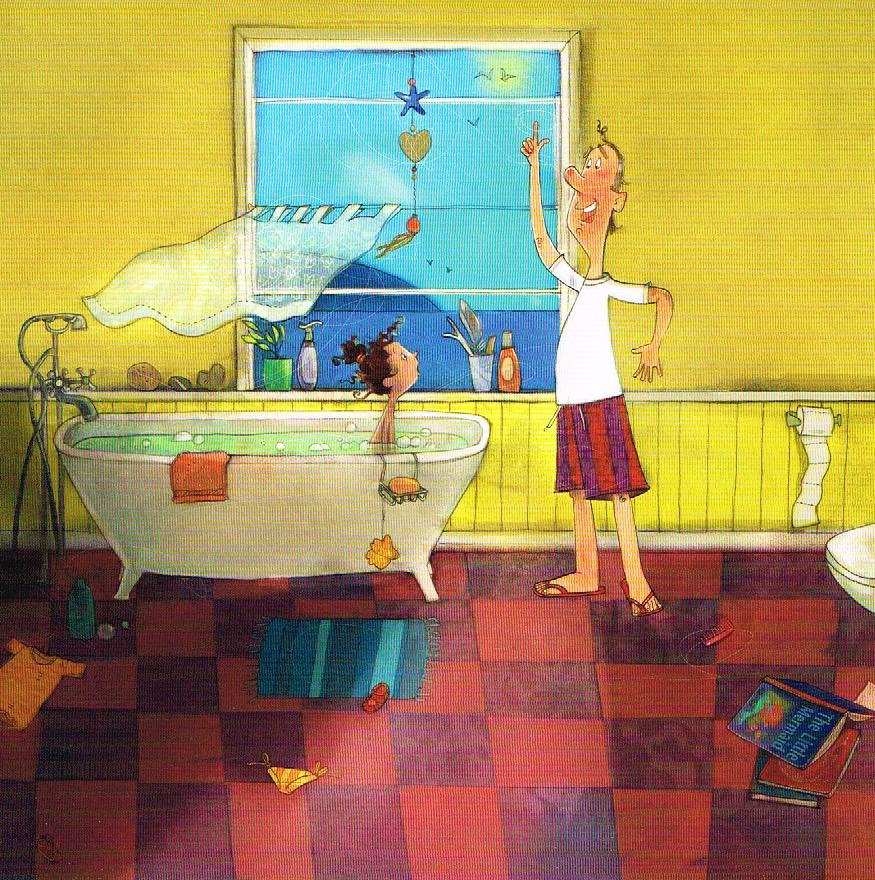
What is it with so many kids and baths?  For Leanne, “It’s so boring! It’s annoying! It’s a pain!”  But her father has an idea (or more than several) how to make it more fun and it has him running back and forth to bring the sea in to her bathtub.

There’s one turtle, then two eels, three clown fish, and four seahorses.  At the four seahorses, Leanne is exclaiming, “Taking a bath is exciting! It’s the best!”  But her father, delighted in  making his daughter happy, continues to feed her requests for more or different with five shrimps, six hermit crabs, seven sea urchins, eight anemones, nine starfish and ten octopi.  Needless to say, that bathtub becomes a little crowded and they must find a solution to a new problem.

Taking a bath has never been so much fun!  The repartee between father and daughter is priceless. There is such warmth and affection that it’s easy to see why Leanne’s father would take such delight in his daughter’s joy.  He’s a little goofy, with his paunch, flat feet and receding hairline, but he’s all about being a good dad.  And little Leanne, with her head full of curls and splattering of freckles, is the quintessential inquisitive child with eyes and heart wide open.

Though Andrée Poulin’s text is based on counting, and would be a fun way for parents or teacher to help young children with numbers,  Going for a Sea Bath is so much more than that.  It’s a fun romp at bath time, with a tub full of different sea creatures, while looking at their behaviour and physical characteristics (though I didn’t know octopi knew how to use a toilet or that the hermit crab would enjoy playing with toilet paper!) Andrée Poulin, whose award-winning The Biggest Poutine in the World I recently reviewed here on CanLit for LittleCanadians, is staggerinly effective in her story-telling, whether for the very young or middle-grade.

From Going for a Sea Bath by Andrée Poulin, illus. by Anne-Claire Delisle
But the precious factor for Going for a Sea Bath goes beyond priceless because of Anne-Claire Delisle’s illustrations. The details in all the animals and in the scenes she composes of Leanne and her father amongst the backdrop of the bathroom are so full that I continue to look back on the book and find more and more features that delight.  From the shrimp draped in Leanne’s hair and the reclining turtle to the octopus squeezing shampoo from a bottle, Anne-Claire Delisle’s artwork is charming.

And, if there isn’t enough to love about this book, teachers will love talking synonyms with the adjectives, like magnificent, phenomenal and super-stupendous, that Leanne’s father uses to describe each new idea.  Going for a Sea Bath is  some kind of wonderful!

December 27, 2015

The Biggest Poutine in the World


by Andrée Poulin
Translated by Brigitte Waisberg
Annick Press
978-1-55451-825-8
160 pp.
Ages 9-12
March, 2016
Reviewed from advance reading copy 

Using food to fill the void of loneliness and to quench the anguish of abandonment would not be unusual but using a 650-kilogram poutine to smother the emptiness of a cold, distant father and an absentee mother is definitely unique.  But that’s what twelve-year-old Thomas Gagné of Sainte-Alphonsine believes might offer his pathetic life some hope.
A glimmer of hope lights up in my mind.  A tiny, fragile, trembling glimmer.  I try not to pay too much attention to it. I’ve tasted disappointment before, and it doesn’t taste good. (pg. 11)
Though it has been seven long years since he’s seen his mother–and yet he does receive  very brief notes with cash from her at his birthday–Thomas has fond memories of her making poutine for him: peeling whole bags of potatoes, buying cheese curds together, making the gravy and cooking the fries.  Taking a cue from his favourite website, the Guinness World Records, Thomas concocts the idea of making a giant poutine and feeding hundreds of people so that he might earn a world record and become worthy of the attention of his parents.  So begins the Phenomenal Poutine Project, PPP, for which Thomas enlists the help of his best friend, Sam Bernier; Sam’s godfather and French fry truck owner Fat Frank; and Irene Ladouceur, who runs the local cheese shop and insists Thomas include her daughter Elie in the project.  But things run amok when the mayor, Thérèse Tartatcheff, refuses to rent the arena to Thomas for the event.

Thomas is not deterred, however, and cooks up a plan to kidnap the mayor’s Senegal parrot and then recover the bird, all to sway Tartatcheff into relenting to his PPP.  But, as with so many good plans, things go awry.  His friendships with Sam and Elie, his missing mother, his aloof father, an allergic reaction, a wayward parrot, and a candy-pink note all get heaped on top of each other and smothered in emotions.  Fortunately, all culminates in a satisfying fusion of humour and coming-of-age drama, with a side order of dysfunctional family.

The Biggest Poutine in the World is the English translation, by Annick Press’s Brigitte Waisberg, of Andrée Poulin’s La plus grosse poutine du monde (Bayard Canada, 2013) which won the 2014 Prix TD de littérature canadienne pour l’enfance et la jeunesse and the 2015 Le Prix Tamarac of the Ontario Library Association’s Forest of Reading.  The story is a visually-appealing mixture of graphics, including fun text messages between Thomas and Sam, drawings of emails between Thomas and Elie, an album of types of poutine (who knew there were so many!), and black-and-white sketches, with text set in large font and broken into small chapters with massive titles.  Young readers will undoubtedly appreciate the organizational format of the book but it’s the story line with which they will empathize.  Thomas is a boy with much resentment, anger and jealousy and yet he can still see the potential for hopefulness.  He even has a willingness and positivity to accept a challenge to captivate that hope although obstacles and self-doubt test him.

With The Biggest Poutine in the World, Andrée Poulin demonstrates an understanding of the complexities of a child’s mind when faced with familial conflict.  Being an accomplished author of over 30 French-language picture books and children’s novels, Andrée Poulin effortlessly translates that strife with compassion and humour into an uplifting tale of friendship and determination and emotional growth.  It does pull a bit at the heart, but no more than the occasional high-cholesterol poutine might.


(A version of this review was originally written for and published in Quill & Quire, as noted in the citation below.)

Kubiw, H. (2016, January/February). [Review of the book The Biggest Poutine in the World, by Andrée Poulin]. Quill & Quire, 82 (1): 44.